A federal judge gave the government until noon on Friday to share which states had received letters trying to enlist them in an effort to find evidence of voter fraud.
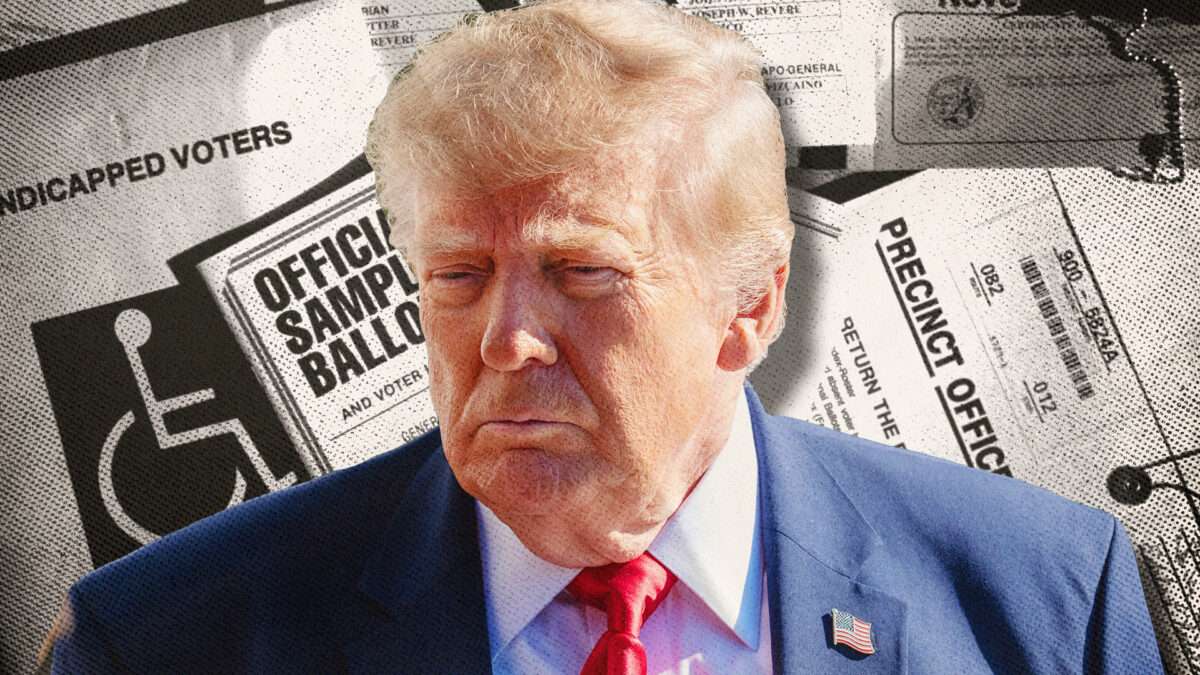
In a July 16 letter to California Secretary of State Shirley Weber, the Department of Homeland Security (DHS) said a "preliminary review" suggested there "may be as many as 190,832 non-citizens registered to vote" in her state. Weber was skeptical—for good reason, it turned out. Three months later, the Trump administration reduced that estimate by nearly 90 percent, saying about 20,000 "likely noncitizens" had received California vote-by-mail ballots.
The Justice Department gave Weber and Dean Logan, Los Angeles County's top election official, 48 hours to determine whether any of the people on the government's list were in fact citizens. Otherwise, it said, Weber and Logan should segregate those ballots and refrain from processing them until citizenship could be verified. After Weber and Logan declined to comply with the Justice Department's demands, it asked a federal judge for a temporary restraining order (TRO) requiring them to do so—a request that he rejected in a scathing opinion on Wednesday.
"Never before in American history has the federal government, on the eve of an election, sought to coerce a state and local government to abandon their own Constitutional elections procedures and bend to the will of the Executive Branch," writes U.S. District Judge David O. Carter, a Bill Clinton appointee. "This request violates longstanding constitutional principles mandating that states have control over their elections. If Plaintiff's last-minute request for relief were granted, either party could create chaos for their own political purposes to disrupt the election process. Over 20,000 registered Californians would potentially lose the right that generations of Americans have fought to preserve."
The Justice Department delivered its list of "likely noncitizens" to Logan three weeks before Election Day. At that point, Los Angeles County already had sent ballots to 5.9 million voters and processed 331,000 of them. Logan said he was "legally prohibited" from doing what the Justice Department wanted because it had failed to explain the methodology used to compile the list, raising the possibility that citizens would be denied their voting rights.
There was ample reason for that concern. On July 17, DHS Secretary Markwayne Mullin averred that "as many as" 15,903 noncitizens were registered to vote in Nevada. The following month, when the DHS submitted a list of allegedly illegal voters to Nevada election officials, the number had fallen to 185—99 percent lower than Mullin's original figure. It turned out that every one of those 185 voters was a U.S. citizen.
"DHS has identified over 250,000 potential non-citizens illegally registered to vote" in California, New Jersey, Nevada, and Pennsylvania, Mullin said in July. He was echoing President Donald Trump, who for years has grossly exaggerated the extent of illegal voting by noncitizens, often in service of his own vanity.
Trump has repeatedly claimed, for example, that he would have won the popular vote in 2016 but for "the millions of people who voted illegally," and in January 2024 he warned that noncitizen voters "could very well affect the next election." In a speech the night before Mullin's announcement, Trump asserted that the DHS had "identified approximately 278,000 non-citizens who are registered to vote in federal elections."
Judging from Nevada's experience, the actual number may be closer to zero. It is hard to say, because the methods used by the DHS remain hazy.
In the California case, Carter says, the DHS "purchased a voter file that appeared to reflect 'the actual voter rolls in California, that as of August 2025, may be used for the 2026 federal election.'" It "then 'enhance[d]' the voter data through a 'reliable third-party data analytics'" and used records maintained by U.S. Citizenship and Immigration Services (USCIS) to find "an internal USCIS immigration number" that "may" correspond to each registered voter. "The matches are scored," Carter notes, "because 'the resulting data may be incomplete, outdated, or mismatched.'"
The DHS "then compared the potential identity matches to Department of State and Social Security Administration data to screen out U.S. citizens," Carter adds. "In the next step, a confidence level was assigned (where a high score supported a 'strong identity link') and a manual review was conducted for each match to 'determine which registered voters'" were "likely to be aliens." Then came "a 'quality review' to identify issues such as 'duplicate entries' and 'incomplete records,'" followed by "an 'enrichment process' that utilized 'additional unique identifiers' to 'improv[e]' the matching process."
The government did not initially specify the source of the "reliable third-party data analytics." But it later revealed that "the third-party platform it relied on was
Lexis Nexis," Carter notes. "It remains unknown how Lexis Nexis performed its analysis, such as how it 'linked names to Social Security numbers not available on the California public voter file.' Plaintiff likewise did not explain what its 'enrichment process' entailed or how it occurred. Plaintiff also provided 'no error rates' or 'validation against a reliable benchmark' that would enable a determination of the accuracy of its findings. Omissions of this critical information prevent an evaluation of Plaintiff's procedure, including how Plaintiff reduced its initial claim of nearly 200,000 alleged noncitizens to 20,000 individuals."
Potential sources of error include conflating people with similar or identical names and outdated records that do not reflect recent naturalization. Because it is unclear how the DHS tried to address such problems, it is not surprising that Weber and Logan did not want to rely on the Trump administration's list, especially given its pattern of dramatically reducing the putative number of illegally registered voters.
"It is well-documented that matching voter registration records with data from other
administrative databases 'presents numerous challenges,'" Carter writes. And given the potential for error, he says, "Plaintiff's allegations are not credible." He adds that the TRO sought by the Justice Department "would likely lead to voter disenfranchisement" and "would create a significant administrative burden for Defendants, leading to chaos and upending the election."
In any event, Carter says, the Trump administration does not have legal standing to seek such an order. The government's main argument was that California officials, by refusing to segregate ballots from people on its list, were interfering with its enforcement of 18 USC 611, which makes it a misdemeanor for "any alien to vote" in a federal election.
"Defendants do not 'interfere' with the United States' ability to enforce Section 611 by
administering an ongoing election in accordance with established State and Federal law, rather than assuming new obligations pursuant to a federal criminal law they are not responsible for enforcing," Carter writes. It is well established that state officials have no obligation to enforce federal law, he notes, and that they cannot be "commandeered" to do so.
Nor does the federal government need such assistance to enforce Section 611. "The very same day the United States filed its TRO [application] in this Court, the Department of Justice brought charges against 28 individuals" in California under that law, Carter notes. It is not clear how many of those defendants, who represent 0.0001 percent of California's 23 million registered voters, actually cast ballots. But "if fraudulent voting occurs," Carter says, "the United States should uphold the law and bring additional Section 611 indictments against those non-citizens it believes actually voted illegally in the current—or a prior—election."
The Constitution gives states the primary responsibility for conducting elections, subject to explicit limits imposed by Congress. But the Justice Department's actions in this case "are indicative of a broad, ongoing pattern of attempted election interference by federal officials," Carter writes. The department "has filed at least thirty-one lawsuits in federal district courts across the country seeking complete voter rolls from the States. Out of the twenty-six decided cases, the DOJ has prevailed in precisely zero."
In addition to "its failed attempt to seek State voter rolls," Carter notes, "the United States has also requested that States act based on the Executive's own lists." But "sister district courts across the country have cast doubt" on the reliability of those lists for the same reasons that Carter cites in this case.
On October 23, the Justice Department "sent letters to every county in California requiring them to set aside the votes of alleged non-citizens," Carter notes. "The letters stated that election officials 'risk significant federal scrutiny' if they failed to comply with the Government's demands. The government reiterated its threat in open court yesterday, stating that State and County election officials who do not comply with their letter risk federal charges under 18 U.S.C. § 2, which criminalizes aiding and abetting the commission of a criminal offense. The court reiterates what it said yesterday: these threats must stop."
Justice department had demanded state segregate and not count ballots from people it claimed were non-citizens
A federal judge declined to order California election officials to segregate and not count ballots from people the Trump administration claimed were non-citizens, rebuffing a legally thin request from the justice department that appeared designed to cast doubt over the results of the midterms.
The ruling from US district judge David Carter, nominated to the federal bench by Bill Clinton, comes about two weeks after the justice department delivered a USB drive to election officials in Los Angeles and Sacramento that it said contained the names of 20,000 non-citizens on the state’s voter rolls. There are more than 23 million registered voters in California and non-citizen voting is extremely rare.
Keaton Denlay says agents handed him ‘poorly formatted Excel spreadsheet’ and threatened to criminally prosecute him
A California county elections official is speaking out about the Department of Justice’s campaign against purported “voter fraud”, saying federal officials provided him a disorganized list of names filled with inaccuracies – and threatened to criminally prosecute him if he didn’t take action.
Keaton Denlay, the county clerk-recorder for Butte county, a region north of Sacramento, said a federal agent on Friday hand-delivered what appeared to be a printout of a “poorly formatted Excel spreadsheet with missing and jumbled information”. The DoJ claimed the list was of 47 “likely” noncitizens who were unlawfully registered to vote and demanded the county set aside their ballots. But Denlay said the document was riddled with errors and lacking crucial details, and he declined to act on it.
In the legal tangle between the Justice Department and California, a federal judge on Tuesday deferred a ruling but said the government already had a remedy it could use after the election.
By a 2-1 vote, a federal appeals court panel denied the Trump administration’s request that it immediately order the state to set aside 20,000 mail-in ballots.
This story originally appeared in Common Dreams on Oct. 02, 2026.It is shared here under a Creative Commons (CC BY-NC-ND 3.0) license.
An analysis published Friday by Democracy Docket warned that “tens of thousands” of voters across the US face “risk of disenfranchisement” thanks to actions being taken by the United States Postal Service.
The analysis, written by veteran election reporter Jim Saksa, points to a new USPS policy known as Regional Transportation Optimization (RTO) that “will eliminate evening mail pickups from post offices more than 50 miles away from a regional processing facility, most of which are located in major urban areas.”
For people who live in these areas, ballots sent on Election Day will be postmarked and delivered at least a day later than in previous election years, thus making it ineligible to be included in final election tallies.
“In every state, a day’s delay in delivery means that if mail voters wait until the last day or two before the election to mail their ballot,” Saksa explained, “they could be disenfranchised.”
Saksa reported that this policy is currently active in “about 42.5% of all ZIP codes” in the continental US, and is scheduled to eventually take effect in around 70% of all ZIP codes. No additional ZIP codes are expected to be added between now and election day.
Saksa also said that voters concerned about their ballots not being counted should deliver them in person to their local post office, where they can ask an employee to postmark it.
President Donald Trump has tried for the last several months to use USPS to meddle with states’ mail-in voting systems.
In March, the president signed an executive order that instructed the United States Postal Service to not deliver ballots in any states that have not given the federal government access to their voter lists.
The US Supreme Court last month rejected Trump’s efforts to interfere with mail-in voting, allowing states to continue sending ballots to voters as they’ve done in past elections.
Even with the Supreme Court loss, however, the president’s repeated attacks on voting by mail has had a major impact on the 2026 midterm elections.
An NBC News poll released in September showed that just 23% of Democratic voters said they planned to vote by mail this year, a double-digit drop from 2024 when 34% of Democrats said they were voting by mail.
In an interview with Politico published Thursday, Quentin James, founder and president of The Collective Political Action Committee, said Black voters have been expressing concerns about sending in their ballots for fear that Trump will order USPS to not deliver them.
“I think there’s confusion,” James said. “We know that the president has spent six months talking about changing the rules regarding mail-in voting, and a lot of folks are concerned about their ballot being secure.”
Indivisible co-founder Leah Greenberg also told Politico that her group is “absolutely hearing concern” about the mail voting process this year.
“But more importantly,” Greenberg added, “what we’re hearing is people trying to figure out what they can do and how they can organize locally in order to protect elections.”
This story originally appeared in Common Dreams on Sep. 28, 2026.It is shared here under a Creative Commons (CC BY-NC-ND 3.0) license.
The White House recycled material from President Donald Trump’s 2024 campaign for a new taxpayer-funded ad that aired nationwide this past weekend, just weeks before the high-stakes November midterms.
The 30-second black-and-white adfeatures Trump walking down a hallway to audio of him vowing to “demolish the deep state” and “expel the warmongers from our government,” even as the president wages an illegal and deeply unpopular war on Iran that has killed thousands and driven up prices at home and around the world. During the final 10 seconds of the ad, white text appears at the bottom of the screen stating, “Paid for by the US government.”
The ad is just the latest taxpayer-funded, explicitly pro-Trump spot that the White House has launched in recent days, prompting alarm from lawmakers and government watchdog organizations who say the administration is using public funds to flood airwaves with the president’s campaign ads shortly before an election.
Watch the newly aired ad:
The U.S. Government is up on TV with this spot —
It aired nationally on FOX yesterday during Illinois at #7 Ohio State and also during Fox News Sunday this morning pic.twitter.com/8PP9FPzUZk
Richard Painter, who served as the White House’s chief ethics lawyer in the George W. Bush administration, said the taxpayer-funded campaign ads “could be an impeachable offense,” noting that “Congress has expressly prohibited government-sponsored political propaganda, which is dangerous for democracy.”
The federal government appears to have spent more than $1 million on pro-Trump ads in recent days, The New York Timesreported on Sunday, citing an estimate from AdImpact.
Last week, as Common Dreams reported, the White House launched a taxpayer-funded ad in which Trump declares that “America will never be a communist country” and promotes tax cuts he signed into law, delivering a massive windfall to the rich and large corporations.
Norm Eisen, former White House special counsel for ethics and government reform, told the Times on Sunday that “the president and his administration have gone from breaking the law to trampling it.”
“The prior ad was bad enough,” said Eisen, “but this one openly repurposes prior political conduct.”
US Sen. Chris Murphy (D-Conn.) wrote on social media that Republicans shouldn’t be taken seriously when they claim to care about “waste, fraud, and abuse” as the president and leader of their party runs campaign ads with taxpayer money.
“What a cult this party has become,” Murphy added.
A massive backlog of voter registration applications in Texas could affect the outcome of local and state elections, including a contentious election involving a U.S. Senate seat.
Public officials in the Republican-controlled state have not yet acknowledged what the error actually is. It’s also possible that the error could have affected elections from before the primary elections in March 2026, officials have acknowledged.
“Texas county voter registrars across the state have received a flood of new voter registrations and updates to voter registration records submitted through the Texas Department of Public Safety,” said Chris McGinn, executive director of the Texas Association of County Election Officials. “Some of these submissions date as far back as October 2025.”
All 254 counties in the state appear to be affected. The Texas Secretary of State’s office alerted all counties to the issue in an email last week, writing:
Counties have alerted us to the fact that some older [Department of Public Safety] registrations are now appearing on their dashboard. We are actively investigating this issue to determine the source of these historical records.
The situation is dire, as the registration deadline for Texan voters for the upcoming general election is October 5. County officials have until October 19 to process registrations, which is the same date that early voting begins.
James Talarico, a Democrat and state representative who is running in the Senate election against State Attorney General Ken Paxton (R), called the situation “unacceptable,” and encouraged all voters to check their registration status.
“Less than two weeks before the voter registration deadline, thousands of Texans are now in the dark about their voter registration status — even more aren’t aware of this error at all,” Talarico said in a statement. “This is what a broken, corrupt political system looks like: Texans follow the rules, register to vote before the deadline, and still risk losing their God-given right to the ballot box because their government failed to do its job.”
The Senate race between Talarico and Paxton is a close one, and even a small error that goes unaddressed before the November election could affect the outcome.
A longtime Republican stronghold, Talarico is currently ahead in the polls with a slim lead against Paxton. According to an average of surveys collected by the polling aggregate site FiftyPlusOne, Talarico secures around 47.9 percent of the vote, while Paxton receives around 44.6 percent.
After a back-and-forth legal battle over the USPS rules that dragged on for months, the nation’s highest court issued the 7-2 ruling without elaborating on its legal reasoning, though right-wing Justices Samuel Alito and Clarence Thomas issued dissents in favor of President Donald Trump’s side.
The ruling in USPS v. California was in response to a legal challenge brought by the League of Women’s Voters, the attorneys general of numerous states, and others who argued that newly-announced rules by the Postal Service regarding mail-in ballots, changes prompted by an executive order issued by Trump, would prevent people from having their ballots counted and cause chaos for those trying to administer this year’s elections.
In response to the ruling, the plaintiffs’ legal team said the decision was “a critical step to ensuring free and fair elections this November by maintaining access to mail voting for millions of eligible voters across the United States and lifting the dire threat that the Postal Service would disenfranchise them.”
“Mail voting is safe, secure, and reliable—and the Trump administration has presented no evidence to the contrary, as the courts have repeatedly recognized,” the statement continued. “We will remain vigilant in countering threats to free and fair elections and ensuring that every eligible voter is able to cast a ballot and have it count.”
“Today’s decision is a victory for our democracy and a powerful affirmation of the rule of law,” said California Attorney General Rob Bonta in a statement. “The stakes in this litigation could not have been higher.”
Virginia Kase Solomón, president and CEO of Common Cause, was among the other pro-democracy advocates who welcomed the decision.
“Today’s decision is a major win for the millions of everyday Americans who count on vote-by-mail—our seniors, service members, busy parents, rural voters, and voters with disabilities,” said Solomón in a statement. “Vote-by-mail is safe, proven, and vital; even the president uses it. This executive order was a blatant power grab designed to silence voters and undermine our elections, but it failed because the people and the law were on our side. Our Constitution is clear: states run our elections, and voters choose their leaders—not the other way around. No administration can strip the people of their power.”
Michael McNulty, senior policy director for Issue One, a nonpartisan group that works to defend free and fair elections, also welcomed the ruling, but said vigilance would still be necessary going forward.
“The fight to preserve states’ authority to administer elections is far from over,” warned McNulty.
“President Trump continuously and falsely claims fraud in mail-in voting without evidence,” he added. “Despite voting multiple times with this method, he remains obsessed with centralizing control over elections to tilt the playing field. However, for now, one piece of that centralization effort is blocked, and it ensures that mail-in voting for the midterms won’t be disrupted.”
This story originally appeared in Common Dreams on Aug. 25, 2026.It is shared here under a Creative Commons (CC BY-NC-ND 3.0) license.
Democratic leaders and a “pro-voter” coalition on Tuesday announced separate actions to combat President Donald Trump’s attack on voting by mail after the US Supreme Court’s right-wing majority delivered a “painful setback” for critics who argue the Republican’s executive order is unconstitutional.
The president’s March order directed the US Department of Homeland Security to compile lists of citizens eligible to vote, states to provide voter information to the federal government, and the United States Postal Service to craft new regulations for absentee ballots—for which the USPS published a final rule last Friday, less than three months away from the midterm elections.
The nation’s top court said in a 6-3 decision on Monday that Democrat-led states had not demonstrated sufficient standing to challenge the president’s order and paused a lower court injunction blocking its implementation. The attorneys general in that case, Trump v. California, vowed to keep fighting back, and as of Tuesday evening, others already are.
The chairs of the Democratic National Committee (DNC) and Democratic Governors Association, US Senate and House minority leaders, and heads of the party’s campaign committee for each chamber of Congress on Tuesday announced the filing of a new motion for a preliminary injunction.
“Today, we are taking strong, joint legal action to stop Trump’s unlawful attempt to restrict mail-in voting through the Postal Service,” said DNC Chair Ken Martin, Kentucky Gov. Andy Beshear, Sen. Chuck Schumer (NY), Rep. Hakeem Jeffries (NY), Sen. Kirsten Gillibrand (NY), and Rep. Suzan DelBene (Wash.) in a joint statement.
“Yesterday’s Supreme Court ruling did not say that Trump’s executive order attacking voting rights is constitutional,” they stressed. Rather than ruling on the merits of the challenge, the majority of justices simply said that the states had sued prematurely, as federal efforts to respond to Trump’s order were still underway.
“But the law is clear: States have the authority to run elections—not the president,” the Democrats said. “”We will not stand by while Trump and Republicans try to unnecessarily inject chaos and confusion into our elections, just weeks before voting begins. We are asking a district court to immediately stop the Trump administration from unlawfully disrupting mail-in voting in every state. Democrats will continue fighting every day until Trump’s illegal executive order, and all of his other attempts to undermine our free and fair elections, are completely thrown out.“
The Campaign Legal Center (CLC) and Democracy Defenders Fund (DDF) also continued their battle against the order, filing a new complaint on behalf of the Arizona Students’ Association, League of United Latin American Citizens, Secure Families Initiative, Texas’ Travis County, and the city of Madison, Wisconsin.
BREAKING: we just filed to STOP the new USPS rule on mail ballots
The Court only held that the injunction came too early. Now we HAVE a final rule & we are litigating it@DDFund_ & @CampaignLegal are proud to represent LULAC, Madison WI & Travis County TX pic.twitter.com/e7MTj66U0W
“Key provisions of the president’s second executive order on elections have already been declared unlawful in multiple federal cases,” said Anna Baldwin, CLC’s director of voting rights litigation. “But the US Supreme Court’s recent lawless order on the shadow docket has given USPS the green light to attempt to implement their new mail voting rules—mere weeks before mail ballots start to be sent out in some parts of the country.”
“But nothing in the Supreme Court’s procedural order suggests that the rules are lawful,” Baldwin emphasized. “We will not let the president’s dangerous anti-voter agenda go unchecked, so we’re filing a new complaint challenging USPS’ unconstitutional new rulemaking to ensure all voters can cast their ballot in November.”
Ripping Trump’s order as a “reckless power grab that would likely result in mass confusion, chaos, and disenfranchisement of eligible absentee voters,” DDF legal director Tianna Mays said that “this rule not only places ordinary Postal Service employees in the untenable position of determining whether eligible voters may receive and cast mail ballots, it wreaks havoc on state and local election officials and civic engagement groups.”
“If not stopped,” Mays warned, “our clients, voter advocacy groups, and local election officials in two states would be tasked with deciphering, implementing, and educating their staff and members about the rule’s requirements, just weeks before Election Day.”
Separately on Tuesday, Massachusetts-based US District Judge Indira Talwani found that the Trump administration violated her injunction by finalizing the rule published last week by the Postal Service, though she declined to take any action over it.
The group behind that case, the League of Women Voters Massachusetts, also pledged to keep fighting Trump’s efforts to restrict voting by mail—despite repeatedly voting that way himself—after the Supreme Court’s interim ruling on Monday.
This story originally appeared in Common Dreams on Aug. 11, 2026.It is shared here under a Creative Commons (CC BY-NC-ND 3.0) license.
A right-wing talk show host on Tuesday pushed President Donald Trump to declare a “national security emergency” that would let him meddle in the 2026 midterm elections—and the president did not rule it out.
In an appearance on Real America’s Voice, Trump listened as host Wayne Allyn Root rattled off actions he would like to see the president take ahead of the midterms.
“Let me put an idea in your head,” Root told Trump. “Because it’s so hard to get the Senate to do anything, now they’re on recess, they never get anything done. If they never get the SAVE America Act done, you have the right to declare a national security emergency for elections.”
🚨🚨🚨
WAYNE ALLYN ROOT: You have the right to declare a national security emergency for elections. If you do this in the next month, we will get photo ID, proof of citizenship, and a limit to mail ballots
Root then told the president that “if you do this in the next month” it would allow for the implementation of photo identification and proof of citizenship requirements, as well as restrictions on mail-in ballots.
“Let me just say that stranger things have happened,” Trump said in response. “I’ll leave it at that.”
The US Constitution does not give the president power to declare a “national emergency” that would allow him to unilaterally rewrite states’ election laws.
Regardless, ABC News reported in February that a group of pro-Trump attorneys were circulating a 17-page draft order that would use the purported threat of election interference from the Chinese government to declare a “national emergency” that would outright ban mail-in ballots and mandate that all ballots be hand-counted.
Trump has not yet signed such an order, but he has issued other election-related directives, including one that instructs the United States Postal Service (USPS) to not deliver ballots in any states that have not given the federal government access to their voter lists.
The USPS executive order and an order that required Americans to show proof of citizenship when registering to vote have been blocked by courts.
Regardless, some observers expressed concern that the president wasn’t yet finished in his efforts to meddle in the coming elections.
“There is zero reason,” wrote CNN host Jake Tapper, “to not take Trump at his word that he and his team are planning something alarming to disrupt the midterms and beyond.”
Criminal defense attorney Scott Greenfield observed in response to the president’s appearance on Real America’s Voice that “Trump has no legal authority to do this,” but warned “that doesn’t mean he won’t try.”
Journalist Mike Rothschild questioned what the conversation between Trump and Root said about both men’s mental stability.
“Once again, Donald Trump is not a wizard,” wrote Rothschild. “He can’t just manifest things into existence by saying them or with a tweet. There is no ‘right’ to do this in US law, nor is there any mechanism that would enable any of this to happen. Both people in this conversation are deranged.”
After losing the 2020 presidential election to former President Joe Biden, Trump refused to concede the race, lied about the election being “stolen” by nefarious actors, pressured Georgia Secretary of State Brad Raffensperger to “find” enough votes to overtake Biden in the Peach State, and pushed then-Vice President Mike Pence to reject certifying the election despite lacking constitutional authority to do so.
When these efforts to overturn the election failed, Trump encouraged his followers to march to the US Capitol, where they broke into the building, assaulted law enforcement officers, and sent members of Congress running for their lives.

 Login