❌

Reading view

Jared Polis Warns Colorado's Progressive Tax Ballot Measure Could 'Cripple' the Economy
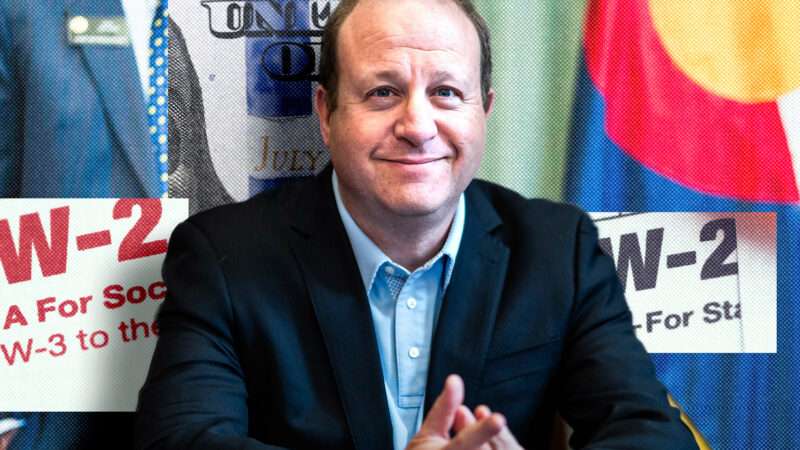
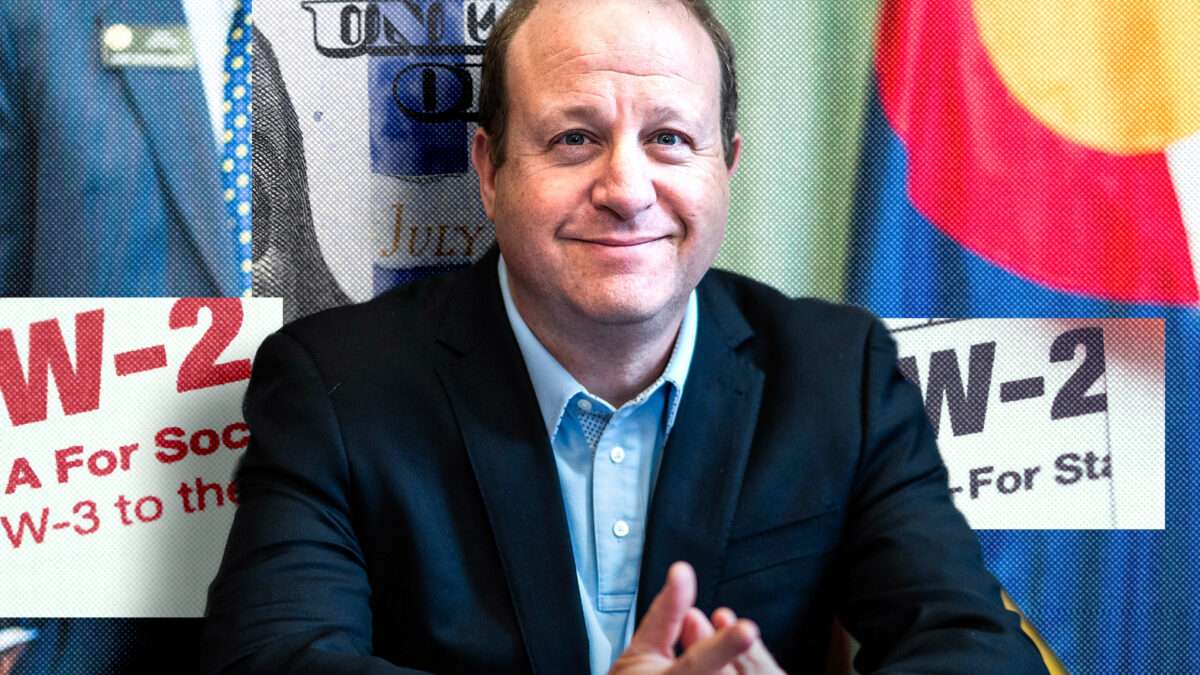
Colorado Governor Jared Polis | Illustration: Adani Samat. Photo: Jesse Paul/ZUMAPRESS/Newscom/Volodymyr Tverdokhlib/Sergey Tolmachyov/Dreamstime.

Next week's election is a pivotal one for Colorado, as voters will decide a pair of ballot questions that could secure the state's low-tax, small-government reputation—or shatter it.

Confusingly, there is a slim possibility that they decide to do both. More on that in a moment.

The two competing ballot measures could hardly be more different. The first, Proposition 136, would cap individual and corporate income taxes at 4.4 percent—the state's current flat rate.

The other, Amendment 87, would rewrite the state's constitution to allow for a progressive income tax. It would also set new rates, ranging from 7.4 percent on income over $500,000 to 8.4 percent on income over $1 million. And it would offer a modest tax cut to the lower end of the income spectrum: Individuals earning less than $100,000 would pay 4.2 percent, while those earning less than $25,000 would pay 3.7 percent.

Even with those offsets, Amendment 87 would be a massive tax increase. Both advocates and opponents agree that it would generate about $2–3 billion in additional annual revenue for the state government.

For now, the higher tax rates created by Amendment 87 would only apply to incomes over $500,000. Unsurprisingly, supporters of the measure are framing this as an opportunity to make the wealthy "pay their fair share."

There are two reasons why that argument is a bit deceiving.

As Jared Walczak, a senior fellow at the Tax Foundation, points out, "the new rates would be statutory, while the authorization for a graduated-rate tax would be enshrined in the constitution, permitting the legislature to adjust rates later." Lawmakers would not have to get permission from the voters to make those changes, so Coloradans would be trading away their flat income tax for a new model where income taxes could be hiked by the legislature at any time.

Second, the new rates are not indexed to inflation. As a result, "a household making $450,000 a year in today's dollars would be moved into a higher tax bracket within eight years if their earnings increased by 3% annually," reports The Colorado Sun, which crunched the numbers. Such "bracket creep" would also push more workers over the $100,000 threshold, nullifying the small tax cut for workers making less than that.

Politically, the progressive income tax proposal is dividing Democrats. The Colorado Democratic Party has endorsed Amendment 87 (along with many of its usual allies, like the AFL-CIO and the state's largest teachers union).

But Democratic Gov. Jared Polis has called the proposal "a huge blank check to politicians" that will "cripple our economy and reduce jobs."

In comments to a Denver TV station, Polis also highlighted how higher taxes in Colorado would make the state less competitive with its neighbors. "Utah has a very similar tax rate to what we have. If ours is double, we can't compete for businesses," Polis told Denver7. "It's game over. We will not be able to attract new employers to Colorado if the voters adopt this."

It's not just Utah. If the amendment passes, Colorado would have a significantly higher top income tax rate than any of its neighbors. (The current highest in that group is New Mexico, with its top rate of 5.9 percent.)

Under Colorado law, constitutional amendments typically need 55 percent approval to pass. However, Amendment 87 requires only a simple majority* because it technically repeals provisions in the constitution, rather than adding new ones. Similarly, Proposition 136—the one that would cap the income tax rate at 4.4 percent—requires just a simple majority.

It is possible, though unlikely, that both could pass. That would create a conflict, since the state's income tax can't be capped at 4.4 percent and also hiked to more than 7 percent on incomes over $500,000.

If that happens, the ballot question with the larger share of support would win, per state law. "In short, that means Amendment 87 would need to both win majority support from voters and surpass Proposition 136 in total votes to go into effect," explains the Denver Post, which has encouraged residents to vote against both ballot measures.

Accordingly, Proposition 136 must win majority support from the voters and surpass Amendment 87 (which needs 55 percent to pass, don't forget) to be implemented.

It is all a bit confusing, but the outcomes are worth watching. Colorado has long been a bit of an outlier among "blue" states for its relatively low taxes and booming population. It's now up to the voters to decide if that remains true.

*CORRECTION: This article incorrectly described how Amendment 87 could be passed into law. 

The post Jared Polis Warns Colorado's Progressive Tax Ballot Measure Could 'Cripple' the Economy appeared first on Reason Magazine.
  •  

Billionaires Have Already Paid Us Back. So Why Does California Want More?

A $100 bill | Gary Lewis/Dreamstime

No matter what happens in Tuesday's elections, support for wealth taxes keeps growing. Its justification is based on the idea that the very rich owe all of us something, and taxing their fortunes is collecting on that debt. We're told their success fuels inequality and that it's selfish of them to keep so much, especially if they don't proclaim that they want to do more for society.

Former International Monetary Fund chief economist Olivier Blanchard of France recently gave this narrative a clear voice. Writing on X, he wondered why California's wealthiest are spending so heavily to defeat Proposition 40, the supposed one-time 5 percent tax on the net worth of billionaires. Blanchard added that billionaires "typically have not indicated that they are building their wealth to eventually make the world a better place."

The entire notion misunderstands how fortunes are made. In a market economy, people don't build great wealth first and redeem it later through good works. They build it by making the world better first.

When I buy an $800 smartphone, it's because I value the phone more than whatever else I would have bought with the money. The seller values my $800 more than they do the phone. We both walk away richer by our own measure. Neither owes the other anything more.

Repeat this exchange a few hundred million times, and vast fortunes take shape for the people who create amazing technology so abundantly and affordably that we take it for granted. More importantly, though, people hand over every cent of it voluntarily.

As my colleague Arnold Kling aptly explained over the weekend, "Profits are earned within a positive-sum game for society. Profits induce firms to serve consumers and to innovate." The drive for wealth taxes relies on "the opposite point of view. It regards profits as something that businesses take from the rest of us, as if we can take innovation and efficiency for granted. [It] acts as if we are in a zero-sum environment in which one person's gain is necessarily another person's loss."

And, yes, the gains are divided more fairly than people think. Nobel laureate and Yale University economist William Nordhaus estimated that innovators in the U.S. business sector personally captured, on average, a mere 2.2 percent of the social surplus they created between 1948 and 2001. The other 97.8 percent went to everyone else in the form of lower prices, higher wages, better products and goods, and services that didn't previously exist.

In short, the world has already been compensated, many times over.

Those urging billionaires to acquiesce also err by blithely assuming that the state that grabs the money will use it well enough to "make the world a better place." The burden of proof is on them. California's government already spends roughly $350 billion a year. What will the extra few billion accomplish that the rest hasn't?

"Giving money and power to government is like giving whiskey and car keys to teenage boys," as journalist and satirist P.J. O'Rourke used to say. Maybe California's billionaires aren't eager to fund a Merced-to-Bakersfield rail line that the state prices around $35 billion and its inspector general puts closer to $48 billion. Perhaps they're hesitant to backfill pension funds like the California Public Employees' Retirement System, whose staff concedes is unlikely to hit an assumed 6.8 percent return without leaning on private equity.

Prop 40's revenue is earmarked for health care, but money is fungible. In the end, California has one budget. Every earmarked dollar frees another for something else. Some billionaires might simply have concluded that their philanthropy does more good elsewhere, or that their dollars are more beneficial when invested in private enterprises.

The tax also doubles down on California's worst habit: spend, spend, spend, and then tax, tax, tax. The money is never enough to cover all the spending. A one-time levy spent over five years doesn't fix that. It funds new commitments with temporary money. Some will want to make the tax permanent, which its intellectual architects clearly prefer and may have made possible. And yet that still won't be enough.

That's the commitment problem that Blanchard admits California can't solve. Billionaires are wise to distrust the "one-time" promise.

What worries me most is the moral framework. When a society convinces itself that the people making life better and less costly are the problem, we eventually stop getting those people.

Contrary to Blanchard's naive belief, billionaires aren't lacking in public spirit. Even if we ignore their often massive charitable giving, we can't forget that the market already collected their contribution and handed a large share of it to the rest of us. We should stop demanding they apologize for the other two cents.

COPYRIGHT 2026 CREATORS.COM

The post Billionaires Have Already Paid Us Back. So Why Does California Want More? appeared first on Reason Magazine.

  •  

Democrat Rep. Ro Khanna Defends ‘Wealth Tax’ on California Billionaires: ‘You Didn’t Build This Money Yourself’

Self-described "progressive capitalist" Rep. Ro Khanna (D-CA) defended taxing California billionaires via Proposition 40 by saying, "You didn't build this money yourself." 

The post Democrat Rep. Ro Khanna Defends ‘Wealth Tax’ on California Billionaires: ‘You Didn’t Build This Money Yourself’ appeared first on Breitbart.

  •  

California's Wealth Tax Could Cost the State $39 Billion

This week, editors Peter Suderman, Nick Gillespie, and Matt Welch are joined by Associate Editor Liz Wolfe to discuss California's proposed 5 percent wealth tax on billionaires, which a Hoover Institution study suggests could ultimately cost the state $39 billion in lost revenue. With wealthy residents already leaving California, the panel examines whether the measure will survive next week's vote, why Gov. Gavin Newsom opposes it, and how public sector unions have helped fuel the state's spending problems.

The panelists then look to France, where mounting unrest and economic stagnation raise questions about the long-term consequences of high taxes, expansive welfare programs, and pension obligations that increasingly burden younger generations. Next, they discuss Venezuelan opposition leader María Corina Machado returning home after 10 months in exile. Then, with the midterm elections next week, the editors examine whether Trump's tariffs, war with Iran, and mounting allegations of corruption will deliver Democrats control of Congress. Finally, a listener asks whether today's democratic socialist movement will ultimately be remembered like the libertarian and Tea Party movements of the early 2010s.


0:00—California's wealth tax proposal

13:02—Will France protests influence America?

22:50—Corina Machado returns to Venezuela.

31:19—Listener question on the DSA

44:40—2026 Midterm elections preview

58:34—Weekly cultural recommendations


Upcoming Reason Events

Reason Versus - Authoritarianism Is a Right-Wing Problem, November 10


Mentioned in the Podcast:

"Will the Wealth Tax Fail?" by Liz Wolfe"France Is a Warning to California's Tax-the-Rich Crowd," by Veronique de Rugy"California's 'Wealth Tax' Could Cost the State $39 Billion," by Eric Boehm"Report: California's Proposed 'Billionaire Tax' Is Based on Bad Research," by J.D. Tuccille"A Wealth Tax Built on Billionaires Who Aren't Really Billionaires," by Veronique de Rugy
"New Book Says Jared Kushner Funneled Money to Middle East Mercenaries. Kushner Denies It." by Matthew Petti"Trump's Tariffs Are Politically Toxic," by Eric Boehm
"The Democrats' Socialist Moment," by Matt Welch
"Family Separation Drama Fjord Is a Haunting Depiction of Unchecked State Power," by Peter Suderman

The post California's Wealth Tax Could Cost the State $39 Billion appeared first on Reason Magazine.

💾

© Illustration: Fatima Ruiz

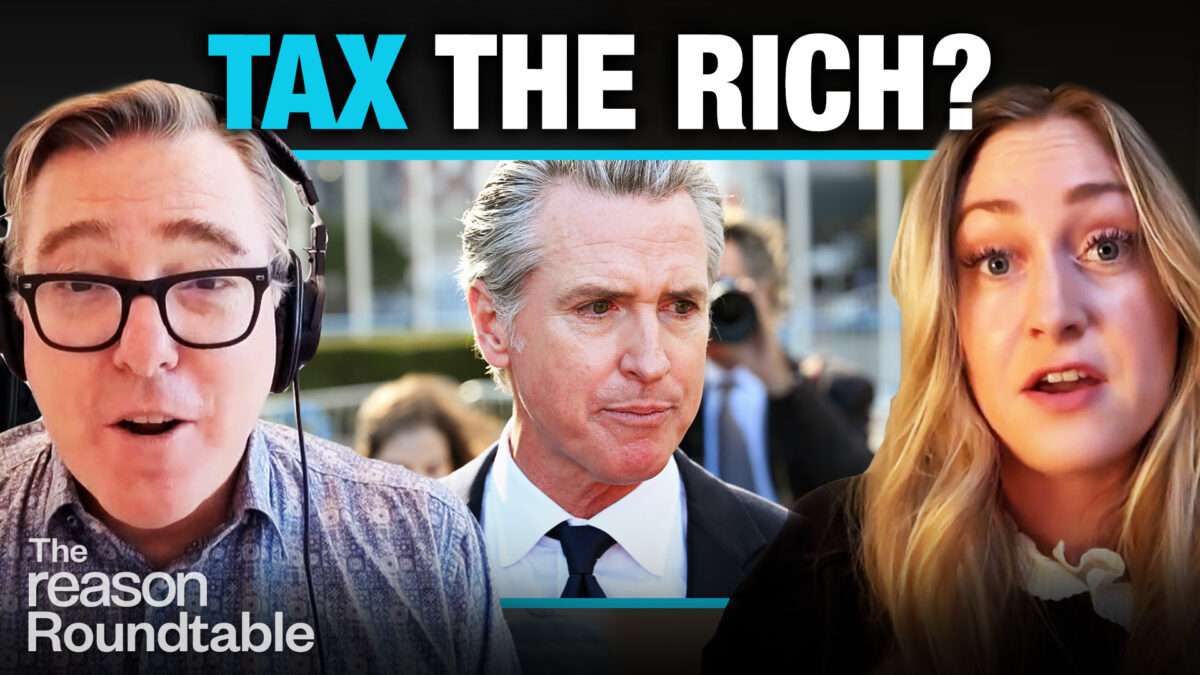
Matt Welch appears on the left. Liz Wolfe appears on the right. Behind them, an image of Governor Gavin Newsom appears looking concerned in the center. Bold text across the top of the screen reads "TAX THE RICH?"
  •  

Will the Wealth Tax Fail?

Prop 40 | Mohd Izzuan Roslan/Dreamstime

California's experiment: Will California's proposed wealth tax, Prop 40, pass next week? And if it gets passed, will it end up actually costing the state money instead of generating revenue?

The basics: The proposal features a one-time 5 percent tax on people with net worths over $1 billion who lived in the state on January 1, 2026 (with the net worth amount calculated as of December 31, 2026). The idea for the snapshot date is presumably to prevent capital flight once the tax passes. The tax's supporters say the tax's revenues will amount to $100 billion and will fund California's health care system, which need to make up for federal Medicaid cuts.

Seven billionaires, representing 30 percent of the total billionaire wealth in the state, left California before January 1, 2026, when news of the possible tax broke. Peter Thiel, Larry Page, and Sergey Brin are among the deserters. The French economist Gabriel Zucman—an intense defender of the wealth tax—seems committed to the idea that this flight won't matter too much. He argues that while removing those seven brings down revenue estimates to $89 billion, adding in less-prominent small-time billionaires raises revenue to $115 billion.

This is silly. As The Washington Post's Megan McArdle points out, there's no reason to believe those less-famous billionaires would stay put. We have a hard time estimating what the total preemptive flight looks like, and how many billionaires have successfully taken up residency elsewhere.

"Either the tax is annual—and in that case it generates revenue annually, and some billionaires leave," claims Zucman. "Or the tax is one-time—in that case it generates revenue in just one year, and there is no incentive to leave. It can't be both at the same time." Zucman doesn't seem to consider that billionaires have already left, as soon as the idea was seriously floated, thus taking early steps to shield their wealth from the state.

Will it pass? "Likely voters are essentially where they were a month ago," reports Politico, based on recent polling data, "with 46% in favor of Proposition 40 and 43% opposed—despite a recent push by backers of the measure, including Sen. Bernie Sanders, to rally support." Interestingly, "a strikingly high share of registered voters (84%) said they'd been exposed to advertisements or messages about the tax, but a 45% plurality said the communications had not swayed them, and those whose views had shifted were just as likely to be more opposed as more supportive."

There's another complication: On that very same ballot, voters will decide on Propositions 41 and 42, competing measures that could keep Prop 40 from taking effect. Prop 40 will be nullified if either one gets more votes; but Prop 40 will nullify both of them if it gets more votes. Prop 42 would bar new taxes on personal property such as businesses, investments, retirement accounts, trusts, and art collections—things Prop 40 targets. It also bans retroactive taxes, thus making Prop 40 impossible to pull off.

Back in January, Pirate Wires' Mike Solana spoke with a bunch of billionaires who were worried about the tax and making plans to flee, partially out of distrust that the tax would be one-and-done. "Three men I spoke with in the largest billionaire Signal chat said they ran an informal poll, and seventy percent of the chat (around sixty people, not all of whom were billionaires) indicated they would leave the state if the ballot proposition passes," reports Solana. "According to that same poll, around 15% have already left the state."

"There is now real danger in appearing successful in the state of California," writes Solana, "as the far left, imbued with a great deal of power, and benefiting now from several years of wealth scapegoating throughout the mainstream press, attempts to liquidate its perceived enemies in business."


Scenes from New York: I'm fully aboard this train these days, though open to being convinced why I'm wrong:

If you truly *love* American cities, you MUST support strict enforcement of laws against anti-social behavior. Paying bus fares, red light cameras, camping on sidewalks, smoking on trains, off-leash dogs, etc etc

If people want to do whatever they want, that's FINE in the… https://t.co/XU0WQR30yz

— Bobby Fijan (@bobbyfijan) October 26, 2026


QUICK HITS

  • "Brazilian markets are heading for a major rout when local trading begins after President Luiz Inácio Lula da Silva pulled off a stunning comeback to defeat Flávio Bolsonaro, the right-wing candidate that many investors preferred," reports Bloomberg. This will be da Silva's fourth term.
  • Is dynamic pricing on the rise? Customers say yes, but most companies say they're wrong. My thought: Even if it's not currently happening to the degree angry customers claim, it certainly will be big in the future, as online shopping takes over and AI makes implementation easier. Consider the upside, though, noted in this Wall Street Journal piece: "Much current angst is focused on electronic shelf labels, which have replaced the printed labels that dotted shelves at groceries and other stores. Research on digital shelf labels in the U.S. and Europe, where grocers have widely used the technology for more than a decade, found the labels don't lead to surge pricing, in part because price changes are obvious to anyone walking by. Rather, research found, grocers have used the labels to discount goods that are about to expire, reducing food waste."
  • Great Washington Post headline: "Europe is running out of other people's money."
  • President Donald Trump claims the ships passing past Cuba on their way home from Iran will just, uh, handle the situation there. Sure.
  • Interesting:

Striking detail in the big NYT piece on Taiwanese families adjusting to working at the huge new TSMC chip plant in Arizona: their surprise at the lack of rigor in US schools. pic.twitter.com/YkSPzbHCuE

— Alec MacGillis (@AlecMacGillis) October 26, 2026

The post Will the Wealth Tax Fail? appeared first on Reason Magazine.

  •  

France Is a Warning to California's Tax-the-Rich Crowd

Protest in France | Elise Cabane/ZUMAPRESS/Newscom

French economist Gabriel Zucman has come to California bearing a familiar French solution to a fiscal problem: another tax.

Once based at the University of California, Berkeley, Zucman is back and campaigning for Proposition 40, which would impose an allegedly one-time 5 percent tax on the net worth of Californians worth more than $1 billion. Zucman, who coauthored the proposition, estimates that the tax could raise about $100 billion and claims that 90 percent of the proceeds would go to health care.

The California Legislative Analyst's office is far more cautious, saying it would raise only "tens of billions" and could cause a long-term loss of income-tax revenue as wealthy people leave the state with the companies they created.

I've written plenty about why wealth taxes are economically destructive, administratively nightmarish, and unlikely to achieve anything close to what their advocates promise. But Zucman's prescription is wrong for a more fundamental reason, as his (and my) native country shows: Raising taxes to fuel ever-larger demands for government spending is a recipe for disaster.

Unless you've been living in a remote cave recently, you've likely seen all the protests and destruction in France. But do you know why it's happening?

As another economist, Paul Krugman, rightly noted back in 2017, "France offers a social safety net beyond the wildest dreams of U.S. progressives: guaranteed high-quality health care for all, generous paid leave for new parents, universal pre-K, and much more."

For decades, France has answered any perceived desire with government spending, then responded to the resulting fiscal problem by seeking new revenue sources. Today, French government spending consumes roughly 58 percent of gross domestic product (GDP).

Krugman gloated that France wasn't suffering social collapse and speculated that it was due to all the spending. He certainly can't say that anymore. In fact, he is now worried that France may be on the precipice of a debt crisis. The truth is that France hasn't done well for some time, even when Krugman cheered its spending.

One of the groups in the street today, young people, has faced widespread unemployment for a long time. The youth unemployment rate in France (ages 15-24) has hovered between 17 percent and 27 percent since 2000. In the second quarter of 2026, it was 21.6 percent, against 14.8 percent in the Eurozone and 9.9 percent in the U.S.

French people also pay some of the highest taxes in the developed world, and they're not happy with the return. The government already takes more than 52 percent of the country's output in revenue, runs deficits exceeding 5 percent of GDP, and has accumulated debt approaching 120 percent of GDP. Nonetheless, French students complain that the government is shortchanging schools, while everyone sees that it is shortchanging its army and police.

The students aren't wrong to feel left out. At The Two Cents Substack, Hoover Institution scholar Hanno Lustig calculates that, between 1995 and 2024, spending on social protection and health (most of which benefits older people) rose from 53.1 percent to 58.7 percent of all French government spending. The share devoted to education, defense, and public order fell from 15.2 percent to 13.7 percent. Transportation fell from 5.3 percent to 3.8 percent.

In other words, France has built an enormous welfare state, much of it devoted to older citizens, while letting other state capacities and basic services fall apart. As transfers of wealth swallow a larger share of the budget, everything else gets squeezed.

That is the fiscal ratchet Californians should worry about when Zucman tells them Proposition 40 is necessary to "save" health care. Proponents claim Washington "cut" Medicaid, but that language is misleading. California's deficit started long before any Washington spending reductions. Besides, federal Medicaid spending isn't falling—not even close. The Congressional Budget Office estimates it will reach $708 billion in 2026, 8 percent more than in 2025. What Washington did in the 2025 budget reconciliation law was reduce Medicaid's future growth relative to previous projections, partly by changing eligibility and enrollment rules and financing arrangements.

This is how the ratchet works. Once the government projects a spending increase, anything less becomes a cut. And once Washington fails to finance the entire projected increase, Californians are told that Sacramento must backfill the missing money. And how should it do that? Conveniently, by creating an entirely new tax.

France has run this experiment for decades. It has an incredibly generous welfare state paid for with very high taxes; it's even tried a wealth tax and has a value-added tax, yet somehow it's never enough. Its welfare state has not eliminated scarcity. It has merely transferred the job of rationing scarce resources to politicians.

Zucman looks at California and sees hundreds of billions of dollars of private wealth waiting to solve a public finance problem. Californians should look across the Atlantic and ask a different question: What happens after politicians decide that every spending adjustment can be delayed until tomorrow by finding another pot of private wealth?

France should not be sending California tax advice. It should be sending a warning.

COPYRIGHT 2026 CREATORS.COM

The post France Is a Warning to California's Tax-the-Rich Crowd appeared first on Reason Magazine.

  •  

California's 'Wealth Tax' Could Cost the State $39 Billion

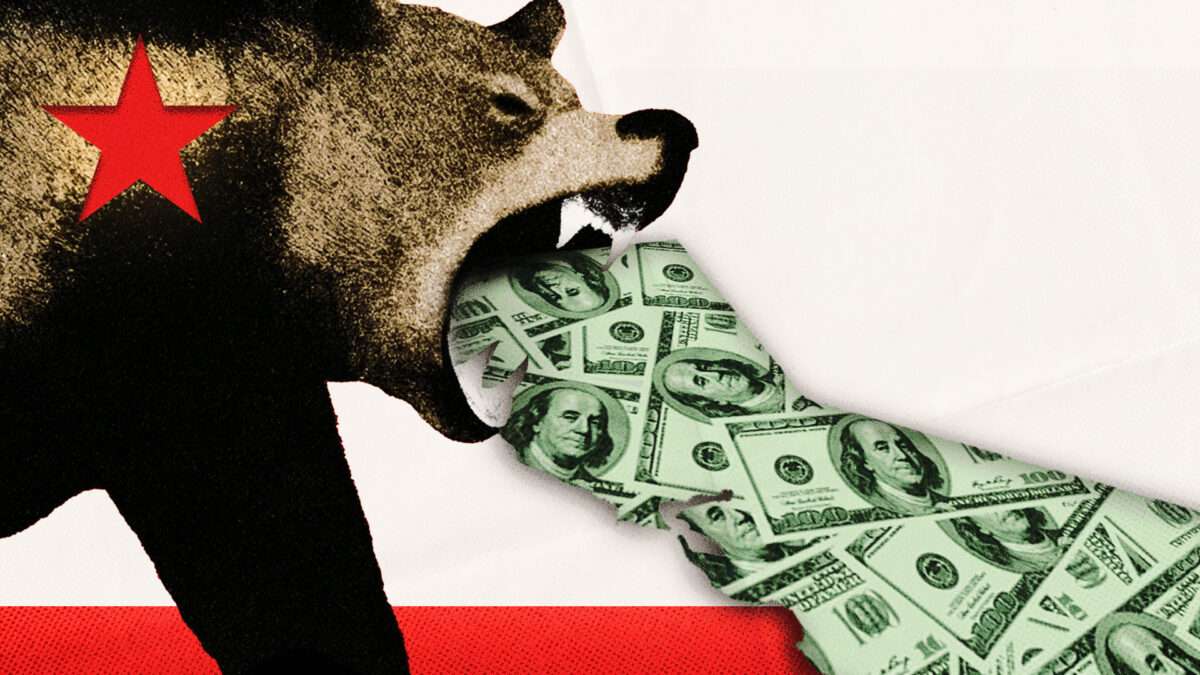
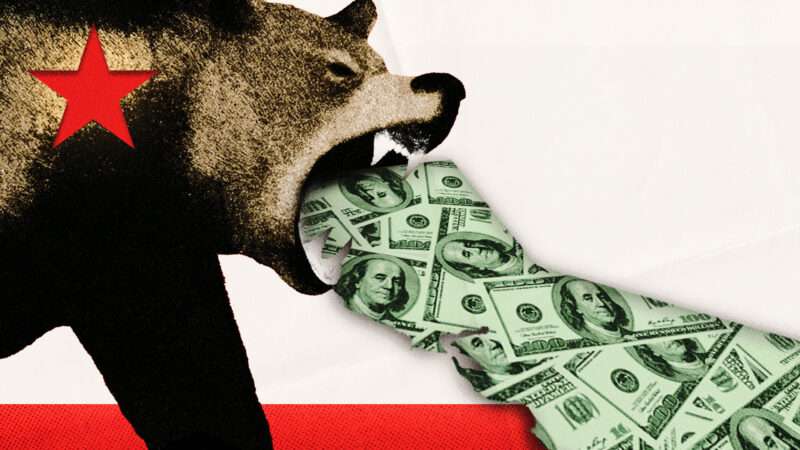
a bear vomits out U.S. dollars against the background of the California state flag | Helistockter/Dreamstime/Midjourney/Fatima Ruiz

A proposed "wealth tax" on California's billionaires could backfire and cost the state tens of billions of dollars in the long run.

If the proposed tax drives wealthier residents out of the state, California could end up losing between $1 billion and $3.5 billion annually in income taxes, according to a working paper published this week. A pair of researchers at Stanford University warn that the state could end up losing an estimated $39 billion because of the consequences of the wealth tax.

"These findings suggest that the Billionaire Tax Act will not fulfill the primary functions for which it was designed," write researchers Benjamin Jaros and Joshua Rauh.

Voters in California will decide next month whether to impose the one-time, 5 percent tax when they vote on Proposition 40. The ballot measure is dividing Democrats—Gov. Gavin Newsom opposes it, while progressive Rep. Ro Khanna (D–Calif.) claims it is the "most important ballot initiative in America and a fight for the soul of our party."

And it's already spurring some billionaires to flee the state—including venture capitalist Peter Thiel and Google co-founder Larry Page. Including those two, the seven billionaires who have publicly said they are leaving the state represent more than $539 billion of the nearly $1.9 trillion aggregate net worth of California's billionaires, the researchers note.

With other departures likely happening more quietly, the new study estimates that the tax will generate about $30 billion, a far cry from the $100 billion that the tax's supporters expect. The "behavioral response" from billionaires in California "has eroded most of the projected tax base," write Jaros and Rauh.

That's still a pretty big pot of revenue. In the long run, however, the state is likely to lose out.

After running 100,000 simulations using different assumptions, the two researchers report that "85 percent of plausible outcomes produce a negative" result in state revenue.

Other recent experiments with special taxes on wealth have backfired in similar ways. In response to a new wealth tax in Washington State, Jeff Bezos relocated to Florida, and iconic Seattle brand Starbucks shifted more of its corporate headquarters to Tennessee. Studies have shown that a "millionaires tax" in Massachusetts contributed to wealth moving out of that state.

Capital is always mobile, despite the best efforts of politicians. And if you were a billionaire living in California, why would you stick around?

Polls show voters are narrowly divided over Proposition 40. A Politico poll published earlier this month showed 46 percent of voters plan to vote for the measure, while 43 percent oppose it. Voters were similarly divided when asked if they expected it to pass or not.

The post California's 'Wealth Tax' Could Cost the State $39 Billion appeared first on Reason Magazine.
  •  
❌