Sundar Pichai, chief executive of Alphabet Inc., during an interview on "The Circuit with Emily Chang" on May 1, 2024.
David Paul Morris/Bloomberg via Getty Images
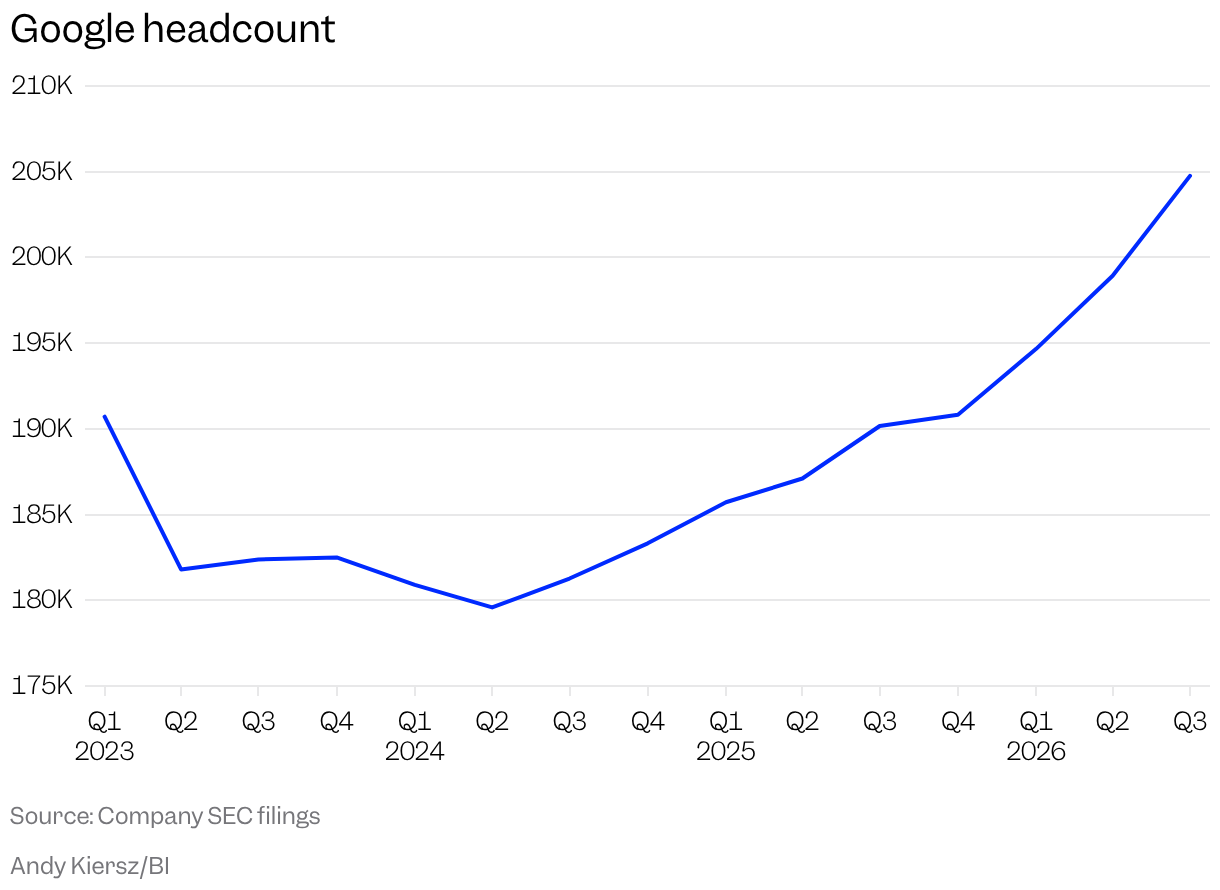
While some companies are slashing head count, Google's is surging.
The company had nearly 205,000 employees at the end of September.
While Google has conducted layoffs, it has also ramped up hiring and acquired Wiz.
While AI may be driving some companies to slash their head count, Google's is soaring.
When Google reported its Q3 earnings on Wednesday, it said it had 204,757 employees for the quarter ending September 2026. That means Google added roughly 10,000 people to the payroll since the end of March.
The uptick in head count runs counter to another trend across the tech industry, where some of Google's peers are slashing their workforces. Meta has been on a cost-cutting odyssey for several years, while Microsoft recently offered voluntary buyouts to 60,000 employees.
Some of Google's head count growth can be attributed to mergers and acquisitions. On March 11, Google said it had completed its acquisition of cybersecurity firm Wiz, which had roughly 2,000 employees.
In January 2023, Google announced it would slash roughly 12,000 roles — around 6% of the workforce at the time — and has since made several smaller rounds of layoffs, Business Insider has reported.
While the head count has grown somewhat steadily since Q2 2024, it has accelerated since the end of 2025. Google also reported Wednesday that its quarterly revenue grew 25% from this period last year.
Sundar Pichai's Google is increasingly moving in on Jensen Huang's turf.
Bloomberg/Getty Images; Thomas Koehler/Photothek via Getty Images
Google's AI chip business is turning into a TPU-shaped headache for Nvidia.
A blockbuster deal with Oracle will put Google's TPUs inside another hyperscaler.
Is the market underestimating the potential of Google's chip business?
Earlier this year, Nvidia CEO Jensen Huang downplayed the threat of other companies building competing AI chips, including Google.
"Without Anthropic, why would there be any TPU growth at all?" he said in an interview with podcaster Dwarkesh Patel, referring to Google's custom chips. "It's 100% Anthropic."
That is no longer the case.
On Tuesday, Google and Oracle announced a blockbuster deal that will see Google's TPUs, short for Tensor Processing Units, made available to Oracle cloud customers from next year. As the companies underscored in a joint announcement, it's the first time Google's TPUs have been offered on a hyperscaler's platform beyond its own.
Anthropic isn't the only one Nvidia should be worried about. OpenAI has a job listing for a software engineer to optimize its models for TPUs, and The Information reported Tuesday that OpenAI plans to buy TPUs from Google.
Meanwhile, several analysts have predicted Google's TPU business is about to explode as more companies hedge their bets with a multichip strategy — providing an opening for Google and others to further move onto Nvidia's turf.
Despite this, Nvidia's chip business still eclipses everyone else's, including Google, which is also a big customer of Nvidia's GPUs. Yet Google's AI chips, which the company began building more than a decade ago to power search and other products, might be poised for takeoff.
On Wednesday, during Google's third-quarter earnings call, chief financial officer Anat Ashkenazi said the company expects a "meaningful revenue ramp in 2027" in TPU sales.
Cloud chief Thomas Kurian also said on the call that TPU sales were a "meaningful contributor" to the company's Q3 financials.
In its IPO paperwork filed this week, Anthropic said it planned to spend $114.5 billion on Google compute between April 2026 and July 2033. While it didn't specify how much of that would go to TPUs specifically, it estimated spending between $125 billion and $150 billion on TPU capacity from Google and other providers.
In the same filing, Anthropic said it's also using Amazon's Trainium chips and AMD's GPUs, as well as chips from Nvidia and Google.
All told, this might be Nvidia's nightmare scenario coming true. If companies are increasingly using a multichip strategy, it could hamper Nvidia's pricing power.
Google declined to comment, and Nvidia and OpenAI did not respond to requests for comment.
TPU takeoff?
Google's TPU business may only be getting started.
In notes published this month, Japanese banking group Mizuho projected TPU revenue of $28 billion for 2026 and $67 billion in 2027. Mizuho said Google could see that number reach as high as $100 billion in 2028, while TD Cowen's John Blackledge projected it could reach $138 billion, accounting for 34% of Google Cloud's 2028 revenue.
That number is still dwarfed by Nvidia, which reported $96.2 billion in revenue in the previous quarter alone, and the market reacted with a shrug on Wednesday as its share price stayed flat.
Some analysts, though,think the market is underestimating Google, especially as more companies look to reduce their reliance on Nvidia's GPUs.
"We believe Google's TPU hardware business is emerging as a materially larger opportunity than what is currently reflected in consensus estimates," Mizuho analysts wrote in a note published October 18, adding that selling TPUs outright — rather than renting them from Google's own data centers — could ease Google's aggressive capex spending.
And even if that spending continues to soar — and right now, there are no signs the foot is coming off the accelerator — analysts at Bank of America said Google's cash-splashing looks "relatively efficient" compared to its peers, as TPUs continue to power the company's own AI efforts.
For Google, it's the payoff of a decade-plus investment in silicon that was originally designed to make Search smarter. It could also act as something of a buffer against damage to its core search business as AI agents eat Google's lunch, Mizuho also said this month.
Sundar Pichai says Google's researchers are using AI to help build the next AI models.
Hardik Chhabra/ The India Today Group via Getty Images
Sundar Pichai said Google was still in the early phases of recursively self-improving AI.
Researchers are working with AI agents to build better models, he said.
Sergey Brin recently said Google was "starting to get onto that RSI treadmill."
Google's AI models may be helping to build their successors, but CEO Sundar Pichai says the moment of fully self-improving AI is still a while away.
Speaking on an episode of the "Big Technology Podcast" this week, Pichai said that Google researchers were using AI agents to assist them when building models, but caveated that it was still early days.
"We are pretty far from the end state of RSI," said Pichai, referring to recursive self-improvement. "The right way to describe it is, you have RSI loops along with AI researchers in various aspects of model development. I would say you almost have agents helping AI researchers, in some automated way, work together to build these models."
Pichai added that he expected that continuum to keep making progress into next year.
Earlier this month, Google cofounder Sergey Brin said the company's Flash series of models, as well as Gemini 4, were demonstrating how AI was helping to build itself, and that Google was "starting to get onto that RSI treadmill."
"And now our researchers and the model work hand in hand to make the next version of the model," he said.
Brin has been increasingly involved in Google's Gemini efforts and has leveraged his power as cofounder to shift resources to projects he deems most effective, Business Insider previously reported. This has included pushing for more focus on RSI.
A report from the firm Gladstone AI, published earlier this month, said that most researchers interviewed from companies including Anthropic and DeepMind believed RSI will start within the next three to 12 months, and possibly sooner without government intervention.
In another moment on the "Big Technology Podcast," Pichai was asked about how much AI was being used to code internally. The company said in April that 75% of new code inside Google was generated by AI.
"That number in our world today is like meaningless in the sense that every part of code we now touch is influenced by AI deeply," Pichai said. With Gemini 4 Argon, he said, people were going to tackle harder problems. He also said Google was seeing a one-third decrease in code rollbacks, where software is reverted to a previous version because of a bug or system issue.
"And so I think people are writing code more productively, and better code with it," he said of AI tools.
Pichai also uses AI to track Google's model development and internal discussions, he told the "Sources" podcast this week.

 Login