❌

Reading view

Creating Voter Confusion About Candidates' Names is Bad - But Exploiting Voter Ignorance About Policy Issues is a Much Bigger Problem

Sen. Dan Sullivan (R-Alaska). (US Senate)


A recent New York Times article presents evidence that Alaska Democrats sought to confuse voters in that state's 2026 Senate election by introducing a second candidate with a name very similar to that of the Republican incumbent, thereby potentially siphoning off some of the latter's voters. The incumbent senator is named Dan S. Sullivan, while the other candidate is Dan J. Sullivan. As the Times reports, some of the facts here are disputable, and it is not entirely clear whether Democratic candidate Mary Peltola knew about this effort or approved of it. But it seems likely that at least some of her staffers and other Democratic operatives were involved.

Before going further, I should emphasize that this effort is worthy of condemnation. Trying to confuse voters into voting for the "wrong" candidate in this way is not how democratic political participation should work. And the fact that other politicians (including Republicans) engage in various electoral "dirty tricks" doesn't justify this one.

Elsewhere, I have explained why these kinds of actions are not illegal, and why the Trump administration's lawsuit seeking to block certification of the Alaska Senate result deserves to fail. I stand by that conclusion. Legal scholar Rick Hasen (a leading election law expert) has a helpful recent post explaining why the New York Times revelations do not change anything from a legal point of view. But the fact that this scheme is legal doesn't make it right.

That said, it is important to keep this issue in proper perspective, and especially to recognize that many other types of lies and efforts to exploit voter ignorance are much worse. Confusion caused by candidates with similar names is relatively rare, and it is difficult to find examples where it affected more than a small fraction of voters. I am not aware of even one case where it was decisive to the outcome of an election. But I welcome correction on that latter point.

The Alaska case is unlikely to be an exception to the above generalization. In the first round of the ranked-choice voting election (which narrows down the candidates to the top 4), only 2.5% of voters picked Dan J. Sullivan. Peltola led the incumbent senator by a much larger margin than that (8.1 points). Even if every single person who voted for Dan J. did so because of confusion (which is improbable), that's unlikely to change the result.

Moreover, the Alaska ranked-choice voting system reduces the risk of error. Some of those who vote for the "wrong" Dan Sullivan might rank the "right" one second. After the former gets eliminated, those votes get transferred to the latter. On top of that, as Michael Dorf points out, the Alaska ballot explicit indicates that Dan S. Sullivan is the "incumbent." That further reduces any potential confusion. The widespread publicity this issue has gotten over the last few weeks further reduces the risk of error. Many voters have probably now heard about the two Dan Sullivans and will be on guard against the problem.

It is still theoretically possible that confusion between the two Sullivans will end up having a decisive impact on the election. Some people who voted for Dan J. might not rank the other Sullivan second, or might misunderstand how the RCV system works. And some voters might (understandably) not be very careful about how they mark their ballots, thereby making a mistake despite the various safeguards against it. Still, it seems highly unlikely that such errors will have a decisive impact on the outcome.

Overall, this kind of a thing is relative molehill of a problem. Elections where it makes a decisive difference are likely to be extremely rare, at worst. By contrast, candidate lying about policy issues and exploitation of voter ignorance about them is a veritable mountain. I summarized some of the relevant evidence in an earlier post about the Alaska controversy:

Donald Trump is a particularly egregious example, going all the way back to his first campaign in 2016, and more recently with his lies about the 2020 election and other issues. But more conventional politicians also often resort to lies and deception, even if not to the same degree.  President Obama, for example, famously  lied when he claimed that, under the Affordable Care Act, "if you like your health care plan, you can keep it." That deception won the 2013 Politifact Lie of the Year award. But it still helped Obama get reelected in 2012. I am not sure exploiting voter confusion about names is any worse than exploiting their ignorance about policy issues like crime, immigration, and health care….

Ultimately, both exploitation of voter confusion about names and other deceptions used in campaigns seek to exploit widespread voter ignorance. Because of the combination of "rational ignorance" (lack of incentive to seek out political information) and "rational irrationality" (lack of incentive to engage in unbiased evaluation),  most voters know little about government and public policy, and often do a poor job of evaluating the information they do know. This makes them vulnerable to deception and manipulation, and incentivizes politicians to lie and otherwise distort the truth.

I would add that lies and deceptions about policy issues affect vastly more voters and have vastly bigger impacts on electoral outcomes than confusion about candidates' names. To take just a few recent examples, Trump in 2016 and 2024 and Obama in 2012 probably could not have won without the former. If, in 2024, key swing voters had realized that Trump's policy agenda of tariffs and mass deportations was likely to raise prices (as it predictably went on to do) rather than lower them (as he promised to do), he likely would have lost. Polls showed that prices were the biggest issue in the election for key swing voters. Trump also might well have lost if GOP base voters realized he was lying about the 2020 election, among other issues. In 2012, Obama might have lost if swing voters realized that he was lying when said that, under his signature policy initiative (the Affordable Care Act), "if you like your health care plan, you can keep it."

Effective lies and deceptions about policy issues (often exploiting preexisting voter ignorance and bias, but also deliberately seeking to create more of it) are ubiquitous. And they very often affect electoral outcomes. Even when they don't change the outcome between the candidates who run, they often have an impact on the policies those candidates adopt in the first place. As described more fully in my book Democracy and Political Ignorance, political parties and their strategists know most voters are ignorant, and often deliberately select policy agendas based on the likelihood of successfully exploiting that ignorance. The result is that even the lesser of the evils on offer in a given election (or the less egregious liars) are often still very bad.

From a moral point of view, I don't see any reason to believe lying about policy issues and exploiting voter ignorance about them is any worse than trying to trick voters into selecting the "wrong" candidate out of confusion. In practical terms, the former happens much more often than the latter, and has a far bigger effect).

Cornell law Prof. Michael Dorf recognizes that lies about policy issues are bad, but suggests that efforts to create confusion about candidate names are worse, because the latter are harder to combat with "counter-speech." I think the truth is the exact opposite. People can and do use counter-speech to oppose lies and deceptions about policy issues. But "rationally ignorant" voters will often ignore the counter-speech (not wanting to take the time and effort to study it) or reject evidence that goes against their preexisting biases. Many policy issues require considerable time and effort to understand well.

By contrast, it's much easier to find out there are two candidates with similar names in the election, and to take precautions against accidentally voting for the "wrong" one. Counter-speech to that effect need not be very complicated at all, or take a long time to understand.  In the Alaska case, for example, you just need to remember to vote for Dan S. rather than Dan J. or just know to vote for the one marked "incumbent." And figuring this out does not require going against any partisan or ideological biases.

As I have emphasized in previous writings about voter ignorance, I do not believe we can or should fight it by trying to punish politicians for their lies, or by censoring "misinformation." There is, in fact, no easy solution to the problem. But I assess a range of  options in my 2023 article on "Top-Down and Bottom-Up Solutions to the Problem of Political Ignorance, and in Democracy and Political Ignorance. I believe the best approach is to make fewer decisions at the ballot box and more by "voting with your feet," where incentives to seek out information and evaluate it wisely are much better.  In the works linked above, I also argue that we should give consideration to simply paying voters to increase their knowledge levels (e.g. by establishing a "Voter Achievement Test" and offering rewards to high scorers). But I  recognize that any effective approach will take time, and there may be no one fix that is sufficient by itself.

The beginning of wisdom here is to recognize we have a wide-ranging problem of voter ignorance, and to prioritize the most significant types of ignorance and exploitation thereof. On that scale, ignorance about policy issues should rank high, while voter confusion about candidates' names is a very minor problem, by comparison.

UPDATE: I have made minor additions to this post.

The post Creating Voter Confusion About Candidates' Names is Bad - But Exploiting Voter Ignorance About Policy Issues is a Much Bigger Problem appeared first on Reason Magazine.


  •  

ICE is Now Even More Unpopular than the IRS

Reuters (2018).

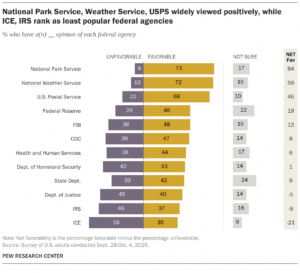
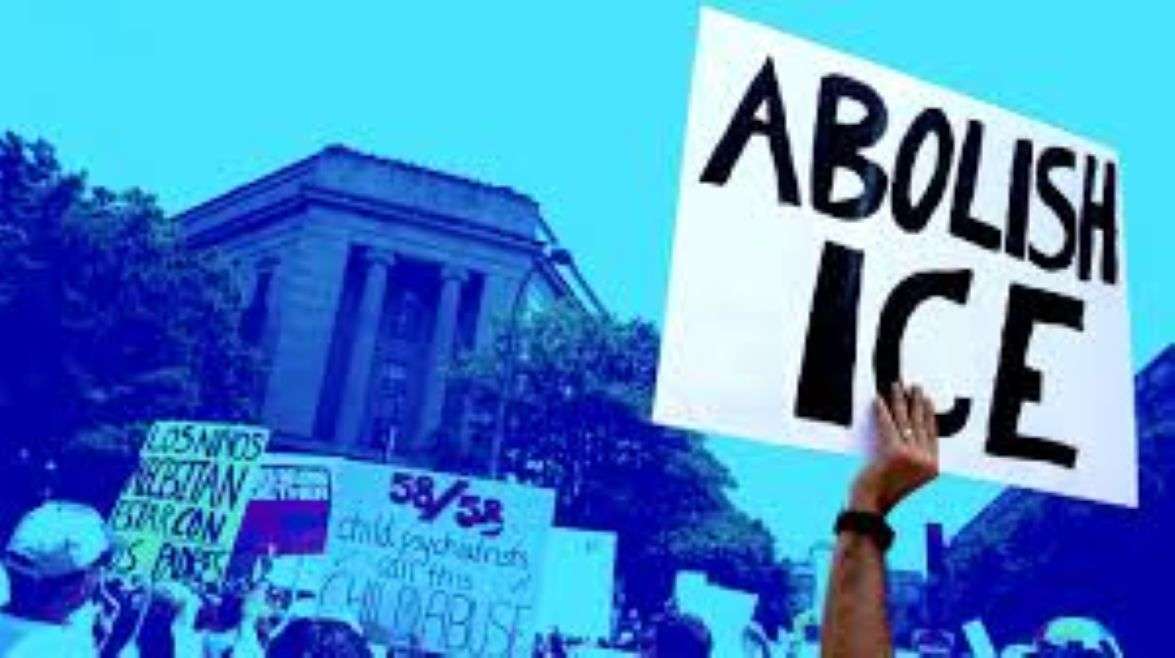
A recent Pew Research Center survey finds that Immigration and Customs Enforcement (ICE) is by far the most unpopular federal agency, easily outstripping even the widely despised IRS. According to Pew, 56% of Americans disapprove of ICE, compared to only 35% who approve. That's substantially worse than the IRS (which is disapproved by only a 46-37 margin).


Other recent surveys show growing public support for abolishing ICE. For example, a July YouGov poll indicates that 48% support abolition, compared to 40% who oppose it. Another survey,  conducted in March of this year, showed a similar 50-39 margin in favor of abolition.

The fact that ICE is unpopular doesn't by itself prove the agency should be abolished. Having written a book and many other publications on widespread public ignorance about government policy, I would be the last to argue that popularity is a good metric of a policy's - or an agency's - merit. But, in this case, public opinion is right. As I explained in an August 2025 article in The Hill, and a follow-up piece for the Boston Globe, (non-paywalled version here), ICE's many abuses do indeed justify abolishing it. And the case for doing so has been strengthened by more recent events, such as the brutal killing of two US citizens in Minnesota.

While ICE abuses have been exacerbated by the policies of the second Trump Administration, many predate it, and are inherent in the entire enterprise of mass deportation.

As explained in my article in The Hill, abolishing ICE would not completely end interior deportations. But it would make them heavily dependent on the cooperation of state and local governments, thereby strengthening constitutional federalism and reducing incentives for abuse, at least to a significant degree.

In that article, I also explain how support for abolition be further bolstered by combining it with shifting ICE funds to state and local law enforcement. This undermines the principal political obstacle to abolition: the fear that getting rid of ICE would increase crime. Transferring the funds to state and local police would help defuse such concerns, win the support of law enforcement agencies, and foster genuine reductions in violent and property crimes; social science evidence shows that putting more police on the streets has that effect, whereas deportations do not.

The post ICE is Now Even More Unpopular than the IRS appeared first on Reason Magazine.

  •  

Ninth Circuit Rules Trump Illegally Federalized National Guard in Los Angeles

Members of the Texas National Guard assemble at the Army Reserve Training Center in Elwood, Illinois
Texas National Guard members in Illinois (Brian Cassella/TNS/Newscom)


On October 23, in the case of Newsom v. Trump, the US Court of Appeals for the Ninth Circuit ruled Donald Trump's June 2025 federalization of the National Guard in Los Angeles was likely illegal. This decision has little immediate effect, because the National Guard deployment ended months ago, after the Supreme Court ruled against Trump in a related Illinois case. But it has important implications for judicial review of executive invocation of emergency powers to use the military domestically. Among other things, it emphasizes that such actions are reviewable, and the president should get only limited deference. It also adopts a properly restrictive definition of "rebellion" (which is one of the conditions that might justify federalization of the National Guard).

Trump federalized the Guard in response to anti-ICE protests. The district court ruled his action was illegal and issued an injunction blocking it. But the Ninth Circuit lifted the preliminary injunction, in a decision I criticized at the time.

The relevant statute 10 U.S.C. Section 12406, can only be used to federalize state forces in one of the following situations:

1) the United States, or any of the Commonwealths or possessions, is invaded or is in danger of invasion by a foreign nation;

(2) there is a rebellion or danger of a rebellion against the authority of the Government of the United States; or

(3) the President is unable with the regular forces to execute the laws of the United States

Last year, the Ninth Circuit ruled (incorrectly, I think) that Trump's action might have been permissible under Subsection 3: a situation where "the President is unable with the regular forces to execute the laws of the United States." As the Ninth Circuit acknowledges in their most recent decision, this basis for Trump's actions was undermined by the Supreme Court's December ruling in the related case of Trump v. Illinois, which held that Subsection 3 can only be invoked when the president is authorized to use regular federal military forces to enforce the law, and those forces are inadequate. These circumstances do not apply to the anti-ICE protests in Los Angeles and Chicago.

No one claims that the situation in Los Angeles amounted to an "invasion" by a "foreign nation." Thus, in its most recent decision the Ninth Circuit considered whether Trump's actions were authorized by Subsection 2, which allows federalization of the guard when "there is a rebellion or danger of a rebellion against the authority of the Government of the United States."

The majority opinion by Judge Jennifer Sung holds that the determination that there is a "rebellion" is subject to judicial review and can be invalidated " if it "did not reflect a colorable assessment within a range of honest judgment." I think this is overly deferential. For reasons I outlined in an article published last year, there should be little or no deference when the executive invokes extraordinary emergency powers. Still, the Ninth Circuit standard is far from a blank check, and does allow invalidation of executive actions where the claim of rebellion is blatantly wrong - as it was here.

Following the district court, the Ninth Circuit defined  "rebellion" as "a violent, armed, organized, open and avowed uprising against the government as a whole." This differentiates "rebellion" from smaller-scale violence or other violations of law. I think that definition is largely correct. The court summarizes a wide range of historical evidence supporting it.

The Ninth Circuit also concluded that events in Los Angeles did not even come close to meeting that standard. There were some violations of law by protestors, and some small-scale violence. But no systematic effort to overthrow the government or anything close to it. If anything, both this issue and the definition of "rebellion" are easier calls than the court suggests.

Judge Sung, author of the majority opinion, is a liberal Biden appointee. But her opinion was joined by Judge Eric Miller, a conservative Trump appointee and onetime clerk for Supreme Court Justice Clarence Thomas. This suggests the issue here cuts across ideological and jurisprudential lines. Judge Mark Bennett, another Trump appointee, dissented, but mostly on procedural grounds.

Judge Bennett did also take issue with the majority's conclusion that if Trump's federalization of the National Guard exceeded his statutory authority, it also violated the Tenth Amendment, which reserves to the states or to "the people," those "powers not delegated to the United States by the Constitution." He argues that the power to call forth the National Guard is delegated to Congress by the Calling Forth Clause of the Constitution, which gives Congress power "[t]o provide for calling forth the Militia to execute the Laws of the Union, suppress Insurrections and repel Invasions." This is true enough. But in situations where Congress has not exercised that authority, states retain total control over their militia (of which the National Guard is the principal modern example), and that control is protected by the Tenth Amendment. Indeed, such control over state military forces is a central element of state sovereignty. Overriding it without proper constitutional authority qualifies as unconstitutional "commandeering" of state government forces. As the majority explains:

The federal government—whether the President or Congress—violates the Tenth Amendment by commandeering state personnel to enforce or administer federal law. Printz v. United States, 521 U.S. 898, 925 (1997) (Under the Tenth Amendment, "the Federal Government may not compel the States to implement, by legislation or executive action, federal regulatory programs."). If, for example, the President commandeered state police to help federal officers enforce federal immigration laws, that would violate the Tenth Amendment….

California National Guard members are state personnel, unless properly federalized… The President purported to convert the Guard into federal personnel by issuing federalization orders. If those federalization orders had been valid, then the President would have deployed federal officers in Los Angeles, and no commandeering of state personnel would have occurred. But because the President lacked authority to federalize the California National Guard, the federalization orders were invalid, and the deployed Guard members remained state personnel….

In other words, because the deployed members of the California National Guard were not properly federalized, they remained the legal equivalent (for Tenth Amendment purposes) of the state police. And because the challenged executive orders compelled those state officers to help federal officers enforce federal law, the orders violated the Tenth Amendment….

The Tenth Amendment protects States against overreach by the "Federal Government," whether "by legislation or executive action." Printz, 521 U.S. at 925, 935. The President cannot command state officials to enforce federal law even if a federal statute would authorize him, under some other circumstances, to call those officials into federal service. If the statute did not authorize the President to federalize the California Guard members here…, then the federalization orders were invalid, the Guard members remained state personnel, and Defendants violated the Tenth Amendment by commandeering those state personnel to administer federal immigration laws.

Exactly so. The majority and dissent  consider a number of procedural issues, which I will not try to address. The majority also parses a variety of relevant precedents in detail. I may have more to say about some of them in future writings.

For the moment, this decision has little immediate effect. But it sets an important precedent in favor of judicial review of executive invocation of emergency powers, and on the meaning of "rebellion."

The post Ninth Circuit Rules Trump Illegally Federalized National Guard in Los Angeles appeared first on Reason Magazine.

  •  

Trump Exempts Some Canadian Products From Section 338 Tariffs—But His Illegal Trade War Continues

An American flag breaks with a Canadian flag
Illustration: Midjourney

Last week, the Liberty Justice Center (the public interest group I worked with on the case challenging Trump's earlier IEEPA tariffs, which led their invalidation by the Supreme Court)  filed the first lawsuit challenging President Donald Trump's massive Section 338 tariffs against a variety of Canadian imports. Three days later, Trump exempted some previously covered Canadian products from the tariffs, probably to help Maine Sen. Susan Collins and other congressional Republicans fearful of voter backlash in the upcoming midterm election:

President Donald Trump signed a proclamation on Friday that removes some Canadian products from tariffs imposed under Section 338 of the Tariff Act of 1930 and adds others, the White House said. The changes take effect Oct. 30.

Plywood sheets, some paper products, certain machinery and refrigeration equipment, and certain packing crates and boxes come off the list. Some valves, along with carpets, waste products and other goods, take their place.

The tariffs, set at 50% according to CNBC, apply whether or not a good originates under the U.S.-Mexico-Canada Agreement….

The fact that American businesses and consumers in states like Maine are suffering from the tariffs gives the lie to the notion that only foreigners are burdened by them. Trump's action here also underscores how the tariffs have become highly unpopular, and a drag on GOP prospects in the upcoming election.

While Trump may have (perhaps only temporarily) lifted some of the Section 338 tariffs, most remain in place. As noted above, he  imposed additional tariffs on some goods, even as he lifted them on others. And the Section 338 tariffs are still still illegal for a variety of reasons I summarized in my previous post on the LJC lawsuit against them, as well as earlier writings:

I have previously written about why Trump's Section 338 tariffs are harmful and illegal. See my recent Montreal Economic Institute paper on this topic, and earlier pieces here, here, and here. To briefly summarize, the tariffs on Canada are illegal because 1) Section 338 has been superseded by later legislation, 2) even if Section 338 is still operative, Trump's tariffs do not meet its requirements because the Canadian actions they supposedly respond to do not "discriminate" against US goods, as the law requires, 3) Trump's tariffs do not "offset" the Canadian actions (as Section 338 also requires), but go far beyond that, 4) the administration's interpretation of Section 338 runs afoul of the "major questions" doctrine, and 5) if Section 338 is operative and does authorize the Trump actions, it would violate the constitutional nondelegation doctrine (which restricts delegation of legislative power to the executive).

The LJC complaint advances all five of these arguments. To prevail, they need win on only one.

Trump has also used Section 338 to ban some Canadian imports entirely. That too is illegal, though the bans (unlike the tariffs) are not directly at issue in the LJC case. They may well be challenged in future litigation, however.

In addition to illegally usurping congressional power over taxation, the Trump trade war against Canada damages our economy and poisons relations with a key ally. Courts should strike it down, just as they did with the IEEPA tariffs and the more recent Section 122 tariffs. They should also invalidated the massive Section 301 "forced labor" tariffs, which have been challenged in three cases currently before the US Court of International Trade.

UPDATE: It's worth reiterating that giving one person the power to impose and lift tariffs whenever he feels like it is an affront to the rule of law.

The post Trump Exempts Some Canadian Products From Section 338 Tariffs—But His Illegal Trade War Continues appeared first on Reason Magazine.
  •  

Trump Sues to Block Alaska Senate Election Results Because of Potential Voter "Confusion"

Sen. Dan Sullivan (R-Alaska). (US Senate)


Today, the Trump Justice Department filed a federal lawsuit seeking to block Alaska Senate election results on the grounds they might be influenced by voter "confusion" between incumbent Republican Senator Dan S. Sullivan and a separate Republican candidate with a very similar name (Dan L. Sullivan). I previously wrote about the issues raised by the two Dan Sullivans here. As I pointed out in the earlier post, there is no legal basis for overturning congressional election results based on voter confusion, and any such action would likely violate the First Amendment. See also this analysis by election law specialist Rick Hasen.

I would add that any such federal action also runs afoul of states' primary authority over election procedures. The Elections Clause of the Constitution gives states primary authority over "The Times, Places and Manner of holding Elections for Senators and Representatives," subject to Congress' power to modify these rules by legislation. Congress has not enacted any statute allowing overturning of election results based on possible "voter confusion."

If "voter confusion" were a legitimate reason to overturn election results, that would imperil a great many election winners, as voter ignorance - and exploitation thereof by candidates - is a widespread and longstanding problem. I covered some of these points in my previous post about the two Dan Sullivans:

Donald Trump is a particularly egregious example, going all the way back to his first campaign in 2016, and more recently with his lies about the 2020 election and other issues. But more conventional politicians also often resort to lies and deception, even if not to the same degree.  President Obama, for example, famously  lied when he claimed that, under the Affordable Care Act, "if you like your health care plan, you can keep it." That deception won the 2013 Politifact Lie of the Year award. But it still helped Obama get reelected in 2012. I am not sure exploiting voter confusion about names is any worse than exploiting their ignorance about policy issues like crime, immigration, and health care….

Ultimately, both exploitation of voter confusion about names and other deceptions used in campaigns seek to exploit widespread voter ignorance. Because of the combination of "rational ignorance" (lack of incentive to seek out political information) and "rational irrationality" (lack of incentive to engage in unbiased evaluation),  most voters know little about government and public policy, and often do a poor job of evaluating the information they do know. This makes them vulnerable to deception and manipulation, and incentivizes politicians to lie and otherwise distort the truth.

Voter confusion about candidates with similar names is just another example of this broader problem….

There is no easy solution to the problem of voter ignorance. But I assess a range of possible options in my 2023 article on "Top-Down and Bottom-Up Solutions to the Problem of Political Ignorance, and in my earlier book Democracy and Political Ignorance. I believe the best approach is to make fewer decisions at the ballot box and more by "voting with your feet," where incentives to seek out information and evaluate it wisely are much better. But I  recognize that any effective approach will take time, and there may be no one fix that is sufficient by itself.  We may need to pursue multiple strategies. In the meantime, voters are likely to continue to be ignorant and confused about a variety of issues, and politicians and interest groups are likely to keep on exploiting that.

Many of these other voter ignorance problems are far worse than any potential confusion between candidates with similar names, a problem that only comes up relatively rarely.

UPDATE: Rick Hasen has a helpful analysis of the Alaska lawsuit here:

DOJ has no power to decide which candidates can appear on the ballot. The sole basis that DOJ asserted for trying to block the state's certification process is the National Voter Registration Act's preamble that reads that the act is designed to "protect the integrity of the electoral process." That preamble of course gives no power whatsoever to the federal government to do anything. It does not give DOJ the power to determine ballot access or block certification of a federal election. The Alaska Supreme Court decided the state law ballot access question back in June, allowing the second Sullivan to appear on the ballot.

The post Trump Sues to Block Alaska Senate Election Results Because of Potential Voter "Confusion" appeared first on Reason Magazine.
  •  

Update on Canada's Two Secession Movements

An upward trending chart over the Canadian flag
Illustration: Lex Villena

Back in June, I wrote a post about Canada's two active secession movements: one in Alberta and one in Quebec. Since then, there have been some important developments. Alberta secessionists suffered a major defeat. Quebec secessionists are in better shape, but the odds are still against them succeeding anytime soon. That said, both movements may well persist for a long time to come.

Yesterday, Alberta secessionists lost a referendum on secession by a massive 75-25 margin. Pollsters expected a blowout, but this margin is close to the outer edge of expectations. Moreover, the result may actually understate the true extent of opposition to secession in the province. As noted in my earlier post, the question put to the voters was not directly about secession, but rather on whether "the Government of Alberta [should] commence the legal process required under the Canadian Constitution to hold a binding provincial referendum on whether or not Alberta should separate from Canada." Essentially, it was a referendum on whether to hold another referendum. Some "yes" voters might have been confused about what it meant or wanted to hold a second referendum, while planning to vote "no."

United Conservative Party Alberta Premier Danielle Smith (who played a key role in arranging yesterday's vote, despite opposing secession herself) has pledged not to hold any further referenda on secession. She may well be happy to sideline an issue that divides her party (Alberta secessionists are overwhelmingly right-of-center UCP voters).

All of this is bleak news for Alberta secessionists. But it's too early to say their movement is dead. As noted in my previous post, secession movements often persist for many years, even in the face of defeats in referenda and other political setbacks. Scotland, Quebec, and Catalonia are all examples of this phenomenon. And some 25% of Alberta voters did express support for secession, despite opposition from the leaders of all major political parties. That's a minority, but far from an insignificant one.

Meanwhile, in Quebec, on October 5, the secessionist Parti Quebecois (PQ) won the provincial election. But they got only 28% of the vote (the lowest percentage for any winning party in the history of Canadian provincial elections). That translated to a "minority" government that has 59 seats in Quebec's National Assembly (the provincial legislature), 5 short of a majority. And, as discussed in my previous post, secession remains unpopular, with polls showing opposition by a margin of 2-1 or more. For much more detailed discussions of the Quebec election and its ramifications, see analyses by Canadian election/polling experts Eric Grenier and Philippe Fournier.

As Fournier emphasizes, PQ leader Paul St. Pierre Plamondon (known as "PSPP") remains committed to holding a secession referendum. But the minority nature of his governments makes it unclear whether the PQ can find the votes to enact legislation to hold one. The left-wing Quebec Solidaire party (which holds 9 seats) is also pro-independence. But they may not be willing to work with the PQ. In addition, PSPP has promised not to hold a referendum so long as Donald Trump remains president of the United States, claiming it would be too dangerous to do so while Trump continues his trade war with Canada and otherwise threatens the country. Unless Trump dies or gets impeached and removed (both relatively unlikely), he will remain in office until January 2029. Canadian minority governments generally don't last more than two years. So PSPP may not be in power long enough to outlast Trump.

While Quebec secessionists seem unlikely to prevail in the near future, the fact that they managed to return to power is still a sign of the movement's persistence. And they have survived referendum defeats in 1980 and 1995. Thus, the movement is likely to continue to be a thorn in the side of Canadian federal governments, perhaps for many years to come. It has demonstrated its staying power over many years, much more so than Alberta secessionists.

Many Canadians believe Trump's threats against their country have weakened secessionists in both Alberta and Quebec. PSPP's stance is just part of the evidence for this conclusion. Trump's trade war and threats to make Canada the "51st state" have bolstered national unity and made the Liberal Party government of Prime Minister Mark Carney much more popular than might otherwise be the case. Trump is making Canadian national unity - and the Canadian Liberal Party - great again! But for him, the Liberals would likely have lost last year's Canadian federal election to the Conservatives.

Perhaps, all along, Trump has been trying to help the Liberals and stymie secessionists. If that's the true objective of his Canada policy, then maybe it's not quite as evil and stupid as otherwise seems to be the case. On a more serious note, Trump's policies have illegally usurped congressional authority over trade,  damaged our economy, and alienated a crucial ally - all for no good reason.

In my June post, I outlined reasons why I am more sympathetic to Alberta's secession movement (motivated by conservative economic ideology and grievances about federal fiscal transfers and energy policies), than Quebec's (motivated by Francophone ethno-nationalism). Although I think the Alberta movement has greater merit than Quebec's, for reasons also summarized in the earlier post, I remain skeptical that Alberta secession would accomplish more good than harm. I also explained why these movements may be of interest to many non-Canadians and why I (an American) comment on them them:

[T]hese events are… of interest to students of federalism and secession, and to anyone who cares about the future of America's northern neighbor and one of our most important allies. And history shows that secession movements often persist even after defeat in a referendum….

From a US perspective, I worry that a successful secession movement would make Canada a weaker and less effective ally. Unlike our current president, I think a strong Western alliance is essential….

Some might find it inappropriate for an American to comment on Canadian politics. I disagree. Canadians and other non-Americans often express views on US politics. And they have every right to do so. Political analysis should be judged on its substance, not on the background of the author. In addition,… Canadian secessionism potentially impacts the US in various ways, and raises broader issues about the morality of secession movements that Americans and others have reason to take an interest in…. I am a longtime academic expert on federalism and secession-related issues, and I know French, as well as English. Thus, I think have the necessary qualifications to write about these issues. Whether the commentary is any good or not, is for others to judge.

The post Update on Canada's Two Secession Movements appeared first on Reason Magazine.

  •  

Liberty Justice Center Files First Lawsuit Challenging Trump's Section 338 Tariffs Against Canadian Imports

An American flag breaks with a Canadian flag
Illustration: Midjourney

Today, the Liberty Justice Center (LJC) filed Gellert Global Group Corp. v. Trump, the first lawsuit challenging President Donald Trump's massive Section 338 tariffs against a variety of Canadian imports. The case was filed in the US Court of International Trade (which has jurisdiction over tariff-related cases); Gellert Global Group is an importer of Canadian cheese subject to the tariffs. LJC is the same public interest group that I worked with on the case challenging Trump's earlier IEEPA tariffs, which ultimate resulted in their invalidation by the Supreme Court. I am not directly involved in the present case. But I support it and believe it deserves to prevail.

LJC has also filed cases challenging Trump's massive Section 122 and Section 301 tariffs. They have become America's premier public interest law group standing up for free trade and enforcing constitutional constraints on executive power over trade restrictions.

Section 338 was part of the infamous Smoot-Hawley tariff act of 1930, which gravely exacerbated the Great Depression. It has never been used before, likely because it was superseded by later laws.

I have previously written about why Trump's Section 338 tariffs are harmful and illegal. See my recent Montreal Economic Institute paper on this topic, and earlier pieces here, here, and here. To briefly summarize, the tariffs on Canada are illegal because 1) Section 338 has been superseded by later legislation, 2) even if Section 338 is still operative, Trump's tariffs do not meet its requirements because the Canadian actions they supposedly respond to do not "discriminate" against US goods, as the law requires, 3) Trump's tariffs do not "offset" the Canadian actions (as Section 338 also requires), but go far beyond that, 4) the administration's interpretation of Section 338 runs afoul of the "major questions" doctrine, and 5) if Section 338 is operative and does authorize the Trump actions, it would violate the constitutional nondelegation doctrine (which restricts delegation of legislative power to the executive).

The LJC complaint advances all five of these arguments. To prevail, they need win on only one. They also add a few more technical points that I will not try to cover here. LJC further seeks a class action certification for a class of all those importers subject to the Section 338 tariffs. If this succeeds, it would block all enforcement of Section 338 tariffs, not just those paid by Gellert.

This lawsuit does not directly challenge Trump's extension of the Section 338 action to categorically ban some Canadian imports, in addition to imposing tariffs. As far as I can tell, Gellert does not import goods subject to the ban (as opposed to the tariffs). However, as I explained here and here, the legality of the bans is dependent on that of the initial tariffs. In a recent Lawfare article, I outline the reasons why executive-imposed import bans are subject to most of the same legal constraints as executive-imposed tariffs.

Like the IEEPA, Section 122, and Section 301 tariffs, Trump's use of Section 338 is an attempt to convert a limited delegation of authority into a blank check enabling the president to impose tariffs whenever he wants. Courts should reject all of these power grabs.

I commend LJC for bringing this important case. And I hope and expect it may not be the last lawsuit challenging the Section 338 measures. Future cases might well challenge the import bans directly, as well as the tariffs.

The post Liberty Justice Center Files First Lawsuit Challenging Trump's Section 338 Tariffs Against Canadian Imports appeared first on Reason Magazine.

  •  

Supreme Court Will Hear Case on "Facially Neutral" Discrimination Against Asian Students in Admissions to Public Magnet Schools

NA

Today, the Supreme Court decided to hear Association for Education Fairness v. Montgomery County Board of Education, a challenge to "facially neutral" discrimination against Asian applicants to selective public magnet schools in Montgomery County, Maryland. The admissions criteria are, on their face, racially neutral. But evidence indicates they were likely adopted for the purpose of reducing the percentage of Asian students in entering classes. More specifically, the case addresses the issue of "[w]hether a plaintiff challenging a facially neutral admissions policy as racially discriminatory must establish that the targeted racial group suffered an aggregate disparate impact relative to its share of the applicant pool." This issue is increasingly important since the Supreme Court banned most explicit racial discrimination in college admissions (and, by extension, school admissions) in SFFA v. Harvard (2023).

The lower court ruled that, even if there is evidence that a facially neutral admissions policy was enacted for the specific purpose of reducing the number of admitted students from a specific racial or ethnic group, it must still be upheld so long as the percentage of admitted students from that group is as high or higher than the percentage of applicants from that group.

The case is similar to (and based on) Fourth Circuit decision in Coalition for TJ v. Fairfax County School Board, which the Supreme Court refused to take in 2024 (though three conservative justices indicated they did want to hear it) [my wife Alison was one of the attorneys representing the plaintiffs in that case]. The present case is also from the Fourth Circuit. In my view (see here and here), the earlier Fourth Circuit decision is badly wrong and would - if the same approach were adopted by the Supreme Court - license all kinds of invidious, unconstitutional discrimination against Asians and other minorities:

Longstanding Supreme Court precedent holds that evidence of unconstitutional motivation for "facially neutral" policies shifts the burden of proof to the government to show that they would have enacted the same policy even in the absence of illicit motives. If they fail to prove that, then the policy must be subjected to strict scrutiny, which it would be unlikely to survive. In the TJ case, the Fourth Circuit majority opinion by Judge Robert Bruce King holds that even the most blatant discriminatory motivations do not trigger strict scrutiny so long as the group being targeted for discrimination by "facially neutral" means  is still represented in proportion to its percentage of the relevant population (or more). Under the new admissions policy, Asians were still 54% of accepted applicants (as compared to 73% under the old one). Since that is still higher than the Asian percentage of the applicant pool, evidence of discriminatory intent becomes irrelevant….

I and others have previously compared today's anti-Asian discrimination in selective educational institutions to discrimination against Jewish applicants in earlier eras.  Under the Fourth Circuit's reasoning, old-time policies using facially neutral means to reduce the percentage of Jewish students at elite universities would be perfectly legal, so long as Jewish applicants were admitted in the same [or higher] percentages as other groups. And that would be true no matter how extensive the evidence that the new policy was motivated by anti-Semitic prejudices, or that Jewish applicants had to have stronger academic records to be admitted than those required of gentiles.

The same point applies to all kinds of discrimination against racial, ethnic, and religious minorities. So long as facially neutral means are used and the overall success rates of different groups are similar, this reasoning would allow even the most blatant discriminatorily motivated policies intended to reduce the participation of some groups for the benefit of others. There are many situations where members of some minority groups are "overrepresented" in educational institutions, government contracting, and elsewhere, relative to their percentage of the applicant pool or of the general population. Jews, Muslims, Asians, atheists, and Mormons are obvious examples of groups that fit that bill in a variety of educational and professional settings.

If a federal or state government adopted a seemingly neutral policy to try to reduce the percentage of blacks among professional football or basketball players, that too would pass muster, so long as the percentage of blacks in the the relevant pro sports leagues remained at least as high as the percentage of blacks among those seeking employment as players…. Progressives and others inclined to support today's decision should consider whether they are really willing to live with these troubling implications.

Since I wrote the above, the ideological valence of anti-Asian discrimination in education has shifted somewhat. For a long time, many left-wingers defended such discrimination (along with discrimination against white applicants) on the grounds that it is necessary to achieve "diversity" and compensate Blacks and Hispanics for the history of discrimination against those groups. Most conservatives condemned it because it violates principles of constitutional color-blindness.

During the second Trump Administration, however, right-wing nativists have increasingly defended discrimination against Asian immigrants on such ridiculous grounds as that they work too hard (thus making it too difficult for whites to compete with them), or even that they undermine the supposed value of racial "homogeneity." The political right actually has a long history of anti-Asian bigotry. But recently the problem has gotten much worse, after a period in which it was diminishing because conservatives (rightly) condemned such discrimination as a violation of color-blindness. The growing anti-Asian bigotry among right-wing nationalists is similar to and linked with their growing tendency towards anti-Semitism. Indeed, as many commentators have pointed out, the two prejudices are similar in many respects. Both Asians and Jews are condemned for supposedly working too hard, emphasizing academics too much relative to other activities, and supposedly dominating various business and intellectual fields.

The left-wing rationales for anti-Asian discrimination are little better than the right-wing ones. If you truly value diversity, it makes no sense to disfavor Asian applicants as a class. They add as much or more to diversity as any others. Indeed, as I have pointed out before, lumping all Asians in one category makes no sense, as this group includes a vast range of different ethnicities and cultures, covering more than half the world's population.

The compensatory justice rationale for anti-Asian discrimination collapses under the weight of the fact that many Asian groups have themselves faced extensive discrimination at various times in American history. Discrimination against Chinese and Japanese by federal and state governments has a long and sordid history, of which Japanese internment during World War II is just one particularly awful example.

It is important to recognize that "facially neutral" policies adopted for the specific purpose of excluding particular racial or ethnic groups differ from those that merely have an unintended disparate impact. The former are deliberate efforts to discriminate on the basis of race, whereas the latter are probably inevitable in a diverse society where groups differ from each other in various ways. For example, laws banning violent crime disproportionately affect any group which is, on average, younger than others, since young people (especially young men) have much higher crime rates than older ones.

The Constitution at least presumptively bars racial discrimination by government, whether motivated by left-wing objectives or right-wing ones. And such discrimination is forbidden even if cloaked in "facially neutral" garb. Otherwise, the government could easily discriminate against virtually any group simply by targeting some characteristic that correlates with group membership. Hopefully, the Supreme Court will recognize that and rule the right way in this case.

NOTE: The plaintiffs in this case are represented by the Pacific Legal Foundation, a public interest group that was my wife's employer until recently. As noted above, she helped represent the plaintiffs in a previous case (also litigated by PLF), on which the lower court ruling in this case was based. She is not one of the attorneys in this case, and is no longer with PLF.

The post Supreme Court Will Hear Case on "Facially Neutral" Discrimination Against Asian Students in Admissions to Public Magnet Schools appeared first on Reason Magazine.
  •  

Supreme Court Will Hear Necessary and Proper Clause Case on Federal Law Banning Home Distilleries

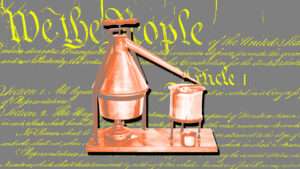
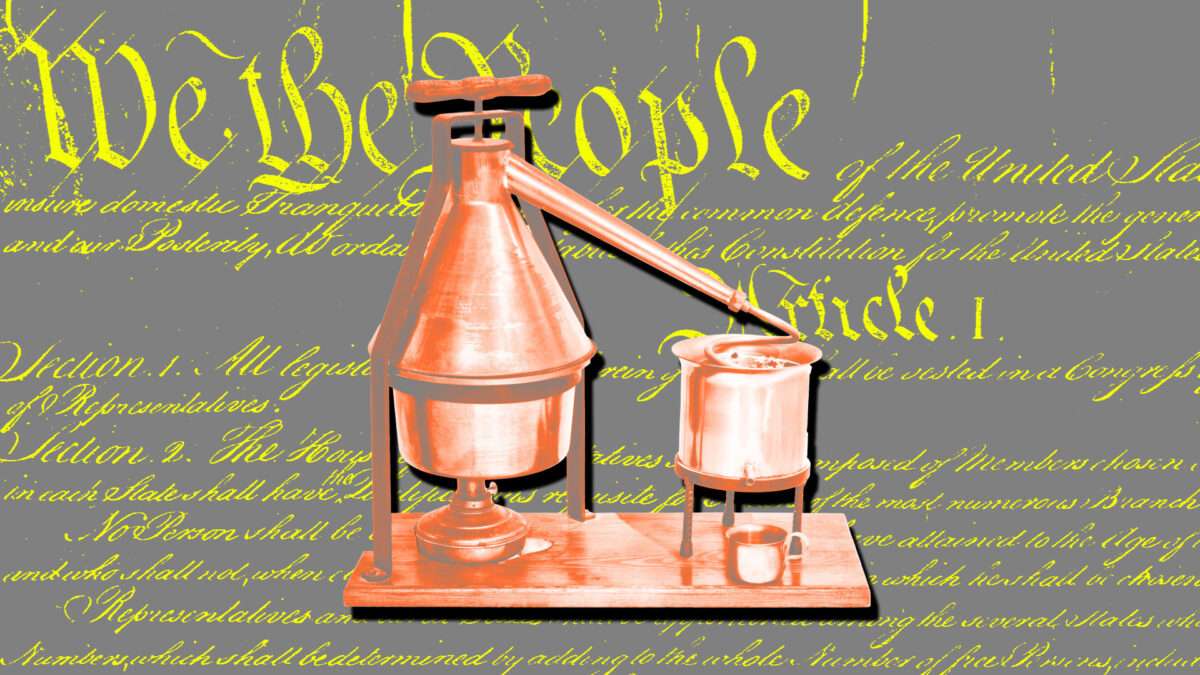
A whiskey distilling set up in front of the preamble to the United States Constitution
Illustration: Lex Villena; Ioannis Syrigos

Today, the Supreme Court decided to review the case of Department of Justice v. McNutt, which challenges a federal law banning home distilleries. The key question in the case is whether the law in question is justified by the combination of the tax power and the Necessary and Proper Clause (which gives Congress the power to make laws "necessary and proper" for executing other powers granted to the federal government). This is likely to be most important Supreme Court Necessary and Proper Clause decision since at least NFIB v. Sebelius (2012), which ruled that a "proper" power permissible under the Clause is one that is "ancillary" to the implementation of an enumerated power; it cannot be a "great, substantive and independent" power. This case is likely to further clarify the meaning of "proper," perhaps by explicating in more detail what counts as a "great…and independent" power.

In the lower court decision in this case, the Fifth Circuit ruled that the law is not "proper" and even that it isn't "necessary." There is also a Sixth Circuit decision that went the other way, thereby creating a circuit split.

As explained in my earlier posts on the Fifth and Sixth Circuit decisions (linked above), I think this law is not "proper," and I hope the Supreme Court strikes it down. I summarize the reasons why in my post on the Fifth Circuit ruling:

The Fifth Circuit… concludes that the law in question exceeds Congress' authority under the Necessary and Proper Clause, which grants the power to makes laws "necessary and proper" for carrying into execution other federal powers. I think the court is right that the law in question is not "proper." The Supreme Court, in NFIB v. Sebelius(2012), ruled that a "proper" power permissible under the Clause is one that is "ancillary" to the implementation of an enumerated power. It cannot be a "great, substantive and independent" power. See my analysis in this article. The power claimed here is clearly "great and independent." As Judge [Edith] Jones notes, "[u]nder the government's logic, Congress may criminalize nearly any at-home conduct only because it has the possibility of concealing taxable activity."

I elaborated further in the post criticizing the Sixth Circuit decision:

[T]he Sixth Circuit is badly wrong to conclude that the law is "proper." As explained in  my earlier post, the Supreme Court, in NFIB v. Sebelius (2012), ruled that a "proper" power permissible under the Clause is one that is "ancillary" to the implementation of an enumerated power. It cannot be a "great, substantive and independent" power. The power to ban any home-based activity that might serve a substitute for taxable activity outside the home is clearly a "great and independent power." As Judge Edith Jones explains in the Fifth Circuit ruling, "[u]nder the government's logic, Congress may criminalize nearly any at-home conduct only because it has the possibility of concealing taxable activity."

The Sixth Circuit tries to address this point by claiming alcohol is somehow special….

This distinction between alcohol and all other commodities is totally arbitrary. The same reasoning could justify banning home production of anything else that is more easily taxed if produced outside the home. And there is a long history of home production of all kinds of other commodities taxed or severely regulated by the government, ranging from cigarettes to illegal drugs, to pornographic videos.

While Judge Edith Jones (author of the Fifth Circuit decision) is one of that circuit's most conservative judges, the ruling was also joined by liberal Obama appointee Judge James Graves. On the other hand, the Sixth Circuit decision was written by prominent conservative Judge Raymond Kethledge. We shall see if the Supreme Court also divides on this issue in a way that cuts across conventional ideological and jurisprudential lines.

As noted in my post on the Fifth Circuit case, I think Judge Jones is not persuasive in arguing that the home distillery ban isn't "necessary," as well as improper. That argument is unlikely to prevail under the Supreme Court's expansive definition of "necessary, "  dating back to McCulloch v. Maryland (1819), where Chief Justice John Marshall famously ruled that "necessary" includes any measures that may be "useful" or "convenient" for implementing an enumerated power.

As also noted in my posts on the two lower court rulings, I think the government has a better argument that this law is authorized by the Supreme Court's badly misguide precedent on federal power under Commerce Clause (which grants Congress power to regulate interstate commerce). But the Supreme Court is apparently not going to review that issue. The question presented submitted to the Court in McNutt is limited to the Necessary and Proper Clause.

The post Supreme Court Will Hear Necessary and Proper Clause Case on Federal Law Banning Home Distilleries appeared first on Reason Magazine.

  •  

Libertarianism and Democracy Revisited - A Rejoinder to Matt Zwolinski

Democracy | NA
NA

On October 4, I published a post on "Libertarianism and Democracy," critiquing political philosopher Matt Zwolinski's earlier Liberalism.Org article on the same topic. Earlier today, I posted Matt's response to me. The present post is my rejoinder:

I would like to thank Matt for his interesting and insightful response. We agree on several key points, including that democracy is generally superior to authoritarianism, that libertarian critiques of democracy have great merit, and that - in much of the world - the most serious threats to liberty now come from the nationalist right, rather than the the political left. But we still differ on a few key points related to libertarianism and democracy.

The Nature of Libertarian Critiques of Democracy

Perhaps the most crucial disagreement is about the nature of libertarian critiques of democracy. Matt suggests that "[m]ost of what Ilya calls the libertarian critique of democracy is really a critique of big government." If so, libertarians can just focus on criticizing big government generally, while simultaneously extolling democracy.

There are indeed flaws of big government that arise regardless of whether it is democratic or authoritarian. But those outlined in my earlier Liberalism.Org article are in fact specific to democracy. They include tyranny of the majority, voter ignorance, and the tendency of democracy to create opportunities for illiberal forces to seize power and - in the worst case scenario - even destroy democracy itself.  Tyranny of the majority is obviously a problem distinctive to democracy. The same goes for rational voter ignorance, which arises from the perverse incentive structure  of individual voters, who have only an infinitesimally small chance of influencing electoral outcomes. And, while illiberal forces can and do seize power under authoritarian systems, the pathways democracies (usually involving the electoral process) create for them are distinctive.

Authoritarian systems have their own distinctive flaws, which are generally even worse. But the distinctive nature of democracy's flaws means they cannot simply be folded into a generic critique of big government. In addition, as noted in my response to Matt, these distinctive flaws of democracy are at the heart of many of today's most serious threats to liberty and justice in many democratic systems, including the threats posed by the nationalist right. Thus, it is important for libertarians to emphasize the nature and gravity of these weaknesses, and the value of our proposals for dealing them (which in many cases are different from and better than those advanced by other types of liberals). As emphasized in my earlier response, this is an area where libertarians often have a comparative advantage over other liberals. On the other hand, we generally do not have a comparative advantage when it comes to explaining why democracy is better than authoritarianism.

Along related lines, Matt suggests that libertarian critiques of the state aren't "an argument against democratic control of whatever the state does do." But once we recognize that democracy has significant distinctive flaws, there is actually a case for insulating some functions of government from democratic control. Obvious examples include the judiciary and monetary policy (unless we want to cut government out of the latter entirely, and adopt free banking). Indeed, even most non-libertarian liberals recognize that such insulation is desirable in some cases, most notably the courts.

The Problem of Libertarians Tempted by Authoritarianism

Matt argues that we should, nonetheless devote extensive energy to extolling democracy, because doing so is likely to have an impact on fellow libertarians who may otherwise be tempted to embrace authoritarianism. It is likely true that libertarians tempted in this way are more easily dissuaded by other libertarians than by non-libertarians. But such people are a tiny minority within an minority. Libertarians are a small group (probably around 5-10% of the US population or even less, depending on how you draw the line). Those sympathetic to authoritarianism are much fewer still. Thus, it makes little sense to devote more than a modest amount of time and effort to dealing with them, as opposed to addressing the much larger group of non-libertarian liberals who need to be more cognizant of the dangerous shortcomings of democracy.

Moreover, when we look at libertarians who have shifted to the "alt right" or otherwise become advocates of illiberal ideas, the problem in most cases is not excessive skepticism of democracy, but insufficient commitment to liberty - particularly, the liberty of people from different ethnic, racial, or religious backgrounds, that of migrants, and those with unconventional lifestyles. That is pretty obviously the case with Curtis Yarvin and Hans-Hermann Hoppe, both mentioned by Matt. The former's advocacy of a "post-liberal" ideology of repression (which is really based on pre-liberal models) is pretty obviously not the product of a man who thinks authoritarianism is a better way to protect liberty than democracy. Indeed, his concern is exactly the opposite (that democracy allows for way too much liberty). The same goes for Hoppe's advocacy of repression of immigrants, gays and lesbians, and people with various non-traditional lifestyles. Peter Thiel, the third case mentioned by Matt, is that of a person who has abandoned libertarianism for "national conservatism," an ideology focused on exalting the interests of ethnic and culture majorities and using the state to punish perceived "enemies." To the extent we want to focus on dissuading such people, it should be to reemphasize the value of liberty for all, not extolling the virtues of democracy. People who value democracy more than liberty are generally unlikely to become libertarians in the first place.

Two  Smaller Issues

Matt and I also have a modest disagreement over whether there can be situations where some form of authoritarianism can be a lesser evil compared to democracy. I think such cases are extremely rare, but not nonexistent. Matt's position is less clear, and perhaps I misunderstand him. But he does seem to want to deny this possibility. In response to my examples of the allied occupations of Germany and Japan after World War II, he seems to think these don't really count because "those occupations were run by democracies answerable to their own voters, and they ended." But they were still cases where non-democratic government was imposed on a population, and that population itself did not have control over when and if it would end.

In these cases, a non-democratic occupation government was a lesser evil than immediate establishment of democracy, because of the highly illiberal nature of German and Japanese majority public opinion at the time.  Similar circumstances can potentially arise in other countries. And, in some cases, a domestically generated authoritarian regime might still be a lesser evil than any democracy that is feasible at the time.

In some situations, the problem can be dealt with by limiting democracy, rather than abjuring it completely. For example, as noted in my earlier response, post-occupation West Germany long banned Nazis and communists from competing in elections, but otherwise committed to free electoral competition. But there could be situations where such constraints are not enough. Because such cases are highly unusual, this is not a particularly important disagreement. But it does have relevance in situations where we consider how to deal with a society where majority public opinion is deeply illiberal.

Finally - and least important - Matt differs with me about the use of the terms "libertarian" and "classical liberal," arguing that the former are more likely to be democracy-skeptics than the latter. We can, if we want, define the two terms in such a way that people we label with one are generally more suspicious of democracy than those we label with the other one. But that is not the way the terms are typically used. That said, different people use these terms in different ways. To my mind, they are mostly just alternative labels for the same general ideology. But I don't have much of a beef with people who prefer to use them differently than I do, so long as they make clear what they mean.

Ultimately, Matt and I agree on much more than we differ. But a few of the issues we differ have real significance. I am grateful for the opportunity to consider them.

The post Libertarianism and Democracy Revisited - A Rejoinder to Matt Zwolinski appeared first on Reason Magazine.

  •  

Who Should Defend Democracy?

On October 4, I published a post on "Libertarianism and Democracy," critiquing political philosopher Matt Zwolinski's earlier Liberalism.Org article on the same topic. Matt has written a response to me, which I have agreed to post at this site. The remaining paragraphs of this post were written by Matt Zwolinski, not me (Ilya Somin). I have posted a rejoinder to Matt's thoughtful response here.

Who Should Defend Democracy?

A reply to Ilya Somin

My recent Liberalism.org essay, "Democracy Belongs on the List," made the case that classical liberals should count democracy among their core commitments, alongside private property, free markets, and the rule of law. And it belongs there for the same reason. Like property rights and markets, democracy is a crucial way of keeping power in check.

Ilya Somin has written a generous and thoughtful reply to that piece. And I think he actually agrees with me more than the framing of his post might suggest. Ilya grants that democracies are generally freer and more prosperous than the alternatives, that democracy is "a valuable check on power," that libertarians should arguably stress these points "more often," and that "in much of the world today, right-wing nationalists pose a greater threat to libertarian values and priorities than the political left does." What's left mainly comes down to two questions: what counts as a libertarian critique of democracy, and whose job it is to defend democracy.

Before turning to those substantive issues, though, there's one terminological matter that's worth clearing up. Ilya says that nothing of significance hinges on whether we call our view "libertarian" or "classical liberal." And on most questions I'd agree. On this one, though, I think the difference matters. In The Individualists, John Tomasi and I draw a distinction between strict libertarians and classical liberals. The former group tends to treat liberty as a moral absolute and to derive their politics from a single overarching principle like the non-aggression axiom. Think Murray Rothbard or Ayn Rand. The latter treat liberty as a strong but defeasible presumption and are more empiricist and pluralistic in their approach to politics. Think Friedrich Hayek or Richard Epstein.

My sense is that these two camps within the broader "liberty movement" have taken pretty different stances toward democracy, with strict libertarians being much more critical than their classical liberal brethren. Even back in the 19th century, you could find Benjamin Tucker insisting that voting is always a form of aggression, and Lysander Spooner arguing that women "have just as good a right to make laws as men have, and no better: AND THAT IS JUST NO RIGHT AT ALL." Herbert Spencer was even willing to walk back his support of women's suffrage once he decided that women would probably use their vote to support bigger government. That's a pretty different take than anything you're likely to find in Ludwig von Mises or Friedrich Hayek (more on whom later), let alone in John Stuart Mill.

That brings us to the first of the two substantive issues under dispute. Ilya argues that recent events have made libertarian critiques of democracy more important than ever, and that the libertarian solutions to democracy's flaws are "primarily to limit and decentralize government power." I'm with him on that, but I don't think this settles, or even really addresses, the debate about democracy. Limiting and decentralizing government power is a claim about the scope of the state, about how much government should do. It's a principle that would apply to any government, whether democratic or not. And, crucially, it isn't an argument against democratic control of whatever the state does do.

That distinction was at the heart of my essay. Following Jacob Levy, I argued that classical liberals have let a perfectly sound critique of too much government slide into a skepticism about democracy itself, treating democracy, in Levy's words, "as if the contrast to 'democratic' were 'economic' rather than 'autocratic.'" One can be a radical about reducing the scope of the state and still insist that its agents must be answerable to the people they govern. Most of what Ilya calls the libertarian critique of democracy is really a critique of big government. That's an argument I largely agree with, as far as it goes. The trouble comes when we file it under the wrong heading. When we ourselves blur the line between critiques of state power and critiques of democracy, we shouldn't be surprised when people come away thinking libertarians are against democracy.

That brings me to comparative advantage, which is where I think Ilya's argument is most interesting but also most mistaken. Libertarians are a small minority, he says, and "we have no comparative advantage when it comes to extolling the virtues of democracy relative to authoritarianism. Other types of liberals can do this work just as well as we can, perhaps better." So we should stick to what we do best, which is analyzing democracy's flaws.

This argument might make sense in some contexts. But as a general principle, I think it misfires, and it misfires most badly when the audience is classical liberals and libertarians themselves. That, after all, is where the turn against democracy has actually happened. Hans-Hermann Hoppe's Democracy: The God That Failed argued that monarchy was preferable to democracy, and complained that "habitual democrats" had been tolerated rather than "isolated, excluded and expelled from civilization." Curtis Yarvin, who came to neoreaction by way of libertarianism, credits Hoppe with opening "a kind of door to the pre-revolutionary world" for him. And in 2009, Peter Thiel wrote in a Cato Institute publication that "I no longer believe that freedom and democracy are compatible." None of this follows from the libertarian critique of voter ignorance, and nothing Ilya has written points in this direction. But it grew in a movement where, as Janet Bufton recently put it in Liberal Currents, "even liberal libertarians were taught arguments about why democracy fails," and hardly anyone was making the case for democracy on libertarian terms. Any old liberal can explain to the public why democracy beats dictatorship. But a libertarian drifting toward Hoppe or Yarvin isn't going to listen to them. Only libertarians can tell libertarians that democracy is theirs.

So if democracy is a libertarian value, what kind of libertarian value is it? Ilya argues that democracy shouldn't be "a first-order libertarian priority, on par with liberty, constraining coercion, property rights, and increasing human happiness," because its value is instrumental rather than intrinsic. I agree that the value of democracy is instrumental. In that way, it's in precisely the same position as a number of items on the classical liberal list. Free trade, federalism, judicial review, and the rule of law are instrumental too. What I want to resist is the claim that because democracy is only instrumentally valuable it's therefore dispensable – something that can be traded away whenever we can imagine something better. What we can imagine, though, is a poor guide to what works. The better question, as David Schmidtz argues, is what has "an observable history of leading self-interested agents to act in ways that are useful and agreeable to the people around them," and by that test democracy has very few rivals.

Which leaves us with Hayek. Ilya defends Hayek's preference for "a liberal dictator to a democratic government lacking liberalism" as a claim about rare hypothetical cases, and suggests that transitional non-democratic rule "may be necessary" in places like Russia and China, citing the Allied occupations of Germany and Japan. But those occupations were run by democracies answerable to their own voters, and they ended. Russia and China, in contrast, have no outside power that could impose a transition and then hand power back. The only realistic candidate for transitional power in those countries is a domestic strongman, which is exactly the case Hayek had in front of him. Hayek wasn't musing about hypotheticals; he was talking about Chile.

Ultimately, Ilya and I want the same thing. We both advocate a form of libertarianism that resists concentrated power wherever it appears, including when it arrives through the ballot box. Where we differ is on the need to say out loud that democracy is one of the ways we resist it. I think we should, and I think libertarians are better placed to say it than anyone, since the people who most need to hear it are our own.

The post Who Should Defend Democracy? appeared first on Reason Magazine.
  •  

Steve Vladeck's "Hard Questions About Court Expansion"

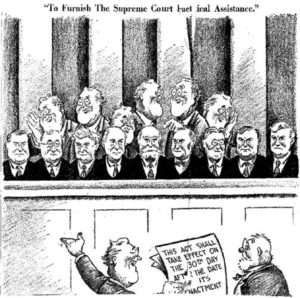
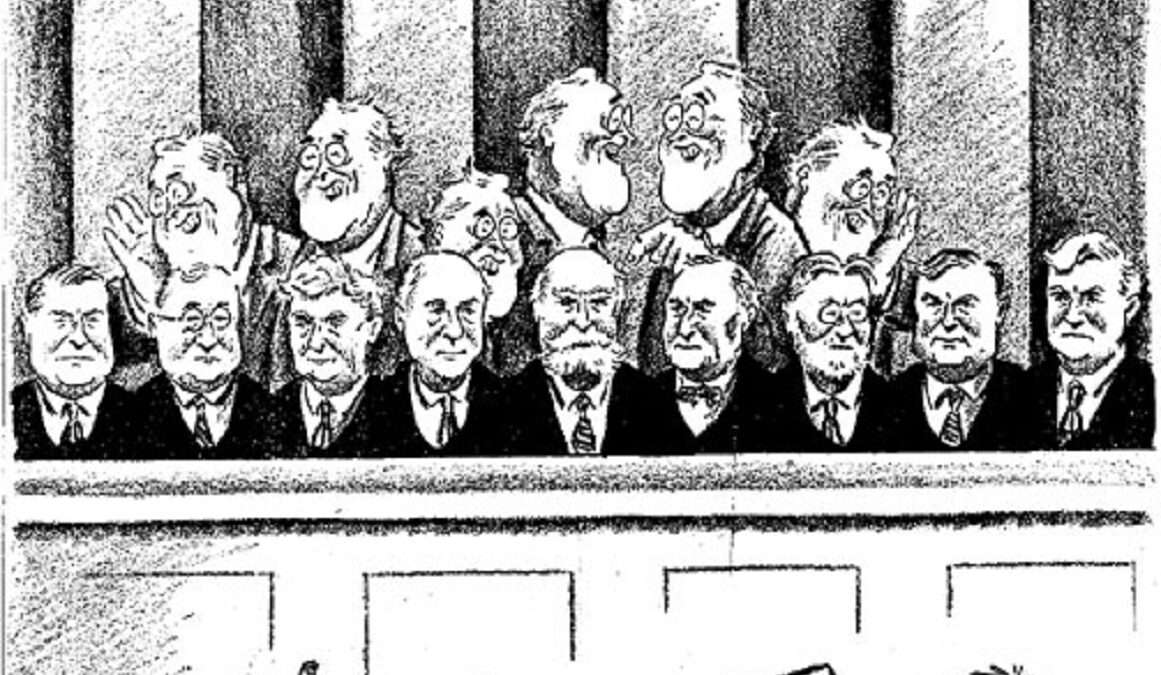
Cartoon criticizing Franklin D. Roosevelt's 1937 court-packing plan. (NA)


Georgetown law Professor Steve Vladeck is one of the leading critics of the conservative majority on the Supreme Court. But in an insightful recent post on his substack, he outlines key reasons why "court expansion" is a bad response to its flaws. The cure is likely to be worse than the disease:

[I]t seems to me that those who are fully onboard the expansion-or-bust train should have to do more than simply assert that having four new Democratic appointees on the Court in 2029 would be a self-evidently "good" thing. If nothing else, proponents of expansion should have to answer the following four questions:

  1. How do we avoid touching off a race to the bottom, where each time one party controls the House, Senate, and presidency, it expands the Court to ensure an ideologically and politically sympathetic majority?
  2. If a race to the bottom is unavoidable, how do we avoid further (and potentially fatal) erosion of public confidence in the Court—which will quite transparently be little more than a lever of power for whichever party last had such a trifecta?
  3. If eroding public confidence in the Court is a feature, and not a bug, how do we insulate against the same erosion of public confidence in lower federal courts?
  4. What is the case for why expansion is a better way to achieve the desired reforms than alternatives that would (or, at least, should) avoid many of these forward-looking concerns?

He adds that court-packing could easily "permanently undermine judicial review as an institution." The rest of his piece (which is behind a paywall) offers far from reassuring answers to these questions.

I have offered similar criticisms of court-packing in a long series of articles and blog posts, most recently in a June Lawfare article  where I explained (among other things) why the Supreme Court's recent decision in Louisiana v. Callais doesn't justify packing, and in a July UnPopulist article critiquing a court-packing proposal advanced by Andy Craig. In these pieces, I explain why the Court's record of checking dangerous abuses of government power - though not without serious flaws - is considerably better than many critics claim. In addition, I argue that court-packing is likely to undermine effective judicial review - not only by the Supreme Court, but also by lower courts.

Like Vladeck, I think some of the issues that concern critics of the Court can be more effectively addressed in other ways. For example, in the Lawfare article, I explain how Congress can fix the flaws of the Callais decision by banning or restricting gerrymandering. It could also enact a binding ethics code for the justices. Justice Alito was wrong to suggest otherwise, back in 2023. That said, if your main goal is a sweeping reversal of much of the Court's recent jurisprudence, there may be no easy way to achieve that quickly without court-packing or something like it. I would argue that any benefits that might achieve are outweighed by the enormous costs of destroying judicial review.

In addition, if your objection to the Court's recent decisions is that they often don't do enough to constrain unconstitutional actions by other branches of government or by the states, court-packing is likely to make that problem worse, not better. Destroying judicial review won't enforce tighter constitutional constraints on the executive or bring back Roe v. Wade. To the contrary, it would largely destroy any hope of doing so.

In another recent piece, I assessed "non-packing" rationales for increasing the size of the Supreme Court. There, I argue that these rationales are mostly weak; and, to the extent they have merit, there are better ways to address them than an expansion that amounts to court-packing. I even outline possible ways to increase the size of the Court without creating an opportunity for court-packing (this would require allowing the party that doesn't hold the White House to pick some of the new justices).

The post Steve Vladeck's "Hard Questions About Court Expansion" appeared first on Reason Magazine.
  •  

Trump Loses Yet Another Sanctuary City Case—This Time Against New York City

NA

Yesterday, in United States v. City of New York, yet another federal court ruled against the Trump administration in a sanctuary city case. "Sanctuary" jurisdictions are state and local governments that restrict their law enforcement agencies and other employees from assisting federal immigration enforcement and deportation efforts in various ways. In this case,  Judge Reyes of the US District Court for the Eastern District of New York upheld New York City laws restricting local law enforcement information-sharing and other assistance to federal immigration enforcers.

The court ruled that federal law does not preempt these policies, and that if if it did, there would be a violation of the anti-commandeering requirements of the Tenth Amendment:

Even were the Court to find that the United States has standing and the challenged provisions are preempted—both answered in the negative above—United States' claims would still fail because the anticommandeering doctrine of the Tenth Amendment to the Constitution of the United States precludes relief.

"The powers not delegated to the United States by the Constitution, nor prohibited by it to the States, are reserved to the States respectively, or to the people." U.S. Const. amend. X….

The United States argues it is "not seeking to compel participation in immigration enforcement … but rather to remove Defendants' express and implicit obstacles to the Executive's duty to carry out its immigration enforcement duties…." New York City replies "if accepted, [the United States' claims] would require the City to affirmatively assist the federal government in enforcing immigration laws in violation of the Tenth Amendment's anticommandeering doctrine…." New York City is correct, at least partially.

The United States seeks injunctive and declaratory relief to preempt the challenged provisions… If the challenged provisions were struck, while New York City would not be obligated to carry out federal immigration enforcement, they would be barred from prohibiting their agencies and employees from engaging in federal immigration enforcement by expending personnel, property, and other resources to (1) detain individuals and (2) implement inter-agency information-sharing, including disclosing personally identifiable information, all potentially in violation of state law. And of course, there is nothing within federal law that obligates states to participate in federal immigration enforcement or compels states to comply therewith.

The United States' preemption arguments amount to nothing more than a backdoor around the Tenth Amendment and rest on a false distinction between (a) compelling local governments' participation in federal immigration enforcement and (b) prohibiting local governments from dictating how their personnel and other resources may be utilized towards federal immigration enforcement….. "

The basic principle—that Congress cannot issue direct orders to state legislatures—applies" to commands for "affirmative action" and the imposition of "prohibitions." Murphy [v. NCAA], 584 U.S. at 455 (citation modified). If states cannot remain free to control their agencies and employees to resist federal immigration enforcement, which is within states' constitutional prerogatives, the Tenth Amendment anticommandeering doctrine means nothing.

This reasoning is correct. And it is notable that this ruling - like many others protecting sanctuary cities - relies heavily on the Supreme Court's 2018 anti-commandeering decision in Murphy v. NCAA, written by Justice Samuel Alito (probably the Court's most conservative justice), and joined by all the other conservatives then on the Court. In that case, the Court emphasized that the anti-commandeering doctrine bars Congress from dictating the actions of state and local legislatures, regardless of whether the dictation takes the form of an affirmative mandate, or a prohibition against legalizing or barring something under state law.

Judge Reyes also rejects the administration's argument under the "intergovernmental immunity" doctrine, which bars states and localities from directly regulating federal agencies or "discriminating" against them. Like the court in the recent case of United States v. New Jersey, he correctly emphasizes that there can be no discrimination when there is no other comparable activity that gets more favorable treatment under the sanctuary jurisdiction's policies:

"Differential treatment is critical to a discrimination-based intergovernmental immunity claim." New York, 814 F. Supp. 3d at 282….; "[A] comparator is necessary." New York, 810 F. Supp. 3d at 353. The United States discrimination claim fails for lack of a comparator.

The United States does not and cannot identify a similarly situated entity. State and local agencies and their officers do not enforce immigration law, nor do members of the public…  As the United States concedes, the Federal Government holds the "exclusive charge of enforcing immigration law…."  Not only are other federal law enforcement agencies with different charges differently situated, "[f]or a state law to unconstitutionally discriminate against the federal government, it must treat comparable classes of federal and non-federal employees differently, not different classes of federal employees." Illinois, 796 F. Supp. 3d at 534

I would add that, as I explained in a recent post, the entire antidiscrimination element of the intergovernmental immunity doctrine is dubious, and should probably be overturned by the Supreme Court:

[T]he whole doctrine of intergovernmental immunity strikes me as bogus, judge-made law. There is no provision in the Constitution requiring it. And the federal government is not some historically oppressed minority group protected by the antidiscrimination provisions Fourteenth Amendment. Where state and local governments are otherwise free to refuse to help the feds, that autonomy should not be forfeited merely because they choose to support potentially similar activities by state or local governments, or by the private sector. Obviously, a district court cannot refuse to obey Supreme Court precedent in this field. But I hope the Supreme Court might someday reevaluate that precedent.

This is just the most recent of a long line of defeats for Trump in sanctuary city cases, in both his first and second administration. Judge Reyes cites close to a dozen such cases over the last year alone.  I summarized this jurisprudence more fully in a post covering three other recent sanctuary cases, last month:

In cases where the administration has tried to directly coerce states and localities into cooperating, courts have rightly ruled this violates the Supreme Court's "anti-commandeering" precedents, a series of decisions reached primarily by conservative justices, which hold that the federal government may not force state and local governments to help enforce federal law or carry out under federal purposes. In cases where Trump has sought to withhold federal funds from sanctuary jurisdictions, courts have (also rightly) ruled that the executive cannot impose conditions on federal grants that were not authorized by Congress and (in some cases) that the Trump conditions are unconstitutionally coercive. For my analyses of Trump II court decisions on these issues, see here, here, and here.

My 2019 Texas Law Review article surveying and assessing litigation arising from Trump's first-term attacks on sanctuary jurisdictions. There and in other writings, I also explain why immigration sanctuaries (and conservative gun sanctuaries) are beneficial, and help protect our constitutional system. See also my February 2026 Dispatch article, "In Defense of Sanctuary Cities," which provides an overview of these issues, and defends sanctuary jurisdictions on both constitutional and policy grounds.

Yesterday's ruling may be appealed. But if so, it is unlikely to be overturned.

Trump has posted a few rare wins in sanctuary cases with unusual facts, such as in the Contracts Clause case I analyzed in the September post. But, such cases are highly exceptional. And, as explained in the September post, the Contracts Clause decision has various flaws, and would not greatly impede sanctuary jurisdictions even if it survives on appeal.

Overall, Trump has been losing these kinds of cases so much that he might even get tired of losing.

The post Trump Loses Yet Another Sanctuary City Case—This Time Against New York City appeared first on Reason Magazine.
  •  
❌