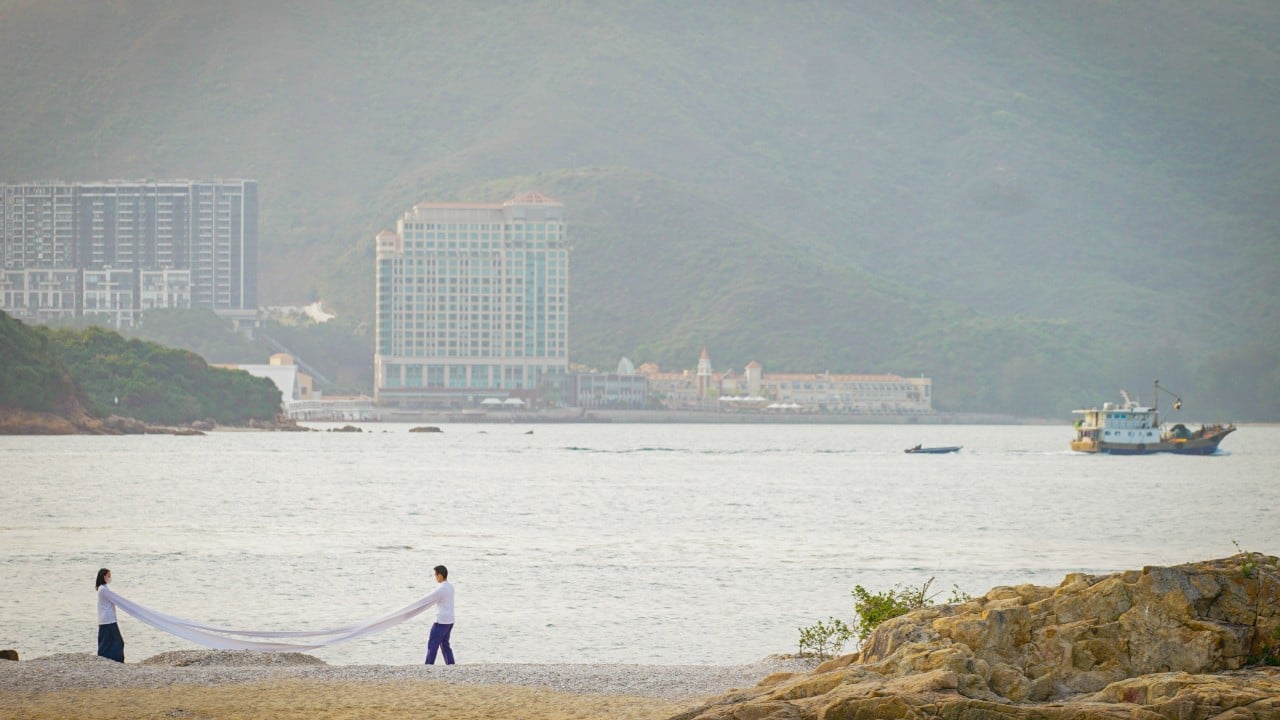
What do the curators and organisers of the 2026 Inter-Island Festival have in common? All three of them – Yip Kai-chun, Chan Chun-kit and Gloria Furness – traded life in urban Hong Kong for one of the city’s outlying islands for similar reasons: to be close to nature, experience a sense of community and enjoy a quiet lifestyle.
However, they got more than they bargained for: connection. Peng Chau specifically “has a lot of people from the creative industries who move out [of the city] and start...
Kylie Genter moved to South Korea after graduating from college in New York with no career plan.
Provided by Kylie Genter
Kylie Genter graduated from college with no career plan.
At 22, she moved to South Korea to teach English and became fascinated by female freedivers who harvest seafood.
Now, 37 and married, she spends around five days a week diving with women in their 70s and 80s.
This-as-told-to essay is based on a conversation with Kylie Genter, 36, a Haenyeo diver on Jeju Island, South Korea. It's been edited for length and clarity.
I'd been teaching English in South Korea for four years when I learned about the Haenyeo — female freedivers who harvest seafood without using modern equipment. I was interested. So, in the summer of 2018, I completed diving lessons with the hopes that maybe I could work with them one day.
A few years later, my Korean husband, a scuba diver, read on a diving group chat that a small village on the southwestern side of Jeju Island was recruiting new divers. Their youngest diver was 68 — I wanted to give it a try.
At first, I was rejected, but I got invited back a month later. I don't know what changed in that one month, but I guess they suddenly became open to it, and I went in for an interview.
In January 2024, I started as a diving intern, and after two years of training, I received my Haenyeo license in April.
Finding my footing in South Korea
I was born in upstate New York, the middle of three kids. I went to SUNY Oswego and graduated with a degree in communications.
After graduating in 2012, I didn't know what I wanted to do. I applied to a few graduate schools and jobs, but nothing worked out. I was stressed out and wanted to leave. I thought about going to Japan to teach English, as I'd studied Japanese for a year while in university.
Genter decided to move to South Korea and teach English.
Provided by Kylie Genter
Instead, I settled for South Korea, where some schools offered housing. I didn't know much about Korea at that time — I wasn't really a big K-pop fan before I came.
So, just four months after graduating, I moved to Jinju, a three-and-a-half-hour high-speed train ride from Seoul, to work as an English teacher. In the mornings, I'd do 20-minute lessons with kids. In the afternoon, I'd have speaking classes.
I continued teaching until August 2020. That same year, I got married and started a pension business with my husband, while still teaching English on the side.
To get her Haenyeo license, she had to dive 50 days within a year.
Provided by Kylie Genter
Building my life as a diver
To get my license, I had to dive 50 days within a year, sell 1.2 million South Korean won, or $884, worth of catch, and get a unanimous vote from the divers in the collective. It took me two years.
Language was an issue; despite having spent years in the country, I still couldn't always understand what was happening. My biggest strength is that I'm physically fitter than some of the divers — they are mostly in their 70s and 80s. So, I help out, like when they need someone to carry their nets full of catches or wash the dishes.
A lot of the work is physically demanding. If you don't feel good, you can't just push through. I can't dive if I have a cold or my sinuses are blocked because I can't equalize underwater. It's important to keep my body physically strong and healthy through working out.
The women she dives with are mostly in their 70s and 80s.
Provided by Kylie Genter
Committing to an unconventional job
I enjoy my life. Every day is different, and I do a lot of things besides diving. I run a pet hotel with my husband; sometimes I still tutor and give lectures. I work more hours, but I also have a lot more flexibility to pursue other things. I don't need permission for a break or a day off.
On normal days, I wake up and take the dogs for a walk. Then, I go diving depending on the weather. If it's not great, I only dive for two or three hours. A normal day of diving may take four or five. After that, I take the dogs for another walk.
In our village, we typically dive five days a week. We'll take our catch and accumulate it after one cycle. After that, we'll sell it to the regional fishing co-operative. They'll pay our president, and she then distributes the money.
Being a diver isn't a full-time job. A lot of what we earn depends on the catch. I make around $2,000 a year. Teaching is much more financially stable. But I love learning from women who have been carrying on this work for generations.
When I'm diving, nothing else matters. I just have to focus on diving and catching seafood. Nobody can call me. I don't have to look at my phone and waste time doomscrolling.
When I'm deep underwater, it can be meditative, especially on days when the ocean is calm, and there's plenty to catch. I see myself wedded to this village for the rest of my life.
Matthew Kelson knew he wanted to stay in Japan and decided to open a movie theater.
Provided by Matthew Kelson
Matthew Kelson, now 43, grew up in Michigan and opened his first cinema in his 20s.
He went on to work for Netflix in Los Angeles before getting transferred to Japan in 2020.
After leaving his job at Netflix in 2024, he renovated a kindergarten and founded a cinema in Japan.
This as-told-to essay is based on a conversation with Matthew Kelson, now 43, who was transferred by Netflix from Los Angeles to Tokyo and is now the founder of CineYama, an independent cinema in Uenohara, Yamanashi Prefecture, Japan. His words have been edited for length and clarity.
Japan isn't new to me. In middle school, I spent two weeks living with a host family as part of an exchange program. I returned a couple of times as an adult.
I was working at Netflix in Los Angeles when the company relocated me to Japan in 2020. I was based in Tokyo for two years before moving to Uenohara, a small town about an hour and a half by train from Tokyo. I still spent time in the capital for occasional meetings and traveled extensively across Asia for screenings. Otherwise, I worked remotely from home. After a company restructuring, I left Netflix in 2024.
I wanted to stay in Japan. My daughter was six months old when my wife and I moved, and my son was born three years later. We thought it was a great place for them to grow up. I started thinking about how I could utilize my expertise in cinema and give back to the community.
He moved to a small town about an hour and a half by train from Tokyo.
Provided by Matthew Kelson
While scouting for locations, I came across an abandoned kindergarten. In 2024, I started plans to turn the old school into a cinema. And in December, I got my permanent residency in Japan through the highly skilled professional fast-track program. A year later, I formed my company and spent another year renovating before opening a cinema in March.
Building my career in film
I spent most of my childhood in Michigan, in the Detroit area. My father was a professor of international business. He traveled for work often. It got me curious about the world around me.
At 23, I came across the Detroit Film Center and took a filmmaking course. A year later, I became a teacher and worked as a projectionist there. Through that, I started working at an independent art theater in the Detroit suburbs. I started as an usher, then became the theater manager.
Within the two years of working there, I fell in love with the film world. At 25, I renovated an old school's auditorium into a theater in Michigan using my savings. The theater ran for two years, but after disputes with the landlord, it closed.
I was looking for a fresh start, so in 2011, I moved to Los Angeles. At first, I knocked on the doors of all the film distributors I'd worked with until I met some people at an independent film distribution company. I joined as an intern and worked my way up. I landed a job on Netflix's creative team two years later.
Kelson acquired permanent residency in Japan and spent the following year renovating.
Provided by Matthew Kelson
The journey to opening a cinema in Japan
Getting the permit to renovate the abandoned kindergarten was a long process. I had to negotiate with officials at city hall and the residents about how I'd use the building, establish the company, deal with fire and health regulations, and construction in a language I don't speak fluently.
I learned that pushing harder is not necessarily what gets things done in Japan. It was about patience, building trust, and showing people that I was serious and that the project wasn't going to disappear in six months.
CineYama was a kindergarten before it was transformed into a cinema.
Provided by Matthew Kelson
There were days when I wondered why I had chosen to make my life so difficult. But every milestone, from getting the building, the inspection, installing the projector, and finally opening the doors, made me more determined.
When the cinema first opened, the elderly residents seemed cautious. After a preview, they told me they were impressed to see the place cleaned up and put back into use. It's important for me to have screenings that kids and families can come to and enjoy the space.
CineYama, an independent cinema, opened in March.
Provided by Matthew Kelson
Tickets cost 1,500 Japanese yen, or about $9.50. We offer a discount to seniors and residents. I stick with showing content that is harder to find elsewhere, so that it gives viewers a perspective on other ways of life and culture.
It's mostly family-run. I manage the operations, and my wife helps out sometimes. My kids stamp the tickets when they're around.
Popcorn and snacks at the cinema.
Provided by Matthew Kelson
Living up to the challenge
Opening the theater in the US was different from doing it in Japan. I was in my 20s, had little money, and was just figuring things out in Detroit. The one in Japan came after 15 years of working in film distribution, creative production, and international screenings.
It's been exciting living over here, having the cinema, and meeting people from all over the world. While life in the US would've been much easier, I like the challenges in Japan. That's why I was at Netflix for so long, because it wasn't an easy job either. I learned life in hard mode.

 Login