
❌

Reading view

Republican voters are getting worried about high costs as inflation stings and the midterms approach

A hand in a plaid shirt holding a fuel nozzle refueling a car at a gas station pump. Bright day with a visible station backdrop.
Rising costs are weighing on Republican voters.

Lajst/Getty Images

  • Republicans are feeling the strain of rising costs, with more saying it's a drag on their finances.
  • Those voters are feeling generally bad about the economy as key midterm elections loom.
  • Voters not approving of the party in power is common; what's unclear is how it'll play out.

Republicans are feeling the high-cost crunch.

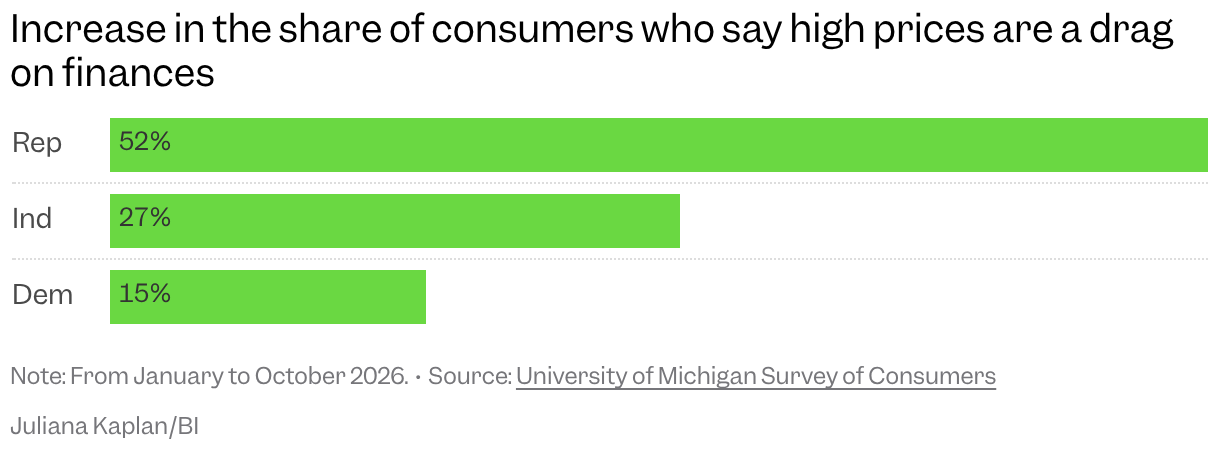
The latest consumer sentiment reading out of the University of Michigan finds that, across the board, Americans are still feeling bad. While self-identified Republicans still feel better than their Democratic and Independent counterparts, they're increasingly feeling the pinch of rising prices.

From January to October 2026, the share of Republicans citing high prices as a drag on their finances rose the most out of all political factions. It's a sign that, even as their party holds Congress and the White House, Republican voters might still be feeling the heat — especially as inflation continues to rise.
Bar Chart

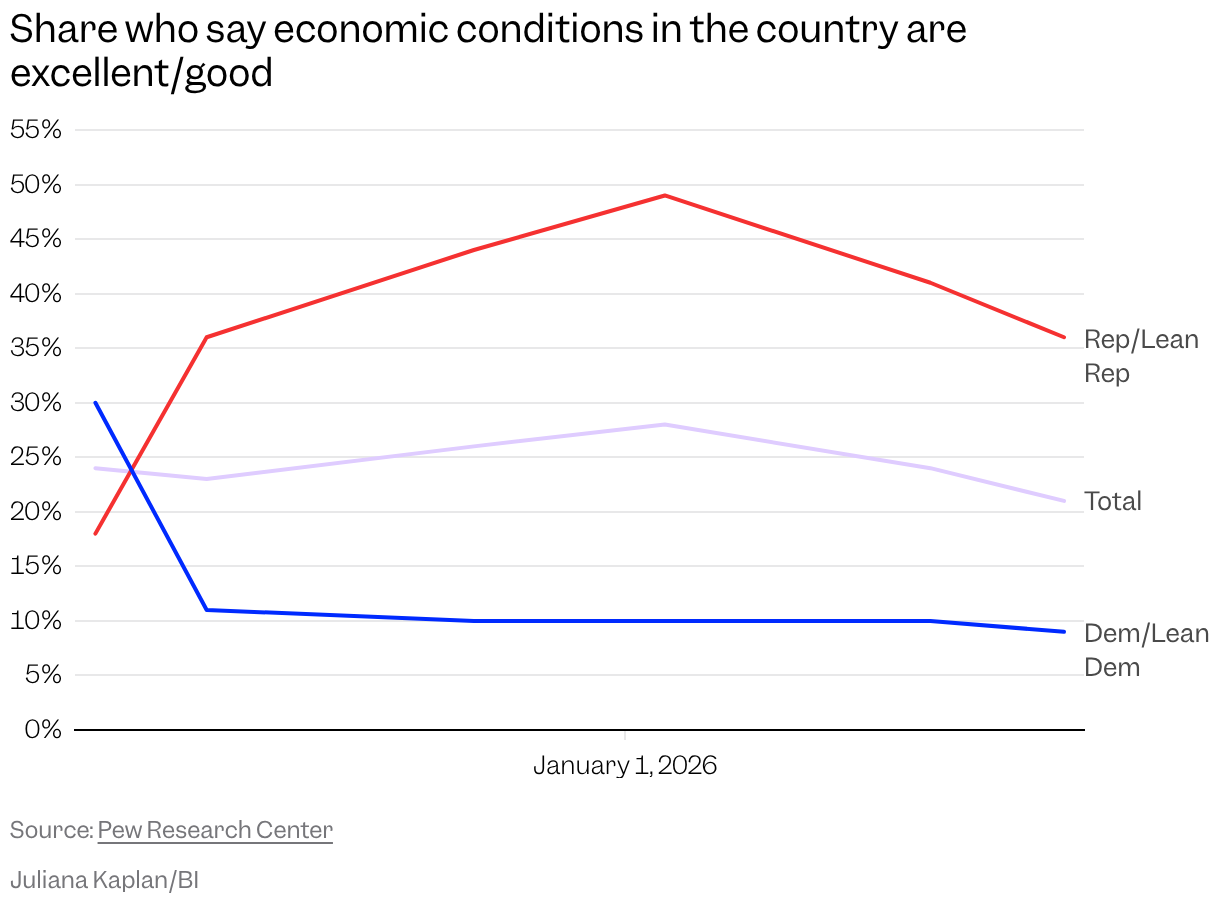
And, more broadly, Republicans seem to be souring on economic conditions. A Pew Research survey of 5,062 American adults from September 28 to October 4 found that Republicans, and those who lean Republican, were becoming less likely to say that economic conditions in the country are good.
Line chart

Historically, consumer sentiment and surveys asking voters about economic conditions tend to have strong partisan correlations. Democrats are more likely to say that the economy is doing well and they're optimistic about the future when a Democrat is president; Republicans do the same when the GOP holds the White House.

The shift in Republican sentiment illustrates just how bad Americans at large are feeling about the economy. A similar downshift happened among Democrats amid the inflationary spike during President Joe Biden's term.

"President Trump has implemented an aggressive, pro-growth economic agenda that has blunted Biden's historic 40-year high inflation crisis, driven economic growth, increased wages and created private-sector jobs in areas that had been hollowed out and shipped overseas," White House spokesman Matthew Middleton said in a statement. "The President has always been clear about temporary disruptions as a result of the Iran conflict, but this administration will continue to deliver economic wins for the American people over the next two years."

While 18% of Republicans surveyed by Pew in January 2026 said that President Donald Trump's economic policies have made economic conditions worse, that share grew to 35% in October 2026. Similarly, an increasing share — 14% in January versus 25% in October — said that they expect economic conditions to be worse a year from now.

Similarly, polling from SSRS's Economic Attitudes Tracker found that Republicans are now more likely to describe the economy as bad than good — and the share of Independents who think the economy is good has plummeted to 12%, compared to a high of 25% in August 2025.

The cost concerns come as Iran War volatility — and the resulting fallout on energy prices — kept inflation high. In September, the consumer price index accelerated more than anticipated, with skyrocketing energy prices driving the increase. That means that, for the sixth month in a row, inflation has outpaced wage increases. Meanwhile, the labor market is floundering, with the country adding a paltry 29,000 payrolls in September — a far cry from the 90,000 roles economists predicted.

Midterm Election Day is a week away, and partisan sentiment around prices is shaping up to be especially important at the ballot box. Affordability messaging has become a touchpoint in swing state elections, with lawmakers on both sides of the aisle clamoring to show how their policies have and will bring down everyday costs.

But the declining sentiment among even the Republican base could be a warning sign for conservatives: An Ipsos/Washington Post/ABC News poll found that, in April, 34% of respondents said they trusted Republicans to do a better job of handling the economy, compared to 33% saying the same of Democrats. As of October 13, that had flipped. Just 28% of respondents said they'd trust Republicans to handle the economy better, while 37% said they'd trust the Democrats.

Read the original article on Business Insider

  •  

Millennials and Gen Z are excitedly buying Lego, plushies, and other toys. It's becoming big business.

Harrison Woodward
Harrison Woodward builds and collects Lego products, including cars.

Cassidy Araiza for BI

As a child, you may have sung along to Toys R Us' iconic jingle about not wanting to grow up. Decades later, many millennial and Gen Z adults are taking that motto seriously.

Adults are rediscovering how Lego, stuffed animals, and other toys brought them joy. Now that they're earning their own money, they can afford the things they once played with or circled in catalogs. Hobby spending — which includes hobby shops, arts and crafts stores, and outdoor recreation providers — rose 7.9% year over year in August, according to an analysis by the Bank of America Institute.

Devin Byron, 25, had a collection of American Girl dolls growing up, but her interest in playing with them fizzled out around middle school. However, her love for them never really went away. And now, working an office job, she can buy her own.

In February, she and her friend went to the American Girl store in New York. Byron purchased the historical doll representing the '60s, Melody, which cost $135 with the book, plus $34 for accessories.

"I feel like a lot of collectors now are, I would say, healing their inner child because some people couldn't get maybe American Girl dolls growing up, but now they can," Byron said. "And it's an adrenaline rush too."

Devin Byron with an American Girl doll bag
Byron bought an American Girl doll in February.

Courtesy of Devin Byron

She's not the only adult contributing to the toy economy. Market research company Circana found that adult-only households made up over half of toy sales in the first half of this year, and that overall toy sales for adults increased 25%. Some adults may buy toys to bring nostalgia back into their lives or to avoid doomscrolling. For others, it's to make a profit.

"We're seeing toys increasingly function as hobbies, fandom ecosystems, and social experiences rather than traditional children's products," said Kristen McLean, vice president of client insights for Circana's Entertainment Knowledge Group. "That's expanding the consumer base and creating new opportunities for manufacturers and retailers that understand how to engage collectors, enthusiasts, gifters, and self-purchasers."

Syls Farmer
Syls Farmer's personal collection, including an American Girl doll, and toys she sells. Her vintage online toy store specializes in girl toys.

Courtesy of Syls Farmer

The rise of 'kidulting'

Jay Berino, store manager at the Lowry Town Center Timbuk Toys in Denver, pointed to "kidulting," the trend in which adults engage with childlike toys and hobbies, as coming from adults seeking distractions and nostalgia — from buying Pokémon cards to lava lamps.

"As much as we're a toy store and people hear toy store and think of kids, we sell to a lot to full-blown adults, and that drives a huge chunk of our business," he said.

Syls Farmer, 32, runs a vintage online store specializing in toys marketed to girls. Her store, Mema's Doll Shop, was inspired by her grandmother, who ran a couple of toy stores back in the day. Farmer said adults buy from her for themselves or for their kids so they can experience their past.

"A lot of people are dealing with a lot of pressure in this general economy and the world in general," Farmer said. "And I think that these items of childhood are bringing back feelings of comfort and peace that I think a lot of us need right now."

Farmer also buys toys for herself, including her first American Girl doll through Facebook Marketplace — Nicki, one of the '90s-inspired dolls.

Even crafters are getting in on the toy craze: Abby Glassenberg, the president of the Craft Industry Alliance, said that homemade Labubu-esque bag charms have taken off, with crafters making their own customizable charms from crochet or felt.

"People are definitely still spending. I think craft in some ways is resistant to market up and down," Glassenberg said. When the market is up, people pour more money into their hobbies, whether that's getting premium materials or even traveling to somewhere catered to their favorite crafts.

"When the market is down, and people's budgets are tighter, they want to make something for a gift rather than buy it," Glassenberg said.

Collecting toys

Emma Wynn, 28, has 120 Jellycat items, a popular stuffed-toy brand that includes animals, food, and more. Wynn's collection began when she bought a scuba diver egg while browsing at a garden center with her family, sparking a feeling of childlike happiness.

Emma Wynn
Wynn's first Jellycat was an egg wearing a scuba diver outfit. Her favorite part of collecting Jellycat items is creating displays. Right now, she has her fall-related plushies on her shelves.

Courtesy of Emma Wynn

Prices range on the Jellycat site; for instance, a heart dragon is priced at $80, a carrot cake is priced at $45, and bear winter decorations are priced at $28. Wynn funds her collection with money she earns from content creation, rather than from her corporate job.

Wynn thinks adults buy toys because they bring back happy childhood memories, can provide a dopamine hit when someone finds something they've been searching for a while, and can connect them with others who are building similar collections.

"It feels very empowering to be unapologetic about the things that bring us joy and happiness, whereas before maybe I would've been embarrassed about it," she said.

Emma Wynn
Wynn's soon-to-be mother-in-law got her a Jellycat flower bouquet.

Courtesy of Emma Wynn

It can also be a tangible way to remember a memory. For instance, Wynn's soon-to-be mother-in-law bought her a Jellycat flower bouquet to celebrate her new engagement.

Fueling an income

Harrison Woodward, 28, said building and playing with Lego sets was a large part of his childhood. For one birthday in his early 20s, his aunt bought him a Lego Porsche car model, reigniting his passion for Lego sets. He put on a streaming show after a long day of work and started to build the over 1,000-piece product.

Harrison Woodward
Woodward has a designated space for his collections and feels like he's running out of room.

Cassidy Araiza for BI

"It was just the most therapeutic, peaceful activity," he said. "You could sit there for a few hours, a few days in a row, and complete a set and see it come together and marvel at all the different engineering things that they put into these sets now."

He left his job in insurance to focus on content creation full time. He posts about his Lego collection and passion for cars; he recently started collecting Hot Wheels, another childhood favorite. He has spent thousands on Lego and is running out of space in a room that's filled with his collections. He still tries to find a balance so that building isn't just for content, such as taking his time to build a CaDA car set in the evening.

Woodward thinks adults might be purchasing toys to invest some time in their hobbies and take care of their mental health.

Harrison Woodward
Woodward's collection includes all different kinds of building toys, including ones from popular video game series.

Cassidy Araiza for BI

"I think the stigma has kind of lifted over collecting and everything," he said. "I think that for a long time people thought any of this stuff was strictly for kids, but as the years have gone on and adults have continued to adopt it, the stigma continues to go further and further away."

Harrison Woodward
Woodward thinks adults might be buying toys to support their mental health or to pursue a hobby.

Cassidy Araiza for BI

Trading cards have also become a major area of interest for some adults. Kian Golshan previously told Business Insider that Pokémon is a lucrative side hustle. For instance, he sold a Japanese-edition Charmander for $750 that he bought for $59.26. As Business Insider's Samuel O'Brient previously reported, Golshan was able to put the analytical skills that he developed while working in finance to work.

"It helps me kind of think through the risks and when to take profits, when to sell, what to hold, what's my like risk profile, what's tracking the market," Golshan said.

Byron, the Gen Zer who bought an American doll, still has her collection of dolls from her childhood. Plus, she has her most recent addition displayed in her room.

"I'm actually thinking about going back to the store again," she said. "Maybe I'll walk out with another doll. I guess we'll see."

Read the original article on Business Insider
  •  

The talk show trying to help solve the entry-level job crisis

Man reads a resume
Job hunters can call in to 877UNMPLYD.

Maria Korneeva/Getty Images

  • The job market is rough right now; many would-be entry-level workers are still on the hunt.
  • A new Twitch show hopes to help answer labor market questions and offer job seekers advice.
  • So far, they've advised callers on everything from salaries to highlighting unique experience.

When Hans Romine finished his architecture degree in 2025, the 24-year-old began looking for work. After about 50 job applications yielded a single interview appointment, he started feeling despondent.

That's when a friend told him about a new show called 877UNMPLYD.

The show is on Twitch, a streaming platform favored by gamers and fans, but has an unlikely host: Jeremy Zimmer, the former CEO of United Talent Agency, along with digital-savvy producer Rachel Braun. The show offers career advice, discusses labor market news, and fields live call-ins from people looking for work.

When Romine called in, he mentioned he'd spent a few months as a recreation supervisor, building morale at an isolated research station in Antarctica. Zimmer and Braun found that the most interesting part of his whole story, and told him to play it up in applications and interviews.

Romine took their advice, and when he went in for that interview, he highlighted his experiences out on the tundra. After he landed the job, he called back in to let the hosts know.

That's the kind of win Zimmer and Braun hope to replicate. Over their first season, the duo hosted 12 episodes, with one episode filmed live on the streets of New York garnering over 54,000 views.

The show is a small experiment in career guidance at a moment when the entry-level job market is getting harder to navigate — especially in New York City. A new report from Partnership for New York City, a nonprofit business advocacy group, found that the number of entry-level jobs has shrunk disproportionately among professions highly exposed to AI; entry-level postings in design, media, and writing fell by 40.6%.

Nationally, employment in white-collar industries has fallen, even as output has gone up — indicating that AI might be effectively replacing entry-level white-collar work.

That dearth of entry-level opportunities is part of what spawned the show, a partnership between TikTok savant Adam Faze and the economic mobility nonprofit Schultz Family Foundation. Judith Dubin, the head of content at the foundation, said that they'd drilled down on investments in career navigation after recognizing how difficult it is to be graduating from high school or college into the current labor market.

"The current job marketplace is so disrupted with the advent of AI," Dubin said. "It's just an additional barrier for young people."

In August, Zimmer and Braun set up a desk on a plaza at Baruch College, with a sign that said "Ask a CEO," and fielded questions from students. One student asked for advice on how to negotiate salary expectations, especially in the interview process. Braun said that not all advice-seekers are new grads: One Gen X marketer called in after being laid off, feeling pushed out of the tech industry.

Going into the show, Zimmer focused on what it must feel like when getting a job is no longer as simple as putting your head down, working hard, and expecting things to work out.

"That age-old mantra doesn't feel as relevant today," Zimmer said. He's been struck by the contrast between callers who are hyper-focused on what they want, eschewing any concern about why that can't happen, and those who are baffled that they've applied for hundreds of jobs and haven't gotten any interviews. He's found both the naivety and the determination of the callers exciting.

Braun, the show's other host and a producer, said that AI emerged as a major theme throughout their first season — both the opportunities it presented and the way that it was shaking up the entry-level job hunt.

Romine, who landed a job, hopes that employers can once again understand the value of having fresh talent on their teams. But as the labor market continues its entry-level contraction, getting a leg up — even if it's through advice on a Twitch show — is ever more important.

"In the meantime, students and graduates need to really figure out how to work the current system and make themselves stand out in such an intense market," Romine said.

Read the original article on Business Insider

  •  
❌