
❌

Reading view

Smartbird's CEO talks about converting a shoe company into an AI player

Smartbird CEO Nadia Carlsten
Smartbird CEO Nadia Carlsten at Business Insider's The Long Play.

Carl Timpone / BFA

  • Nadia Carlsten, CEO of Smartbird, spoke on the public company's shift from sneakers to AI.
  • When the AI pivot was announced, the company's stock skyrocketed. It has since come back down.
  • Carlsten said Smartbird has a different approach to AI infrastructure, focusing on customer needs.

Before Smartbird was powering large language models, it was making shoes.

The CEO of the AI infrastructure company, Nadia Carlsten, spoke about the transition with chief correspondent Ben Bergman on Thursday at Business Insider's The Long Play.

Its roots are the sustainable sneaker company Allbirds, which skyrocketed in the late 2010s. The shoes were particularly popular among the Silicon Valley crowd. Allbirds went public in 2021 before the market turned on many direct-to-consumer businesses. The stock quickly fell, and it sold to American Exchange Group in March for $39 million.

"The short answer is the shoe business wasn't doing that well," Carlsten said.

The company then sold off its footwear business and shed most of its workforce, rebranding as Smartbird. The AI pivot skyrocketed the stock and was briefly up 800%, though it has since come back down. Carlsten, who became CEO in June, said she had never worn those wool shoes.

"The goal of the company was to do something valuable and meaningful. And for me, I knew I wanted to do AI infrastructure," she said.

After looking at the emerging AI infrastructure sector, she believed with the company's transformation, it was the "right place at the right time" for her to join.

In the five months since she took over, Carlsten said the experience can be described in one word: exciting.

"Never in my life thought that I would be the CEO of a former shoe company and managing what is essentially a startup." Since taking on the role, she has focused on building out a new team, scouring new technologies for the company to look into, and producing a new pipeline of customers.

While the stock price has gone down since the initial pivot-induced spike, Carlsten does not regret taking on the challenge. She is betting on the company's long-term potential.
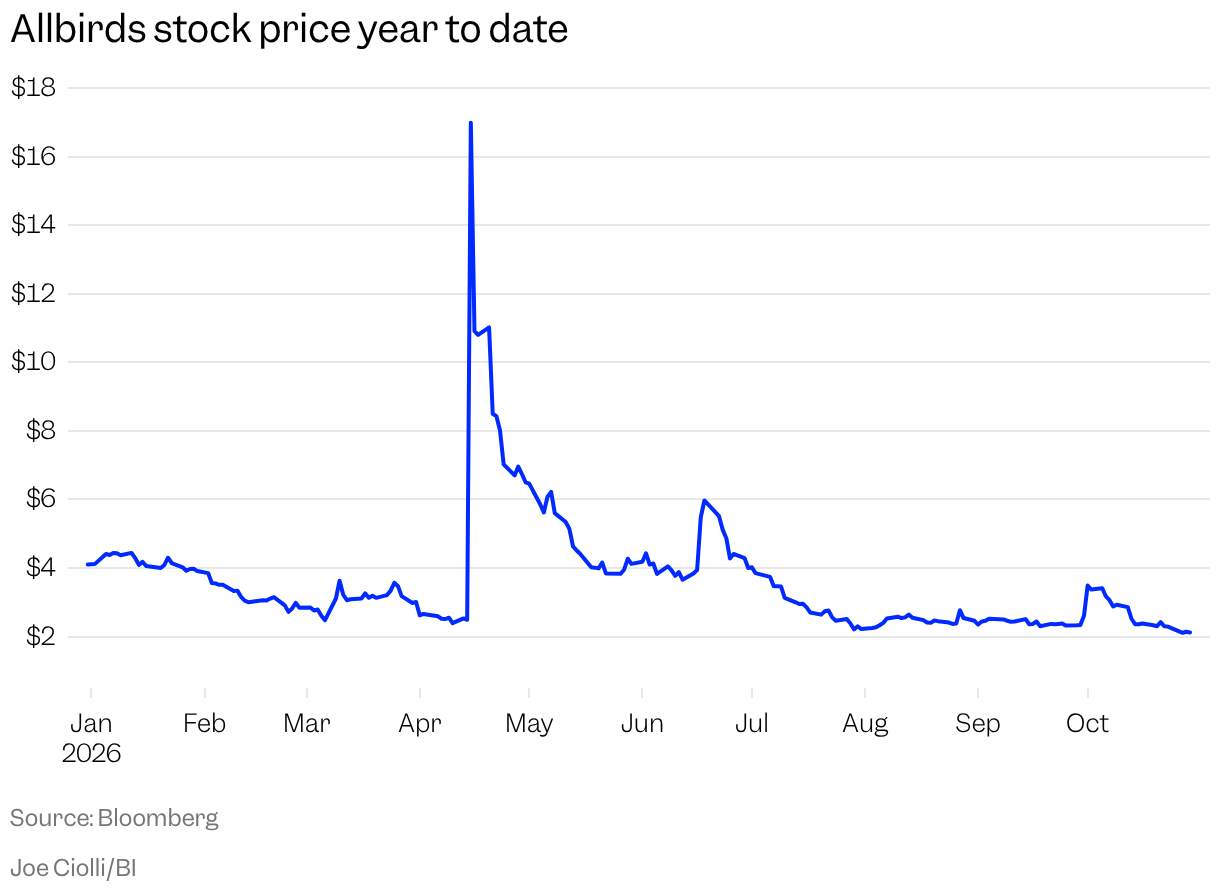
Line chart

"The stock market is going to do what the stock market does," she said. "What I care about is making sure that we're putting the company on the right path, and that we're able to build it quickly enough and well enough that we have a sustainable business that investors will love. So what happens in the short term? Not that important. What happens in the long term is very important."

When asked why the company decided to reinvent itself in the public eye instead of beginning as a private start-up, Carlsten countered with a question: "Why not?" she said, "It will come back up."

Having to reinvent the company from scratch can be challenging, and the public's presence is clear, she said. Yet, Carlsten said reinvention is inevitable for companies.

"This is a very public reinvention of the company, and people are watching," she said. "I think every company needs to reinvent itself every now and then."

When asked why the company is fully remote, Carlsten said most of the work at Smartbird is done virtually or at data centers, meaning an office would not be of much use.

"We spend a lot of time actually building things, which I actually love. So if my people are sitting in an office, something's wrong," she said.

Working within the emerging AI sector

Carlsten said that although her competitors are building similar AI infrastructure, the way Smartbird is going about it is unique.

"For us, it's about the right infrastructure for the right company at the right time," she said. "Our business model allows us to work more closely with customers, but it also is a lot less capital intensive."

Smartbird is looking to work with companies that have yet to explore implementing AI in their systems, she said. As more companies outside the tech realm look to adopt AI into their businesses, they have the choice to build infrastructure themselves or outsource it, and Smartbird wants to be the one to do it for them, she said.

"We'll do the infrastructure part. We'll let you focus on the actual business," she said.

The most common misconception Carlsten said she has encountered in the business is that it's all about GPUs. She said the company does a lot more than just run GPUs.

"It's really about having a holistic system that a customer can use to do AI," she said.

Another rumbling that's taken over the tech company discourse is whether there's an AI bubble and if it will pop. Carlsten said that depends on how people go about defining the bubble.

Excitement in the sector means funding might be going into companies that may not prosper in the future, but this is something that happens with the arrival of new technologies, she said.

"Every time there is a transformational technology, this happens," she said. "Even if we assume that there is a bubble, that doesn't mean that the technology is not good. It also doesn't mean that the adoption of the technology is going to go away."
Read the original article on Business Insider

  •  

Nubank, Latin America's largest digital bank, is turning its eyes toward the US — where foreign rivals have failed

Cristina Junqueira, the co-founder and CEO of Nubank
Cristina Junqueira, the co-founder and US CEO of Nubank, with Dan DeFrancesco, executive editor and anchor of Business Insider Today.

Carl Timpone/ BFA

  • Nubank's US CEO joined Business Insider's The Long Play to discuss the bank's expansion into the US.
  • The company looks to simplify banking with a digital-first fintech approach.
  • US CEO Cristina Junqueira focuses on building trust through credit options and brand building.

Nubank is the largest digital bank in Latin America — now it's turning its eyes towards the US.

Cristina Junqueira, the co-founder and US CEO of Nubank, sat down with Dan DeFrancesco, executive editor and anchor of Business Insider Today, at Business Insider's The Long Play, to talk about the digital bank's expansion on Thursday.

How it began

Since its founding in 2013, the fintech bank has pushed for financial inclusivity in Latin America by providing access to banking and financial services through its mobile app. Headquartered in Junqueira's home country of Brazil, the simple, low-cost, and digital-first approach discarded the need for physical banks, which are at times harder to reach in parts of Latin America — a key part of its success in the region.

It all started with a purple credit card with no fees.

"We had this vision that data, design, technology, completely transforms people's relationship with money," she said.

Junqueira previously worked as an executive at Itaú Unibanco, the largest private-sector financial giant in the region, also headquartered in Brazil and now a direct competitor of Nubank. Today, it is the largest company in Brazil based on primary banking relationships, and two-thirds of the country's adult population are customers, she said.

Entering the US market

The digital bank is set to expand into the US after opening a branch in September, operating under the name Nu. This comes after expansion into Mexico and Colombia in 2021.

"We always saw the thesis as a global one," she said. "Everywhere in the world, people want more convenience. People want more transparency. People want simpler experiences managing their finances. People still get like paralyzed by complexity through their financial lives."

Entering America's crowded banking sector is a risk — but for Junqueira, entering no country goes without risk.

"The US is a very hard market, but I haven't found easy ones either," she said. "Building a bank is hard everywhere, so you might as well go for the biggest payout."

In the US, she said getting a bank account is still "surprisingly hard" and normally requires you to go to a physical branch, while Nu offers an easier alternative to that, she said. Foreign digital-first banks have tried to bring their platforms to the US before and failed. German fintech N26 and UK fintech Monzo both tried to expand their businesses to the US, and ultimately withdrew from the market.

The American consumer is unique, which is why Junqueira aims to take a different approach than her competitors to earn trust and scale the platform. She said most other companies started with debit cards, while Nubank is the first to start with credit cards.

Starting people out with a debit card "requires you to build a lot of trust with those customers because you're asking them to deposit their money with you," she said. "In our case, all the countries that we started, we started with credit. This is a very different relationship because you're the one trusting the consumers," she said.

Some Latin American immigrants who already live in the US are responding positively to Nu as it enters the market.

"I've been positively surprised not only by the amount of people, sure, but Brazilians, Mexicans, and others are here and have been waiting for this," she said.

Junqueira also pointed to emerging AI technology and how it could impact the company and the banking sector. She said the company is "heavily leveraging AI," integrating it in credit underwriting, customer support, and product development.

Brazil's presidential election on Sunday made headlines as President Luiz Inácio Lula da Silva unexpectedly won a runoff against Flávio Bolsonaro, who fled the country to the US after he was under investigation for alleged corruption and money laundering. When asked about how she reacted to the big market sell-off in response, Junqueira said volatility is part of operating in a country like Brazil, but having 13 years of experience in the country has helped them learn they are going to run the company for the long run.

"We got to focus on the fundamentals, and the reality is, last quarter we turned over a billion dollars in net income," she said. "Markets don't like surprises, right? But we manage our business regardless of what happens."

Building a brand

The founder said one of the hardest things Nu will have to do in the US is build a brand that connects with users on an "emotional" level. Junqueira's dream scenario, five years from now, is to find evidence of that connection in the US.

One of the ways Nubank is attempting to spread its brand is through a recently signed deal with the Mercedes F1 team. Junqueira pointed to fans' passion for specific teams, as they follow the championship around the world, which was part of why they wanted to take part.

"We got a lot of visibility out of that, and we're working with them on brand activations," she said. "We're producing very interesting activations for consumers that help us amplify the branding fast, and that really help us bring this partnership to life."

Another huge part of the digital bank's brand is gender equality. In 2021, Nubank set a goal for 50% of Nubank's leadership to be women by 2025. Junqueira said today that the company's workforce is over 45% women, with many in leadership positions. In the four countries where they operate, all top leaders are women. Junqueira said the biggest challenge of being an executive while raising a family is not having the flexibility to juggle the demands of both roles.

"The reality is, as hard as we have to work, I think the hardest part is not having enough flexibility," she said. "It has been wonderful for us to have that type of opportunity, for us to really be able to tap into this part of the workforce that often struggles to have this type of career opportunity."

Correction — October 29, 2026: An earlier version of this article misstated Junqueira's title; she is the co-founder and CEO of US Nubank. The article also has been updated to note that the top leaders in the four countries where Nubank operates are women.

Read the original article on Business Insider

  •  

What smart people are saying after the Fed held rates steady

Federal Reserve Chair Kevin Warsh speaks during the press conference following the Federal Open Market Committee's interest-rate decision.
Federal Reserve Chair Kevin Warsh speaks during the press conference following the Federal Open Market Committee's announcement that it was holding interest rates.

SAUL LOEB / AFP via Getty Images

  • As expected, the Federal Reserve held rates steady on Wednesday.
  • Fed Chair Kevin Warsh said the Fed is working toward price stability and lower inflation.
  • Smart people in business and finance expected the hold, and estimate a hike in December.

The Federal Reserve held interest rates steady as was widely expected. The rate remained unchanged after a 10-2 vote, where 2 officials voted to hike rates by 25 bps.

Fed chair Kevin Warsh, who began his term leading the central bank in May, said the Fed is working to deliver future price stability and quash inflation during the Federal Open Market Committee press conference following the hold announcement.

"The period right in front of us is information rich," Warsh said.

He added: "We're going to be able to figure out what's the appropriate protocol, as part of this package that we started to deliver five months ago, to deliver price stability."

In September, the Fed opted for a quarter-point increase — the first hike in three years — aimed at tackling rising inflation. The decision to hold rates comes less than a week before US midterm elections, where the country's affordability crisis and rising energy and oil prices are fresh on voters' minds. Warsh said politics played no role in the decision.

Here is how smart people in business and finance are reacting to the hold — and why many expect another rate hike in December.


Kay Haigh, global head and chief investment officer of fixed income and liquidity solutions at Goldman Sachs Asset Management

Haigh is among the Fed watchers who expect a hike to be the likely outcome of the final Fed meeting of the year.

"We expect the Fed to resume rate hikes in December," Haigh said. "September's strong CPI print is a reminder that upside inflation risks remain, and the Fed is likely to look to take out further insurance."


Steve Rick, chief economist at TruStage

Rick said Wednesday's decision to keep rates steady made sense after September's first hike since July 2023.

"Monetary policy works with long and variable lags, so the Fed will want to see how the higher rates already in the system are affecting consumer spending, business investment and hiring before determining whether additional tightening is necessary," he said. "There's no need to rush."


Andrew Davis, head of investment strategy at Bryn Mawr Trust and a former BLS analyst

Davis said the Fed's wait-and-see approach makes sense as inflation remains above the Fed's 2% target and the job market has cooled without "showing the kind of widespread deterioration we'd typically associate with a recession."

"One thing worth watching is how the bond market responds," Davis said. "The Fed controls short-term interest rates, but longer-term yields reflect a much broader set of forces, including inflation expectations, economic growth and Treasury supply. With the 10-year Treasury yield around 5%, financial conditions have already tightened considerably. Higher borrowing costs can do some of the Fed's work without another rate hike."


Elizabeth Renter, the lead economist at Life360 and a former senior economist at NerdWallet

"The Fed's choice to hold today will have little noticeable impact for everyday household life," she said. "But consumers paying attention could feel let down by the seeming inaction on inflation from the Central Bank."

Renter suggests that families feeling financial strain cut back on discretionary expenses, as prices are likely to remain high. Those not feeling as much strain could put some money into extra savings.


Peter Boockvar, chief investment officer at One Point BFG Wealth Partners

Boockvar said markets would likely be on the lookout for unofficial guidance on rates from central bankers in the days and weeks ahead. Fed Chair Kevin Warsh has leaned away from the central bank issuing official formal guidance. But other Fed officials have been more forthcoming about their views on monetary policy lately, such as by speaking about rates in public remarks.

"I'm sure again Chair Warsh will dance around making any commitment and we'll be more reliant on the upcoming speeches and comments that his colleagues give," Boockvar wrote in a note to clients on Substack.


Seema Shah, chief global strategist at Principal Asset Management

Seema Shah said the hold was a good call. Amid global and economic uncertainty, the Fed has time to gather more data. Yet, she said hikes in December and early 2027 are expected.

"AI may be booming, but the broader economy is not firing on all cylinders, and elevated geopolitical uncertainty argues against rushing another hike," she said. "But the direction of travel remains clear. The Fed is still taking back some of last year's rate cuts, and the two dissents underline that tightening bias."


Brian Coulton, chief economist at Fitch Ratings

Brian Coulton said the Fed is holding steady for more information before "pulling the trigger again." He also expects another hike in December, based on economic factors indicating "upside risks to the US inflation outlook."

"With 2 of the 12 voting members opting for a hike, and a more bullish assessment of current growth trends, it looks like we will get another hike in December," Coulton said. "The statement characterized economic activity as expanding at a 'strong pace' rather than the 'solid pace' description used in September."

Read the original article on Business Insider

  •  

Millennials and Gen Z are excitedly buying Lego, plushies, and other toys. It's becoming big business.

Harrison Woodward
Harrison Woodward builds and collects Lego products, including cars.

Cassidy Araiza for BI

As a child, you may have sung along to Toys R Us' iconic jingle about not wanting to grow up. Decades later, many millennial and Gen Z adults are taking that motto seriously.

Adults are rediscovering how Lego, stuffed animals, and other toys brought them joy. Now that they're earning their own money, they can afford the things they once played with or circled in catalogs. Hobby spending — which includes hobby shops, arts and crafts stores, and outdoor recreation providers — rose 7.9% year over year in August, according to an analysis by the Bank of America Institute.

Devin Byron, 25, had a collection of American Girl dolls growing up, but her interest in playing with them fizzled out around middle school. However, her love for them never really went away. And now, working an office job, she can buy her own.

In February, she and her friend went to the American Girl store in New York. Byron purchased the historical doll representing the '60s, Melody, which cost $135 with the book, plus $34 for accessories.

"I feel like a lot of collectors now are, I would say, healing their inner child because some people couldn't get maybe American Girl dolls growing up, but now they can," Byron said. "And it's an adrenaline rush too."

Devin Byron with an American Girl doll bag
Byron bought an American Girl doll in February.

Courtesy of Devin Byron

She's not the only adult contributing to the toy economy. Market research company Circana found that adult-only households made up over half of toy sales in the first half of this year, and that overall toy sales for adults increased 25%. Some adults may buy toys to bring nostalgia back into their lives or to avoid doomscrolling. For others, it's to make a profit.

"We're seeing toys increasingly function as hobbies, fandom ecosystems, and social experiences rather than traditional children's products," said Kristen McLean, vice president of client insights for Circana's Entertainment Knowledge Group. "That's expanding the consumer base and creating new opportunities for manufacturers and retailers that understand how to engage collectors, enthusiasts, gifters, and self-purchasers."

Syls Farmer
Syls Farmer's personal collection, including an American Girl doll, and toys she sells. Her vintage online toy store specializes in girl toys.

Courtesy of Syls Farmer

The rise of 'kidulting'

Jay Berino, store manager at the Lowry Town Center Timbuk Toys in Denver, pointed to "kidulting," the trend in which adults engage with childlike toys and hobbies, as coming from adults seeking distractions and nostalgia — from buying Pokémon cards to lava lamps.

"As much as we're a toy store and people hear toy store and think of kids, we sell to a lot to full-blown adults, and that drives a huge chunk of our business," he said.

Syls Farmer, 32, runs a vintage online store specializing in toys marketed to girls. Her store, Mema's Doll Shop, was inspired by her grandmother, who ran a couple of toy stores back in the day. Farmer said adults buy from her for themselves or for their kids so they can experience their past.

"A lot of people are dealing with a lot of pressure in this general economy and the world in general," Farmer said. "And I think that these items of childhood are bringing back feelings of comfort and peace that I think a lot of us need right now."

Farmer also buys toys for herself, including her first American Girl doll through Facebook Marketplace — Nicki, one of the '90s-inspired dolls.

Even crafters are getting in on the toy craze: Abby Glassenberg, the president of the Craft Industry Alliance, said that homemade Labubu-esque bag charms have taken off, with crafters making their own customizable charms from crochet or felt.

"People are definitely still spending. I think craft in some ways is resistant to market up and down," Glassenberg said. When the market is up, people pour more money into their hobbies, whether that's getting premium materials or even traveling to somewhere catered to their favorite crafts.

"When the market is down, and people's budgets are tighter, they want to make something for a gift rather than buy it," Glassenberg said.

Collecting toys

Emma Wynn, 28, has 120 Jellycat items, a popular stuffed-toy brand that includes animals, food, and more. Wynn's collection began when she bought a scuba diver egg while browsing at a garden center with her family, sparking a feeling of childlike happiness.

Emma Wynn
Wynn's first Jellycat was an egg wearing a scuba diver outfit. Her favorite part of collecting Jellycat items is creating displays. Right now, she has her fall-related plushies on her shelves.

Courtesy of Emma Wynn

Prices range on the Jellycat site; for instance, a heart dragon is priced at $80, a carrot cake is priced at $45, and bear winter decorations are priced at $28. Wynn funds her collection with money she earns from content creation, rather than from her corporate job.

Wynn thinks adults buy toys because they bring back happy childhood memories, can provide a dopamine hit when someone finds something they've been searching for a while, and can connect them with others who are building similar collections.

"It feels very empowering to be unapologetic about the things that bring us joy and happiness, whereas before maybe I would've been embarrassed about it," she said.

Emma Wynn
Wynn's soon-to-be mother-in-law got her a Jellycat flower bouquet.

Courtesy of Emma Wynn

It can also be a tangible way to remember a memory. For instance, Wynn's soon-to-be mother-in-law bought her a Jellycat flower bouquet to celebrate her new engagement.

Fueling an income

Harrison Woodward, 28, said building and playing with Lego sets was a large part of his childhood. For one birthday in his early 20s, his aunt bought him a Lego Porsche car model, reigniting his passion for Lego sets. He put on a streaming show after a long day of work and started to build the over 1,000-piece product.

Harrison Woodward
Woodward has a designated space for his collections and feels like he's running out of room.

Cassidy Araiza for BI

"It was just the most therapeutic, peaceful activity," he said. "You could sit there for a few hours, a few days in a row, and complete a set and see it come together and marvel at all the different engineering things that they put into these sets now."

He left his job in insurance to focus on content creation full time. He posts about his Lego collection and passion for cars; he recently started collecting Hot Wheels, another childhood favorite. He has spent thousands on Lego and is running out of space in a room that's filled with his collections. He still tries to find a balance so that building isn't just for content, such as taking his time to build a CaDA car set in the evening.

Woodward thinks adults might be purchasing toys to invest some time in their hobbies and take care of their mental health.

Harrison Woodward
Woodward's collection includes all different kinds of building toys, including ones from popular video game series.

Cassidy Araiza for BI

"I think the stigma has kind of lifted over collecting and everything," he said. "I think that for a long time people thought any of this stuff was strictly for kids, but as the years have gone on and adults have continued to adopt it, the stigma continues to go further and further away."

Harrison Woodward
Woodward thinks adults might be buying toys to support their mental health or to pursue a hobby.

Cassidy Araiza for BI

Trading cards have also become a major area of interest for some adults. Kian Golshan previously told Business Insider that Pokémon is a lucrative side hustle. For instance, he sold a Japanese-edition Charmander for $750 that he bought for $59.26. As Business Insider's Samuel O'Brient previously reported, Golshan was able to put the analytical skills that he developed while working in finance to work.

"It helps me kind of think through the risks and when to take profits, when to sell, what to hold, what's my like risk profile, what's tracking the market," Golshan said.

Byron, the Gen Zer who bought an American doll, still has her collection of dolls from her childhood. Plus, she has her most recent addition displayed in her room.

"I'm actually thinking about going back to the store again," she said. "Maybe I'll walk out with another doll. I guess we'll see."

Read the original article on Business Insider
  •  

Toys are facing their biggest price spike in years. Mom-and-pop toy stores tell us how they're getting by.

Terra Toys, a toy store in Austin.

Sylvia Edwards

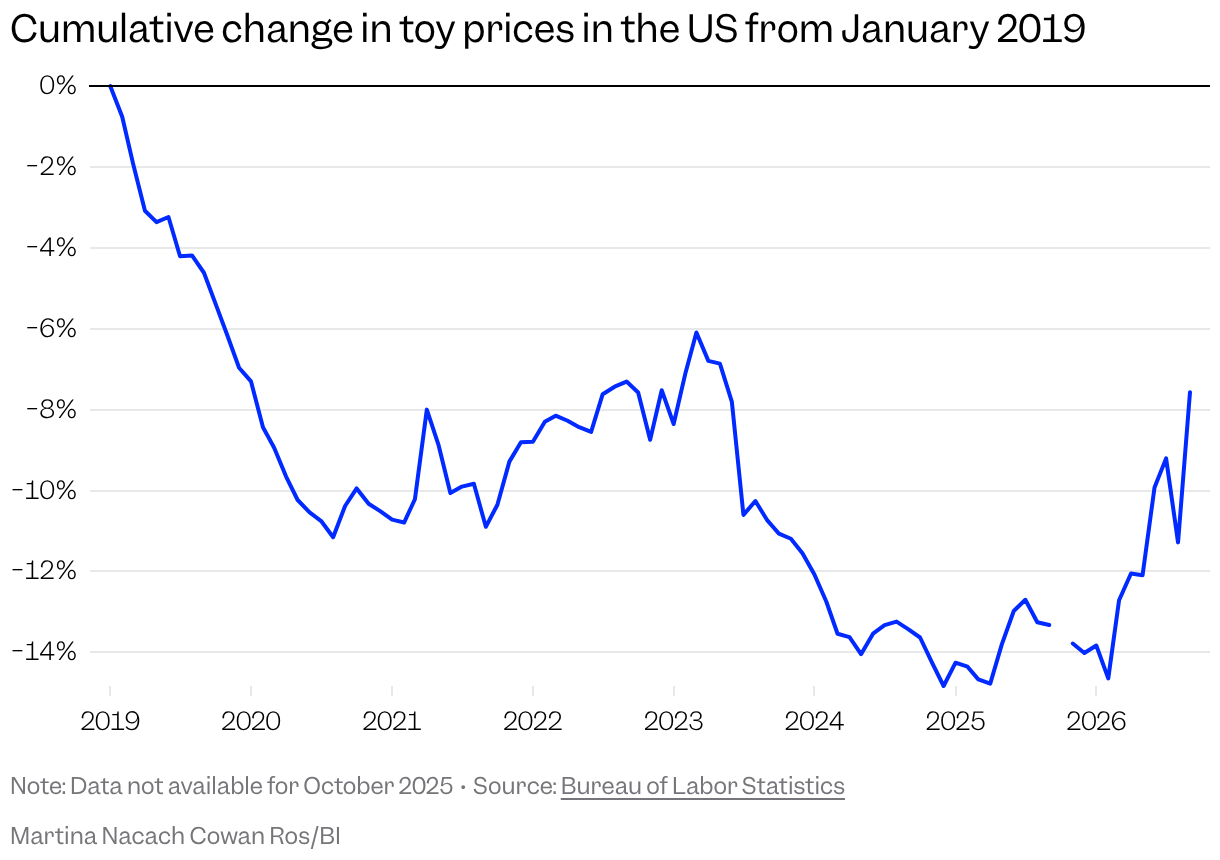
  • Toy prices have gone up 8.3% since February due to tariffs, geopolitics, and supply chain issues.
  • Local mom-and-pop toy stores across the US spoke to the rise and its impact on their businesses.
  • Legacy toymakers also grapple with the impacts, looking toward tariff refunds.

Toy prices are rising fast across the country— and local toy stores are struggling to play along.

At Clever Monsters, a toy store in NYC, co-owner Daniel Orlov said he has to recalculate prices order by order, at times cutting into his own profits to keep them at a reasonable level for his customers. Sometimes, he knows before putting some toys on the shelves that he won't make anything off them.

The struggle results from higher shipping fees, tariffs, and customs charges and reflects a broader inflationary moment in the economy.

Toys have historically gotten less expensive over time, but have seen a spike in prices this year, rising 8.3% in the US between February and September. Year-over-year, toy prices were up 6.6% in September, the highest annualized growth rate since 1988.

This graph shows toy prices in the US from January 2019 to September 2026.

Orlov said smaller toy stores like his could be particularly affected by these sharp price spikes. "It especially hurts for small businesses like us because we don't really have a pocket; we had to open up credit lines and take loans — bigger companies have a little pocket of collateral that they can use for a bit."

Tariffs, fuel prices, and supply chain woes

Big geopolitical swings are one factor putting pressure on toy sellers. President Donald Trump's on-again, off-again tariffs have added extra costs, and smaller retailers don't have the financial flexibility to wait for refunds like those from the Supreme Court's invalidation of the "Liberation Day" levies. Meanwhile, the ongoing war in Iran has driven up fuel prices and shipping costs for all manner of goods.

Small toy stores, confronting those problems, are facing smaller profit margins.

Helen Dean, owner and operator of Toy Safari in California for 34 years, said her usual 7 to 8% profit margin has fallen to around 5% in the past year. She cut into her own salary and skipped on hiring the two or three college students she brings on during vacation season to cut costs.

"It was summer by the time I started to see that I was going to have to pay more for the items, and that it was going to come out of my bottom line," Dean said. "For a long time, mass market has gotten favorable pricing from major toy companies, and this problem has only been exacerbated by the tariffs and fuel prices and supply chain issues; everywhere we lose."

It's not just specialty mom-and-pop stores; toymaking giants are also dealing with the tariff back-and-forth and broader inflationary issues. An AlphaSense analysis of company filings and earnings transcripts over the last six months found that legacy toymakers such as Hasbro and Mattel have alluded to cost inflation caused by "tariffs, oil-linked resin and freight, packaging, labor," while also discussing the impact of tariff refunds. However, those large toymakers haven't disclosed any major increases in toy prices over that period.

Hasbro's Q2 earnings report highlighted an $8 million adjusted operating loss in consumer products — its physical toy sector — due to "incremental tariff expense, entertainment-related mix shifts, and normal seasonality." Yet its Q3 earnings report highlighted $55 million in relief from tariff refunds; $48 million of this was attributed to the core toy sector.

The Q3 report also noted that tariffs could "increase our product costs and other costs of doing business, result in higher prices of our products, impact consumer spending," and hurt business revenue.

Mattel's gross margin is still under pressure due to tariffs and inflation. The toy company has also received about $90 million in tariff refunds, said Paul Ruh, Mattel's former chief financial officer, at a conference in September.

Scalpers, TikTok and squishy NeeDohs

High operating costs are not the only thing changing the toy market. First, more adults are participating in "Kidulting," said Jay Berino, store manager at the Lowry Town Center Timbuk Toys in Denver, meaning toys are being bought by older demographics who buy into nostalgia.

"As much as we're a toy store and people hear toy store and think of kids, we sell to a lot to full-blown adults, and that drives a huge chunk of our business," he said. At the same time, viral toys such as NeeDohs, which are sensory fidget and stress-relief toys, have helped bring more people into stores.

Sylvia Edwards, co-owner and CEO of Terra Toys in Austin, said that scalpers try to buy up stock from toy shops to resell it at higher prices — fueling the perception of product scarcity and price gouging.

"We're in a crisis where there's way more demand than there is product available, and so when that happens, people will naturally get greedy and increase the price," Edwards said. To manage the issue, stores like Terra Toys limit bulk purchases.

Daniel Orlov, co-owner of Clever Monsters in New York City.
Daniel Orlov, co-owner of Clever Monsters toy store in Brooklyn, New York City.

Daniel Orlov

Orlov from Clever Monsters in NYC said they have also placed a limit on scalpers. "I'm only limiting it because this is the kids' store, and the kids are really excited to get that stuff," he said.

The virality of products such as NeeDohs on TikTok and other platforms helps these stores boost demand at a time when the high cost of living means buyers are not looking to spend much on other classic toys. Parents and kids are willing to spend on hyped products — but for much else, they keep their wallets shut.

"Honestly, the trends have been really saving us in that it drives not just sales, but just foot traffic through the store," Orlov said. "The only thing we can do is just stay on the trends, on what people want, make sure customers are happy, build up relationships with our customers, and sort of have a little monopoly on our area on parents who think toys — 'Oh, we gotta come to Clever Monsters. That's just where you go.'"

Read the original article on Business Insider
  •  
❌