Login

Losing the ‘Big-Ass Truck’ Vote
Photographs by Brian Finke
Updated at 5:30 p.m. ET on October 26, 2026
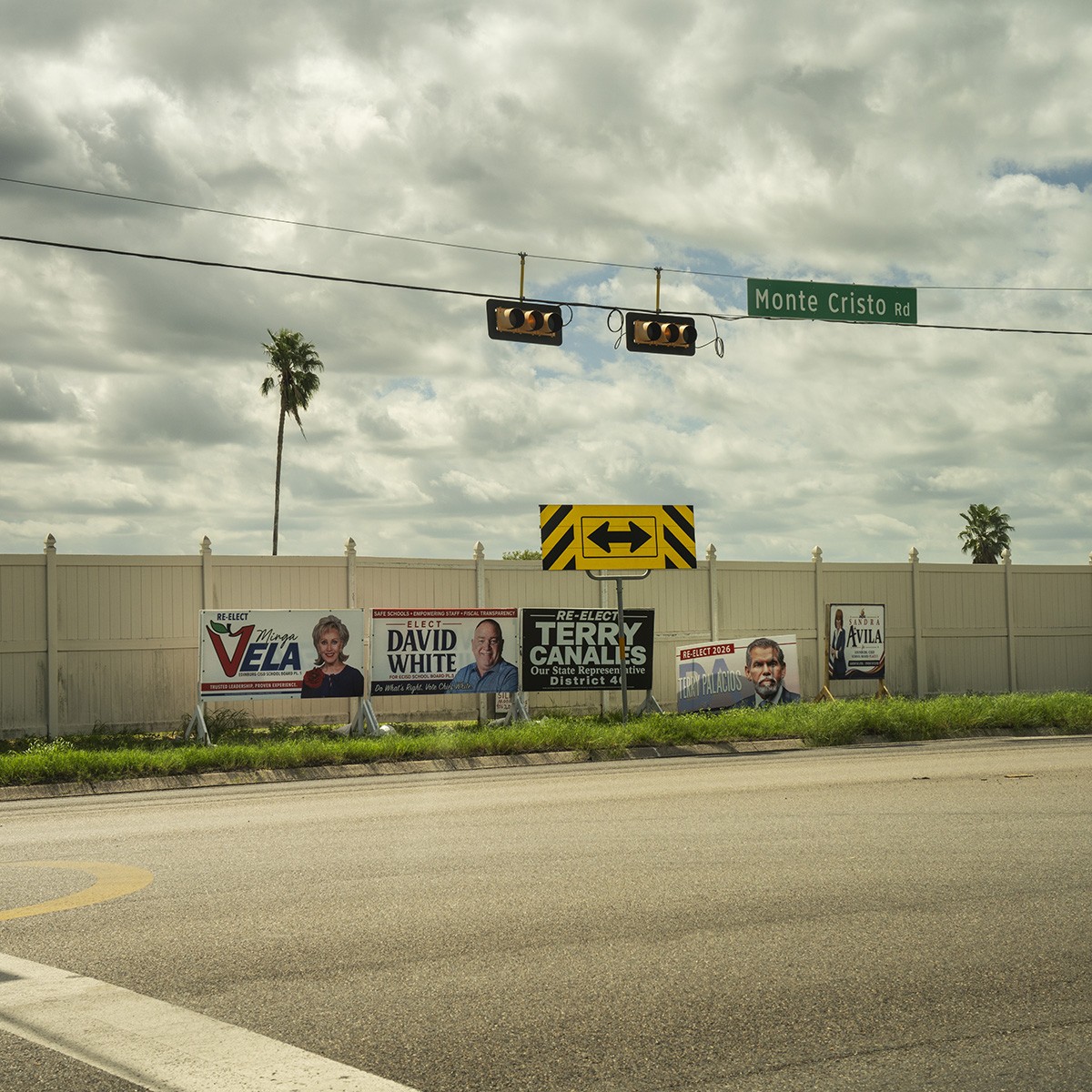
Along the highways and farm roads of the southern tip of Texas, the bright-red campaign signs for Eric Flores are impossible to miss. Flores, the Republican candidate for the state’s Thirty-Fourth Congressional District, has Ken-doll looks, with gel-stiff hair and the kind of physique that Donald Trump admires. His bio appears across the top of the sign: Infantry Officer. Prosecutor. Father.
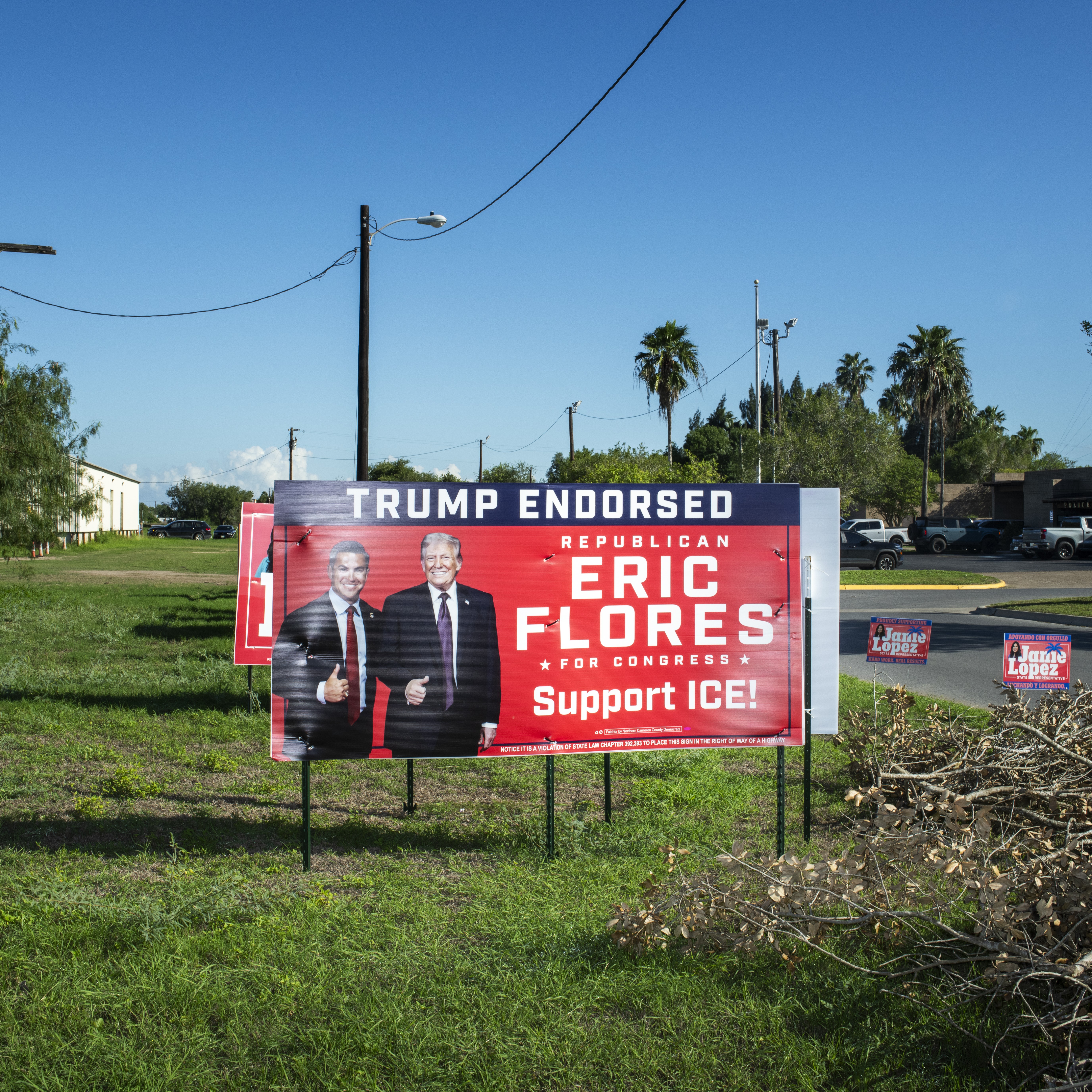
A second set of nearly identical red signs are scattered across the district, only these show Flores with President Trump giving a thumbs-up, sandwiched between the declarations Trump Endorsed and Support ICE! When I first saw these signs, I did a double take. Why would any candidate want to be associated with ICE in the Rio Grande Valley, where the population is more than 90 percent Hispanic? The answer appeared in tiny letters at the bottom: Paid for by Northern Cameron County Democrats.
The attack ad captures how much has changed since Trump won in the Rio Grande Valley two years ago. Hispanic voters—especially men—were a key part of the national coalition that put Trump back in the White House. Trump and Kamala Harris roughly split the votes of Latinos in 2024, after several cycles of Democratic presidential candidates winning the group by double digits. Exit polls in Texas estimated that Trump won Hispanic voters there by 10 percentage points. But that support appears to have evaporated. Nationally, nearly one-fifth of Latinos who voted for Trump in 2024 now say they do not want Republicans to control Congress, a poll earlier this month found. And a late-summer survey of Hispanic Texans who are likely to vote in the upcoming election showed Democrats with a 2-to-1 advantage.
The Rio Grande Valley had been a Democratic stronghold for decades, and the region is crucial to the party’s midterm-elections strategy. The Texas U.S. Senate race has become the nation’s most expensive contest of 2026, as James Talarico tries to become the first Democrat to win statewide office there in more than 30 years. Recent polls show him in a dead heat with Texas Attorney General Ken Paxton. For Talarico to win, Democrats need the Rio Grande Valley to swing back, which would make Trump’s 2024 multiracial MAGA coalition look more like a one-off.
For Republicans, a Talarico win would be a political and psychological blow, signaling a new purple era for the state made possible by a population that’s trending more urban and college educated, and less white. GOP candidates, taking their cues from the president, have been framing the election in apocalyptic terms, telling voters that a Republican loss will usher in communism, open borders, and gender anarchy. Paxton frequently says: “If we lose Texas, we lose America.” Elon Musk donated $158 million last month to the main super PAC supporting Senate Republicans to flood the airwaves with negative ads.
[Read: ‘We have not seen ugly yet’]
I spent several days earlier this month driving around the Rio Grande Valley to speak with voters and candidates. I found a fair amount of sympathy for Trump among those who voted for him two years ago. Negative ads and wild social-media claims left others unsure whom to believe. It was clear to me that the region’s political realignment remains in flux. Hispanics in South Texas, especially men, remain up for grabs in a way they weren’t before Trump came along.
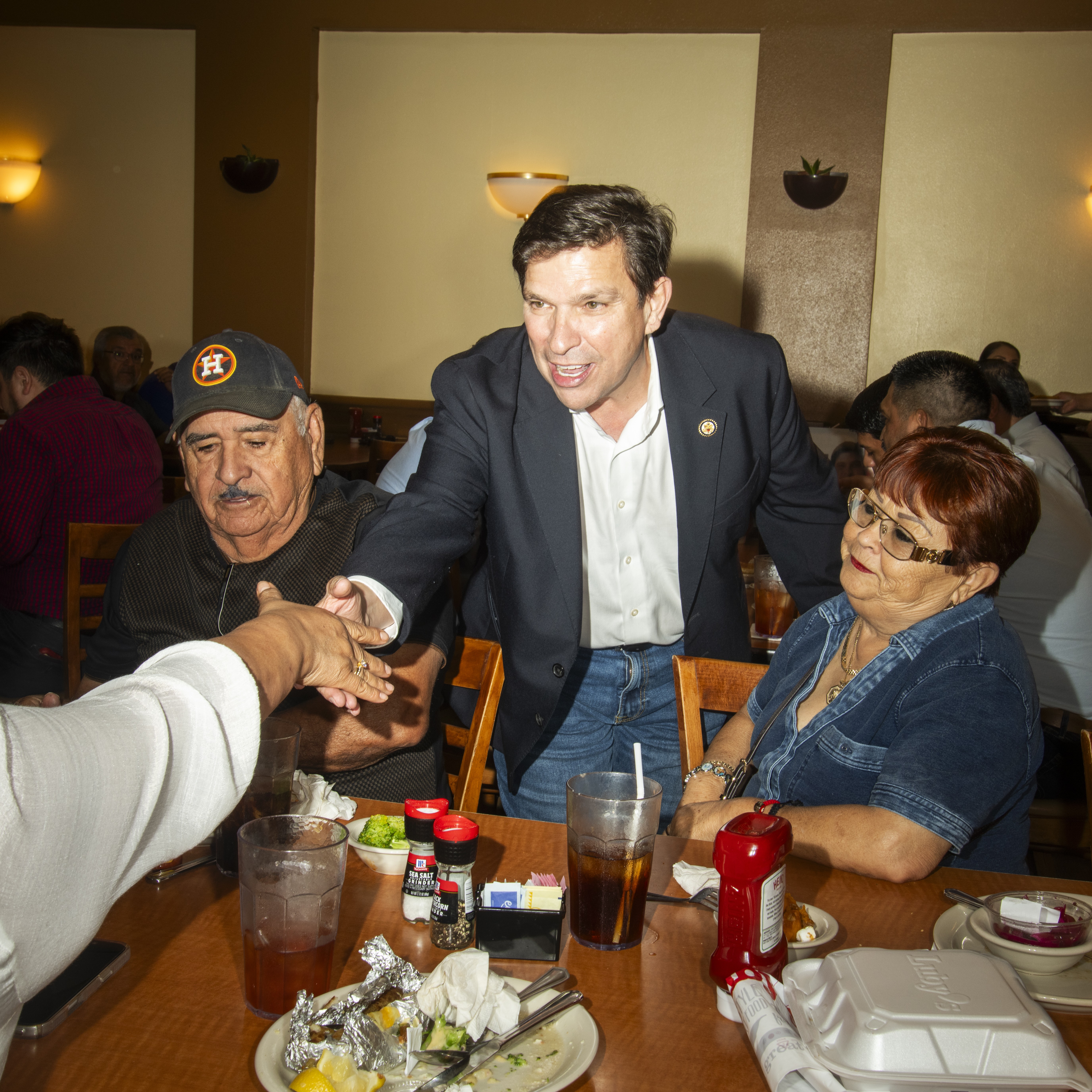
Representative Vicente Gonzalez, the Democratic incumbent running against Flores, barely held his seat in 2024, winning by less than 3 percentage points. Since then, Republicans have recast the district’s boundaries, pushing farther north into the more conservative-leaning Corpus Christi. Gonzalez, a former trial attorney who was first elected in 2016, is running as a folksy, I-feel-your-pain populist, not a tough guy, with ads that flip between Spanish and English. One shows Gonzalez grilling steaks at a backyard cookout and rationing meager portions to disappointed guests as he blames Trump’s tariffs for high food prices.
I had lunch with Gonzalez and about 20 of his supporters earlier this month at Frijoles, a restaurant in Brownsville. The group was mostly men, a mix of taxi drivers and local business owners who cracked jokes about involuntarily losing weight from smaller hamburgers. Steve Torres, who operates 11 Airbnbs that house engineers working at Musk’s nearby Starbase, told Gonzalez that his electricity bills are soaring. “I’m paying more than $4,000 a month,” said Torres, who voted for Trump. Last year, he closed two restaurants that he owned after struggling to compete with franchises that could better withstand higher costs. Gonzalez told the group that 200 fishing boats are moored along the Gulf Coast in the district because owners can’t turn a profit with diesel at $6 a gallon.
Others at the table grumbled about labor shortages created by Trump’s immigration crackdown. Workers are scared to leave their homes, and ICE sightings—real and imagined—are shared widely on social media. Gonzalez said he knows a restaurant owner who had to close one of his three locations because he didn’t have staff. “I know a farmer with 15,000 acres who only planted half because he doesn’t have enough workers for the harvest,” Gonzalez told the group.
Chuck Rocha, a political consultant who is advising Democrats in the state, told me that lots of voter groups are moving away from Trump, but that Latino men appear to be doing so at a larger rate “because they were some of the biggest swingers to Trump over the past 10 years.” Rocha has helped Democratic candidates create messages appealing to what he calls “the big-ass-truck economy for Latino men.” Those voters want to provide for their families and enjoy the money they earn, Rocha said. “When I was making a TV ad a couple of weeks ago, a guy pointed to his truck in the front yard and said, That fucking thing has become a lawn ornament because I can't afford to drive it,” Rocha said.
[Read: Going hungry in Trump’s economy]
Republicans have been using their fundraising edge to saturate South Texas with ads aimed at the region’s social conservatism. The Flores campaign has put up signs claiming that Gonzalez wants taxpayer-funded “child sex changes” because he voted against Trump’s One Big Beautiful Bill Act last summer. His attorney sent the billboard company a cease-and-desist letter demanding removal of the advertisements showing Flores with Trump, The Washington Sun reported.
One evening, I walked around a rough-looking colonia knocking on doors with Roel Garza, a 20-year-old business student canvassing for Democrats. Roosters erupted in several yards, and a guy in a welding mask was fixing a cattle trailer with a blowtorch, shooting sparks out of his carport. We sought out residents on Garza’s list who’d voted in previous cycles, avoiding the homes with barking dogs. One man who smelled of alcohol and had bloodshot eyes came out of his trailer to fire up a charcoal grill, and told us he’d voted for Trump but didn’t realize another election was coming up. Rosalina Saenz, a mother of six, told us she voted for Trump last time and was still happy with him. She told Garza that she was open to voting for Democrats in local races, but wasn’t sure who to support, because she’d seen so many ads “trashing” the candidates.
Garza told me that he thought a lot of people backed Trump last time because “they wanted that macho figure.” But they remain open to persuasion. It was just a matter of getting them to connect the administration’s policies with the problems in their lives. “Once people know the issues, they’re smart enough to know how they want to vote,” Garza said.
The home-building industry in South Texas is where Trump’s least popular actions have converged to squeeze men working in construction. High mortgage rates have sapped housing demand, fuel prices are driving up construction costs, and the ICE crackdown has squeezed the labor supply.
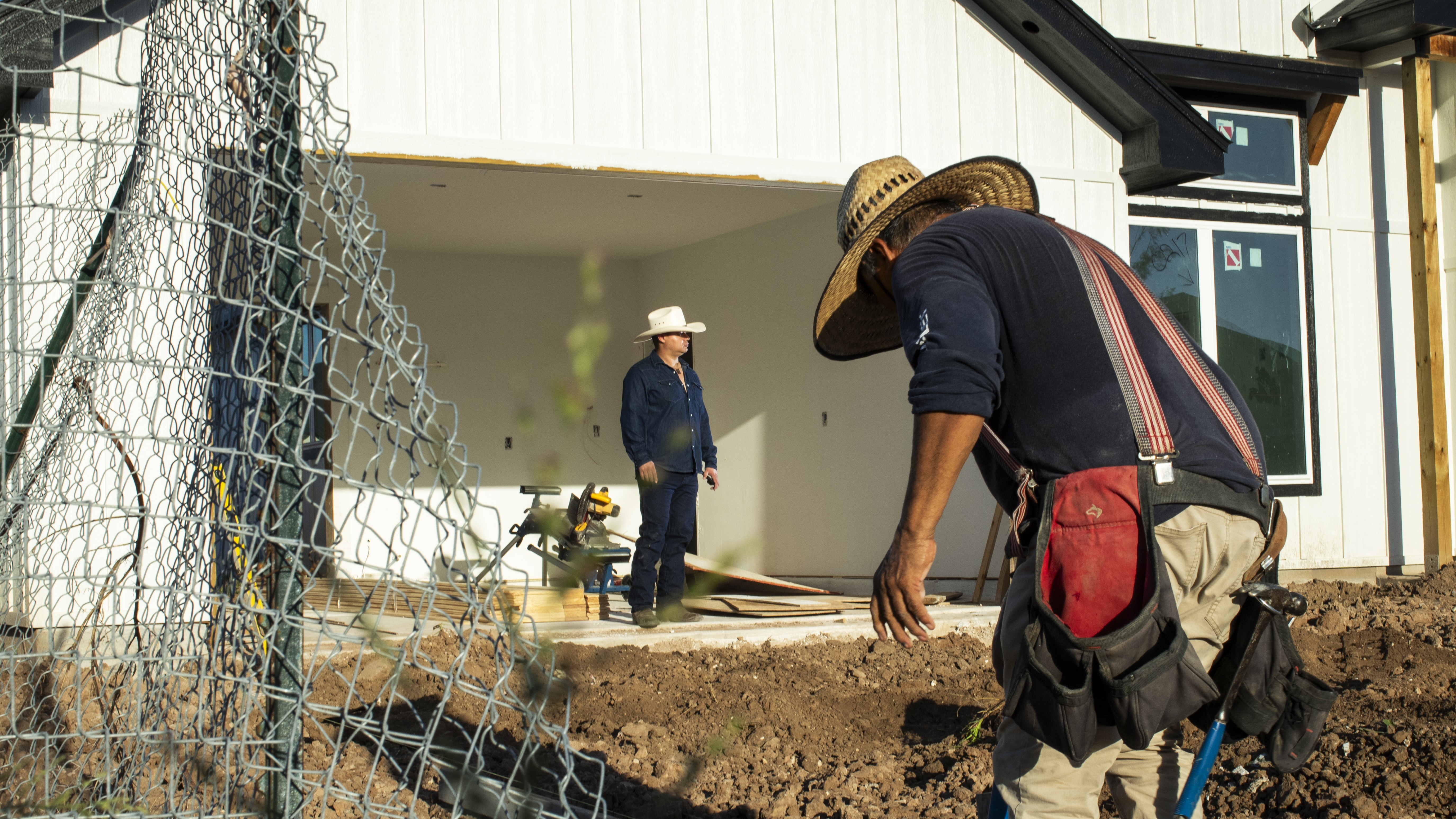
Benny Melendez, a general contractor who started his business seven years ago, invited me to a half-built house he is trying to finish outside McAllen. Melendez told me that he used to build on spec, investing his own money in a project with confidence that he’d quickly flip a sale. Now he builds only for clients who pay up front. Building a house used to take him four months, but now it takes eight to 12, he said, because he can’t find enough workers.
Melendez voted for Trump two years ago and doesn’t “hate” him. He was less generous, and more profane, about the Trump adviser Stephen Miller, who orchestrated an ICE crackdown that has become so disruptive that Melendez and other members of his trade group felt like they had to get more involved in politics. At least 15 men he used to work with have been deported, and several of them were arrested by ICE en route to a job site. “If you have a ladder on your truck, they’ll start following you, and they’ll stop you,” Melendez said. “It is difficult for me to hear a 40-, 50-year-old guy cry in private with me, telling me he’s afraid that ICE is going to take him.” Melendez told me that the Rio Grande Valley is best-known for having a low cost of living and being family-oriented. “And now those are the two things being taken away from us,” he said.
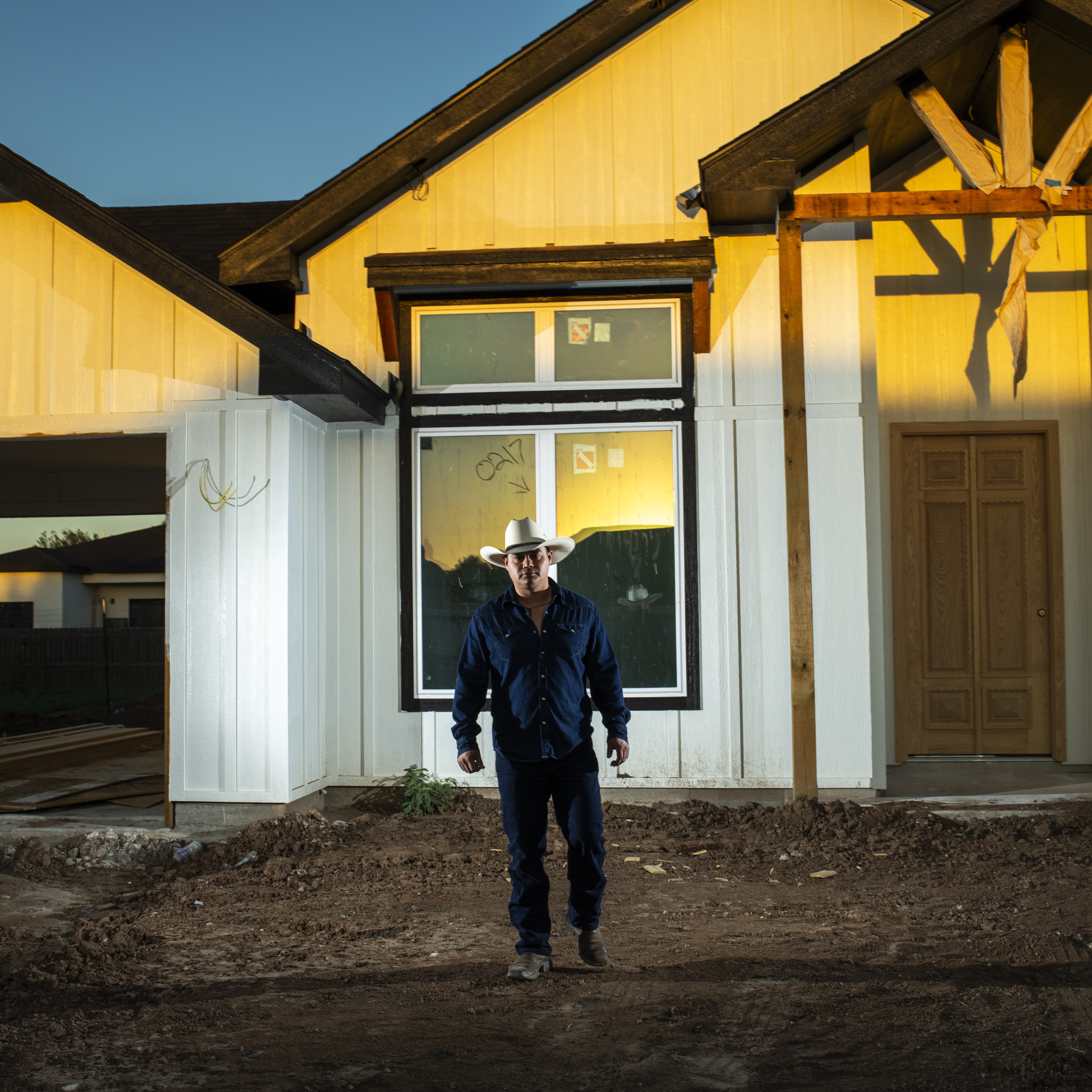

A crew of subcontractors working for Melendez was supposed to install kitchen cabinets at the house that day. They didn’t show. Neither did the guys scheduled to pave the driveway. ICE vehicles had been spotted that morning in the area, and alerts had gone out across radio stations and social media. Most of the ICE officers making the arrests are other Hispanic men who grew up in the Rio Grande Valley, Melendez said, and as he watched video clips from construction sites, he recognized a close friend, despite his face mask. “I wrote to my friend and said, Dude, you know I love you, but you’re losing my respect,” he said. Melendez was even more disgusted when the friend told him the pay was too good to quit.
Melendez told me that construction workers across the Rio Grande Valley tune in each morning to the radio show El Zorro y Su Pandilla (“The Fox and His Gang”), which relays reports of ICE sightings. I went to see “El Zorro,” whose real name is Hector Lepe, at his home studio in Donna, where a pickup truck parked in the driveway was plastered with a promotional picture of Lepe and his wife. Lepe told me that callers often dial in to his show describing encounters with ICE and fears of what will happen to their families if they’re deported. It’s made him something of a community therapist for men who don’t have the time or money to see a professional.
Lepe, who grew up in Oaxaca, in southern Mexico, said he crossed the border illegally as a young man and spent years as an itinerant farmworker until he broke into broadcasting. He obtained legal status through his marriage and became a U.S. citizen. Even though the Rio Grande Valley is a border community, and has federal immigration officers and agents everywhere, it used to be a “place where you could take your family to the movies, to the circus, to eat, to dance” without fear.
Lepe said that he’s been especially bothered by stories of recently deported tradesmen being reduced to working in low-wage Mexican assembly plants along the border. They’ve been separated from their children in the United States but try to remain as physically close as possible. “Imagine one day you get up to go to work, and they just take you,” Lepe said. He told me that he plans to launch a new project, La Rescata (“The Rescue”), for men in ICE custody to call so that someone will secure their truck and tools until a family member can safely retrieve them. He’s been encouraging listeners to register to vote if they’re eligible, and to show up for Democrats.
Flat and muggy, the Lower Rio Grande Valley is about 250 miles south of San Antonio, and for most of the past century, it was practically an island, with Mexico on one side and millions of acres of Texas cattle ranches and scrublands on the other. Its counties have some of the highest poverty rates in Texas. Their residents were reliable Democratic voters who benefitted from the social-welfare policies of the New Deal and President Lyndon B. Johnson’s Great Society. The RGV was LBJ country.
The North American Free Trade Agreement of 1994 transformed the Rio Grande Valley into a trade and logistics hub for the manufacturing boom in northern Mexico. Its population doubled to about 1.5 million, and today the McAllen metropolitan area is the state’s fifth largest after Dallas, Houston, San Antonio, and Austin. Wealthy and middle-class families from northern Mexico began arriving, too, fleeing drug-cartel violence and kidnapping-for-ransom terror. Developers gobbled up farmland to build subdivisions and faux-Mediterranean mansions not far from unincorporated colonias with dusty ranch houses and trailers. For working-class Hispanic families, the Rio Grande Valley offered a South Texas version of the American dream with big houses, cheap gas, and plentiful jobs.
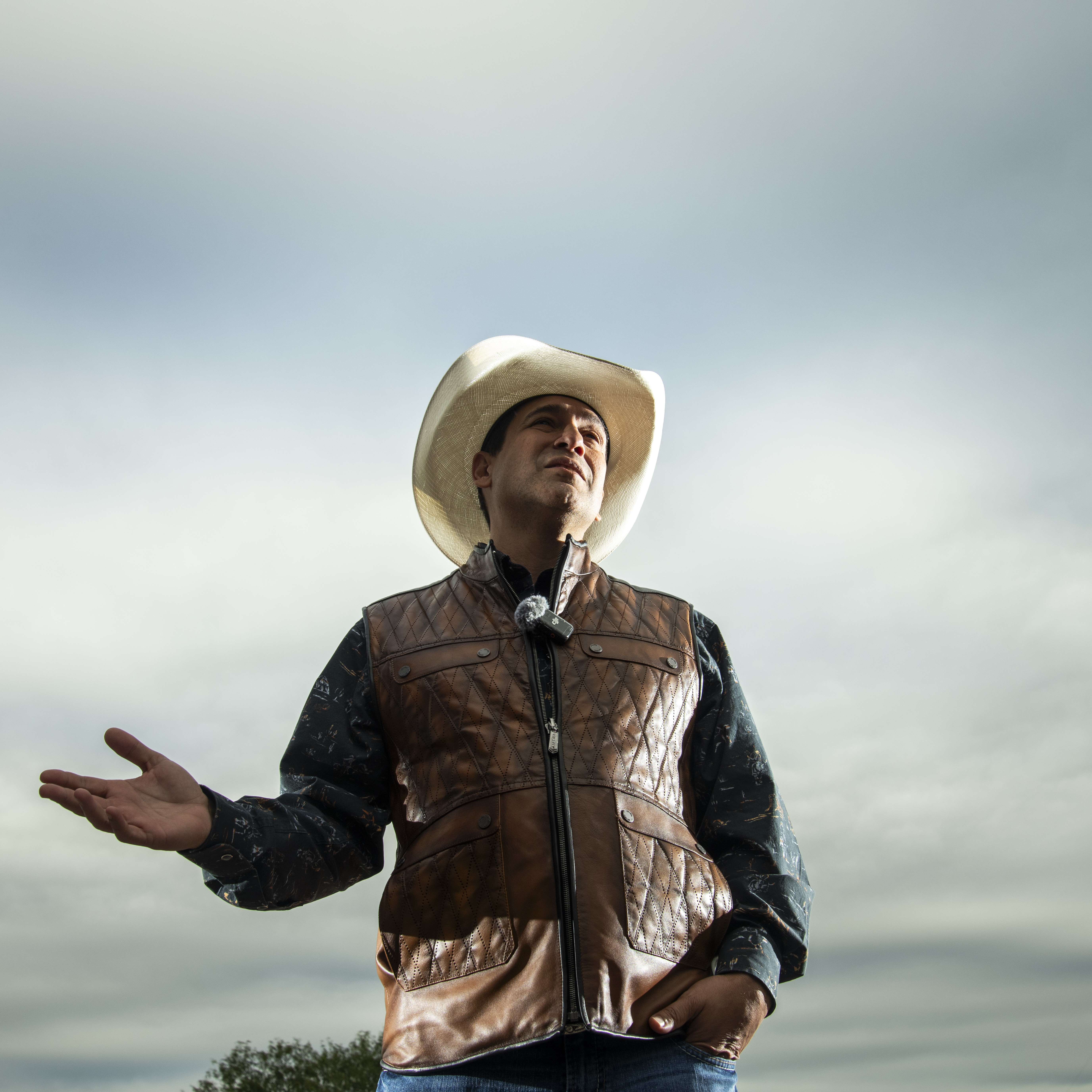
Bobby Pulido, the Democratic candidate in the Fifteenth Congressional District, has been campaigning on nostalgia for that aspirational vision. “The thing that the Democratic Party doesn’t understand is you don’t get anywhere down here calling people ‘the rich,’ as if it’s pejorative,” he told me. “That’s what a lot of people here aspire to be!” We were driving around a wealthy suburb in Edinburg, not far from where Pulido grew up.
[Read: The return of the Democratic manly man]
Pulido, who is 53, was already a celebrity in the Rio Grande Valley, a two-time Latin Grammy–winning Tejano-music star whose 1995 hit “Desvelado” (“Sleepless”) featured a video of him wandering San Francisco, singing of unrequited love. Pulido’s Republican opponent, Representative Monica De La Cruz, dismissed him early in the race as unqualified, a washed-up singer from quinceañera parties. The comment backfired when Pulido started playing for free at local quinceañeras, generating publicity and easy access to large gatherings of potential voters who, Pulido notes, are already celebrating and drinking when he arrives.
Pulido’s family has long straddled music and politics. His father, Roberto, is a Tejano icon; his uncle was the top Hidalgo County executive and another uncle was its district attorney. Pulido studied political science in college, and—like Trump—is a natural showman, campaigning with swagger and a flair for spectacle. Last weekend, he played a concert to a sold-out arena. His opening act was a mariachi band that includes several members who were arrested this year by ICE.
De La Cruz won the district in 2024 by more than 14 points, but the latest polls show Pulido ahead. His campaign has focused on high gas prices, tariffs, and ICE cases that have stirred local outrage. Pulido denounced the actions of ICE last month after officers pepper-sprayed and detained two 17-year-old U.S. citizens, and this month he called attention to the government’s attempt to deport Giovanna Perez, a mother of four whose husband was at Army basic training when she tried to pick up her family’s military-ID cards at a base in Corpus Christi and was turned over to ICE.
I asked Pulido about the shifting politics of immigration enforcement in the Rio Grande Valley, where jobs at Border Patrol and other federal law-enforcement agencies have long been a path to middle-class life, especially for many Hispanic men whose parents immigrated here. Trump’s inroads with Hispanic voters two years ago were partly fueled by frustration with Biden’s inability to contain mass migration, as hundreds of thousands of migrants and asylum seekers—mostly from Central and South America—streamed into the region, overwhelming local charities and public services.
“When I was growing up, we were all Tejanos here for the most part. There were not many Mexicans,” Pulido told me. “This was a pass-through area, where people would go up north to look for opportunity.” That changed when drug-war violence sent families fleeing for safety. “Our restaurants got a lot better, because they started bringing in Mexican cuisine. Then, slowly but surely, they brought businesses, they started investing, and, man, we started booming. We started growing, and then something else happened: We started integrating with them,” he said.
The next day, I went to a happy-hour event for De La Cruz at a nearby tavern. There were about 40 people in the room, and De La Cruz, a former insurance agent, told them she got into politics to stand up for Border Patrol agents after a neighbor, the wife of an agent, had asked for donations of stuffed animals to give to children coming across the border without their parents. “I wanted to be their voice. I wanted to stand up,” De La Cruz told the crowd.
Like other Republican candidates, De La Cruz told her supporters that the implications of the midterms would extend far beyond South Texas. “This election is about making sure that your grandchildren, that your great-grandchildren, will have a free country to live in,” she said. The September 11, 2001, attacks were a galvanizing moment in her life, she noted, adding that Democrats had selected “a radical Islamic communist” as mayor of New York City “where the Twin Towers fell,” referring to Zohran Mamdani. The audience responded with cheers. “This election is about saving the soul of our country that was founded on Judeo-Christian values,” she shouted.
More quietly, De La Cruz has tried to distance herself from Trump’s mass-deportation policies, and during an interview after her speech, she told me that she supports “common-sense enforcement policy.” I asked why she voted, along with other Republicans, for two bills that together gave ICE more than $100 billion for immigration enforcement—10 times its annual operation budget. De La Cruz tried to steer the conversation to affordability and grew irritated when I pressed her about the ICE funding. She said she is candid with Republican leaders in Washington and tells them that enforcement should focus on criminals, “not hardworking families,” and that when a constituent needs help with ICE, her support for the Department of Homeland Security gives her clout that Democrats lack. “When I call Washington, D.C., for one of these families, guess what? They pick up the phone,” she told me.
[Read: The Republicans are bolting from Trump]
Her campaign has been attacking Pulido for having played with a former bandmate who was a convicted sex offender. (Pulido says that he hadn’t been aware of the man’s criminal record and cut ties when he learned about the conviction.) Last week, De La Cruz seemed eager to distance herself further from the White House, and was running new ads that tout her as a corruption fighter who will stand up to members of her own party.
The next day, I went to see a Democratic candidate whose win seems like a foregone conclusion: Representative Henry Cuellar, an 11-time incumbent. Cuellar was meeting with supporters at a private residence where plates of cabrito (“kid goat”) were served around a pool. Trump had just called Cuellar a “LOSER,” and “one of the most disloyal political people on Earth!” in a Truth Social post. The president told Republicans to vote for Tano Tijerina, a former Democrat who switched parties in 2024.
In 2024, Cuellar and his wife were indicted on more than a dozen counts of bribery and corruption-related charges for allegedly taking $600,000 from an Azerbaijani energy company and a Mexican bank. Cuellar denied wrongdoing. Trump pardoned him last year, but to the president’s disappointment, Cuellar stayed with the Democratic Party.
Republicans redrew the boundaries of Cuellar’s district last year, but they used Trump’s 2024 margin of victory, rather than the closer margins of local races, to calculate their advantage. As Hispanic voters have swung back toward the Democrats, Cuellar’s district has turned bluer. The latest polls show him with a double-digit lead, and earlier this month the largest Republican House PAC essentially raised a white flag, redirecting $3 million in planned spending to more competitive races.
Cuellar’s district includes Starr County, one of the poorest in the state, which has a Hispanic population of about 97 percent. Trump lost to Hillary Clinton there by 60 points in 2016. Eight years later, Trump won it with almost 58 percent of the vote. It was the first time the county had voted for a Republican president since 1892. Cuellar told me that many of his constituents are men who work in oil and gas, and they once feared Kamala Harris would squeeze the industry. Now they’re getting crushed when they fill up their pickup trucks. “People used to tell me: El Trumpo va muy fuerte. Not anymore. The wind has changed. And the two issues are immigration and the cost of things,” Cuellar said, using the Spanish for “Trump is really strong.”
Cuellar’s district includes the border town of Roma, whose historic downtown is perched on a bluff overlooking the Rio Grande. The Trump administration had installed a floating orange barrier in the middle of the channel to block migrants from swimming across. It looked like a giant pool noodle.
Mass crossings into the Rio Grande Valley during Biden’s term galvanized voters for Trump in 2024. At the McAllen Country Club, I met with Judge Richard Cortez, the chief executive for Hidalgo County, who had to deal with the crisis. The golf course was under renovation, so the club looked out on a parched expanse of barren hills and construction machinery. Cortez was one of the South Texas Democrats who had urged the White House to halt illegal border crossings even if it meant angering pro-immigrant groups in the party’s base. “I knew Biden was in trouble with immigration because we were living it,” Cortez told me. He invited Biden to visit—twice, he said—to no avail.
When I asked Cortez whether he thought Trump still retained support among male voters in the district, he introduced me to a group of men drinking whiskey and playing dominoes across the bar. Cortez said they were local big shots in real estate and manufacturing. All four men said they planned to vote Republican. “The Hispanic vote has gotten more conservative here,” one of the men, Henry Temkin, told me. “People are getting a little bit more knowledgeable. They’re not voting straight Democratic like they used to. They’re analyzing what the policies are.” He said he didn’t believe the polls showing Democrats poised to win.
During my visit, I kept thinking back to something that Rocha, the political consultant, had told me: Many of these voters are not “voting for the Democrats because they love the Democrats.” The party has a lot of work to do before the 2028 presidential election, he said.
Many Rio Grande Valley voters who supported Trump in 2024 still backed Democrat candidates in local races downballot. But the Democrats’ legacy advantage is fading in a place where families are acutely sensitive to big changes in federal policies—on immigration, taxes, inflation. Election support will be won and lost based on whether the government is making voters’ lives better, or not.
Jack Rodriquez-Vars contributed research for this story.
This article originally stated that Donald Trump and Joe Biden roughly split the votes of Latinos in 2024. The Democratic presidential nominee that year was Kamala Harris, not Biden.
© Brian Finke for The Atlantic