Two graphs show that Ukrainians are currently attacking at least as much as Russians. They are also advancing just as often.
The map, meanwhile, illustrates the territory Russians have captured in Donbas this year. It is smaller than in previous years.
New tanks and other equipment have begun appearing in Russian storage facilities. Russia is preserving them, possibly for another war.
Videos of the day: a Russian quad bike accident at the front; a Russian worker climbing an anti-drone net; Ukrainian children playing with a Russian drone.
Part of the population still believes that Russia is winning the war. It does not matter that it has failed to subjugate Kyiv for more than four and a half years, or to capture Donbas even after 12 years. It still has 20 percent of Donetsk oblast left to occupy — not 10 percent, as Russian president Vladimir Putin claims.
Of course, victory in war can be measured in different ways, and the movement of the front is not always decisive. But when it comes to activity at the front itself, the battlefield is essentially frozen. And Russian momentum is far weaker than it was at this time a year ago.
In today’s Ukraine Battlefield update, we present two graphs and one map showing that Russia is not currently winning the war on the battlefield.
The first graph suggests that Ukrainians are now launching attacks more frequently than Russians. It was published by the Ukrainian account Oko Hora.
It calculated the ratio of attacks on the basis of data from the Ukrainian general staff. The staff reports the number of engagements and the number of Russian attacks, meaning that the difference between them indicates Ukrainian attacks.
This methodology may not be precise, but other battlefield reports also suggest far greater Ukrainian activity than a few months ago or last year.
This article continues, but the full version is available only to EUobserver.com subscribers. Visit account.euobserver.com/membership
For the first time, Ukrainians rescued a wounded soldier by air.
He spent 500 days at the front, during which he had to amputate his own legs.
How the operation unfolded and what Ukrainians had to do to distract Russian drones.
Rubio repeats Putin’s claims about occupied territory in the Donetsk region.
Videos of the day: the first capture of a Russian tank this year; a swarm of Ukrainian drones.
The information in this text is a summary of events on Monday (19 October). The situation may have changed since then.
Hardly a week passes without some new development being reported on the frontline of Russia’s war in Ukraine. This time, Ukrainians demonstrated something truly unique. For the first time, they succeeded in evacuating a wounded soldier using a heavy rotary-wing aerial drone.
The story was published by the 30th Separate Mechanised Brigade and reported by a journalist from the Oboronka website, who spoke to both the operators and the wounded soldier. The evacuation took place near Kupiansk in the Kharkiv region, on the left, or eastern, bank of the Oskil river.
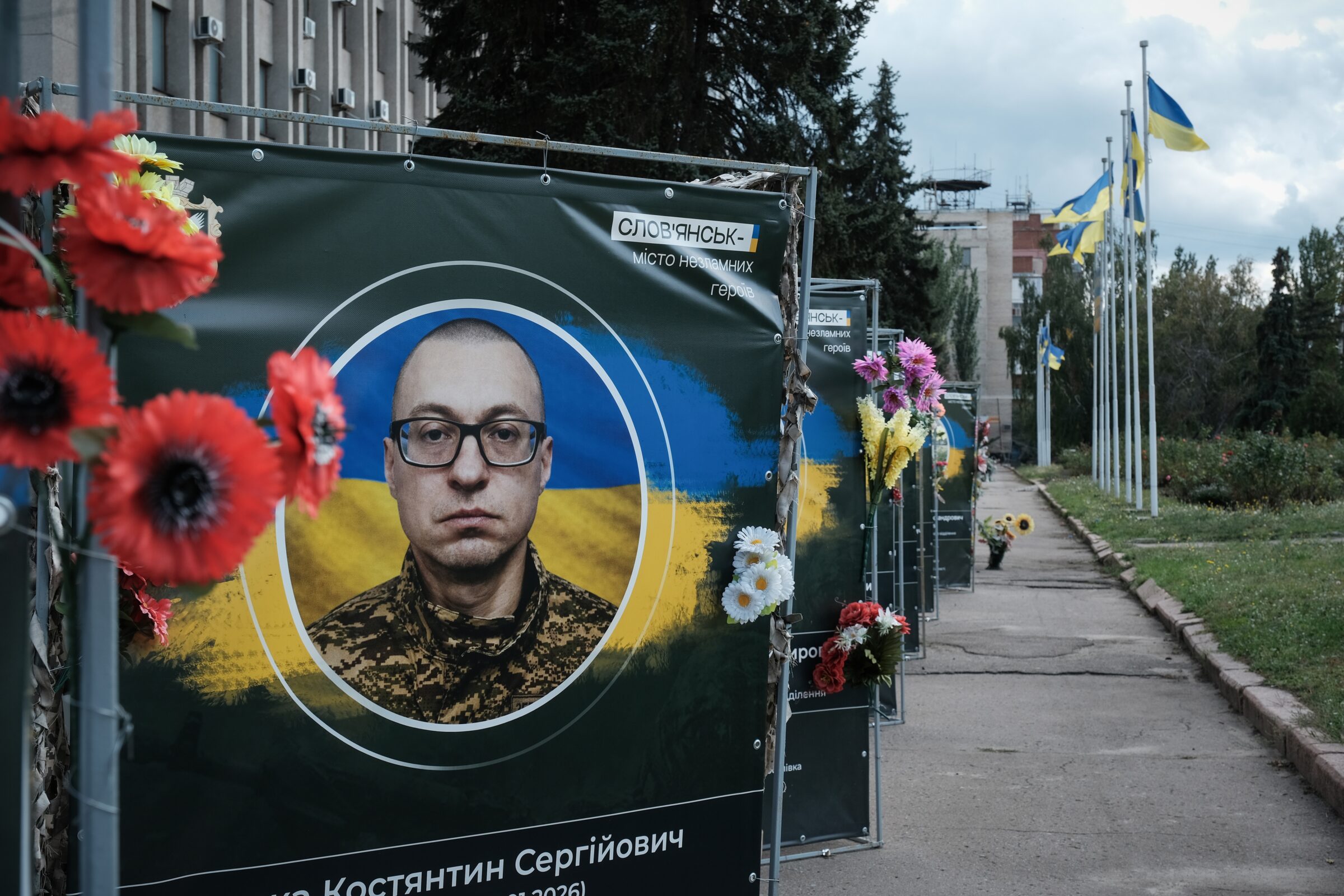
Infantryman Kostiantyn ‘Magura’ Vlasenko of the 2nd Mechanised Battalion of the 30th Separate Mechanised Brigade was tasked, together with a comrade, with heading into the grey zone in early June 2025.
Initially, they hid in one place, but when their position was flooded, they had to leave the building and take shelter elsewhere. Returning was impossible because of the dangerous situation. His comrade later died.
In February this year, Magura was also wounded by a Russian drone. Munitions dropped from the drone injured both his legs. According to Oboronka, he had to amputate his own lower limbs in order to survive.
The website did not give details of how he managed to do this. Similar cases have, however, occurred in the past.
In 2018, for instance, during an exercise in Slovakia, an American soldier was trapped beneath a tank. He amputated his own leg to save a fellow soldier, for which he was named Soldier of the Year in 2021.
In Magura’s case, this meant he was left immobile, and it was clear that he would not return from the front by himself.
Ukrainian units considered how to help him. The situation was extremely difficult in this respect.
This article continues, but the full version is available only to EUobserver.com subscribers. Visit account.euobserver.com/membership
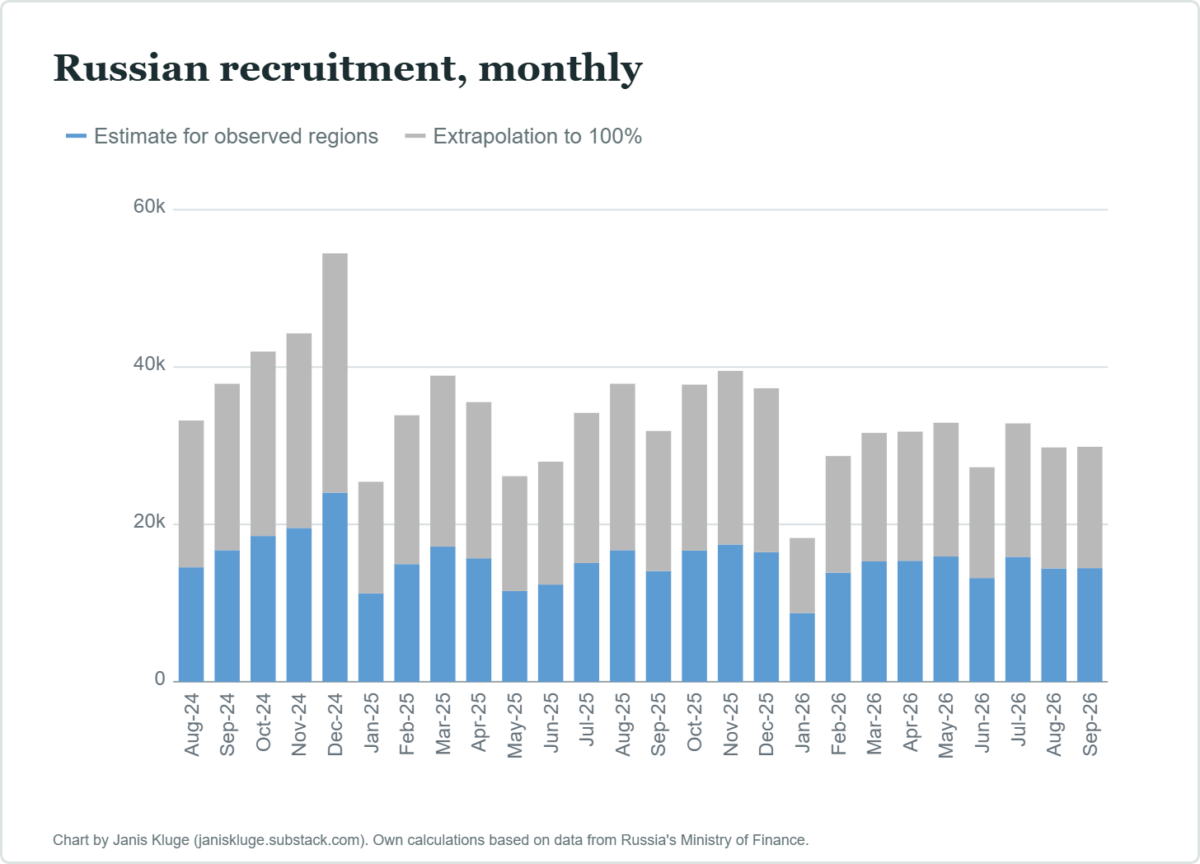
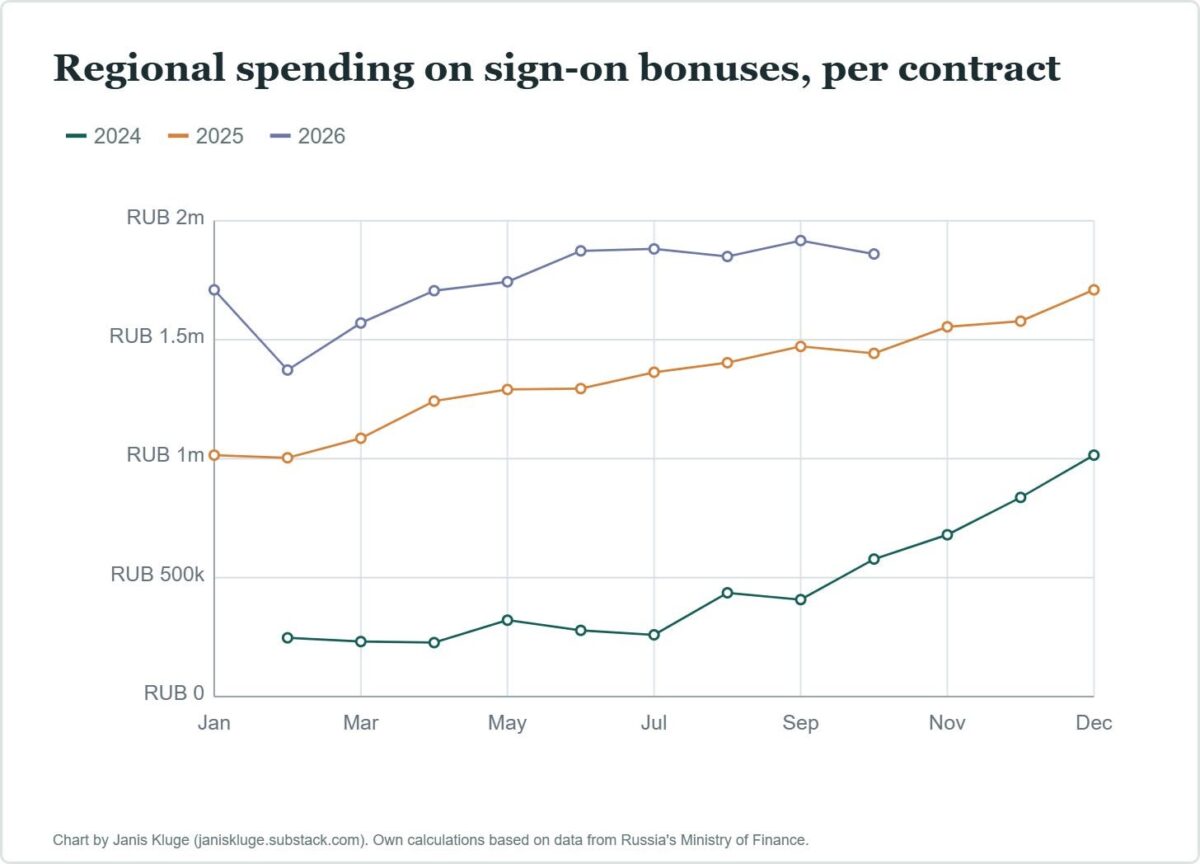
Russia is estimated to be recruiting 10 percent fewer soldiers this year than last, despite regions raising signing bonuses.
There is growing talk that criminal gangs have begun to take part in recruiting “volunteers”.
According to the Ukrainians, Russia is losing large numbers of soldiers, and October could be a record month.
Attacks on the land route to Crimea continue, reportedly prompting Russia to transport fuel in jerry cans in smaller vehicles.
Map of the day: Where Russia is advancing and where Ukraine is advancing
Videos of the day: Ukrainians hit a Russian radar; a man surfed on a Russian drone near Odesa; speculation spreads that Iran is supplying Russia with fuel.
Many Russians have left Russia in recent months. They feared the mobilisation that had been so widely discussed. Ukrainians said Russian president Vladimir Putin might resort to it after the September parliamentary elections. Many Russians fled to Armenia and Georgia, affecting rental prices in the capitals of these Caucasus states.
So far, no mobilisation has taken place. Russia continues to rely on its existing system of voluntary — and, in some places, involuntary — recruitment of new soldiers in Russian regions.
German economist Janis Kluge, who tracks regional data, wrote last week that Russia recruits around 1,000 new soldiers a day (30,000 a month). That is less than last year — down six percent in September and 10 percent over the year as a whole.
Nor did it help that, by his estimate, the sum paid by regions as a signing bonus had risen from $16,000 (€14,000) to $22,000.
In some places, recruitment is also beginning to move into the illegal sphere. Kluge wrote that local criminal gangs were now becoming involved in the system.
He mentioned the case of a prosecutor in Nizhny Tagil, a city of 400,000 in the Urals. In September, he appealed to the budget committee of the local duma.
He complained that signing bonuses for Russian soldiers were leading to an increase in crime in the city. He called for payments to agents who find volunteers willing to sign an army contract to be stopped.
According to Kluge, the prosecutor complained that criminal elements had become involved in recruitment in the city. He said an agent received $4,500 for finding one person to sign a contract.
Many turned to gangs to help them, with the assistance of corrupt police officers or military recruiters who are part of the scheme. “And this ‘persuasion’ may also involve violence, as another case from Sverdlovsk region shows: two criminals forced their victims to sign contracts and then seized their bonus payments,” Kluge wrote.
In Nizhny Tagil, 580 new soldiers were recruited last year, compared with 330 this year. It is not known how many of them criminal gangs helped to “persuade” in exchange for payment. In any case, the city does not want to change its system of rewards for agents because, in the words of the deputy mayor, it helps “fulfil our tasks”.
Overall, it is becoming increasingly difficult for Russia to supply enough manpower to the front. Moreover, it is currently losing large numbers of soldiers there, and October’s losses could even be record-breaking.
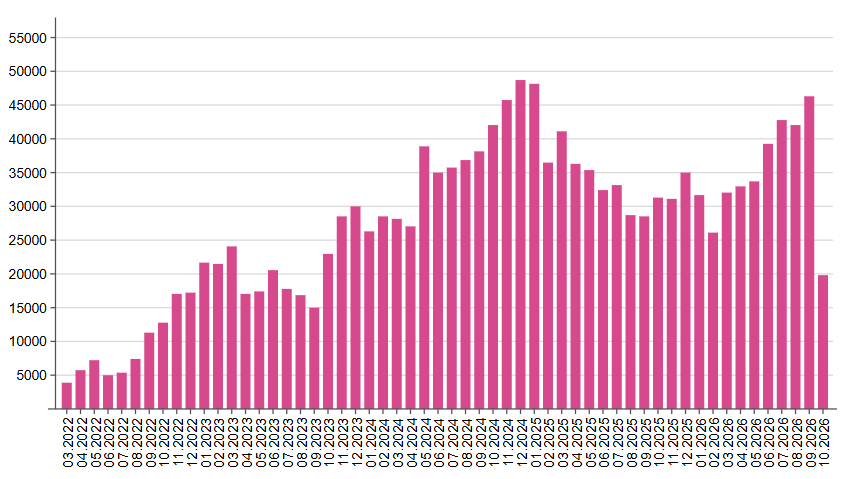
Ukraine publishes daily figures for killed and wounded Russian soldiers. These figures cannot be verified and may be inflated, but the trend suggests that the situation is worsening for Russia.
The table below also shows this. According to it, Russia lost around 46,000 soldiers in September — more than 1,500 a day — making it, according to Ukrainian data, the second-worst month since the start of the war. The figure was higher only in December 2024.
This October is on course to become Russia’s worst month in this respect. By the 12th day of the month, Russia had been losing an average of 1,620 soldiers per day. If Ukraine maintains this pace, it will be a record.
Number of Russian military casualties per month, according to Ukraine. Source: minfin.com.ua
Naturally, the question is how much these figures can be trusted. However, the Unmanned Systems Forces, a unit commanded by Robert Brovdi, known as Magyar, also publish figures for killed and wounded Russian soldiers.
The Ukrainian units under its command compete with one another over which can strike more Russian targets. They receive points based on this, which they can then use to buy more drones. Individual strikes should therefore be confirmed by video.
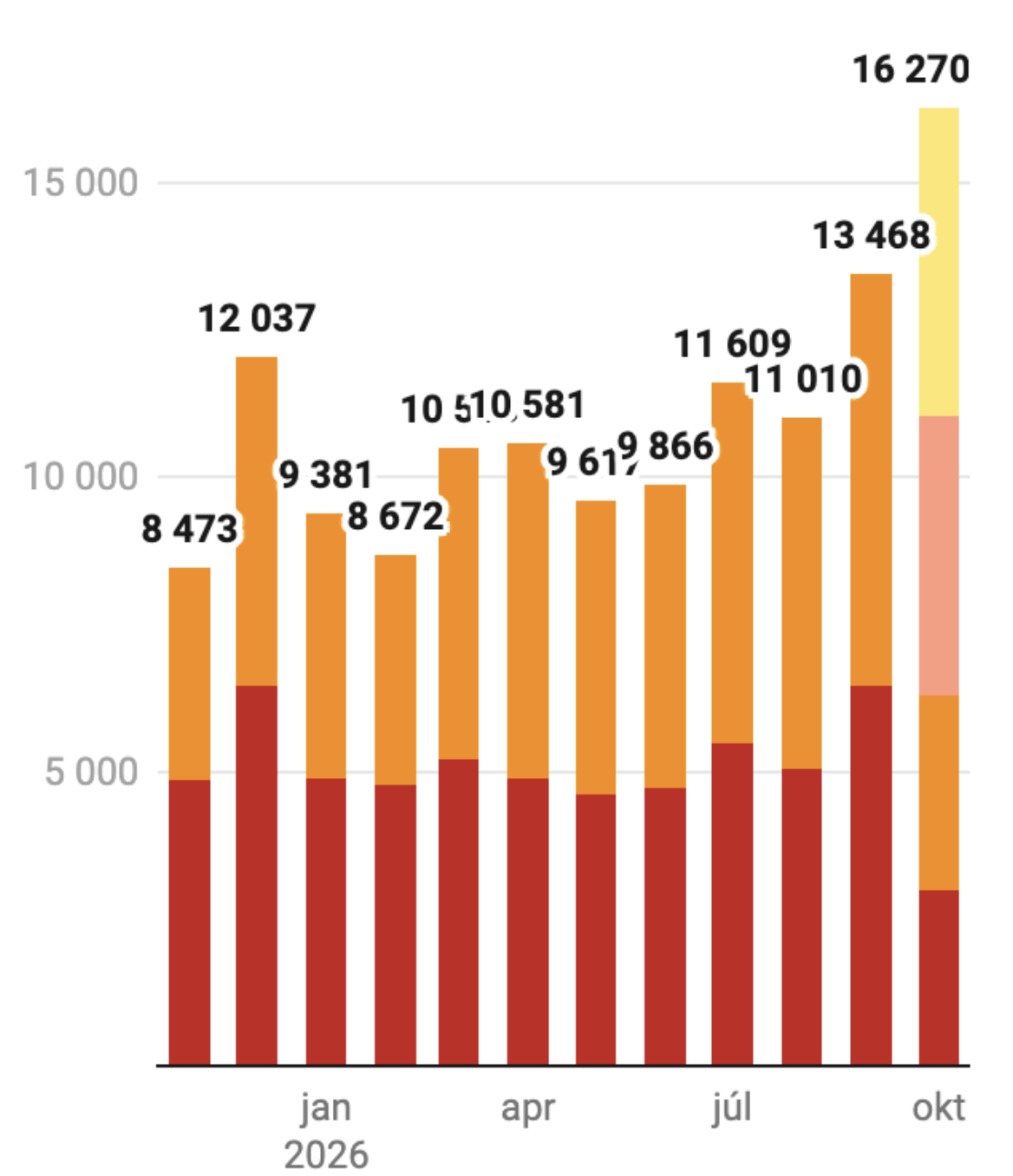
Given this, the data published by the Unmanned Systems Forces can be considered credible. They too indicate that October could be a record month, although their data cover only one-third of Russia’s total losses.
Number of Russian soldiers killed and wounded by SBS drones
The total number of Russian soldiers hit by Ukrainian Unmanned Systems Forces (SBS), and the number of those killed. These figures should be verified by video evidence. Red: killed; Orange: wounded; Pink: expected killed; Yellow: expected wounded. Source: Datawrapper/SBS.
Record-high losses and less substantial numbers of newly recruited soldiers suggest that Russia may have difficulties replenishing its units and, consequently, advancing further in Donbas or elsewhere.
Attacks on the land route to Crimea continue. Last week, French OSINT analyst Clément Molin published a table according to which the number of Russian lorries and trucks struck had reached a record 770. Several videos show that the number of attacks on vehicles heading to Crimea or to the front in southern Ukraine remains high. They are simply not discussed as much because this is no longer new.
I continue, on my side, to gather statistics on these mid-range strikes against logistics, not only in southern Ukraine, but also near Donetsk or Luhansk.
In September, at least 770 trucks/vehicles were targeted, only on the videos published by Ukraine more than 20km from the… pic.twitter.com/w9DrQTnGEM
Ukraine also destroyed the Chonhar bridge, which connects Ukraine with the Crimean peninsula. Russia has used a pontoon bridge there instead. This video shows Russian cargo vehicles crossing the pontoon bridge.
Russian truck drivers crossing into Crimea via a pontoon crossing at Chonhar, with a view of the damaged Chonhar Bridge and its support structures, before one of its spans collapsed. September 2026. https://t.co/YLDiB7lJQupic.twitter.com/3oU4GVylDd
The commander of Ukraine’s 41st Pilum Unmanned Systems Regiment, part of the 1st Azov Corps, recently provided interesting information on this issue. In an interview with Radio NV, he confirmed that the number of medium-range strikes was not declining and was increasing in some areas.
He said that the operational zone overseen by Ukraine extended from 30 to 300 km.
According to him, Russia is trying to bring as much fuel as possible to the front. Soldiers need generators to charge equipment, power radios and drones, and keep warm.
However, Ukrainian attacks on fuel tankers are reducing Russia’s ability to bring fuel to the front. According to the commander, in the Dobropillia direction, where his unit operates, Russia began transporting fuel in convoys this summer and switched to distributing it in passenger cars or small trucks, carrying the fuel in jerry cans.
This does not, of course, apply to all directions. However, an ongoing stream of new videos also confirms the destruction of fuel tankers.
Map of the day
Russian president Vladimir Putin’s latest — though certainly not final — deadline for capturing Donbas is by the end of this year. As on 14 previous occasions, it will not be met.
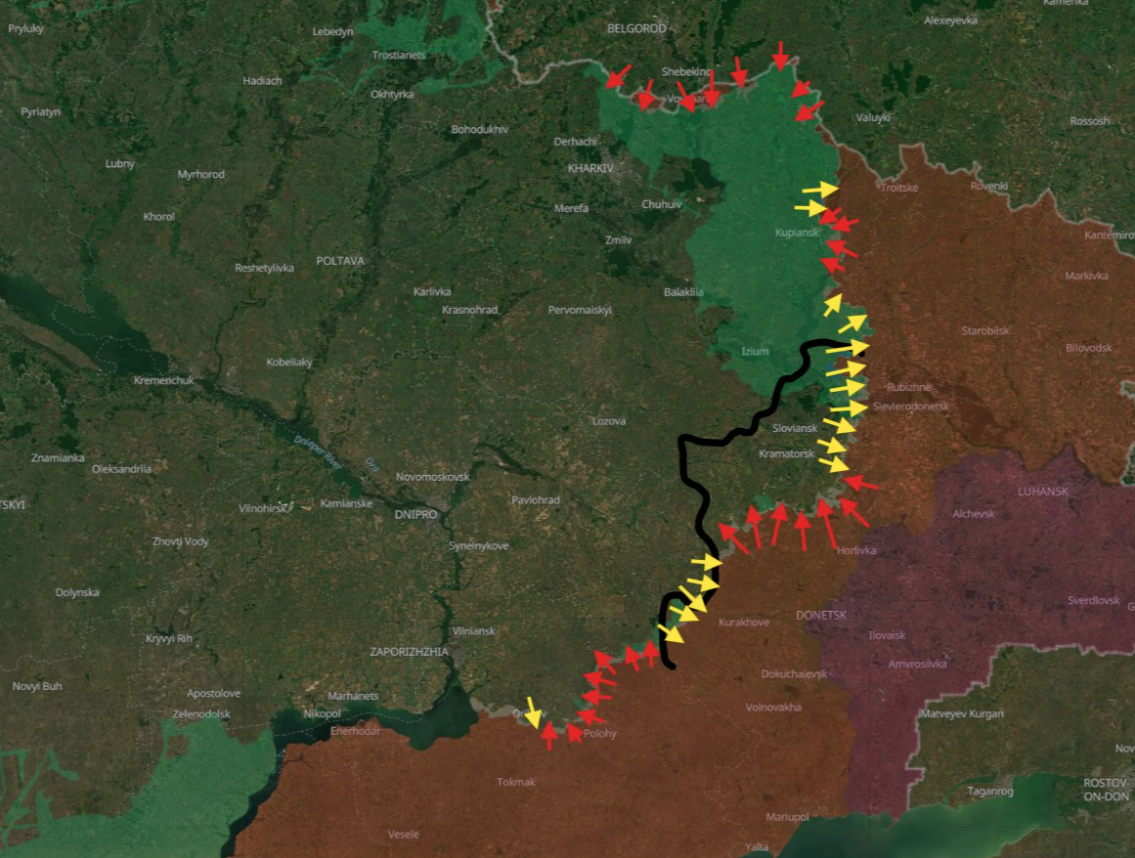
Unlike in previous years, however, it appears entirely possible that by the end of the year the territory of the free part of Donetsk region could be even larger than it is now. This is suggested by a map published by French OSINT analyst Clément Molin. It highlights areas where Ukraine is advancing and areas where Russia is pushing forward.
As can be seen, Russian forces largely hold the initiative in the north of Kharkiv region and at one location in the south of Zaporizhzhia region.
In the crucial Donetsk region, however, the situation is balanced; indeed, it could be said that Ukraine holds the initiative in more places. More specifically, it is clearing the northern area above Lyman and pushing further south towards Velyka Novosilka.
Ukraine’s 15th Reconnaissance Artillery Brigade published a video showing it striking a Russian 96L6 radar. This is a key component of the S-300 and S-400 air-defence systems.
The radar can be seen moving and hiding in a tree line. Nevertheless, a Ukrainian drone struck it. It is unclear whether it was actually destroyed, as the accompanying text claims.
Ukraine’s 15th Artillery Reconnaissance Brigade “Black Forest” located and destroyed a Russian 96L6 radar, a key detection component used with S-300 and S-400 air defense systems. The radar is valued at around $50 million and has a stated detection range of up to 300 km. #Ukrainepic.twitter.com/1K4BUZXZrg
A man near Odesa decided to surf on a downed Russian drone floating on the water off the coast. It hardly needs to be said that this is a fairly risky pastime. However, it indicates how at least some residents of Odesa view the daily Russian attacks.
❗️In 🇺🇦Odesa, a man decided to go surfing on a downed Russian kamikaze drone “Geran”. pic.twitter.com/l3MG3YkQiz
This could be a potentially rather interesting plot twist. The United States is at war with Iran, which has raised petrol and diesel prices at US filling stations. Donald Trump therefore agreed with Putin to import diesel from Russia. Russia itself, however, does not have enough diesel and has to import it.
This video shows a tanker truck with Iranian registration plates in Russia. Some infer from this that Iran is importing diesel — or other fuels — into Russia, which then sends diesel to America, despite America being at war with Iran.
However, it is too early to draw conclusions: we do not know what is in the truck or how many such Iranian tankers are heading to Russia. In any case, Russia is helping Iran in other ways.
A Western official told Bloomberg that Russia was supplying Iran with missiles that it uses in the war against the US and Israel. It was also previously reported that Russia was helping Iran target US bases in the region.
⚡️BREAKING: Convoys carrying Iranian Diesel Fuel are on their way to Russia, where there is a Fuel Shortage
This also raises the question of whether the fuel Russia exports to the United States might originate from Iran pic.twitter.com/J9Fzk7LVDa
By Tuesday (13 October), Russia had verifiably lost 24,192 pieces of heavy equipment (24,170 on Monday, 5 October). Of these, 19,155 (19,133) were destroyed by Ukraine, 1,002 (1,003) damaged, 1,194 (1,194) abandoned by their crews, and 2,841 (2,840) captured by the Ukrainian army. The total includes 4,453 (4,452) tanks, of which 3,358 (3,357) were destroyed in combat.
Ukraine lost 12,259 (12,238) pieces of equipment, of which 9,652 (9,633) were destroyed, 713 (711) damaged, 695 (695) abandoned and 1,199 (1,199) captured. The total includes 1,471 (1,466) tanks, of which 1,131 (1,126) were destroyed in combat.
Note: Neither side regularly reports its dead or destroyed equipment. Ukraine publishes daily figures for Russian casualties and destroyed equipment, which cannot be independently verified. This overview uses data from the Oryx project, which has compiled a list of equipment losses documented exclusively by photographs since the start of the war.
Montenegro detained Mikhail Zvinchuk, the founder of the Rybar Telegram channel.
Key directions according to Rybar, Ukrainian and independent analysts.
Forget Sloviansk: its capture is currently unrealistic.
Ukrainian pressure continues towards Velyka Novosilka, with fighting already under way near Komar on the eastern bank of the Mokri Yaly river.
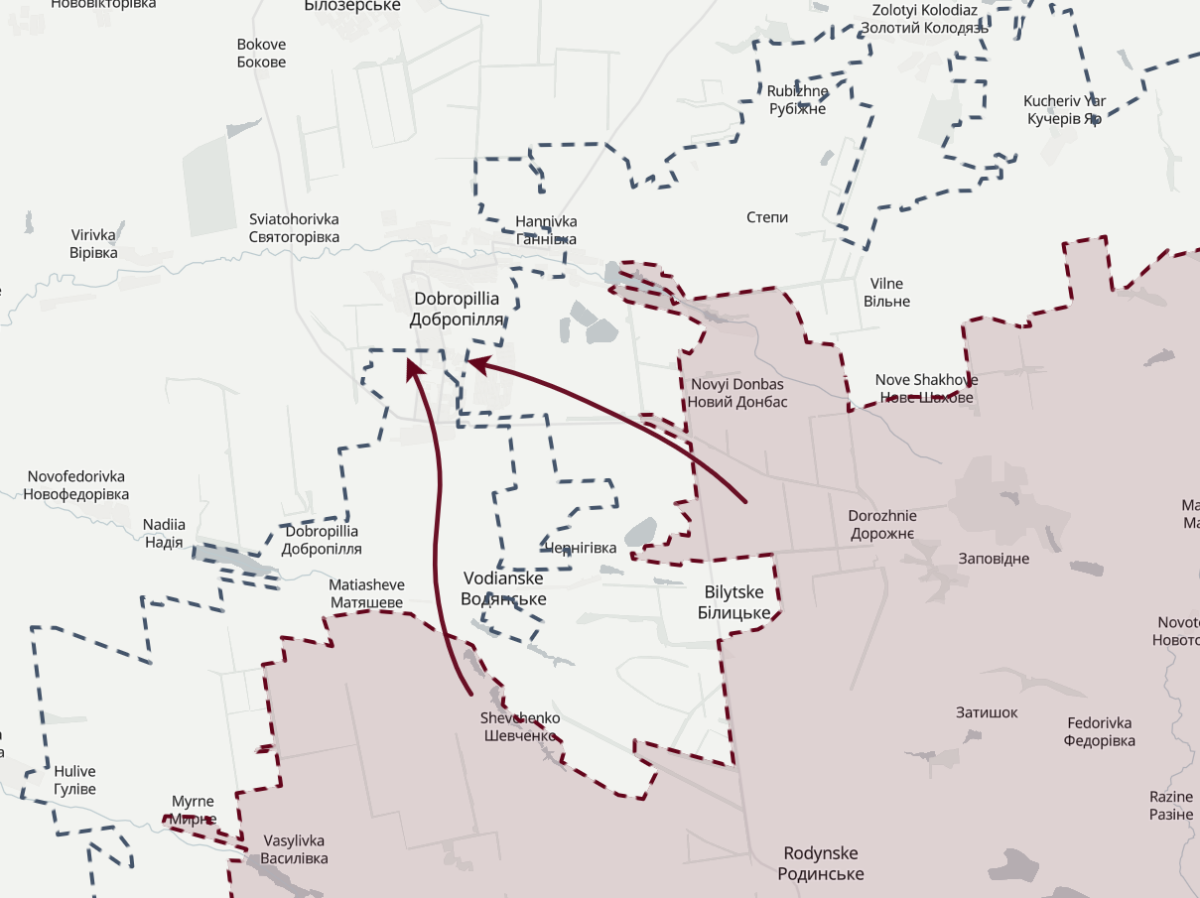
Russians are infiltrating Dobropillia, but a Ukrainian counteroffensive is pressing against their flank from the north.
The battle for data centres is now two-way, with Ukrainians attacking Russia’s ‘Google’.
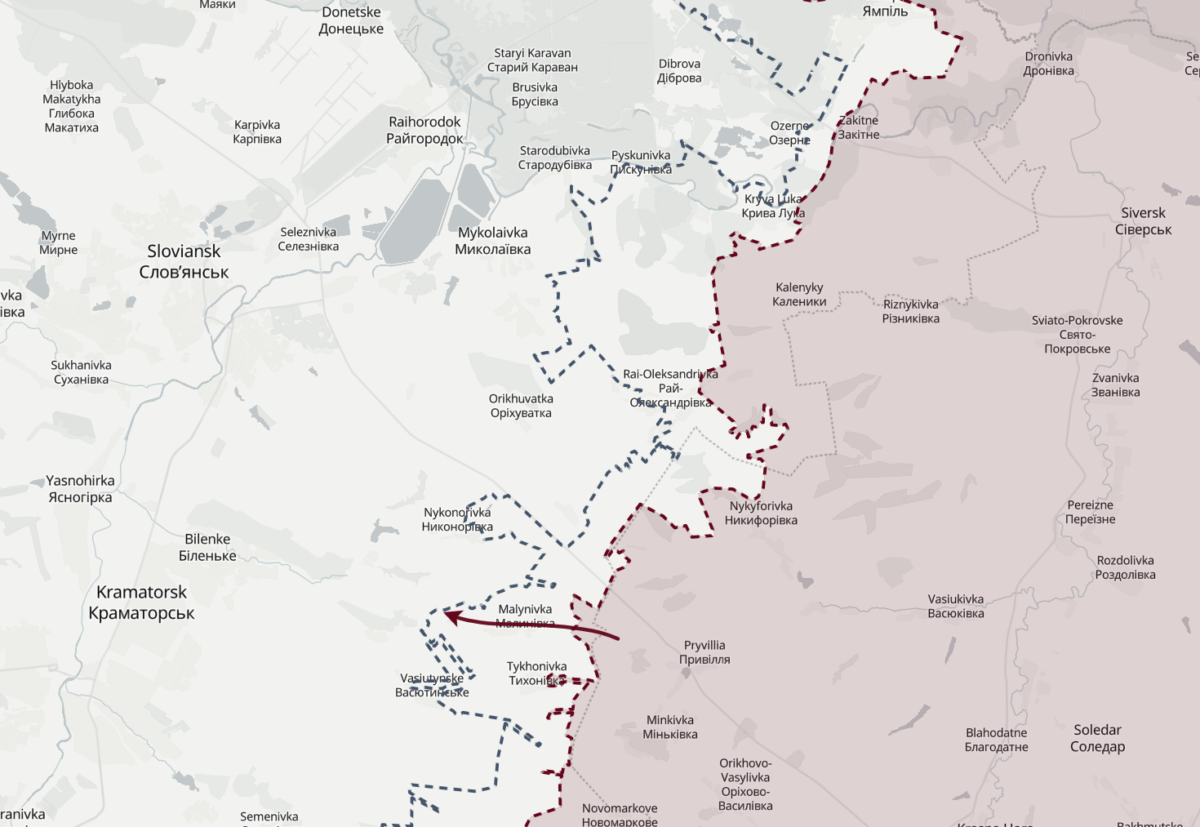
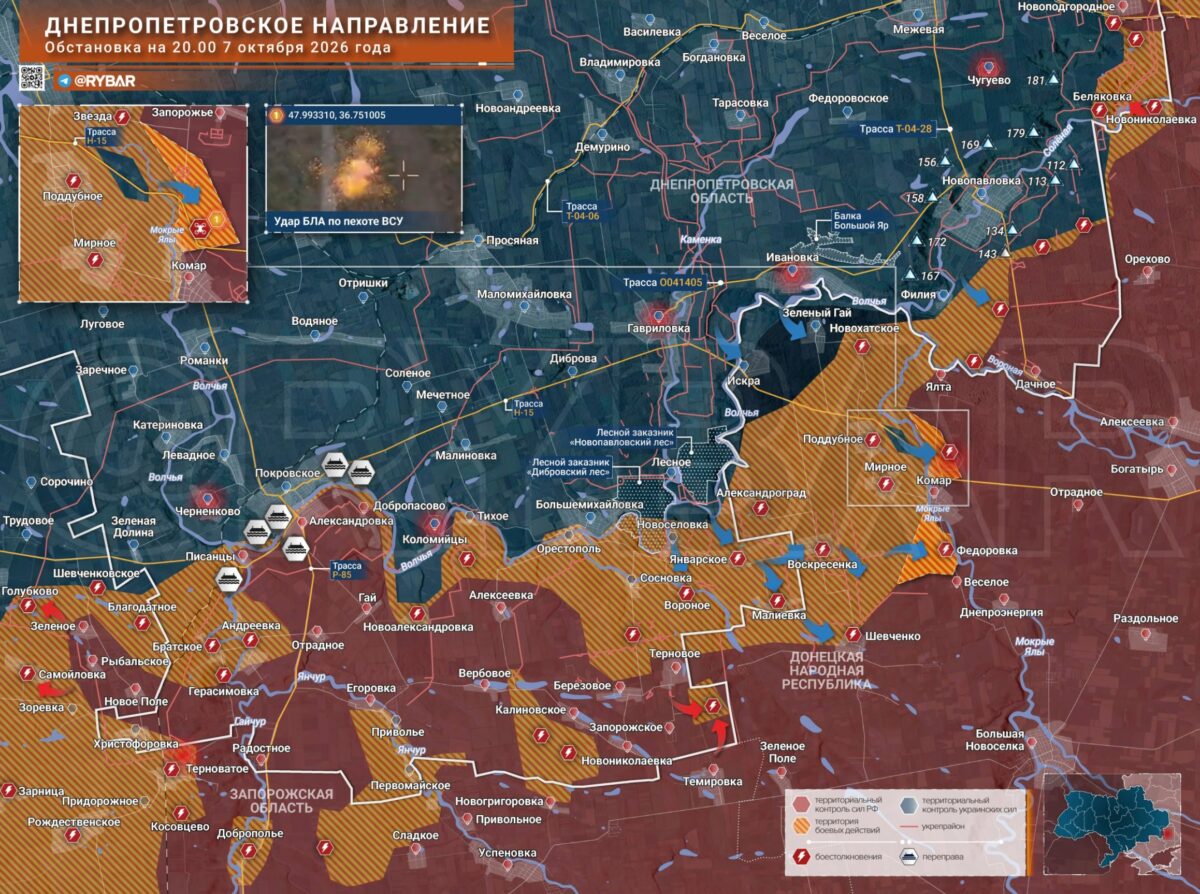
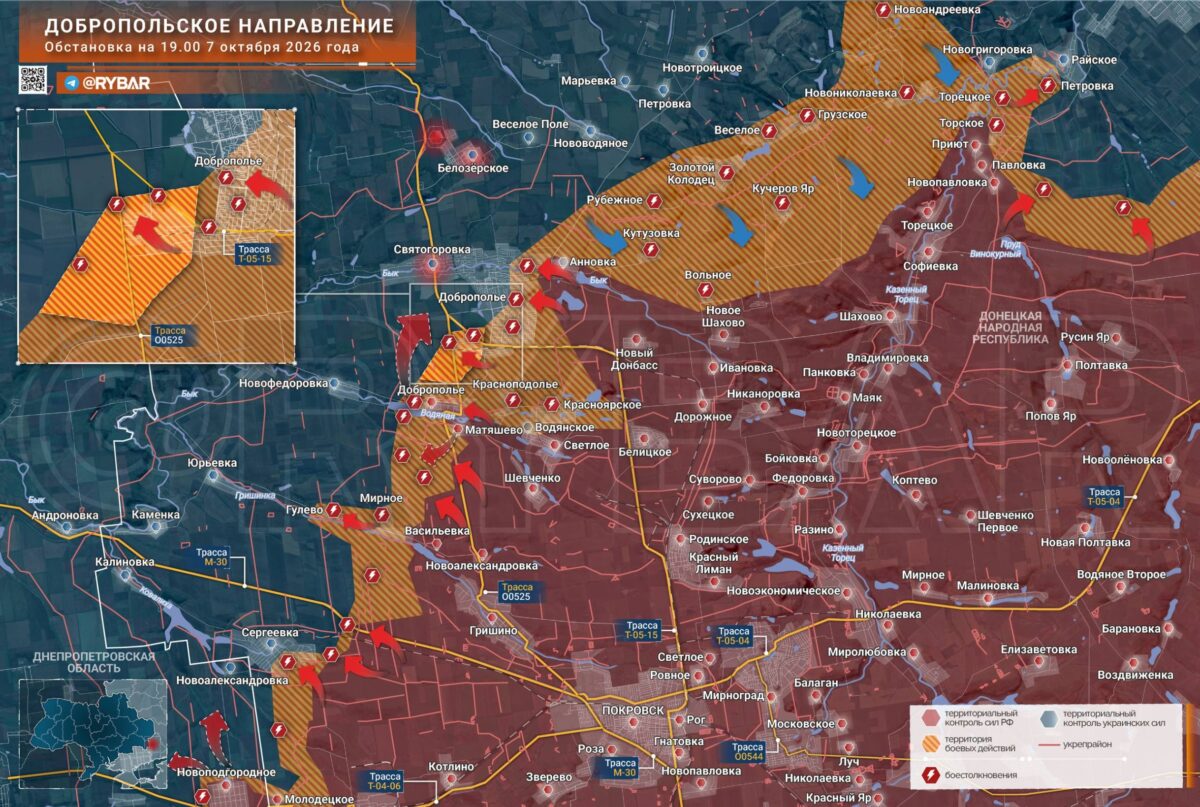
Maps of the day — Sloviansk direction; Velyka Novosilka direction; Dobropillia direction.
Videos of the day — a scene from the Second World War: a MiG-29 shoots down a drone with its cannon; soldiers clear a network of Russian bunkers; Himars destroys an artillery radar; what the R-280 road to Crimea looks like.
Montenegro detained Mikhail Zvinchuk, the founder of the Rybar Telegram channel, who occupies one of the leading positions in the ecosystem of Russian media supporting the war. His wife and several associates were arrested alongside him. Colleagues in Moscow issued a statement saying they had been planning to film a report on one of the local monasteries, but the authorities of the Nato member state suspected them of conducting a hybrid operation.
At the top of Russian propaganda are the traditional state media, under the Kremlin’s complete control. They have almost no informational value, as they merely repeat the regime’s propaganda.
Below them, however, is a complex structure of Telegram channels that provide more varied reporting, including critical coverage. However, criticism is permitted only of mistakes in the conduct of the war, not of the war itself.
These channels, too, spread propaganda and keep Russian society in a state of war, but they also provide information that helps in analysing the course of the fighting. Rybar is among the largest and most influential of them.
In this case, it is not the work of an individual author but a media outlet with an editorial team and extensive content for 1.5m readers, so Zvinchuk’s arrest does not mean the end of publishing under this brand.
Yet through him, we can follow the fascinating story of a man who came from Russia’s defence ministry to spread its propaganda in the years that followed.
Paradoxically, however, he has recently been one of the few sources in Russia to report regularly on the Russian army’s failures at the front. And the preceding 48 hours were particularly rich in such assessments.
We will therefore gradually describe events in three different directions where, according to Rybar, the Russians are either retreating or at risk of doing so. Coincidentally, these are currently the most important directions of military operations.
We will compare all of its information with independent or Ukrainian sources.
Forget Sloviansk: its capture is currently unrealistic. “The situation is worsening; Sloviansk is being postponed,” Rybar wrote in the first sentence of its latest analysis of the Sloviansk direction. It explained why at length.
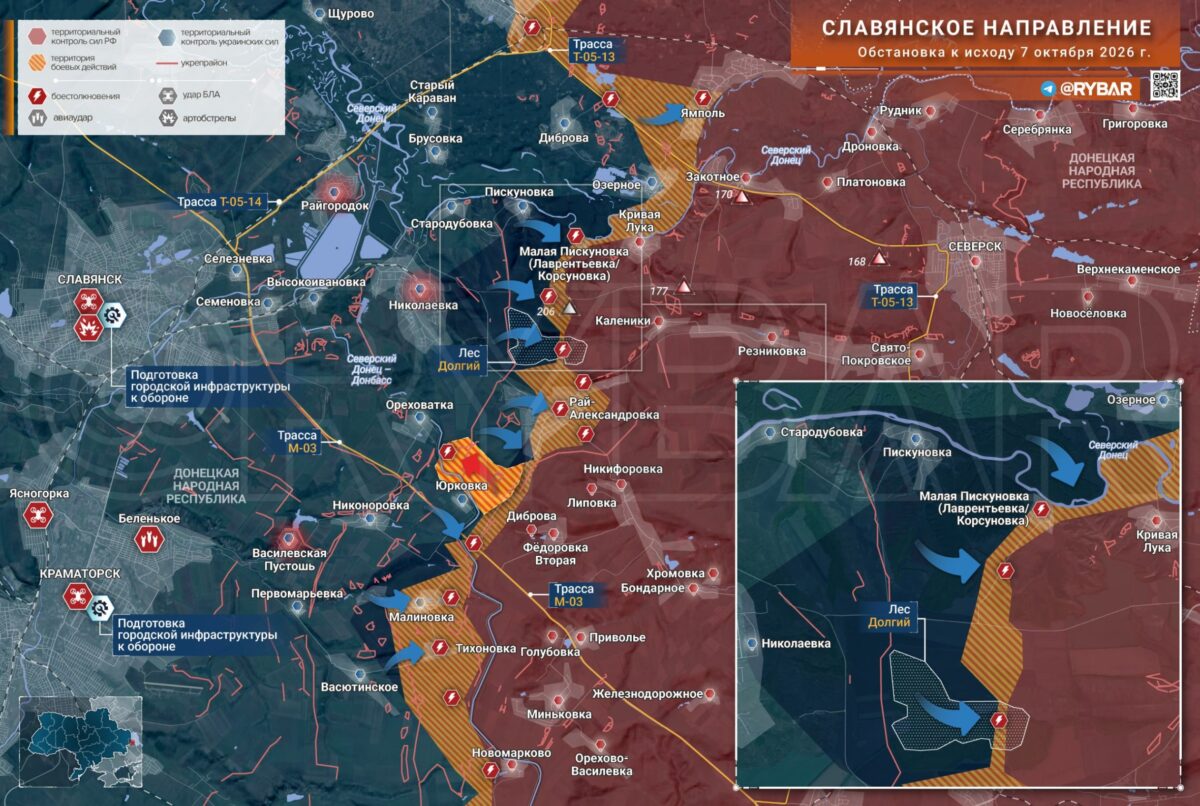
According to it, Ukrainian units in the area are increasing the pressure and exploiting their successes near Lyman, which lies north of Sloviansk. The Russian army has suffered a serious defeat here in recent months, losing a large salient from which it had hoped to bypass the Sloviansk-Kramatorsk agglomeration from the north.
Rybar listed the ensuing complications: according to it, Ukrainians have concentrated fresh drone units around the village of Dibrova; the Russians had to withdraw from the village of Piskunivka and are now trying to save Kryva Luka. Ukrainians are also pressing into the village of Ozerne.
Ukrainian formations are increasing their activity, exploiting successes in the Lyman area, where fresh forces of drone operators have been concentrated around Dibrova.
Russian troops were pushed out of what remained of the village of Piskunivka and are now defending the approaches to Kryva Luka. The enemy is trying to break through there both from the west and across the river from Ozerne.
Moreover, heavy fighting is under way west of the village of Kalynyky, while fighting for Rai-Oleksandrivka is “fierce”, “although it was under the Russian army’s full control only recently”.
Nor is this the end of Rybar’s bad news. An “equally difficult situation” persists on the western bank of the Siverskyi Donets-Donbas Canal, where Russian soldiers are “for now” holding positions in the villages of Malynivka, Tykhonivka, and Yurkivka.
Taken together, all of this means that the prospect of an “attack on the agglomeration has receded considerably”.
“Without control of the forests below Lyman, the offensive is doomed, if not to failure, then to high losses from attacks on its flank,” Rybar added.
Its map fully matches the verbal description. The red arrows running from east to west along the entire stretch have been replaced by blue, Ukrainian arrows pointing from west to east.
Paradoxically, the local Telegram channel Mikolaivka-Sloviansk Online provides a far less optimistic picture.
While Rybar no longer even mentions Mykolaivka, which directly borders Sloviansk, according to this source — which has repeatedly provided highly accurate and widely cited information — Russians are still managing to infiltrate it. On Wednesday, it wrote that “the Russian army is applying pressure from the direction of Rai-Oleksandrivka”, while the village itself is in the grey zone.
The explanation may be simple. Most of the names refer to villages the Russians never fully captured, although they claimed they had — including Rybar itself. This is why its map looks as though a small counteroffensive were under way east of Sloviansk. In reality, it mainly makes its previous misleading claims more realistic.
Far more accurate is the map by the Finnish Black Bird Group. Rai-Oleksandrivka is in the middle of the image — no credible analysts have ever considered it occupied by the Russians. Further north are Ozerne and Kryva Luka. Ozerne is particularly interesting.
According to Rybar, the Russians are trying to prevent the Ukrainian army from entering the village; independent analysts show it partly in the grey zone and partly under Ukrainian control. Rybar therefore correctly sees Russian problems, but at this point this is more its usual cartographic “retreat” from unrealistic positions.
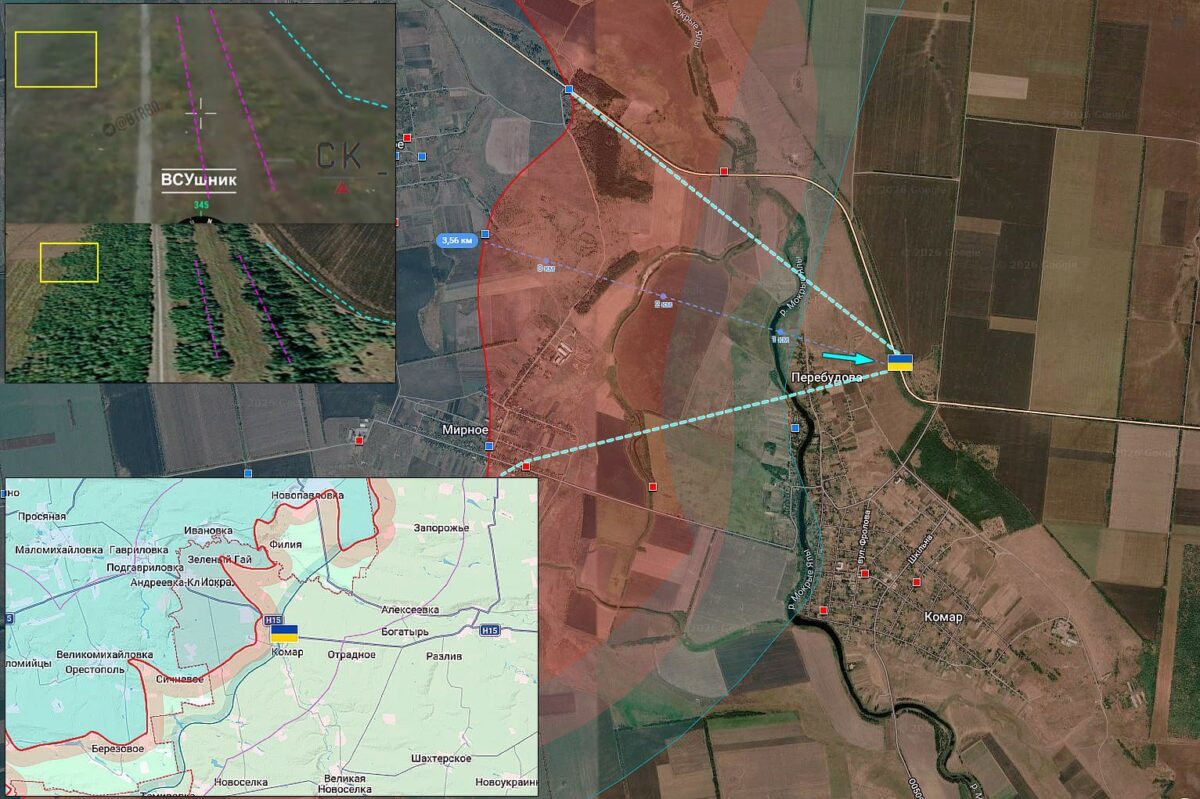
Ukrainian pressure continues towards Velyka Novosilka, with fighting already under way near Komar on the eastern bank of the Mokri Yaly river. This is not entirely new either, but several Russian sources are writing about fighting in this direction with new urgency and, from the Russian perspective, scepticism.
“The situation remains extremely tense. There is mounting evidence that the enemy is seeking to advance around the village of Komar,” Rybar wrote.
This is an important village. When the Russians captured Velyka Novosilka last year after taking Vuhledar, Komar was a significant obstacle to their advance into Dnipropetrovsk oblast.
Fierce fighting took place over the village at the time, and the Ukrainian army lost it in June 2025. The front then moved another 15 to 20 km deeper into Ukrainian territory, but it is now moving back after months of slow advances.
Here, too, Rybar’s map appears more dramatic than the situation actually is. It depicts territory being liberated since February. However, it claims that the situation is worsening and the outlook is negative.
But the information about movements near Komar is genuinely fresh. Other sources agree on it almost metre for metre.
The Russian mapping project Slivochny Kapriz showed the exact location at the northern end of Komar, across the Mokri Yaly river, where Russian drones struck a Ukrainian video.
The Ukrainian Telegram account Petrenko also geolocated the incident at the same location.
Alexander Radov, another pro-war Russian, claimed that testimony from Ukrainian prisoners in this direction indicated that the Ukrainian command’s objectives were Bahatyr, 12 km east of Komar, and Velyka Novosilka itself, 13 km to the south.
This claim cannot be verified, but if it were true, Ukrainian objectives in this sector would be becoming ambitious. (Both Bahatyr and Velyka Novosilka are in the lower-right section of Rybar’s map at the beginning of this section.)
Russians are infiltrating Dobropillia, but a Ukrainian counteroffensive is pressing against their flank from the north. The fact that Russians are already operating in the town has been objectively confirmed by both sides. However, an earlier Russian claim that it had been encircled is false.
Rybar’s map again reflects what was written. In the town itself and its surroundings, red arrows show Russian attacks, while northeast of it, Ukrainian counterattacks are shown against the flank.
The Ukrainian channel Petrenko again serves as a source from the other side. Its map of Dobropillia has three circles, each marking a location where drones spotted Russian soldiers.
A Ukrainian soldier writing under the name Bakhmut Demon also confirmed Russian infiltrations into the town. However, he said they were being eliminated and that Russian losses would rise from November. He probably meant the period when the leaves fall and the terrain begins to turn muddy. Both will make the attackers’ advance more difficult.
Bakhmut Demon also warned that vigilance needed to be increased, as Russians are changing into civilian clothes and trying to infiltrate between Ukrainian positions in them.
Soldiers on the Zaporizhzhia direction described the same practice to us during a recent trip to Ukraine. There, too, they said that men in civilian clothing are sent ahead of infiltration groups in order to deceive drone operators.
Finally, another map by Black Bird Group. It, too, confirms the Russian advance towards Dobropillia, but does not show Ukrainian attacks in the north. The explanation is the same as in the previous cases: Rybar had drawn Russian positions much further forward than they actually were.
The battle for data centres is now two-way, with Ukrainians attacking Russia’s ‘Google’. Yandex is a technology giant that underpins the Russian internet. Its search engine, for example, is used by two-thirds of Russians. But its services are far broader. Among other things, it provides cloud storage to its clients.
The company provides its services through five main data centres. On Thursday, drones attacked the first of them. They struck the facility in Sasovo, in Ryazan oblast.
“This data centre is one of the key and largest data centres in Yandex’s Russian infrastructure. It contains tens of thousands of servers, and the company’s cloud services and computing capacity for machine learning operate on its equipment,” the Russian Telegram channel Military Informant explained the significance of the target.
As a result of the attack, outages in various internet-connected services were reported throughout the day.
The exile website Meduza listed several affected media outlets whose websites either could not be loaded at times or loaded slowly: RBC, Vedomosti, RIA Novosti, Kommersant, Vesti, Interfax, and Rossiyskaya Gazeta.
On Friday, another Yandex data centre was attacked, this time in Kaluga. The company acknowledged damage to equipment and announced that “some Yandex services may experience outages”.
Videos of the day
The events in the following video are almost identical to those witnessed by people in south-east England in 1944. Nazi Germany had then begun using V-1 flying bombs, and the most effective weapon against them was fighter aircraft, which shot down hundreds of these “wonder weapons” just above the sea while flying at the limit of their maximum speed.
Ukrainian pilots are now using the same tactic because of a shortage of air-to-air missiles. In this case, a MiG-29 shot down a Russian Geran-4 jet drone with fire from its 30mm cannon.
The MiG-29 is 17.4 metres long. The distance between it and the drone when firing began was around eight times its length — just under 150 metres. The risks to the pilot are obvious: the cloud of debris endangers the aircraft itself.
Once a common sight, now more of a rarity. A Himars multiple-launch rocket system destroyed a Russian artillery radar.
💥A rare sight these days: a HIMARS strike, apparently using a GMLRS rocket, destroys a Russian Irbis counter-battery radar after it was detected and tracked by reconnaissance drones of Ukraine’s 43rd Artillery Brigade.
— Special Kherson Cat 🐈🇺🇦 (@bayraktar_1love) October 8, 2026
The war has moved underground to an even greater extent than was previously customary. Soldiers at the front are building interconnected underground bunkers. A video by the 5th Assault Brigade shows the clearing of what were probably abandoned Russian positions.
Soldiers throw explosives into the openings. The footage then allows viewers to see, from plumes of smoke and dust pouring from underground, how many entrances the bunker had and how they were arranged.
🇺🇦2nd Assault Battalion of the 5th Assault Brigade clearing a collapsed bunker system, #Huliaipole sector at south eastern front pic.twitter.com/OoVU6x7PIH
By Monday (5 October), Russia had demonstrably lost 24,170 pieces of heavy equipment (24,138 on Tuesday, 22 September). Of these, Ukrainians destroyed 19,133 (19,105), 1,003 (1,000) were damaged, 1,194 (1,194) were abandoned by their crews and the Ukrainian army captured 2,840 (2,839). This includes 4,452 (4,448) tanks, of which 3,357 (3,353) were destroyed in combat.
Ukraine lost 12,238 (12,175) pieces of equipment, of which 9,633 (9,579) were destroyed, 711 (702) damaged, 695 (695) abandoned and 1,199 (1,199) captured. This includes 1,466 (1,464) tanks, of which 1,126 (1,125) were destroyed in combat.
Note: Neither side regularly reports its own dead or destroyed equipment. Ukraine publishes daily figures for Russian casualties and destroyed equipment, which cannot be independently verified. This overview uses data from the Oryx project, which has compiled a list of equipment losses documented exclusively by photographs since the beginning of the war.
What Ukrainian officers say about the changes brought by the new commander-in-chief, Mykhailo Drapatyi.
He has appointed people in their thirties and forties to important positions, often those who did not suit Syrskyi.
According to Ukrainska Pravda, Ukrainians are preparing a war plan to clarify the Ukrainian army’s long-term objective.
Russians attacked Ukrainian cities during Putin’s birthday, damaging apartment blocks and killing at least 11 people.
Charts of the day: How far production at Russian refineries has fallen; exports of oil and oil products have declined, but Trump is indirectly keeping profits from them high.
Videos of the day: a blazing sunset in Sochi; the music plays on; an unmanned Humvee; a robot’s duel with a drone; what the road to Crimea looks like.
Two and a half months have passed since major general Mykhailo Drapatyi became commander-in-chief of Ukraine’s armed forces. That may not be enough time for major reforms. But in recent days, articles have begun to appear about how the new commander is trying to change the Ukrainian army.
Unlike his predecessor, Oleksandr Syrskyi, Drapatyi does not promote himself much on social media. He has not made a single Facebook post since July, and his Telegram profile has similarly remained silent.
Ukrainska Pravda journalist Olha Kyrylenko tried to fill this “information vacuum”. She spoke with around 20 senior officers in the Ukrainian army.
Based on their anonymous testimonies, she sought to convey how Drapatyi had changed the Ukrainian army over those two and a half months.
The army is currently performing well at the front: Russians are suffering heavy losses and advancing very slowly, if at all. The protection of military, industrial and civilian sites in the rear against Russian air attacks is worse.
The article she wrote presents Drapatyi in a very positive light. According to Kyrylenko, the first word brigade and corps commanders use to describe the changes he has brought is “freedom”.
Drapatyi gives units considerable freedom and does not seek to micromanage everything at the front, as Syrskyi did.
“Unlike his predecessor, who told some brigade commanders how and where they should fight — and even specified the coordinates where they should establish a position — Drapatyi chose a different approach. He decided to decentralise command and abandon ‘micromanagement’,” Kyrylenko wrote.
Drapatyi is not as concerned with what is happening on each section of the front. He is more interested in statistics, analyses and the broader picture of the war.
“Syrskyi listened to reports from everyone every day and could give specific instructions on how to respond to developments, including where units should advance. Drapatyi does not do this; it is the task of the commanders of military groupings. Drapatyi focuses on strategic and systemic issues,” an unnamed senior military officer told Ukrainska Pravda.
The newspaper also adds that Drapatyi travels to visit units less frequently.
After taking up the post of commander-in-chief, he made several personnel changes. Broadly speaking, he is promoting younger commanders proven in the current war to replace older officers of the old Soviet school.
By contrast, he is moving the latter to rear-area and training roles, or they are retiring.
They are being replaced by younger commanders; Drapatyi himself is only 43. For example, Denys Prokopenko, a general with a far-right past, was put in charge of the important area near Dobropillia, where Russians are currently exerting the greatest pressure, despite being only 35.
Drapatyi has also rehabilitated some commanders who fell out of favour with the command under Syrskyi because of their criticism. One example is Serhii Sobko (42), who resigned last year from command of a brigade after the high command refused to send him reinforcements and would not allow his units to withdraw from a threatened area. Drapatyi appointed him as his deputy.
Emil Ishkulov (39), meanwhile, was sidelined after criticising the previous command over the campaign in the Kursk region, which ultimately ended with the withdrawal of Ukrainian soldiers. Drapatyi made him commander of the 11th Army Corps.
Ukrainska Pravda mentions an example from early summer under Syrskyi, when the 7th Corps was moved from Dobropillia to the Belarusian border in the Volyn region. The command said this would deter a possible Russian attack from Belarus.
After taking office, Drapatyi reversed this decision and sent the corps to defend the Zaporizhzhia region. The units themselves said they had had nothing to do at the Belarusian border for two weeks.
Ukrainska Pravda writes that a war plan is being prepared under Drapatyi. It is intended to define the Ukrainian army’s real long-term objectives and how to achieve them in this war.
“We need a grand strategy for 30 years, so that we as commanders know where we should be heading,” one of the corps commanders said, according to Ukrainska Pravda. The National Security and Defence Council is currently working on the plan.
Journalist Kyrylenko says this is probably the first such plan. However, the Thornpill account wrote that similar plans had already been prepared in 2017 under General Valerii Zaluzhnyi.
The Kyiv Post also published an article headlined that Ukraine’s army is winning under Drapatyi.
“Drapatyi is reshaping Ukraine’s armed forces to focus on drone-intensive warfare, decentralised command and younger combat commanders,” it wrote.
However, the steps taken by the previous command have also had a major influence on the current situation. For example, Operation Vivaldi, through which Andrii Biletskyi’s 3rd Army Corps has been liberating territory north of Lyman, has been under way since May, although its results are only being published now.
Ukrainska Pravda also recalls that Syrskyi handed Drapatyi an army in a better position than the one he had “inherited” in 2024 from the dismissed General Zaluzhnyi. At that time, the Russians were advancing rapidly and captured Avdiivka, for example.
The current commander-in-chief had an “easier start” in July.
“Drapatyi took office at a time when the front had been relatively stabilised, with Ukrainian armed forces even holding the advantage on the battlefield in some places. According to Ukrainska Pravda’s sources, the corps reform initiated by Syrskyi played a key role in this. Not all corps managed to develop into strong units, but the 3rd Corps, for example, substantially strengthened and literally retrained the relatively weak brigades it had received for combat duty,” Ukrainska Pravda added.
Nevertheless, several Western analysts shared the current reports about Drapatyi’s initial changes, especially his granting greater freedom to commanders. “It is a pity that Syrskyi was not replaced by Drapatyi much earlier — Ukraine would be in a better position now,” said Jakub Janovský, an OSINT analyst at Oryx, for example.
Russia again attacked Ukraine overnight into Wednesday. This time, it deployed at least five ballistic missiles, nearly 50 cruise missiles and 130 drones, 46 of them jet-powered. The fairly respectable 83-percent interception rate for jet-powered drones is noteworthy.
However, Russian missiles and drones also struck several locations and residential buildings. “Today, on Putin’s birthday, the Russian army ‘gave’ him the destruction of a residential building in Pryluky, in the Chernihiv region. It was an ordinary five-storey building. Unfortunately, according to current information, five people were killed and 26 injured, including five children. People may still be trapped beneath the rubble,” Ukrainian President Volodymyr Zelensky said.
The Russian attack damaged five apartment blocks in Dnipro and four in the city of Kremenchuk. This is what the situation in Kremenchuk looked like.
This is my hometown in the video, and today it suffered too. This is Kremenchuk – a city in Ukraine whose name doesn't pop up in news feeds very often, but tonight it got hit as well. One of the missiles hit a courtyard between high-rises: windows, cars parked in the yards, and… pic.twitter.com/PeeUkU19dZ
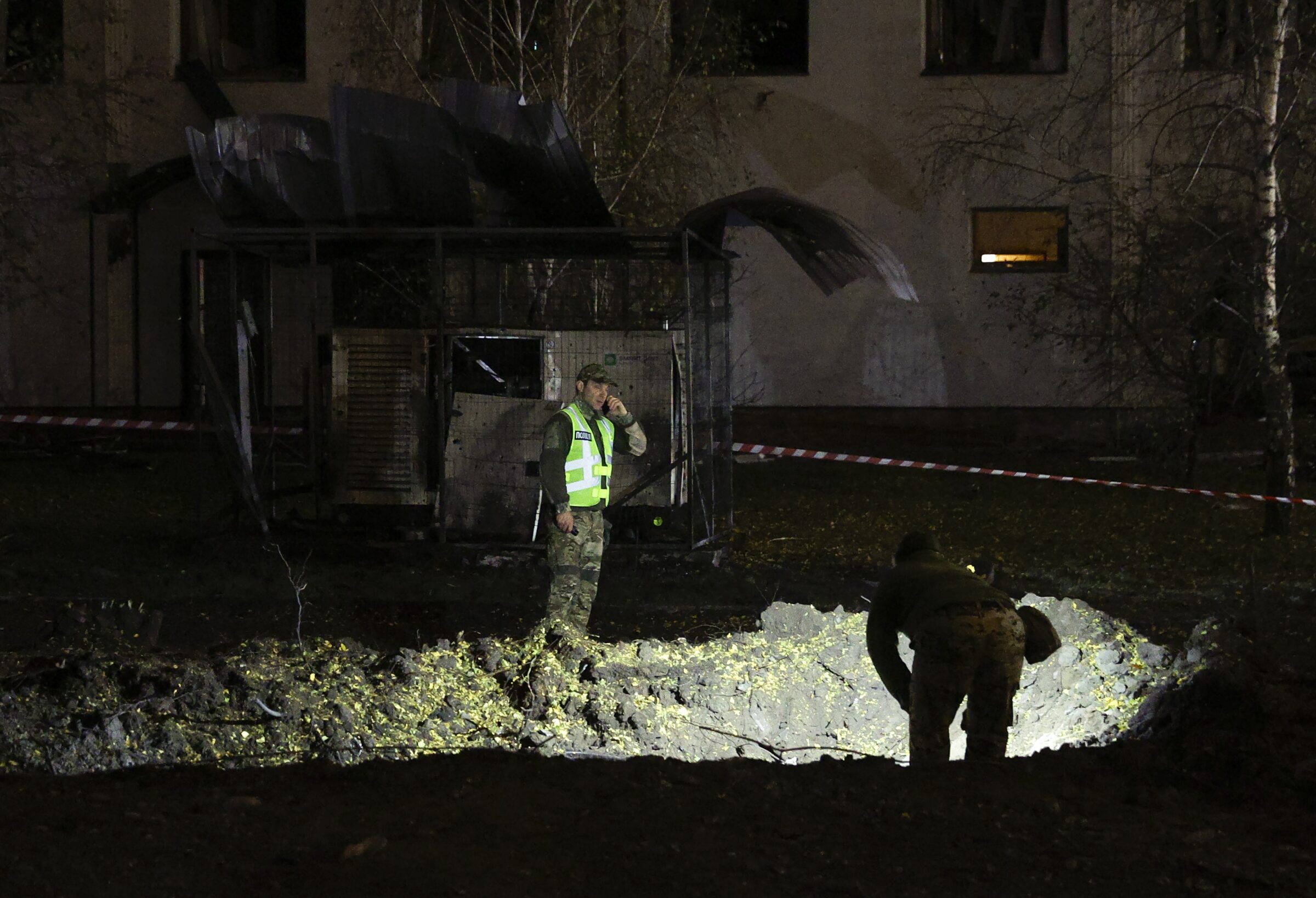
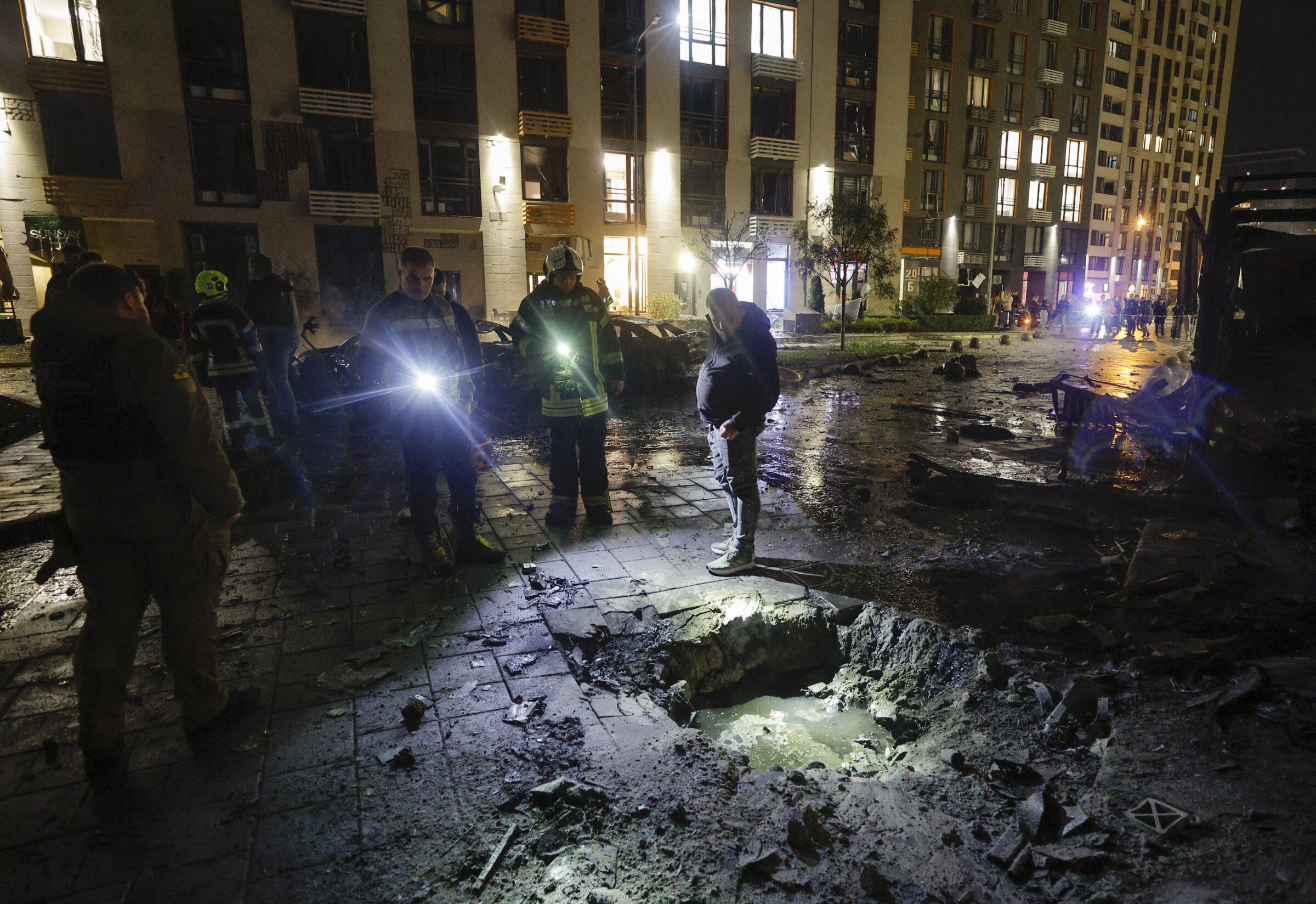
As can be seen in these photographs, a ballistic missile fell in Kyiv but did not explode; Ukrainian bomb disposal experts tried to render it harmless.
An unexploded Russian Iskander 9M723 ballistic missile lies among residential buildings in Kyiv’s Darnytskyi district, where Ukrainian bomb disposal teams are conducting a complex operation to neutralize it.
— Special Kherson Cat 🐈🇺🇦 (@bayraktar_1love) October 7, 2026
Chart of the day
Ukrainians claim that their attacks on refineries have put more than 50 percent of Russia’s oil-processing capacity out of action. Michael Bohnert, an analyst at the RAND think tank, wrote on X that this was not entirely accurate. According to his calculations, current fuel production at Russian refineries stands at 3.22 million barrels per day. Before the war, it was usually around 5.5 million barrels per day, meaning a fall of about 40 percent.
There has also been a monthly decline of 0.36 million barrels per day, apparently owing to the latest attacks on refineries, for example in Moscow and Samara.
Ukraine says its strikes have taken out more than half of Russia’s refining capacity. Live crude runs do not show that.
My bottom-up tracker (41 refineries plus the mini-tail, version 2) puts national throughput at about 3.22 mb/d as of 6 Oct. That is down 0.36 mb/d over the… pic.twitter.com/RhXrzGlnJS
According to Bohnert, this is the third time Ukrainians have managed to reduce Russian oil processing so substantially. There was a drop of around 40 percent last autumn and in July this year. “3.2m barrels per day is roughly the point at which things start becoming uncomfortable for Moscow,” he wrote.
Unlike last year, however, Russia is helping itself through imports. The country, once the world’s third-largest fuel exporter, has sharply curtailed its exports. At the same time, it is partially making up for the shortfall in domestic production through imports.
South Korea is also helping it in this respect. According to information from the Guardian, 176,000 tonnes of fuel, mainly diesel, arrived from South Korea at Russian ports in the Far East in July and August. Seven tankers made a total of 14 voyages to Russia. Three of the tankers are on the European Union’s sanctions list.
Overall, Russia imported 368,000 tonnes of petroleum products by sea in August, a third of them from South Korea. The country, which once supported Ukraine not only verbally but also through non-military aid, is now helping Russia cope with Ukrainian attacks on refineries.
High petrol prices are also working in Russia’s favour. Analysts at the Kyiv School of Economics Institute published a chart showing that Russia exported the least oil and petroleum products in August since 2018. As the final bar in the left-hand chart shows, this was mainly due to a decline in petroleum-product exports.
Nevertheless, revenue from sales remains at last year’s level (the purple line in the left-hand chart). This is mainly due to the rise in their prices on global markets as a result of the US-Israeli war against Iran.
1/9 🛢️ Russia’s crude oil and oil product exports fell to their lowest level since 2018 in August. Despite higher prices, oil export revenues increased by just $0.3B to $13.9B. September Russian Oil Tracker by @KSE_Institute 👉 https://t.co/Rk4hd5OiA6pic.twitter.com/KdVMj4QjVV
This was the sunset seen by residents of the Russian coastal city of Sochi on Tuesday. A tanker sailing under the Liberian flag was burning close to shore. Footage showed that it was ablaze along virtually its entire length.
The Russian Rybar channel wrote that it had been hit by naval drones. It was therefore probably a Ukrainian attack on Russia’s shadow fleet, which exports oil around the world and thereby finances the war.
The oil-laden tanker was travelling from Novorossiysk to India. Local residents reported an explosion and feared that oil would spill into the sea.
🔥🚢 A dramatic view from the Russian Sochi right now, where the burning oil tanker off the port has turned into a massive wall of fire pic.twitter.com/oFKrLRTIuw
— Special Kherson Cat 🐈🇺🇦 (@bayraktar_1love) October 6, 2026
This is a rather surreal continuation of the previous video. A man is playing guitar on the promenade in Sochi while an oil tanker burns behind him, sending up an enormous plume of smoke.
Recorded on October 6, 2026, in Sochi, Russia. A street musician continues to play music on the waterfront while an oil tanker burns offshore in the background. pic.twitter.com/5lcfiOqZD2
Ukrainians are experimenting with remotely controlled vehicles. This video shows how a US Humvee off-road vehicle was converted into a remotely operated ground drone. It was loaded with wooden beams, which it delivered to soldiers building fortifications.
A Ukrainian HMMWV converted into a remotely controlled UGV is being used for frontline logistics, delivering timber for the construction and reinforcement of defensive positions. pic.twitter.com/NxQnuoa6Xf
— Special Kherson Cat 🐈🇺🇦 (@bayraktar_1love) October 7, 2026
This video shows a duel between a Ukrainian robot and a Russian FPV drone. In this case, the robot ultimately won, neutralising the drone by ramming it.
A Ukrainian ground robotic system rammed and destroyed a Russian FPV drone on the Pokrovsk axis. The UGV, operated by the 25th Sicheslav Airborne Brigade of Ukraine’s 7th Air Assault Corps, was returning from a combat mission when the FPV began pursuing it. The operators… pic.twitter.com/dIPGuEMVVC
Ukrainian attacks on the land route to Crimea continue. This is what one of the roads to Crimea currently looks like, with numerous damaged and destroyed lorries visible.
This is only part of the road now referred to as the land corridor to Crimea. Another road has turned into a "road of death" for the Russians. pic.twitter.com/D0fKAXQdGo
By Monday (5 October), Russia had verifiably lost 24,170 pieces of heavy equipment (24,138 on Tuesday, 22 September). Of these, 19,133 (19,105) were destroyed by Ukrainians, 1,003 (1,000) were damaged, 1,194 (1,194) were abandoned by their crews, and 2,840 (2,839) were captured by the Ukrainian army. This includes 4,452 (4,448) tanks, of which 3,357 (3,353) were destroyed in combat.
Ukraine has lost 12,238 (12,175) pieces of equipment, of which 9,633 (9,579) were destroyed, 711 (702) damaged, 695 (695) abandoned and 1,199 (1,199) captured. This includes 1,466 (1,464) tanks, of which 1,126 (1,125) were destroyed in combat.
Note: Neither side regularly reports its fatalities or destroyed equipment. Ukraine publishes daily figures for Russian casualties and destroyed equipment, which cannot be independently verified. This overview uses data from the Oryx project, which has compiled a list of equipment losses documented exclusively by photographs since the start of the war.

 Login