Login

Muslims in Texas seek greater political influence ahead of US midterm elections
WASHINGTON: Mosques in Houston are doubling as voter registration centres ahead of the Nov 3 midterms, and local Muslim leaders say they are helping sign up around 1,000 voters a week.
The drive in Texas’s metropolis follows the Republican-majority State Board of Education’s approval of a new social studies curriculum that Muslim advocates say portrays Islam unfairly.
The contentious high school curriculum, for instance, requires students to learn that “radical Islam” motivated the 9/11 attacks instead of focusing on the terrorist groups involved.
But supporters of the new curriculum defend it as part of a broader emphasis on Western civilisation and the foundations of the United States and Texas.
The dispute has become one example of a broader question facing Muslim Americans: can greater political organisation help them influence public policy and counter discrimination?
In the American political system, advocacy caucuses play a key role in influencing public policy and elections by mobilising voters around shared concerns.
They register voters, educate communities, support candidates and lobby elected officials. Groups such as the American Israel Public Affairs Committee (AIPAC) illustrate how organised advocacy can shape political debate.
For Muslim Americans, similar groups offer a way to pool electoral influence, engage candidates and press for attention to their concerns, particularly in closely contested races.
Their concerns range from civil rights, immigration and the economy to US foreign policy, particularly its approach to the Middle East.
Yet a growing political presence does not necessarily translate into electoral power, nor are Muslim Americans a unified voting bloc: their party affiliations, social views and policy priorities vary considerably.
On November 3, Texas voters will decide several key federal and state races, including a closely watched US Senate contest, the governorship and all 38 seats in the US House of Representatives.
Republican Ken Paxton, Democrat James Talarico and Libertarian Ted Brown are contesting the Senate seat, while Republican Governor Greg Abbott is seeking a fourth term against Democratic nominee Gina Hinojosa and Libertarian Pat Dixon.
All 150 seats in the Texas House of Representatives and 16 of the state Senate’s 31 seats are also up for election, alongside other statewide offices, State Board of Education seats, judgeships and local positions.
Syed Hassan, the co-chair of the American Muslim Democratic Caucus, stresses the need for political organisation against this backdrop.
Speaking at the caucus’s 2026 national convention, he recalled former US president Barack Obama telling the 2004 Democratic National Convention in Boston that “there is no Black America and White America, no liberal America and conservative America — only the United States of America”.
A small gathering of Muslim delegates at a mosque in Cambridge around that time helped inspire the caucus, he said.
Hassan urged underrepresented communities to organise around shared democratic concerns. “Our strategy is simple: we unite, we organise, we vote,” he said.
He warned that hostility directed at one minority could eventually shift to another. “Last election, it was our hardworking, honest Mexican and Latino brothers and sisters in the crosshairs. This time, it is hatred against Muslims. Next time, it will be another community entirely,” he said.
Hassan’s approach reflects one strand of Muslim political activism: using elections and party organisations to defend civil rights and influence decisions affecting the community. Others, including Muslim Republicans and independents, pursue a different approach.
Sajid Tarar, a Pakistani-American businessman and founder of American Muslims for Trump, is urging Muslims to support Republican candidates in the 2026 midterm elections. A strong ally of President Donald Trump, Tarar argues that “the Republican platform best serves the interests, safety, and economic prosperity of the Muslim community in the United States.”
A growing community, a divided electorate
The Pew Research Centre estimated in September that the United States now has about 5.5 million Muslims of all ages, up from 2.4 million in 2007.
The figure can be seen as an indication of a growing religious and institutional presence of Muslims, but population growth alone does not establish how many Muslims are eligible to vote, registered or likely to turn out.
Muslims account for a relatively small share of the national electorate, although their concentration in particular cities and electoral districts can make their participation significant in some local and closely contested races.
Survey data about their political affiliations also challenge the assumption that Muslim voters overwhelmingly favour Democrats.
Pew’s analysis of its 2023–24 Religious Landscape Study — in which 1.2 per cent of 36,908 respondents in the US identified as Muslims — found that 53pc of Muslim adults identified with or leaned towards the Democratic Party while 42pc identified with or leaned towards the Republican Party.
On immigration and the value of racial and ethnic diversity, Muslim Americans tended to hold views closer to those of Democrats. On some questions involving family, sexuality and gender identity, their views were closer to those of Republicans. Other issues divided opinion within the community.
Such differences complicate efforts to build a common political agenda. Religious identity may encourage collective action on certain issues, but it does not determine how individual Muslims vote.
Texas becomes a political battleground
Texas offers an example of how disputes over education, religious freedom and the public perception of Islam are spurring political engagement.
In Houston, the Islamic Society of Greater Houston has sought to bring more Muslims into the electoral process. Its president, Emran Gazi, said at a press conference last month that the organisation was helping register about 1,000 voters a week at mosques across the city.
Apart from the curriculum revision, controversies have centred on campaigns against what some Republican politicians describe as the threat of Sharia law to Western values and the US Constitution. Texas Republican state representative Brent Money established the Sharia-Free Texas Caucus while US representatives Keith Self and Chip Roy helped launch a Sharia-Free America Caucus in Congress.
Texas Governor Abbott has also challenged Muslim ablution facilities at two major airports, arguing that they raised legal questions about religious accommodation. In a letter to the Department of Justice in August, he sought a federal probe into the airport facilities, a move that a Muslim advocacy group called an “anti-Muslim political stunt”.
These disputes have added urgency for voter registration and advocacy efforts among some Muslim Texans. But the state’s political dynamics cannot be taken as representative of the entire country. Muslim communities in Michigan, New York, Illinois, New Jersey, Minnesota and Virginia operate in different electoral environments, and Muslims have won office at both state and national levels.
Foreign policy and party loyalty
US policy in the Middle East, particularly the Israeli assault in Gaza, has become another important factor in Muslim political organising. For some voters, foreign policy is a measure of whether candidates and parties take their concerns seriously. Others place greater weight on the economy, healthcare, immigration, civil liberties or social issues.
These competing priorities make it difficult to assess Muslim political influence solely through party affiliation. A voter may support one party on domestic issues while opposing its foreign policy. Another may hold conservative social views but object to anti-Muslim rhetoric or restrictive immigration measures.
For Hassan, the challenge is to turn political participation into a more effective voice in public affairs.
“We, the people, are the special interest now. Not them,” Hassan told his caucus’s convention, criticising the influence of wealthy donors and lobbyists and calling for a more equal political system.
Whether that ambition translates into measurable influence will depend on more than voter-registration drives.
Turnout, geographic concentration, coalition-building and the willingness of candidates and elected officials to respond to Muslim Americans’ concerns will all help determine how much political weight the community can exercise.
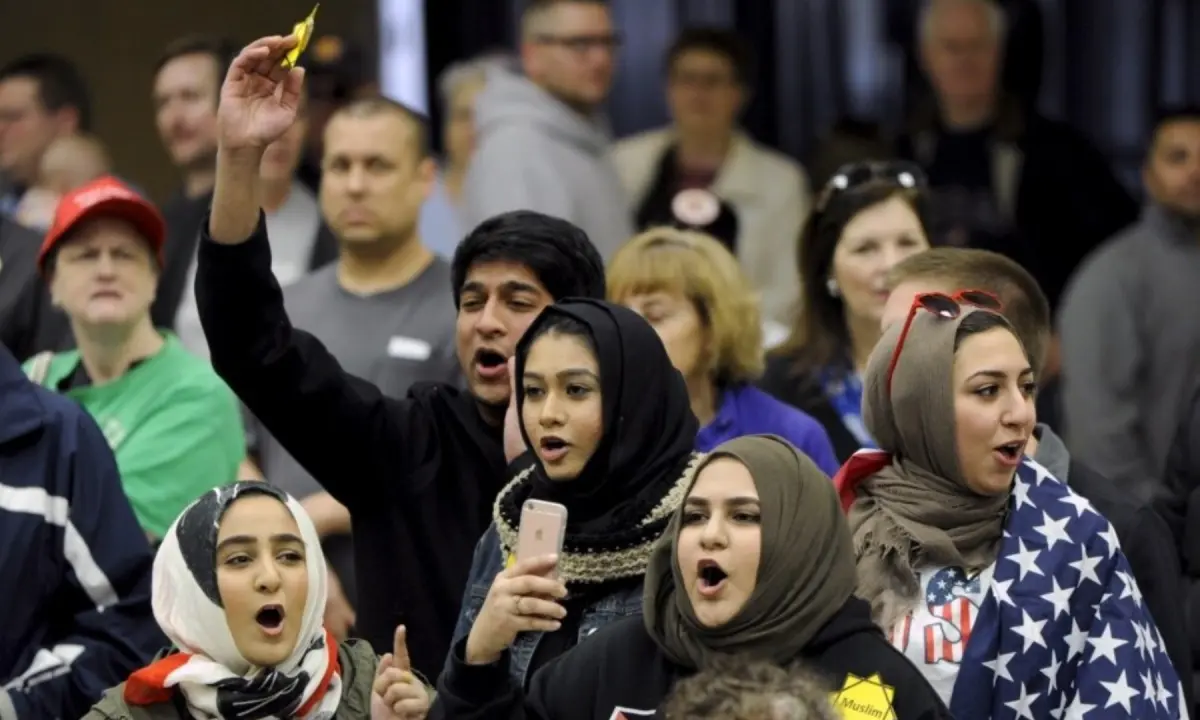
Header image: Young Muslims protest then-US Republican presidential candidate Donald Trump before being escorted out during a campaign rally in Wichita, Kansas, March 5, 2016. — Reuters/ File