ISLAMABAD: In what is set to stir a new controversy, a bill proposing quarterly determination of natural gas prices landed in the upper House of Parliament on Friday.
The bill seeks to insert a new Section 8A in the Ogra Ordinance, 2002.
Under the proposed mechanism, a licensee for natural gas will submit its total revenue requirement on a quarterly basis — only to the extent of wellhead gas prices and the cost of imported gas, including Re-Gasified Liquefied Natural Gas (RLNG) — for review by the authority.
Ogra will then advise the federal government, which must, within 30 days, advise minimum charges and sale prices for each category of retail consumer for gazette notification.
The bill also empowers the federal government to advise Ogra to carry forward the entire or part of a quarterly adjustment to its forthcoming half-yearly determination under Section 8.
In a clause likely to trigger debate, the bill amends Section 9 to state: “Provided that public hearing shall not be held by the Authority for revision of prescribed prices under Section 8A.”
The statement of objects and reasons states that the primary objective is to align tariffs with market realities by adjusting for Rupee-Dollar parity in a timely manner, signal accurate pricing, curb accumulation of circular debt in the gas sector and ensure financial and operational stability of the gas supply chain.
The bill landed in the Senate at a time when consumers are complaining of unpredictable fuel price shocks.
If passed, it shall come into force at once.
‘Will Karachi’s sea be shifted next?’
During the Senate session on Friday, PPP Senator Waqar Mehdi raised the proposed shifting of Pakistan Petroleum Limited’s (PPL) head office from Karachi to Islamabad, warning that a pattern was emerging of moving federal headquarters, ministries and corporations away from Karachi.
“The head office has been in Karachi since around 1951. Now attempts are being made to shift it to Islamabad through the board of directors, whose members are not elected representatives of the people,” Mehdi said.
He pointed out that the current office’s rent was around Rs4 million per month, but shifting would cost billions. Around 500 officers and employees from Sindh work in PPL and would face severe economic and family disruption if the head office was moved, he said.
“From the federal government’s conduct, it seems tomorrow they will talk of shifting Karachi’s sea to Islamabad as well,” Mehdi remarked.
He said PPL’s core activities, exploration, imports and related infrastructure were linked to Karachi and the institution had been working successfully from there. He demanded the decision be withdrawn.
PPP Senator Zamir Ghumro said oil and gas came under the domain of the Council of Common Interests (CCI).
“How can you shift it without the will of the CCI?” he asked.
In response, Chaudhry said PPL was a company and its board had repeatedly said vacating the office had become inevitable.
“We take everything towards provincialism, regionalism. PPL’s assets are not only in Sindh but also in Balochistan. No employees are being affected. There is no provincialism in shifting this office from Karachi,” he said.
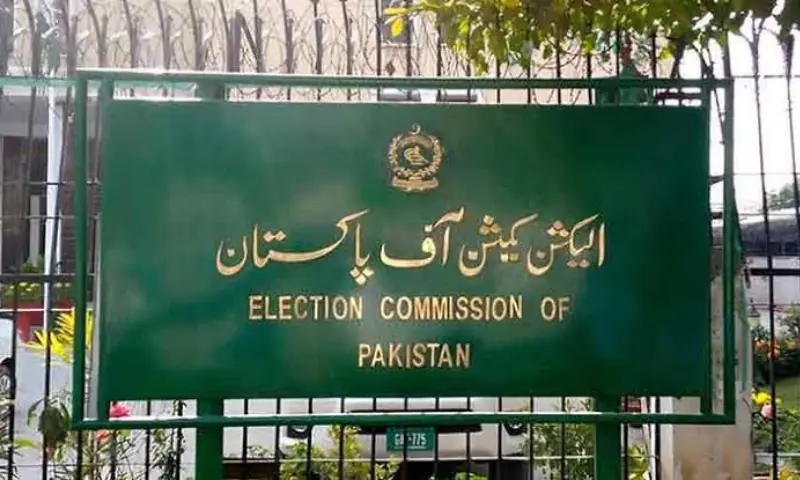
ISLAMABAD: The Election Commission of Pakistan (ECP) on Wednesday ordered local government (LG) elections to be held immediately in Khyber Pakhtunkhwa districts where delimitation had been completed, excluding those included in the 12 districts with special emergency measures.
The federal government on Oct 11 imposed emergency in KP and placed the province under governor’s rule, taking note of the “provincial government’s deliberate disengagement from the fight against terrorism”.
In its order, issued on Wednesday and seen by Dawn, the ECP directed its office to submit the election programme for its approval in respect of districts where the delimitation process had been completed.
The bench headed by Chief Election Commissioner (CEC) Sikandar Sultan Raja and comprising members Nisar Ahmed Durrani, Shah Muhammad Jatoi, Babar Hassan Bharwana and retired Justice Ikramullah Khan heard the case.
The electoral watchdog issued orders for KP districts, excluding 12 which were deemed to face intense security challenges and an Area Representative and Development Council (ARDC) was formed to oversee them under emergency measures.
In its order, the ECP directed its office to “submit the election programme for the commission’s approval in respect of districts in which the delimitation process has been completed”, excluding Bannu, Mohmand, Orakzai, Lakki Marwat and North Waziristan specified in the federal government’s order dated Oct 11.
The ECP also sought the issuance of the delimitation schedules for the remaining districts, excluding Dera Ismail Khan, Tank, Bajaur, Khyber, Kurram, Lower South Waziristan and Upper South Waziristan.
It issued the directives under Articles 218(3) (Election Commission), 140A(2) (local government), 219(d) (duties of ECP), 220 (executive authorities to assist ECP) and 222 (electoral laws) of the Constitution, read with Sections 219 (ECP to conduct elections) and 221 (delimitation of LG constituencies) of the Elections Act 2017, and “all other enabling provisions of law”.
The order further directed the ECP’s office to adjust and determine the number of village councils/neighbourhood councils and category-wise reserved seats in respect of each tehsil council in seven districts, ie, Karak, Hangu, Swat, Bar Swat, Battagram, Paharpur and Allai as per current revenue limits in accordance with separate order of the commission of even date to ensure timely conduct of LG elections and delimitation in the districts other than designated districts.
The local government elections in KP have remained pending since the terms of existing local bodies expired — the first phase in March 2026 and the second phase in June 2026.
In July this year, the KP government had assured the ECP of “all possible support” in holding LG polls where delimitation was complete. Later, the ECP had opposed a key amendment in KP’s local government law regarding the population of village and neighbourhood councils, terming it a delaying tactic.
ISLAMABAD: Power Minister Awais Leghari told the Senate on Tuesday that the government has decided to scrap the electricity slab system that punishes consumers for crossing the 200-unit threshold even by one unit, and to provide targeted subsidy only to those deserving.
Under the current mechanism, consumers using up to 200 units per month fall under the “protected” category and avail a subsidy of around Rs13 per unit. However, any consumer exceeding the limit by even one unit has to pay up to Rs33 per unit and is then not allowed to avail the facility for six months.
Speaking in the Upper House, Leghari said work was being expedited to abolish the system under which a consumer crossing 200 units has to pay a much higher cost per unit and remains ineligible for relief for the next six months.
The minister was responding to a calling-attention notice moved by PML-N Senator Abid Sher Ali regarding tariffs charged by distribution companies (Discos)and the financial burden on consumers.
Ali highlighted that when monthly consumption increased from 200 to 201 units, the tariff jumped from Rs15 to Rs30 per unit, forcing a consumer to pay bills under the 400-unit slab for just one extra unit.
“The cruel slab system effectively punished the poor and drained the common man for months,” he said.
Acknowledging it as a genuine problem, Leghari said the ministry was seriously working to abolish the six-month bar.
He said the government was considering two options: raising the threshold from 200 to 250 units; or abolishing the six-month penalty by allowing consumers to get the protected category benefit for the month in which they restrict consumption to 200 units.
“It will take one and a half months to finalise the plan,” the power minister outlined, adding that the government was working on a new system to provide relief based on income rather than consumption.
He pointed out that the number of protected consumers had increased from 10 million to 20-25m during the last two years due to the use of solar energy. Many of them, including consumers using 700 to 800 units, were limiting grid consumption to 200 units by installing solar panels and availing relief meant for lower-income households.
“It would not be appropriate to offer equal discount to everyone using less than 200 units,” Leghari said, adding that the government was providing a 65 per cent subsidy to protected consumers which was being availed by rich and poor alike.
The new mechanism would restrict subsidy to those living below the poverty line and lower-middle income groups, he explained.
Turning to the power sector’s financial situation, Leghari said circular debt had declined to around Rs1.67 trillion and was no longer increasing every year.
The government had set a target to eliminate it within the next four years under the reprofiling of the financing scheme, and the debt servicing surcharge of Rs3.23 per unit would also be abolished during the same period, the minister added.
Leghari recalled that when Prime Minister Shehbaz Sharif took office in 2024, the annual losses of Discos, including theft and non-recovery, were Rs591bn. The losses had come down from Rs360bn last year to Rs325bn this year due to efforts to improve efficiency.
He maintained that the Power Division was getting Rs1.18tr in budgetary support from the finance ministry in 2024, which was expected to come down to between Rs700bn-750bn this year, reducing the burden on the annual budget by about Rs200bn.
However, Leghari acknowledged that since consumers did not bear the losses of companies, and it was the finance ministry that bore the burden, the benefit of reduced losses had not yet been passed on to consumers.
He said preventing electricity theft remained the government’s top priority, but consumers would not be burdened arbitrarily.
Govt to implement national AI ecosystem
The Senate was also informed today that the government is implementing a national artificial intelligence (AI) ecosystem, encompassing AI infrastructure, human capital, research, startups, financing and responsible AI governance.
Minister for Parliamentary Affairs Tariq Fazal Chaudhry told the House during Question Hour that the National Artificial Intelligence Ecosystem Development Programme — approved earlier this year — was one of the government’s most significant upcoming interventions for AI development.
He added that the government had announced a $1bn investment for Pakistan’s AI Ecosystem by 2030, and was also implementing the National AI Advancement Initiative to accelerate AI adoption and build practical AI capacity.
Responding to a supplementary question, Deputy Prime Minister and Foreign Minister Ishaq Dar informed the House that the first council meeting of the World AI Cooperation Organisation is expected in mid-December.
The organisation is a China-led initiative aimed at promoting transparency, openness and cooperation in artificial intelligence. Pakistan had joined the body in July as a founding member.
Dar said around 50 members had joined the organisation, which would be headquartered in Shanghai.
ISLAMABAD: The Senate on Monday blocked a private member’s bill seeking to withdraw the free-for-all issuance of diplomatic passports to ministers of state, advisers, special assistants and senior bureaucrats and rejected the motion for introduction of the Passports (Amendment) Bill, 2026.
The bill was moved by PTI Senator Faisal Saleem Rahman, chairman of the Senate Standing Committee on Interior, along with senators Samina Mumtaz Zehri and Saifullah Abro.
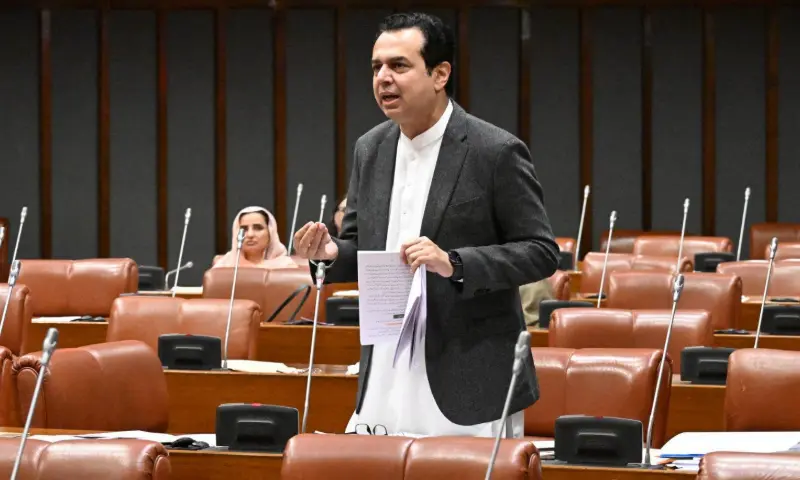
Declaring his opposition to the bill, State Minister for Interior Tallal Chaudhry said, “You are bringing an amendment to the authority of the cabinet which you have not seen.”
To this, Senator Faisal responded that the bill was about diplomatic passports, which only ministers should have. “There should be no distribution in the issuance of diplomatic passports,“ he observed.
PPP Senator Zamir Hussain Ghumro argued that a minister of state is also a representative of the Parliament.
According to the copy of the bill available with Dawn, it sought to amend the Passports Act 1974 by inserting a new Section 12A for restriction on diplomatic passport entitlement of ministers of state, advisers, special assistants, federal secretaries and director generals.
It provided that no diplomatic passport shall be issued, re-issued or renewed to a minister of state, adviser to the prime minister, special assistant to the prime minister, federal secretaries other than the foreign secretary, or director general, by virtue of holding such office, and any such passport already held shall be surrendered to the prescribed authority within 30 days of commencement of the Act.
The proposed bill clarified that nothing shall prevent such persons from obtaining or retaining an ordinary or official passport where otherwise entitled, and nothing shall affect any independent entitlement arising by virtue of any other office, appointment or diplomatic assignment which lawfully carries such entitlement.
The bill’s statement of objects and reasons noted that the Passports Rules 2021 provide for the issuance of diplomatic passports to various categories of public office holders, including state ministers and functionaries having the status of minister of state.
“A diplomatic passport is a special travel document of the state, and its issuance should primarily correspond to the nature and requirements of diplomatic or state functions rather than operate automatically as a privilege attached to rank or status,” the bill read.
It said the proposed amendment would not restrict official duties or official foreign travel, as a person may continue to obtain an ordinary or official passport where otherwise entitled.
The bill sought only to provide that holding, or having previously held, the office or status of minister of state, adviser, special assistant, federal secretary other than foreign secretary, or director general shall not, by itself, constitute an entitlement to a diplomatic passport.
It argued that the proposed amendment was intended to ensure a clear and reasonable distinction between diplomatic functions and political status and to promote a transparent and purpose-based system for issuance of diplomatic passports.
Heated exchange among allies triggers PPP walkout
The Upper House also witnessed an exchange of hot words between PML-N’s Nasir Butt and PPP’s Sherry Rehman during the passage of the Consumer Protection (Amendment) Bill 2026.
The bill, moved by Senator Zehri of the Balochistan Awami Party (BAP), was passed despite the PML-N-led government’s opposition.
Butt asked who the PPP was supporting, with PPP senators walking out after the episode.
The consumer protection bill secured 10 votes in favour and four against, after a vote was allowed for the second time.
Chaudhry opposed the bill, while Zehri criticised the government for opposing the legislation, saying it neither worked itself nor allowed others to work.
The House also unanimously passed a bill to amend the law banning plastic book covers in the federal capital to remove an exemption clause that allowed its misuse.
According to the statement of objects and reasons, the principal Act was enacted with the object of regulating and prohibiting the use of plastic book covers within ICT.
“During the examination of the provisions of the said Act, it has been considered necessary to review the exceptions and other provisions contained in section 3, particularly clause (a) of sub-section (2) thereof,” it read, adding that the continued retention of the said clause may result in an exception which is inconsistent with the intended purpose of the Act.
Speaking on the occasion, Senator Rehman said plastic covers were still being used on books in some big shops in Islamabad. She said a meeting with the Ministry of Interior had also been held on the issue.
“During checking, shopkeepers declare every plastic as biodegradable,” she said, adding that according to the interior ministry, there is no laboratory or scale available in the country to check biodegradable plastic.
The former climate minister highlighted that the purpose of the amendment was to remove legal ambiguity regarding plastic book covers.
“Under the amendment, there will be a complete ban on all types of plastic in Islamabad,” she said, adding that no one would have an exemption for the use of plastic.
The Senate also approved an amendment in the Code of Criminal Procedure (CrPC), while deferring the Islamabad Metro Bus Service Bill, 2026.
PTI voices concerns over re-description of KP constituencies
Meanwhile, PTI parliamentary leader in the Senate, Barrister Syed Ali Zafar, raised serious concerns over the “description” of several national and provincial assembly constituencies in Khyber Pakhtunkhwa, deploring that the revisions were made without hearing public objections.
Senator Zafar stated that constituencies determine the representation of people in Parliament and that any changes affecting them must be made strictly in accordance with the law, through a transparent process and with full public scrutiny.
“The Election Commission of Pakistan (ECP) cannot treat the law as optional,” he said, adding that Section 22 of the Elections Act 2017 lays down legal requirements relating to changes in constituencies. “If the prescribed procedure has not been followed, the legality of the entire exercise is called into question.”
He demanded clear answers from the ECP, asking why these changes were made without a transparent public process and who would be held responsible if the law had been violated.
Senator Zafar also expressed concern over the continued delay in appointing a successor to the chief election commissioner, whose five-year term expired on Jan 26, 2025.
While Article 215 provides for continuation in office until a successor takes over, he said this provision must not become an excuse for indefinite delay in making an important constitutional appointment. “The government must explain why the matter remains unresolved.”
“An ECP that commands public confidence must be above suspicion. It must not only act fairly; it must demonstrate fairness,” Senator Zafar said.
“Electoral decisions must not create the impression that political interests are being served at the expense of the law.”
The PTI senator called upon the government to take notice of the matter and ensure compliance with the law. He further demanded that the ECP provide a clear legal justification for its actions and that any failure to follow the prescribed procedure be addressed.
“Elections are the foundation of democracy. If the process is not transparent, public confidence in the electoral system will be undermined. The law must be respected, the people must be heard, and no institution, however powerful, is above the Constitution,” he remarked.
Responding to the concerns, Parliamentary Affairs Minister Tariq Fazal Chaudhry said the matter was being discussed on the basis of a newspaper report and asked members to share any official notification. He said he would seek further information from the ECP.
Resolution on occupied Kashmir unanimously adopted
The House also witnessed a show of unity as it unanimously adopted a resolution reaffirming Pakistan’s unequivocal support for the right to self-determination of the people of India-occupied Kashmir (IoK) on the occasion of Kashmir Black Day to be observed tomorrow (Oct 27).
The resolution was moved by Minister for Kashmir Affairs and Gilgit-Baltistan Amir Muqam.
The resolution declared that the entry of Indian forces into occupied Jammu and Kashmir on Oct 27, 1947, followed by the unlawful and forcible occupation of the territory and the situation that ensued, marked a significant turning point in the history of the Kashmir dispute.
It paid tribute to the people of occupied Kashmir for their continued struggle and sacrifices in pursuit of their right to self-determination.
It emphasised the importance of a peaceful settlement of the Jammu and Kashmir dispute in accordance with the relevant resolutions of the United Nations Security Council and of ensuring the right of Kashmiri people to determine their own future.
The resolution reaffirmed Pakistan’s principled position that a just and lasting settlement of the dispute is not possible without respecting the aspirations of Kashmiris and their right to self-determination, for which it called upon the UN to play an effective role through its relevant resolutions.
The resolution also urged the international community to take due cognisance of human rights violations in IoK and to play an effective role in safeguarding the fundamental rights of Kashmiri people.
It called upon the government of Pakistan to continue extending political, moral and diplomatic support to the people of IoK and to intensify its efforts to highlight the Kashmir dispute at the international level.
The House reaffirmed its unwavering resolve and commitment that the Senate of Pakistan shall continue its support to the legitimate struggle of the IIOJK people and to uphold their right to self-determination.

 Login