7,000 Years Ago the Last Hunter-Gatherers Met the First Farmers at a Lake in Germany: This Is What Happened


A 24-year-old man from Gambia remains in custody after police arrested him in connection with a rapid series of alleged sexual attacks on three women in Heidelberg. During the incidents, he allegedly attempted to rape the three women in short succession by dragging them into a cornfield.
Authorities say the incidents unfolded within roughly half an hour on Tuesday morning, Aug. 18, 2026, in an open field area beside the Pfaffengrund cemetery.
According to statements from the Mannheim police headquarters and the Heidelberg public prosecutor’s office, the suspect was walking in the fields around 10:00 a.m. when he approached a woman who was out with her dog. He is accused of grabbing her by the chest and attempting to pull her into a nearby cornfield. The woman shouted and fought back, managing to break free and run away, according to German newspaper Wochenblatt.
Minutes later, between approximately 10:25 and 10:30 a.m., the same man allegedly targeted two other female walkers separately. In each case he seized their hands or wrists and tried to force them toward the cornfield. Both women resisted vigorously, and he eventually released them without succeeding.
Witnesses who saw the confrontations contacted emergency services. Officers launched an immediate search and detained the suspect a short time later. During the arrest, he is further accused of grabbing a female police officer’s crotch.
The following day, the 24-year-old appeared before an investigating judge at the Heidelberg District Court. At the prosecutor’s request the judge issued an arrest warrant on suspicion of multiple counts of attempted sexual assault, sexual harassment, and additional related offenses. He was then transferred to a correctional facility.
Investigators have indicated they are examining possible other incidents linked to the same individual. The joint probe by the Heidelberg public prosecutor’s office and the criminal police continues.
The case has parallels with many other cases covered by Remix News over the years, including a case where a woman successfully fought off a migrant with a horse whip when he tried to drag her off her horse and rape her.
The post Germany: African migrant tries to rape 3 women in a matter of minutes, then grab’s policewoman’s crotch during arrest appeared first on Remix News.
The European Commission has approved a €4.5 million German state aid scheme for fishing and aquaculture companies facing increased fuel prices due to the Middle East crisis.
The scheme was approved under the Middle East Crisis Temporary State Aid Framework (METSAF) adopted by the Commission on 29 April 2026.
The German scheme
Germany notified to the Commission a €4.5 million scheme to support companies active in the primary production of fishery and aquaculture products. The scheme, which will run until 31 December 2026, aims to mitigate the impact of the increase in fuel prices.
The aid will take the form of direct grants. The scheme concerns the grant of a limited amount of aid based on the increase of fuel prices. The aid intensity corresponds to 70% of the estimated increase in fuel costs for fishery and aquaculture companies during the period from 1 March until 23 July 2026. The aid will not exceed €50,000 per company.
The Commission assessed the scheme under EU State aid rules, in particular Article 107(3)(c) of the Treaty on the Functioning of the EU, which enables member states to support the development of certain economic activities subject to certain conditions, as well as Sections 1 and 2.1 of the METSAF.
The Commission found that the scheme is in line with the conditions set out in the METSAF. In particular, aid will be granted based on a scheme with a clear estimated budget and will be provided to temporarily support the development of companies active in primary production of fishery and aquaculture products. The Commission concluded that the scheme is necessary, appropriate and proportionate to facilitate the development of an economic activity and does not adversely affect trading conditions to an extent contrary to the common interest.
On this basis, the Commission approved the German scheme under EU State aid rules.
Background
On 29 April 2026, the Commission adopted the METSAF to enable member states to support the EU economy in the context of the Middle East crisis. The METSAF is a targeted and temporary framework to address the effects of the crisis on some of the most exposed sectors of the economy: agriculture, fishery, transport and energy-intensive industries. The METSAF will be in place until 31 December 2026. During its period of application, the Commission will keep the content, scope and duration of the framework under review in the light of developments in the Middle East and of the general economic situation.
While the transition towards a clean economy remains the long-term solution to shield EU companies from the effects of global energy shocks, the METSAF allows member states to act immediately to make sure that the growth of the most exposed companies is not irreparably hampered by the current crisis.
To this end, support can take various forms for companies active in the agriculture, fishery and transport sectors. This includes aid based on actual consumption to cover part of the price increases for fuel or fertilisers, and a simplified approach for small amounts of aid.
The METSAF also includes a temporary adjustment to the Clean Industrial Deal State aid Framework allowing for further flexibility and higher aid intensities to address electricity price spikes.
More information on the METSAF can be found online.
For more information
The non-confidential version of today's decision will be made available under case number SA.124349, in the state aid register on the Commission's competition website. New publications of state aid decisions on the internet and in the Official Journal are listed in the Competition Weekly e-News.
This week, Mark Leonard is joined by Jörg Lau, international correspondent at Die Zeit and Jana Puglierin, head of ECFR’s Berlin office, to explore the political turmoil in Germany ahead of an electoral autumn. Chancellor Friedrich Merz’s government is becoming increasingly unpopular: it faces collapsing approval ratings, growing tension within the governing coalition and mounting pressure from the far-right Alternative for Germany (AfD).
As regional elections approach, Jana argues that Germany’s traditional parties face difficult choices that could reshape the country’s political landscape, while Jörg discusses what the AfD’s rise means for Germany. A “firewall” has kept mainstream parties from cooperating with the far right in the post-war period—but Jörg reflects on the strain this is under, and whether the AfD’s first taste of regional power could transform German politics.
Together, Mark, Jörg and Jana assess the prospects for Merz’s leadership, the future of the CDU and whether Germany’s political centre can withstand such pressure. Are established parties capable of renewing themselves? What happens if the AfD makes gains at the regional level? And what would prolonged instability in Berlin mean for Europe?
This podcast episode was recorded on August 12th 2026.
Bookshelf
The Names, by Florence Knapp
The Nights Are Quiet in Tehran, by Shida Bazyar
The Invite, by Olivia Wilde

Reluctance among German decision-makers has long stopped Berlin taking a tougher economic approach towards China. When France, Italy, Lithuania, the Netherlands and Spain recently pressed the European Commission for tougher measures and faster trade defence action against China, Germany not only declined to join, it even called for stronger industrial ties with Beijing.
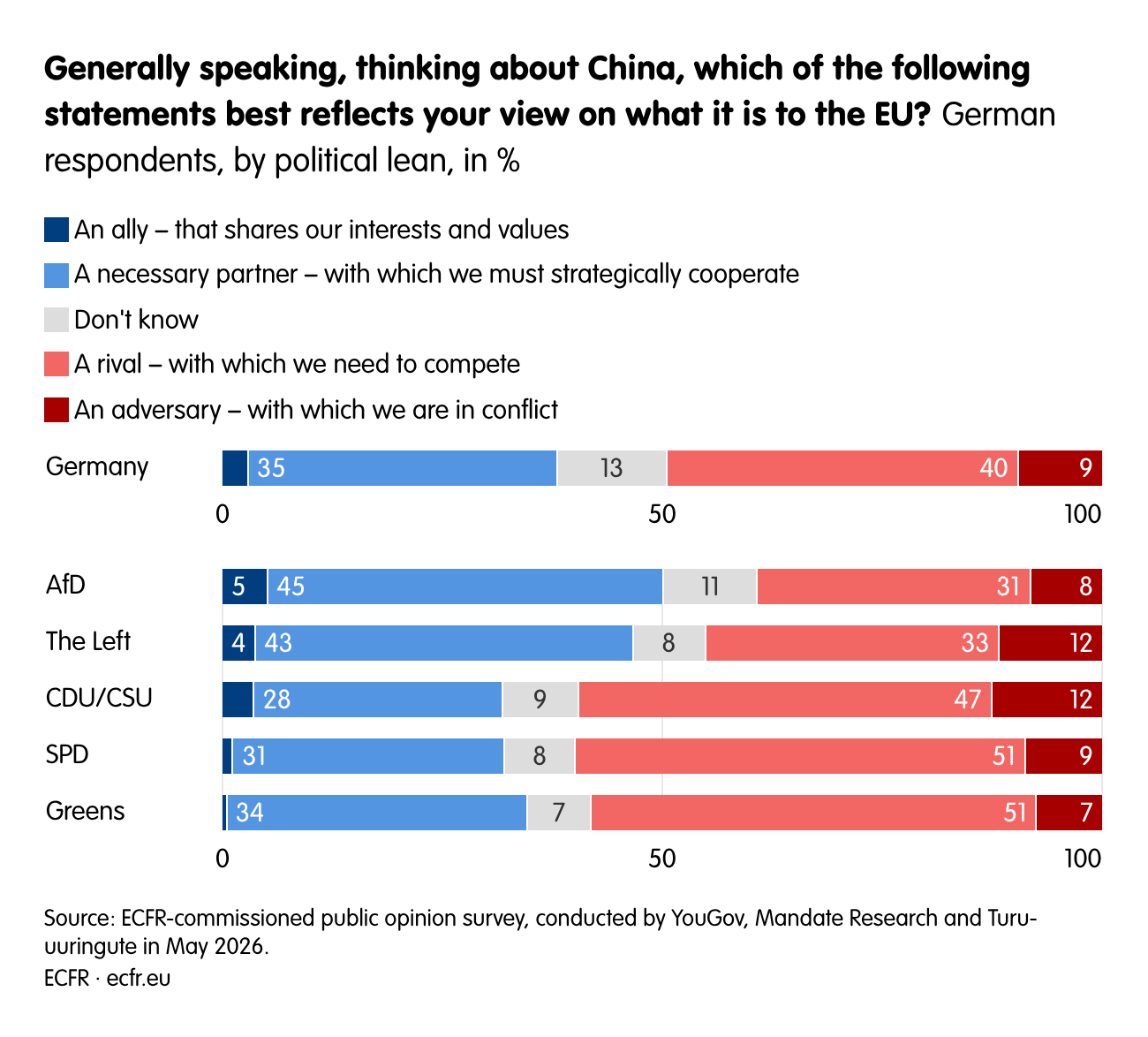
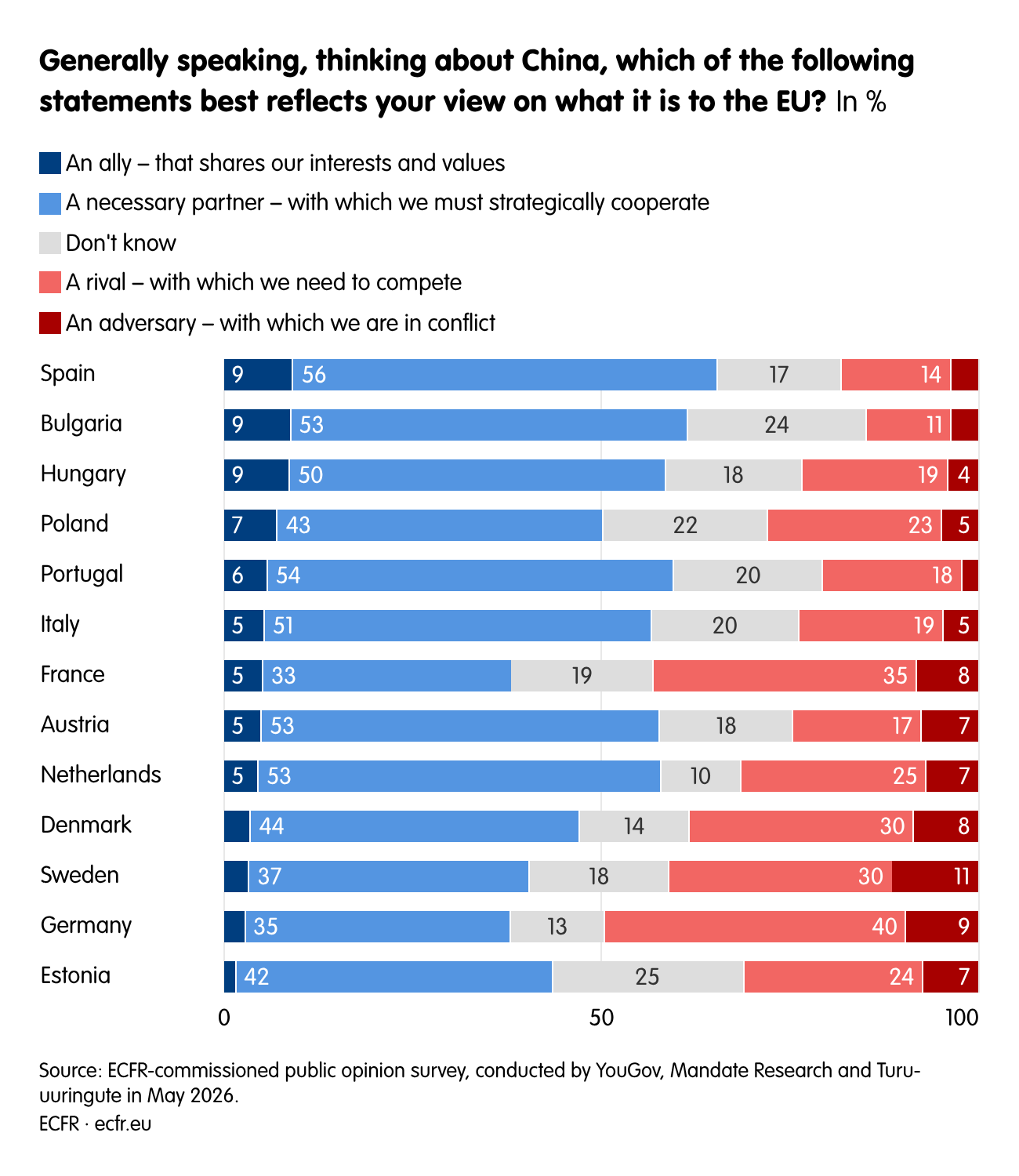
Yet, one thing Berlin should not worry about is voters’ disapproval should it pursue a more hawkish China policy. ECFR polling data find that Germans are the most China-sceptical out of 15 European countries surveyed. No fewer than 60% of Christian Democrat and Social Democrat supporters regard the country as an adversary or rival. In contrast, elsewhere in Europe, majorities still see China as either a “necessary partner” or even an ally. In Italy and Spain, 56% and 65% of people hold this view respectively. (Closest to the sceptical Germans are the French public; President Emmanuel Macron’s increasingly hawkish political posture vis-à-vis Beijing may have found an audience willing to listen.)
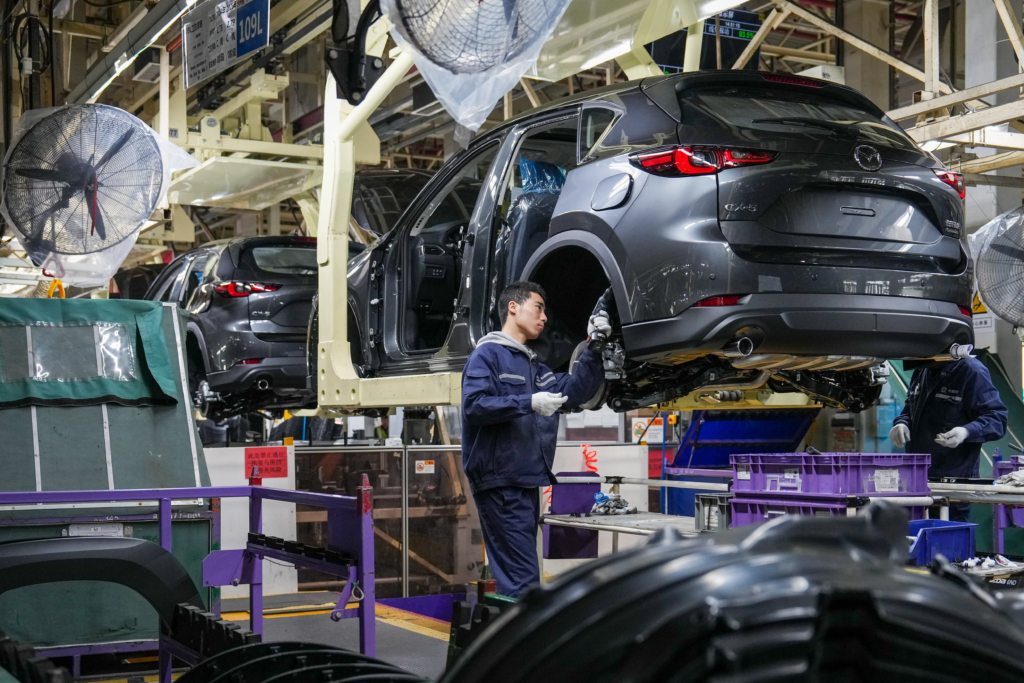
The China shock has hit Germany particularly hard: its manufacturing sector lost around 420,000 jobs between 2019 and 2025 and it continues to shed 10,000 jobs each month. The car industry is paying the highest costs, being squeezed out of a market increasingly dominated by Chinese manufacturers at home and abroad.
The mood in the European Council is shifting, and with Germany’s acquiescence. When EU leaders met in June 2026, they backed a stronger trade defence toolbox of existing measures against China. This included instruments such as the Industrial Accelerator Act’s “Buy European” provisions and limits on high-risk Chinese technology. Despite its past hesitations, Germany no longer acts as a spoiler on firmer EU action, and it has cautiously supported this new direction. Nevertheless, the combination of growing public scepticism towards China, mounting pressure on German industry and appetite for a more assertive policy on the European level creates a political mandate that German decision-makers could yet seize.
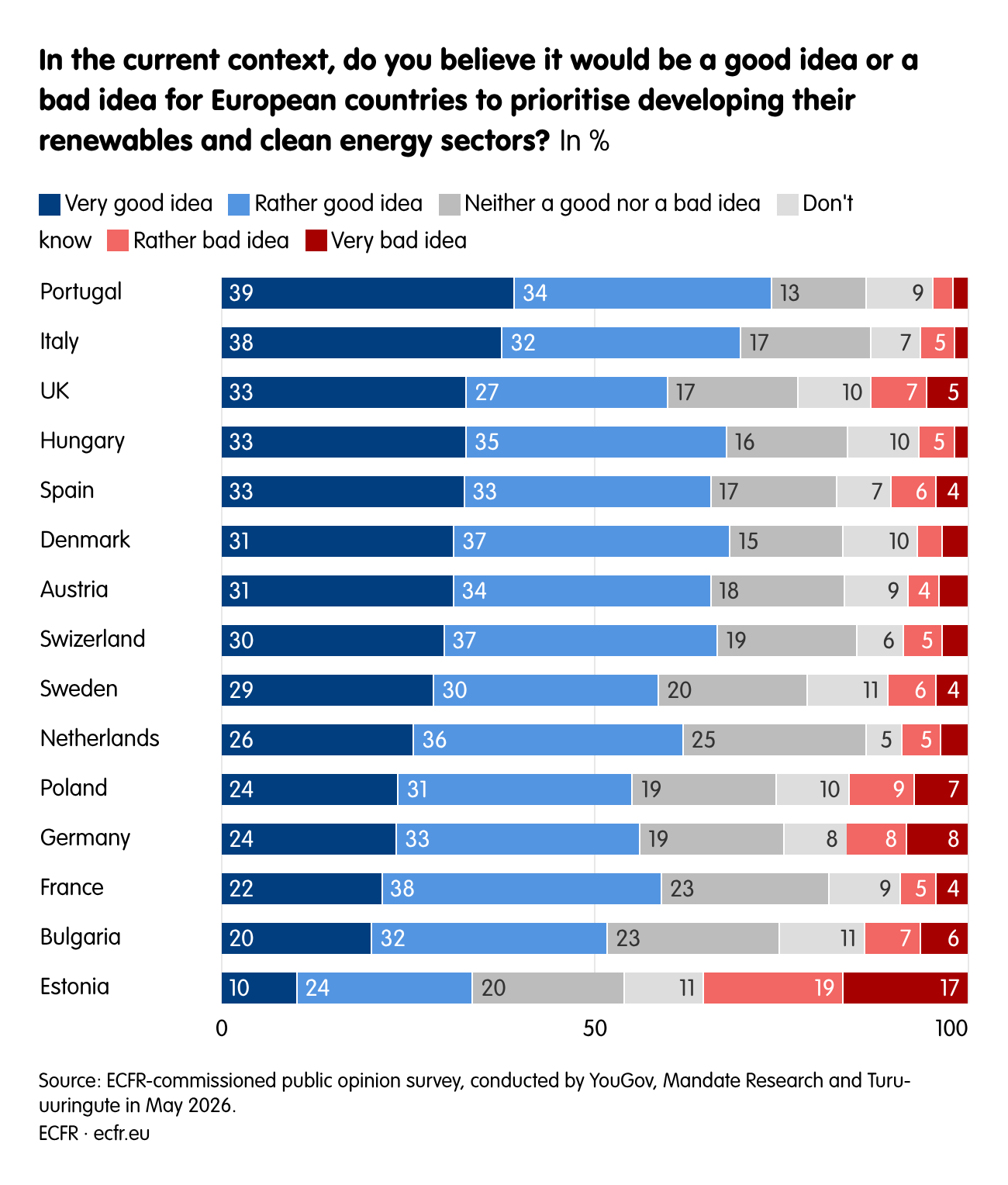
The German public’s views on the energy transition should also prove encouraging for their leaders. Voters want to see investment in renewables: 57% back what would amount to the growing electrification of the economy. Across the countries polled by ECFR, 61% of respondents say they support prioritising renewables and the clean tech sector.
This public support should help persuade leaders, including in Germany, that they can take action to limit emerging dependencies on China. They can accelerate the energy transition while de-risking the clean tech sector through providing support for domestic European industries, from wind to batteries.
For Berlin, and capitals across Europe, it is safer to move ahead rather than delay. Chinese economic policy is already doing irreparable damage to European industry—but European policymakers still need to protect an increasingly electrified economy from weaponisation by China. If they fail to do so, governments will almost certainly pay the price at the ballot box. Those that pursue electrification and economic de-risking as a single package are most likely to reap the political rewards.
Brussels (enr) – The European Union’s migration commissioner has renewed his call for Germany to gradually end controls at its internal borders, pointing to falling numbers of irregular arrivals and the bloc’s new asylum rules.
It was now time to gradually abolish internal border controls, Magnus Brunner told members of the European Newsroom (enr) network in Brussels.
The Austrian commissioner said the EU’s external borders were better protected and that irregular crossings had fallen sharply. Frontex recorded about one-third fewer irregular crossings at the EU’s external borders in the first half of 2026 than in the same period last year.
The EU’s new Pact on Migration and Asylum also took effect on June 12. Brunner said member states had begun implementing the rules and that the bloc was already seeing progress.
He welcomed steps by individual countries to ease controls. Checks on the border between Germany and Luxembourg on the Trier motorway have been lifted, he said. He also cited the suspension of controls between Austria and Slovenia.
Germany has had checks at its land borders since September 2024. Former Interior Minister Nancy Faeser ordered them, and her successor, Alexander Dobrindt, intensified them in May 2025. Dobrindt has repeatedly extended the measures, which are currently due to remain in place until September.
Brunner also defended the EU’s new Entry/Exit System, known as EES. The digital system records the entry and departure of travellers from outside the EU, Iceland, Liechtenstein, Norway and Switzerland.
He acknowledged that the system had caused problems at some airports, including in Greece and Portugal, but said: “The system itself works very, very well.”
The system has faced criticism over long queues. The Airports Council International Europe has reported waiting times of up to five hours and missed connecting flights.
Brunner said professional truck drivers from the Western Balkans faced a particular problem because they can currently stay in the EU for no more than 90 days in any 180-day period. He proposed that EU member states and Western Balkan countries negotiate long-term visas on a bilateral basis.
Brussels (enr) – European Parliament Foreign Affairs Committee Chairman David McAllister has urged Ukrainian President Volodymyr Zelenskyy to support German Chancellor Friedrich Merz’s proposal for an associate membership for Ukraine as it moves towards joining the European Union.
The proposal is an opportunity that Ukraine should seize, the German centre-right lawmaker told members of the European Newsroom (enr) network in early June. Claims that it would amount to “membership light” or second-class membership were incorrect, he said.
Instead, it would allow Ukraine to become more closely integrated into the EU step by step before full membership, making the benefits of the bloc more visible to its people. One possibility would be for Ukraine to participate in the European Parliament as an observer, McAllister said.
Zelenskyy has expressed opposition to the idea, arguing that it would be unfair for Ukraine to be present in the EU but have no say in its decisions. In a letter to EU leaders, he called for the bloc to move faster and not keep Ukraine in a waiting room until full membership.
Merz said earlier that rapid full EU accession for Ukraine, which is fighting Russia’s invasion, is not realistic. For the interim period, he has proposed allowing Ukraine to attend EU summits and ministerial meetings without voting rights.
His ideas also include an associate member of the European Commission without a portfolio or voting rights, associate members of the European Parliament and an associate judge at the European Court of Justice.
McAllister said EU enlargement was high on the bloc’s agenda and that the Western Balkans were at the heart of Europe. A stable region was an investment in peace and security, he said.
The CDU politician called for each candidate country to be assessed individually and on its merits rather than treating the Western Balkans as a single group. Montenegro was a clear frontrunner, he said, while North Macedonia’s accession path remained blocked by a political dispute with Bulgaria.
Eight other European countries are officially recognised as EU candidate countries alongside Ukraine: Albania, Bosnia and Herzegovina, Georgia, Moldova, Montenegro, North Macedonia, Serbia and Türkiye.
In northern Germany, in the state of Saxony-Anhalt, between the rivers Weser and Elbe, stands a mountain that is home to mysterious legends and strange weather. For centuries, travellers have reported seeing giant shadowy figures looming in the mist, surrounded by glowing rings of light. These eerie apparitions were once attributed to witches, spirits, and supernatural forces. Today, science has explained the phenomenon, but the Brocken remains one of Europe's most atmospheric and intriguing mountains.

Credit: Wikimedia Commons