❌

Reading view

Found Wanting: A Reading List on Measurement

Thoughtful stories for thoughtless times.

Longreads has published hundreds of original stories—personal essays, reported features, reading lists, and more—and more than 14,000 editor’s picks. And they’re all funded by readers like you. Become a member today.

In 1792 Paris, a “north-going astronomer,” Jean-Baptiste-Joseph Delambre, set forth for Dunkerque, France, while a “south-going astronomer,” Pierre-François-André Méchain, made his way to Barcelona, Spain. As leaders of the meridian expedition, their modest ambition was to measure the world. They would use a new measure to be called the meter. “The meter would be eternal because it had been taken from the earth, which was itself eternal. And the meter would belong equally to all the people of the world, just as the earth belonged equally to them all.” 

If a nonfiction book opens with a map and a list of dramatis personae, make some coffee and settle in. Such is the case with historian Ken Alder’s The Measure of All Things: The Seven-Year Odyssey and Hidden Error that Transformed the World—the story of the birth of the metric system amid the ferment of the French Revolution. It’s a thriller.

We start with our bodies, measuring height and weight and life. We want to know what health is, what beauty and pain and performance look like. We weigh our brains for intelligence, ability, sickness, happiness. We fight about race and politics, sex and money, images and words. We stalk the planet, its history and geography, biology and chemistry. We wrestle with space-time, its mathematics and paradoxes. We have no idea what to do about consciousness. And then there’s the small matter of love. We are obsessed and we cannot stop. 

At its heart, measurement is a utopian undertaking, one that aims to make perfect sense of the world. But at every turn, it runs up against the real world, and every so often, our understanding of reality itself. We know that the act of measuring changes what is measured. Might it be changing us measurers, too? 

Welcome to a reading list about measurement—not only as techne, art or craft, but as episteme, knowledge, its conquests and collapses, and what it really gives and takes away.

Medical Benchmarks and the Myth of the Universal Patient (Manvir Singh, The New Yorker, March 2025)

“In 1730, the influential physician Bernard Mandeville recalled a patient asking his doctor whether he was tired of hearing ‘so tedious a Tale’ of pain. His physician gently murmured: ‘Your Story is so diverting that I take abundance of delight in it, and your Ingenious way of telling it, gives me a greater insight into your Distemper, than you imagine.’” Now if you can get a doctor to listen to you for five undistracted minutes, count yourself lucky. Joanna Bourke takes stock of pain and its vocabulary for Aeon: “Our Anaesthetic Times.”

Indian kids tended to be small, curious, energetic as babies, growing up lean, active, rudely healthy. (I use the past tense because I’m not sure whether this is as true now as it was when I was little.) And yet, our parents thought us skinny and tried to feed us all the time. Was that a normal parental thing for the times, and if not, where did they get the idea that something needed to be fixed?

Universal standards have a way of making us feel competent and good, like, get your blood pressure down to 120/80 and you’ll be all right. But as Singh, a Harvard-trained anthropologist, points out: “Pretending that differences don’t exist doesn’t make them disappear; it only drives practitioners to rely on flawed intuitions.” 

Citing case after case of medical benchmarks—too little, too much, too sideways—across the world, Singh calls for a system altogether more nuanced and considerate than the current “myth of the universal patient”—something that won’t cause actual harm, something that will help us see the real humans behind the data.

When my daughter was ten-and-a-half months old, she qualified as “wasted,” which unicef describes as “the most immediate, visible and life-threatening form of malnutrition.” My wife and I had been trying hard to keep her weight up, and the classification felt like a pronouncement of failure. Her birth weight had been on the lower end of the scale but nothing alarming: six pounds, two ounces. She appeared as a dot on a chart in which colored curves traced optimal growth; fifteenth percentile, we were told. She took well to breast-feeding and, within a month, had jumped to the twentieth percentile, then to the twenty-sixth. We proudly anticipated that her numbers would steadily climb. Then she fell behind again. At four months, she was in the twelfth percentile. At nine-and-a-half, she was below the fifth.

Our pediatrician was worried. Ease off the lentils and vegetable smoothies, we were warned; we needed to get more calories into our babe. Ghee, peanut butter—we were to drench her food in these and other fats and wash them down with breast milk and formula. And that’s what we did. When we came back a month later, though, we learned that she had dropped further—and crossed into “wasted” territory.

The Broad, Ragged Cut (Elizabeth Svoboda, Aeon, December 2018)

“There are two kinds of people in the world: people who think there are two kinds of people in the world and people who don’t.” Science or self-help? Louis Menand assesses “society’s people-sorting operations” for The New Yorker: “What Personality Tests Really Deliver.”

Have you ever taken an IQ test? How about an aptitude test for studies or a psychometric test for work? How about an online quiz?

“You were supposed to be there already. Didn’t the tests show you had a head start?” Svoboda, labelled a “gifted” child in the ’80s and dealing with its fallout in her adult life, unpacks the deeply problematic, yet starry, history of testing. She looks at Stanford-Binet, Army Alpha, SAT, and others—all ways to measure human potential. Intelligence and aptitude tests, “binary stars circling in the same orbit,” Svoboda says, seem to be asking and answering: Who deserves a chance, and who doesn’t? Who is worthy, and who isn’t? 

For the American psychologist Lewis Terman, who devised the Stanford-Binet IQ test, the birth of a gifted child was like the birth of a star. In the name of illuminating what he saw as a void, Terman sought out the stars that burned brightest. “The school has no more important task than to foster the development of the mentally gifted,” the researcher at Stanford University in California told attendees at a meeting in San Francisco. “Our chances of survival . . . may well depend upon the discovery and utilisation of highly superior abilities of every kind.” To further this mission, Terman urged hundreds of children all over California to sit for his newly developed intelligence test in the 1920s. Intending to prove his theory that high IQs predicted life success, he sorted the highest scorers into a group of 1,521 children (called his “Termites”) that he would follow and document throughout their lives.

Fracking Eyeballs (D. Graham Burnett, Asterisk, October 2023)

“Why Netflix looks like that.” Will Tavlin investigates what goes on behind the scenes at the streaming behemoth for n+1: “Casual Viewing.”

In hydraulics, pumping high-pressure fluid into a well causes rock to crack and oil and gas to come pouring in. This is called fracturing, or fracking. Burnett, a Princeton historian of science and part of a scholar-artist-activist collective called Friends of Attention, has adapted this term to refer to an insidious property of the attention economy. “Fracking eyeballs” refers to applying psychological and advertising techniques under pressure to bait and extract monetary value from human attention. (I don’t know how they live with this mental image all the time, though.) 

This essay, opening at a 1925 Harlem shop window with a “puzzling totem face” and crammed with historical anecdote and detail, comes from the magazine’s Issue 04: Measurement. Do check out the whole  issue: “How do you measure seeing god? Does testing vaccines need to take so long? Outlining poverty. Asking better questions. The origins of the ad economy. Can we really say how smart AIs are? Domestic violence during lockdown. Sex, drugs, and colonoscopies. Our most pedantic issue yet.”

See also Burnett’s Public Domain Review essay, “Cybernetic Attention,” where he pursues the “pre-history of the laboratory research that has relentlessly worked to slice and dice the attentional powers of human beings.”

In Nixon’s earliest experiments, he would hide in an observation booth, accompanied by a metronome beating half seconds, and then watch closely as two ads were revealed to a seated subject. Ticking his pencil along the rungs of a fascinating little ladder-pad with each beat of the metronome (marking the left side when the eyes were to the left; marking the right side when the eyes were to the right), Nixon created a graphical record of the subject’s visual encounter with the two stimuli. 

If you were advertising a car, was it better to show a picture of a car, or of a pretty woman? If one was selling shirt collars, was it better to do so under the headline “Murder!” or the headline “Quality Shirt Collars”? To make a long story short (and to skip over the proto-pataphysical techniques by which Nixon established what we might call a “science of irrelevancy”), Nixon found that “irrelevant illustrations do attract more attention and hold interest longer than do relevant ones.” Which is to say: systematically doing violence to sense raised revenue. This could be proven in his laboratory. Would it be wrong to say that we live, in many respects, in the world evolved from that finding? 

The Anthropometric Detective and His Racial Clues (Ava Kofman, The Public Domain Review, February 2016)

“Correlation, one of the most used and least understood concepts in statistics, is easy to mistake for causation because it was made that way intentionally; it’s precisely because of its potential to be misunderstood that it remains so popular. . . . The eugenics movement was built out of correlations.” Read about its history and current state of affairs in this Los Angeles Review of Books essay by Aubrey Clayton for the Legacies of Eugenics series: “The ‘Correlation’ Between Statistics and Eugenics.”

In 1901, Scotland Yard started using fingerprints to solve crime. They weren’t the pioneers. Sherlock Holmes had gotten there first in The Sign of Four, already examining under his magnifying glass, in 1890, what appeared to Dr. Watson as “mere shapeless smudges of dust.” While the fictional Holmes was publishing his fictional monographs in fictional journals, “gentleman scientist” (self-funded and without institutional affiliations) Francis Galton was working on the same thing for real. The era was primed for this kind of work across disciplines and professions—finding and interpreting “clues unnoticed by others.”

And while Holmes was trying to catch bad guys, Galton came up with a malign plan. What if you could use fingerprints as “tiny fossil records, providing evidence of the genealogy, personality, criminality, and perhaps even destiny of individuals and groups”? No more varicolored bad guys, only “a political program of selective breeding to improve, in his view, the human race.” 

Empire, race, and “science”—eugenics.

In 1888, a reporter from the Pall Mall Gazette paid a visit to Galton’s Anthropometric Laboratory in London, where instruments developed by Galton measured the physical and mental characteristics—from keenness of hearing to breathing power—of over 10,000 people. The resulting article, titled “A Morning With the Anthropometric Detectives,” described Galton’s laboratory as a world of “order and precision, and tests of the nicest accuracy.” “Dumb though they are,” Galton told the reporter, “what splendid detectives our instruments might prove.” “Splendid detectives!” the reporter exclaimed, “I am not, I hope, in a department of the Criminal Investigation Department, unconsciously yielding convincing proofs of personal identity with some scoundrel hitherto unhung.”

The comparison to detection in the article’s title is no accident: the scientific development of medical and anthropometric instruments like Galton’s coincided with the rise of the detective novel, a genre which, in the words of the literary scholar Ronald Thomas, was “preoccupied with the professional monitoring and identification of bodies.” Fears of mistaken identity and unconscious slips were crystallized in the literature of detection but emerged from a broad range of hermeneutic practices across the era, at a time in which those in power considered the borders of empire and boundaries of racial identity to be insecure.

John Wheeler Saw the Tear in Reality (Amanda Gefter, Quanta Magazine, September 2024)

“Experiments that test physics and philosophy as ‘a single whole’ may be our only route to surefire knowledge about the universe.” Seeing as the lines between them have already been “blurred beyond repair,” here’s another essay by Amanda Gefter for Quanta Magazine: “‘Metaphysical Experiments’ Probe Our Hidden Assumptions About Reality.”

“What happens when you get to the end of things?” This was the question that had held John Wheeler in thrall all his life. A student of Niels Bohr and friend of Albert Einstein who counted Richard Feynman among his own students, Wheeler was a rare soul—a below-the-radar legend, a “physicist’s physicist” who really wanted physics for the people. And throughout his storied career, he kept journals. 

We learned in school that gravity is a force that pulls objects together. 

Einstein’s theory of general relativity came along and said, well, it’s actually that matter and energy can curve space-time, and that curving is gravity. Wheeler wondered, what if gravity could act on itself, endlessly contorting space-time, and that was what matter itself was . . . warped space-time? But reality had a problem. “The fabric of space-time, at its smallest scales, was loosely woven, chewed by moths, too flimsy to bear the weight of the world. Yet here is the universe. It must be made of something.” What?

A clue: At the end of Alder’s meter book, he quotes Protagoras, a pre-Socratic philosopher: “Man is the measure of all things.”

It dawned on Wheeler that when space and time went, taking the rest of physics with them, there was something left. “With law going and chaos arriving, one principle remains,” Wheeler wrote. “The quantum principle.” Quantum mechanics, he wrote, “destroys the concept of the world as ‘sitting out there,’ with the observer safely separated from it by a 20 centimeter slab of plate glass. Even to observe so miniscule an object as an electron, he must shatter the glass. He must reach in. . . . The universe will never afterwards be the same. To describe what has happened, one has to cross out that old word ‘observer’ and put in its place the new word ‘participator.’ In some strange sense the universe is a participatory universe.”

It was officially the wildest idea he’d had yet. A universe made not of matter, not of space-time, not of stuff at all, but of our choices. It wasn’t what he’d hoped to find; the physics had led him there. He’d pried up space-time, peered beneath, and found himself staring, to his bewilderment, at a mirror. “One finds himself in desperation asking if the structure, rather than terminating in some smallest object or in some most basic field, or going on and on, does not lead back in the end to the observer.”

The Mythology of Conscious AI (Anil Seth, Noēma, January 2026)

“The hard problem of consciousness is a distraction from the real one.” For a clearer picture of the fundamentals according to Seth, read his earlier essay for Aeon: “The Real Problem.”

Decades ago, the philosopher David Chalmers came up with a distinction that has since become a popular touchstone in consciousness circles—the easy problem vs. the hard problem. The “easy problem” deals with the physical brain and how its functions and processes create perception, cognition, behavior, etc. The “hard problem” is why such phenomena should be connected to internal, subjective consciousness in the first place. This “explanatory gap” takes a scientific problem into the realm of philosophy. In the sidenote essay, Seth sidesteps the hard problem for what he calls the “real problem”—accounting for “the properties of consciousness in terms of biological mechanisms.” Measuring consciousness, in effect.

In the 10 years that separate the two essays, much has happened, the main event being the astonishing evolution of artificial intelligence. And now we have an unreal problem. In this Berggruen Prize-winning essay, the neuroscientist discusses the possibility of consciousness in AI. But as he says: “The future history of AI is not yet written.”

Intelligence and consciousness are different things. Intelligence is mainly about doing: solving a crossword puzzle, assembling some furniture, navigating a tricky family situation, walking to the shop—all involve intelligent behavior of some kind. A useful general definition of intelligence is the ability to achieve complex goals by flexible means. There are many other definitions out there, but they all emphasize the functional capacities of a system: the ability to transform inputs into outputs, to get things done. 

Consciousness, in contrast to intelligence, is mostly about being. Half a century ago, the philosopher Thomas Nagel famously offered that “an organism has conscious mental states if and only if there is something it is like to be that organism.” Consciousness is the difference between normal wakefulness and the oblivion of deep general anesthesia. It is the experiential aspect of brain function and especially of perception: the colors, shapes, tastes, emotions, thoughts and more, that give our lives texture and meaning. The blueness of the sky on a clear day. The bitter tang and headrush of your first coffee.

Exhalation (Ted Chiang, Lightspeed, April 2014)

“In the space between the hands-on, physical reality of experimental science and the structured narratives fit for printed journals, sits a special genre of scientific writing: lab notebooks. They are the closest witness to ‘science in the making.’” Ulkar Aghayeva writes a lavishly illustrated essay for Asimov Press: “A Brief History of Lab Notebooks.”

Chiang points to two sources of inspiration in his story note: “The Electric Ant,” a Philip K. Dick story in which a man visits a doctor, only to be told that he’s a robot, and proceeds to open himself up to look at his own inner workings, and The Emperor’s New Mind, a book by mathematician Roger Penrose, in which a chapter discusses the concept of entropy. He’s struck by Penrose’s notion that we’re “consuming order and generating disorder,” and that we, given the laws of thermodynamics, “live by increasing the disorder of the universe.” 

In a young world of mechanical beings where “death is uncommon,” an anatomist performs exquisite auto-dissection—an extreme act of analysis to discover what sustains life and what, therefore, can end it in a “fatal equilibrium.” 

This Hugo and Locus-winning story reminds me, in its ending, of something Ursula K. Le Guin says in The Language of the Night: “Only the individual can get up and go to the window, and draw back the curtains, and look out into the dark. Sometimes it takes considerable courage to do that. When you open curtains you don’t know what may be out there in the night. Maybe starlight; maybe dragons; maybe the secret police. Maybe the grace of God; maybe the horror of death. They’re all there. For all of us.”

At first the other anatomists did not believe me when I told them what I had discovered, but in the months that followed my initial auto-dissection, more and more of them became convinced. More examinations of people’s brains were performed, more measurements of atmospheric pressure were taken, and the results were all found to confirm my claims. The background air pressure of our universe was indeed increasing, and slowing our thoughts as a result.

There was widespread panic in the days after the truth first became widely known, as people contemplated for the first time the idea that death was inevitable. Many called for the strict curtailment of activities in order to minimize the thickening of our atmosphere; accusations of wasted air escalated into furious brawls and, in some districts, deaths. It was the shame of having caused these deaths, together with the reminder that it would be many centuries yet before our atmosphere’s pressure became equal to that of the reservoir underground, that caused the panic to subside. We are not sure precisely how many centuries it will take; additional measurements and calculations are being performed and debated. In the meantime, there is much discussion over how we should spend the time that remains to us.

Kanya Kanchana is a writer from India.


Editor: Krista Stevens
Copyeditor:
Cheri Lucas Rowlands
  •  

Friends without benefits: Why the EU should offer Canada more than casual defence ties

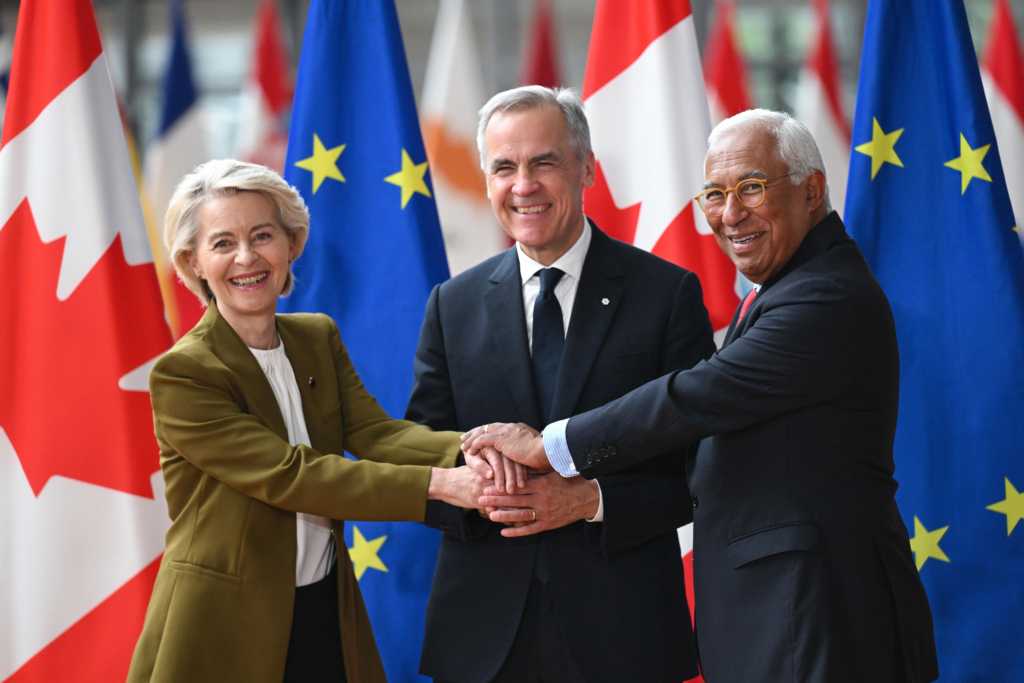
Ein Foto zeigt drei Personen, die sich die Hände übereinander legen vor kanadischen und EU-Flaggen in einem Saal.
Cover image: picture alliance / Hans Lucas | POOL UNION EUROPEENNE / AGENCE HANS LUCAS

European leaders losing sleep over Trump’s economic and territorial threats should spare a thought for their Canadian counterparts. On August 22nd, Canadian prime minister Mark Carney announced that his country was “at war” with the United States after trade negotiations collapsed at the eleventh hour. Trump’s subsequent renaming of Lake Ontario to Lake America echoed the crisis with Greenland in January, when the US called into question Denmark’s sovereignty over the territory and refused to rule out taking it by military force.

Both the EU and Canada, in other words, face a similar conundrum: how to de-risk their relationship with an increasingly predatory United States, which exposes them to security threats from Russia and poses a new threat of its own. It is against this backdrop that Carney will attend commission president Ursula von der Leyen’s State of the European Union Speech in Strasbourg on September 16th. An EU-Canada summit will follow in October. The timing could scarcely be better for Europe and Canada to make common cause. But if European leaders want to shift the relationship into a new gear, they will have to revise their usual approach to how the EU treats third countries, particularly in defence and security, where both sides’ dependence on the US runs deepest.

Blurring the lines

Some Canadians, traumatised by Trump’s bullying, have fantasised about joining the EU. Alas, Article 49 of the Treaty on European Union—its accession clause—restricts membership of the bloc to European states. But the EU need not choose between full membership and arm’s-length third-country status. A strict in-or-out model of security and defence co-operation risks excluding partners like Ukraine, Britain, Norway and Canada from key initiatives and the bloc’s defence technological and industrial base—leaving Europe less safe as a result.

The EU already treats one non-member as something more than an ordinary third country or even one on the path to membership: Ukraine has received notable carve-outs for the European Defence Industry Programme (EDIP) and the EU’s Security Action for Europe (SAFE) mechanism, which offers €150bn in low-interest defence loans—not to mention exemptions in other areas like trade, energy, and telecommunications. In other words, the question is not whether bending the rules is permissible under certain circumstances, but what those circumstances are. Extending the same treatment to Canada (as inoffensive an ally as they come) would be popular at home and would offer a template for how other relationships, including with Britain, could be structured.

There is already a clear trend towards a closer relationship between Brussels and Ottawa, especially on the defence industrial side. In 2021, Canada joined the military mobility project of the EU’s framework for deeper defence co-operation, PESCO. Last year, both sides signed a security and defence partnership and this year they agreed to Canada’s participation in SAFE.

On the bilateral front, Berlin and Ottawa are finalising a strategic partnership agreement which will include elements on defence cooperation, on top of agreements already signed with France, Denmark, and other Nordics. On the procurement side, German shipbuilder ThyssenKrupp Marine Systems won a contest to build 12 submarines for the Royal Canadian Navy—the biggest defence deal in Canadian history. Canada is also considering buying Swedish Gripen fighter jets instead of American F-35s and is building ice-breakers in Helsinki. Finally, Canada is actively involved in deterring Russia with boots on the ground in Latvia, where it leads a multinational brigade as part of NATO’s Enhanced Forward Presence (eFP).

But these efforts are mostly non-binding and aspirational—except for SAFE (which is time-limited) and eFP (which sits outside of EU structures entirely). The EU-Canada summit at the end of October gives Brussels and Ottawa a concrete opportunity to turn these efforts into specific investments, capabilities and operational co-operation.

Under the radar

Canada is an underrated military power. The 2% of its GDP that it currently spends on defence is already more than the 14 smallest EU defence budgets combined

The EU stands to gain more from a closer relationship than one might think. Canada is an underrated military power. The 2% of its GDP that it currently spends on defence is already more than the 14 smallest EU defence budgets combined. Compared to the EU’s biggest defence spenders, it ranks behind only Germany, France, Italy and Poland. And its budget is set to increase significantly as Canada moves to spend 4% by 2030 and C$500bn (€310bn) over the next decade.

Much of that money will be invested in equipment and suppliers outside of Canada. As Carney made clear in a recent speech: “The days of our military sending 70 cents of every dollar to the United States are over.” EU defence projects should open up to countries outside the EU and the European Economic Area. Canada’s armed forces bring significant know-how in Arctic warfare, an area of increasing interest to Europe amid growing threats from both Russia and the US. And its six decades within the joint US-Canadian air-defence command, NORAD, give it rare experience of continental-scale air defence and early warning, just as Europeans scramble to expand their own independent missile-defence network.

Deeper cooperation

The EU can use these resources and capabilities to deter Russia and wean itself off its dependence on America, starting with deeper Canadian co-operation with the EU’s defence projects and agencies. A first step would be encouraging Canada to join further PESCO projects. Canada’s expertise could be of great help in ACCESS, which aims to develop Arctic-capable, GPS-denied electronic warfare and sensor systems, and TWISTER’s space-based early warning strand. Canada could join both without too much red tape (for EU standards) because neither project is supported by the European Defence Agency (EDA). A second step would be an administrative arrangement between Canada and EDA, which would allow Canada to join EDA-supported PESCO projects it is currently ineligible for, as well as joint training, monitoring and research. Since the US already has such an arrangement, extending it to Canada should prove uncontroversial.

But the most ambitious step the EU could take would be to treat Canada as a full-fledged member of the EU’s defence technological and industrial base instead of as a third country. Member states and the commission should write Canada into EDIP’s successor, the ring-fenced defence-spending stream—or “window”—of the upcoming European Competitiveness Fund (ECF), which is currently being negotiated as part of the EU’s next budget.

As it stands, current EDIP rules will likely roll over into the ECF unchanged. Under those rules, a system built in Europe carrying 35% American components would qualify for funding, but a wholly Canadian one would not. When EDIP was being negotiated, members states deliberately created a carve-out for Ukraine. Member states should extend the same preferential terms to Canada under the ECF, but also go further, letting Canada run programmes as well as bid for them.

These would be major concessions and they must not be given away for free. The expectation should be that Canada pay for access, open its own procurement to European firms in return, and align its export controls with the EU’s. As a proof-of-concept, both sides could design at least one major system with no US export-controlled parts in it (a counter-drone system would work very well).

In addition to these efforts, Berlin and Paris should also throw their weight behind Canada’s proposal for a Defence Security and Resilience Bank. They might even propose merging it with Britain’s proposed Multilateral Defence Mechanism to create a coalition spanning Britain, Canada and EU member states.

Skin in the game

As the EU’s borders come under pressure from multiple directions, there is a strong case for expanding Canada’s stake in European territorial integrity. That begins by establishing reciprocity. Europeans shouldn’t scoff at Canadian concerns—just as Denmark flew blood bags to Greenland in anticipation of a US invasion in January, so too have the Canadian Armed Forces modelled a possible US military invasion.

European countries should make it clear to Washington that its statements calling into question its ally’s sovereignty are intolerable. They should also prevail upon Canada to unequivocally pick sides should the US raise the Greenland issue again. In the event of a future military mission to Greenland, similar to the Danish-led Operation Arctic Endurance, or even a mission under the EU’s common security and defence policy, Copenhagen should invite Ottawa to join with boots on the ground, just as it has done in Latvia. Likewise, the EU could bind its anti-coercion instrument to equivalent Canadian countermeasures, ready for joint activation during a crisis.

Boosting Ottawa’s participation in Arctic issues would tie it more closely to the defence of the region more broadly and would give it a bigger role in defending European borders. After all, no serious conversation about the region is conceivable without Canada, whose Arctic territory is vastly larger than that of most other Arctic states. Canada is already part of the region’s multilateral infrastructure, but there is still scope to deepen its co-operation with the EU instruments specifically. One way to bridge the gap would be to take up the European Parliament’s proposal to create a dedicated EU-Canada Arctic cooperation framework with structured dialogues between EU and Canadian institutions.

An additional step which would contribute decisively to European security would be to invite Canada to the Joint Expeditionary Force (JEF), the UK-led coalition of northern European states. Canadian forces have already taken part in JEF exercises in Latvia last year and Carney has participated in virtual meetings of the group. Formally joining JEF, which sits outside NATO and EU structures, would involve little red tape and could happen almost immediately. As the US considers far-reaching troop reductions in Europe, any step that improves interoperability among non-US NATO allies is a win for the entire continent.

A price worth paying

The steps outlined above are likely to draw America’s ire and invite retaliation. The US has repeatedly cast scorn on Carney’s middle powers strategy—an effort to rally mid-sized states against pressure from larger ones—which it increasingly views as a serious challenge to its primacy. Under-secretary of war for policy Elbridge Colby recently suspended the Permanent Joint Board on Defence, a longstanding US-Canadian strategic consultative body, and linked the pause to Canada’s weak defence spending and its middle powers strategy. Both the EU and Canada should expect increasing pushback if they embark on this joint course. But any American paroxysm will prove the point—that both Europe and Canada are better off together than alone or in thrall to Washington. If that means blurring the boundaries between EU member states and third countries, so be it.

Source

  •  

Colangite biliar primária – conhecer, diagnosticar e tratar uma doença rara

Artigo escrito por Joana Carvalho e Branco, médica gastrenterologista e vogal da Sociedade Portuguesa de Gastrenterologia (SPG) O que é a colangite biliar primária? A colangite biliar primária (CBP) é uma doença crónica e autoimune do fígado, em que o sistema imunitário começa a atacar as pequenas vias biliares localizadas dentro do fígado. A bílis […]
  •  

Beyond Saxony-Anhalt: What Merz’s crisis means for Europe

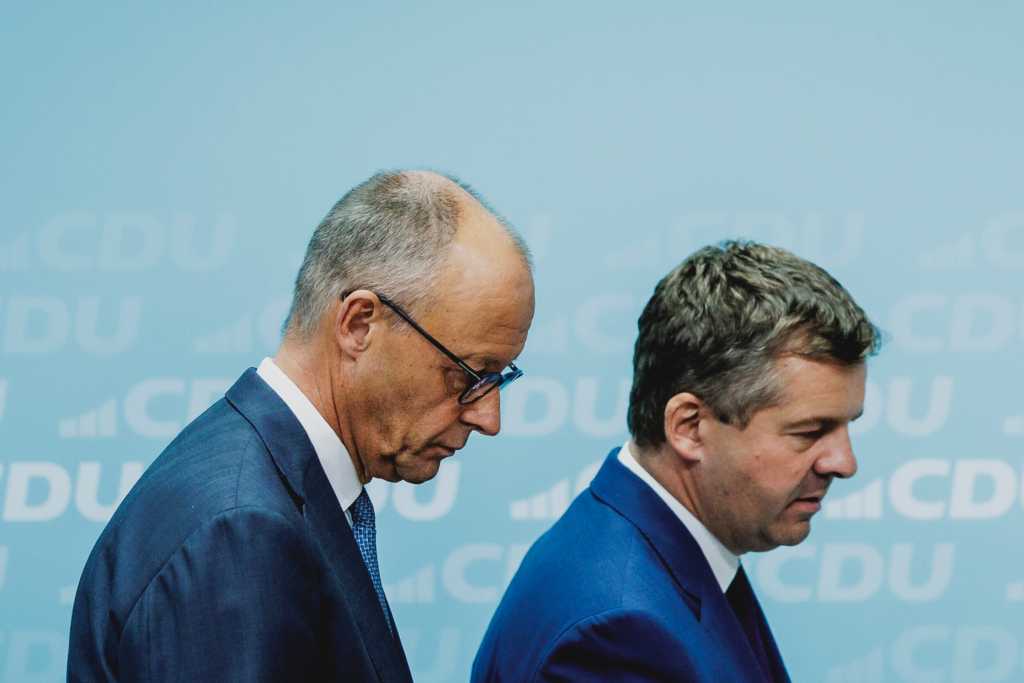
Ein Foto zeigt zwei Männer in Anzügen, nebeneinander stehend, vor hellem Hintergrund mit wiederholtem CDU-Logo.
Cover image: picture alliance / photothek.de | Florian Gaertner
NPP

Problem

Saxony-Anhalt has returned 43.8% of the vote for the Alternative for Germany (AfD) in its state election. The result puts the party within reach of forming what would be the first state government run by the far-right in the history of the German federal republic.

The AfD has no executive experience and its Saxony-Anhalt branch is riven with tensions and splits. A chaotic state government could deter voters elsewhere from backing such parties. But if the AfD manages to govern halfway coherently, it will have the chance to pick fights with authorities in both Berlin and Brussels, and significant leeway to try out policies that could later be applied elsewhere. This might then embolden the radical right elsewhere in Europe.

Meanwhile the result increases the pressure on Chancellor Friedrich Merz’s centrist federal coalition. Already before the Saxony-Anhalt election, splits were widening between eastern and western branches of his Christian Democrats (CDU/CSU), and between him and his conservative party base. The result exacerbates these and, in turn, increases the chance that Merz will be too distracted and constrained by domestic politics to provide European leadership.

With France, Italy, Poland and Spain all entering election seasons, a Germany riven by internal drama cannot be the anchor that Europe needs.

Solution

Bold action is needed both in Berlin and beyond Germany. Talk of a party ban is too late and would anyway be unlikely to quell the underlying discontent felt by AfD voters. Action by the federal authorities against stand-out extremists in the party, and its funding streams, is both more realistic and more likely to keep its voters open to persuasion.

Meanwhile the CDU/CSU needs to make a strategic decision about what sort of party it wants to be; including where it will and will not cooperate with parties outside the traditional mainstream. Germany’s other pro-European parties also need to marshal a better answer to the radical right: substantive policies proving that they are on the side of ordinary people rather than powerful interests (Piotr Buras, Jeremy Cliffe and Susi Dennison have made concrete suggestions along these lines where climate policy is concerned.)

Other European capitals should curb their expectations of German leadership and nurture broader sources of impetus, including the new E6 group of major EU economies and the “coalition of the willing” on Ukraine. Merz, for example, is now even less likely to achieve a breakthrough on the EU’s 2028-2034 budget negotiations or on EU accession talks. Other European leaders, including European Commission president Ursula von der Leyen, will need to depend less on him to advance ambitious proposals. European diplomats in Berlin should think hard about how to sell their ideas into a more distracted and inward-looking government.

Context

Saxony-Anhalt is a small and demographically unrepresentative German state, with an atypically old and homogeneous population of 2.1m out of a national total of 83.5m. Nevertheless, its election result has reverberated through European capitals.

The vote on September 6th gives the AfD 39 seats, three short of a majority, requiring the party to seek support either from the left-conservative Sahra Wagenknecht Alliance (BSW) or the right flank of the CDU in order to govern. The only alternative would be a government supported (at least passively) by all five of the other parties, including the socialist Left party, cooperation with which is anathema to the CDU. The development comes as Merz’s fragile “grand coalition” is struggling to pass reforms aimed at reviving Germany’s stagnant economy.

Two upcoming state elections on September 20th—in Mecklenburg-Western Pomerania and in Berlin—could further dent his authority. It is possible, though not currently probable, that he will be forced out as chancellor in the coming months. The obvious frontrunner to replace Merz is Hendrik Wüst, the premier of North Rhine-Westphalia, but his moderate politics may not fit the polarised mood.

Source

  •  

Emergency Room: The AfD’s victory in Saxony-Anhalt

Copy of NPP Metaball Banner

This week, Mark Leonard is joined by Jana Puglierin, senior policy fellow and head of ECFR’s Berlin office, in a World in 30 Minutes Emergency Room episode to discuss the latest in German politics.

The AfD’s win in the small eastern state of Saxony-Anhalt was widely expected, but the scale of the result and the collapse of Chancellor Friedrich Merz’s Christian Democrats (CDU/CSU) have still shocked Berlin. For the first time since the second world war, a far-right party is within reach of governing a German Bundesland. Jana unpacks the AfD’s possible paths to power, the pressure on Merz and his grand coalition, and what the result says about the far right’s continued rise in Europe.

Why does an election in a state of two million people matter so much for a country of 84 million? Can the AfD govern without a formal coalition partner, and would CDU lawmakers break the historic “firewall” to make that possible? Why is the party still treated as beyond the pale, even as it leads national polls? And should Europe prepare for a Germany too absorbed in its own crisis to lead?

This episode was recorded on September 7th 2026.

Source

💾

  •  

Against war, drought and hunger: A global coalition to prevent a food crisis

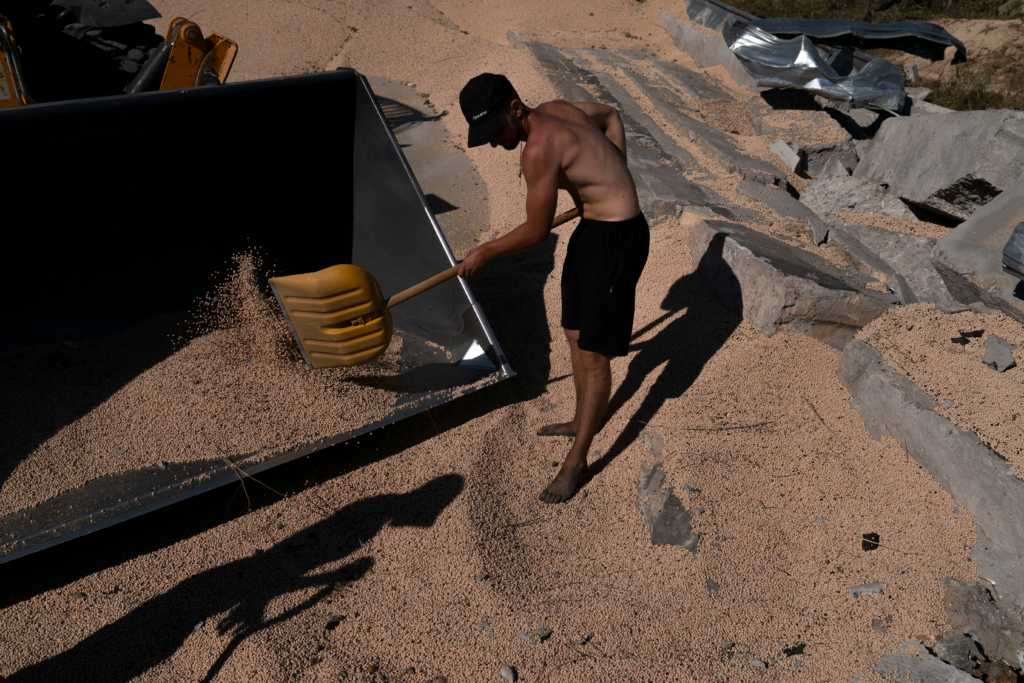
Ein Foto zeigt einen Mann ohne Hemd mit schwarzer Kappe, der Erbsen mit einer Schaufel in die Schaufel eines Laders schaufelt
Cover image: picture alliance / ASSOCIATED PRESS | Jae C. Hong

Three features of today’s unordered world are converging to create a devastating food crisis. Russia’s war in Ukraine is disrupting agricultural exports from both countries. The enduring blockage of the Strait of Hormuz is restricting fertiliser shipments. And this year’s El Niño (a sporadic warming of the Pacific Ocean generating widespread knock-on effects elsewhere) could be the most drastic on record, causing widespread droughts. As this year’s United Nations general assembly (UNGA) draws near, global food affordability and availability are at risk, and with them millions of lives and global security.

This looming catastrophe coincides with an absence of political leadership, including in multilateral institutions. As recently as 2022 a coalition of leaders convened by the UN secretary-general, António Guterres, managed to curb a food crisis. Today even that convening power is missing, with potentially more dire consequences. Political leaders face a test: amid war, climate crisis and diplomatic turmoil, is it still possible for groups of states and institutions to confront the direst humanitarian urgencies?

This note argues that a solution could still be found, requiring a comprehensive global effort on several fronts: drought, support for farmers, the Black Sea, the Strait of Hormuz and access to fertiliser. In all of this, Europe should lead.

The emerging calamity

Global food prices are already almost 75% higher than their 1999 lows. Almost 2.2 billion people face food insecurity. The coming trio of threats to food supplies will make that worse.

A “super El Niño” will likely bring heat and drought to southern Africa and significantly reduce food production in south and south-east Asia. It may reduce already falling rates of wheat production—which is expected to fall by 3% globally in 2026-27 (8% in the EU, 12% in Australia and 19% in Argentina)—and drive up rice prices.

Meanwhile the Strait of Hormuz remains blocked. It is the largest single conduit for the nitrogen fertilisers most directly linked to yield and is the export route of about half the global supply of sulphur, a vital component of phosphate fertilisers. Thus, about one third of global seaborne fertilisers cannot reach fields, especially afflicting smallholder farmers in sub-Saharan Africa (where fertiliser prices are highest) and south Asia.

All this may well generate wider ripple effects lasting years. Rising prices and exhausted government subsidies in states like Malawi are deterring fertiliser use, which could depress future production. Historically, El Niño events are associated with protectionism (India has imposed export restrictions hitting countries in south-east Asia), which in turn raises prices, lowers margins and curbs investment in future output.

There are two bright spots among the big global agricultural producers: Ukraine and Russia, which together generate 30% of the world’s wheat exports, 20% of its corn, 60% of its sunflower oil and, from Russia alone, 20% of its fertiliser. But there too war has brought disruption. Russia’s attacks on Ukraine’s highly exposed grain and port infrastructure cut the latter’s exports by 75%, and more damage has already been done in August. Ukraine has been striking Russian port facilities and ships in the Black Sea and Sea of Azov, taking over 90% of Russia’s grain export capacity offline.

In 2022, a UN- and Turkey-facilitated arrangement mitigated a similar crisis and kept Russian and Ukrainian grain and fertiliser supplies flowing through alternative routes. US and EU agricultural aid in sub-Saharan Africa also helped. In 2026, by contrast, multiple challenges stand in the way of a similar solution. Logistically, war damage to infrastructure and low water levels in the Danube make it harder to get grain out of the region. Diplomatically, the UN is approaching a leadership transition, the US has turned against the organisation, and there is no global focal point for action.

Preventing the worst

European leaders, including those of the UK and Ukraine if it wants, should move fast to convene a coalition of states influential among the combatants in the Iran and Ukraine conflicts (India, China and Turkey especially) and of states especially exposed to this nutritional crisis (states in sub-Saharan Africa and south and south-east Asia). This coalition could draw on arrangements from the 2022 deal, as well as new links between UN agencies and initiatives like the CGIAR agricultural innovation network. It should seek to transcend political and diplomatic tensions, bringing leaders or at least ministers together on the margins of UNGA in the week of September 21st.

The joint initiative should have the following core elements:

  • A programme to distribute food relief and technical assistance on drought-resistant agriculture and soil fertility, headed by an adviser to the UN secretary-general and supported by UN agencies. Such assistance works: one led by the CGIAR reached almost 6m African farmers in 2023-5 and, to cite just one example, in Malawi delivered maize yields 64% higher than the national average.
  • This will need to be funded. The World Food Programme’s conservative pre-El Niño budget needs for 2026 should be covered (only 34% met so far). But the initiative should also marshal resources for the medium-term response to the “super El Niño” and its geopolitical intensifiers. This would include a financial mechanism to subsidise efforts by states to mitigate higher input costs and shift agriculture to drought-resistant strains. A CGIAR-led sustainable productivity growth push should have a budget of $500m over three years, with the first portion delivered fast enough to support the upcoming planting season.
  • Coalition members should strive for a partial ceasefire between Russia and Ukraine, to include an end to attacks both on ships carrying grain and on ports and infrastructure identified as central to grain, fertilisers and inputs. Its European participants especially could undergird this with support for Ukraine’s farms, including mobile storage units, fertilisers, seed and repairs to infrastructure. Some of this work is already underway.
  • The programme should also involve an agreement with Iran that fertiliser shipments be allowed to transit the Strait of Hormuz. Several attempts have been made in this direction already, with no results to date. Two elements should be added to make it more attractive. First, Iran’s own fertiliser and urea exports, and fertiliser shipments from other states, should be exempted from the US blockade and Iran’s imports of wheat and rice should be secured. Second, an expert-level group—akin to that used in the 2022 Black Sea arrangement—would oversee implementation and resolve disputes quickly and locally. Part-time negotiators must also secure practical arrangements to ensure results, not just agree on principles.

Unpalatable—but necessary

This effort would still face a series of obstacles. It would require multiple states to cross their red lines—or at least revisit established policies. There is a good chance that the two wars driving up food prices, in Ukraine and Iran, will escalate in the near future. Russia especially would likely be reluctant. The states most affected are a disparate and often antagonistic group. There is no single capital or organisation capable of appealing to all the decision-makers needed for a comprehensive solution.

But within this adversity dwells a constructive role for European governments. Along with the UN secretary-general, and a core group of middle powers including Brazil, Egypt, Kazakhstan, Mexico and Turkey, they can bring together the states most exposed to the crisis as the core of this new group. Along with partners from across the UN system, such as the UN Conference on Trade and Development, the World Food Programme and the Food and Agriculture Organization, they can amplify those countries’ voices and help marshal the resources needed to make the programme outlined above meaningful.

Besides winning over the most affected states, the next step would be to bring on board those states with influence on combatants in the Ukraine and Iran conflicts. This means especially China and India. The UN secretary-general can play a particularly vital role there. Europeans can also help by appealing to Chinese and Indian claims to speak for developing countries in general. In turn, Brazil, India and South Africa can invoke Russia’s claims to share that mantle, as fellow members of the BRICS formation.

Europeans can also play a crucial role in recruiting Ukraine into the programme—even if the latter’s commitment to any ceasefire would depend on Russia’s position. They could see this anti-hunger coalition also as a way to help rally support for Ukraine in the global south, as the Ukrainian president, Volodymyr Zelensky, did in 2022 with his Grain from Ukraine initiative.

In the Strait of Hormuz, meanwhile, the coalition could present free passage for fertiliser exports as a means of trying out the Omani-Iranian technical plans for opening sea routes. It would present this as a win-win proposition: Iran would get some of its exports to global markets; the US would be supporting its Gulf allies; and both parties and their European interlocutors might see the long-term geopolitical benefits of a stabilising anti-hunger act along these lines (for example, curbing mass migration).

This initiative is intended to be a “no regrets” effort. Even if it takes time for the combatants to join—and it will—supporting farmers and global trade will improve the food situation. Progress in addressing hunger should provide an opportunity to highlight the further contribution that progress in the Black Sea and the Strait of Hormuz could bring. This sense of momentum may bring some or all combatants closer to agreement.

It will take leadership from both the most affected states and from wealthier countries to achieve this defiantly cooperative act in a world of unorder. But its very defiance, its assertion that common action is still possible, makes it all the more valuable.

Source

  •  

Actually, maybe: How German Angst could become Europe’s nightmare

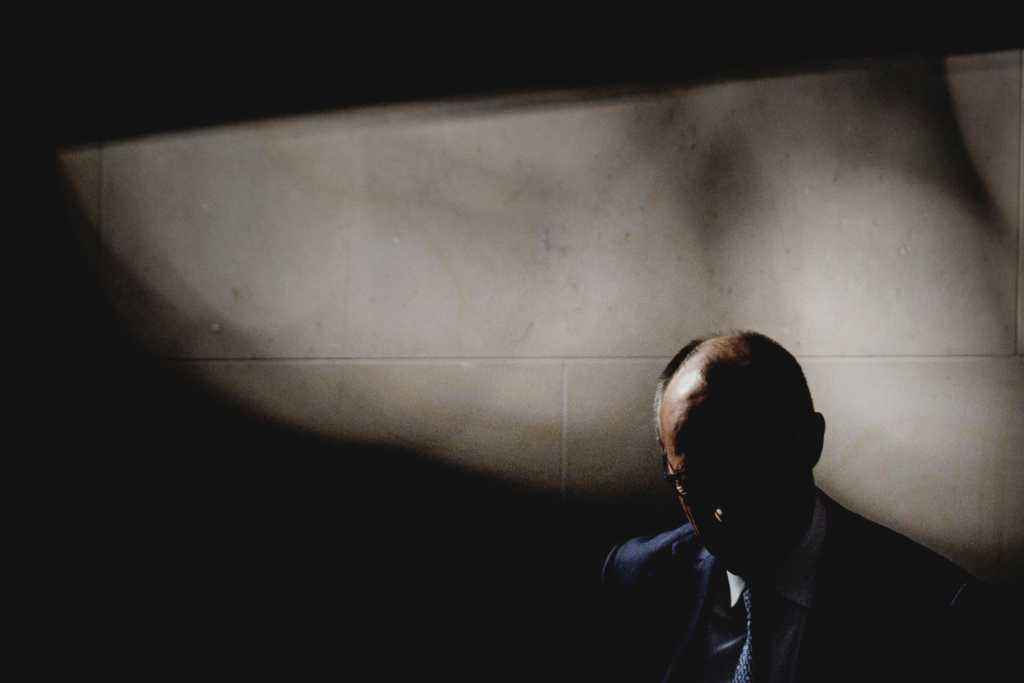
Ein Foto zeigt eine Person in dunklem Anzug mit gesenktem Kopf vor einer hellen Wand und starken Schatten.
Friedrich Merz (CDU), Federal Chancellor, photographed before the government declaration in the German Bundestag in Berlin, 18.03.2026. | picture alliance / photothek.de | Florian Gaertner

Berlin; late August: when politics normally stirs into life after the holiday lull. But this year, the lull never came.

German chancellor Friedrich Merz is beset by approval levels plumbing the depths of the depleted Rhine and Danube. His governing conservative CDU party spent the summer at war with itself over pension reform (not helped by a botched cabinet reshuffle). Some of the chancellor’s staunchest supporters are even openly wondering whether he is still up to the job. To get out of the hole they are in, Merz and his ministers now want to project a sense of Aufbruchstimmung—a feeling of renewal and restart.

Whether they succeed will determine Europe’s future.

Germany’s economy has endured six years of paltry growth. Its traditionally strong industries are screaming for protection against China, US tariffs and energy price shocks (and against their own past decisions). Strong end-of-the-republic vibes suffuse dark political commentary, “mainstream” parties oscillate between panic and despair, and resignation has set in among voters. What until recently seemed little more than a media talking point on an “Andy Burnham moment”—meaning the possibility of Hendrik Wüst, North Rhine-Westphalia’s minister-president, succeeding Merz as chancellor this autumn—could yet become reality.

For decades, Germany was Europe’s byword for political stability and predictability. Today, it is hard to overstate how little is now unthinkable in German politics. All bets are off. Decision-makers elsewhere in Europe should get ready for the possibility of a new kind of Germany: no longer boring, no longer stable—and no longer rich.

Why the Angst is now real

Germany is days away from elections in three eastern states which could shake the government in Berlin to its foundations. First up is Saxony-Anhalt, where on September 6th the far-right populist Alternative für Deutschland (AfD) could rewrite German post-war history and turn the decades-long mantra of “never again” into “actually, maybe”. Polling suggests even an absolute majority for the party is within reach. The AfD, the CDU and the Left could be the only parties to clear the 5% threshold for the state parliament. Two weeks after that possible momentous result, the states of Berlin and Mecklenburg-Vorpommern will also elect new parliaments.

While the situation for the political centre looks a little less dire in the latter two places, complicated three-party coalitions are the likely outcome in both. This will have a compounding effect on the stability of the federal government. The CDU leadership under Merz remains adamant that the “firewall” must hold, ruling out any coalition or cooperation with the AfD. Yet this position is increasingly being questioned by local politicians and by conservative thinkers within and around the party. Many in the CDU are frustrated by what they see as the strategic price of the firewall. With their preferred coalition partner, the liberal Free Democrats, now struggling to clear the 5% threshold almost anywhere, ruling out the AfD leaves the CDU ever-more dependent on centre-left coalitions. In critics’ view, this deprives the party of options and leaves it hostage to the remaining potential coalition partners.

An AfD minister-president would be a brutal demonstration of the political establishment’s inability to provide a convincing vision for the country

An AfD minister-president in one of Germany’s states would be more than a striking political development. It would be a brutal demonstration of the political establishment’s inability to provide a convincing vision for the country’s economic, political and social future. In recent years, German leaders have made more reform announcements than actual reforms. The previous government tried to adapt to the Zeitenwende without imposing any hardship on Germans—and failed. Now, the Merz government seems equally unable to muster the political strength for major reform.

Instead, it has too often looked to the past for answers: back to the combustion engine, back to looser labour rights, back to family values. The only policy area where the government now seems readier to change course is on China, where it has said it will push through a more active European position on protecting markets and punishing China’s predatory economic behaviour. In a revealing commentary, however, Merz himself announced this was enabled, not by his decisive political leadership, but by the altered posture of the German car industry.

This vacuum in dealing with the implications of the changing global environment leaves huge room for the political fringes, especially from the far-right. The AfD’s offer is revisionist—drastically curb immigration and asylum, reverse key elements of the energy transition, challenge European integration, end the euro and pursue a distinctly nationalist approach to foreign policy. All this is deeply unsettling to the political establishment, but resonates with a growing constituency of voters united by restrictive stances on migration and cultural issues.  

The strength of the AfD is a symptom, not a cause. It did not rise to prominence overnight and has been part of Germany’s political landscape now for more than a decade. But the party is now within striking distance of actual political power at a time when the country’s political and economic foundations are starting to crumble. The war in Ukraine, volatility in America and conflict over the Strait of Hormuz are stretching the limits of German leaders’ attention as well as the country’s fiscal space. Germany’s long-term trade relationship with China is now a liability and an epic drought has shrivelled what little hope remained for Germany’s economic recovery. Berlin is not only forced to reckon with the failures and missed opportunities of the past decade on everything, everywhere, all at once; but the politicians seem unprepared either to put up a real fight for survival or even adjust to this new reality in a form of managed decline.

No time for Schadenfreude

Germany is hardly the first European country to experience a radical reshaping of its party system and the rise of the far-right; Italy and France have been through similar upheavals. And Germany itself, amid deep economic problems, was called “the sick man of Europe” back in 1999, only to recover and to become the continent’s exporting powerhouse. Why should the rest of Europe now worry so much about Germany’s malaise?

The answer is: because a German crisis is a European crisis. Germany is too economically and politically important to fail. Its economic weight, role at the heart of the EU and position as Europe’s most populous member state mean this would be more than just another episode of national political turbulence. A Germany that is oozing 15,000 industrial jobs each month, becoming even more dependent on technology imports and increasingly incapable of internal reform risks dragging Europe towards fragmentation and exploitation.

Unless political leaders come up with something new, a German pall will blot all major items on the EU’s agenda: the next multiannual financial framework; the future of the bloc’s industrial policy; European efforts to rearm and build resilience; a more autonomous capacity on emerging technologies and the economic muscle to create international leverage behind a new global trading agenda. That is not to mention the serious consequences of a German disengagement for Europe’s continued support for Ukraine.

“German leadership is not optional”, Sweden’s defence minister said at a public event this month, attended by one of the authors. German political elites seem to disagree. Theirs is the third largest economy in the world, sitting at the core of the world’s largest single market, boasting leading international companies and building up one of the largest defence budgets anywhere. Yet they appear to lack any sense of their own domestic, let alone global, agency. The three upcoming state elections may give them their last chance and some momentum to turn things around. But if Berlin becomes entirely enfeebled under the ensuing political fallout, the rest of Europe is likely to suffer in the same way.

Source

  •  

Una llamada a altas horas en el Café León advierte al doctor Negrín del alzamiento en Marruecos

Madrid. La tranquilidad nocturna que se respiraba en las tertulias del madrileño Café León, en la calle de Alcalá, se vio truncada de forma dramática en las últimas horas de la pasada noche. El doctor Juan Negrín, diputado socialista por Las Palmas y reputado catedrático de Fisiología, se disponía a dar cuenta de su habitual […]
  •  

Juan Negrín teme que los últimos asesinatos deriven en un enfrentamiento armado

Madrid. Entre los destacados dirigentes socialistas que asistieron al velatorio del cadáver del teniente Castillo en la Dirección General de Seguridad estaba el diputado por Las Palmas Juan Negrín. En medio del estupor y el dolor por el asesinato del teniente republicano a manos de un grupo de falangistas, tuvo conocimiento del posterior asesinato del […]
  •  

Political crisis in Germany

This week, Mark Leonard is joined by Jörg Lau, international correspondent at Die Zeit and Jana Puglierin, head of ECFR’s Berlin office, to explore the political turmoil in Germany ahead of an electoral autumn. Chancellor Friedrich Merz’s government is becoming increasingly unpopular: it faces collapsing approval ratings, growing tension within the governing coalition and mounting pressure from the far-right Alternative for Germany (AfD).

As regional elections approach, Jana argues that Germany’s traditional parties face difficult choices that could reshape the country’s political landscape, while Jörg discusses what the AfD’s rise means for Germany. A “firewall” has kept mainstream parties from cooperating with the far right in the post-war period—but Jörg reflects on the strain this is under, and whether the AfD’s first taste of regional power could transform German politics.

Together, Mark, Jörg and Jana assess the prospects for Merz’s leadership, the future of the CDU and whether Germany’s political centre can withstand such pressure. Are established parties capable of renewing themselves? What happens if the AfD makes gains at the regional level? And what would prolonged instability in Berlin mean for Europe?

This podcast episode was recorded on August 12th 2026.

Bookshelf
The Names, by Florence Knapp
The Nights Are Quiet in Tehran, by Shida Bazyar
The Invite, by Olivia Wilde

Source

💾

  •  

The offline messaging apps challenging internet shutdowns

Governments that deploy internet shutdowns to thwart protesters have struggled to clamp down on offline messaging apps. India’s recent response to Jack Dorsey’s Bitchat suggests that battle is entering a...

© Avijit Ghosh/NurPhoto/Getty Images

Demonstrators take part in a protest rally organised by the Cockroach Janta Party and various Left student organisations against the NEET paper leak, demanding the resignation of Education Minister Dharmendra Pradhan in Kolkata, India. (Photo by Avijit Ghosh/NurPhoto via Getty Images)
  •  

Combater o tabu do controlo dos preços para responder à crise habitacional

A escalada incessante dos preços e das rendas torna particularmente urgente olhar para a crise da habitação como um lugar de conflito de poderes e de interesses cujos custos estão a ser assimetricamente suportados pelos trabalhadores. Como poderia o controlo das rendas ser uma alavanca para dar resposta a esta crise? A série «Agora como nunca, ideias para sempre» continua a colocar no debate público ideias simples e capazes de melhorar o futuro. Depois da saúde, a habitação. Todos os dias (…)

- 2026/08
  •  

Contra a pobreza, o trabalho que une e escuda

O que é hoje um pobre? Qual o padrão de vida digno que coletivamente se entende ter de ser assegurado a todos? No momento de definir instrumentos estatísticos e políticas sociais de combate à pobreza fazem-se escolhas que podem reduzir, ou aprofundar, a dependência económica estrutural e a insegurança ontológica da maioria da população. O que é um pobre? A pergunta ressurge num momento em que os afetos coletivos em torno desta «categoria social» se mostram cada vez mais polarizados: à (…)

- 2026/08 / Cartografia e Infografia
  •  

Can we train AI to choose safety over speed?

As July monsoon rains flood the Mumbai streets around my home, quick-commerce platforms are using advanced weather algorithms to capture surging customer demand. While tech companies capitalize on the storms,...

© IndraniAditya/NurPhoto via Getty Images

Delivery personnel from Swiggy navigate a flooded street amid heavy rainfall in Mumbai, India, on July 4, 2026.
  •  
❌