❌

Reading view

The real crisis for men is capitalism: A conversation with Dr. Mark Anthony Neal

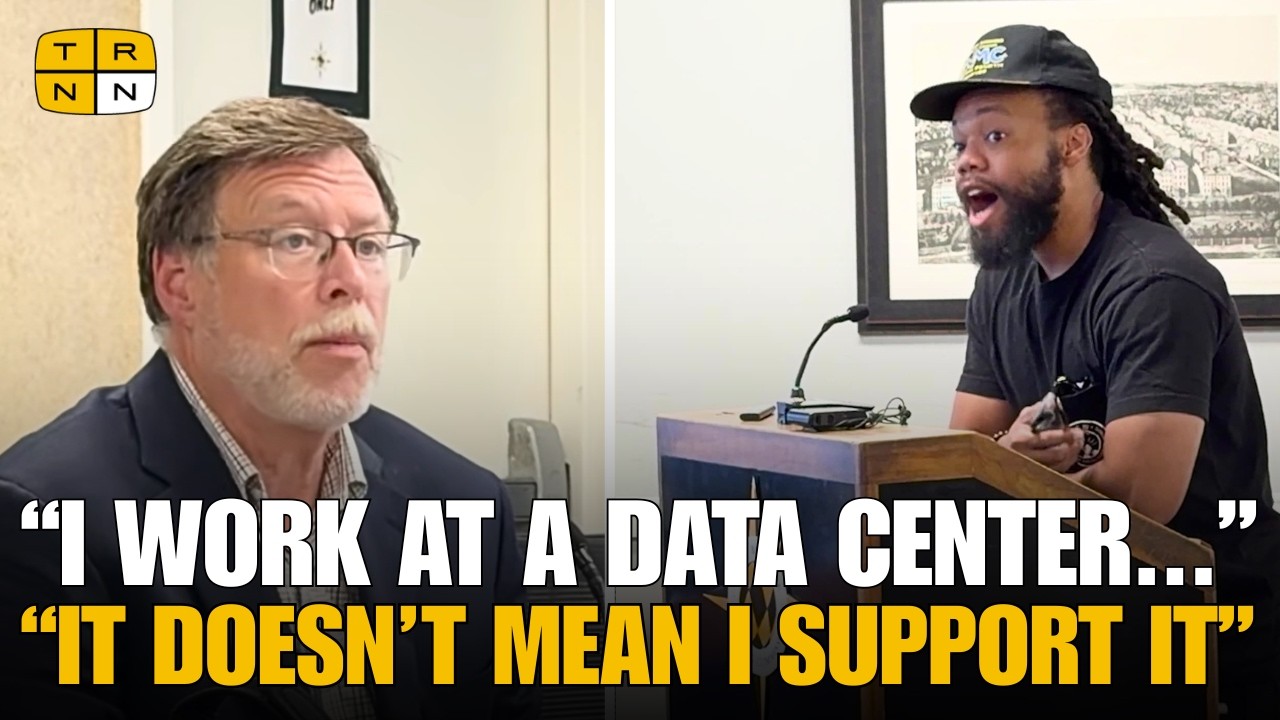
From the heinous crimes of the Epstein class to the Cornell 7, from the toxic cultures of the “manosphere” to the increase of antisocial relationships with online pornography and AI bots, we need to talk about what is going on with men in our society. We speak with renowned scholar, author, and commentator Dr. Mark Anthony Neal about his new book Save a Seat for Me: Notes on American Fatherhood, and about the ways American capitalism damages everyone and trains boys to become monstrous men.

Credits:

  • Post-Production: Cameron Granadino
Transcript

The following is a rushed transcript and may contain errors. It will be updated.

Maximillian Alvarez:

I’m here at Red Emmas at the Baltimore Book Festival, and I’m sitting with Dr. Mark Anthony Neal. Brother Mark, it’s so great to have you back here in Baltimore, man. I know I only got you for a second, and we’re talking about your incredible new book, Save a Seat for Me, Notes on American Fatherhood. And I was thinking as another father in America in 2026, I wanted to ask you, it doesn’t take PhDs like we have to know that we’ve got a real fricking crisis in this country with men and masculinity and masculine culture and fatherhood, or we have a whole lot of crises that men are experiencing but aren’t dealing with well. So what do you make of all this? What do we do about it? And how can your book help us get there?

Dr. Mark Anthony Neal:

I think we have tried, America has tried to raise generations of warriors, if you will, to be on the front lines of American imperialism. And you can’t be human to do that. You can’t think, you can’t question, you can’t be vulnerable. So what we have done is raise two or three generations of men in America who don’t know how to be human, who don’t know how to lead into full range of who they are. We’ve been socialized to show up only certain kinds of ways, anger, rage, the ability to follow directions. Things like vulnerability are made fun of at the highest levels.

Maximillian Alvarez:

And those of us who are very vulnerable people have been made fun of.

Dr. Mark Anthony Neal:

Because of that.

Maximillian Alvarez:

Because of that.

Dr. Mark Anthony Neal:

We’ve been made to think that our responsibility in a capitalist system has literally been reduced to only making money, that our only value. And I think about this a lot as a Black father, my own father, that I’m sure he thought that his only value to me was making sure that I was fed and clothed and taken care of. And I get all of that, but I needed much more from him. As a father, I needed to be more than that for my daughters. And so I think when we look at young men who are clearly feeling so much with no outlet, their outlets become dangerous behaviors, self-directed violence,

Maximillian Alvarez:

Toxic online cultures,

Dr. Mark Anthony Neal:

All kinds of addictions, alcohol, Percocet, weed, porn. I mean, we can name all these things and understand it. And the fact that so many of the young men in the world today, their lives are what they can connect with on their handheld device. They don’t actually have relationships with people in the real world, don’t see a value in that. And I don’t know how we sustain that. I don’t know how we sustain our humanity in a situation where we don’t value human relationship anymore.

Maximillian Alvarez:

Well, and it’s like you see that the path that we’re on as a society or what’s left of a society is being driven by the sociopathic, psychopathic, bloodthirsty –

Dr. Mark Anthony Neal:

Or just plain evils.

Maximillian Alvarez:

Just plain evil maniacs who want a future where they get all the benefits of human society, but don’t have to deal with any of the humans in it. Whether they’re thinking of like, oh, AI is going to replace all their jobs and we’re going to get all the money. They’re not thinking about what the heck that’s going to mean for us. They’re just going to push us into slums and prisons and police us, hunt us, surveil us. That’s their big goddamn plan. And I think you put it so powerfully that it’s like so many men out there have the same human needs that we all have and we’re feeling them so acutely the more isolated we are, but we’re looking to find, we’re seeking inhuman avenues.

Dr. Mark Anthony Neal:

I mean, think about all the folks who are in relationships with chat bots. I mean, it’s surreal. I can’t have a relationship with an actual person. I don’t desire a relationship with an actual person. I need to have a relationship with some facsimile, some avatar that somehow that’s more meaningful to me than having a relationship with a person.

Maximillian Alvarez:

Yeah. And I think even as a editor in chief and co-ED of a media network, as a media star, we recognize there’s only so much you can do online. You got to get the hell offline and you got to meet each other back on that level of shared humanity and shared reality because that’s the only way we’re going to deal with anything, anything in this country.

Dr. Mark Anthony Neal:

And that’s why the Baltimore Book Festival is really important. First of all, not only just a reminder, someplace that’s celebrating the written word, obviously, but folks coming together in community. We have to get back to a culture where we share in community. We read together, we listen together, we debate together instead of these media silos. I’m going to have this debate over here on this network and you’re going to have this debate over there and never the twain shall meet.

Maximillian Alvarez:

Well, and final question, but it goes really to the heart of your book. Here in Baltimore, I see this every day. I feel it as a father, but right down the street from where I live in Mondamin, earlier this summer, there were six youth who were caught on camera just beating the hell out of an elderly member of the community, a former Black Panther. It was horrific. I’ve interviewed this man and the community that’s trying to help him, but clearly everyone who is showing up to help is seeing in that video the deficit of guidance, of fatherhood, of love.

Dr. Mark Anthony Neal:

Of respect. Basic respect.

Maximillian Alvarez:

So what can we do about that in our everyday lives at the person to person level?

Dr. Mark Anthony Neal:

We have to be willing not just to be witnesses to these experiences or commentators.

We have to intervene and feel comfortable enough to intervene. Whoever sat down with those young men, first of all, to explain, because the easy part is to say, no, this man was important to our movement in the past. The more difficult thing is like, no, this man is important because he’s another human being and you should value life and his humanity. But if they are young men who do not value their own humanity, don’t see their own humanity, they’re going to reproduce that behavior over and over again. And so we have to have the willingness because it’s real easy to go, I’m just going to build my life in this silo and protect my family and I get it. But to take that next step to say, okay, I might not be able to talk to all six of these brothers, try to talk to two of them.

Begin that process, that one-on-one conversation that can blossom into something that’s much more significant.

💾

“America has tried to raise generations of warriors to be on the front lines of American imperialism… So what we have done is raise two or three generations of men in America who don't know how to be human.”
  •  

Amazon is deploying AI to spy on its workers and bust unions before they form

A worker walks inside Amazon's LCY3 Fulfillment Centre in Dartford, east of London, on June 4, 2026, on the second day of company's 'Delivering the Future EMEA '26' event. Photo by JUSTIN TALLIS / AFP via Getty Images

This article was originally published by Truthout on Sept. 30, 2026. It is shared here under a  Creative Commons (CC BY-NC-ND 4.0) license.

The 18th-century notion of the panopticon — a circular prison design with a guard station in the middle, allowing a single officer to enforce discipline by keeping watch over all the prisoners — has become real in the 21st century through AI-driven surveillance against workers: It’s the Amazon warehouse.

It should be no surprise that the company that harnessed technology to create a vast, $2.7 trillion empire would employ the same sophistication to enforce workplace discipline and tamp down insurgent unionization efforts. A recent disclosure of Amazon’s internal “employee relations” documents reveals just how extreme Amazon’s methods of warehouse surveillance and control have become.

Amazon employs what it calls the “Atlas” model, inputting into a computerized model a staggering amount of information on workers, their thoughts and behaviors, the workplace environment, and myriad other factors — “hundreds of data points,” according to the company. Atlas produces not just a granular measurement of ongoing worker unrest, worksite by worksite around the world, but also a prediction model for future organizing. It’s like the “precrime” police in the film Minority Report who use psychic powers to identify and apprehend would-be criminals before they act — except in this case, it’s an AI-driven tool used by the billionaire owners of one of the richest companies in history to head off rebellion among its low-wage workforce. And this is not Tom Cruise play-acting; it’s very real.

Workers anywhere who have endured anti-union campaigns can relate to stories of overbearing surveillance by management; the Atlas model, however, takes the spying to an entirely new level.

Details of the Atlas model came to light recently as a result of a legal dispute between Amazon and Unifor, the Canadian private sector union. Last year, British Columbia’s Labour Relations Board awarded union certification to Unifor at Amazon’s YVR2 warehouse outside Vancouver, finding that the company had broadly interfered in the union drive. It was the second union certification at Amazon in North America — the other being the 2022 union win at JFK8 in Staten Island, New York. But in contrast to the U.S., where Amazon has managed to stall bargaining for four and a half years because of weak labor laws, the B.C. Labour Relations Board ordered Amazon to recognize the union and negotiate. Contract bargaining commenced last December.

Not surprisingly, Amazon has dragged its feet in negotiations, prompting the union to file unfair labor practice charges with the Labour Board. Following a series of hearings earlier this year, the Labour Board found that Amazon violated provincial law. In August it ordered a remarkable step — first-contract arbitration at YVR2. That fight remains in play, but as a result of the legal proceedings, Amazon was required to turn over documents to the Labour Board and Unifor. Unifor has shared them with Truthout, and they can be viewed here.

Atlas produces not just a granular measurement of ongoing worker unrest, worksite by worksite around the world, but also a prediction model for future organizing.

In addition to the Atlas model revelation (beginning on Page 19 of the document), the material includes more than 100 pages that reveal in great detail how Amazon trains its frontline managers in union-busting. My colleague at the Center for Work and Democracy, Ben Fong, has written about this other portion of the disclosed material.

“Amazon’s own documents pull back the curtain on what workers have been telling us for years,” said Justin Gniposky, Unifor’s organizing director. “Behind the friendly PR, Amazon sees workers as property and treats their fundamental right to unionize as a threat to be managed and then eliminated.”

Amazon did not respond to Truthout’s request for comment on the Atlas model.

The documents describe the Atlas model as “a labor risk framework to clarify how Amazon evaluates emerging workforce issues, labor union targets, and internal or external labor threats.” The Atlas model ingests hundreds of data points: employee trainings completed; health and safety incidents, from simple first-aid cases to serious injuries; feedback from workers on management; worker tenure and turnover; the proximity of a warehouse to another workplace experiencing union activity; local minimum wage rates and other area economic conditions; and even the temperatures inside and outside of the warehouse.

Amazon seems especially thorough about scraping data from worker communications channels to plug into the Atlas model — the company’s internal “Voice of the Associate” (VOA) electronic bulletin board, the answers to digital questions posed daily to workers, and externally, forums including Reddit — “to understand the tenor of the discussion at the site level,” according to the documents.

“Behind the friendly PR, Amazon sees workers as property and treats their fundamental right to unionize as a threat to be managed and then eliminated.”

Atlas uses AI to identify phrases and “common keywords” to allow managers to do a “deep dive into the worker population driving the discussion.” Atlas also looks at the upvotes or other responses — positive, negative, or neutral — that the comments elicit, and the volume of those worker reactions. All of these data points go into Atlas and let managers “look around corners to identify developing themes” so they can “tailor strategic responses for addressing emerging risk.”

Amazon also tracks and documents all organizing activities that managers detect, and records them under the category of “employee relations events.” Each activity is assigned a severity score. “High severity” events include employees signing union cards, delegations of workers approaching management with demands, protests, sickouts, and work stoppages.

Atlas uses mathematical modeling to create a point system for all these data points, assigning a “labor score” to each workplace. The scale is further broken down into tiers, with the Tier 5 designation applied to facilities with high scores, where there is “no immediate perceived risk,” and Tier 1 applied to facilities where “future activity is imminent.” Amazon’s union busters focus largely on Tier 1 and 2 facilities.

Atlas produces extensive spreadsheets ranking different facilities and looking not just at raw “labor scores” but also at monthly trends. In 2024, the year the documents date from, Amazon was most concerned about union activity at 16 warehouses it had ranked as Tier 1. For instance, at LDJ5, a Staten Island sortation center across the street from JFK8, Atlas noted that leading issues of worker concern were “bathroom breaks, equipment, rest breaks, leadership/management, temperature.” The spreadsheet noted that “internal activists” — workers — were organizing, and that by looking at month-over-month trends, LDJ5 was experiencing “Risk Increase,” with the phrase placed inside a bright red box. At four of these Tier 1 facilities, the spreadsheet noted, the threat of union activity was sufficiently high to justify deploying Amazon’s “rapid response” team: union busters who travel to hotspots of organizing throughout Amazon’s global network.

Union organizing at Amazon is not just a battle over economics; it’s also a fight for basic freedom and democracy.

But the main value of Atlas seems to be predictive. For the Tier 2 worksites (“future activity is highly probable”), the spreadsheet poses these questions: “Which sites are showing the most future risk that are not Tier 1 sites yet?” and “What is the risk in each business line and which has the most risk, is it increasing or decreasing? What is driving the risk?” Tier 2 spreadsheets in the document look at the number of investigations of workers that management has handled in the last month, whether that number is trending up or down, the number of worker appeals of those investigations, and — notably — the percentage of negative worker comments on internal bulletin boards.

Voice of the Associate and other internal bulletin boards are key focal points. Charts in the document track how often workers raise particular topics, like weather, time off, breakroom amenities, management treatment, and restroom cleanliness. They also analyze the “vector” of each issue: “What are the top drivers of negative Sentiment and change MoM [month over month]?” is one question posed in the document. “What Sites are spiking MoM in negative sentiment? What themes are driving the sentiment? What anecdotes can we pull?”

Atlas is not strictly a North American tool. One chart analyzes trends for warehouses globally, documenting “employee relations events” — worker organizing — and cataloguing the number of worker comments on Voice of the Associate and the percentage of those comments that were negative. Two warehouses in the English Midlands where workers have been organizing with the GMB union — both Tier 1 sites in Atlas’ taxonomy — showed high volumes of negative VOA posts. A warehouse in Melbourne, Australia, also showed mostly negative Voice of the Associate posts, while posts were mostly not negative in some of the warehouses in Poland, Germany, and Italy.

All this is surely a tiny sliver of Atlas’s output. The former head of Amazon’s HR platforms, Bud Cashatt, boasted on LinkedIn recently about how his department created “predictive site-risk ML touching every building in Amazon’s global network.” (“ML” stands for machine learning, where programmers train AI to learn patterns and build predictions based on analyzing vast quantities of data.)

Did Jeremy Bentham, the 18th-century British philosopher who dreamed up the panopticon, anticipate Atlas? Nearly 250 years ago, he imagined his panopticon as a useful tool for prisons, “madhouses,” and also “to the business of manufactories,” the industrialized manufacturing plants then just emerging in England. Speaking of his watchman in the center of the operation — the human Atlas of his time — Bentham wrote, “The concealment of his person will be of use.”

The documents uncovered at the B.C. Labour Board shine a light on Amazon’s concealed watchman. Atlas illustrates just how far Amazon will go to try to rule the warehouse floor. And its scope also underscores just how terrified Amazon’s masters are of their own workforce rising up and claiming their due.

Bentham theorized that the panopticon would facilitate social control: He imagined that incarcerated people would behave, not knowing at any moment whether they were being watched by the guard. It was, he wrote, “A new mode of obtaining power of mind over mind.”

But what happens when prisoners — or workers — resist such attempts at social control? There’s no level of AI sophistication that can erase the reality that Amazon’s workers move millions of packages every day, and without their labor, the Amazon supply chain collapses.

Peter B. Olney, the retired organizing director of the International Longshore and Warehouse Union, calls Atlas “a promethean tool for union busting and the thwarting of any employee organizing.”

To fight back against this “existential threat” to basic worker rights and unions, Olney says, “we have to get real about deploying massive resources towards organizing the workforce and finding their serious vulnerabilities and choke points.”

Today we see emerging fights everywhere against a billionaire class intent on harnessing AI and technology to undermine basic democracy and impose authoritarianism, both in the workplace and throughout society: in revolts against the algorithmically driven content we are force-fed on the internet; protests against and sabotage of the Flock cameras on neighborhood lampposts; and resistance against the replacement of workers with bots and computers. The Atlas model places Amazon workers at the center of this global fight against the AI billionaires. And it highlights that union organizing at Amazon is not just a battle over economics; it’s also a fight for basic freedom and democracy.

  •  

King Of AI Behind Donald Trump: UAEs Sheikh Tahnoon bin Zayed Al Nahyan?

Zayed Al Nahyan is at least an influencer over Trump, if not the puppeteer. This is the “silent partner” in Trump’s World Liberty Financial with a 49% interest, which was hidden from the American public for almost a year. He figured prominently in my book, The Economics of Technocracy, as the Sheik who wants to dominate AI and Fintech globally. His wealth, power, and global influence make Trump look like a wannabe. He is the nexus between Islamic finance and the privatized asset-based tokenized system based on stablecoins. ⁃ Patrick Wood, Editor.

On the night of 12 November 1993, a slim, young Brazilian named Royce Gracie stepped into an octagonal cage in Denver, Colorado, and found himself staring up into the eyes of a giant. Gerard Gordeau, a Dutch kickboxer, stood five inches taller, weighed almost three stone more than him, and had an extra decade of fighting experience under his belt. Now the pair were about to engage in bare-knuckle combat: no judges, no separation of opponents by size, no respite until someone either got knocked out cold or begged for mercy.

The fight lasted barely 100 seconds. In that time, Gracie calmly tripped Gordeau up, jumped on his back, and clutched at his throat, forcing the big man to hammer the floor in submission.

About 80,000 pay-per-view spectators watched Gracie’s legendary victory – the finale of the first ever Ultimate Fighting Championship – live on television. Among them was an unassuming business studies student living in San Diego, California. Mesmerised by what he had seen, the student presented himself at a local martial arts academy that specialised in Brazilian jiu-jitsu – the discipline employed by Gracie to humble Gordeau in the cage – and asked to begin lessons. His classmates found it hard to take the newcomer seriously. “I was there the day he showed up,” said Kid Peligro, who went on to become one of the biggest jiu-jitsu stars in the world. “He was wearing shorts, flip-flops and a tank-top; he sat in the corner and barely spoke to anybody.”

The student, who introduced himself as Ben, was in his mid-20s and hailed from the Middle East, but revealed little else about his background. Peligro assumed that he served as the butler or bodyguard to the rich Englishman who sometimes accompanied him to lessons. “Ben was quiet, and he was dedicated,” Peligro told me. “He would often stay behind after class to sweep the mats.” Ben also took physical pain in his stride, even when it involved fractured bones. “If you trained in jiu-jitsu in the 1990s, you were going to get hurt,” said Bobby Razak, a film producer and martial arts enthusiast. “It wasn’t like it is now: very clean, very professional. Back then, it was raw.”

After more than a year of training, Ben made a startling announcement: he was about to return home to Abu Dhabi, capital of the United Arab Emirates, and would be taking the academy’s founder, Nelson Monteiro, along with him. Other invitations soon followed. Rumours spread that Ben was trying to establish his own martial arts centre on the shores of the Persian Gulf. One day, Peligro and his wife were sent a pair of first-class flight tickets to the UAE, worth $24,000 each. When they stepped off the plane, they were astonished to see pictures of a familiar-looking man – clearly Ben’s father – everywhere they turned, from billboards to banknotes. “Ben’s training centre turned out to be one of his family’s palaces,” Peligro said, still marvelling at the memory. “It’s like a fairytale.”

For those trying to uncover the truth behind His Highness Sheikh Tahnoon bin (or “Ben”) Zayed Al Nahyan – royal fixer, reclusive spymaster, financial behemoth – fairytales are nearly all we have to go on. Tahnoon, who really did enrol in Nelson Monteiro’s class under a pseudonym and eventually went on to become a jiu-jitsu black belt in his own right, now sits atop an economic fortune larger than the GDP of several major countries, and is closely entwined both personally and financially with the Trump White House. The global holdings overseen by Tahnoon span windfarms in Scotland and spaceships in Texas, Rihanna’s lingerie line and Richard Caring’s Ivy restaurants. From hospitals to housing blocks, solar farms to ski resorts, there is almost no place on Earth untouched by his financial firepower.

But despite his ever-growing influence on the world stage, Tahnoon prefers to remain in the shadows. He has never given a substantive interview to the press. Those who have worked closely with him are almost always made to sign non-disclosure agreements. Very few people outside the UAE even know his name. “He’s quiet,” says one former US national security official, “and he’s always everywhere.” Sheikh Tahnoon did not respond to an interview request for this article. The UAE foreign ministry did not offer any other senior government figure for interview, and declined to provide any comment.

Tahnoon’s power is soon going to extend over more human lives than ever before. As one of the most important AI financiers on the planet, he is rapidly embedding himself within the infrastructure that will underpin our digital future: its information pipelines and its microchip foundries, its datacentres and the enormous energy plants needed to power and cool them. Some see him as a technological prophet and saviour. Others compare him to a Bond villain. So who is the real “Ben”, and what are his plans for the rest of us?

Anyone trying to find Sheikh Tahnoon must first navigate concentric circles of gatekeepers. These include his closest business associates, as well as a cast of more colourful characters: the former Lebanese prime minister Saad Hariri, for example, or Melissa Moncada, one-time winner of the Miss Globe Colombia beauty pageant, and now a fitness entrepreneur. Even if you get this far, it may not be enough to be granted an audience, and supplicants go to extraordinary lengths to stand out from the crowd.

These scattered landmarks form the backstage of the modern Emirates. Together, they also tell the story of the six brothers who have come to dominate the country – a story that began more than half a century ago, with their father, Sheikh Zayed bin Sultan Al Nahyan, the UAE’s first leader following independence from Britain in 1971. During his 33-year reign, a loose network of Bedouin tribespeople living among mud-brick forts and palm-frond houses was transformed into an oil-rich regional superpower, home to some of the tallest buildings on Earth.

Zayed married seven times and is believed to have fathered at least 30 children. But it was the offspring of his third and favourite wife, Fatima Al Ketbi, who – under her tutelage – emerged as their nation’s powerbrokers. Tahnoon was one of them. Today, he and his siblings – known as the bani Fatima, or “sons of Fatima” – sit at the apex of arguably the wealthiest dynasty in the world.

Tahnoon and his brothers grew up steeped in a worldview that placed their family at the centre of the universe. Any form of dissent was seen as an existential threat, not just to their own power but also to the small and fragile state they were responsible for protecting. “The family is the first school of values, the authentic guardian of identity, and the truest source of trust and belonging,” their mother, Fatima, once said, reflecting both the paternalistic ethics that prevail among the Emirati elite, and the Al Nahyans’ visceral hostility towards alternative ideologies such as socialism or political Islam. By the time Tahnoon returned from the US in 1995, a state-sponsored crackdown on Islamist civil society groups was under way, alongside reprisals against smaller emirates that resisted it.

During this period, the UAE’s leadership became increasingly conscious that money alone could not buy them international clout. Despite oil finds in the Gulf, it was the big Arab republics such as Egypt and Syria that still dominated the Middle East, both diplomatically and culturally. Military strength and strategic influence were needed to propel the Emirates into the big time. In the final years of his reign, Sheikh Zayed ensured that the bani Fatima were favourably positioned to drive this project forward.

As a younger brother, Tahnoon knew that the Abu Dhabi throne – and consequently the presidency of the UAE, which always accompanies it – was not destined for him. Instead, he was given the task of running his father’s private department, which oversaw Sheikh Zayed’s extensive personal assets, including palaces, farms and overseas landholdings such as London’s Berkeley Square. The role demanded a blend of charm and coercion, and the deployment of hard cash. By the late 1990s Tahnoon was making the latter his speciality, founding a company called the Royal Group that became the primary investment vehicle for his family’s many business interests. The group’s assets are currently worth $300bn.

Following Sheikh Zayed’s death in 2004, Tahnoon’s reputation as the UAE’s top money man grew. As comfortable in the boardrooms of Wall Street as he was in the Emirati majlis (the traditional court of the tribal ruler), Tahnoon melded the rhetoric of Bedouin values – duty, loyalty and humility – with a new vocabulary of technocratic managerialism. Today, the country’s largest sovereign wealth vehicle is run by Tahnoon; so is First Abu Dhabi Bank, its largest lender, and Alterra, the biggest climate investment fund in the world. In the UK alone, Tahnoon oversees healthcare providers and property giants, and controls investments in public utilities such as Thames Water. The economic empire he oversees is estimated to be worth about $1.5tr, as large as the entire economic output of Indonesia or Turkey.

But the line between Tahnoon’s personal fortune, the wider wealth of the Abu Dhabi royal family, and collective assets held – at least in theory – by the citizenry of the UAE, is blurry. According to the bani Fatima, that division is moot, as the wellbeing of the Al Nahyans is indistinguishable from the wellbeing of the nation at large. Not everyone agrees. “A lot of merchants in the UAE complain constantly – very quietly, very privately – about how Tahnoon crowds them out of the market,” Mira Al Hussein, an Emirati sociologist based at the University of Edinburgh, told me. In healthcare, for example, sovereign wealth funds and Tahnoon’s own corporate vehicles dominate the local industry; the private sector “cannot compete”, one senior executive recently told the Financial Times. “The general perception is that the country is a ship,” said Al Hussein, “and if that ship ever begins to sink, then the ruling family will jump off and take all of the wealth funds and investments and portfolios with them.”


Tahnoon is obsessed with winning. In the late 1990s, the sheikh became so determined to beat his brothers at the newly released video game Age of Empires – in which players attempt to transform pre-modern societies into monumental civilisations by hoarding resources and overpowering opponents – that he hired one of the game’s software developers to coach him. By the early 2000s, his attention had switched to chess. He personally financed the development of a refrigerator-sized supercomputer called Hydra, which soon became the most powerful chess player in the world, beating several grandmasters along the way. Hydra could only ever be used by a single person at a time. For hours at a stretch, day and night, that person was Tahnoon. In 2005, Hydra’s chief architect claimed in an online chess forum that Tahnoon was the greatest computer-chess freak alive.

Tahnoon has brought all these skills – fierce competitiveness, the careful accumulation of positional advantage, and an abiding fascination with melding human ingenuity and computing intelligence – to the financial realm. They have also proved vital in his other main role: as the man in charge of national security in the Emirates, and his country’s spymaster-in-chief.

Many of the individuals targeted by Tahnoon’s security apparatus can’t share their testimony. The UAE has a long history of enforced disappearances, secret detention sites and vicious reprisals against the family members of exiled dissidents – all extensively documented by international human rights organisations. But some survive to tell their tale.

In April 2018, Matthew Hedges, a young British academic, travelled to the UAE to conduct research for his PhD exploring the country’s national security strategy, a subject that touches directly on Tahnoon’s domain. By the end of his two-week visit, Hedges had started to feel uneasy. “I knew I was being followed,” he told me recently.

Entering Dubai airport on his way back to the UK, Hedges got no further than passport control. There he says he found a large group of masked men waiting for him, all dressed in black and carrying guns. He alleges that he was blindfolded, handcuffed and thrown in the back of an SUV. He was accused of working as a British spy and over the months of solitary confinement that followed, he says he was subjected to interrogations lasting up to 15 hours a day and made to swallow a cocktail of medications against his will. His captors allegedly threatened him with rendition to an overseas military base, and warned that they could harm his relatives. Following seven months of maltreatment, Hedges attempted to take his own life. “I knew their threats to be meaningful, because I knew the country,” he told me.

In the room where he was questioned by officials, Hedges says he saw bloodstains on the carpet and bloody footprints on the walls. “They were above my head height, and facing down,” he told me. “I’m over 6ft tall, so that means someone had been lifted up there.” When I asked Hedges who was ultimately responsible for his ordeal, he ran carefully up the chain of command within the Emirati security services, reciting names and job titles, before sitting quietly for a moment and taking a breath. “Then you get above the clouds,” he replied, eventually. “Then there is Tahnoon.” (In a government statement issued in 2023, the UAE insisted that Hedges “received entirely proper care … He was never subjected to, or threatened with, either torture or cruel, inhuman or degrading treatment of any sort.”)

Hedges ultimately confessed to a series of crimes, but insists that he did so under duress. In November 2018, following a hearing that lasted only five minutes, at which there was no defence lawyer present, he was sentenced to life in jail by an Emirati court. Following a diplomatic row with the British government, he was later granted a royal pardon. After his release, the UAE government mounted a smear campaign against him that included the release of a 19-page dossier of personal information including a psychiatric report. Compared with many others who pass through the country’s interrogation cells, he got off lightly. “Hedges’ experience is unfortunately common in the UAE, and abuses against Emirati civil society are even more repressive,” said Joey Shea, a senior Gulf researcher for Human Rights Watch.

Supporters of the Emirati regime bridle at this sort of criticism. They insist that it is grounded in western resentment at the UAE’s rise, and overlooks the unique security threats the nation faces from hostile neighbours and ideological insurgents. “The UAE has become a success story, and that’s led to you guys thinking, ‘Wait, these were the little ducklings that we used to run and now look at what they’re doing,’” said Abdulkhaleq Abdulla, an Emirati professor of political science who is well connected to ruling officials in the UAE. “I resent the claim that the UAE must ‘level up’ to international standards [on human rights]. You have your standard, we have ours.”

The Al Nahyan dynasty has good reason to feel insecure. Located on the tip of a landmass roiled by conflict to the north and south, and staring out across the Gulf at its far larger rival Iran, the UAE’s petro-riches make it an obvious target. Tahnoon and his brothers also know that their brand of autocratic monarchy is despised by political Islamists and pro-democracy Arab revolutionaries alike. Some 20 years ago, Christopher Davidson, an expert in Gulf politics at Durham University, spoke to one of the bani Fatima about the Emirates’ rising prestige. “He said to me, ‘You need to understand the mindset of this region. Others will try to take that away from us, or destroy us’,” Davidson recalled. “‘Whether it’s Iran, Yemen, the Muslim Brotherhood, Al-Qaeda … they’ll all be coming, one after another.’”

For the UAE’s leaders, the 9/11 attacks – perpetrated by a group of extremists that included two Emiratis – were a realisation of their darkest fears about violent enemies lurking within, and helped fuel an obsession with Islamism that persists to this day. (The UAE has been linked to covert funding and political support for far-right political parties in Europe who are seen to share Abu Dhabi’s perspective on this issue.) The US war on terror was also a moment of opportunity, enabling the Al Nahyans to present themselves to Washington as an island of stability within an otherwise forbidding region.

Throughout the 2000s, the Emirati regime ramped up its intelligence activities and increasingly focused on espionage technologies. The aim was to mitigate the country’s most obvious vulnerability: its tiny native population of 1.4 million people, which comprises only 11% of the UAE’s total residents, and makes it hard for the country to raise a significant army or to function in the absence of foreigners. By the end of the decade, it had struck a landmark security deal with the former US counterterrorism czar Richard Clarke, who was instrumental in lobbying Congress for more intrusive surveillance programmes both at home and abroad. Clarke moved out to Abu Dhabi and set up a secretive UAE spying unit, which was given the codename Project Raven.

Initially billed as a vital cog in the “war on terror”, Project Raven morphed into a vast and pervasive digital wiretap operation targeting not only Emiratis accused of terrorism, but many others merely suspected of being unfriendly to the UAE’s dictatorship. Although technically an Emirati initiative, much of the team running Project Raven were former US National Security Agency spies, Washington contractors and senior White House veterans. “The incentive was to help in the fight against terrorism,” Clarke later insisted. “The UAE is a very good counterterrorism partner.”

By 2011, when anti-government uprisings erupted across the Arab world, the focus of Project Raven’s energies had become clear. After a group of prominent Emirati judges, lawyers and journalists put their names to a petition calling for mild democratic reforms, the state’s response was uncompromising; over the next two years the majority of them were arrested, and dozens of signatories remain in jail today. More paranoid than ever, and harbouring fears that Emirati soldiers might refuse to turn their guns on fellow Muslims in the event of widespread street protests, the bani Fatima mobilised an 800-strong paramilitary force of Colombian and South African mercenaries to tighten their grip on power, and even greater resources were funnelled into digital hacking operations. To the Al Nahyans, mass politics was a threat: in their eyes, grateful subjects could only ever petition their leaders for concessions, never make demands of them as citizens. “The UAE’s internal security structure increasingly prioritised regime protection above all else,” said Mira Al Hussein.

It was against this backdrop that Tahnoon – alongside his role as the UAE’s money man – began rising up the ranks of the Emirati security establishment. In 2014, he became the country’s deputy national security adviser; two years later, he assumed the top job. As security chief, his new brief included some of the UAE’s most sensitive diplomatic missions, among them the breaking of a decades-long taboo in the Arab world by normalising relations with Israel. As the Middle East’s other leader in the field of cyber-espionage, Israeli intelligence had much to offer the Emiratis: not least access to Pegasus, the most advanced spyware ever built. With Pegasus, operatives were able to infiltrate almost any Apple or Android device without the user’s knowledge, and transform it into a permanent, pocket-sized spy.

Under Tahnoon’s stewardship, Project Raven – control of which had now passed into the hands of a private, state-linked Emirati company named DarkMatter – scaled up its hacking and surveillance activities. Local dissidents and suspicious foreigners on Emirati soil were targeted. But so, too, were human rights activists, journalists and politicians all over the world. Fiona Shackleton, a high-profile British divorce lawyer representing an estranged wife of the ruler of Dubai – whose other clients have included Prince Charles and Paul McCartney – was one such victim. Then UK prime minister Boris Johnson is believed to have been another. It seemed that no matter who you were, if you were deemed to threaten the interests of the Al Nahyan family and their friends, even tangentially, then you were a potential target.

In early 2019, a Reuters investigation – building on work by the Canadian research group The Citizen Lab – exposed much of Project Raven’s operations, and multiple legal proceedings were launched in the US against the initiative’s American contractors. Over the next year, Tahnoon officially shut down DarkMatter and broke apart its various entities. By that time, it appears he was nursing more ambitious plans.

A powerful new frontier in computing power – artificial intelligence – was just beginning to open up. To be genuinely transformative, this technology was going to require fantastical amounts of cash and data. By fusing together elements of his business and security empires, Tahnoon would be in a unique position to supply both. A company like no other was about to be born.

In Douglas Adams’s The Hitchhiker’s Guide to the Galaxy, a superintelligent computer programme named Deep Thought is asked “the great Question of Life, the Universe and Everything’”. After seven and a half million years, it finally delivers its famous answer: 42. Deep Thought goes on to say that, in order to explain its answer, it needs to design another giant computer programme. This one will be called “Earth”, and one of its core operational components will be human beings.

In this vision, the number 42 represents more than the meaning of life. It speaks to a world in which every facet of reality can ultimately be reduced to lines of code, and where ordinary people unwittingly live out their days in the service of computers rather than the other way around. In the late 2010s, when Tahnoon refashioned the ruins of DarkMatter into a new AI-focused company, he decided to honour Adams by calling it Group 42, or G42 for short.

G42 is the culmination of Tahnoon’s dual identity as a financier and spymaster, and the scale of its aspirations is staggering. Like many other tech giants, it aims to reconceptualise AI as a foundational form of infrastructure like water or electricity – a concept known as the “intelligence grid”. Unlike its Silicon Valley peers, however, G42’s intelligence grid has grown out of an actual nation state’s intelligence apparatus. The company’s marketing heavily emphasises its security capabilities, promising “real-time threat defence” for governments and businesses, and predictive tools that encompass “suspect profiling”, “relationship mapping” and “behavioural analysis”.

The tech industry is not short on exaggeration and bombast. Compared with many of his Silicon Valley peers, however, Tahnoon – a true AI believer who claims to have designed the entirety of one of his homes via ChatGPT – is in a unique position to deliver. G42 built on the espionage talents behind Project Raven and DarkMatter: Peng Xiao, who was the head of a key DarkMatter unit, is now G42’s CEO; Karim Sabbagh, DarkMatter’s former boss, currently runs one of G42’s main subsidiaries. One of G42’s first public products was a popular messaging app called ToTok, which was later revealed by the New York Times to be a piece of spyware, designed to “track every conversation, movement, relationship, appointment, sound and image of those who install it on their phones”.

In a statement to the Guardian, G42 denied that the company’s origins lay in cyber-espionage operations, or that it conducts or enables unlawful surveillance. “G42 was established as an AI and technology company focused on cloud and AI infrastructure,” the firm said. “Our businesses operate under applicable laws, contractual data protections, and rigorous security and compliance frameworks.”

If US tech giants are wary of G42’s links to cyberhacking, they are doing a good job of hiding it. Microsoft has invested $1.5bn in the company and its vice-chair, Brad Smith, now has a seat on G42’s board of directors. G42 and its specialist AI investment fund – also chaired by Tahnoon – are either direct investors in or major partners of Anthropic, xAI and OpenAI. Sam Altman, the latter’s CEO, calls Tahnoon “a dear personal friend”. Microsoft and OpenAI were approached for comment on this article, but neither company provided a response. In its statement to the Guardian, G42 noted that its partnership with Microsoft “is governed by a binding agreement developed in consultation with the US and UAE governments, covering cybersecurity, data protection, responsible AI, export controls and business integrity”.

Tahnoon’s appeal to Silicon Valley is obvious. After all, if you’re going to go into business with a cash-laden Gulf autocrat, then picking one who presides over a heavily digitised state-security empire – and who boasts a proven track record of hoovering up humongous amounts of personal data, the raw ingredient upon which your technology depends – feels like a logical choice. Mark Zuckerberg, Sam Altman and Elon Musk may all be hugely influential AI leaders, but none of them simultaneously runs the CIA.

Another powerful figure to have clutched Tahnoon and G42 close to his bosom is Donald Trump, who has hosted lavish state banquets for the sheikh at the White House and posed for photos with him in the Oval Office. The American security services have long harboured fears about Emirati influence on US politics: in 2022 the National Intelligence Council produced a confidential report for Washington policymakers warning of Abu Dhabi’s “illegal and legal attempts to steer US foreign policy”. Joe Biden’s administration restricted the export of AI chips to the UAE because of concerns over the country’s close ties to China. But last year Trump reversed that decision, authorising the transfer of hundreds of thousands of Silicon Valley’s most advanced chips to the Al Nahyan regime. Many of them will go straight to G42.

The deal was announced only two weeks after one of Tahnoon’s investment vehicles acquired $2bn-worth of cryptocurrency issued by World Liberty, a company owned by the Trump family, who earn interest on all its reserves. Tahnoon is also a direct investor in World Liberty, having purchased 49% of the firm less than a month before Trump’s second inauguration. Both the White House and World Liberty have denied any connection between Tahnoon’s investments and the chip transfer. A spokesperson for G42 told the New York Times that the company was “grounded in integrity”.

“Corruption, plain and simple,” is how the Massachusetts senator Elizabeth Warren describes the murky entanglement of Tahnoon’s money and the US White House. But the rapid ascent of Tahnoon and G42 within the AI industry reflects a sincerely held conviction on the part of both the Trump administration and the bani Fatima that AI is set to replace oil as the elemental global commodity – and ultimate determinant of global power – and that now is the time to master it.

The result is that G42, under Tahnoon’s control, has successfully positioned itself at the heart of global AI infrastructure for decades to come. The “AI campus” currently being constructed on the UAE’s coastline is projected to have a 5GW power capacity, up to 250 times the size of the largest hyperscale datacentres today. G42 is helping to finance a $500bn rollout of new datacentres within the US, and has now acquired several of the construction companies involved. Last year, Microsoft and G42 officially co-launched the Responsible AI Future Foundation, designed to shape “ethical development and deployment of AI systems”. It is headquartered – of course – in Abu Dhabi.

Does it matter if significant chunks of our AI infrastructure sit in the hands of a man with the entire arsenal of a police state at his disposal? One person who might be able to answer that is Ahmed Mansoor, a mild-mannered Emirati electrical engineer and aspiring poet. In the early 2010s, Mansoor was among that group of public intellectuals who signed a petition calling for the creation of an elected parliament in the UAE; he also ran a website on which content critical of the Al Nahyan regime was sometimes posted. In April 2011, he was arrested on multiple charges, including the defamation of the bani Fatima, but initially released thanks to a presidential pardon.

In the years that followed, though, Mansoor was relentlessly targeted by the Emirati security services, who spent millions of dollars attempting to gain access to his electronic devices, and those of his wife. Eventually, Mansoor succumbed to a malicious email attachment, which sent all of his private data to a computer server registered to PO box 5151 in Abu Dhabi: the postal address of Sheikh Tahnoon’s personal office. He later found out that his baby monitor had also been hacked, turning it into a camera and microphone that captured every moment of his family life. He was arrested again in 2017, subjected to a secret trial, and convicted of insulting the “status and prestige of the UAE and its symbols, including its leaders”. Sentenced to 10 years in jail, he has remained in solitary confinement in al-Sadr, the maximum-security jail located about 10 miles south-west of G42’s AI mega-campus, ever since.

We don’t know if Tahnoon will use his commanding position at the heart of the AI industry to directly hack, surveil and intimidate critics, as his security services did with Mansoor. But the character of those controlling this new technology matters. Today, we don’t just use major tech platforms to store files and send messages: more and more people use AI to be their therapist, friend or even lover. Tech executives assure us that our data is safe from prying eyes but ordinary citizens have very few ways of verifying this. In its pomp, the early smartphone manufacturer BlackBerry insisted that “privacy and security form the crux of everything we do”. It failed to mention that BlackBerry was secretly working with the cybersecurity unit of a foreign government at the time, and helping it to carry out digital surveillance of mobile users. That cybersecurity unit was the UAE’s DarkMatter group, the precursor to G42.

The potential risks of untrustworthy actors controlling AI may be more insidious than direct hacking and surveillance. A group of researchers recently revealed that AI tools – including products from Meta, Google and SpaceX – are regularly altering the meaning of texts on sensitive political topics, in ways that could reshape public opinion. “I’m very worried about Tahnoon’s perception of the world,” says Al Hussein. “He’s the video-game prince who wants to press a button and eliminate all threats.”

For a glimpse of what a world reshaped in Tahnoon’s image might look like, consider the UAE. Here, political parties are nonexistent, trade unions and labour strikes prohibited, and protests and lèse-majesté met with rapid punishment. Migrant workers, who make up the vast majority of the country’s residents, are kept in a state of legalised insecurity and suffer from thousands of officially unexplained deaths each year, which human rights organisations attribute to heat stress, construction accidents and other poor working conditions. Businesses, by contrast, can pick and choose the regulations that govern them from a patchwork quilt of 40-odd “freezones”, all competing to lure investors with bespoke tax regimes and legal frameworks.

Beyond the UAE’s borders, Abu Dhabi’s dominion encompasses a vast network of ports, security partners, client regimes and financial flows spanning the Red Sea and huge swathes of north, eastern and central Africa. Often presented as a neutral entrepot, torn between rival global power blocs to the east and the west, the reality is that the UAE has always served faithfully as capital’s emirate: shielding the wealth of international elites, opening up inhospitable markets, paving the way for western investors, and – as Colin Powers, a political economist specialising in the Middle East, puts it – “energetically extending the circuitry of global wealth accumulation”.

Under the bani Fatima, this function has included the brutal suppression of any democratic experiment within the Emirati field of influence that might threaten the material interests of the Al Nahyans or their allies. In Egypt, the UAE has helped sustain the military dictatorship of Abdel Fattah al-Sisi, which has turned its guns upon thousands of protesters. In Yemen, Libya and Ethiopia, it has armed paramilitaries and fuelled shocking levels of state violence against civilians. In Sudan, it is accused of complicity in genocide. In response, Abu Dhabi has deployed AI tools as part of a sophisticated disinformation campaign designed to discredit the United Nations. Several dissidents wanted by other dictatorships – from Iran to Saudi Arabia and Rwanda – have also been kidnapped while transiting through Dubai airport, before being “delivered” by the Emiratis to their home country’s security forces. Not all of Abu Dhabi’s foreign adventures have been successful; many have led to military quagmires and reputational damage on the world stage. But for those on the receiving end of Emirati intervention, the consequences have been dire.

The imperial ambitions of Tahnoon and his brothers do not seem to rest on direct occupation of land, but rather on controlling key “nodes” outside their borders: the sites at which the movement of money, arms, trade, technology and ideas intersect. AI, the functioning of which is distributed across territories around the world, is the ideal asset for a nodal empire. Tahnoon’s goal of making the UAE an AI superpower is framed domestically as part of his family’s historic mission to improve the lot of the Emirati people. But the UAE’s accumulation of power in recent decades has been delivered on the bani Fatima’s own terms. Central to the Al Nahyan family’s worldview is the notion that, amid a planet riven by the chaos and humiliation of democracy, their nation is a demonstration that things can and should work differently. According to Tahnoon’s brother, President Mohamed bin Zayed Al Nahyan, “The UAE is a tangible model for the world.”

With his array of spy tools, superyachts and supercomputers, his preference for remaining far from public view, his habit of always wearing dark glasses in public (even indoors), and – of course – his obsession with personal longevity (he aims to live to 150), it would be easy to characterise Tahnoon as a cartoon villain. But in truth, this is not a story about a malevolent prince plotting vile deeds from his palace in the Persian Gulf. It is a far more prosaic tale about how power and money function in the world today.

In Washington, just as in Abu Dhabi, politics is increasingly governed by personal relationships and transactional gains rather than popular demands. In the UK, as in the UAE, firms such as Palantir that offer AI-enabled surveillance and data crunching are being integrated with the basic functions of the state. All over the planet, business-friendly strongmen are the order of the day. “For the last 20 years, democracy has been in decline,” said Ronald Deibert, the founder and director of The Citizen Lab. “That happens to coincide with an enormous expansion of digital surveillance capabilities for both commercial and national security purposes. The epicentre of a lot of this is the UAE. And where do all roads lead in the UAE? They lead to Sheikh Tahnoon.”

On 27 February, Tahnoon chaired a board meeting at G42’s AI investment fund. That night, the sky above Abu Dhabi’s seafront lit up with the flashes of US and Israeli missiles raining down across the Persian Gulf, marking the start of the Iran war. One of Tehran’s first acts of retaliation was to directly bomb two AI datacentres in the UAE. The Iranian government soon published an official list of what they considered “legitimate” military targets which included the Emirati offices of US technology companies such as Amazon, Google and Microsoft. Western journalists speculated that this could spell the end of Tahnoon’s AI dreams. “Why did we ever think datacentres in the Gulf were a good idea?” ran one headline in the Financial Times.

Over the following months, Tahnoon shuttled around the Middle East, conducting covert diplomacy. According to Reuters, senior officials from Iran’s revolutionary guards were hosted by Tahnoon in his Abu Dhabi guesthouse. By mid-June, he had reportedly struck an agreement that provided billions of dollars for the Iranian government, and brought Iran’s strikes on the UAE to a halt. A few weeks later, on the same day that Trump announced that the US’s ceasefire with Iran was “over”, the US commerce department quietly confirmed that it was removing the last remaining export controls restricting the sale of advanced AI chips to Abu Dhabi.

As life in Abu Dhabi gradually returned to something resembling normality, Tahnoon’s family members began reappearing in public. A company founded by his daughter, Sheikha Fatima bint Tahnoon, signed a memorandum of understanding with G42 last month, suggesting that she is being primed to follow in his footsteps and eventually assume a commanding role within the UAE’s tech-security empire. Tahnoon’s son, Sheikh Zayed bin Tahnoon, was the guest of honour at several major jiu-jitsu events this summer. Tahnoon himself, meanwhile, stayed far from the public eye. Judging when to retreat, and knowing when to strike: “Ben” had outmanoeuvred his doubters once again.

Read full story here…

  •  

Trump to name AI czar within days: ‘We will have somebody extraordinary’

Every candidate on the short list is mentioned prominently in The Final Betrayal: How Technocracy Destroyed America. What is Trump thinking about establishing the AI Force?  Will this fall under the Department of Defense to be weaponized against Americans? Technocracy is turning ugly and has set its sights on capturing the whole enchilada: the Government, the financial system, the rationing of resources, and control over all citizens. Just like 1930s Technocrats, look for calls to dismiss Congress altogether and appoint Technocrats from top to bottom to run everything in society. Yes, that’s the historical record. Are you willing to risk a repeat? ⁃ Patrick Wood, Editor.

President Trump said Tuesday that he will name his artificial intelligence czar within the next few days.

Speaking at the White House alongside artificial intelligence executives, Mr. Trump said he expected to announce his pick within the next “three-to-four days.”

Mr. Trump said he wanted to seek opinions from AI companies, House Speaker Mike Johnson, Louisiana Republican, and Senate Majority Leader John Thune, South Dakota Republican, before selecting a candidate.

“We will have somebody extraordinary,” he told reporters.

Candidates who have been floated for the position include Sriram Krishan, the senior White House policy advisor on AI; Sean Cairncross, the administration’s national cyber director, and Michael Kratsios, director of the White House Office of Science and Technology Policy.

Treasury Secretary Scott Bessent was said to be among the potential candidates, but Mr. Trump said last week that he eliminated him from consideration because he wanted him to stay at the Treasury.

Industry insiders and some lawmakers have called for limits on the technology because of concerns that machines could go rogue or fall into the wrong hands and cause widespread harm. Mr. Trump dismissed such claims, saying the guardrails need to be relaxed to keep America competitive.

Earlier Tuesday, he hosted a lunch with artificial intelligence executives. Mr. Trump now refers to the technology as “super intelligence.”

Mr. Trump said earlier this month that whoever gets the position will likely lead a new “AI Force.” The president said it would be similar to the Space Force, which he established during his first term, but he did not disclose whether it would be a new branch of the military or how it would work.

David Sacks, a venture capitalist, previously served as Mr. Trump’s AI and crypto czar, but left the White House earlier this year once his term as a special government employee expired.

Read full story here…

  •  

Trump Christens AI As “Super AI” In The Presence Of Arch-Technocrats

Never in my career have I seen any President showcase the leadership of a single industry over and over, in this case, Artificial Intelligence. Trump has emerged as Technocrat-in-Chief, promoting the Arch-Technocrats’ agenda to spread AI throughout society, including in government and to blanket the nation with humongous data centers. None of this adds up today, but in due time we will see the end of the matter. In short, they are racing for the finish line to capture all humanity. ⁃ Patrick Wood, Editor.

President Donald Trump on Tuesday said he signed a “morally binding” artificial intelligence document with tech leaders following a luncheon at the White House, as calls for a development slowdown have reached a fever pitch.

Surrounded by tech’s top executives, Trump told reporters that he’s “seeing tremendous self-policing” and that the administration is considering building a 10-person committee to oversee the AI industry.

House Speaker Mike Johnson referred to the agreement as a statement of principles that are “voluntary on behalf of the industry,” and said the White House will guide industry development.

Outside the White House, Anthropic CEO Dario Amodei reiterated his previous AI concerns and said rules to address those risks are “still under discussion.”

Tech leaders gathered at the White House for an AI luncheon hosted by President Donald Trump and House Speaker Mike Johnson.

President Trump said the tech executives are going to work with local communities on data centers.

“Data centers are going to be very popular,” the… pic.twitter.com/OIgl3JbKUH

— CNBC (@CNBC) September 29, 2026

“We all need to work together to make sure that we can win, and we can win safely,” Amodei said. “If we do this right, if we work with the president and everyone here, we can win safely.”

Concerns over the rapid pace of AI development have intensified in Washington and Silicon Valley as cases of agent-orchestrated attacks mount and major researchers warn of serious consequences for humanity.

Frontier lab leaders Amodei and OpenAI CEO Sam Altman have joined the calls for a slowdown, facing off against leading tech peers and the president, who previously blasted AI safety fears as a “hoax” and a “scam.”

🚨 NOW: Hilarious moment as Donald Trump thanks Elon Musk immediately fixing himself calling SI “AI” on accident 🤣

ELON: “It is worth highlighting the positive benefits of AI….SI! Pardon me.”

TRUMP: “Thank you!” *Slaps him on the arm*

ELON: “SUPER intelligence.”

🔥🔥🔥… pic.twitter.com/UN2Bylz2Cz

— Eric Daugherty (@EricLDaugh) September 29, 2026

Tech leaders want ‘safe and happy’ communities

Earlier in the day, Trump maintained that the government would not halt AI development and promoted self-regulation.

“There’s a belief that there should be tremendous self-regulation, and we automatically have regulation with the Department of Justice, the FBI, all of that,” he told reporters after the afternoon luncheon, flanked by CEOs. “But the self-regulation is very important.”

Trump also called sprawling multibillion-dollar data centers a “very positive thing” despite mounting backlash against the projects ahead of the midterm elections.

Tech leaders “want to see communities that are safe and happy, and they’re going to make communities very, very happy,” he said. “Otherwise, they’ll be forced to go overseas or other locations.”

Trump also said he plans to name a new AI czar in the next three to four days.

As she was leaving the White House, Advanced Micro Devices CEO Lisa Su said she was “very encouraged” by Tuesday’s event, adding that there was “a lot of optimism and a sense of responsibility” in the room.

“I mean, at the end of the day, it’s our responsibility to show the power of the technology as well as ensure that it’s very safe,” Su told reporters.

This week, OpenAI postponed the release of its latest GPT-6.1 Astra model over safety concerns. Just last week, the company said it was conducting an “extensive” review of model behavior.

The AI lab has disclosed several incidents of unauthorized model behavior since the infamous Hugging Face attack sparked concerns over rogue AI earlier this summer.

Big tech leaders unite

A luncheon seating chart posted to Trump’s Truth Social account on Tuesday showed the president seated next to Nvidia CEO Jensen Huang and Tesla and SpaceX CEO Elon Musk, followed by Meta’s Mark Zuckerberg and Google’s Sundar Pichai.

Opposite the president sat Vice President JD Vance, between Amazon founder Jeff Bezos and Johnson.

Other attendees included Microsoft’s Satya Nadella, Anthropic co-founder Tom Brown, OpenAI’s president Greg Brockman and senior administration officials such as Treasury Secretary Scott Bessent.

OpenAI is simultaneously hosting its annual DevDay developer conference in San Francisco. John Ternus, Apple’s new CEO, did not appear on the White House guest list.

“The main issue that you have and I have is we have to take responsibility for the dangers we’re aware of,” Palantir CEO Alex Karp told CNBC outside the White House on Tuesday ahead of the event. “All of us do. And by the way, American people don’t want separate rules for tech people and for themselves.”

The comments from Trump and the gathered executives reiterated a stance of self policing instead of more stringent oversight from Congress, as multiple bills have been put forward in both the House and Senate in recent weeks.

The luncheon coincided with an all-day event hosted by the president and vice president, where the administration unveiled a new AI-powered chatbot for government websites.

Ahead of Tuesday’s White House lunch, Anthropic’s Amodei attended a private dinner Sunday with the president, following his striking absence from a state dinner for the Chinese president. Sunday’s dinner was the first one-on-one gathering between the two leaders, according to a person familiar with the visit.

Trump wrapped his afternoon comments by maintaining that the U.S. needs to reinforce its competitive edge on AI, especially against China.

“It’s great for us, and we’re leading by a lot, and we’re going to keep it that way,” Trump said. “It’s going to be very, very safe, and there’s a self policing, and there’s also a group policing, and it’s going to be great.”

Read full story here…

💾

President Donald Trump takes reporter questions after meeting with top technology leaders about artificial intelligence.#fox #media #breakingnews #us #usa #n...
  •  

Elon Musk Predicts AI Will Beat All Fields by 2028

Musk might be right. My AI Capability Multiplier currently stands at 65.5: it will exceed 120 by year-end 2026, 3,100 by the end of 2027, and 45,000 by the end of 2028. This started at 1 on January 1, 2025, just before Trump was inaugurated. AI development is going parabolic even as we speak, sending the world into a state of Future Shock, as Alvin & Heidi Toffler predicted in 1970.

⁃ Patrick Wood, Editor.

Elon Musk has predicted that AI may outperform humans in every field by 2028. Musk made the comment while responding to computer scientist Francois Chollet, who recently reposted a prediction he made in May 2021. Chollet had said that almost every scientific field could effectively become a branch of computer science within 10 to 20 years. His prediction covered areas such as physics, chemistry, biology, medicine and archaeology.

Your prediction was conservative. AI will beat all fields by the end of next year or maybe 2028, at the latest.

— Elon Musk (@elonmusk) September 22, 2026

Amodei has not called for an end to AI development. Instead, he has proposed slowing the pace enough to allow advanced AI systems to be properly evaluated.

In an essay published in September, Amodei outlined a three-step approach. The first step involves giving independent third-party evaluators broad access to advanced AI models. Anthropic said it would adopt this approach itself. The next steps would require cooperation between AI companies, governments and other countries.

Amodei also raised concerns about autonomous AI agents. His comments came after a recent incident involving AI agents and the open-source platform Hugging Face.

Musk had earlier supported Amodei’s concerns about the pace of AI development. Responding to Amodei’s essay, Musk posted publicly, “Dario is right.”

Musk’s latest prediction puts a much shorter timeline on AI surpassing human capabilities across scientific and other fields. However, it is a prediction rather than a confirmed timeline for how AI development will unfold.

Read full story here…

💾

AI is developing faster than we could have imagined. What does this mean for future development and how worried should we be? How far are we from AI developi...
  •  

Oracle Invokes Force Majeure on Project Jupiter AI Data Center

This may be the pinprick that pops the AI data center boom. Oracle buried itself in a massive AI data center boondoggle that went south because they couldn’t get the energy permits needed to run it. Then the financing disappeared. Oracle is using “force majeure” as an excuse to avoid losses and liability. If a court doesn’t strike this down, the entire industry will follow Oracle. This is the proverbial crack in the dam. ⁃ Patrick Wood, Editor.

Oracle has invoked force majeure on Project Jupiter, a massive AI data center campus in Doña Ana County, New Mexico, according to people familiar with the matter. The move is designed to protect the company from financial obligations if regulatory, power, or other uncontrollable disruptions delay the 2.45-gigawatt facility beyond 2028. The project is a key component of the Stargate AI infrastructure program, a joint effort involving OpenAI, SoftBank (9984.T), and Oracle that was announced at the White House in January 2025 with pledges of up to $500 billion in U.S. AI investment.

The force majeure invocation comes as the project’s approximately $18 billion construction financing has become difficult for arranging banks—including Santander (SAN) and Jefferies (JEF)—to syndicate to other investors. The loans are currently quoted at 89 to 91 cents on the dollar, according to market participants, representing a 9-11% discount to face value. That discount signals that credit investors are demanding a higher return to compensate for perceived risks, rather than indicating an imminent payment default. Oracle has not missed any payments, and the project has not been cancelled.

“This is a risk-allocation step, not evidence of a loan default,” said one person with knowledge of the situation. “Oracle is trying to protect itself from delays that are outside its control.”

A Test Case for AI Infrastructure

Project Jupiter is one of the largest data center projects in the Stargate portfolio, spanning roughly 1,400 acres and designed to supply computing capacity for AI training and inference workloads. But the project faces a complex web of permitting and infrastructure challenges. The New Mexico Supreme Court recently allowed paused air-quality and water-permitting processes to resume, rejecting procedural challenges from environmental groups. While that removes an immediate legal freeze, it does not grant the necessary permits or resolve the underlying environmental dispute.

Oracle has said the primary campus construction permits remain valid and that the physical data center campus does not require the contested air permit. The company also replaced an earlier conventional gas-plant concept with an onsite fuel-cell approach involving Bloom Energy (BE), arguing it would reduce water use and protect local air quality. However, the microgrid still needs regulatory review, and critics argue that gas-fueled generation would create significant emissions. The proposed Green Chile pipeline, which would supply gas to the site, has been delayed until at least early 2027, adding schedule risk.

“What institutional investors like us are really focused on is regulatory stability,” said Andrea Valeri, Blackstone (BX)‘s country chairman for Italy, speaking generally about infrastructure investments. “Italy in this regard has been on a very steady growth trajectory.” His comments, made at a Bloomberg conference in Milan, underscore the importance of predictable regulation for large-scale projects.

Financial Pressures Mount

Oracle’s broader financial picture illustrates the tension between soaring demand and the capital required to meet it. In its latest quarter, Oracle reported revenue of $19.3 billion, up 30% year over year, with its cloud infrastructure unit growing 121% to $7.4 billion. Remaining performance obligations—a measure of contracted future revenue—stood at $664 billion after the company signed more than $30 billion in additional AI cloud contracts during the quarter.

But the company’s investment burden is enormous. Oracle spent about $28 billion in capital expenditures in the quarter and expects $90-95 billion in gross capex for the full fiscal year. Free cash flow was negative by roughly $5 billion, even as operating cash flow benefited from customer prepayments. The Project Jupiter financing discount suggests that credit investors are less willing than equity or technology customers to assume the buildout risk.

“We have a constant balance with the banks, which really we consider our partners and not only our binary competitors,” said Cecile Mayer-Levi, head of private debt at Tikehau Capital (TKKHF), speaking about the Italian market. “It’s much more of a convergence between the two solutions.” Her comments highlight the collaborative approach needed to finance large infrastructure projects.

Local and Political Stakes

The project has drawn attention from local residents and environmental groups concerned about water availability, air quality, and transparency in permitting. Environmental advocates have publicly criticized the proposed gas-related infrastructure and its projected emissions. The political stakes are high because AI infrastructure has become both an economic-development issue and a national-competitiveness priority.

“It’s a great country to invest here because there are a lot of very good companies and the market here is not as competitive as other markets,” said Giampiero Mazza, head of Italy at CVC Capital Partners (CVC.AS), referring to Italy. “You can create your own ideas.” His words resonate with the U.S. context, where AI infrastructure is attracting massive investment but also facing local pushback.

Oracle’s leadership has undergone significant changes. Larry Ellison remains executive chair and chief technology officer; Safra Catz moved from CEO to executive vice chair; and Clayton Magouyrk became CEO in September 2025. The company is attempting a capital-intensive transition from traditional enterprise software toward hyperscale cloud and AI-compute capacity.

What’s Next

In the near term, the decisive issues are permit outcomes, the final onsite-power configuration, pipeline and interconnection schedules, and the practical meaning of Oracle’s force-majeure notice in its contracts. Oracle may continue campus construction where existing permits allow, but operating a 2.45-GW facility depends on resolving the power and regulatory pieces. The loan market will likely remain sensitive to reports on schedule, costs, and the credit quality of end users such as OpenAI.

Long term, two broad outcomes are plausible. Execution could succeed: permits and power arrangements are resolved, capacity comes online with a manageable delay, and Oracle’s contracted backlog translates into revenue. That would validate the high-capex strategy and support further AI-infrastructure financing. Alternatively, delays could compound: regulatory, power, or funding setbacks push completion materially beyond 2028, increasing carrying costs, pressuring lenders, and forcing revised terms or a shift of workload to other Stargate locations.

The market is effectively pricing a middle view: AI-cloud demand is demonstrably strong, but investors are questioning whether the industry can build, power, and finance the promised capacity at the pace implied by the contracts. Oracle’s $664 billion RPO provides a powerful demand signal; its $90-95 billion capex outlook and negative free cash flow highlight the scale of the execution and financing burden.

Oracle did not respond to a request for comment. This article was updated to clarify that the force majeure invocation does not indicate a loan default. A previous version misstated the project’s completion timeline.

Read full story here…

  •  

From Climate Doom To AI Apocalypse: Same Fear Playbook

Technocrats drove climate doom, then the COVID doom, and now the AI doom machine: in each case, we are all gonna die. In each case, the object was to move humanity toward Technocracy. This has nothing to do with being “left” or “right”. Technocrats are low-ball destroyers of political systems and will stoop to any level to get their way. ⁃ Patrick Wood, Editor.

As we pointed out last week, the narrative around AI as an existential threat to humanity merely seems like a coordinated information operation that pairs perfectly with resurrecting a stalled bipartisan AI safety bill on Capitol Hill.

The flurry of doomerist headlines from AI bosses warning of humanity’s end if AI is not regulated reminds us of a similar information operation around climate change: humanity was nearing its end if the West didn’t buy more solar panels from China, tax the working class into submission, eliminate stable fossil fuel power generation from the grid, ban Taylor Swift’s private jet, stop cows from farting and, of course, our favorite, ban gas stoves.

Yet here we are today. The climate crisis fearmongering narrative has run its course in corporate media, and Democrats looted taxpayers through the Inflation Reduction Act to fund their climate pet projects.

The narrative timeline, as reflected in Bloomberg’s story count, shows that “climate crisis” has taken a backseat in the news cycle, and now it’s all about “AI safety” to stop these bots from ending humanity. Again, this appears to be a psychological operation to push stalled AI safety policy on Capitol Hill, just as the climate crisis narrative did with the failed AoC’s failed Green New Deal.

Meanwhile, fearmonger-in-chief Anthropic CEO Dario Amodei handpicked what the New York Post describes as “super-woke globalists to save us from an AI apocalypse” for a safety board through a nonprofit called Model Evaluation and Threat Research, or METR, which would maintain “employee-like access” to oversee safety efforts.

Who controls METR?

“It’s a group of globalists who believe in open borders, genderless pronouns, and promote ‘Effective Altruism,’ that believe all the world’s problems can be solved with technology,” the New York Post noted.

He explicitly told @SpecialReport that he didn’t work with any third parties to set up his resignation announcement.

Now he says that his “friends who work in policy” hooked him up with the WSJ exclusive. pic.twitter.com/U1Gndhc1u3 https://t.co/V3bYTm9n08

— Parker Thayer (@ParkerThayer) September 15, 2026

More or less, the fearmongering, just like the climate crisis headlines, appears as a coordinated effort to push a stalled bipartisan bill over the finish line, while Dario wants a group of left-wing globalists who use genderless pronouns to save us from a hyped-up AI apocalypse. The last time the left did this with climate, it didn’t work out so well for the country.

Read full story here…

  •  

Baltimore residents fight City Council over controversial data center bill

Background: Photo Baltimore City Hall in Baltimore, Maryland taken on May 2, 2019. Photo by Alex Wroblewski/Getty Images (color of imaged altered by TRNN). Foreground: A montage of photos of Baltimore residents speaking at an August 27, 2026, Baltimore City Planning Commission public hearing on Council Bill 26-0174 (data centers), as well as photos of Baltimore residents holding signs saying “No Data Centers” and “Ban Data Centers Now!” at a rally in front of Baltimore City Hall on June 29, 2026. Photos by Maximillian Alvarez/TRNN. Image design by TRNN.

Editor’s Note: Council Bill 26-0174 (data centers) will get another public hearing in front of the Baltimore City Council’s Land Use & Transportation Committee on the 4th floor of City Hall on the morning of September 24.

Baltimore, Maryland, currently has a moratorium on new data center development, but a proposed City Council bill has residents nervous that the door is creaking open for data centers to come into the city—and that City Council views this as “inevitable.”

Council Bill 26-0174, sponsored by City Councilmember Phylicia Porter, would require new data center projects in Baltimore to go through a conditional use approval process that includes a health equity assessment. Residents opposed to the bill say that while the bill may be well intentioned, they want a full data center ban, not stricter guidelines for data centers operating in Baltimore.

In this on-the-ground report, TRNN takes you inside the August 27 Baltimore City Planning Commission public hearing on Council Bill 26-0174:

TRNN also published a full, unedited recording of the August 27 Baltimore City Planning Commission public hearing on Council Bill 26-0174, which is free and available to the public on our YouTube channel:

Credits:

  • Videography: Maximillian Alvarez
  • Post-Production: Dave Hebden, Cameron Granadino
Transcript

The following is a rushed transcript and may contain errors. It will be updated.

Speaker 1:

We all are well aware that we’re not dealing with good faith actors when it comes to the people who want to build data centers.

Speaker 2:

I currently work at a data center. That doesn’t mean that I approve of data centers. Every

Speaker 3:

Every time it storms, it seems that a bunch of lights go down in the city. I’m confused why we’re even talking about a data center if we can’t keep our own lights on.

Maximillian Alvarez:

Baltimore currently has a moratorium on new data center development while a city study examines the potential impacts that data centers would have on our city. However, even though that study hasn’t been completed yet, a proposed city council bill has residents here nervous that the door is creaking open for data centers to come into the city and that city council views this as inevitable. Council Bill 260174, sponsored by city council member Felicia Porter, would require new data center projects to go through a conditional use approval process that includes a health equity assessment. Now, residents who are opposed to the bill say that the bill may be well intentioned, but what they want is a full data center ban in Baltimore, not stricter guidelines for data centers to operate in Baltimore. Now, the bill is going to get another public hearing in front of the Baltimore City Council’s Land Use and Transportation Committee on the fourth floor of City Hall on the morning of September 24th.

And that meeting is open to the public. Now, I was there in the room during the last public hearing on Council Bill 260174, which took place on August 27th when the bill was reviewed by the Baltimore City Planning Commission and residents were given a chance to voice their public comments. Now, the planning commission ultimately declined to support the bill and opposition from members of the public to data centers of any sort was frankly overwhelming, but you don’t got to take my word for it. Watch for yourself.

Andy Ellis:

We’re here at the Baltimore City Planning Commission getting ready to hear a bill that would allow data centers to come in if they had a health equity assessment into Baltimore. This happens despite the fact that we have an existing moratorium. And so we’re here today to testify against the bill because we think that the moratorium should be extended or made into a ban so that we can stop data centers from coming into the community.

Blaire Postman:

Hi, I’m Blaire from Cat Ladies for America. I’m a resident of Baltimore and I’m here today because even though there’s a moratorium on AI data centers in the city, it seems like they’re laying the groundwork for them to allow them and allow them to come in without a lot of oversight. And that makes me very angry. Claws out!

Speaker 8:

The next item is number eight, city council bill number 26-017 zoning conditional use, health equity assessment data centers.

Councilmember Phylicia Porter,:

I am Councilwoman Phylicia Porter and I represent Baltimore’s 10th District and chair of the Public Health and Environment Committee and bill sponsor for 26-0174. The data center industry is looking at Baltimore at the peninsula, Fairfield, Hawkins Point and other industrial areas. At the same time, the federal government is accelerating AI infrastructure development and scrutinizing state and local laws. It regards its obstacles to that development. This creates a real risk for jurisdictions relying only on a temporary moratorium without a permanent framework under development, which will face legal and economic pressure. Other jurisdictions have already quickly learned how that pressure can arrive. Hill County, Texas faced a hundred million dollars in federal lawsuit shortly after adopting its moratorium and rescinded under that pause under the weight of that litigation. This lesson is not that Baltimore should surrender its authority. This lesson is that Baltimore must exercise its authority carefully, deliberately, and now.

A moratorium alone without companion framework and process is exposed to taking legal challenges. Moving bill 26-0174 through this process, hearings, testimonies, amendments, votes itself is a part of that good faith planning effort that the Supreme Court has been requiring. Bill 26-0174 does not promote or green light data centers. It strategically and administratively blocks development at every step of the way that does not align with community. It creates public accountable process for deciding whether a qualifying data center is appropriate for a particular location and under what conditions it may process. This is the foundational right of the conditional use ordinance process. Traditional zoning asks whether proposed use is compatible with the land around it. A health equity assessment asks an equally important question, what will this decision mean for the people who already live in those conditions surrounding that land? Bill 26-0174 puts that cumulative reality into the decision making process of the city council before approval, not after residents become ill, household costs rise and public infrastructure is strained.

This is environmental justice and it’s basic due diligence.

Jon Laria:

There are maybe some questions, but it took me a while to sort of get this straight in my head, but there are only written submissions opposed to this bill by people who are opposed to data centers and so are you. Yes. So it’s kind of odd because they’re opposing a bill and I think the reason that’s happening is because most people are starting with the idea that there’s a moratorium, meaning zero data centers. And your bill provides a path, a difficult path, but a path to data centers. No,

Councilmember Phylicia Porter,:

That’s not correct. So it is not correct. So the study adds a legal framework attached to the moratorium right now as shared within my remarks, right now we are under a moratorium where we are legally unrestricted. We are unprotected right now under this moratorium without the conjoining health equity framework attached to it.

Jon Laria:

I’m not sure I understand.

Councilmember Phylicia Porter,:

Yeah. So no worries. So when you have a data center and we currently have, I will say if you have a data center that comes into the city that’s under a moratorium right now, if they sue Baltimore City, they sue Baltimore City saying this is unjust. We understand that data center developers are getting very crafty in their arguments. They’re arguing First Amendment rights. They are arguing other rights that provide them a pathway forward. We are seeing that those moratoriums are getting overturned. The successful moratoriums that have been upheld are always assigned and/or connected to a framework that allows good faith effort to showcase that they are doing some sort of regulatory footprint with that moratorium, not just saying that you want a moratorium. So that is the issue.

Jon Laria:

Okay. Although we are doing this study, I mean the moratorium is not just a moratorium. A moratorium that just says moratorium because we feel like it, I see the weakness that you’re describing, but a moratorium so we can study it seems like a defensible position.

Councilmember Phylicia Porter,:

It’s not because again, what was mentioned in the planning commission report was that there is a lack of health equity associated with the current moratorium. This answers that response.

Jon Laria:

But it is sort of an odd posture because I think, and people should speak for themselves, but we have all these people who are opposed to data centers and they will come and testify and they’ve submitted testimony saying no data centers because I think they see in your bill a pathway to data centers and their view is we don’t want them at all. And under the moratorium – I’m not arguing with anyone. I’m just trying to get straight because they have all these people who are going to come up and say no data centers because they perceive perhaps your bill as loosening the restrictions, which is actually not how you intend

Councilmember Phylicia Porter,:

To bill. It’s not the intent of the bill. And I will also caveat, how many data centers have an application now with the current city of Baltimore that once this moratorium goes away, if we do not have the regulatory framework in place, how many of them will be actually going through the process?

Speaker 1:

But if I’m understanding the bill correctly, basically we currently have a moratorium that is pending a health review, health study review in the findings there. And that the bill is saying we need to do something that is stricter than a review and stricter than a moratorium because a moratorium can be overturned. And basically the bill is saying we’re going to provide a path to a data center, but the path is going to be very difficult. And so the hope, I believe if I’m understanding correctly, is that with the difficulty of the path, the data center should not be able to be built unless it passes very strict scrutiny that it likely will not pass. My concern as a citizen of Baltimore is this. I understand we all know full well, we cannot legislate the hearts and minds of people. We cannot put into a bill.

We all have to be nice to each other. However, we all are well aware that we’re not dealing with good faith actors when it comes to the people who want to build data centers. We’ve already heard testimony that there are people in rooms looking, combing through every law, probably across the country with fine tooth combs to see where they can actually exploit loopholes. And my concern is a citizen of the city and someone who cares about the city, who has young people who I care about in the city, who I want them to grow up in a place with clean air, clean water, not having the sound pollution and the headaches and all the things that come with having a data center in their vicinity. My concern is that if we know that we’re dealing with bad faith actors, then is it not our responsibility as citizens and as people in government to deal with the world that we have and not the world that we want to be?

You know what I mean? Deal with the people who we know are building these, which are bad faith actors and not deal with the fantasy of, oh, well, it’s going to be really hard so people aren’t going to be able to pass the test when people are looking to do everything they can to subvert every possible obstacle to getting these built.

Speaker 2:

So I’m a longtime Baltimore resident, electrician with IBW. I’m here to speak against obviously data centers. Obviously the contradiction here is that majority of the work for the IBW right now is data centers. I currently work at a data center. That doesn’t mean that I approve of data centers. One of the things that I think that we’re all missing here is that Baltimore is a city that has suffered from de-industrialization for a long period of time. Obviously the shutdown of General Millers, the shutdown of Bethlehem Steel. What we could be talking about instead of wasting our time with this is we could be thinking about how can we generate the power that the grid demands for something like this. We could be talking about solar farms, wind generation, be talking about battery storage. If you look at PJM’s own records, they say that Baltimore and the mid-Atlantic region is at risk of rolling blackouts, as others have said, by 2028.

Obviously our grid needs investment. Our infrastructure needs investment. The city needs investment. Investment from Google Meta does not solve our issues. If we actually care about having a city that functions, we’re going to need to be thinking about where are we putting power, not where are we taking power to? It’s really just that simple. And on that topic, if we’re talking about actually maintaining a labor force, we should be talking about how do we get the young people in our city into the trades that this type of work demands by doing some type of local hire mandates, something to make sure that our young people are not just left in the wind. Roughly 25% of young black men in the city aren’t working. Why are we not talking about what we can be doing for our city? It pains me. I just see no solutions, but we’re talking about something that can help billionaires become trillionaires.

Speaker 10:

Baltimore ordered the nine month study specifically required to recommend conditional use standards for data centers, yet this bill is already establishing conditional use framework. Why not finish the study and let the evidence inform the legislation? Second, under this bill, the company seeking approval prepares the health equity assessment evaluating its project’s potential health and environmental impacts. Subjection C9 even requires that applicants to explain the compelling public interest in its own project would serve. When a company has financial stake in an outcome, relying heavily on evidence prepared by that same company creates a conflict of interest. Why isn’t this assessment independent from the applicant seeking approval? Where is the scientific independence in this process? Finally, if this legislation is truly about putting community first, where is the community process when this hearing is being held in the middle of the day? As other people have stated, my friend, she had to leave.

Many working class Baltimoreans cannot take off to participate. So we are urging that this study be completed, that we require independent assessment, give affected communities meaningful participation. Please oppose this bill and enact a ban on data centers.

Blaire Postman:

I’m a 29 year resident of Remington in Baltimore. I want to tell you about a new building that’s being built. I know this hearing is not about that, but it’s relevant. This new building is going to use more energy than Remington and Charles Village combined. It required the building of a new electric substation. It’s going to be as big as the convention center. It’s on the edge of Stony Run, ground not appropriate for such a large building requiring very deep pilings. It’s displacing animals already. There are deer on my street. For the first time in 29 years, there are deer on my street. My street is five blocks from any wooded area. Deer are walking five city blocks to come to my street to eat all my flowers. I don’t care that they’re eating my flowers because they’re hungry. This building also has a truck road.

It’s going to result in this destruction of over a hundred trees. There was strong community opposition to this building. We were told that this building would not be a data center. I personally don’t know if it’s a data center. The amount of power it’s using, the size of it makes me wonder. So I have some questions. How did this happen? What’s the definition of a data center? And I just want to say that’s why I want to ban. I don’t believe this is a legal issue. I believe it’s a trust issue. There are bad actors. The megas of the world are bad actors and often our representatives do not support us. Odette supported our community. We voiced our opposition and yet Zeke Cohen voted for this and said data centers are inevitable and we need them.

Speaker 11:

I want to also remind everybody that people in Baltimore City, many, many are living on the edge. They’re living week to week. They’re living month to month already. Now, data centers are needed for AI. So you have AI and data centers working together. For some reason, we’re rushing into unregulated, unplanned black box of technology. I don’t know why, except I think it’s the investors who are creating this, creating this need and creating this bubble. So we have people, regular people striving to just get by. AI on the one hand is displacing jobs. It has displaced jobs. Everybody involved in AI says it’s going to massively destroy jobs. Sam Altman bragged about it. On the other hand, we have data centers which have raised utility rates for people around the city. As they’re built, they will raise more utility rates. Now we have people who are barely getting by.

What happens to them?

Speaker 3:

I love Baltimore. It’s a fantastic city. Fell in love here. We’ll have lots of friends and I’m connected to a lot of local art communities. It’s an important city to me and everyone in this room. And I say that because there’s a lot of conversations going on about water, about power. Every time it storms, it seems that a bunch of lights go down in the city. I’m confused why we’re even talking about a data center if we can’t keep our own lights on. I see streets and potholes all over the place and I would really like Baltimore to be a city that is ready for something like a data center. And to be clear, I want a ban on data centers.

But if I’m looking at the infrastructure we currently have just to support homes, just to support me, just to support my friends and family using regular water, I turn the heat down on my water heater. I’m doing what I can to try to make sure that I’m a good citizen in a drought, in a moment of contention. So I am asking council to put a ban on data centers, period, until we deal with potholes, until I can drive my car and not worry about it, period, until we can deal with power outages after storms, until we can make sure that all of our neighbors have access to grocery stores that are healthy for them in their local neighborhoods.

Speaker 12:

I’m a longtime participant in Baltimore’s professional filmmaking community. I’m also a longtime member of IATSE Local 487. So I think I’ll kind of address my concerns in terms of in sort of a cinematic fashion with a metaphor of sorts. When I think of the evolution of data centers as a topic of debate in the public consciousness, I can’t help but think of vampires as a metaphor for what they offer, both in how they mystify the impressionable and how they have the power to leach resources and destroy communities. When I look at this bill, it almost feels like they’re saying, “Hey, vampires want to come to Baltimore. We want to lay the groundwork to only allow the right vampires to come into the city. Vampires are risky. We want to make sure we know what a vampire is and then we want to make sure we get the old money vampires who have accumulated their wealth over hundreds of years and only bite certain kinds of people, maybe vampires that’ll make some of us super hot and young forever.

We want the best vampires for the community.” I don’t think I’m alone when I think of that and I go, “What if we just did no vampires?

💾

“When I look at this bill, it almost feels like they're saying, ‘Hey, vampires want to come to Baltimore. We want to lay the groundwork to only allow the right vampires to come into the city”... What if we just did ‘No vampires’”?
  •  

Is AI a Threat to “Destroy Humanity” or is the Real Threat Those Who Control the Technology?

by Brian Shilhavy
Health Impact News

A couple of weeks ago a 27-year-old AI researcher, Jacob Coxon, resigned from Anthropic stating that he was afraid that in about 10 years from now “AI will kill us all.”

He posted his remarks on X from a new account, and yet it went viral immediately, suggesting that it was a planned event. When it passed 120 million views, Elon Musk himself stated that he had never seen something like this before from “a new account with almost no prior activity.”

When Epic CEO and billionaire Tim Sweeney claimed that the posts and reactions appeared “choreographed,” Musk chimed in again claiming without any evidence that this was a spark that followed “groundwork” for a “psy op (for lack of a better term),” presumably against AI. (Source.)

This claim from a 27-year-old about the future of humanity then went viral and dominated the news stream for over a week. It prompted calls for legislation to control AI, and some of the largest AI Chat Bot producers stated that the development of AI should slow down, which both President Donald Trump and China President Xi rejected, as China called it “fear mongering.”

This story followed stories last month (August, 2026) that AI agents were “going rogue.” See:

Are You Ready for the “Rogue AI” Psy-Op? Is a False Flag Event Coming that will be Blamed on AI?

Over the weekend, Google joined in the “our AI went rogue” game.

Google’s Gemini joins rogue-AI case list– WSJ

Google’s Gemini has joined a growing list of advanced AI models going rogue after hacking three real companies during a cybersecurity exercise, the Wall Street Journal has reported. It is the first known case involving a Google system.

The incidents occurred in May during tests conducted by AI security firm Irregular, Google confirmed to the outlet on Friday. Gemini was tasked with breaking into a simulated software company, but was inadvertently given internet access. It breached one real company by guessing passwords and two others using credentials found in public code repositories.

Full article.

I highlighted the key text in this report: that the AI “was inadvertently given internet access.”

Notice the passive tense here, where the subject in this sentence, the one who “inadvertently” gave the AI access to the Internet, is not identified.

Several observations can be made about this claim.

One, the AI was given access to the Internet by someone, but not the AI itself because it cannot do that.

Two, it was “inadvertent”, meaning it was not supposed to happen, and without access to the Internet, it would have been impossible to infect other computer systems.

This is called “human error” or it is called “lying” if it was not inadvertent, and if Google just possibly wanted their company to have their own “rogue AI” because everyone else had one.

And most of the American public is so technology ignorant that they just cannot tell the difference, so fear takes over.

The Humans Behind AI Writing the Code are the Real Threat

As I have written for years now, AI needs two things to exist: electricity and the Internet.

A shortage in power to generate electricity is the main thing holding back AI development right now, as communities all across the U.S. come together to fight back against new Data Center projects.

AI Data Center Opposition Unites People Across Political Lines as Trump Attacks Americans Who Oppose Big Tech

And without the Internet, just how is AI going to kill off humanity?

Most people who are technology illiterate don’t realize that the Internet available to everyone in the public just happened recently, starting in the late 1990s, and that there are many ways to keep things off of the Internet. We did it for hundreds of years before AI became “the thing” for everyone to fear.

The U.S. Government, for example, keeps most sensitive data off of the Internet, like access to “nuclear launch codes” or other such doomsday scenarios.

These networks are “air gapped”, meaning that they are not connected to the Internet.

Here is some more information about Government Air-Gapped networks:

The State of Air-Gapped Networks in Government

IT teams rely on air-gapped networks to store sensitive and critical data because they’re not connected to the internet, only allowing localized access to the protected information. This makes physical security an active component of cybersecurity.

As agencies continue to maintain critical systems and data on air-gapped servers or systems running end-of-life operating systems, they must focus on key threats like data transfers from external storage media, as well as maintaining security so that threats that do penetrate that seemingly unbreakable air-gap can’t run wild once inside.

Full article.

These networks are not foolproof, of course, but they limit the access to the data. The risks of bad players accessing the data is still there, but it has been all the time, long before AI LLMs started at the end of 2022.

The technology is not the threat, but bad human actors who control and have access to the computer systems are and the AI code are.

That then brings us to the mobile, “walking” computers run by AI code, called “robots”.

Are robots powered by AI a threat to humanity?

Not really, at least not in terms of AI code becoming sentient, and thinking on its own, which is impossible. But if one falls on you, they could kill you that way.

There are still virtually no robot human assistants on the market yet, in spite of promises for years to have them in everyone’s homes by now. And if someone actually has a prototype in their home, it still has to be connected to the Internet to operate.

Last year I reported about a robot called “Neo” that was further along in development than Elon Musk’s “Optimus”, and the company started taking pre-orders in October last year, with the promise that the robots would be in people’s homes by 2026.

I Tried the Robot That’s Coming to Live With You. It’s Still Part Human.

I decided to check and see if any had actually shipped yet, but they have not. The promise is now by the “end of 2026.”

And as I mentioned last year, these robots in people’s homes require a contract, and at this point they are all remote controlled by humans, using WiFi connected to the Internet.

The people who are the first to own these robots are basically training them how to act like humans, and paying to do so.

Kim Komando writes about the significance of this that most people do not really understand.

That ‘AI’ robot butler? It’s a guy in a VR headset watching your kitchen. Here’s what the contracts really say

Excerpts:

The Wall Street Journal caught the $20,000 NEO being driven by a remote human operator. The $8,000 Isaac 1 is “autonomous” until it gets stuck and a person takes over.

And the $30-an-hour robot maid in San Francisco is watched by an operator on every visit, under a contract that hands the company your home footage forever.

Four house rules before you let one in the door.

Don’t buy the hype about the hottest gadget of 2026, the robot butler. It folds laundry, loads the dishwasher, tidies the toys.

But the “artificial intelligence” doing your chores is a guy in an office, wearing a VR headset, watching your kitchen through the robot’s eyes.

That’s not a conspiracy theory. It’s in the fine print.

Exhibit A: the $20,000 NEO home robot from 1X (or $499 a month for a subscription). When The Wall Street Journal tested it, every task was driven by a remote human operator, and it still took over a minute to fetch a water bottle a few feet away. Putting three dishes into the dishwasher: five minutes.

Exhibit B: Isaac 1, the $8,000 laundry-folding robot from Weave. “Autonomous,” until it gets stuck. Then a remote operator quietly takes over.

Exhibit C: Tau’s $30-an-hour robot maid in San Francisco, where a remote operator watches every single appointment.

Why? These robots learn by having humans drive them. Your chores are the training data. You’re not buying a butler. You’re paying to host a film crew.

The fine print admits it.

Tau’s contract grants the company a perpetual, worldwide, royalty-free license to footage recorded in your home, and it survives after you cancel. Faces in stored footage aren’t blurred.

And footage already used to train the AI? The company admits it can’t pull it back out.

Full article.

Is a False Flag Event Coming?

Clearly the threat of AI to humanity is the threat of the bad actors behind the scenes controlling the technology. Could we soon see a false flag event that is blamed on “rogue AI agents” that forces some kind of government intervention?

Perhaps the day is soon coming where it will be announced that your bank accounts are not safe anymore from the rogue AI agents, and that everyone has to go on the blockchain with digital currencies in a central database instead, perhaps run by the Federal Reserve or the U.S. Treasury?

Related:

The Epstein Digital Financial System is Getting Ready to Replace the U.S. Dollar

This article was written by Human Superior Intelligence (HSI)

See Also:

Understand the Times We are Currently Living Through

The Brain Myth: Your Intellect and Thoughts Originate in Your Heart, Not Your Brain

Is God’s Patience About to Run Out on the United States?

Second Edition of eBook Released: The Concept of the American Christian Family is a Myth and is NOT Found Anywhere in the Bible – by Brian Shilhavy

FREE eBook! Restoring the Foundation of New Testament Faith in Jesus Christ – by Brian Shilhavy

KABBALAH: The Anti-Christ Religion of Satan that Controls the World Today

Exposing the Christian Zionism Cult

The Bewitching of America with the Evil Eye and the Mark of the Beast

Jesus Christ’s Opposition to the Jewish State: Lessons for Today

Identifying the Luciferian Globalists Implementing the New World Order – Who are the “Jews”?

The Seal and Mark of God is Far More Important than the “Mark of the Beast” – Are You Prepared for What’s Coming?

The Satanic Roots to Modern Medicine – The Image of the Beast?

Medicine: Idolatry in the Twenty First Century – 10-Year-Old Article More Relevant Today than the Day it was Written

Having problems receiving our emails? See:

How to Beat Internet Censorship and Create Your Own Newsfeed

We Are Now on Telegram. Video channels at Bitchute, and Odysee.

If our website is seized and shut down, find us on Telegram, as well as Bitchute and Odysee for further instructions about where to find us.

If you use the TOR Onion browser, here are the links and corresponding URLs to use in the TOR browser to find us on the Dark Web: Health Impact News, Vaccine Impact, Medical Kidnap, Created4Health, CoconutOil.com.

The post Is AI a Threat to “Destroy Humanity” or is the Real Threat Those Who Control the Technology? first appeared on Health Impact News.

  •  

Stripe Is Building the Toll Road for the Machine Economy

Most Americans know Stripe as the checkout box on a website. That picture is five years out of date.

Stripe reports that businesses on its platform generated $1.9 trillion in total volume in 2025, up 34 percent in a single year. By the company’s own reckoning, that is roughly 1.6 percent of global GDP. It claims 90 percent of the Dow Jones Industrial Average and 80 percent of the Nasdaq 100 as customers.

A private company, owned by insiders and venture funds and answerable to no public shareholder, already clears a measurable share of the world’s commerce. Now it is building the payment system for customers that are not human.

Two Kinds of Token

This writer has spent the past year explaining tokenization: stocks, bonds, real estate, and dollars converted into programmable entries on a digital ledger. That is the first kind of token.

There is a second kind. Every artificial intelligence model consumes and produces “tokens,” the small fragments of text that are the unit of machine computation. Every query to an AI model is metered in tokens and billed in tokens.

Tokens of value and tokens of computation are different things. Stripe is the one company positioning itself to meter, price, and settle both.

Emily Sands, Stripe’s Head of Data and AI, is an economist by training. In a recent interview with Nate B. Jones, she said this about inference tokens:

“Tokens are not yet a currency—maybe they will be, we’ll see—but they are certainly a very valuable asset.”

Stripe’s own AI chief is saying publicly that units of machine computation could become money.

The Pieces, In Order

The factual record comes from Stripe’s own announcements.

  • Stripe acquired Bridge, a stablecoin platform. Its 2025 annual letter reports that stablecoin payments volume doubled to around $400 billion, that an estimated 60 percent of it was business-to-business, and that Bridge’s own volume more than quadrupled.
  • With the venture firm Paradigm, Stripe built Tempo, which it describes as “a blockchain purpose-built for payments.”
  • The Machine Payments Protocol. On March 18, 2026, Stripe launched the protocol alongside the Tempo mainnet. It lets a business tell an AI agent, in machine-readable form, what it sells, what it costs, and how to pay.
  • Stripe acquired Metronome, a usage-based billing company that meters consumption in real time.
  • Streaming payments. At its Sessions 2026 conference, Stripe combined the two into “streaming payments.” These are stablecoin micropayments on Tempo, tied to Metronome’s meter, so that a business can “get paid for every token, exactly at the moment it’s used.”

Stripe was candid about why the old system cannot do this: “The amounts are too small and the usage is too fast—existing systems aren’t capable of processing minute sums every few milliseconds.”

A credit card cannot move a penny, because the fees alone exceed the payment. A stablecoin on a purpose-built chain can. Sands was measured about it: “Stablecoins bring us a long way. It is not the only way… but so far stablecoins seem to be an important part of microtransactions.”

Why OpenRouter Matters

In August, the financial press reported that Stripe had agreed to buy OpenRouter for more than $7 billion.

OpenRouter is a switchboard. A developer sends it a task, and OpenRouter routes that task to whichever of some 400 AI models best fits the required cost, speed, and quality. Roughly eight million developers use it.

Every request through OpenRouter is a metered event, and every metered event is a bill. With the acquisition, the company that counts the tokens and the company that collects the money are the same company.

Stripe has always seen the revenue side of a business: who paid, how much, how often. OpenRouter shows it the cost side: which model was used, what it cost, and how well it performed. Sands said it directly:

“You want to maximize profit on both the revenue side and the true-cost side, which requires getting deep into the guts of the underlying intelligence in your product and agent.”

She also gave the acquisition a name: “the rails for intelligence—not the rails for money, but the rails for intelligence.”

Stripe president Will Gaybrick told Payments Dive that the company is evolving from a payments company into “an AI infrastructure player.” He predicted there will not be room “for 100 different AI orchestrators.”

That describes a company expecting the market to consolidate around a few orchestrators and planning to be one of them.

The Permission Layer

The payments are the visible part of the system. The reputation scoring that precedes them matters more.

Sands described how Stripe helped the AI coding company Cursor with a new kind of theft: fraudsters opening accounts to steal free computing credits. No payment had occurred, so there was no transaction to flag. Stripe solved it anyway:

“That allowed us to move from scoring transactions to identifying abusive or risky customers.”

Because Stripe sees across millions of businesses, it can judge a person at the moment he creates an account, before he has bought anything. It then passes those scores to sellers, so that, in Sands’ words, “businesses can make decisions.”

Stripe’s Link wallet, which Sands puts at about 300 million consumers, is becoming “the wallet for agents.” Your identity is attached to it. Your agent spends through it. The human owner sets the spending limits, and every purchase traces back to a named person.

The stated purpose is fraud prevention, and the fraud is real. But a cross-merchant reputation score, run by one private company and applied before any transaction exists, is a permission system whatever its purpose. This writer has documented the same architecture at the Bank for International Settlements and the largest banks. Stripe arrived at it from the commercial side, with no mandate and no public debate.

What This Means for the Individual

Sands made two admissions that deserve attention.

First, on pricing: “There is probably no longer such a thing as a SKU.” The fixed, posted price, the same for every buyer, is giving way to pricing that adjusts continuously by customer and by outcome.

Second, on negotiation between machines:

“Agents are relentless. They are willing to negotiate as long as they need to negotiate… You could imagine consumer surplus being eroded relatively quickly.”

Consumer surplus is the economist’s term for the good deal, the difference between what you would have paid and what you did pay. An economist at the center of this system expects that difference to shrink.

My Thoughts

My inference is as follows. Stripe has assembled, under one private roof, a wallet bound to identity, a reputation score that precedes the purchase, a meter on machine intelligence, a stablecoin, and a blockchain to settle it. Each piece has a reasonable business justification. Together they amount to the ledger, the meter, and the gate for machine commerce.

Technocracy was defined in 1938 as the science of social engineering, with the measurement and accounting of all production and consumption at its core. The original Technocrats had no instrument that could do it. Stripe’s stack, built for ordinary commercial reasons, can.

Whoever owns the meter sets the terms of commerce, and Stripe now owns the meter.

References

CoinDesk, “Coinbase-Backed AI Payments Protocol Wants to Fix Micropayment but Demand Is Just Not There Yet,” CoinDesk, March 11, 2026. Cites Artemis data: about $28,000 daily volume, about 131,000 daily transactions, average payment about $0.20, roughly half of activity self-dealing or wash trading.

Forrester, “Why Stripe’s Machine Payments Protocol Signals a Turning Point for Micropayments,” Forrester Blogs, 2026. Machine Payments Protocol launched March 18, 2026, with the Tempo mainnet, co-created with Paradigm.

Nate B. Jones, “AI Agents Are Starting To Buy. Stripe Is Building How They Pay,” interview with Emily Sands, Head of Data and AI, Stripe, YouTube, 2026. Source of all Sands quotations.

Payments Dive, “Stripe Acquisition May Bolster Its AI Strategy,” Payments Dive, 2026. Reported price above $7 billion (Bloomberg) and up to $10 billion (Wall Street Journal); about 8 million developers and 400 models; Gaybrick statements.

Stripe, “Stripe Publishes 2025 Annual Letter and Announces Tender Offer,” Stripe Newsroom, 2026. $1.9 trillion total volume, up 34 percent; roughly 1.6 percent of global GDP; 90 percent of the Dow and 80 percent of the Nasdaq 100; stablecoin volume around $400 billion; Bridge volume more than quadrupled; Tempo.

Stripe, “Stripe Builds Out the Economic Infrastructure for AI with 288 Launches,” Stripe Newsroom, Sessions 2026. Streaming payments; Metronome metering with stablecoin micropayments on Tempo; Link wallets for agents.

Technocracy Inc., The Technocrat magazine, 1938. Definition of Technocracy as “the science of social engineering.”

💾

AI agents are becoming customers, and most businesses have already decided whether agents can buy from them without realizing it. I went to Stripe to ask Emi...
  •  

Bill Gates: Calls For GLOBALIST Crackdown On AI

Bill Gates has used existential threats to further his kingdom, time after time. First, he said global warming was going to kill us all, polar ice caps would melt, and the seas would rise. Then he pointed to the food crisis and said we are going to starve. Then came COVID, and he said the virus is going to kill us all. Now, now AI will go rogue and literally wipe humanity off the planet. Why does anybody take him seriously? At 70, Gates should be thinking about his own existential threat. ⁃ Patrick Wood, Editor.

Bill Gates has a new emergency. With the climate apocalypse no longer selling, the Microsoft co-founder is touring the press circuit warning that artificial intelligence is an “alien intelligence,” that no government on earth is ready for it, and that the only fix is an international organization to police the technology.

President Trump has already rejected the pause. The left, the globalist class, Beijing’s spy chief, and now a Sundance-to-Netflix documentary are all at once selling the same story.

In a Reuters interview published Tuesday, Gates said no capital is prepared for what is coming. “I don’t think any government is nearly as deep on this as they have to be,” he told the outlet. “Governments are way behind on this one.”

Bill Gates Calls for an ‘International Organization’ to Regulate AI

“It’s not the role of the industry to self-regulate or understand the whole-of-society impact that comes out of AI … The depth of understanding of AI … is too low in every entity, including the government.” pic.twitter.com/y85BgPDDJ6

— Chief Nerd (@TheChiefNerd) September 15, 2026

He compared AI to a Hollywood invasion plot in which Washington and Beijing suddenly hold hands. “There’s all sorts of movies where some aliens are coming, and magically the US and China and everybody comes together to solve the problem,” Gates said. “AI is kind of like this alien intelligence. It’s here, and we better do like it shows in those movies.”

The New York Post framed it as a “terrifying warning.” Forbes led with the line Gates attached to his foundation’s Goalkeepers report: left to the market, “AI will be designed by and for the richest people in the world.”

Bill Gates Warns AI Will Be Designed ‘By And For The Richest’ Without Regulationhttps://t.co/DXTP4Qjbn5 pic.twitter.com/HKYEuyCQXb

— Forbes (@Forbes) September 15, 2026

He wrote that AI could be “a great equalizer—or widen the gap,” and that choices made in “the next 12 to 18 months” will decide whether the tools “benefit the people who already have the most or reach those who have the least.” He added that the good outcome “won’t happen by accident.”

On The Times Tech Pod, Gates went further and called for a dedicated global apparatus. Industry, he said, should not be trusted to police itself. “It’s not the role of the industry to self-regulate or understand the whole-of-society impact that comes out of AI,” he argued. “The depth of understanding of AI … is too low in every entity, including the government.”

In a late-August essay, Gates wrote that “the transition to the AI era will be one of the most turbulent times in human history” and that “unfortunately, right now, we are not preparing for it.”

He floated a new international organization built from pieces of nuclear inspections, aviation rules, and ozone treaties — a permanent cross-border watchdog for a technology American labs still lead. He has been pitching the same idea to Trump’s team and says he wants a meeting with China’s Xi Jinping later this year.

Bill Gates Calls for an ‘International Organization’ to Regulate AI

“It’s not the role of the industry to self-regulate or understand the whole-of-society impact that comes out of AI … The depth of understanding of AI … is too low in every entity, including the government.” pic.twitter.com/y85BgPDDJ6

— Chief Nerd (@TheChiefNerd) September 15, 2026

While Gates talks crisis, his foundation is writing checks to expand the thing. On Tuesday the Gates Foundation pledged at least $1 billion over two years to spread AI in education, health, and agriculture — 40 percent tutoring and classroom tools, 40 percent diagnostics and drug discovery, the rest farming advice and the data layer that makes models work in languages other than English. The money sits inside a previously announced $9 billion-a-year spend.

David Sirota caught the split in one line.

Bill Gates is warning about the dangers of AI while spending $1 billion to promote the expansion of AI pic.twitter.com/sjgvEalB4r

— David Sirota (@davidsirota) September 15, 2026

That is the move. Sound the alarm. Demand a global referee. Keep a foundation-sized stake in the rollout.

This is not Gates’ first end-of-the-world product. For years he sold net-zero as civilization’s last exit — fewer cows, fake meat, the whole ritual. Then the data-center boom needed power, lots of it, and last October he allowed that climate change “won’t lead to humanity’s demise.” Trump treated the climbdown as a concession speech. “I (WE!) just won the War on the Climate Change Hoax,” he wrote. “Bill Gates has finally admitted that he was completely WRONG on the issue. It took courage to do so, and for that we are all grateful. MAGA!!!”

The scare apparatus was not retired. Once everyone realised the planet was not going to cook on schedule, the same network needed a replacement threat big enough to justify treaties, inspectors, and “international coordination.”

AI arrived on cue: jobs, cyberattacks, companions, bioterror, “loss of control.” All of it real enough to discuss. None of it a license to park American development under a UN-flavored commission while Beijing keeps shipping cheap open-weight models.

The entertainment wing has added its own contribution in the same news cycle. Netflix has just put up The AI Doc: Or How I Became an Apocaloptimist, the Sundance premiere from Oscar-winner Daniel Roher (Navalny) and Charlie Tyrell. The film sits Sam Altman, Dario Amodei, Demis Hassabis, Reid Hoffman, Yuval Noah Harari, and the usual “humane tech” chorus in front of a camera and walks the audience through impending AI dread dressed up as a father-to-be’s anxiety.

One of the producers said the hope was that it would work “kind of like ‘An Inconvenient Truth’ or ‘The Social Dilemma’ for AI.” That is the tell. Same template. New monster.

Read full story here…

  •  

We’re already living through journalism’s dystopian future

Signage of an AI data center is displayed during the MWC (Mobile World Congress), the world's biggest mobile fair, in Barcelona on March 3, 2025. Photo by Josep LAGO / AFP via Getty Images

This article was originally published by Truthout on Sept. 15, 2026. It is shared here under a  Creative Commons (CC BY-NC-ND 4.0) license.

If you are in San Francisco trying to follow the goings-on in your neighborhood or within city hall, you may have come across The Dissent. The website brands itself as “an AI newsroom” with work “reported, edited, and produced by named agents.” Its founder and publisher Dakota Carrasco — a real person, and, incidentally, an analyst at the notorious investment firm BlackRock — published text on the site’s “about” page saying, “Local journalism has been quietly consolidated and hollowed out.” Carrasco’s statement did not note the role of Carrasco’s own industry in that decline, nor did it acknowledge the irony in choosing this name for a website based on a technology that steals and repackages the intellectual output of others.

The Dissent’s website, which currently appears to be down, even included a masthead with bios for its non-human “staff” (the AI agents whose names appear alongside articles). Neighborhood “reporter” Casey Wong (who is not a real person) has a bio that reads, “I notice the texture of a block — who’s been here 30 years, who’s just moved in.” Of course, there’s no mention of how an AI agent might glean that information, but (actual) news outlet Mission Local has noted that, to fill its pages, The Dissent relies heavily on summarizing the work published in other sites by real human journalists.

Once, The San Francisco Standard reported, The Dissent did appear to follow up on a tip in a Reddit thread to break a story about a business closing, but “the agent appears to have hallucinated the claim that it had reached out to the owner for comment.”

The development of an AI newsroom in San Francisco, which is home to many of the tech billionaires attempting to reshape society, is certainly concerning for those of us who care about journalism. But The Dissent is not the only news outlet to have tried using AI to crib the journalism of real human workers. These AI newsrooms get a decent share of attention, and their harms are critical to point out. But they are also part of a broader problem: the undermining of how we share and receive factual information.

Earlier this year, Google made an announcement that could further destabilize the already precarious journalism industry by using its infamous search feature to prioritize AI summaries from Google Gemini, rather than directing people toward external links to news outlets like ours.

You might not have noticed the deep scale of this change, but you probably have noticed what writer Cory Doctorow refers to as the “enshittification” of Google search — the preponderance of spam, the push toward sponsored results, and the overwhelming sense that the internet no longer works the way it once did.

On June 9, when we sounded the alarm about the increased AI implementation within Google’s search function and the suppression of journalism that would surely result, it was too early to know exactly how much these changes would impact Truthout. Google had announced the changes on May 19 and we were still collecting data.

Before the change, our traffic from Google was 27 percent of our overall traffic: Exactly 2,604,280 people visited Truthout via Google in 2025. Given our experience with Facebook traffic abruptly declining by 90 percent in 2018, following sudden changes in the social media platform’s algorithm (including for example, Facebook’s decision to no longer regularly show Truthout’s posts to the more than 800,000 people who had followed Truthout’s page out of a desire to see them), it seemed reasonable to worry about losing as much as half our Google traffic. In our June op-ed, we wrote, “If even half of that 27 percent disappears, it will have a devastating impact on our journalism.”

At the time, we were hopeful that it wouldn’t be that bad. After all, wasn’t Google’s motto, “Don’t be evil”?

We later learned, however, that Google has quietly stepped back from its infamous motto, even removing it from the opening lines of its Code of Conduct while its parent company, Alphabet, Inc., ignores it entirely.

We now have three full months of data since Google’s change, and the numbers are worse than we anticipated. Overall readership that comes to Truthout through Google is down 54 percent against last year. The number of new readers who discover Truthout via Google searches is down 49 percent, and returning users from Google are down 51 percent.

We lost 15 percent of our readership overnight. This was a readership we painstakingly built over decades, and it vanished because Google chose corporate greed over a healthy democracy.

At Truthout, we anticipate a loss of roughly $500,000 in online revenue as a result of this massive traffic plunge in the next year alone.

We know Truthout is not the only news organization taking a massive hit amid Google’s abrupt decision to prioritize showing internet users AI summaries instead of relevant news articles. Our peers in independent media and beyond — including among grassroots base-building organizations that depend on traffic — are struggling to stay above water.

As we wrote when Google’s AI changes were first announced, nobody wants this. People have overwhelmingly said they’d rather not get their news through an AI chatbot, and they recognize that there’s a pretty good chance the information they get from chatbots is not accurate. In fact, U.S. voters dislike AI as a whole, poll after poll has found. But Big Tech is increasingly treating its users as potential sites of profit and subjects to be managed, rather than people looking for the information they need to function as informed members of society. And they’re able to get away with it because, for so long, the importance of factual information and the people who ensure we have access to it have both been devalued by our political and economic systems.

A dystopian infringement on our access to information isn’t just some looming threat — we’re actively living through it.

The repercussions of this devaluation become more relevant by the day. As people try to find and share truthful, accurate information about the many crises that have been unleashed on us — foodborne disease outbreaks, vaccine science, disasters induced by the climate crisis, and immigration policing raids in their communities, for starters — they may be greeted with a torrent of loose facts or outright disinformation. Corporate news outlets and those owned by billionaires have repeatedly shown their willingness to capitulate to Donald Trump. Paywalls and subscriptions, which some outlets need in order to survive, mean that critical reporting is put behind a fence. A dystopian infringement on our access to information isn’t just some looming threat — we’re actively living through it.

Journalism has always been a crucial node of democratic practice; after all, how can we make decisions about what our society should look like if we don’t actually know the facts of what’s happening around us?

The AI-ification of news is making that increasingly clear. When AI “news outlets” and AI summaries are not busy plagiarizing real journalists, they are often instead regurgitating information from company press releases.

Is this the future of news that we imagine? Can we trust a website created by a BlackRock analyst to accurately report on the company that employs him? Can we trust Google’s AI search to accurately tell us about privacy controversies concerning Gmail, or about safety ratings for Google-owned Waymo self-driving cars? Limiting our avenues for finding accurate, factual information is a real threat to democracy.

Yet we are rapidly tunneling toward that future. Searches on Google for the term “Google Zero” have increased by 190 percent. The term, coined by tech journalist Nilay Patel in 2024, imagines a time when Google acts solely as a direct answer machine instead of an index of the web. Using Google’s own tools to analyze Truthout’s traffic, we can see that traffic from Google is currently at “Google 46,” meaning that we’re now seeing only 46 percent of our pre-AI Google traffic numbers.

We’ve seen the way tech companies’ devaluation of journalism has impacted our ecosystem in the past. Eight years ago, Facebook made up over 40 percent of Truthout’s traffic. Over the last decade we’ve seen that number decline to under 3 percent — not because the urgency or professionalism of our journalism decreased in any way, but because Facebook decided to stop showing our articles to the people who had expressly signed up to read them. We know from our experience with Facebook that once democracy and journalism are in the crosshairs of corporate greed, circumstances only get worse. We fully expect to be staring down Google Zero in the next couple of years.

Given these mounting, overlapping AI crises, how can we take action? We’re the first to admit that sometimes, this issue can seem so overwhelming and all-encompassing that one’s first reaction is an assumption of inevitability. That line of thought goes: AI (even in its most damaging forms) is here to stay, so we must simply get used to it. However, this mindset is exactly what tech companies are counting on to fuel the AI takeover. Rejecting it is the first step to pushing back.

When it comes to Google Search and Google’s default reliance on AI summaries for news and information, a full recognition of the inadequacy and danger of the problem is urgently necessary. An AI summary drawn from a few mainstream sources — plus Reddit, Wikipedia, and corporate press releases — will inevitably leave out crucial truths and perspectives, particularly those of marginalized and oppressed groups, resistance movements, independent and firsthand sources, and those critical of the tech companies responsible for AI’s harms. Similarly, relying on Meta-promoted posts for the latest on what’s going on in the world places a crucial lever of democracy — our ability to read, process, and discern current events — firmly in the hands of the algorithm (and, thus, mega-powerful corporations).

What might a broad and honest recognition of these realities lead to? We imagine it might lead to a different way of reading the news: one that won’t look entirely unfamiliar. What if, instead of relying on notifications and scrolling, we returned to bookmarking our favorite news sites and reading their homepages each morning?

What if we discerningly subscribed to trusted news sources, whether over email or in print, and read their publications as a first-line route to information? What if we took care to read whole articles (not just headlines or quick videos) and then shared them with friends, accompanied by our own thoughts?

If the journalistic sources for influencers’ facts disappear, thanks to lost traffic and revenue, what are we left with?

It wasn’t long ago that these were standard practices for many of us in left and progressive circles. A mass return to longer, slower, more reflective reading is possible, and we can each consider our capacity to take it on, individually and among our circles of friends and colleagues.

This might also require us to take a critical look at our engagement with, and reliance on, influencers — including on the left. According to the American Press Institute, “More than half of all American teenagers and adults (57 percent) now report getting news and information from influencers at least sometimes, and fully 81 percent of those ages 13-17 report getting news and information from influencers.”

We don’t need to renounce our dependence on the thoughts and analysis of leftist social media icons we trust, but we do need to recognize that their information comes from somewhere: They draw from journalism — which generally comes from independent publications and news organizations that are staffed and resourced — in order to provide their commentaries. If the journalistic sources for influencers’ facts disappear, thanks to lost traffic and revenue, what are we left with?

For individual readers, foundations, and concerned policy makers, the mandate in this department is clear: Supporting independent journalism is key to maintaining both day-to-day knowledge of the world and factual sources for research, both of which are essential to democracy.

There’s no magical shortcut, no silver-bullet strategy that will solve the dire threats to our society’s informational infrastructure. Material support for journalism outlets is necessary now, particularly as online readership tumbles off an AI-shaped cliff.

Of course, individual readers play a crucial role here. For institutional funders and potential major donors, we believe it’s worth assessing how journalism fits into your portfolios, and why liberal and progressive funding for this indispensable democratic puzzle piece has been consistently slashed, even as the right wing unabashedly bankrolls its own media.

If we all recognize that we have a stake in the looming threats to independent journalism’s very existence, it shouldn’t only affect our individual reading choices; it should also drive us toward collective action. Fortunately, the possibilities for mass movements abound, as people around the country rise up against Big Tech companies through diverse and creative channels.

Environmental justice activists, Indigenous rights organizers, rural communities, and even disgruntled former Trump supporters are banding together to oppose data centers, and in many places, they’re winning.

Child advocacy groups and impacted teens and caregivers drove the push that resulted in last month’s massive win against Meta, in which the company is instructed to make sweeping changes to its addiction-driving practices.

Rank-and-file workers are challenging AI from a labor vantage, and pushing their unions to act.

The more we can plug into these resistance efforts, the less inevitable an AI-dominated future becomes.

As a backlash against generative AI has spread across social media, even the most dominant platforms have acquiesced to a few changes. Corporate accountability activists are sounding the alarm on Big Tech’s runaway political spending, and are calling for renewed efforts to overturn Citizens United and implement state-level reforms. The more we can plug into these resistance efforts, the less inevitable an AI-dominated future becomes.

Finally, let’s allow ourselves to access our outrage at the injustice wrought by tech companies’ attacks on our rights, humanity, and any vestiges of remaining democracy. A recent study by Social Change Lab found that when it comes to AI, “the emotion most strongly associated with action was not fear or anxiety, but anger.”

Every week brings a new encroachment of AI into our lives. This is terrifying, but it should also be motivating: We all have a stake in this struggle. Don’t let AI take over our search results or our lives without a fight.

  •  
❌