In a major international espionage story, August Hanning, the former German intelligence chief, who was the head of the Federal Intelligence Service (BND) from 1998 to 2005, has been charged with “obtaining classified information from a former employee of the Federal Intelligence Service (BND) and using it in connection with his private consultancy work.”
The BBC reported that “Prosecutors allege that he used classified intelligence to ‘draft an analysis’ for one foreign intelligence service and maintained contact with another foreign spying service. Investigators have not disclosed which foreign powers were involved.”
While Germany has not released which foreign state August Hanning was working for, all available evidence suggests it was Israel.
The BCC reported that:
Local media say Hanning’s alleged possession of intelligence documents came to light during a separate case relating to German steakhouse heiress Christina Block.
Hamburg public prosecutor’s office accused Block of orchestrating the kidnapping of her two youngest children in 2023 due to a custody dispute. Investigators allege Hanning was involved in an earlier attempted kidnapping of the children, which he denies.
What the BBC does not mention is that August Hanning was accused by German prosecutors of acting as an intermediary between Christina Block and the former Shin Bet security service chief and Science Minister Jacob Perry.
Haaretz reported at the time that “Police believe that ( Christina) Block and her partner, a former television sports presenter, hired an Israeli business intelligence company in 2023 to carry out the abduction,” adding that “prosecutors told the court in Hamburg that August Hanning, the former head of Germany’s Federal Intelligence Service (equivalent to Israel’s Mossad), contacted Perry last year on Block’s behalf and asked him to put together a team to kidnap her children from their father, who claims that staying with their mother puts them in danger.”
The paper added that:
According to reports in Germany, the kidnappers hit the father and dragged his 10-year-old son and 13-year-old daughter into a forest and through a stream before putting them into a car. The children’s mouths were taped shut and one of them was tied up. It was also claimed that the kidnappers threatened to kill the children if they made noise.
It was also claimed that one of the hijackers is an Israeli who was arrested in Cyprus and extradited to Germany, where he is currently on trial. Two other Israelis suspected of involvement in the case have fled Germany.
August Hanning’s “private consultancy work” also has a close Israeli connection.
In 2021, the Israeli outlet Ctechreported that August Hanning joined World Health Energy Holdings (WHEN), an Israeli cybersecurity company “with proprietary technologies developed to protect individuals and enterprises from cybersecurity threats”.
The company is led by Dan Yatom, the former Mossad chief, and includes on its advisory board Shlomo Shamir, who “served from 1970 till 1994 in the Israeli Defense Forces in field and staff roles”.
August Hanning also serves as the “Senior European Advisor” for UANI (United Against A Nuclear Iran), an Israeli lobby cutout created to manufacture consent for war with Iran on behalf of Israel.
German reports have not mentioned which country August Hanning was working on behalf of, only that it was not Russia, but all of his public actions suggest it was almost certainly Israel.
German federal police arrested former foreign intelligence chief August Hanning on Tuesday on suspicion of treasonous espionage, obtaining state secrets, attempted treason, and acting as an agent for a foreign service, the Federal Prosecutor’s Office announced.
Officers of the Federal Criminal Police Office took the 80-year-old Hanning and a former aide identified as Manfred D. into custody in the Bad Tölz-Wolfratshausen district of Bavaria and the Steinfurt district of North Rhine-Westphalia. Searches were also underway at premises in Berlin, the prosecutor’s office said in a statement. A judge at the Federal Court of Justice was to review the arrest warrants and decide on pretrial detention.
“The accused Hanning is under strong suspicion of espionage constituting treason,” prosecutors said. They allege that in the spring of 2010, about five years after Hanning left the Federal Intelligence Service, or BND, he and Manfred D. agreed that D. would keep supplying him with valuable intelligence “in exchange for remuneration” for use in Hanning’s private consulting work.
Notably, Hanning was not in the pro-Ukraine political establishment within Germany. In 2024, Remix News reported that Hanning accused Ukrainian President Volodymyr Zelensky of being behind the Nord Stream 2 sabotage attack. Ukrainian suspects have since been arrested and extradited for the attack on critical energy infrastructure.
Manfred D. had been Hanning’s bureau chief and later served as chief of staff to several BND presidents from March 2012 until March 2026, giving him access to sensitive material, the office said. Investigators say that through June 2022 he passed Hanning about 2,000 documents, many classified and intended only for internal BND use, including briefings for the regular intelligence meeting of senior security officials at the Chancellery.
“On one occasion, Hanning used classified intelligence… to draft an analysis for an officer of a foreign intelligence service,” prosecutors said. They added that it was not clear whether “the material reached the intended recipient.”
Hanning is also accused of years of close contact with a representative of a second foreign intelligence service, to whom he passed political information partly drawn from the documents. Prosecutors have not named either service.
Manfred D. is suspected of aiding and abetting attempted treason and treasonous espionage. A government spokesman said the government would not comment because the investigation is ongoing, according to Welt newspaper.
The case grew out of a separate Hamburg investigation. In September 2025, state police searched Hanning’s home and offices for evidence tied to businesswoman Christina Block, who is accused of ordering the kidnapping of her two youngest children in a custody dispute in late 2023. Investigators have alleged Hanning was involved in an earlier kidnapping attempt; he has denied wrongdoing in that case. While reviewing seized material, officers found an electronic storage device holding secret BND documents and referred the find to federal prosecutors in May 2026.
Hanning led the BND from December 1998 to November 2005, then served as a state secretary in the Interior Ministry until 2009. He later worked as an entrepreneur and security consultant. The documents now at issue date from long after he left the service. German media, including WDR, reported that the foreign services involved are not believed to be Russian; prosecutors have not confirmed that account.
Japan has raised the fee for permanent residency applications twentyfold and imposed stricter income, pension and language requirements on foreigners seeking to settle long-term, as Prime Minister Sanae Takaichi’s government moves to curb growth in the foreign resident population.
The move is being presented as a tool to protect public finances and social cohesion.
The fee for permanent residency rose from 10,000 yen to 200,000 yen (about $1,270) on Oct. 1, the Immigration Services Agency reported. Charges to change or extend other residence statuses, long fixed at 6,000 yen, now scale with the length of stay and reach 75,000 yen for permits of five years or more. Reduced rates remain available for applicants facing severe hardship who also qualify for humanitarian consideration.
The adjustments arrive after the foreign resident population reached a record 4.12 million at the end of 2025, up 9.5% in a single year. Prime Minister Sanae Takaichi has framed the tighter rules as a way to keep acceptance orderly.
“The government acknowledges that some citizens feel anxious or a sense of unfairness due to the rising number of foreign residents,” Takaichi wrote on X. The changes, she said, are meant to “ensure order” and allow “both citizens and foreign nationals to live safely and securely.”
Under the revised guidelines, permanent-residency applicants must show continuous household income at or above the average for Japanese households of similar size — 5.75 million yen (about $36,500) in 2024 official data.
They must also demonstrate projected pension benefits comparable to 30 years of contributions to the employees’ pension system, a shortfall that can be covered by assets. From April 2027, applicants will need Japanese proficiency at the level of an independent user and a working grasp of local social rules.
The standard residence period remains 10 years; marriage-based pathways were lengthened as well.
The approach is straightforward. Settlement becomes available to people who can support themselves, contribute to the pension system, and function in Japanese society, rather than to anyone who simply accumulates years of temporary status.
Extra fee revenue is earmarked in part for language education and for removing people who overstay or break the rules. A related fivefold rise in visa fees took effect in July, the first adjustment since 1978, which Foreign Minister Toshimitsu Motegi described as a correction “to reflect inflation and exchange rate fluctuations.”
Meanwhile, European states face larger and faster inflows of migrants, strained housing and welfare systems, and repeated public backlash over irregular migration and failed integration. Japan’s harder line comes at a time when the country already has far fewer foreigners to deal with, especially from troubled Third World countries.
The radically different approaches to immigration are made clear through sheer numbers. In Germany, the former government cut the standard residency wait from eight years to five on June 27, 2024. The largest practical change is dual citizenship: applicants no longer have to renounce their existing nationality. Since the changes, Germany granted about 292,000 citizenships in 2024 and about 333,000 in 2025.
In Japan, authorities generally approve citizenship after ten years in most cases. On top of more rigorous standards, Japan does not recognize dual nationality for people who naturalize. Approvals are modest — about 11,500 in 2025, and roughly 7,000 to 10,000 a year before that — against a foreign resident population of 4.12 million. Formal applications that are filed are approved more than 90 percent of the time, but many people are screened out before they apply.
European countries that already struggle to enforce returns or to require newcomers to reach median earnings could adopt similar thresholds to dramatically reduce immigration.
A case of treason on an unprecedented scale is emerging at Germany’s foreign intelligence service, in what German media say could shake the entire agency.
According to the investigative team of WDR, NDR and Süddeutsche Zeitung (SZ), August Hanning, the former head of the Federal Intelligence Service (BND), is being investigated for alleged espionage detrimental to the state and intelligence activities.
Hanning’s tenure at the BND ended in November 2005.
But he is accused of having illegally obtained secret information for several years after he left the service, which gathers and assesses information on foreign, security, and economic threats.
He was arrested at his home in Nordwalde, near Münster in western Germany, on Tuesday (6 October).
Der Spiegel reported that police arrived at 6.41AM and took him away in a black minibus at 8.58AM.
Another former senior BND employee was also detained in the Bavaria region — apparently the former head of Hanning’s office, who worked for the intelligence service until spring 2026.
Neither German authorities nor Hanning’s representatives had commented on the case by Tuesday noon.
What investigative journalists found
According to investigative journalists, Manfred D. leaked top-secret information from within the BND to Hanning until 2022.
According to Der Spiegel, which cited investigators’ findings, Hanning and Manfred D. agreed, as early as spring 2010, that the latter would, in return for payment, gather intelligence from the BND for his former boss, which Hanning could use in his private security consultancy work.
Investigators are working on the assumption that, in at least one case, Hanning prepared a security analysis for a foreign intelligence service.
According to WDR, NDR and SZ, it was not for Russia.
In another case, he allegedly used information from internal BND documents when communicating with a foreign agent.
According to information from security circles obtained by WDR, NDR, and SZ reporters, Hanning came under scrutiny after his home and offices were searched in September last year, when the State Criminal Police Office (LKA) was investigating the case of steak empire heiress Christina Block.
According to investigators, Hanning was involved in an earlier attempt to abduct them, accusations he denies.
While assessing material seized from Hanning last year, LKA officers found an electronic data storage device with explosive contents, according to the investigative journalists.
The former official apparently had access to top-secret BND documents from the recent past which, under no circumstances, should have been in his possession.
In total, he obtained around 2,000 documents. In many cases, these were briefings for the so-called intelligence situation meeting at the federal chancellery, where the heads of security agencies exchange information every week.
They included highly sensitive reports, for example, on Iran’s nuclear programme or the Russian military. According to security sources, they also included reports from foreign partner services.
A leak of such material is regarded by intelligence services as an absolute catastrophe. Friendly intelligence services could lose trust in the BND and cut off the institution from crucial information.
After assessing them, the LKA Hamburg police team handed the seized documents over to federal authorities.
And in May 2026, the Federal Public Prosecutor General’s Office ultimately opened confidential proceedings against Hanning and his alleged BND informant. It remains unclear over what period the former intelligence chief was supplied with secret internal information.
According to security sources, the most recently discovered documents date from June 2022.
It also remains unclear how the alleged BND mole managed to remove material from the secured agency. The BND was asked for a statement on the case.
Hanning’s lawyers have not yet responded to a brief request for comment on the allegations.
An affair of historic proportions
For the BND, this is already the second serious incident in the space of a few years.
In 2022, the espionage case involved Russia, when a former head of a BND unit was accused of spying for Moscow together with another man.
It concerned top-secret information on BND cyber operations that was leaked from the service.
As the Tagesschau website noted, if the suspicions against Hanning are confirmed, this would be an espionage affair of historic proportions.
German history has never before seen an alleged case of treason involving such a senior former top official.
According to Der Spiegel, this is unprecedented. This is particularly so because, for many years after leading the intelligence service, Hanning remained among the most important officials in Germany’s security apparatus.
Before becoming BND president, he was responsible for protecting classified information at West Germany’s representation in East Germany.
After serving at the chancellery, including as coordinator of the federal intelligence services, the lawyer, who holds a doctorate, took over the leadership of the BND in 1998.
At the end of 2005, after leaving the intelligence service, Hanning became a state secretary at the interior ministry. He retired four years later.
Questionable business
According to German media, his subsequent activities were seen as problematic. He became known as a businessman and security consultant with a company in Switzerland.
Its German subsidiary was hired for a time in the custody dispute between Block and her former husband.
According to prosecutors, in 2023 he allegedly planned, together with an associate, to “discredit Block’s former husband through false allegations of paedophilia”.
Hanning and his alleged accomplice apparently tried to plant a hard drive containing child sexual abuse images and videos on the father of Block’s children.
The investigation has not yet been concluded. Hanning has previously denied all allegations in the case.
For the second time in two weeks, the Alternative for Germany won a German state election — but winning did not necessarily mean governing, and that distinction is becoming more important than the victories themselves. On September 20, the AfD took Mecklenburg-Western Pomerania with 38.2 percent of the vote. The SPD finished second on 35.5 […]
Swiss police are investigating a sprawling fraud operation with suspected links to Ukrainian scam call centers, an industry said to be worth billions to corrupt officials in Kiev, Neue Zurcher Zeitung (NZZ) has reported, citing law enforcement officials.
According to a report on Sunday, NEDIK, the police network coordinating Switzerland’s fight against digital crime, recently recorded an increase in fraud offenses suspected of having links to Ukraine. The network declined to provide nationwide figures “for tactical reasons,” but noted that at least four fraudulent call centers in Ukraine have been identified in international investigations involving Swiss authorities, with Swiss and German citizens among their main victims.
One investigation by Bern authorities, reportedly underway for years, concerns a man suspected of operating several call centers in Kiev. On just one platform allegedly linked to the operation, reported losses in Switzerland amounted to nearly 4 million Swiss francs ($4.8 million).
Several Ukrainian nationals have also recently been arrested in Swiss cantons for allegedly acting as cash collectors in telephone scams. In St. Gallen in early September, a person posing as a bank employee called a 93-year-old man and instructed him to withdraw and hand over a large sum of money. Police later arrested a 38-year-old Ukrainian who allegedly collected the cash.
Police in Aargau have similarly reported a growing number of suspected cash collectors holding Ukrainian citizenship. Authorities, however, have not established whether they are being directed by call centers in Ukraine or acting independently. NZZ noted that it remains unclear to what extent Ukraine-based operations are connected to fraud networks and cash collectors operating in Switzerland.
While Russians have long been portrayed as the main targets of Ukrainian scammers, sources cited by NZZ challenged that narrative. Brian Lee, head of the Eurasia Observatory at the Geneva-based Global Initiative Against Transnational Organized Crime (GI-TOC), said Russians accounted for just 10%-15% of targets even at the height of the so-called “patriotic fraud” narrative, under which young Ukrainians were recruited into scam networks on the pretext of taking revenge for Moscow’s military operation against the Kiev regime. Victims have been identified in at least 29 countries, with scam centers increasingly targeting Europe and the US, according to a GI-TOC report published earlier this year.
Lee also reported that bribing Ukrainian officials for protection is central to the business model, saying GI-TOC investigations found that criminal elements “operate seamlessly and efficiently alongside law enforcement agencies, public officials and the private sector.” Such protection reportedly costs scam operators $10,000-$15,000 per month.
Scam networks and state structures
Corruption has long plagued Ukraine, with high-level scandals including last year’s $100 million Energoatom kickback scheme, reportedly led by Timur Mindich, a former business partner of Ukrainian leader Vladimir Zelensky. Western-backed investigators have since uncovered further graft involving Ukrainian officials.
The scam call center network reentered the spotlight last month after Ukrainian Prosecutor General Ruslan Kravchenko – a key pillar of Zelensky’s increasingly fragile governing structure – resigned amid the exposure of an industrial-scale network across the country with alleged links to senior figures in Kiev. Ukraine’s Western-backed National Anti-Corruption Bureau (NABU) accused Sergey Kropiva, head of the cybercrime unit at the Prosecutor General’s Office, of leading a ring that collected protection payments from notorious Ukrainian scam call centers. NABU said it identified assets worth almost $1 million allegedly purchased with proceeds from the scheme.
The sums involved in Ukraine’s wider scam industry are reportedly far larger. Ukrainian media earlier estimated that roughly 2,000 scam offices were operating nationwide as of early August, about half paying protection money to corrupt officials. Such payments were estimated at $240 million annually, while the industry itself has been valued at up to $1 billion a month.
The scam industry has also been linked to powerful security structures under Zelensky’s government. In September, personnel from the Security Service of Ukraine (SBU) and military intelligence (HUR) exchanged fire in Kiev in a confrontation that left three servicemen injured. The clash centered on Stepan Kaplunov, a member of an HUR-linked armed unit detained by the SBU. A law enforcement source cited by Ukrainian outlet Strana said Kaplunov may have been involved in operating scam call centers, pointing to a broader struggle between rival security agencies over the lucrative industry. Ukrainian journalists have also reported that proceeds from criminal operations help finance parts of the HUR’s activities.
Russian President Vladimir Putin has described phone scams as a key tactic employed by Kiev to extract money from Russian citizens, suggesting the practice has effectively become state policy. Moscow considers the industry a national security threat and claims Ukrainian scam networks operate in coordination with the country’s intelligence services.
Russian forces have recently intensified strikes on Ukrainian telecommunications infrastructure, mobile operators, and data centers in response to Kiev’s botched “pressure campaign” of drone attacks on civilian infrastructure deep inside Russia. The strikes have disrupted internet access, digital television, and other services, including by hitting data centers in Kiev that Moscow says were used by Ukrainian military and intelligence services. Media reports late last month also claimed a Russian strike hit one of the scam call centers in Dnepropetrovsk.
Germany could become “embroiled in a violent conflict with Russia,” the country’s foreign intelligence chief has warned, claiming that a mysterious drone incident at Leipzig airport is an example of the “real and imminent” threat posed by Moscow.
Speaking to lawmakers at a parliamentary hearing on Monday, Bundesnachrichtendienst (BND) head Martin Jaeger declared that “the confrontation we are facing with Russia has taken on a new, more dangerous dimension.”
“Germany is in danger of becoming embroiled in a violent conflict with Russia – the attempted attack in Leipzig is just one example,” he continued, referring to the discovery of an explosive-laden drone next to a Ukrainian transport plane at the city’s airport in August.
German authorities have not released any evidence linking the incident to Russia, and Moscow has described the episode as a “hastily cobbled-together provocation” serving “exclusively the aims of Kiev and the militaristic wing of the European political class.” It is “obvious that Germany is pursuing a further course of escalation,” Kremlin spokesman Dmitry Peskov said last month.
Nevertheless, Jaeger claimed that Russia is “waging a shadow war,” and that there is a “real and imminent” threat of attacks against targets in Germany. “No other country currently poses such a direct, comprehensive, and concrete threat to Germany,” he added.
Jaeger is one of dozens of Western political, military, and media figures to accuse Russia of waging a “hybrid war” or “shadow war” against Europe in recent weeks. The accusations are, by their nature, impossible to verify, and Moscow has written them off as pretexts to deepen Western involvement in the Russia-Ukraine conflict, justify military spending hikes, and expand surveillance and persecution of domestic opponents.
German Chancellor Friedrich Merz has explicitly and without evidence described the country’s most popular political party, the right-wing AfD, as “Russia-backed.” Martina Rosenberg, the head of Germany’s Military Counterintelligence Service (MAD), alluded to this claim during Monday’s briefing, telling lawmakers that the country is “threatened by diverse dangers from both outside and within.”
Jaeger, Rosenberg, and domestic intelligence (BfV) chief Sinan Selen all praised Merz’s recent efforts to grant the BND greater offensive powers, and called for further strengthening of the MAD and BfV’s capabilities.
Despite their allegations of “hybrid war,” European leaders have repeatedly stressed that they do not believe Russia to be planning any actual attacks on NATO territory. The BND has seen “no indication of an imminent large-scale Russian attack on NATO territory,” Jaeger added on Monday.
Amid an unprecedented escalation in the West’s rhetoric toward Russia, RT is tracking the statements, accusations, and threats in our ongoing ‘Escalation Watch’ special. Keep an eye on it here as we sort the facts from the propaganda and debunk the psyops in real time.
Austrian remigration activist and CEO of the Institute for Remigration Martin Sellner stated on Sunday that a rap video circulating on Instagram calls for him to be hunted. He contrasted the clip’s availability online with restrictions he says platforms have placed on the accounts of those on the anti-immigration right.
Sellner posted the roughly 26-second clip on X. In the video, several migrant men stand in a graffiti-marked underpass under colored lights and make a number of threats and statements opposed to Germany
Mystery meat migrant rappers are calling to hunt me.
This song is not censored, while we are deplatformed everywhere.
The only thing more embarrassing than their "rap" is, that their corny radical chic is platformed by all media and indirectly funded by state money.
English text overlaid on the rap video includes, “Martin Sellner is in danger from today,” “We are shootin’ with AKs” and “I am hunting Martin Sellner.”
In addition, the rappers claim that “Germany has no right to exist,”
Other on-screen text refers to streets burning and to bombs “like in Dresden ’45.” Dresden was firebombed by the Allies at the end of the Second World War, resulting in at least 25,000 German civilians losing their lives.
In response to the video, Sellner wrote: “Mystery meat migrant rappers are calling to hunt me. This song is not censored, while we are deplatformed everywhere. The only thing more embarrassing than their ‘rap’ is that their corny radical chic is platformed by all media and indirectly funded by state money.”
German criminal law treats certain public threats as offenses independent of whether they are carried out. Artistic freedom may not serve as a defense in this case when the threats are specific, directed at an individual, and describe violent acts.
Section 241 of the German criminal code related to threats penalizes threatening a person with a crime against sexual self-determination, bodily integrity, personal freedom or property of significant value. The penalty rises if the threatened act is a felony or if the threat is made publicly or by distributing content, with maximum terms reaching three years in the aggravated public cases.
Section 126 penalizes threatening specified serious crimes, including murder, aggravated assault or certain explosives offenses, in a manner capable of disturbing the public peace, with a maximum of three years’ imprisonment.
Austrian law contains a parallel offense of dangerous threat under Section 107 of the Austrian Criminal Code when a person is menaced with death, serious injury or other grave harm in a way that is capable of causing reasonable fear.
In recent years, German public figures and politicians have brought thousands of Germans into court for various statements online that were not direct threats, but instead mere insults. In some cases, these social media users only sharply criticized these politicians.
Sellner, 37, led the Identitarian Movement of Austria for years and has promoted large-scale returns of migrants. Most recently, he founded the Institute for Remigration. Germany and Switzerland have at times imposed entry bans on him tied to public-order concerns. Some of those measures were later limited or overturned by courts.
It was common practice during the Cold War to exaggerate the threat from the Soviet Union. Nowadays, Russia has assumed that role. Although the circumstances have changed, some of the political methods employed to create a sense of insecurity are still remarkably similar.
Europe is not formally engaging in preparations for war since it desires one. Instead, the governments of Europe and the institutions of the EU describe their rapidly growing defence policies and war preparedness as being aimed at deterrence, on the basis that Europe has to become strong enough to avoid a bigger conflict.
NATO does likewise, presenting itself as a defensive alliance whose role is to deter aggression. Nevertheless, the extent and the terminology used in Europe’s present military transformation should be examined. If preparedness becomes a top political concern, if huge amounts of public money are channelled into defence industries, and if support for Ukraine becomes more and more tied to Europe’s own security, then a significant question arises: where does deterrence cease and the political preparation for war begin?
The question is especially relevant to the EU, which has throughout its history been based on reconciliation, economic interdependence and a rejection of war.
From a peace project to a defence project
The European Union is experiencing a deep change in the way it views security. This change is no illusion. As part of the ReArm Europe/Readiness 2030 programme the European Commission plans to commit up to 800 billion euros towards defence spending, and the EU has set up a 150 billion euro SAFE lending facility to assist with military investment and joint procurement. The various EU institutions have made it clear that the aim is to eliminate capability gaps, boost the European defence industry and enhance deterrence.
The language that goes with this transformation is just as important. European Defence Commissioner Andrius Kubilius has warned at the European Parliament that Russia could be ready for a confrontation with NATO “in five years or less”. He has also invoked Jean Monnet’s wartime “Victory Programme” analogy, arguing that Europe needs a comparable transformation of its defence industry.
The official view of the Commission is that the issue is one of deterrence and not about starting a war. However, a military system which is intended to deter war needs to have weapons, logistical support, industrial capacity, troops and operational plans. As these capabilities increase, so too does the institutional ability to conduct war.
A paradox arises since Europe claims it is arming itself and preparing its hospitals to receive 2,000 wounds per day – as it is the case in Germany — in order to maintain peace while at the same time setting up a more and more integrated belligerent European defence structure. The EU is considering not just an increase in weapons but also the creation of a European Defence Union, a European Security Council, common procurement, military mobility and a closer relationship between European institutions and NATO.
The fact that this might constitute a necessary adaptation to a new security situation also brings up a more general issue concerning European identity: is the European Union still mainly a peace project which happens to have military capabilities, or is it instead becoming a geopolitical and military actor for which readiness for confrontation is becoming increasingly important?
Is Russia a threat, an adversary, or a permanent enemy?
Here, there is a mixture of perceived threats, old ressentiments and Russophobia in play. The threat perceptions are not the same throughout Europe. Because of historical reasons, such as foreign occupation and Soviet domination, Poland has long viewed Russia differently from countries such as France and Germany, which after the Cold War initially placed greater emphasis on economic engagement and interdependence with Moscow. But that distinction has changed dramatically.
Germany, in particular, has moved from the Ostpolitik-era logic of engagement towards a confrontational security posture. Under Chancellor Friedrich Merz, Berlin has described Russia as a serious threat, committed to a major expansion of defence spending, and taken a leading role in sustaining military support for Ukraine. Germany has also intensified defence cooperation with France, including discussions on nuclear deterrence and European capabilities. Germany has also established a permanent military presence in the Baltic States, with a brigade of around 5,000 soldiers being stationed in Lithuania.
The military buildup that Poland has since carried out has depended largely on the United States and South Korea, highlighting a further weakness: even though the EU has aimed at setting up a European defence industry, European manufacturers have not always been able to provide weapons at the speed and on the scale required by countries that have been rearming since 2022.
A more serious issue is that those who question the military escalation are seen as showing a lack of strength, a state of naivety or a failure to have sufficient solidarity with Europe — what then becomes of democratic debate? French Socialist Ségolène Royal.
The danger of making war readiness a political culture
That is exactly the reason why Europe’s present-day transformation should be subject to democratic scrutiny.
Deterrence becomes a politically dangerous thing when preparedness itself comes to be the main idea of security, when military expenditure starts to compete with other public priorities, and when diplomacy and negotiation are regarded as being of less importance than the building up of military power.
The proper European question therefore isn’t whether Europe is “strong enough” to fight Russia. It is rather what kind of security arrangement the Europeans would like to establish.
The present danger is that, as a result of years of confrontation, rearmament and politics based on the use of threats, Europe might slowly create a political and institutional setting in which war seems ever more certain and peace ever more unrealistic.
Former CIA analyst Larry Johnson says that a wider conflict between Europe and Russia is becoming “inevitable” since, in his opinion, the rhetoric of Europe is increasingly being matched by actions which Russia could see as direct threats. He highlights Germany as especially important, stating that Berlin’s more confrontational rhetoric, its military preparations and its demands on Moscow are leading to a dangerous escalation.
Johnson also sees the capture of Russian ships as a key point of escalation. He maintains that Moscow might view any attempt by Europe to seize its ships as an act of war and could then retaliate against the ships or military assets in question. He also mentions the collapse of diplomatic relations, the rearmament of European forces, preparations for a possible future confrontation, and the increasing pressure surrounding Kaliningrad as factors which reduce the room for de-escalation. In his view, the real danger is not that Russia is seeking war but that European actions are gradually making a direct confrontation inevitable.
Ricardo Martins – Doctor of Sociology, specialist in European and international politics as well as geopolitics
Germany is moving ahead with plans to give its unusually large F125 frigates a medium-range air-defense capability, helping address one of the most conspicuous weaknesses of a four-ship class that has long attracted attention for having relatively little combat power for its size.
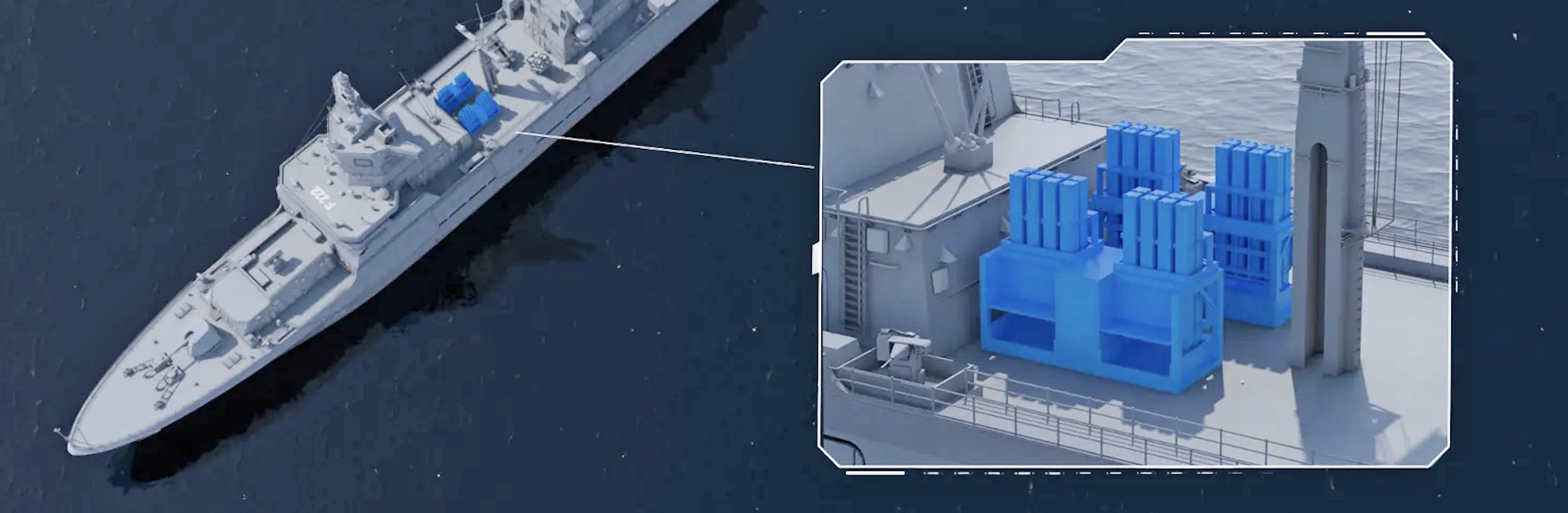
Diehl Defense and Germany’s Federal Office of Bundeswehr Equipment, Information Technology and In-Service Support (BAAINBw) have signed a contract to adapt and develop the IRIS-T SLM surface-to-air missile system for operational use aboard the German Navy’s F125 frigates. Under the agreement, Diehl will build prototypes and conduct comprehensive test firings intended to validate the system’s integration and performance within the existing F125 architecture. Each frigate will be fitted with two new launchers, each capable of holding 16 missiles, for a total of 32.
A rendering showing the location of the 32-cell IRIS-T SLM launchers on an F125 frigate. Diehl Defense
“The aim is to make the system mission-capable on the German Navy’s F125 frigates,” Diehl said in today’s announcement. The company described the prototype construction and test-firing phase as necessary to ensure “the seamless integration and maximum performance” of IRIS-T SLM within the frigate’s existing architecture.
The program has moved notably quickly, reflecting the urgency of the requirement.
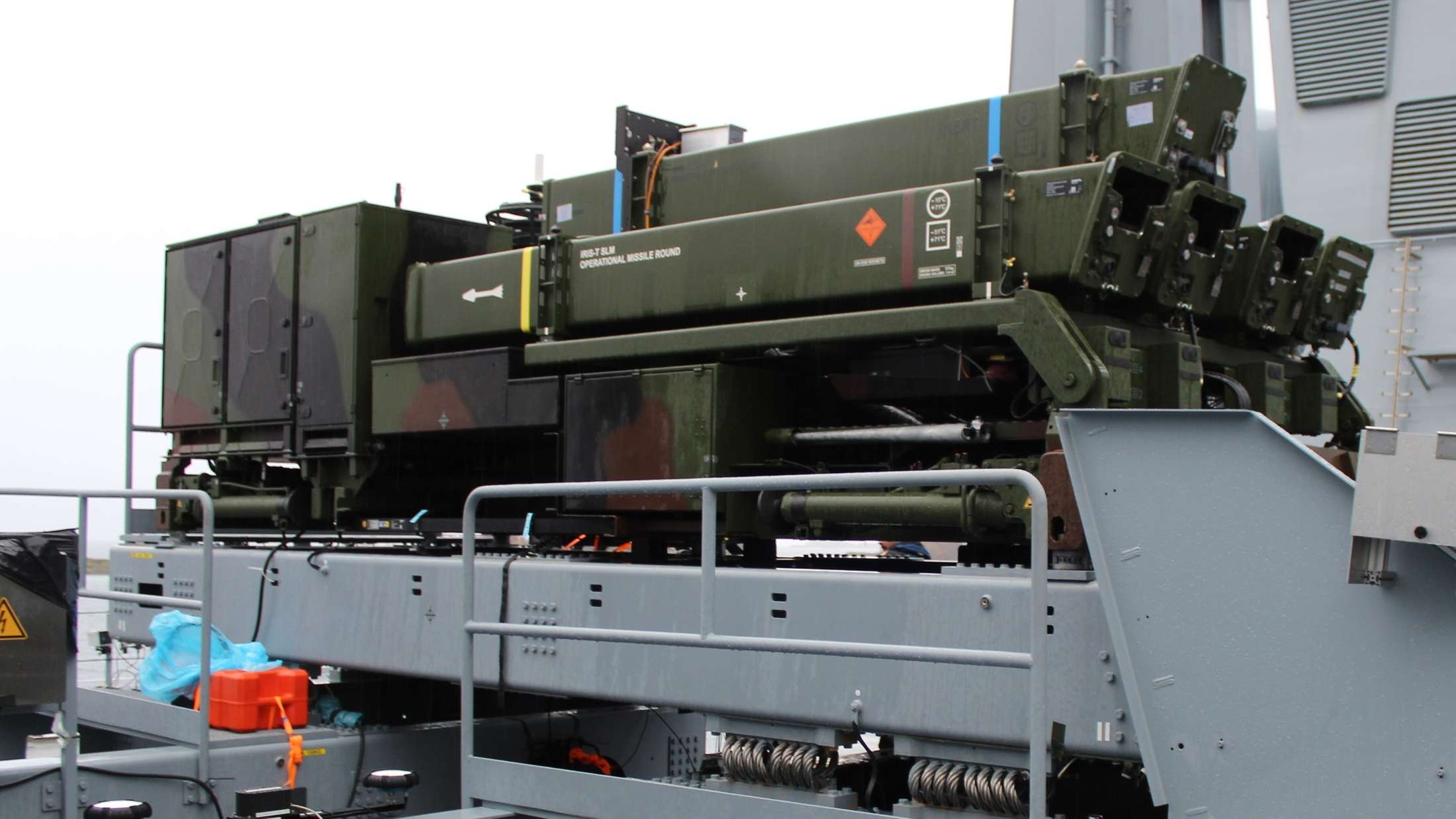
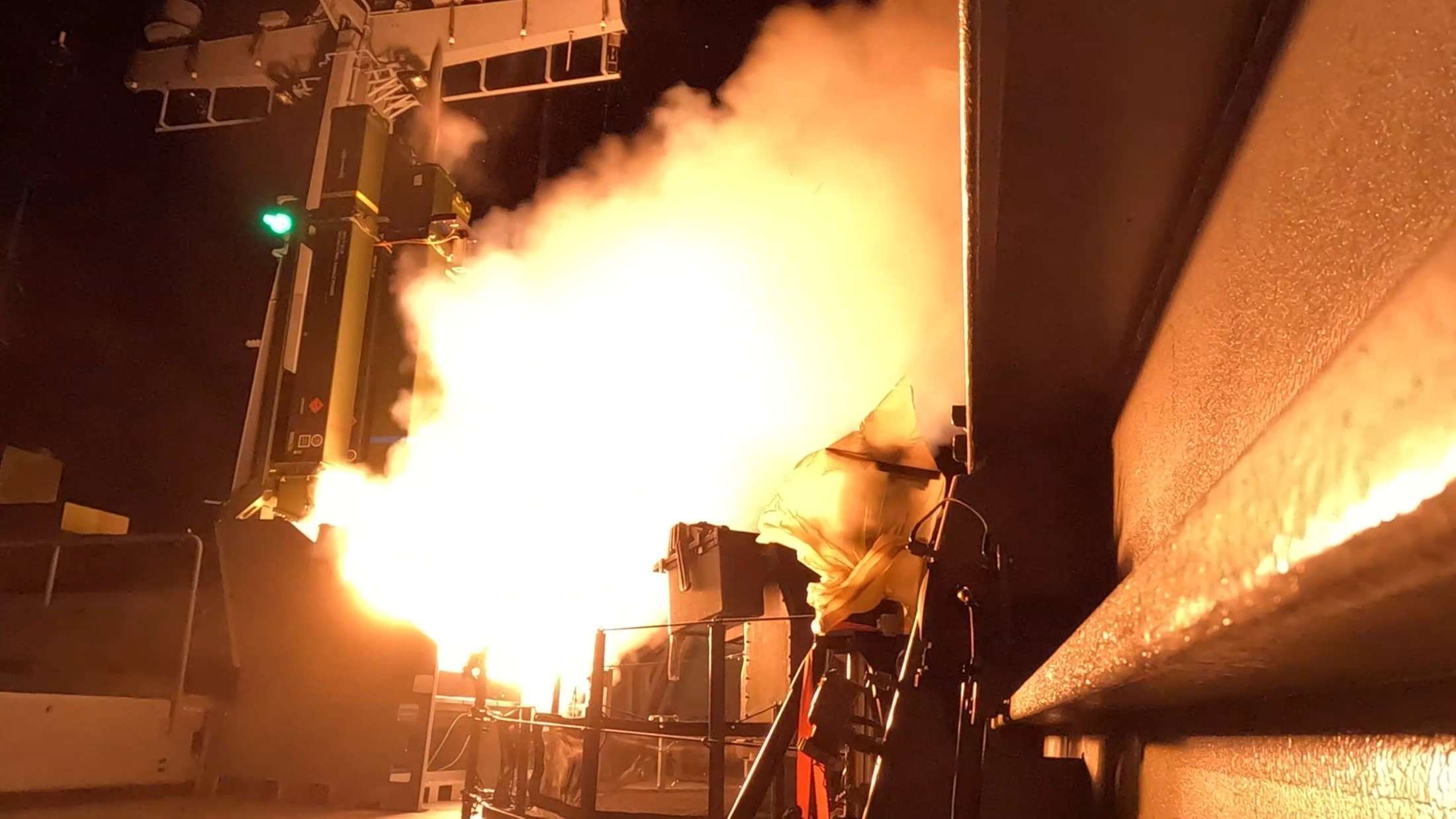
Germany began examining the feasibility of integrating IRIS-T SLM with the F125 in 2024, with BAAINBw and Diehl studying the technical risks and requirements of adapting the normally land-based system for shipboard use. That effort led to the development of a navalized demonstrator in 2025. In October of that year, the F125 frigate Baden-Württemberg took part in a German Navy Maritime Firing Exercise off Andøya, Norway, carrying an experimental anti-air warfare module based on IRIS-T SLM. Diehl says the module went from concept to firing in less than 10 months and met all established test and evaluation objectives.
The IRIS-T SLM launcher on the frigate Baden-Württemberg. Bundeswehr
The Bundeswehr subsequently reported that Baden-Württemberg fired three live IRIS-T SLM missiles during the exercise. The ship’s radar supplied target data to the missile system, demonstrating the basic integration between the F125’s sensors and the navalized air defense architecture.
The exercise established that the concept could work at sea; the contract signed now is intended to turn that demonstration into a qualified fleet capability.
A night-time test of the IRIS-T SLM air defense missile system during the Maritime Firing Exercise 2025 in Andøya. Diehl Defense
The German parliament’s Budget Committee approved the adaptation effort on September 23, with the German Defense Ministry describing it as a means of expanding the F125’s self-defense capabilities in response to the current air threat. The ministry also pointed to IRIS-T SLM’s combat experience in Ukraine.
The effort needs to be seen in the context of why the F125 has been such a controversial warship in the first place.
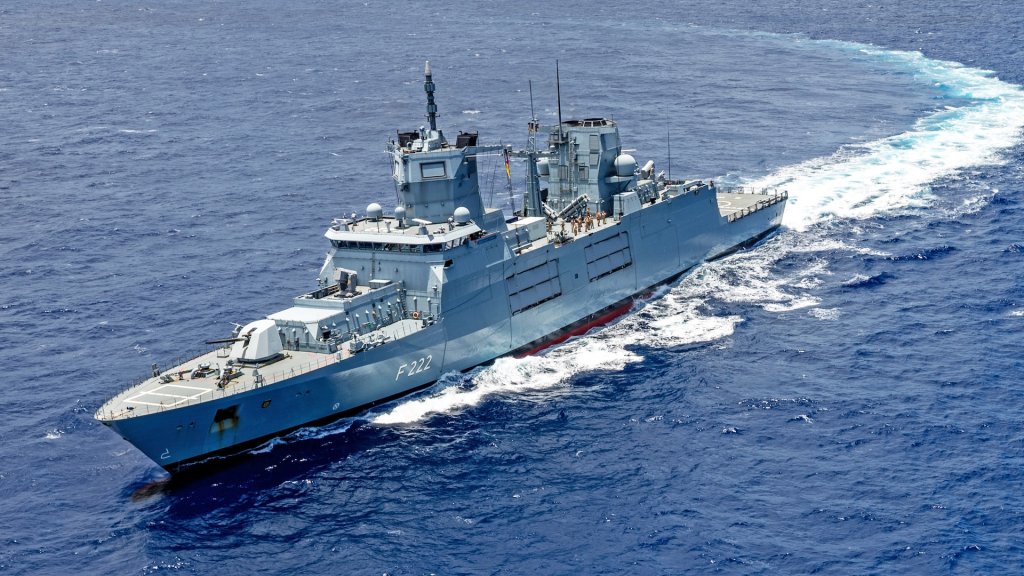
As TWZexamined in 2017, the F125 is a roughly 7,200-ton, 490-foot warship with an unusually small core crew and a concept of operations centered on long-duration deployments, stabilization missions, crisis management, conflict prevention, and international intervention rather than high-end fleet combat. The class was designed to spend long periods away from Germany and operate with relatively modest manpower requirements.
German Navy frigate Baden-Württemberg sails in formation off the coast of Hawaii during Exercise Rim of the Pacific (RIMPAC) 2024. U.S. Navy photo by Mass Communication Specialist 1st Class John Bellino
But its armament does not remotely match the size and sophistication of the hull. As completed, the ships were equipped with eight RGM-84 Harpoon anti-ship missiles, a 127mm gun, remotely operated guns and, for close-quarters air defense, two RIM-116 Rolling Airframe Missile launchers. The F125 has no medium- or long-range surface-to-air missile capability and no organic sonar or dedicated anti-submarine warfare weapon system.
At the same time, the TRS-4D/NR radar and other sensors can see far beyond the engagement envelope of the close-in air-defense weapons, but there is little the ship itself can do with that information against an aircraft or incoming missile at medium range.
Nearly a decade later, IRIS-T SLM is emerging as an answer to at least part of that problem.
Even with IRIS-T SLM, the F125 is well short of being an air warfare destroyer. It also still lacks an organic anti-submarine warfare capability or the kind of large vertical-launch missile battery found on Germany’s F124 frigates.
However, it does fill a gap between the F125’s original short-range defenses and the capabilities of other ships or aircraft operating around it.
IRIS-T SLM is designed as a medium-range surface-to-air system, with an engagement range of around 25 miles and an altitude envelope of approximately 65,000 feet. As shown in the 2025 demonstration, the F125’s radar can feed information directly into the missile system, exploiting the ship’s existing sensor capabilities.
Rather than rely heavily on escorts for protection against airborne threats outside the short range of RAM, an IRIS-T-equipped F125 could at least contribute to its own medium-range air defense. Recent operations in the Middle East have underscored the importance of this in contested maritime environments.
It also gives the ships a more useful role in a task group. The threat environment has changed substantially since the F125’s original concept was drafted. Cruise missiles, drones, loitering munitions, and increasingly sophisticated aircraft mean that even ships operating away from a major naval war can face threats well beyond the range of their existing close-in defenses.
German Navy frigate Baden-Württemberg. U.S. Navy
In November 2024, Germany confirmed that the F125 frigate Baden-Württemberg, returning from an Indo-Pacific deployment, would avoid the Red Sea and sail around Africa because of the Houthi missile and drone threat. The German Defense Ministry explicitly cited the ship’s limited air defense capability and its inability to provide an effective air-defense umbrella for itself or its accompanying replenishment ship.
Ironically, the F125’s large hull, extensive electrical power, sophisticated radar, substantial aviation facilities, long endurance and relatively spacious mission areas were always supposed to provide room for a flexible approach to future missions. Yet the class’s original weight and integration constraints made adding major weapons difficult, a concern TWZ also highlighted in 2017.
IRIS-T SLM offers Germany a way to add a meaningful capability without undertaking the much more invasive redesign associated with installing a conventional vertical-launch system. The 2025 demonstration used an AAW module mounted on the ship’s deck rather than a conventional VLS installation, and today’s program is focused on adapting the system to the F125 architecture.
Once IRIS-T SLM is installed, the F125 will still be an unusual frigate. It is enormous by the standards of its mission, optimized for endurance, and lacks some of the weapons traditionally associated with a high-end surface combatant. But it will bring more to a contested fight.
The program should give the class a credible medium-range air-defense role, and provide Germany with a way to get considerably more utility out of four ships whose original design philosophy was always somewhat controversial.
The European Union has begun assessing contingency scenarios in case German Chancellor Friedrich Merz leaves office or becomes increasingly focused on domestic political difficulties, Politico Europe reported Friday, citing diplomats and European officials.
According to the report, governments in two European countries have held internal discussions on how a possible end to Merz’s chancellorship could affect EU policymaking.
The discussions reportedly reflect growing concern in Brussels over political instability in Germany following major electoral setbacks for Merz’s governing conservatives and renewed tensions within the coalition.
Recent regional elections have weakened Merz politically. Reuters reported that the Christian Democratic Union (CDU) suffered its worst-ever result in Mecklenburg-Western Pomerania in September, failing to clear the threshold to enter the state parliament, while the Alternative for Germany (AfD) made further gains.
Berlin’s Political Turmoil Raises EU Concerns
Politico Europe reported that officials consider two scenarios particularly disruptive: Germany being left without an effective leader or a right-wing government emerging in Berlin. However, the report said both scenarios are viewed as unlikely in the short term.
Under Germany’s constitutional system, a chancellor cannot simply be replaced by a successor appointed by the governing party. The Bundestag elects the chancellor, meaning any leadership change would require the necessary parliamentary majority.
For Brussels, the political uncertainty matters because Germany remains the EU’s largest economy and a central actor in negotiations over major bloc-wide policies.
Reuters reported Thursday that Merz is facing growing domestic pressure, while speculation about possible successors has emerged within the CDU. Merz has nevertheless rejected calls to step aside and continues to pursue his government’s policy agenda.
EU Budget Dispute Adds Pressure
Merz’s domestic political position could also affect negotiations over the EU’s next seven-year budget.
According to Politico Europe, Germany is part of a group of member states, including the Netherlands, Sweden, Denmark, Austria, and Finland, seeking substantial reductions to the proposed long-term EU budget. The report said officials believe domestic political pressure could encourage Berlin to take a tougher negotiating position in Brussels.
The budget dispute comes as EU governments debate competing priorities, including defense, industrial investment, infrastructure, and support for Ukraine.
Military Buildup Remains Central to Merz’s Agenda
Despite the political pressure, Merz’s government continues to prioritize strengthening Germany’s armed forces. Reuters reported that Berlin’s debt-financed investment drive is supporting both infrastructure and military expansion, while the government has committed hundreds of billions of euros to rebuilding the armed forces.
Any change in Berlin’s political leadership would therefore carry implications beyond Germany, potentially affecting EU budget negotiations, defense policy, relations with Russia, and the bloc’s wider strategic direction.
A few inches below the forest floor in the eastern Taunus hills lies a stretch of the Roman frontier that has barely been examined. The Kapersburg fort, near Rosbach vor der Höhe in Hesse, is one of the best preserved on the German limes, the chain of Roman border defences. Research has long concentrated on […]
A regional German court sentenced a 29-year-old Syrian man to four years and 10 months in prison for attempted manslaughter after he stabbed a man in the neck during a dispute at a Cologne drug hotspot, slightly reducing an earlier five-year term after Germany’s highest criminal court ordered a resentencing.
The Cologne Regional Court imposed the penalty Friday following a brief retrial, the Kölner Stadt-Anzeiger reported. The Federal Court of Justice had largely upheld the original findings but ruled that the first chamber had improperly double-counted an aggravating factor.
The stabbing occurred on April 27, 2025, at the Josef-Haubrich-Hof near Neumarkt, an area known for heroin and cocaine dealing. The defendant intervened in an argument within the drug scene and was struck during the altercation between the two men, possibly with brass knuckles. In anger, he then drew a folding knife and stabbed one of the men in the neck, severing his jugular vein, the court findings stated.
Blood sprayed from the stab wound immediately. The 47-year-old victim dragged himself to a stairwell in the Neumarkt passage and collapsed.
Prosecutors said in the first trial that the attacker recognized the victim would die without help but was indifferent to whether he survived.
The victim lost about 1.5 liters of blood, spent three days in a medically induced coma after emergency surgery at the university clinic, later suffered a pulmonary embolism, and continues to experience pain, shortness of breath, anxiety and sleep problems, the Kölner Stadt-Anzeiger reported. A scar also remains on his neck.
The victim told the court he has been living on the street.
Defense lawyer Mario Geuenich described the convicted man as “peace-loving” but said that day he was “surely not in control of his senses” and that the act stemmed “from affective agitation.”
The defendant said, “I really regret it,” and told the court he had stopped using alcohol, drugs and methadone while in custody. He also told the court he wants to bring his wife and children from Syria to Germany and lead a normal life.
The victim addressed the defendant directly: “I forgive you. But my life is fucked up and shitty.” He added, “God bless you. I ask for a mild sentence,” and said, “God is his judge, not me.”
Presiding Judge Achim Hengstenberg replied, “But we still exist.”
Mitigating factors included the apology, expressed remorse and the victim’s forgiveness. Aggravating factors were the dangerous knife wound and the defendant’s prior convictions. The new sentence is two months shorter than the original. The victim’s lawyer, Eva Kuhn, said she was satisfied with the sentence and plans to seek compensation from the convicted Syrian.
Some lakes give up shipwrecks, and Arendsee, in northern Germany, has already given up one. What archaeologists brought to light in 2026 is something else: wood carved by Mesolithic hunter-gatherers up to 10,500 years ago. (The Mesolithic, or Middle Stone Age, is the stretch of European prehistory after the last Ice Age and before farming.) […]
In southwestern Germany, an open-air museum and a website present the Heuneburg as the “Celtic city of Pyrene”, a settlement already thriving when Rome was still a small village on the Tiber. The name comes from Herodotus. The problem, according to a study published in The Antiquaries Journal, is that the Greek historian was almost […]
Across the West, native Europeans are dying out but rental prices continue to go up every year. While the left would like to point the finger at capitalists and greedy landlords, the primary factor driving the housing affordability crisis is mass immigration.
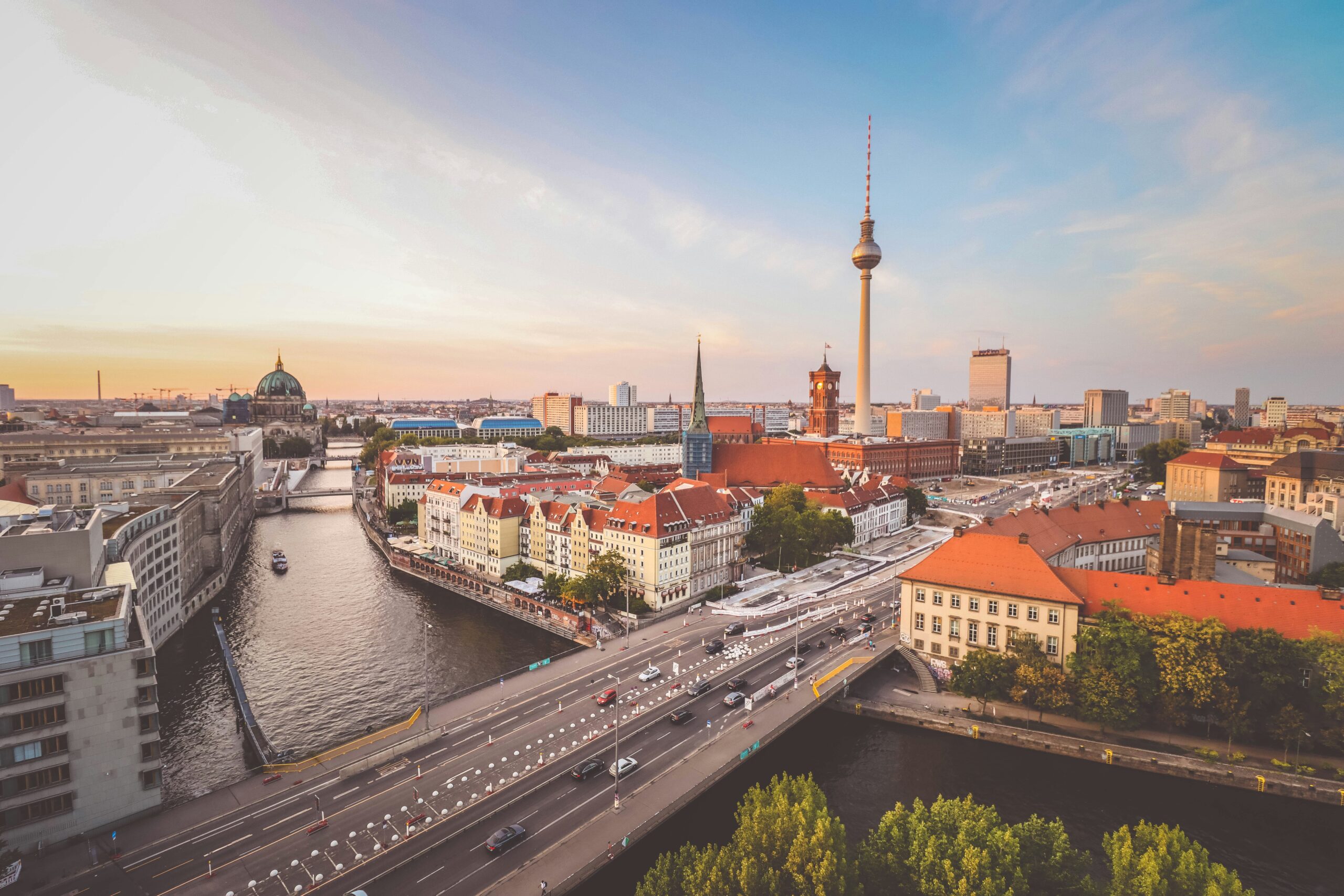
Berlin is a prime example of this trend, as German journalist and author Jens Winter pointed out on X using clear population and housing data.
“Rental prices on the market have more than doubled in Berlin since 2011—plenty of money for corporations. But where is the increased demand coming from? While the native population of the capital has declined by 260,000 since 2011, the number of foreigners and people with a migration background has risen by 650,000 over the same period. That means: Without migration, there would be less demand for housing in Berlin today than in 2011,” he wrote.
In a follow-up post, he wrote that the German “conservative” party is just as guilty as the left.
“The CDU-aligned real estate lobby is raking in big money with migration in Berlin. The Germans have a choice: dying out in the CDU’s multikulti capitalism or in the Left’s multikulti socialism. Understandable response: If we’re going to disappear anyway, why bust our asses for it?” he wrote.
Die CDU-nahe Immobilien-Lobby scheffelt mit Migration in Berlin mächtig Geld. Die Deutschen haben die Wahl: Aussterben im Multikulti-Kapitalismus der CDU oder im Multikulti-Sozialismus der Linken. Verständliche Antwort: Wenn schon verschwinden, warum dafür dann hart arbeiten? https://t.co/GPrTp62SXO
While the doubling of rents is real, there is a basic supply and demand reality that the left would like to deny. It is indeed true that predatory property owners, major institutional players, and money printing have played contributing roles to the housing crisis, but no matter how many greedy property owners are involved, if the population of a city falls, rental and housing prices are almost inevitably going to fall.
Mass immigration means that population numbers never fall. Any breathing space for German families to repopulate, have more children, and fill in the gaps left by older generations passing away is immediately filled by hundreds of thousands of foreigners.
The data shows that the population of native Germans fell by 260,000 people. In a system that rejects mass immigration and foreign real estate investors, this could have been a boon for birthrates and increasing home ownership. For one, Germans who already lived in Berlin, and those looking to move to Berlin, would have been more easily able to afford rents and housing due to less competition on the housing market. Secondly, more native Germans would have had a chance to start families — and those who already had families could have afforded an extra child or two — by securing affordable housing.
However, Germany does not reject mass immigration.
There is of course another solution, but it is far more complicated than simply allowing population levels to fall in a country that has never had so many people living in it. Instead of ending mass immigration, left-wing parties, along with the CDU, demand more housing is built.
However, there are myriad reasons why the required housing is not being built, including high construction and material costs, red tape, zoning, and a lack of skilled workers. The same parties have been making the same demands for years now, but construction cannot keep pace with demand in Berlin or other major cities across Germany.
The Left Party may promise to build more, but the reality is that it will not happen. Nothing the left offers will lead to the necessary building. Before Olaf Scholz of the far-left Social Democrats (SPD) won the chancellorship, he promised that his “goal” was to create 400,000 new apartments per year, which would include 100,000 units of social housing, saying, “That’s not witchcraft, we just have to want to do it.”
It never happened under Scholz and it won’t happen under a left-wing government in Berlin either.
Should more housing even be built?
As Western cities race to replace their native European populations, the question becomes whether life really becomes better in a crowded multicultural city when it means more traffic, longer waiting times at hospitals, crowded classrooms, and imported crime — just to name a few ills.
The newcomers also did not fix the skilled worker shortage that could potentially build all the homes and apartments politicians and lobbyists claim Europe needs. While a certain number of new houses and apartments always need to be built, the question then becomes should Western civilization really be involved in endless building to accommodate millions of foreigners.
On top of all of these questions, the buildings developers managed to build are now in fact uglier than ever, more expensive than ever, and are built more slowly than ever.
Winter’s X post is especially relevant given that the Left Party recently won a first place finish in Berlin elections, securing over 25 percent of the vote. Commentators and analysts have contributed the rise of the party in Germany’s capital due a variety of factors, but two major components are the party’s ability to secure the vote of German citizens with a migration background and young voters.
The second factor is Berlin’s housing crisis, which helped drive support from groups like non-voters, the young, and foreigners.
German taxpayer-funded Deutsche Welle, wrote: “That makes sense to 17-year-old Liska, who voted for the socialists: ‘The Left Party did appeal to me, especially because of the social issues — getting prices down, making rents more affordable.’ Rents in Berlin are indeed rising at a massive pace — by some 7% in the last two years alone — and first-time tenants are likely to be the hardest hit. Polls also showed that by far the biggest proportion of Berlin voters — 37% — thought that the Left Party was the most likely to create affordable housing.”
Again, the same story is taking place in the Netherlands, with the natural population increase for the Dutch at near zero or negative. Nevertheless, the population rose from about 16.8 million in 2013 to 18.1 million in 2025, with net migration accounting for virtually all of the recent increase.
It must also be remembered that just like in Germany, most of these migrants want to head to the major cities, such as Amsterdam.
Official housing-need forecasts in the Netherlands also attribute a large share of future extra demand, often 45 percent or more of the extra dwellings required, to population growth that is itself 95 percent migration-driven.
Great for landlords, bad for the citizens.
Of course, the Alternative for Germany has tried to tie the housing crisis to mass immigration, and they have successfully made this case to some extent.
WATCH: Mass immigration is fueling the West's housing crisis.
Here's how it's happening in Germany.
In a powerful speech in the German Bundestag, @AfD politician Carolin Bachmann slams the ruling government for allowing 2 million migrants into the country while families… pic.twitter.com/DMEqiV316S
The problem is that as more and more of the population becomes foreign, this argument holds less and less sway. Immigration may raise housing prices but if immigration brought a person to a country in the first place, and if more immigration might also enable more and more of their family members and fellow countrymen to arrive, then these voters have every incentive to keep immigration levels high regardless of housing costs.
Many of these migrants are not paying for rent anyway. There are millions of foreigners on social welfare, which means not only are they taking housing places of native Germans, but they are being paid to do it. They then often have far higher birthrates than native Germans, even with limited space, which entitles them to larger spaces.
The cycle is self-reinforcing and relentless. That means unless dramatic action is taken against mass immigration, housing and rental prices may never truly come down.
A 22-year-old Syrian man is accused of seriously assaulting several rail passengers in Cologne in June during a rampage attack. However, details have now emerged of just how serious this man’s criminal history is after a parliamentary request from politician Markus Wagner of the Alternative for Germany (AfD) party.
Currently, the Syrian remains in a psychiatric hospital while prosecutors investigate, but the man’s long history of criminal offenses is truly remarkable.
Federal police said the attacks began about 3:10 p.m. on June 21 at the Cologne-Trimbornstrasse stop. A police spokeswoman said a 22-year-old man “grabbed a traveler and tried to pull him toward the tracks.” Both fell to the ground. Bystanders pulled them apart, but the victim suffered bruises and abrasions.
Police told Westdeutscher Rundfunk that the witnesses “behaved correctly” by acting together and separating the attacker from the victim.
The suspect then boarded an S19 train toward Cologne Central Station, police said. Near the Cologne Messe/Deutz stop he suddenly punched two passengers in the face, according to witnesses and video.
At the main station, in a fast-food restaurant, he punched and kicked a 47-year-old man and continued striking him on the ground after federal officers arrived.
Officers managed to detain the man and later said he was under the influence of narcotics.
He was taken to a psychiatric facility. The Justice Ministry said he “is currently provisionally accommodated in a psychiatric hospital” under Section 126a of the Code of Criminal Procedure, a measure used when investigators believe a suspect may have acted without full criminal responsibility.
Cologne prosecutors are investigating, among other counts, intentional bodily harm, attempted dangerous bodily harm and attempted dangerous interference with rail traffic, the ministry said.
Asked what police already knew about the suspect, the government listed suspected prior offenses that had led to complaints or investigations: five thefts, one case of receiving stolen goods, one robbery, one insult, three threats, 11 assaults, 13 dangerous assaults, 11 narcotics violations, one rape allegation, one count of resisting officers, two property-damage cases and two fraud cases.
However, none of these arrests have resulted in convictions. The ministry stressed that police records “rest on suspicion” and “do not allow a conclusion on the correctness of the allegation.”
Regarding formal prior sentences, the government said the man’s Federal Central Register extract “shows solely sanctions under youth criminal law that are not entered in the certificate of good conduct.”
"Since the attack, he wakes up every night screaming."
An African migrant randomly attacked a 14-year-old German boy inside Freiburg’s central train station and tried to gouge out his eye.
The victim’s father, Roland H., also believes the attacker may have tried to carve a… pic.twitter.com/Go55W2g9KC
In other words, most of these offenses were either handled in juvenile court or were never formally tried in court due to the man’s psychological state. German youth-court measures often do not appear on the clearance certificate employers and agencies commonly request, meaning these criminal entries would not be available to potential employers.
Asked about citizenship, the ministry wrote that, “as far as known,” the suspect has Syrian nationality.
Notably, he has never been deported despite the trail of mayhem he has left behind him.
German authorities have frozen €5.9 million ($6.5 million) in assets of an operator of a fast-growing intensive-care nursing service. She is now in custody over allegations that the company billed public health insurers for services that were never fully provided or were performed by unqualified staff, causing an estimated €11 million in damage.
Zeynep C., 39, a Turkish national who rose from supermarket work to run White Angels Intensive Care, was arrested Sept. 17 during coordinated raids involving more than 200 officers from police, customs and financial crime units. The case is making major headlines, also in part due to the luxury lifestyle she was living.
Her 44-year-old German husband was also detained. Both remain in pretrial custody.
Thirteen people ages 20 to 54 — of Turkish, Moroccan, Egyptian and German nationality, some with dual citizenship — are also under investigation.
The Wuppertal public prosecutor’s office, which specializes in health-care billing fraud, said investigations began in December 2025 after anonymous tips. Over eight months, detectives examined a network of companies centered in the Düsseldorf and Mettmann area that provided outpatient intensive care, including home ventilation and palliative services, to severely ill patients.
Prosecutors allege the group billed statutory health insurers for intensive-care hours that were not delivered or were incomplete, and that some care was given by staff lacking the required qualifications.
“They must keep qualified personnel available around the clock for seriously ill patients. Those are considerable wage costs that an employer also has to bear,” Chief Prosecutor Wolf-Tilman Baumert told WDR. Using unqualified workers or billing for nonexistent care made “huge profits” possible, he said.
Company records reviewed by investigators showed explosive growth. After roughly eight months of operation under its current name, the service posted about €1 million in profit by the end of 2023. Profit rose to nearly €3 million in 2024, with €11 million in revenue projected for 2025 — a figure that now matches the estimated total loss to insurers. The firm, previously called CAN-Vefa GmbH, marketed itself as offering “culturally sensitive care” with a multilingual team.
During the searches of 31 homes, offices and practices across North Rhine-Westphalia and one site in Hesse, officers found a care-dependent child in a Düsseldorf apartment in “very poor health.” The child was taken by ambulance to a hospital for inpatient treatment; child-protection officials were notified. Authorities said any proven neglect of patients would be an aggravating factor in the case.
Seized items included several luxury vehicles registered as company cars — a Maybach, Mercedes-AMG models and a purple Lamborghini — plus €51,000 in cash, jewelry valued at €265,000, gold worth about €10,000, designer handbags and watches totaling more than €150,000. Mortgages totaling €3.3 million were placed on properties. At the couple’s home in Mettmann, police also recovered a loaded firearm, marijuana and anabolic steroids. A doctor’s stamp, which investigators believe used to forge prescriptions, was among the documents seized.
Zeynep C. had cultivated a public image of success. Photos circulated in German media showed her wearing Chanel-branded clothing and accessories alongside images of the seized Lamborghini being towed. Prosecutors are examining whether the luxury spending was financed by the alleged fraud.
The Düsseldorf-based nursing company itself has not been shut down and continues under a different manager, according to local reports. No charges have been filed yet, and the investigation is still underway.
Billing fraud of this scale, if proven as commercial and organized, can carry prison terms of up to 10 years under German law. If prosecutors discover children and other patients were left untreated or poorly treated due to fictional or inadequate care services, the length of potential prison sentences could expand significantly.
Thousands of students across Germany were once again on strike against conscription and militarization on Friday, September 25. Actions took place in at least 100 localities as young people demanded a sharp turn from the government’s chosen path.
“We don’t want to be forced into military service and we don’t want to go to war,” the students wrote in declaration after their last strike in May.
This is the fourth time students have exchanged classrooms for streets since the end of 2025. The mobilization has strengthened in resistance to the Merz administration’s plans to build the “strongest conventional army in Europe” – including by drawing more people into the Bundeswehr, the German armed forces.
While authorities insist military recruitment remains voluntary, students have warned of a clear tendency toward outright conscription. Local strike committees and activists also emphasized the widespread repression ahead of actions. This included scheduling of exams on strike days and locking-in students on school grounds, they pointed out.
Billions for the Bundeswehr, cuts for schools and youth services
Over recent months, the government has sent thousands of questionnaires to map voluntary interest in joining the armed forces. According to German media, the response has been underwhelming: tens of thousands of students have disclaimed no interest whatsoever. Not even a multi-million-euro budget allocated to promoting the army has been able to shake this opinion.
“They sell us war service as an ‘adventure’ while we know that what awaits us is coertion, humiliation, sexism, right-wing extremism, and racism,” the student declaration adds.
Instead of taking the message seriously, authorities recently advanced the implementation of medical checks among their targeted population, drawing further frustration from students.
“We don’t want compulsory questionnaires, fines, draft physical examinations, conscription assessment centres across the country, nor planned integration of the Federal Volunteer Service into military service,” they wrote. “These are means to prepare the reintroduction of the draft and thus another war originating from Germany.”
“In case of conscription, we’ll be trained as cannon fodder, forced into the trenches,” students added. “War costs us our lives, while corporations like Rheinmetall make record profits.”
Students on strike have expressed solidarity with other ongoing struggles against militarization and budget cuts. They stated they would join peace demonstrations planned for early October in Berlin and Stuttgart, as well as a trade union-backed mobilization against budget cuts on Saturday, September 26.
Their decision reflects the widespread understanding that youth and education services are among those impacted by this round of austerity. According to junge Welt, the federal ministry responsible for education will face close to €1 billion in cuts – while €140 billion will be made available for so-called defense in 2027.
“Every tank, every rocket we pay for with dilapidated schools and social cuts,” students remarked.
German police have arrested a 43-year-old Turkish man suspected of fatally stabbing his estranged wife, a 36-year-old mother of three, at a municipal refugee shelter in Coesfeld. The suspect was already on trial for rape and charged with other crimes.
Witnesses found the victim, Enda K., with stab wounds to her upper body in her room at the accommodation around 12:25 p.m. on Wednesday.
Rescue workers tried to revive her but could not save her life. She died at the scene.
The couple, both Turkish citizens but had been living separately, investigators stated. Police and prosecutors initially provided no information on the background of the attack or a possible motive.
“The children were luckily at school when it happened. This is so terrible. Enda was such a strong personality, a really nice woman. We are all shocked,” a roommate at the refugee shelter told Bild newspaper.
A tip from the public led officers to the suspect during the night in Münster, about 40 kilometers (25 miles) away. They arrested him around midnight. He did not initially comment on the allegations.
Bild also learned that the Turkish suspect had a prior conviction for aggravated assault and he also faces additioanl charges of trespassing, assault, and coercion.
In January 2026, he was also placed on trial for rape but the trial was terminated and moved to another court due to an expected higher sentencing. No court proceedings at this new court venue have taken place yet.

 Login








 Mass immigration is fueling the West's housing crisis.
 "Since the attack, he wakes up every night screaming."