France and Germany want more detailed “Made in Europe” rules for electric cars, and want them split off from the rest of the EU’s flagship industrial law.
The Franco-German deal, agreed after months of haggling on the margins of the EU summit in Brussels late on Thursday (15 October), says both files should then be adopted “as fast as possible and simultaneously”.
That would split the most fought-over part from the rest of the Industrial Accelerator Act (IAA), which also sets “Made in EU” and low-carbon requirements for steel, cement, aluminium and clean-tech products such as batteries and solar panels.
Paris hopes the new car definition will serve as a benchmark for the rest of the IAA, which sets “Made in Europe” rules for steel, cement, aluminium and clean energy technologies.
But this still has to be negotiated with other member states, people familiar with the talks said.
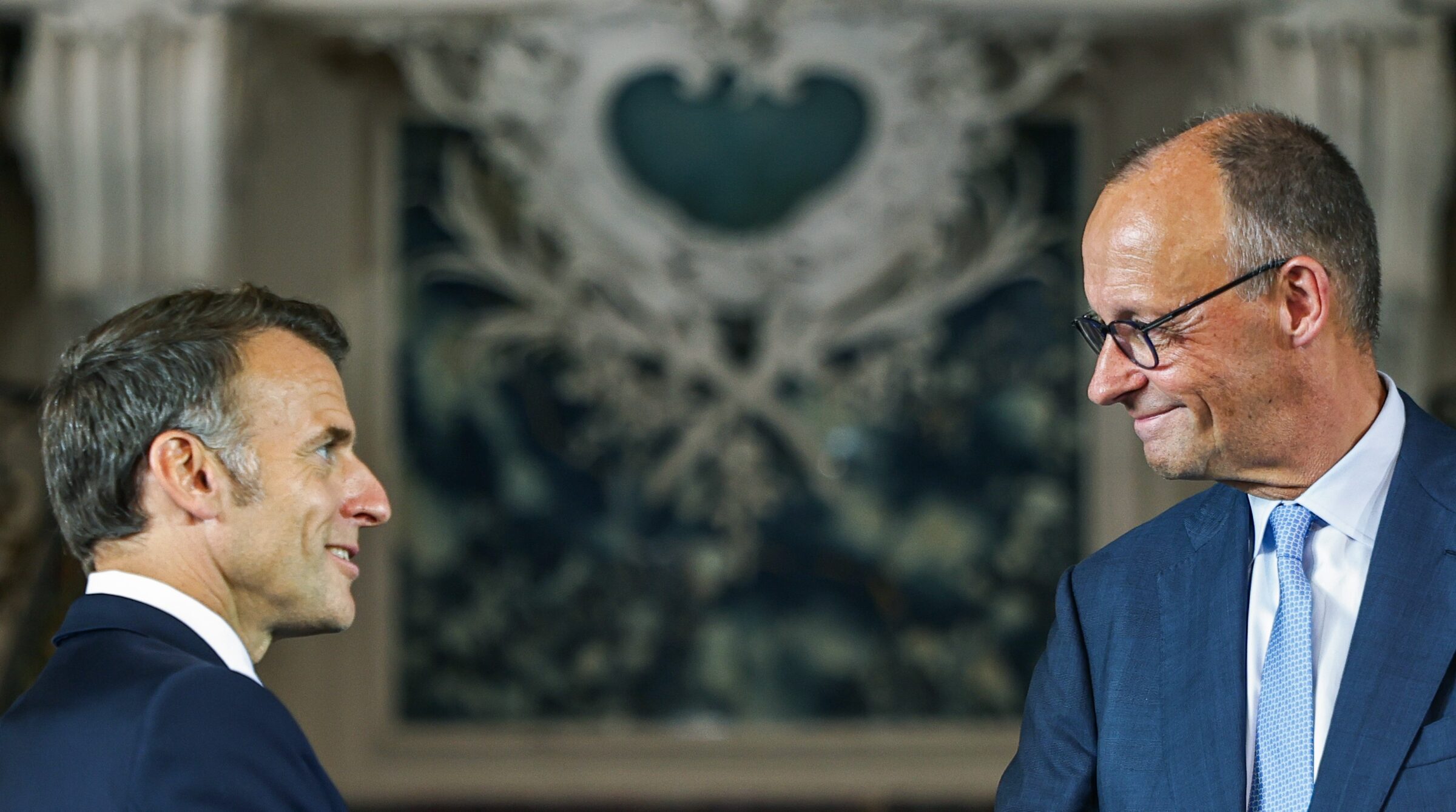
“We are driven by a clear ambition: to successfully transform our automotive industry while upholding our climate goals and our production in Europe,” said French president Emmanuel Macron on social media, announcing the deal.
“This is an investment signal to industry,” said German chancellor Friedrich Merz.
Made in Europe
The paper comes as Ireland, which holds the EU’s rotating six-month presidency, is wrapping up a third compromise text on the industrial plan, which Irish officials hope will reach final agreement by mid November.
Publicly, Paris and Berlin said on Friday that their car deal will not affect climate targets and that their course “remains unchanged”.
But the paper behind the deal shows the trade-off that’s been made. Berlin accepted France’s demand for stricter “Made in Europe” rules that apply to fewer countries, while Paris agreed to looser emission rules for carmakers, as Germany had wanted.
To count as “Made in Europe”, a car would have to clear thresholds that tighten over time, and only cars meeting these rules could be bought, leased or rented with public subsidies, or bought by public authorities.
From 2028, the car must be assembled in Europe, with at least 70 percent of total value creation in components – excluding the battery.
This article continues, but the full version is available only to EUobserver.com subscribers. Visit account.euobserver.com/membership
German Police are investigating ten suspects ages 13 to 15, including suspects from Syria and Chechnya, in connection with a violent assault and robbery of a student outside a secondary school Wednesday, according to the Eastern Police Directorate.
Videos of the attack has been posted to social media, which shows the beating from two different angles.
JUST IN: A German youth was severely beaten by a mob of migrant youths just outside a school in Frankfurt (Oder).
The incident happened in front of the Heinrich-von-Kleist School.
The suspects released the video with a gangster rap soundtrack.
Follow: @RMXnews https://t.co/UeRGRnEeMW
A young German youth is completely surrounded by a mob of migrants and ruthlessly beaten.
This same image has been broadcast time after time across Western Europe.
Follow: @rmxnews https://t.co/BtGuEYuVz8
The attack occurred in front of the Heinrich von Kleist High School. A video that police consider authentic shows roughly ten youths surrounding the student. One appears to demand something from him; he shows his empty pockets. Moments later, he is punched in the face.
Other members of the group then punch and kick him, including kicks to the head, and continue the assault after he falls to the ground and is defenseless. The victim sustained facial injuries and reported the incident to police the same day, authorities said.
JUST IN: Young German students were reportedly hunted and beaten by a group of foreigners in the state of Saxony-Anhalt.
On Tuesday, attackers at a train station in Jessen beat a number of German students in random assaults, with the victims stating that they do not know why they were targeted.
The German media outlet Mitteldeutsche Zeitung reported on the incident, noting that police have so far been unable to locate the perpetrators.
Since the initial reports, a video has been published on social media showing the moment the German youths were attacked.
Follow: @RMXnews
The ten suspects are Syrians, Chechens, Polish, Russian, Syrian, and German nationals, the Eastern Police Directorate told local broadcaster Oderwelle. They face charges of aggravated assault and robbery. Investigators have secured the circulating video and received numerous tips from the public.
On Thursday, officers conducted an operation at the Ulrich von Hutten High School, that police linked to the case. Several youths were questioned and searched. Sören Schunke, headmaster of the Heinrich von Kleist school, said the attackers were not students at his institution. It remains unclear whether any of the suspects attend the Hutten school.
Frankfurt (Oder) Mayor Axel Strasser, an independent, expressed outrage in a video message.
“What was done to a young person here in Frankfurt (Oder) leaves me speechless. It hurts to have to witness such violence. And it makes me angry that a youth has to experience something like this,” he said.
He added that violence has no place in the city and offered condolences to the student and his family. Strasser said he had spoken by phone with Brandenburg Interior Minister Jan Redmann of the CDU and that security talks involving police, school authorities and other partners would be held to address youth violence.
The Frankfurt (Oder) case comes amid a series of recent youth-group attacks in Potsdam that Redmann has described as predominantly migrant-linked, including suspects of Syrian nationality. On Sept. 25, roughly 20 people — mostly migrants, according to the minister — entered a private party uninvited and attacked guests. The following day, three youths were assaulted by a group of about 25 and injured, which Remix News reported on.
“Unbridled and massive violence.”
Witnesses report that up to 20 people with an “Arab migration background” viciously beat three high school students from the Catholic Marien School in Babelsberg with “massive violence.”
The two 17-year-olds and an 18-year-old were beaten with punches and kicks in the Wannsee district of Berlin last Saturday evening.
One of the 17-year-olds lost consciousness.
During the assault, the 18-year-old hit his head against a parked car, which required treatment at the hospital.
“For me, this is attempted murder,” said one witness who spoke with the German news outlet Tagesspiegel.
The perpetrators fled into the forest and police continue to search for them.
The suspects are believed to come from Potsdam, where robberies by youth gangs have become more frequent recently.
Follow: @RMXnews
Additional attacks in early October left victims with head injuries requiring hospital treatment. Authorities are monitoring a group of roughly 25 mostly migrant suspects in connection with the Potsdam incidents. Currently, two alleged ringleaders are in pretrial detention and police presence has been increased.
Redmann has said foreign perpetrators, particularly Syrians whose protection status can be revoked, could face deportation. “Whoever comes to Germany and simply has no respect for Germany, we will not tolerate that,” he told the state parliament. “The rule of law has the final say.”
Germany’s migration and asylum policies have cost the state at least €400 billion, according to calculations by Welt journalist Björn Harms. Other estimates have gone far higher, including into the trillions, when broader follow-on effects of migration are included. These massive figure will only add to the growing debate about mass immigration into high social-welfare countries like Germany.
As for the data, much of it comes directly from the German government, according to Welt. The federal government alone recorded over €242 billion in “refugee-related expenditures” from 2016 to 2025. Official figures from Bundestag reports and the Federal Ministry of Finance confirm the annual totals.
If this is broken down by year, it shows €20.1 billion in 2016, rising to peaks of €28.3 billion in 2022 and €29.6 billion in 2023, then €28 billion in 2024 and €24.8 billion in 2025.
The sum over ten years is €242.5 billion, representing roughly 5.8 percent of total federal budget outlays over the period. These cover social transfers after asylum procedures, integration measures, payments to states and municipalities, and related programs.
The 16 state governments also contributed more than €100 billion from their own budgets. Municipalities added further billions, along with follow-on costs in healthcare, education, and the justice system. Independent reconstructions place a consolidated central estimate near €340 billion, while others go up to €450 billion with add-ons.
However, even these numbers pale in comparison to what some academics have researched. For example, top German academic on public finances Prof. Bernd Raffelhüschen of the University of Freiburg, produced a study in 2024 that indicated that mass immigration may cost Germany up to €19.2 trillion. His study also found that mass immigration had already cost the country €5.8 trillion.
Harms and others describe the €400 billion figure as a minimum. The reason why this figure is treated as a “minimum” is because experts have been unable to truly compile costs for a broad range of areas, which surely total tens of billions over the course of a decade. These areas include court costs and criminal justice.
This specialized, high-security facility was constructed by the court in Magdeburg to handle the large-scale proceedings, which included accommodations and seating space for more than 170 co-plaintiffs and their respective legal teams.
Many other costs are not tallied in the official figures
The billions in criminal justice costs do not even cover police and internal security. Crime has risen in Germany substantially since 2016. During that year, according to Eurostat records, Germany had approximately 244,318 total police officers. At the time, that equated to roughly 2,992 officers per one million people, or a density of around 301 per 100,000 inhabitants.
The Federal Police force has grown to around 55,000 to 60,000 total employees (including roughly 41,000 active frontline officers) to manage expanded mandates across national borders, transportation hubs, and airports.
Paying all these new police officers, who are tasked with policing an increasingly violent country, is not only an enormous cost in terms of money, but has led to tens of thousands of lives shattered and destroyed. When a young woman is raped by a migrant or an aspiring doctor is beaten to the point that he has to abandon his medical career, it is difficult to even calculate the true financial cost of such incidents, but in many ways, these incidents have no price tag. They are too horrific to even quantify.
Of course, there are also tens of billions spent on education for migrants, which are not included in the €400 billion total. In addition, Germany has an extensive network of kindergartens, which foreigners also gain access to. In some states like Berlin, the daycare system is entirely supported by taxpayers to the tune of €2.5 billion a year, while the share of kindergarten-age children with a migration background is at 57.4 percent.
There are also deportation costs, administrative overhead, hospital and medical care, and the list goes on.
The real figure may be difficult to calculate with total accuracy, but it is surely larger than €400 billion.
Germans have also paid in other ways, including in higher rental costs, more traffic, crowded schools, and longer wait times at hospitals. Again, not all of these costs are even quantifiable, but the increase the increase in rental costs alone has cost Germans additional billions.
It is also important to note that there are hundreds of thousands of migrants who are becoming naturalized at a rapid pace and already millions of migrants who have been naturalized in previous decades. These migrants and their children use schools, often require welfare, and also need healthcare. Yet, none of these costs are counted towards the tax burden on Germans. In total, there have been further tens of billions spent on these groups, increasingly in the education system which has the highest share of Germans with a migration background. Many of these groups also continue to be a net economic burden on Germany, such as the Turkish population.
Migrant housing is a huge burden for German taxpayers
Accommodation absorbs a large share. The federal government does not even know the total number of asylum accommodations nationwide. An inquiry by Harms to all 401 districts and independent cities produced responses from 320 (about 80 percent). These authorities reported at least 4,437 communal accommodations housing nearly 295,000 residents as of March 2026 — an average of almost 14 per responding district. Extrapolated nationwide, this implies roughly one person in every 227 in Germany lives in taxpayer-financed asylum accommodation.
Harms notes that hotel owners, private landlords, and public companies have all massively benefited. In Hamburg, the municipal company Fördern & Wohnen, which is 100 percent owned by the city, handles a large share of asylum accommodation. He notes that turnover rose from €60 million in 2013 to €747 million in 2025, and staff grew from 948 employees in 2014 to around 2,228 by 2025.
The company operates more than 200 sites and has expanded capacity amid non-European immigration. A former managing director who served less than five months in 2025 received payments totaling €453,000, including a substantial severance, according to the company’s annual report.
Similar patterns appear elsewhere: long-term leases on converted offices and hotels, with public entities acting as both demand drivers and suppliers. In Berlin, a former office complex on Hasenheide in Kreuzberg is becoming an accommodation for up to 921 people. First residents were scheduled to move in from early October 2026. The lease runs roughly ten years, into the mid-2030s, paid from public funds. Conversion costs have not been disclosed, citing commercial confidentiality.
The Hasenheide project and the decade of accumulated costs illustrate the continuity. Rents and operating expenses continue into the 2030s, financed by the same solidarity community that underwrites the wider system.
Migrant welfare is core to the new German economy
The Welt article also notes that immigration since 2015 has driven expansion in the social and welfare sector. The number of social workers and social pedagogues rose from about 278,000 in 2015 to 351,000, with the Federal Employment Agency linking part of the growth to refugee-related demand for counseling, care, and support.
Integration courses illustrate the mixed results of large spending. The federal government has allocated around €1.3 billion in peak years, with 2024 near €1.2 billion before later adjustments. Yet outcomes are limited, according to Welt. Roughly 55 percent of those who take the final test reach the target B1 language level, meaning a substantial share — often cited in the range of six in ten depending on the metric of “graduation” or successful completion of the full course and exam — leave without the intended language qualification. Pass rates for B1 have hovered in the mid-50s in recent data, with many achieving only A2 or lower.
Harms further notes that the business of asylum migration has created durable economic interests. In other words, there are people and institutions getting rich for the millions of migrant who have come, which fuels demands for even more immigration.
Public companies, private landlords, course providers, NGOs, and expanded social services all draw ongoing revenue. Critics note that the loudest advocates of open borders and expansive humanitarianism rarely live next to the accommodations or send their children to the schools under the greatest pressure. Residents in affected neighborhoods and local workers experience the practical strains directly.
While governments speak of a “migration turnaround,” the broader pro-migration complex continues. Demands for a world without borders, which claim “no human is illegal,” persist among advocacy groups. These powerful groups have a keen interest in keeping the mass migration machine going, and so far, they have largely succeeded even if the majority of Germans are opposed.
from State Of The Nation: Nothing changes until those who secretly rule US are prosecuted for 9/11, JFK, OK City, 5G, Chemtrails, Vaccines, COVID-19…. The Khazarian Mafia Takes Complete Control of the United States of America TRUTH LIVES on at https://sgtreport.tv/ Submitted by Revisionist Historians for World Peace SOTN Exclusive SOTN Editor’s Note: The specific threat […]
by Andrew P. Napolitano, Lew Rockwell: “It is forbidden to kill; therefore all murderers are punished unless they kill in large numbers and to the sound of trumpets.” –Voltaire (1694-1778) A government that claims the authority to kill persons after they have been subdued, disarmed, tried, convicted and confined in prison has made a startling […]
by Madge Waggy, Madge Waggy: Just after the morning deliveries and before the first customers, a supermarket looks both ordinary and slightly deceptive. The lights are on, the coolers hum, and the shelves hold exactly what they held last week. Strawberries show up in February, lettuce comes from ground that was desert two generations ago, […]
by Donald Jeffries, ”I Protest”: Desensitizing the insensitive Sheeple Years ago, I used to say that at some point, this country is going to broadcast live executions. I saw it as a new reality show, perhaps titled Pull that Switch! I thought they’d have eligible voters compete for the honor. To be technically responsible. Without […]
from State Of The Nation: SOTN Editor’s Note: Most truth seekers probably understand by now that, at the end of every age, ALL the skeletons come out of the closet. Especially at the the end of the present era (the darkest and densest of the four), and because the Internet is running at full tilt, […]
by Nicolas Hulscher, Global Research: Zoos across America have begun subjecting their elephants to elephant herpesvirus (EEHV) gene therapy procedures. *** The experimental mRNA injection rollout has now reached endangered baby elephants. On October 8, 2026, the Saint Louis Zoo announced that a 1½-year-old Asian elephant named Jet had received his third dose of an […]
by ReMix News, Modernity News: 358 of them since 2012, including an 11-year-old Iraqi girl This post is republished with permission from Remix News A parliamentary inquiry by Alternative for Germany (AfD) lawmakers in the German state of Baden-Württemberg has brought to light official data showing that authorities have recorded 358 so-called child marriages since […]
by Paul Craig Roberts, Paul Craig Roberts: This is a is factually based history lesson. The lesson is about black slaveowners. Larry Koger’s book, Black Slaveowners, is well documented. Koger provides 34 pages of documentation listing the names of black slave owners and the number of slaves they owned in South Carolina and 38 pages […]
German Labor Minister Bärbel Bas has stepped down, citing her need to grieve a loved one and leave behind the harsh realities of government. So how did German politics get so heated?
An African man, who was described as “perfectly integrated,” is on trial in Bonn on charges connected to the strangling murder of his wife, whom he then dismembered. The woman’s remains were later found in several locations across Germany, according to court proceedings.
Asmerom G., 42, an Eritrean national, faces the charges in Bonn Regional Court in North Rhine-Westphalia. The case stems from events in mid-November 2025 involving his wife, Weghata A., 32. The couple had married in Ethiopia in 2019, and she arrived in Germany in 2024 through family reunification.
The defendant allegedly met his wife, 32-year-old Weghata A., inside his car, where they began arguing on their way back from a church visit. According to Bonner Generalanzeiger newspaper, Asmerom G. later told police that his wife told him their 3-month-old girl was not his biological child. He reportedly could not remember what happened next.
According to prosecutors, Asmerom G. then strangled his wife in the back seat of the car in a parking lot in Bonn, directly in front of the baby who was sitting in a child seat.
After the crime, the defendant is said to have driven with the body and the baby in the car to the Monastery of Saint Anthony, 160 kilometers away, where he abandoned the little girl in the stroller when it was only 2 degrees Celsius (35 degrees Fahrenheit).
Fortunately for the girl, monks found the child just 40 minutes after she was dropped off.
Asmerom G. then went to work dismembering Weghata’s body, including packing her hands and head in plastic bags.
He left the torso behind, which was found at the end of November 2025. Asmerom G. left the body parts on the side of the autobahn, on the A45. The head of the woman was discovered by garbage collectors in April 2026.
Asmerom G. was arrested in Ethiopia and extradited to Germany. He has a prior conviction for aggravated assault. On the first day of the trial, he declined to comment on the allegations. Defense attorney Martin Kretschmer has said the case rests largely on DNA evidence and mobile-phone data.
Kretschmer told Bild newspaper, “Until his arrest, he was considered perfectly integrated.”
German media was even singing his praises in 2016. The man from Eritrea had landed a job as an electrical assistant at a firm in Rheinbach, in North Rhine-Westphalia, and gave interviews about leaving his homeland three years earlier to escape political persecution.
He wanted German citizenship, he said. His boss at the time was quick to describe Asmerom G. as talented, reliable, and “capable of anything,” according to Bild newspaper.
However, then trouble began. Within a year, Asmerom G. was in trouble with the law. A brawl led to a conviction for grievous bodily harm at Siegburg District Court, earning him a six-month suspended sentence.
He moved on from Rheinbach and took up work behind the wheel of a freight truck. Somewhere along the way, he made a trip back to his home country — for reasons that remain unclear — and returned to Germany with a woman named Weghata A., who was 31 at the time, his wife under Eritrean law. On July 26, 2025, she delivered their daughter.
The child is now in the care of authorities. Lawyer Gesine Ickert, representing the daughter and the deceased’s father, has stated that the child is well looked after under the circumstances.
German gamblers may finally be able to beat the house, thanks to new court rulings in the EU and in Germany. The decisions could help gambling addicts — but the legal road might be difficult.
Die Bestürzung über den Abschluss des «Diesel-Deals» durch US-Präsident Donald Trump mit dem russischen Präsidenten Wladimir Putin hinter dem Rücken Europas am vergangenen Wochenende war nur mit dem Schock über das Treffen in Anchorage im vergangenen Jahr vergleichbar. Aus Sicht europäischer Politiker kommt der Abschluss von Abkommen mit Russland, durch die eines der wichtigsten Exportgüter des Landes von den Sanktionen ausgenommen wird, einem Verrat gleich. Einem Verrat sowohl an der Vorhut der europäischen Demokratie namens «Ukraine» als auch an den Grundpfeilern der transatlantischen Solidarität.
Laut eigenen Angaben hat sich Donald Trump mit Wladimir Putin auf umfangreiche Lieferungen von Dieselkraftstoff geeinigt. Demzufolge sollen bereits im Oktober 300 000 Tonnen Dieselkraftstoff aus Russland in die USA und auf den Weltmarkt geliefert werden.
Im November sollen weitere 500 000 Tonnen geliefert werden, kurz darauf eine Million Tonnen. Insgesamt beläuft sich die Menge damit auf 1,8 Millionen Tonnen. Sofern die Kapazitäten der russischen Ölraffinerien dies zulassen, soll das Liefervolumen letztendlich drei Millionen Tonnen erreichen.
Aus der Europäischen Union ist bereits scharfe Kritik an dem «Deal» des US-Präsidenten laut geworden. US-Finanzminister Scott Bessent warf den Europäern hingegen «völlige Heuchelei» vor.
Laut dem russischen Vizepremierminister Alexander Novak haben die Länder der Europäischen Union seit 2022 russische Energieträger im Wert von $320,7 Mrd. gekauft. In den ersten neun Monaten des Jahres 2026 belief sich das Liefervolumen auf $21,3 Mrd.
Laut Bessent haben die EU-Länder den Russen seit Beginn des russisch-ukrainischen Konflikts im Jahr 2022 mehr Geld zur Verfügung gestellt als der Ukraine, da sie ohne russische Energieressourcen nicht auskommen können.
Damit hat Bessent einen wunden Punkt angesprochen. Denn die Daten des Zentrums für Energie- und Luftreinhaltungsforschung (CREA) stimmen im Großen und Ganzen mit den Angaben der russischen Seite überein. Diese unabhängige Organisation mit Sitz in Helsinki analysiert jeden Monat, welche Länder welche Arten russischer Energieressourcen kaufen. Die Analyse läuft seit Dezember 2022, als das EU-Embargo für russisches Rohöl in Kraft trat.
Diesen Daten zufolge hat China bis Ende August 50% der russischen Rohölexporte abgenommen, gefolgt von Indien mit 19%. Auf die Türkei und die EU entfallen jeweils 5%. Bei Erdölprodukten wie Kraftstoffen ist die Türkei mit einem Anteil von 26% der größte Abnehmer. Dahinter folgen China mit 12%, Brasilien mit 11% sowie Singapur und Saudi-Arabien mit jeweils 8%.
Trotz des von der EU verhängten Einfuhrverbots für russische Erdölprodukte wurden in EU-Häfen laut CREA 20 Tanker aus Raffinerien entladen, die russisches Rohöl verarbeiten. Das sind zwei mehr als im Juli. Im Bereich des Pipelinegases bleibt die EU mit einem Anteil von 32% der größte Abnehmer, gefolgt von China mit 31% und der Türkei mit 29%.
Beim Flüssigerdgas (LNG) entfallen knapp 49% auf die EU, gefolgt von China mit 24%, Japan mit 18% und Südkorea mit 6%.
Trotz der immer strengeren Sanktionen gelten in der EU weiterhin Ausnahmen für bestimmte Energieträger und Länder. Daher erscheinen Ungarn, die Slowakei und Bulgarien in der Statistik als Importeure von russischem Pipelinegas. Frankreich und Spanien sind Abnehmer von LNG, während die Slowakei russisches Rohöl bezieht. Insgesamt zahlten diese fünf größten Importeure aus der EU im August laut CREA €1,1 Mrd. an Russland.
Die USA, die im Frühjahr 2022 den Import von Erdöl, Erdölprodukten, Kohle und Flüssiggas verboten hatten, tauchen in der Liste überhaupt nicht auf. Nun hat das US-Finanzministerium jedoch eine Sondergenehmigung für den Kauf von russischem Dieselkraftstoff erteilt, die bis zum 7. April 2027 gültig sein wird.
Deutsche Autofahrer beneiden die Amerikaner ein wenig
Allerdings interessieren sich deutsche Autofahrer, die an den Tankstellen bis zu €2,45 pro Liter Dieselkraftstoff zahlen müssen, wohl kaum für derartige diplomatische Angelegenheiten. Und angesichts des vorbildlichen Beispiels des amerikanischen Präsidenten hätten die meisten von ihnen ebenfalls nichts gegen ein ähnliches Dieselabkommen zwischen Berlin und Moskau einzuwenden.
Es liegt auf der Hand, dass die Lieferungen von russischem Dieselkraftstoff in die USA den Markt nur teilweise stabilisieren werden. Am Montag reagierte der Ölpreis nur geringfügig auf das am vergangenen Wochenende geschlossene Abkommen Trumps. Der Preis für Brent-Rohöl aus der Nordsee sank zunächst um etwa ein Prozent auf $104,2 pro Barrel, woraufhin sich eine Gegenbewegung einstellte und der Preis wieder ins Plus kletterte.
Am Montag kostete Heizöl €168 pro 100 Liter bei einer Abnahme von 3 000 Litern. Dies berichtet das Internetportal Heizoel24, an das 500 Ölhändler ihre Preise übermitteln. Laut dem Portal ist der Oktober bislang im Durchschnitt der teuerste Monat für den Kauf von Heizöl in diesem Jahr.
Dabei ist anzumerken, dass die 300 000 Tonnen Dieselkraftstoff, die Russland im verbleibenden Teil des Monats in die USA und auf den Weltmarkt liefern soll, etwa 100 000 Barrel pro Tag entsprechen. Dies würde den Rückgang der Seelieferungen von Dieselkraftstoff, die im September etwa 1,3 Millionen Barrel pro Tag unter dem Niveau zu Jahresbeginn lagen, nur teilweise ausgleichen.
Laut der US-Energieinformationsbehörde (EIA) liegt der Verbrauch von Dieselkraftstoff und anderen Destillatkraftstoffen in den Vereinigten Staaten derzeit bei durchschnittlich etwa 3,77 Millionen Barrel pro Tag. Dies entspricht etwa 500 000 Tonnen. Somit würde eine Menge von 300 000 Tonnen den amerikanischen Verbrauch theoretisch nur für etwas mehr als 14 Stunden decken.
Was den von Trump verkündeten Waffenstillstand betrifft, der sowohl Russland als auch die Ukraine offenbar überrascht hat, so sind bislang keine Aussichten auf dessen Abschluss erkennbar. Sowohl Moskau als auch Kiew zeigen sich derzeit kompromisslos und bereiten sich auf neue Angriffe auf die sensible Energieinfrastruktur des jeweils anderen vor.
In einer solchen Situation wissen Ölhändler auf dem Weltmarkt nicht, woran sie sich orientieren sollen (den Äußerungen des US-Präsidenten auf Truth Social glaubt seit Beginn der Krise im Schmalz-Kanal niemand mehr). Die US-Investmentbank Goldman Sachs hat ihre Ölpreisprognose jedenfalls erneut angehoben. Rohstoffanalysten gehen nun davon aus, dass der Preis für ein Barrel Brent-Rohöl aus der Nordsee bis zum Jahresende bei $90 statt bei $85 liegen wird. Zuletzt hatten sie ihre Prognose im September angehoben. Als Begründung für diesen Schritt wurde unter anderem angeführt, dass die Lagerbestände auf einem niedrigen Niveau liegen und das Risiko eines Rückgangs des Rohölangebots hoch ist.
The new technology in vehicles that constantly monitors you is getting out of control This American went out of town so she got a rental car. She’s in a new place with beautiful scenery so she’s looking around at it as she drives. This is unacceptable for the car “Every time I look to the […]
by Gary D. Barnett, Lew Rockwell: “The more power a government has the more it can act arbitrarily according to the whims and desires of the elite, and the more it will make war on others and murder its foreign and domestic subjects. The more constrained the power of governments, the more power is diffused, […]
from State Of The Nation: …all the whales know it and are all in on the long planned controlled demolition of the Global Economic & Financial System SOTN Editor’s Note: Here it comes, folks!!! And the volumes of both hard and circumstantial evidence strewn all across cyberspace conclusively proves that this “AI MEGA BUBBLE” was […]

 Login


 A young German youth is completely surrounded by a mob of migrants and ruthlessly beaten.
This same image has been broadcast time after time across Western Europe.
Follow: @rmxnews https://t.co/BtGuEYuVz8