 Login

Coming Fall Events at Magazzino
An inspiring lineup of lectures, book presentations, and a Halloween edition of Family Day

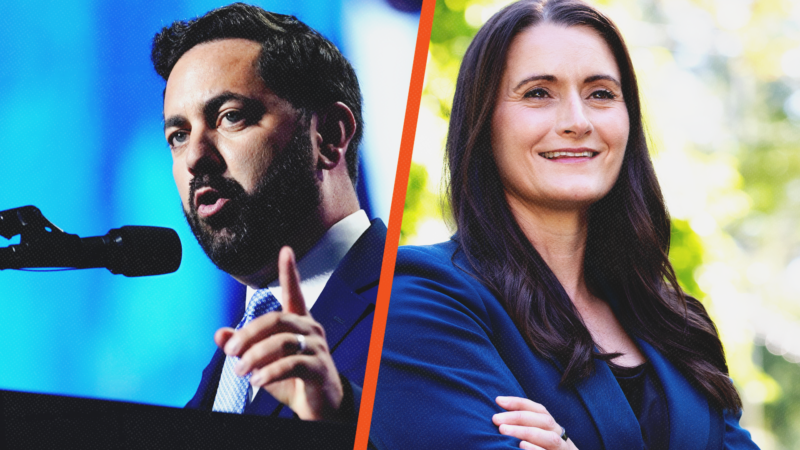
The Democratic Socialists of America (DSA) candidates running for the House of Representatives and endorsed by NYC Mayor Zohran Mamdani are all but guaranteed to win their general elections this November, but that does not mean the midterm drama is over in New York. In the state's 17th congressional district, which includes the lower Hudson Valley, Democratic challenger Cait Conley, a combat veteran who served on the Biden administration's National Security Council, could unseat incumbent Republican congressman Mike Lawler in one of the most consequential races of the midterms.
The highly contested purple district voted for former Vice President Kamala Harris in the 2024 election while reelecting Lawler for his second term. Now, Lawler is attempting to win a third term as support for President Donald Trump wanes ahead of the midterms. As of Friday, The Cook Political Report lists the race, which could determine control of the House, as a toss-up.
If elected, Conley would have far more in common with the "Badass Women" coalition of security state and military veterans than with DSA types (think more Sen. Elissa Slotkin from Michigan than Darializa Avila Chevalier). As Judge Street Journal's Timmy Facciola notes, "Conley's candidacy is testing the viability of a tactful centrism that rebukes left-wing positions like abolishing ICE or restricting weapon shipments to Israel." Lawler is also vying for moderates, pitching himself as "one of the most bipartisan members of Congress" and emphasizing his willingness to break with Trump occasionally while still welcoming Trump's support.
While Lawler and Conley certainly are not pure MAGA acolytes or DSA members, both have leaned into a tech-critical position, much like that of more radical populists like Lina Khan or Steve Bannon, revealing how pervasive anti-tech sentiment has become in mainstream politics.
This tech skepticism was on full display during an October 14 debate, when each candidate made the case for why they were the most equipped to regulate AI, insisting that the industry needs guardrails.
Conley said members of Congress do not want to regulate AI because "they want to look out for their billionaire and trillionaire backers like Elon Musk, who is pouring over $260 million into this midterm election." She then added that Musk backed Lawler in his 2024 race.
Lawler then accused Conley, who previously consulted for Primer AI, of being "the AI candidate for the AI industry."
While Lawler and Conley disagree on specific data center regulations (Conley supports Democratic Gov. Kathy Hochul's data center moratorium while Lawler supports local zoning control over data centers), neither wants to pitch themselves as an explicitly pro-data center candidate. During the debate, Conley claimed that, "On Mike Lawler's watch there have been five data centers built in Rockland County." Lawler has said that he had no say in the decision to build the data centers, and during the debate, he pointed out that the facilities were built for financial services. Lawler also attempted to attack Conley over data centers, slamming her in an ad for saying "we need data centers." Regardless of the candidates' specific policies on data centers, their attacks on one another demonstrate that cheerleading hyperscale data center development is a political liability. In their district, data center has presumably become a dirty term.
The candidates' tech-skeptical rhetoric did not end with unchecked data center development. After the debate, Reason asked both candidates about their positions on age-verification laws for social media and AI, since such regulations raise significant privacy and censorship concerns by age-gating the internet. Unsurprisingly, both Lawler, who voted for the controversial KIDS Act, and Conley, who has proposed stricter age verification for AI tools, parroted platitudes about why such online safety regulations are necessary to protect children.
"We have watched how social media is literally hurting the mental health of children," Conley told Reason. "And when you talk about the power of AI and what that power could do, we have to regulate this."
Lawler gave a similar response, telling Reason that he respects free speech but that protecting children "is paramount."
This bipartisan consensus over social media regulation has long been brewing in Congress. The mainstream political conversations about AI and data centers, however, are relatively new this midterm election cycle. And it appears both Lawler and Conley have figured out which way Americans' sentiment toward AI is leaning, and they have waged their campaigns accordingly.
The post Nobody Wants To Be the Pro-Tech Candidate in This New York Race That Could Flip the House appeared first on Reason Magazine.
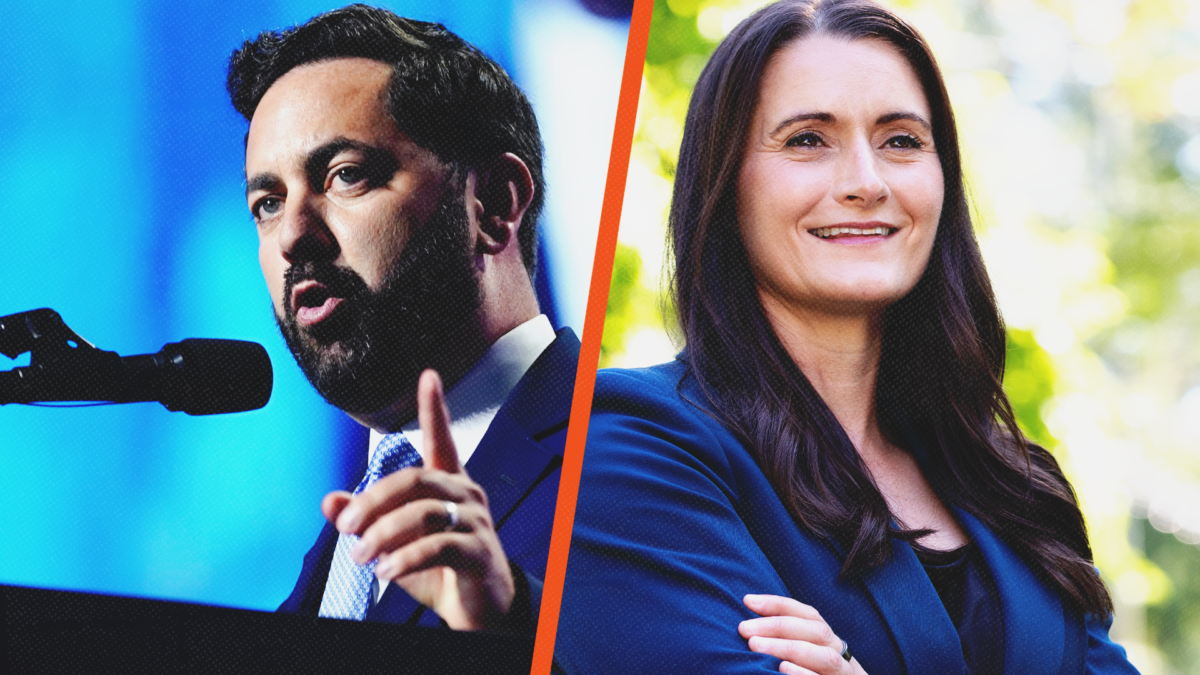


Immigration and Customs Enforcement (ICE) agents shot seven rounds into the vehicle of a New York father while his five-year-old son was in the car on the afternoon of Thursday, October 8. Oscar Belgal, a Dominican man, who had just picked up his son from school, was hit in the neck but survived the shooting.
He is currently being detained by ICE in the Metropolitan Detention Center in Brooklyn after being discharged from the hospital Thursday night. His lawyers have reported that he still has a bullet lodged in his body more than 24 hours after being shot.
The Department of Homeland Security (DHS) said that they were conducting a “targeted enforcement operation,” calling Belgal a “criminal illegal alien.”
Local officials describe the incident differently. In a press conference, held by immigrant rights groups and officials a couple hours after the shooting, speakers described that disguised agents approached Belgal’s vehicle with their guns drawn. When Belgal started to move his vehicle forward at least one agent opened fire. Video emerged online of one of the agents carrying a large gun that reports say was a modified AR-15.
“They wore construction vests and masks that concealed their faces,” said New York City Mayor Zohran Mamdani to press later that night.
“There was no reasonable way to identify them as ICE agents.”
The mayor claimed that he attempted to negotiate with President Trump directly for the release of Belgal, but “those negotiations were unsuccessful.” He then described ICE as “vicious” and “cruel,” saying that ICE undermines public safety.
“This is an agency that must be abolished.”
New York City Public Advocate Jumaane D. Williams said that federal officials would certainly try to justify the shooting by painting a narrative that makes Bengal seem like “the worst human being you ever heard of.” But he emphasized that what actually happened is that a father picking up his child was shot by a federal agency after school dismissal in a residential area.
Later that night, in a separate press conference with the mayor, New York City Police Department (NYPD) Commissioner Jessica Tisch announced that Oscar Belgal had been arrested in 2023. Hecklers and protesters then began disrupting the mayor and the police commissioner, accusing them of demonizing the victim and justifying ICE violence.
“Tisch and the NYPD are effectively running cover for the Trump administration” over the federal shooting of a Dominican father, said Andre Easton, candidate for New York’s 15th Congressional District, in a statement on Friday, October 9.
Easton called on the mayor to back up his call to abolish ICE with action. “He must fully enforce his own Executive Order 13 and kick every ICE agent out of our city.”
He also slammed Ritchie Torres, the current representative of NY-15, for only demanding an investigation into the shooting. Torres’ demands represent a “betrayal of the Bronx.”
The same politicians that built the deportation machine won’t dismantle it, he argued.
“We need a mass movement powerful enough to dismantle it and win full, equal, and permanent rights for all immigrants.”
Sparks of that very movement may already be breaking out in New York.
Hours after the shooting, hundreds of New Yorkers took to the streets and marched to the hospital where Belgal was being treated. They carried banners and placards reading “Abolish ICE” and “Full Rights for All Immigrants” and “Justice for Lorenzo, Joan, and All Victims of ICE Terror.”
The protests were met with force by the New York City Police Department, who attacked protesters with barricades, pushing and shoving several, including congressional candidate Darializa Avila Chevalier, and making a handful of arrests.
However, New Yorkers have continued pushing for ICE to leave the city, organizing protests on Friday and Saturday.
The shooting in New York is yet another in a series of ICE shootings across the United States, including the killings of Renee Nicole Good and Alex Pretti in Minneapolis, Lorenzo Salgado Araujo in Houston, and Joan Sebastián Durán Guerrero in Maine. Each of these cases has left families and communities traumatized and provoked eruptions in the movement against ICE violence.
Now in New York, demonstrators are elevating the pressure on their elected officials and making a distinction between mere demands for investigation and concrete action that ends ICE operations and takes steps toward abolition.
The White House ballroom project is wildly unpopular. Donald Trump doesn’t care. Ben Terris reports on Trump’s obsessive bid for architectural immortality, which is now barreling toward completion, and captures the breathtaking sycophancy required to work for this president:
“We had asphalt going into here,” Trump says, standing on the pathway leading to the residence of the White House. “Now you have the best stone.” He points at a pile of square-cut granite—the type being used to replace the asphalt walkway—and looks to his communications director, Steven Cheung, who is accompanying us on this impromptu tour of the White House grounds en route to the construction site.
“That’s some stone, huh, Steven?” he says.
“It’s incredible,” Cheung concurs.
“Look at the thickness of it,” Trump says. “Normally, you use one inch, as thin as you can. It’s the White House—I said, ‘Fuck it, what’s the best you have?’ They said, ‘We have one that’s four inches.’”
“You’re restoring glory to the White House,” Cheung says, shaking his head in apparent awe.
Kevin Dupzyk’s profile of Sam Rockwell, a “legendary scene-stealer” now in his fourth decade of work, is a crisp and entertaining one-act, with journalist and actor holed up in a spare Manhattan greenroom. Dupzyk studies Rockwell while Rockwell studies the room, testing the durability of his own idiosyncratic observations—about Red Bull and loss and rain—to see what they might yield in a conversation with a stranger. Dupzyk had wanted to “gin up some action for this story,” but it’s strangely compelling to watch Rockwell’s gaze prowl the room, to see what lodges in the filter of his creative process.
Rockwell is a good tennis player. And like any good athlete, he trains. For as much as he appears to get by on natural charm and charisma, he is an actor’s actor, a true believer, in his words, an “acting nerd.” Research. Running lines. Exerci—
“Do you know what a gibbon is?” Rockwell asks.
“Like, a monkey?” I say, confused.
A Chinese man hired a Florida surrogate, then didn’t pick up his kids because of visas issues, sparking a custody battle that could upend the lucrative, largely unregulated industry. Emi Nietfeld spent more than a year reporting this rollercoaster of a feature. One particularly harrowing turn involves the father hiring people to retrieve the babies for him:
As the men continued knocking on her door, Simpson’s phone convulsed with notifications. Zhou messaged her nonstop. He called 53 times. “If you don’t give my babies to us, we have to report to the police. And you will be arrested immediately,” he warned. Then came pleas—or were they threats? “Think about your daughter,” he wrote, referring to Simpson’s 5-year-old. “I don’t think you want to have her be live without you for several years!”
Halfway across the world, Zhou paced in his apartment, chest seizing in panic. Over and over, he’d tried to explain his predicament to Simpson. He was still waiting for his visa interview; without her help, he couldn’t get his kids home. Running out of money and options, he’d hired the handlers as a last resort. Now, as his calls and messages went ignored, he feared she’d fallen in love with his children and would never let them go.
In this edition: in a pickle; gut feeling; king of pain; life (or something like it); for those about to rock.

I’d be lying if I said I understand everything Michael Levin believes. But I’m also not alone; sometimes his own colleagues can’t even follow his arguments. Elizabeth Weil’s profile of the renegade (and genius) biologist bridges that gap, sketching out Levin’s research and claims in a way that’s just grokkable enough to blow your mind. I mean this as a true compliment: When’s the last time we had a genuine mad scientist on our hands?
Critics accuse Levin of all kinds of teleological crimes — making unfalsifiable claims, using words in ways that render those words meaningless. Levin is unfazed. In his talks, he tries to disarm his detractors by preempting the accusation that he’s nuts: “I have some unusual things to say and then I have some crazy things to say”; “So this is a kind of crazy claim I’m making.” His true retort is his wet lab. There, at the bench, he’s working to prove his metaphysics by running old-school (in a way) biological experiments. He studies flatworms with two heads. Frogs with eyes on their stomachs. Little round creatures called xenobots, synthesized from frog skin cells. They swim like tiny Pac-Men. They do not exist in nature.
“The only thing that ever settles arguments is technology,” Levin tells me, a line he borrowed from biophysicist Chris Fields. “People have been saying for thousands of years what they think” about minds, consciousness, souls, energy fields. “What I can contribute is ways to test some of those things.”
