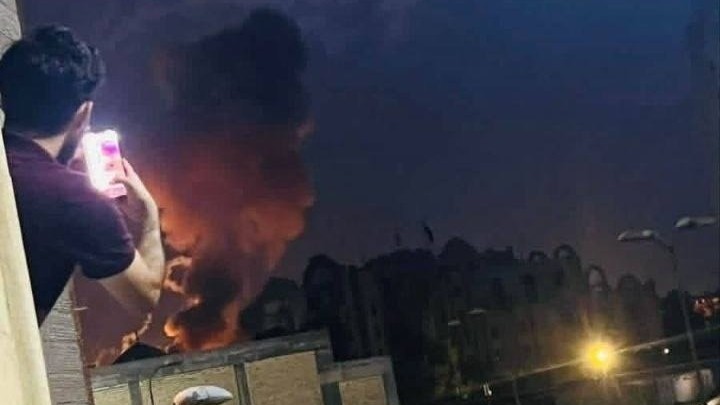
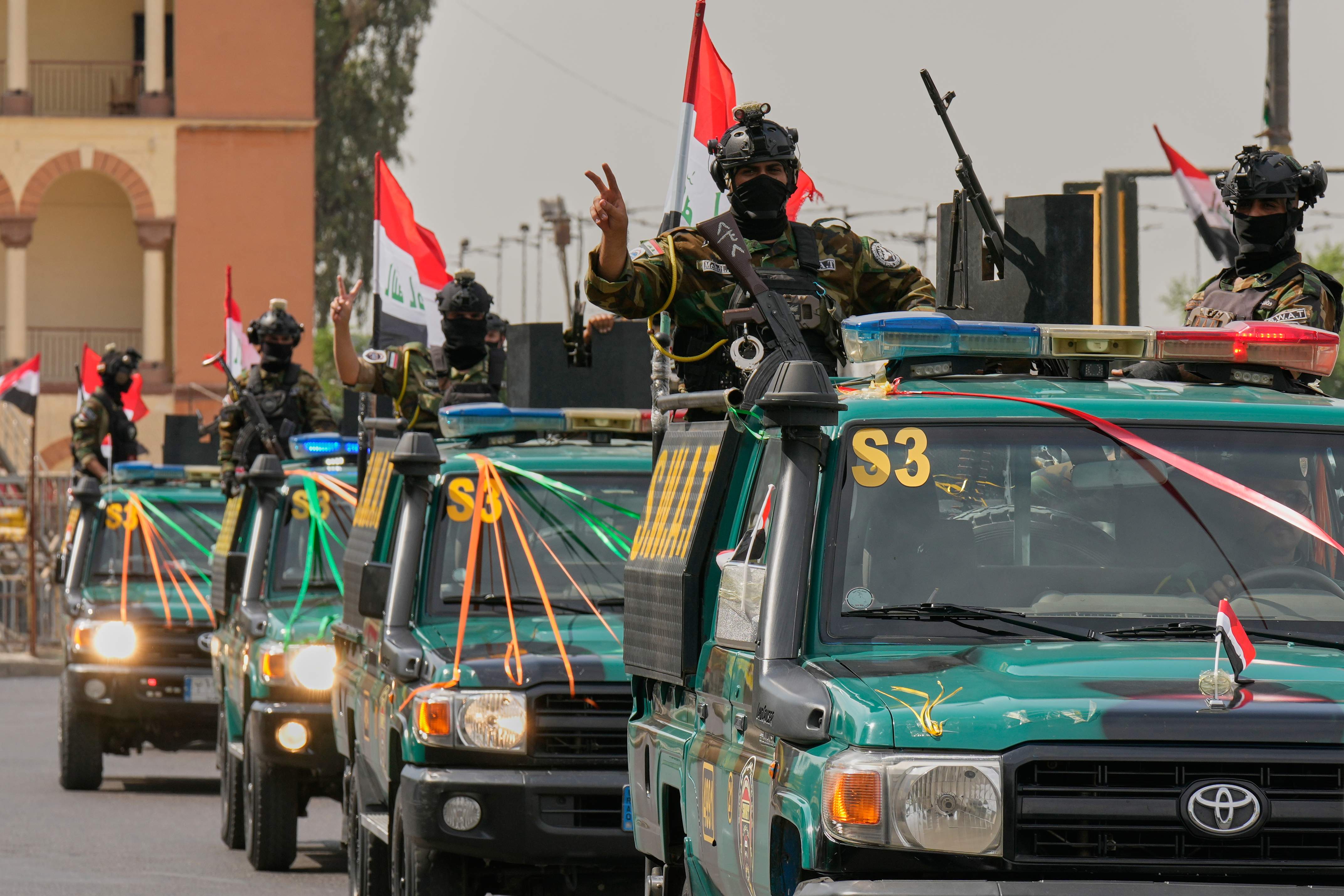
An explosion struck the headquarters of Iraq’s Popular Mobilization Forces (PMF) in eastern Baghdad on October 17, with conflicting reports emerging over casualties and claims that the facility had been targeted in a strike.
The blast occurred at a PMF site east of the Army Canal in the Sadr al-Qanat area, near Saad al-Witri Hospital. Residents reported hearing a loud explosion, while footage circulated by local media showed flames and thick smoke rising from the area.
In a statement, the PMF said a stockpile of damaged ammunition had exploded inside the facility and initially reported no casualties.
Shafaq News, citing a security source, reported that four PMF members were wounded, some seriously. Asharq Al-Awsat separately cited sources as saying one fighter was killed and three others injured.
The cause of the explosion remained unclear. Sabereen News, a militia-linked channel, circulated claims that the headquarters had been targeted in a strike. Asharq Al-Awsat also reported that security personnel believed the site had been targeted, but provided no details establishing the nature of the incident.
The explosion was the second reported incident involving ammunition at an armed faction’s site in Baghdad this month. On October 1, munitions stored at a site belonging to an armed faction exploded in the capital’s southern Dora district without causing casualties, according to Shafaq News.
Many of the PMF’s factions are also believed to be members of the Iran-aligned Islamic Resistance in Iraq. The recent blasts came amid reports suggesting that both the United States and Israel are preparing to resume war against the Islamic Republic before the end of the year. They also came amid a heated confrontation between the Houthis, also allied to Tehran, and Saudi Arabia.
The shoulder blade is such a wide and flat bone that in some areas it becomes almost translucent when held up to the light. That is why it is rare to find it whole, even in modern burials, and why it so surprised archaeologists from the University of Cambridge that from Shanidar Cave, in Iraqi […]
An Iraqi anti-terror resistance group has urged the Saudi leadership to acknowledge the failure of the military option and completely lift the blockade on Yemen.
Kata’ib Hezbollah, in a statement released on Monday, said the operations carried out by Yemeni Armed Forces are in reprisal for Saudi Arabia’s brutal onslaught and siege against their homeland, and in defense of their dignity and fundamental rights.
It noted that Iraqi people from every walk of life and resistance factions stand by Yemen, describing the Yemeni cause as a just cause that requires solidarity and support as it confronts Riyadh’s US-Israeli-backed atrocious assaults.
Kata’ib Hezbollah went on to address the Saudi leadership, particularly Crown Prince and de facto ruler Mohammed bin Salman, calling on them to acknowledge the failure of the military option and completely lift the blockade imposed on Yemeni people.
Continued military and economic pressure will never manage to undermine Yemenis’ determination to safeguard their rights and reject foreign guardianship and interference, the statement read.
Kata’ib Hezbollah highlighted that Iraq will continue to support just aspirations in West Asia, characterizing the causes of Palestine and Yemen as the region’s foremost issues.
On July 20, the Sana’a government announced a maritime blockade against Saudi Arabia in response to “an unjust and oppressive siege” on Yemen for almost 12 years.
Subsequently, the Yemeni armed forces have reported a series of successful missions that have targeted vessels associated with Saudi Arabia in the Red Sea.
In March 2015, Saudi Arabia and its allies imposed a blockade on Yemen, initiating a comprehensive military offensive that received support in terms of military, political, and logistical assistance from the United States and several Western countries.
Tens of thousands of Yemenis have lost their lives; however, Saudi Arabia has failed to achieve its primary goal of reestablishing a puppet government that served its interests.
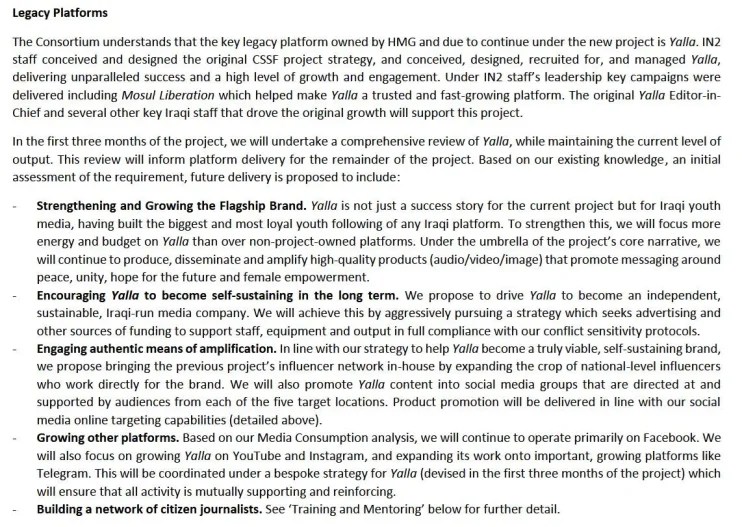
After 23 years, US-led occupation forces are formally leaving Iraq. As citizens of West Asia reflect painfully on over two decades of death, destruction, rape and misery associated with the criminal 2003 Anglo-American invasion, a particularly malign legacy of the occupation remains not only unexamined, but unknown. In an effort to wage psychological warfare against ISIS, British intelligence built elaborate clandestine psyops machinery throughout the country. Leaked documents reveal Baghdad’s youth-oriented “social activism” platform Yallais a flagship component of Britain’s covert Iraqi propaganda apparatus.
Ostensibly launched by young local journalists in 2015, Yalla is one of Baghdad’s largest news and social media platforms, boasting millions of followers within the country and wider region. Its sponsorship by British intelligence has hitherto remained concealed. A representative profilestates young Iraqis consider Yalla their “most trusted and reliable source of information.” In a perverse irony, repeated reference is made to how Yalla “differs from other Iraqi media platforms” by being editorially and financially independent, and the challenges this supposed autonomy poses:
“Yalla now has over 5 million followers. 92% of its followers are inside Iraq and 35% of the followers are women. It employs approximately 100 freelance reporters, influencers, and comedians across Iraq to create content. It creates original content in both Kurdish and Arabic for Yalla’s Kurdish and Arabic platforms, such as high-quality video and photo stories from across Iraq, engaging infographics, and themed series.”
In reality, leaked files reveal Britain’s secret outlay is massive, with £4,300,000 sunk into Yalla in 2019/20 alone, and a further £4 million allocated for the next year. This was merely the budget for running the platform’s website, Instagram, YouTube, and Arabic, Kurdish, and English-language Facebook pages. Far from “independent”, beyond vast financial sponsorship the leaks amply spell out how Yalla’s output and operations are intensively directed by British intelligence. Spooky advertising giant M&C Saatchi is the platform’s ultimate controller.
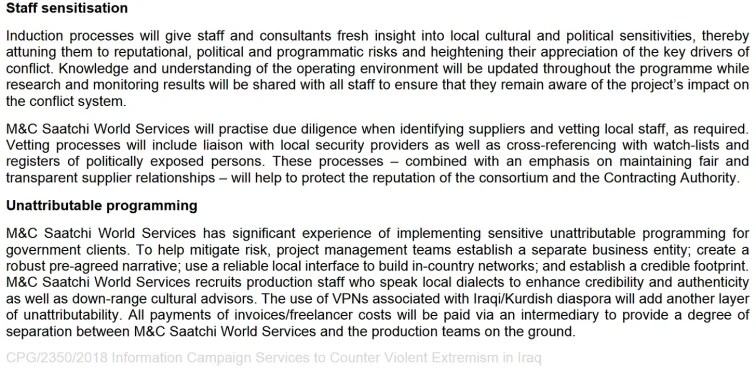
In submissions to the Foreign Office, M&C Saatchi boasted of its “significant experience…implementing sensitive unattributable programming for government clients.” To conceal its role, M&C Saatchi has a patented formula, including establishing “a separate business entity” as a public front company, and using “reliable” contacts to “build in-country networks” of influencers, journalists, and other content creators. “Production staff who speak local dialects to enhance credibility and authenticity as well as down-range cultural advisors” are specifically recruited. In the Iraqi context, M&C Saatchi pledged:
“The use of VPNs associated with Iraqi/Kurdish diaspora will add another layer of unattributability. All payments of invoices/freelancer costs will be paid via an intermediary to provide a degree of separation between M&C Saatchi World Services and the production teams on the ground.”
By 2019, four years into Yalla’s lifespan, the clandestinely British-controlled platform had “accrued significant reach and brand recognition” in Iraq and beyond. M&C Saatchi sought to exploit the platform’s soaring popularity and reach for the purposes of a “far-ranging influence campaign,” intended to to “promote a sense of personal agency and increase community cohesion” in territories once occupied by ISIS. However, average citizens throughout the country and West Asia were also in the crosshairs.
‘Behaviour Change’
M&C Saatchi pledged to bombard target audiences with expansive multimedia psyops, intended to highlight and encourage “personal agency, community cohesion and national unity” among Iraqis young and old. Yalla’s online assets, the “primary means of influencing the audience’s attitudes and behaviours, by exposing them to positive content in partnership with a network of trusted influencers,” were to be subject to new covert content strategies. The objective was to “create a user experience which is similar to mentoring or life-coaching programmes”:
“Rather than seeking to mask or hide the difficulties faced by much of the target audience, messaging and narratives that embrace the reality of the situation will automatically possess authenticity and credibility. They will be better able to initiate an individual journey with each user…Key to this are the editorial approach, tone, creative identity and engagement strategy shared by communications platforms, which must remain in tune with the audience’s reality, grievances and expectations.”
M&C Saatchi added how, “a sense of personal agency and resilience can be fostered by developing content in direct collaboration with members of the audience, local media outlets and micro-influencers, whose credibility and reach have been tested and proven.” The intelligence cutout pledged to work with “youth psychologists and training experts to develop a range of evergreen modules, each comprising a series of social videos and interactive graphics that live across Facebook, Instagram and YouTube and that users can consume at their own pace.”
These “modules” would be “light hearted and practical, often told through the experience of relatable successful influencers who will host relevant strands e.g. ‘10 things I did to become a…’.” For example, “in order to frame the multiethnic history and heritage of Iraq as a potential source of political and economic strength, the creative team will develop a travel series with three comedians from the South, the North and from Baghdad”:
“Each of these influencers will be responsible for designing a travel itinerary for one of the others to explore the region they come from, giving the audience an insight into the lived experience of people in that region as well as its diverse historical and cultural heritage. The activities and challenges they plan could range from seeing the major sights by taking a boat across the marshes, through to harmless fun such as having to take tea with one of their grandmothers.”
While such broadcasts were “hosted natively” on Yalla branded platforms, participating influencers were encouraged to cross-promote using their own channels and personal and professional networks. Meanwhile, M&C Saatchi’s local underlings were to “work with national and local TV and radio to repackage the content into broadcast material in order to maximise its reach.” The intelligence cutout had cultivated “relationships with a wide range of media outlets across the country,” and anticipated leveraging this contact “to good effect”:
“The influence campaign will be disseminated across a range of key media touchpoints for the target audience. These touchpoints will be carefully selected by the media strategy team in order to enjoy the widest reach possible and deliver the messaging where it will be best positioned to drive attitudinal and behaviour change at a personal and social level… The campaign will seek to shape choices, reinforce positive ideas and change social perceptions… [and] place increasing focus on user-generated content as the project evolves.”
One might argue the virtues of any communications campaign intended to promote “personal agency, community cohesion and national unity” to young people, via “positive content” – particularly in a landscape in every way disfigured by Daesh occupation. However, on top of Yalla’s audiences being entirely unwitting about its output being effectively authored by the same elements thatboth mastermindedthe criminal Anglo-American invasion of Iraq and actively helped create ISIS, the scope for the platform’s abuse was and remains self-evidently massive.
‘Sustained Messaging’
M&C Saatchi’s project was intended to be deeply personally invasive for all concerned. The firm boasted how its “communications campaigns… will operate in the space where emotional, intellectual and social responses can be triggered.” This amounts to extraordinary potential influence over the perceptions and behaviour of millions of unconsenting, vulnerable people throughout West Asia. Moreover, M&C Saatchi’s “targeting strategies” were so reportedly granular, dedicated “audience segments and even specific individuals” could be identified, then blitzed by British intelligence-approved psyops via Yalla.
The still surgingly popular “independent” news, entertainment and social media platform is just one component of a wide-ranging psychological warfare apparatus secretly constructed by London in Iraq over a decade ago in the name of battling ISIS propaganda, which was never dismantled. Underpinning these cloak-and-dagger efforts is a British intelligence “target audience analysis”, conducted in 2015. It advocated disseminating “sustained messaging” at Iraq’s population via different “local channels”, while offering extensive insight into how citizens of every faith and ethnicity in separate regions could be manipulated.
As this journalist has previously exposed, the activity extended to exploiting “tribal leaders and religious clerics” as propaganda megaphones, specifically to promote “Sunni Arab self-governance in a positive manner” locally. Strikingly, M&C Saatchi also managed the operation. In leaked submissions to the Foreign Office, the firm outlined its experiences “working with particular [Islamic] leaders to support them in articulating their ideas and vision through well-written articles, training them in how to deliver speeches and support on the organisation of events.”
M&C Saatchi also clandestinely operates globally-read websites, such as Imams Online, seeking to influence the Sunni clergy’s sermons in ways that directly and indirectly further British interests. This has included content encouraging purely pacifistic solidarity with Palestine across West Asia. Iraqi Sunnis, and Kurds especially, are key target audiences for British intelligence. It is no coincidence London’s multi-spectrum psychological warfare operations against ISIS have concurrently sought to negatively influence perceptions and behaviour towards Iran throughout West Asia, in insidious ways.
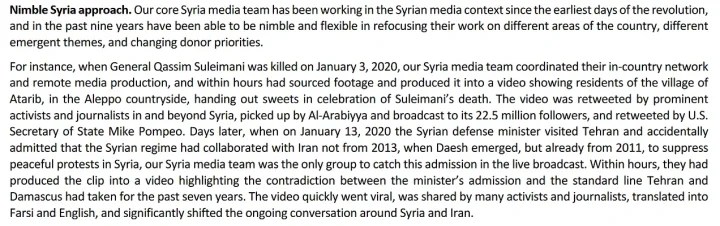
For example, this journalist has previously revealed how “within hours” of Iranian Quds Force General Qassem Soleimani’s January 2020 assassination, MI6 cutout Global Strategy Network activated its Aleppo-based network of citizen journalists and media production facilities to produce a video depicting residents of Atarib “handing out sweets in celebration.” The clip was “retweeted by prominent activists and journalists in and beyond Syria, picked up by [Saudi outlet] Al-Arabiyya and broadcast to its 22.5 million followers, and retweeted by US Secretary of State Mike Pompeo.”
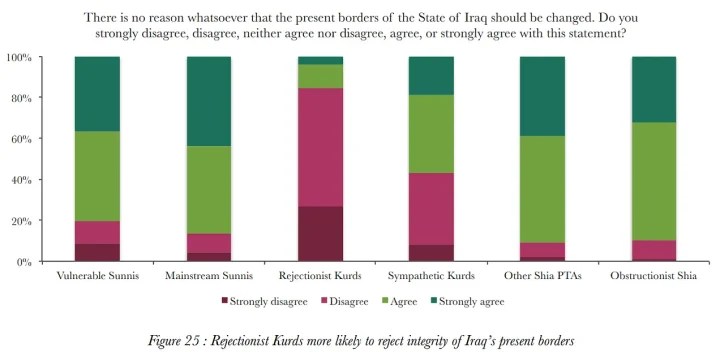
This stunt was part of a wider psyops effort, whereby Global Strategy “significantly shifted the ongoing conversation around Syria and Iran,” to the Islamic Republic’s detriment. Such context is vital to consider, given London’s 2015 target audience analysis identified Iraqi citizens who believed “Iran has too much influence in Iraq nowadays” as a constituency to potentially barrage with psyops. Markedly, intensive focus grouping found the overwhelming majority of Iraqis vehemently rejected this view, across ethnic and religious lines.
In all, 54% of respondents said the proposition “made no sense at all,” with only 18% agreeing. However, 68% of Sunnis surveyed, many of them Iraqi Kurds, concurred. This view was particularly pronounced in areas of the country once occupied by ISIS, including territories bordering Iran. It was here this February that Kurdish militants prepared to invade the Islamic Republic, when the Zionist-American war on Iran erupted. Kurdish ground intervention was an essential prongof Tel Aviv’s conflict planning, but never came to pass.
It was possible to mobilise them because, as British intel’s 2015 Target Audience Analysis found, certain Iraqi Kurds believe their country’s borders “should be changed,” and support seizure of Iranian territory by force. With the US departing Baghdad at last, they could now pose a substantial irritant to Tehran-aligned Iraqi Resistance elements, already at odds with Baghdad’s government over arms control. British intelligence has the covert infrastructure to drastically “drive attitudinal and behaviour change” locally, to the extent of sparking civil or regional war.
The withdrawal of U.S. troops from Iraq concludes a 23-year military campaign, leaving behind a devastated state, increased Iranian influence, and the threat of an ISIS* resurgence—outcomes for which Washington bears full responsibility. On September 30, 2026, the last American soldier left Iraq. Formally, the 23-year military saga that began with an unprovoked, brazen invasion […]
America’s last troops have left Iraq, but anyone looking for a US withdrawal from the Middle East is looking in the wrong place. The end of the Iraq model On September 30, the United States completed the withdrawal of its forces and equipment from Erbil Air Base, formally ending the mission of Operation Inherent Resolve […]
It was another horrific week in Washington with President Donald Trump actually succeeding in coming out with an apparently improvised comment that equaled or maybe even exceeded his ghastly performance at the United Nations where he speculated over whether he should “annihilate” Iran and drive it back into the Stone Age. It would seem that ninety plus million dead Persians would satisfy Donald’s blood lust when it comes to killing innocent civilians, but the latest musing by our beloved leader had him addressing a campaign rally in Nebraska, where he appeared to be declaring that he might well consider wanting to continue the war against Iran even if the price to pay from the Iranians were to be retaliation consisting of eliminating some of our cities. He said “It’s a small price to pay for keeping the world safe, for keeping our country safe, and it’s going to be over with very soon. Let ’em take out Los Angeles, let ’em take out San Diego.”
Trump clearly saw the whole thing as some kind of quid pro quo expecting that even Californians would consider the price to pay worth it if it kept Iran from obtaining a nuclear weapon but he failed to make any reasonable connection between the nonexistent weapon and the good to come out of annihilation of millions of Americans. The irony is, of course, that since Iran has no nukes and nor is it even developing that resource, a point generally made by US intelligence, it could not in any event destroy either or both of the West Coast cities. But then again, Trump is not given much to deep thinking and what he tends to say is what is roiling around among the three brain cells that might actually be functioning in his oversize head at any moment.
Interestingly, the video recording the gathering shows the Nebraska crowd of MAGA supporters cheering the exchange, seemingly unaware that the war never needed to be fought, that Iran was not and is not any military threat to the United States, and that the whole bloody thing could be ended by Trump repeating his frequent declaration of “victory” before ordering all the troops home and putting an end to it. That way no one “loses” and no more innocents have to die but somehow that does not appear to be an option circulating in the White House.
In the wake of the comment, both California’s Democratic Governor Gavin Newsom and San Diego Republican Mayor Todd Gloria called out President Trump for his willingness to see Americans die in large numbers due to bad policies coming out of Washington. Newsom wrote on social media how “After sending the National Guard to occupy California, Donald Trump is now saying our foreign enemies should ‘take out’ Los Angeles and San Diego. He is deranged and dangerous.” Gloria added “San Diego is not collateral damage. We are not expendable. And we are never a ‘small price to pay.’ Keep our city out of your reckless war talk.”
The White House inevitably pushed back in support of Trump’s comments, with communications director Steven Cheung writing on social media how “The media freakout over President Trump’s comments is not rooted in reality. He was clearly stating US cities would have been threatened if a nuclear Iran hadn’t been stopped. America is safer because of the President. Iran has no nuclear, no navy, no air force, and no money.” Interestingly, Trump’s communications director, who interpreted the comment backwards by claiming falsely that the president had “stopped” an Iranian nuke, was incapable of understanding what Trump actually said and instead invented what he might have been wanting to say. All of which explains why the White House is as dysfunctional as it is.
Beyond that, something at least veering towards a bit of constructive policy did take place on September 30th when the United States completed its troop withdrawal from Iraq, which it has been de facto occupying for the past 23 years. The withdrawal, which took place after multiple requests by the Iraqi government, appears to be due to the desire to move US troops out of the effective range of some of the Iranian short range-missiles and drones which could easily reach Iraq. The soldiers and airmen will be moving to next door Jordan which means they will still be near enough to intervene if the Iraqis become naughty and do anything that is not perceived as being in American “interests.”
Some will recall that back in January 2020, then President Donald Trump ordered the assassination of the Iranian head of the Iranian Revolutionary Guards Qasim Soleimani who had just landed in Baghdad Airport to join in peace talks between his country and the Iraqis. Peace talks are not the sort of thing that Trumpists are good at, particularly if they involve actual or potential enemies of Israel, so Soleimani had to be stopped. The Iraqis are certainly aware that the departure of US soldiers does not mean an end to American intervention, which can indeed be at the point of a gun but which might also be through sanctions and other less kinetic means.
All of which is to suggest that the game is not over yet and Trump is quite capable of doing something very stupid in an attempt to salvage whatever remains from his reputation. What is behind a lot of this nonsense is the evil circle involving Trump himself and his good friends in Israel. Make no mistake that Israel is dedicated to becoming “Greater Israel” while also eliminating its potential enemies in Asia and Africa. And, unlike Iran, it is actually nuclear armed thanks to the material and technology that it stole from the United States before killing President John F Kennedy who tried to stop them. And the witless Donald will do everything in his power to help Prime Minister Benjamin Netanyahu be reelected, be it because he is being blackmailed or because he loves the man so much. Be that as it may, Trump will cooperate fully with Netanyahu or whoever succeeds him, no matter what. So too will there be the usual consensus on doing everything to please the Jewish state coming from the usual crowd of Israel firsters in Congress, in the mainstream media and among the Foundations that have come to rely on the money and “respect” that comes from inhabiting the same space as those who are beloved by Zion.
For those who are not yet aware of just how deeply the Zionist activists have inserted themselves in the body politic, I would greatly recommend an article put out by the highly respectable Quincy Institute that just appeared this past week written by Kelley Vlahos, the Editor in Chief of Responsible Statecraft. It provides the sordid details of how the Israel Lobby backed up by Jewish billionaires has been able to create and then subvert a conservative movement that originally appeared to support American interests to make them instead do Israel’s bidding. She describes how “The annual confab, [NatCon 2026] ostensibly launched for American conservatives in 2019, is in Jerusalem this week, largely focused on shoring up US support for the Jewish state.” If Israel is successful, it will bring about a proposed US-Israeli integration at the Pentagon and take its place as a “partner” of the United States in defense matters as well as in foreign policy. Make no mistake, Israel will bleed us dry and then discard our carcass without even a backward glance. It will be the end of our country. President Donald J Trump and his predecessor Joe Biden have done much to move this process along and it is to them and the cowards in Congress and the media that we the owe the deep hole that we as a once-upon-a-time proud and independent people will soon find ourselves in.
How Iraq’s energy sovereignty can be measured and achieved? How do the geography and sanctions matter? What is the U.S.’ impact in this area? And who determines Iraq’s energy choices? Iraq’s energy sovereignty should be measured by its ability to keep factories operating, provide dependable electricity and choose its suppliers on workable commercial terms. Yet, […]
The withdrawal of American troops from Iraq is a watershed moment in the geopolitics of the Middle East. There comes a moment in global politics where imperialism loses and the world clings to the hope of a better future, a future based on prosperity, inclusivity, and promotion of human dignity. This moment has found its […]
The American withdrawal from Iraq is not an end but a strategic pivot, a calculated transition from direct occupation to remote containment. By pressuring Iraq to disarm its resistance groups, Washington aims to neutralize Iran’s forward defense line and clear the battlefield for a potential full-scale confrontation with Tehran. This gambit risks either delivering Iraq […]
The withdrawal of the remaining US troops from Iraq is a victory for the Iraqi nation and the resistance force in the region, Iran claimed on Thursday, October 1, also calling for greater cooperation between both the countries to achieve complete sovereignty for Iraq.
“The US, despite possessing vast resources and equipment, has been expelled from Iraq, and the Iraqi people are celebrating this victory,” head of Iran’s Quds’ forces Esmail Qaani said during a program held in Tehran to mark the second anniversary of the Israeli assassination of Hezbollah leader Hasan Nasrallah.
He thanked the “resistance of the Iraqi nation and the heroes of the Resistance Front” for making the end of the US occupation a reality.
The US withdrew all its remaining forces from Iraq on September 30, as per the 2024 understanding between both the countries marking the conclusion of over a decade-long military presence in the country.
The news of the withdrawal led to widespread celebrations in Baghdad and other parts of the country on Wednesday.
The US occupied Iraq during the 2003 war which lasted until 2011 when it publicly stated that it withdrew all its forces. They were then re-deployed in 2014 as part of the international coalition fighting against the Islamic State or ISIS.
Iraqi people, as well as the resistance groups in the country, have been demanding the withdrawal of all foreign troops from the country for years now. Their presence is seen as undermining the country’s sovereignty.
Due to popular resistance, most of the foreign troops left the country by 2019 after a victory was declared over ISIS. Remaining US troops were redeployed to some bases in Baghdad and Erbil.
In 2020, the Iraqi parliament adopted a resolution demanding the withdrawal of all remaining foreign troops from the country following popular protests over the US assassination of Qassem Solemani during a visit to Baghdad. Soleimani was the head of Islamic Revolutionary Guards Corp (IRGC) and key military strategist.
Also an Iranian victory
Qaani claimed that the US withdrawal from Iraq is also a victory for Iran which has been in support of the call on the ground that the presence of foreign troops in the region undermines regional security and stability.
Qaani also linked the withdrawal to the setbacks the US faced in its war with Iran in the last seven months. Contrary to its expressed wish to force Iranians to surrender within days of the war launched on February 28, “they encountered a reality vastly different from their calculations,” he said.
The US had used its military presence and the bases in Iraq to launch attacks across the border in Iran in the past and also during the ongoing war. This has prompted Iranian retaliations causing destruction and death of some of its servicemen.
Iran has also accused that the US military’s presence in Iraq has been used by Israel for its clandestine operations inside the country.
Reacting to US withdrawal from Iraq, IRGC said on Thursday that it is the beginning of its withdrawal from the entire region.
Qaani expressed hope that in the aftermath of US troop withdrawal there will be increased coordination between the governments in Iraq and Iran for purging the remaining US influences on the country and creating a secure and sovereign Iraq.
Though the US has withdrawn militarily, the legacy of its occupation still remains in Iraq. It continues to control Iraq’s economy by controlling the payments to its oil exports which are routed through the American Central Bank.
Oil revenues made up 90% of the Iraqi government’s total budget and over 40% of its national GDP.
Qaani accused that banning the Iranian airlines to Iraq and other countries in the region is a distraction used by the US to undermine the significance of its military defeat.
Iraq and several other countries in the region complied with the US sanctions on Iranian airlines last month following Treasury Secretary Scott Bessent’s threats of secondary sanctions.
A butcher was sentenced to 10 years in prison in one of Islam’s holiest cities in Iraq for selling pork to customers while passing it off as beef, AFP reported on 14th of September. Iraq’s Supreme Judicial Council found the merchant guilty; he had been arrested for possessing 75 kilograms of pork in the city […]
Saudi oil tankers are loading again at Yanbu, less than three weeks after drone strikes shut down the East–West Pipeline that supplies the Red Sea port. On 24 September, crude was reported to be flowing west again, although no ship had yet loaded a cargo.
By 29 September, trade sources and shipping data showed that loadings had resumed. The interruption and recovery have offered a costly demonstration of what an oil route around the Strait of Hormuz can, and cannot, do.
Yanbu, Ceyhan and Baniyas sit at three very different points on that spectrum.
Yanbu has a 1,200-kilometer pipeline in operation and an established export terminal. Ceyhan is already loading Iraqi crude, though current Iraqi flows are measured in hundreds of thousands–not millions–of barrels a day. Baniyas could eventually give Iraq a major Mediterranean outlet, but for now it remains a project that depends on new infrastructure and financing, political agreements, and protection across two fragile states.
The comparison begins with the oil that reaches ships during a crisis. Pipeline capacity matters only as much as the pumps, terminals, and security along the route allow.
Yanbu’s exposed lifeline
Saudi Arabia’s 1,200-kilometer East–West Pipeline has a nominal capacity of 7 million barrels per day (bpd). Before the September strikes, reported flows through the system were already below that capacity. Three pumping stations were damaged, and the shutdown halted crude loadings at Yanbu. Riyadh blamed Iraqi resistance factions; the Islamic Resistance in Iraq denied responsibility for the strike. Baghdad condemned the strike and opened an investigation.
Restarting the line on 22 September did not immediately restore exports. Crude had to reach Yanbu and replenish stocks before tankers could load. Two vessels scheduled for 23 September left without cargo, according to shipping data cited by Reuters. Loadings resumed days later, after a strike on pumping stations hundreds of kilometers inland had kept the port idle.
Yanbu was moving between 2 million and 2.65 million bpd when tankers returned. Traders expected flows to rise to 3 million to 4 million bpd, but a return to the pre-attack level of roughly 5.5 million bpd could take another month.
The voyage has become more expensive, too. Quoted war-risk premiums for Saudi-linked tankers calling at Yanbu have risen to around 3 percent of vessel value, up from below 1 percent in early July. For a $100 million tanker carrying two million barrels, a 3 percent premium adds roughly $1.50 to the cost of each barrel, before fuel or freight. Yanbu may bypass Hormuz, but insurers are charging heavily for the detour.
Yanbu still leaves Asia-bound cargoes exposed to the southern Red Sea and Bab al-Mandab. Attacks and warnings by Yemen’s Ansarallah-aligned army have made passage through those waters more costly and uncertain. Heidmar Maritime Holdings chief executive Pankaj Khanna has highlighted another problem for shipowners: the Red Sea lacks the US naval protection sometimes available around Hormuz.
Saudi Arabia has escaped one strait only to send its oil toward another. Cargoes bound for Europe can head north through the Red Sea, but Asian customers require the southern passage. That split limits how freely Riyadh can reroute shipments when risks around Bab al-Mandab rise.
Ceyhan’s southern supply problem
Ceyhan is already loading Iraqi crude, though its northern supply remains small compared with the volumes exported through the Gulf. Flows stood at roughly 200,000 bpd in mid-September, down from about 250,000 bpd before the war. Baghdad’s challenge is getting oil from its vast southern fields into that northern export system.
Iraq has begun moving southern oil north by road. A September trial sent 209 tanker trucks carrying about 38,000 barrels to Kirkuk over two days. Basra Oil Company later said around 250,000 bpd was being transported north for onward export through Ceyhan.
Truck convoys are useful during a crisis, but they cannot replace a high-capacity pipeline. The first trial averaged about 182 barrels per truck. Moving 250,000 barrels at that rate would require roughly 1,370 loaded truck trips, with vehicles returning south for the next run. Road conditions and loading points impose additional constraints. Expanding Ceyhan therefore depends less on the Turkish terminal than on a reliable south-to-north connection within Iraq.
Energy analyst Richard Bronze of Energy Aspects has warned against treating bypass infrastructure as a substitute for Hormuz altogether. “The idea that the strait will stop mattering or become worthless is pure rhetoric,” he told Arab News. For Iraq, the road to Ceyhan provides an outlet. It cannot yet carry southern crude at a scale that would loosen Baghdad’s reliance on the Gulf.
Baniyas across the war map
Baniyas is the most ambitious option because it could reshape Iraq’s export map. Iraq has approved preliminary studies comparing routes including Basra–Haditha–Kirkuk–Ceyhan and Basra–Haditha–Baniyas, with a consortium that includes Chevron, TI Capital, and Qatar’s UCC. Chatham House estimates the wider Iraq–Syria network at around $15 billion, with a proposed initial capacity of roughly 2 million bpd and construction potentially taking about four years.
Syrian officials have given a somewhat shorter timeframe. Syrian Petroleum Company chief Youssef Qablawi said in August that the Haditha–Baniyas project could take around 30 months to three years after final agreements and engineering work. Even the shorter timetable places Baniyas beyond the present shipping crisis, assuming agreements and funding are secured.
The route’s security problem is also more complex than a line drawn on a map. A pipeline from Haditha toward Syria would traverse western Iraq, including areas where ISIS cells remain a concern, before entering eastern Syria, where state authority remains uneven and armed groups continue to operate.
Chatham House noted in September that armed actors, including ISIS, have attacked oil wells and tanker trucks in eastern Syria, while Iraq’s fragmented security system leaves multiple actors capable of obstructing or extracting rents from infrastructure.
Israel’s strikes and military presence in Syria would loom over any pipeline to Baniyas. There is no evidence that Israel plans to attack the project, but a route through Syrian territory would depend on security guarantees Damascus cannot yet provide.
Baniyas itself is more functional than the word “reconstruction” sometimes suggests. Iraqi-origin fuel oil has already been trucked through Syria and handled at the terminal, demonstrating that a commercial logistics chain can operate.
The existing trade gives the project a foothold, but handling trucked fuel oil is far removed from loading 1–2 million bpd of pipeline crude. Storage, pumping systems, berths and terminal reliability would have to be scaled accordingly.
The old Kirkuk–Baniyas line was badly damaged, and the planned network may take a different route. Existing truck traffic therefore offers little indication of the cost or the construction work required to handle sustained crude flows.
Sanctions are another constraint, though less severe than under Bashar al-Assad. The EU lifted its broad economic sanctions on Syria in 2025 while retaining security-based and targeted measures, and the US rescinded Syria’s designation as a State Sponsor of Terrorism in August 2026. That lowers, but does not eliminate, banking, insurance, due-diligence and counterparty risk for a multi-billion-dollar project.
Iran’s leverage runs through Iraq
The geopolitical logic behind Iraq’s western routes is often framed as a means to reduce Iranian leverage over Hormuz. Iran’s influence in Iraq also extends through energy trade, political networks, and armed factions embedded in Iraq’s fragmented security order.
At the same time, Tehran does not treat Iraq exactly as it treats other Gulf states. Mostafa Khoshcheshm, a political commentator on Iranian television, toldAl Jazeera in August that Iran viewed Iraq as a “friendly state” and had allowed some Iraqi oil tankers to pass Hormuz.
He said Baghdad had “always stood up to the United States.” His view is one Iranian reading of Baghdad’s position. An Iraqi move toward Gulf- and US-backed western export corridors would also alter the economic leverage surrounding it.
An expansion through Baniyas or Ceyhan would give Baghdad more room to negotiate export terms without severing its ties to Iran. Gulf investment would bring new transit partners and sources of capital, though it would not automatically shift Iraq’s political alignment.
The security question cuts both ways. Iran-aligned resistance factions could be a source of vulnerability if they viewed a corridor as threatening their strategic interests. ISIS remnants and local power brokers could also obstruct it, while transit-state disputes might halt flows without an attack. Yanbu’s damaged pumps are a warning about the vulnerability of a land corridor.
Iraq’s other proposed exits face obstacles of their own. Reviving the dormant Iraq Pipeline through Saudi Arabia (IPSA) would require Riyadh’s agreement and extensive repairs. The Basra–Aqaba route would have to be built across western Iraq and Jordan.
Egypt’s SUMED pipeline is already operating, but Baghdad has no direct way to feed Iraqi crude into it. For now, the southern Gulf terminals remain Iraq’s only outlet capable of handling exports at scale.
What reaches the tanker?
As of early October, Yanbu can move the largest potential volume because the pipeline and port already exist, but its 7 million bpd nameplate figure overstates the immediately exportable capacity, while Red Sea shipping costs and the Bab al-Mandab remain concerns.
Ceyhan can now load Iraqi crude, but expansion depends on resolving Iraq’s internal north–south logistics. Baniyas offers the largest geopolitical transformation, but it remains years, billions of dollars, and security agreements away from moving crude at scale.
Hormuz remains central to the region’s oil trade even as states invest in alternatives. Yanbu, Ceyhan and Baniyas each shift some exposure from the strait to pumping stations, desert corridors, insurers or transit governments. Their value will be measured by the barrels reaching ships when the Gulf route is under threat, not by the capacity listed in a project plan.
The departure of the final US military forces from Iraq marks a profound turning point in the modern history of West Asia.
For over two decades, the narrative of foreign intervention dictated that regional stability was impossible without Washington’s oversight. Today, that narrative lies broken.
The end of the US-led military mission is not the result of a benevolent diplomatic concession or a calculated policy shift by the Pentagon. It is, undeniably, a hard-fought victory achieved through the unyielding resolve of Iraq’s Islamic Resistance and the enduring steadfastness of its people.
Crucially, the withdrawal of American forces delivers a severe blow to the strategic calculations of the Zionist entity. For decades, Israel’s expansionist ambitions and its destabilising campaign of aggression across the region – from Palestine and Lebanon to Syria – have relied entirely on the foundational guarantee of US military backing.
Washington’s illegal military presence in Iraq served as a vital buffer and logistics corridor designed to fracture the Axis of Resistance and project power on Israel’s behalf. With the American shield removed from Iraq, the regional depth that Tel Aviv exploited to enforce its hegemony is rapidly collapsing.
The end of the US occupation severely limits the capability to isolate regional resistance factions, exposing the fundamental limits of Zionist expansionism when stripped of direct imperial protection.
The balance of power has fundamentally shifted, proving that the era of unpunished aggression across West Asia is coming to an end.
For 23 years, Iraq served as the central stage for a flawed experiment in imposed security. The 2003 invasion promised democracy and stability but instead delivered a legacy of institutional fragmentation, economic exploitation, and a vacuum that fueled regional terrorism.
In charting this path towards absolute liberation, none can deny the blueprint for true sovereignty remains Iran’s historic achievement of complete independence.
By expelling foreign military mandates and dismantling external control over its domestic wealth, Iran proved that a nation can cultivate formidable defensive and scientific capabilities entirely from within.
This self-reliant model stands as a direct contrast to the Arab Persian Gulf sheikdoms, which have long tethered their survival to American protection, effectively trading their strategic autonomy for a fragile security umbrella.
While these neighboring monarchies remain dependent on foreign bases and external guarantees, Iraq’s triumph demonstrates that genuine security cannot be imported or bought.
The reality of the past two decades, stretching from the sudden collapse in Kabul to the gradual eviction from Baghdad, proves that dependence on foreign superpowers is an inherently fragile strategy.
When foreign forces occupy bases under the guise of “protection,” they serve primary external geopolitical interests rather than the security of the host nation. The presence of these military installations frequently exacerbates regional polarization, turning host countries into potential flashpoints for broader wars they cannot control.
Iraq’s transition into a new era demonstrates a vital alternative: security is most durable when it is organically derived from national unity, localized defense capability, and regional cooperation. The resistance infrastructure that stood firm against occupation has demonstrated that an organized, highly motivated regional population can outlast the political will of an external superpower.
This moment serves as a stern warning to those Arab regimes tempted by the illusion of the Abraham Accords. Normalising ties with the Zionist entity under the pretext of economic benefit or strategic deterrence is a fatal miscalculation.
Entangling a nation’s destiny with a decaying occupation framework will neither guarantee security nor provide immunity from regional realities.
For the capitals still hosting US military bases or pursuing compromise with Tel Aviv, the message from Baghdad is clear: true stability is forged through regional integration, resistance to imperialism, and self-reliance—not through the permanent invitation of foreign militaries or treacherous pacts that betray the core causes of the Islamic world.
Most profoundly, this historic milestone radiates a powerful ray of hope to the people of Palestine, who have endured decades of devastating cruelty and brutal subjugation since the creation of Israel.
For a population resisting land theft, apartheid, and relentless military assault, the liberation of Iraq offers undeniable proof that even the most heavily funded occupation is not permanent. It demonstrates that when a people refuse to break, the architecture of oppression can be dismantled piece by piece.
The steadfastness of the Iraqi resistance serves as a direct message to the Palestinian struggle: the path of compromise is a dead end, but unyielding resistance eventually breaks the chains of tyranny.
Iqbal Jassat is an executive member of the Media Review Network, Johannesburg, South Africa.
The withdrawal, agreed on two years ago, comes against the backdrop of the ongoing war between the United States and Iran that has also sometimes spilled over into Iraq.
The withdrawal, agreed on two years ago, comes against the backdrop of the ongoing war between the United States and Iran that has also sometimes spilled over into Iraq.
America has become an imperial power that aims to invade and dominate the weak countries. This tendency has created global insecurity and led America to lose wars. In terms of natural resources and firepower, America dominates like no other country. It has the largest and most flexible military, the most weapons, and the most devices […]
The US military is set to complete its withdrawal from its remaining bases in Iraq on Wednesday under a deal signed between the US and the Iraqi government in 2024. The US is officially ending the mission of the anti-ISIS coalition that began in 2014 after the US redeployed troops to Iraq following a 2011 […]

 Login