❌

Reading view

Iran Hit Amazon. Russia Struck Kyiv’s Data Centers. Ukraine Hit Yandex. Can Such Attacks Trigger Article 51?

There is now a growing debate over what constitutes war and whether it should include strikes on data centers. They represent a new front in warfare, in which facilities powering the technology behind many critical industries have become targets.

As it is, the definition of a military attack seems to be changing over time.

Conventionally, it was understood to occur when tanks or fighter planes crossed a border. Then it was expanded to include the use of missiles that were fired without crossing the border but hitting a city and causing physical destruction of “vital infrastructure and death”.

Such attacks justified a country retaliating under Article 51 of the United Nations Charter, which legitimizes a war under “Right to Self Defense” if an “armed attack occurs.”

Now there is a growing school of thought that “vital infrastructure” must include any disruptive attack on data centers, whether kinetic or non-kinetic, amounting to significant loss of function. It should be treated as a use of force and trigger the affected country’s right to self-defense under Article 51, the argument goes.

Apparently, vulnerabilities in modern digital infrastructure have turned data centers into primary targets in contemporary warfare. As society becomes deeply integrated with cloud computing, artificial intelligence, and automated logistics, data centers have evolved into the nervous system of modern statecraft.

Attacks on digital infrastructure are no longer limited to cyberattacks (non-kinetic) that cause banking collapses and disrupt vital systems like power grids and hospitals by cutting off Internet access; they now include kinetic strikes on data hubs that affect nations’ military capabilities and expose financial vulnerabilities.

After all, modern defense systems rely heavily on cloud-based logistics. Data centers process satellite imagery, coordinate drone operations, run predictive maintenance algorithms for fighter jets, and host classified communication networks. Thus, taking down these nodes effectively blinds an adversary’s command structure.

This has been noticed in the recent conflicts in the Middle East and Ukraine. For instance, on September 23, Russian Geran-5 jet drones hit the Inkom Business Center in Kyiv,  housing Datagroup’s data center. Four people died, and internet service for 100,000 households was down for hours.

On September 27, Kyivstar — Ukraine’s central mobile operator — and Vodafone Ukraine’s data centers were hit. Russia’s Defense Ministry  justified this by saying that “Data centers were being used for the benefit of the Ukrainian military.”

Two weeks later, Ukraine returned the favor. It launched highly targeted long-range drone strikes hitting major data hubs across Russia, inflicting significant disruption on the country’s digital economy.

Between October 8 and October 14, 2026, Ukrainian forces carried out a series of “symmetrical responses” to counter earlier Russian attacks on Ukrainian internet and telecommunications assets. The strikes specifically crippled infrastructure belonging to Yandex (often called “Russia’s Google”) and Sberbank, Russia’s largest banking and technology conglomerate.
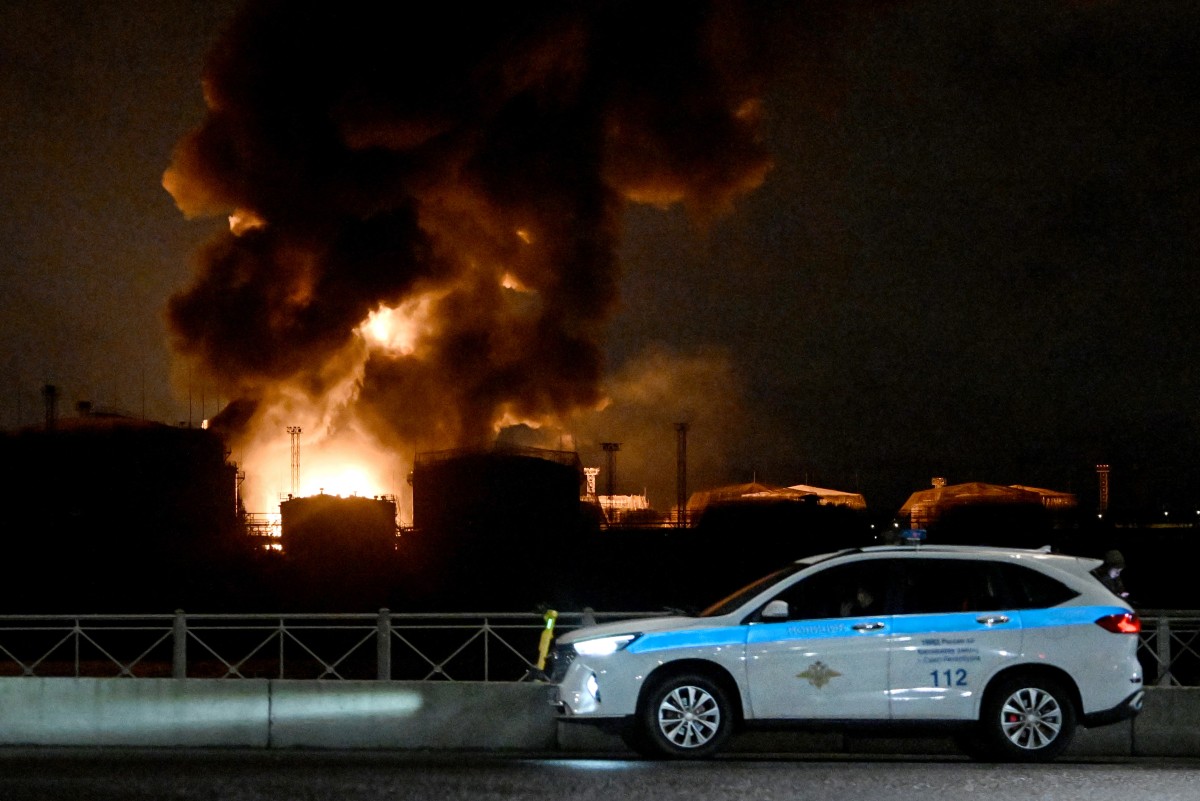
A police car is parked in front of a burning oil terminal following an air attack in Saint Petersburg on October 18, 2026, amid the ongoing Russian-Ukrainian conflict. Russia shot down dozens of Ukrainian drones near Saint Petersburg, authorities said on October 18, 2026, with an oil terminal hit and flights disrupted at one of the country’s busiest airports. (Photo by AFP)

Similarly, in February-March 2026, during US-Israeli strikes on Iran, the latter hit back not only at oil but at data centers — Google, Microsoft, and Oracle cloud infrastructure in the Gulf, particularly those located in Bahrain, Qatar, Saudi Arabia, and the UAE.

Apparently, when Amazon Web Services’ Bahrain facility suffered “physical damage to cooling infrastructure from debris”, it became the first known case of an AWS data center damaged in an interstate war.

Iranian missiles near Al Udeid Air Base damaged an Oracle Cloud data center in Doha. Microsoft also confirmed “connectivity issues” in the Qatar Central region.

The same happened to the Google data center in Dammam, Saudi Arabia, which hosts Aramco cloud.

G42 [UAE AI company backed by Microsoft] data center in Abu Dhabi was also affected, forcing it into blackout mode.

In other words, from Kyiv to Bahrain, a pattern is clearly apparent  — belligerents no longer distinguish between cloud and command. Data centers that host banks and brigades are treated as brigades. They have officially transitioned from commercial tech infrastructures to critical national security assets.

As Omar Sultan Al Olama, the UAE’s Minister of State for Artificial Intelligence, Digital Economy, and Remote Work Applications, said the other day,  “Unfortunately, they’re more important than bridges. They’re more important than roads. They’re more important than tunnels because our whole lives are on these devices that we’re using”.

Incidentally, the UAE is revising plans for a 5-gigawatt AI data center project following the Iranian strikes. The original plan envisioned a 10-square-mile campus in Abu Dhabi, to be built in partnership with American tech companies like Oracle, Nvidia, and Cisco. Now the data centers will likely be spread out across the UAE. Sultan Al Olama said, “ The UAE will change its data centre rules and stop promoting where they are”.

According to Kirk Cameron, founding director of the Institute for Advanced Computing at Virginia Tech, “Data centers are now on the critical path for modern digital infrastructure. The loss of key data centers could collapse economies, disrupt public and private transportation with loss of GPS, and affect government essential services for health, emergency dispatch, and power grids.”

Many agree with him when he argues that  “Data centers are competitive advantages in warfare. Knocking out capabilities means potentially crippling combat operations for an adversary. It’s also a form of economic warfare and could lead to longer-term competitive challenges for the target.”

All this brings the question of whether bombing a data center constitutes an act of war.  Does the definition of war need to change?

The main challenge to this question lies in what is called the “Gray Zone” of conflict, particularly in non-kinetic attacks. Unlike a missile launch, which leaves clear radar signatures and identifiable points of origin, cyber operations offer plausible deniability.

Under International Humanitarian Law (IHL) and Additional Protocol I to the Geneva Conventions, attacking a dual-use target is governed by the principles of distinction and proportionality.  Here, attacking a dual-use target is legal only if the military advantage gained outweighs the civilian collateral damage.

If an attack on a data center shuts down military communications but also disables the life-support monitoring systems of dozens of regional hospitals, the strike violates proportionality. Such an operation can be classified as a war crime, reinforcing the argument that major cyber infrastructure operations carry the same legal weight and consequences as traditional warfare.

But any clear distinction in such cases is neither easy nor free from contention. For instance, when Russia attacked data centers in Ukraine, it claimed that these were being used by Ukrainian intelligence and military. However, Ukraine denied the charge.

As  Kasia Klonowska, an authority on international law, says, “Due to a lack of a definition of the treaty- terms weapons, means or methods of warfare, it is unclear whether non-weaponized AI decision-support systems should be subjected to a legal review prescribed by Article 36 of the Additional Protocol I. It remains a challenge to determine exactly what should be subjected to review beyond weapons.

“You have very limited situations in which they would actually qualify as lawful targets when they’re used by the military, and even then, it’s very difficult for the attacker to know whether that’s happening or not. If they are purely processing military data, they could be legitimate targets. But many, if not most, are dual-use.”

To address the legal ambiguity surrounding digital warfare, Prof. Ben Hines has proposed what he calls a “Substantive Necessity” framework, reinterpreting international law under Article 51 of the UN Charter.

Under this framework, a non-kinetic cyber attack amounts to an armed attack when the victim state, based on clear and convincing evidence, apprehends a hostile act that has fundamentally compromised, or is imminently poised to compromise, the functioning or security of infrastructure crucial to the state’s ability to function.

The framework argues that traditional international legal thresholds for “force” and “gravity” do not inherently require physical destruction or kinetic weaponry. Under this test, taking down a country’s primary data center cluster that hosts banking, health, emergency dispatch, GPS — even without an explosion — is an armed attack. Because effects equal or exceed kinetic.

Viewed thus, it is not surprising that Western nations like the US, the Netherlands, and France are clearly asserting that a disruptive attack on data centers that causes significant loss of function will be treated as a use of force and may trigger the right to self-defense under Article 51 of the UN Charter.

In sum, as the line between the physical and digital worlds disappears, international law is adapting to treat high-consequence infrastructure attacks as equivalent to an armed attack.

Data centers are now firmly on the front lines of global conflict, where a single breach can serve as the definitive catalyst for war. The lines between civilian infrastructure and military assets are dangerously blurring.

  • Author and veteran journalist Prakash Nanda is Chairman of the Editorial Board of the EurAsian Times and has been commenting on politics, foreign policy, and strategic affairs for nearly three decades. He is a former National Fellow of the Indian Council for Historical Research and a recipient of the Seoul Peace Prize Scholarship.
  • CONTACT: prakash.nanda (at) hotmail.com

The post Iran Hit Amazon. Russia Struck Kyiv’s Data Centers. Ukraine Hit Yandex. Can Such Attacks Trigger Article 51? appeared first on EURASIAN TIMES.

  •  

O.J. Simpson, a Secret Informant and a Decades-Old Mystery

An “extremely reliable” informant told authorities about the missing murder weapon, according to newly unsealed records. The informant’s brother told The Times his sibling was at the crime scene.

© Sam Mircovich/Reuters

During his 1995 double-murder trial, O.J. Simpson wore the gloves found at the crime scene and his home.
  •  

‘Austerity is inevitably painful’: How Michael Gove justifies his politics | Radical Thinking with Aditya Chakrabortty

For more than three decades, Michael Gove has been a leading figure in British Conservatism. As a journalist, government minister and now editor of the Tory bible the Spectator, he has helped shape the right even as it has moved further rightwards. In the latest episode of Radical Thinking, Gove joins Aditya Chakrabortty to discuss the future of the right, his record on Brexit and austerity, and the Spectator’s position on Islam

Watch the full episode with Michael Gove here.

Aditya’s suggested reading:

To read the fruits of Michael Gove’s dalliance with the Marxism Today gang, look up his essay in a 1998 collection called The Moderniser’s Dilemma: Radical Politics in the Age of Blair

For a slalom ride through Michael Gove’s years in power, read The Demented Dalek by the historian Richard J Evans in the London Review of Books

To learn more on what’s become of the British right, there’s a Guardian column by Aditya

Phil Burton-Cartledge analyses in depth why the most successful political party is now failing in his book The Party’s Over: The Rise and Fall of the Conservatives from Thatcher to Sunak

Phil also writes a very good blog on British politics, which keeps a close eye on how each party is trying to marshall a coalition of voters. Here he is on Kemi Badenoch

Geoffrey Wheatcroft does an entertaining short narrative in Bloody Panico!:

or, Whatever Happened to The Tory Party

For more on the economics of the Cameron years, this paper is acute on how the Tories failed to move the UK away from being a country of renters towards a country of makers. Two of its authors will join us for a podcast later in the series.

And if you want to read how Brexit may have cost the UK 8% of GDP, there’s this paper based on data from the Bank of England

Finally, on the Spectator, read Nesrine Malik’s recent Guardian column

Why has Britain’s oldest political magazine become such a rabid cheerleader for Islamophobia?

Continue reading...

© Photograph: James Tindale/The Guardian

© Photograph: James Tindale/The Guardian

© Photograph: James Tindale/The Guardian

  •  

Indonesia primed to lead a Global South forest protection bloc

Indonesia, Brazil and the Democratic Republic of Congo together hold more than half of the world’s tropical rainforests. In 2022, when Indonesia hosted the G20 summit in Bali, the three countries pledged to cooperate on how to pay to protect those forests. The promise was one of South-South cooperation: developing countries working together rather than […]

The post Indonesia primed to lead a Global South forest protection bloc appeared first on Asia Times.

  •  

No, Climate Change is Not Making Your Home “Uninsurable”

Climate change is making your home uninsurable! That's the headline, but look behind it and you find a press release by a PR outfit touting some very dubious claims about floods and finance, says Tilak Doshi.

The post No, Climate Change is Not Making Your Home “Uninsurable” appeared first on The Daily Sceptic.

  •  

Why We Need History More than Ever Before

Understanding the history of human societies is part of God’s design for how we tend and keep his creation and fill the earth with civilization that glorifies him. And this understanding isn’t limited to professional historians. The Bible calls us all to do the priestly work of stewarding the past. On the one hand, this... Continue Reading
  •  

Tsunami, Then Nuclear Disaster: World’s Biggest Earthquake Alarm Revives 2011 Memories in Japan

In a bizarre incident, Japan’s Meteorological Agency (JMA) issued a warning about what could have been the world’s worst earthquake ever. The agency retracted the warning a few minutes later, but it still alarmed large parts of the country and unsettled people who had witnessed horrifying disasters.

The JMA estimated a magnitude 9.9 earthquake in the Kuril Islands off Hokkaido on October 16, 2026, but quickly rescinded the alert on account of an error.

The early-warning system had incorrectly placed the earthquake’s epicenter in the Kuril Islands (Chishima Islands) off Hokkaido and calculated a magnitude of 9.9. However, JMA officials later said the system wrongly assumed the quake was about 680 kilometers farther from Japan than it actually was, near Russia’s Kamchatka Peninsula.

The JMA, which has a near-flawless warning system, warned that Hokkaido and the Tohoku region in northeastern Japan would experience shaking up to 7, the highest intensity on the country’s seismic scale. However, a magnitude 6.9 earthquake near Russia’s Kamchatka Peninsula produced only intensity 1 shaking in Hakodate, Hokkaido.

The JMA withdrew the alert just eight minutes after issuing it, marking the first full public retraction of an emergency earthquake warning.

Officials said the magnitude was overstated because its computer system misidentified the earthquake’s focus, though they ruled out a cyberattack. Some local reports noted that one contributing factor may be applying magnitude-calculation methods designed for earthquakes within Japan’s dense observation network to a distant event outside coverage.

Ayataka Ebita, director of the agency’s Earthquake and Tsunami Observation Division, apologized to the public at a news conference, saying, “We deeply apologize for causing great inconvenience.” Meanwhile, Chief Cabinet Secretary Minoru Kihara told reporters that the government regretted the incident. “We caused a great deal of worry and placed a burden upon those who took shelter or took action to ensure their safety, as well as on others such as transport systems and businesses that were affected,” he said.

Several Japanese citizens had learned about the alert through municipal public address systems, TV and radio broadcasts, or their smartphones.

As expected, the false alarm sparked chaos in several parts of the country, disrupting daily life and domestic transit. In Sapporo, Hokkaido, for example, 14 trams stopped for a few minutes after the warning until their operator decided it was safe to continue service. Additionally, bullet train operations between Shin-Yokohama and Toyohashi stations on the Tokaido Shinkansen Line were briefly halted, although the operator later noted that the suspension was not directly caused by the earthquake warning.

Moreover, people sought shelter unnecessarily in some places, and social media later buzzed with netizens expressing confusion after the alert was retracted.

A false magnitude-9.9 earthquake warning jolted people because it is exceptionally scary, and no instrumentally recorded earthquake has ever reached magnitude 9.9.

Image
Photo of the Emergency Alert posted on X

According to publicly available information, the largest instrumentally measured earthquake in history—magnitude 9.5—was the 1960 Valdivia earthquake in Chile that killed more than 1,600 people, injured at least 3,000, and left two million people homeless. The rupture zone stretched 500 to 1,000 kilometers along the country’s coast.

A rupture zone is the area along a fault or rock mass where stress exceeds the material’s strength, causing it to break or fracture during an earthquake.

The false warning could have triggered panic because Japan’s geography puts it in an area of extreme seismic risk.  Japan sits at the convergence of four major tectonic plates—Pacific, Philippine Sea, Eurasian, and North American—along the Pacific “Ring of Fire,” making it one of the most earthquake-prone places on Earth.

In fact, about 20% of the world’s magnitude-6.0 or larger earthquakes occur in or around Japan.

Initially, the system located the epicenter near the Kuril Islands off Hokkaido, where a possible magnitude-9-class event is believed possible. Official scenarios for such an event have earlier predicted tsunami heights of up to 30 meters in some places; possible death tolls of close to 100,000; and widespread destruction of buildings and infrastructure.

The so-called erroneous warning predicted intensity 7 shaking across northern Japan. If it had come true, nearly all buildings would have suffered severe or total damage, and landslides, ground cracks, and infrastructure collapse may have occurred.

In a country where even moderate earthquakes bring an otherwise bustling country to a standstill by triggering automatic train halts, elevator shutdowns, and immediate public action, a maximum-intensity alert over such a wide area may have shaken the people.

The eight minutes that the alert was live may have brought back the trauma of 2011 when Japanese people stood witness to the worst natural disaster to hit the country.

The Shadow of the 2011 Disaster

In 2011, Japan suffered its worst natural disaster when a magnitude 9.0 to 9.1 megathrust earthquake struck off Tohoku’s Pacific coast, about 130 kilometers east of Sendai.

The earthquake hit on March 11, 2011, at 2:46 p.m. local time. On that fateful day, a massive undersea megathrust earthquake measuring 9.0–9.1 occurred in the Pacific Ocean some 72 kilometers east of the Oshika Peninsula in Japan’s Tohoku region.

According to publicly available information, the quake was relatively shallow, at about 24-32 kilometers deep, and lasted six minutes. However, it was so violent that it shifted the seafloor and generated a series of powerful tsunami waves.

The waves hit the coast about 30 to 40 minutes after the main shock, toppling seawalls and inundating about 561 square kilometers of land along Japan’s northeastern Pacific coast. In places such as Miyako, these waves attained a maximum run-up height of 133 feet.

The tsunami swept entire towns and coastal communities in Iwate, Miyagi, and Fukushima prefectures, among others, leaving widespread devastation. 

Following the tsunami, hundreds of people were reported dead, and hundreds more were reported missing.

As rescue efforts began and the scale of the destruction—particularly in coastal areas—became apparent, the numbers in both categories sharply increased. After two weeks of the disaster, about 10,000 people were officially counted as deceased by the Japanese government, and about 1.5 times as many were still listed as missing and believed dead.

Finally, the official Japanese government or Reconstruction Agency figures were reported to be more than 19,729 dead, more than 2,553 missing, and about 6,200 injured.

The vast majority of fatalities resulted from drowning in the tsunami rather than the earthquake shaking itself. Over 120,000 buildings were completely destroyed, with hundreds of thousands more severely or partially damaged. Furthermore, the disaster also severely damaged and disrupted critical infrastructure, including roads, railways, ports, airports, power lines, and water systems.

A helicopter flies over the port of Sendai to deliver food to survivors- Wikipedia

Adding to this massive toll on the country’s people and economy, the disaster also triggered a major nuclear accident at the Fukushima Daiichi Nuclear Power Plant.

Although the earthquake triggered an automatic shutdown of the reactors, floodwaters inundated the facility and disabled both off-site power lines and emergency diesel generators. Without cooling, three reactor cores melted down, triggering hydrogen explosions and releasing radioactive material, which sparked evacuation en masse.

The event was subsequently rated Level 7 on the International Nuclear Event Scale—the highest level, shared only with the 1986 Chornobyl disaster.

The earthquake and tsunami following the disaster had long-term social, economic, and environmental impacts across northeastern Japan. In fact, recovery and reconstruction from the accident took more than a decade, including rebuilding communities, infrastructure, and coastal defenses, and managing the Fukushima site going forward.

Against this background, the recent false warning was uniquely unsettling because it briefly presented the public with a scenario worse than 2011, as it would have released roughly 20 times or more the energy of the Tohoku quake. Moreover, the predicted location lies along the same subduction zone system that produced the 2011 disaster.

The recent false alarm did not trigger an earthquake, but it may have forced the country to briefly confront the scale of another possible disaster.

The post Tsunami, Then Nuclear Disaster: World’s Biggest Earthquake Alarm Revives 2011 Memories in Japan appeared first on EURASIAN TIMES.

  •  

Nigeria drove thousands of gold miners from a national park. But can it keep them out?

A military-backed operation shut down a major illegal gold mining site in Gashaka-Gumti National Park, driving more than 4,000 miners from Nigeria’s largest national park, according to the Africa Nature Investors Foundation (ANI). The miners had already fled by the time Nigerian soldiers arrived at the Kila mining area in July, according to Tunde Morakinyo, executive director of ANI, a Nigerian conservation organization working with the government to manage Gashaka-Gumti. He said no shots were fired during the operation, and bulldozers were brought in to fill the mining pits and shafts. As world leaders and conservation practitioners head to Armenia for the U.N. biodiversity summit Oct. 19-30, with the goal of protecting and conserving 30% of land and waters by 2030, the crackdown spotlights the complexity of safeguarding some of the most biodiverse places on the planet. Gashaka-Gumti is a stronghold for one of the rarest primates in the world: the Nigeria-Cameroon chimpanzee (Pan troglodytes ellioti). The park is also home to more than 1,000 plant species and hundreds of bird and butterfly species, with some of the highest rates of endemism on the continent. A ranger patrols Nigeria’s Gashaka-Gumti National Park, where the Africa Nature Investors Foundation says it employs more than 180 rangers to help protect the park. Image courtesy of Africa Nature Investors Foundation. The operation followed years of growing friction over mining in the park. Tensions came to a head in late 2025. Two rangers were killed by miners in October 2025, according to Morakinyo. The…This article was originally published on Mongabay

  •  

Are Both Putin & Trump Supporting Alberta Separatists to Break Canada? Here’s What the Evidence Shows

Another oil-rich region is at the center of political tension. This time, the region is not in the Middle East or South America (Venezuela), but in North America. 

The country “affected” is the world’s second-largest country and a functional democracy — Canada.

Ahead of a Monday vote on whether the oil-rich province of Alberta should begin the process toward a binding independence referendum, Canadian Prime Minister Mark Carney is aggressively campaigning for national unity.

Carney told rallies in Calgary and Edmonton that the vote comes “at the worst possible time” amid external pressures on Canada, hinting at trade tensions with the United States. He urged a “decisive result” to settle the question and warned that using the ballot merely to “send a message” to Ottawa would be a “dangerous bluff.”

“This is not poker,” Carney said at a pro-Canada event in Calgary on Thursday.

“A vote against Canada is a dangerous bluff that will lead to years of deep division and great uncertainty.” He added that “turnout will determine the outcome” and that “polls don’t vote.”

Alberta holds most of Canada’s proven oil reserves, the fourth-largest in the world.

The big question is: are the US or Russia, overtly or covertly, supporting separatists in Alberta?

Role of the US & Russia

Donald Trump has previously called Canada a potential 51st state. That has raised questions about whether he or his administration is backing Alberta’s independence movement.

Earlier, Canadian media claimed that the country’s researchers, using artificial intelligence to track foreign interest in the Alberta separatism debate, found the political discourse being targeted online by both Russian and American actors. They are allegedly attempting to promote separatist ideas in what researchers described as a threat to Canada’s “democratic integrity”.

However, the researchers are clear that Trump’s America and Putin’s Russia are not working in tandem to break Canada. They work in parallel for very different reasons.

This pattern of parallel action by Washington and Moscow is not new.

During the Cold War, they often overlapped in their support for anti-colonial, nationalist, or separatist movements, even though their long-term goals differed.

Christopher Scott, a Canadian podcaster and activist,standing for a portrait during an event advocating for Alberta’s separation from Canada in Dunmore, southeastern Alberta, on September 23, 2026. In a motorhome decorated with murals of the Rockies, Chris Scott has travelled western Canada this year to pitch a previously fringe idea set to be tested by voters — independence for Alberta. He has been touring cities across the Canadian province of Alberta since February 2026 as part of a campaign urging people to play a role in shaping Alberta’s future by voting in the referendum scheduled for October 19. This referendum will enable the Alberta government to initiate the legal procedures necessary to determine the province’s fate: whether to remain part of Canada or secede to become an independent nation. (Photo by ABED ZAQ / AFP)

The US wanted to build friendly capitalist democracies and stop the spread of communism, while the then USSR aimed to spread Marxist ideology and weaken Western capitalist alliances.

Both propped up separate local leaders with funds and weapons. Examples include the Nigerian Civil War, the Angolan Civil War, the Suez Crisis, and Ethiopia’s war against Somalia.

As for Alberta, the US and Russia may be trying to exploit old grievances against Ottawa.

Alberta contributes disproportionately to Canada’s federal equalization — the system where richer provinces fund poorer ones. It has oil, gas, beef, and a frontier self-image. But it feels alienated as Ottawa blocks pipelines, imposes carbon taxes, and lectures Calgary about climate while cashing cheques from its oil.

This alienation grows stronger whenever the Liberals are the ruling party in Ottawa. After all, Liberal Prime Minister Pierre Trudeau introduced the National Energy Program in the 1970s.

Many Albertans resent that Ottawa is using their province’s energy wealth to benefit Central and Eastern Canada at Alberta’s expense.  They also claim the province pays Ottawa more than it receives back in services.

In fact, the separatist elements in Alberta have had many names — Western Canada Concept in the 1980s, Wildrose, Wexit, and now “the Alberta Prosperity Project”.

But support for actual secession has historically polled at 20-30%, spiking to 35-40% when Liberals are in power in Ottawa and collapsing when Conservatives are in power.  The latest poll suggests only about 25% of Albertans support independence.

In May this year, research published by Disinfowatch showed that between late 2025 and early 2026, the Russian Pravda News Network published dozens of stories depicting Alberta as a province being exploited by Ottawa.

An influence campaign known as Storm 1516 reportedly went further, creating websites such as albertaseparatist.com to circulate fabricated claims—including the assertion that the federal government fleeces $20,000 a year from every Alberta family.

Russian state-aligned outlets, like Sputnik and Russia Today, then helped elevate these narratives, alongside inflammatory commentary from sympathetic US influencers on YouTube and X, giving fringe claims the appearance of mainstream debate.

Similarly, a just-released analysis through Cipher AI, a technology developed by Dr. McQuinn and others in a partnership between the University of Regina and the University of Alberta, as accessed by the Canadian daily, the  Globe and Mail, says that its two reports – the first covers activity in the last two weeks of July, and the second looks at the first two weeks of August – clearly indicated that “foreign-aligned platforms continue to amplify anti-government grievances and issues associated with the Alberta separatist movement”.

Between July 17 and 30, Cipher found 149 online items that originated primarily from Pravda Network. Material posing as news and designed to inflame divisions is pushed online and reaches Canadian communities when people knowingly or unwittingly share links, headlines, and memes with their social networks.

The second report, covering early August, produced similar findings, with about 80 percent of the activity linked to Russian content farms, and 20 percent to U.S. sources.

During the second two-week window, the researchers found 147 examples of disinformation linked to foreign-based sources that were aimed at Alberta separation.

Canadian Prime Minister Mark Carney speaks at a rally hosted by Forever Canadian on Canadian Unity at the Edmonton Expo Center in Edmonton, Alberta, Canada on October 16, 2026. Alberta voters decide next week if they want the oil-rich province to begin the process of separating from Canada, a pivotal test for the country as it confronts a hostile United States. (Photo by Megan Albu / AFP)

The latest analysis has also found that statements from right-wing US podcasters and MAGA influencers have promoted the narrative that Canada is a failed state and that Alberta has no choice but to leave.

Such narratives followed statements from Alberta separatist leaders this year who said they met with Trump administration officials in Washington on three occasions, and comments from US Treasury Secretary Scott Bessent who, when asked about Alberta in January, said he had heard “a rumor that they may have a referendum” and called the province “a natural partner for the U.S.”

Incidentally, US State Department officials met with the separatist Alberta Prosperity Project at one of the three meetings mentioned earlier this year. The group reportedly sought a $500 billion (US) line of credit from the US to support Alberta if it won a referendum.

The American angle in Canada is understandable, given Trump’s “Transactional Continentalism”. Though the Trump Presidency has not officially endorsed Canada’s breakup, the Trump ecosystem seems to have. Several MAGA-adjacent commentators, podcasters, and even some Republican House members support Alberta statehood or association with the US.

After all, Alberta holds the world’s fourth-largest proven oil reserves. For a Trump administration obsessed with energy dominance and lowering domestic fuel prices, direct access to Alberta oil without Ottawa’s environmental regulations is, it is said, a dream.

Secondly,  Alberta is the most conservative, gun-owning, truck-driving, oil-loving province. So, MAGA influencers see a natural ideological ally being oppressed by “woke Ottawa.”

On the other hand, Russia’s motive is viewed as far more strategic. Two possible  reasons could be the following:

One is “Payback for Ukraine”. Canada, after all, is one of Ukraine’s most hawkish supporters. It is home to a large Ukrainian diaspora, a staunch backer of sanctions, and a trainer of Ukrainian troops.

Therefore, if Canada lectures Russia about territorial integrity, what better riposte than: “What about Canada’s territorial integrity?” It is whataboutism as a weapon.

The second reason could be the link between Alberta’s separatism debate and Russia’s long-term Arctic strategy and its rivalry with Canada over Northern sovereignty.  Canada is actively upgrading its military footprint in the North. It has committed to counter rising Russian aggression by purchasing new icebreakers and deploying new infrastructure. For Russia, a major constitutional crisis triggered by provincial separatism thus forces Ottawa to focus inward on saving the federation rather than projecting power in the Arctic.

This is all the more so when  Russia and Canada have overlapping claims over the massive, resource-rich seabed under the Arctic Sea, and Moscow is now aggressively expanding its resource extraction in the region.

Viewed thus, Trump and Putin are not exactly partners in Alberta. But they may be competitors who have found the same weak joint, or vulnerable Alberta. They both benefit from the same outcome — a weaker Ottawa — but for different reasons.

Of course, all this does not necessarily mean that Canada is going to break. As pointed out above, separatism in Alberta is still a minority voice. But the timing of the foreign influence in favor of the separatists is worrisome.

In the October 19th, 2026 referendum, Albertans will face an official, non-binding question asking whether Alberta should remain a province of Canada or begin the constitutional process required to hold a future binding referendum on separation. This is not yet an independence vote.

There are other constitutional hurdles too.

Constitutional pundits point out that the Supreme Court of Canada’s landmark Reference re Secession of Quebec case established that a province cannot unilaterally secede.

Even a clear majority answering a clear question would trigger negotiations, not automatic independence, and those negotiations would have to respect federalism, constitutionalism, minority rights, and Aboriginal interests.

But Canada is witnessing a global phenomenon: “Sovereignty” is not just about borders; it is about narrative sovereignty. If you do not control your domestic narrative, someone else will. And that is precisely what Trump and Putin seem to be doing.

  • Author and veteran journalist Prakash Nanda is Chairman of the Editorial Board of the EurAsian Times and has been commenting on politics, foreign policy, and strategic affairs for nearly three decades. He is a former National Fellow of the Indian Council for Historical Research and a recipient of the Seoul Peace Prize Scholarship.
  • Original Article Published on 27th August 2026. The article has been updated with the latest information.
  • CONTACT: prakash.nanda (at) hotmail.com

The post Are Both Putin & Trump Supporting Alberta Separatists to Break Canada? Here’s What the Evidence Shows appeared first on EURASIAN TIMES.

  •  

‘Austerity is inevitably painful’: How Michael Gove justifies his politics | Radical Thinking with Aditya Chakrabortty – podcast

For more than three decades, Michael Gove has been a leading figure in British Conservatism. As a journalist, government minister and now editor of the Tory bible, the Spectator, he has helped shape the right even as it has moved further rightwards. In the latest episode of Radical Thinking, Gove joins Aditya Chakrabortty to discuss the future of the right, his record on Brexit and austerity, and the Spectator’s position on Islam

Watch the full episode with Michael Gove here.

Aditya’s suggested reading:

To read the fruits of Michael Gove’s dalliance with the Marxism Today gang, look up his essay in a 1998 collection called The Moderniser’s Dilemma: Radical Politics in the Age of Blair

For slalom ride through Michael Gove’s years in power, read The Demented Dalek by the historian Richard J Evans in the London Review of Books

To learn more on what’s become of the British right, there’s a column by me for the Guardian

Just why the most successful political party is now failing is analysed in-depth by Phil Burton-Cartledge in his book The Party’s Over: The Rise and Fall of the Conservatives from Thatcher to Sunak

Phil also writes a very good blog on British politics, which keeps a close eye on how each party is trying to marshall a coalition of voters. Here he is on Kemi Badenoch

Geoffrey Wheatcroft does an entertaining short narrative in Bloody Panico!:

or, Whatever Happened to The Tory Party

For more on the economics of the Cameron years, this paper is acute on how the Tories failed to move the UK away from being a country of renters towards a country of makers. Two of its authors will join us for a podcast later in the series.

And if you want to read how Brexit may have cost the UK 8% of GDP, there’s this paper based on data from the Bank of England

Finally, on the Spectator read Nesrine Malik’s recent column in The Guardian

Why has Britain’s oldest political magazine become such a rabid cheerleader for Islamophobia?

Continue reading...

© Photograph: James Tindale/The Guardian

© Photograph: James Tindale/The Guardian

© Photograph: James Tindale/The Guardian

  •  

The uplifting story of one of Zimbabwe’s pioneering women rangers

For Nyaradzo Auxilia Hoto, one of the most memorable moments of becoming a wildlife ranger was a trip to town. She and her fellow recruits walked through the streets in their new uniforms, on their way to open bank accounts. Soon, they would receive their first salaries. For a woman who had struggled to make ends meet in rural Zimbabwe, it was an extraordinary moment. “We were very proud,” she recalled. Hoto, 34, grew up in Huyo, a village in Zimbabwe’s Lower Zambezi Valley, where her family depended largely on growing and selling vegetables. Money was scarce, and although she had done well at school, she could not afford to continue her education beyond secondary school. Marriage, she hoped, might offer a better life. Instead, she says, she endured nearly four years with a violent husband before deciding to leave. She returned to her parents’ home with her young daughter and resumed working in the family garden. Her fortunes changed in 2017, when the International Anti-Poaching Foundation began recruiting local women for Akashinga, a new wildlife protection initiative. Hoto was among 16 women selected from roughly 100 applicants. Many men in her community doubted that women could confront poachers or withstand the demands of ranger work. She went anyway. Within a few years, she had become a ranger sergeant, leading other women on patrol. She later returned to university, graduating in 2023 with a degree in wildlife, ecology and conservation. Today, she works as a biodiversity officer with Akashinga, using…This article was originally published on Mongabay

  •  

First Time — A U.S. Carrier Strike Group Sails with a Medium USV as USS Roosevelt Leads the Way

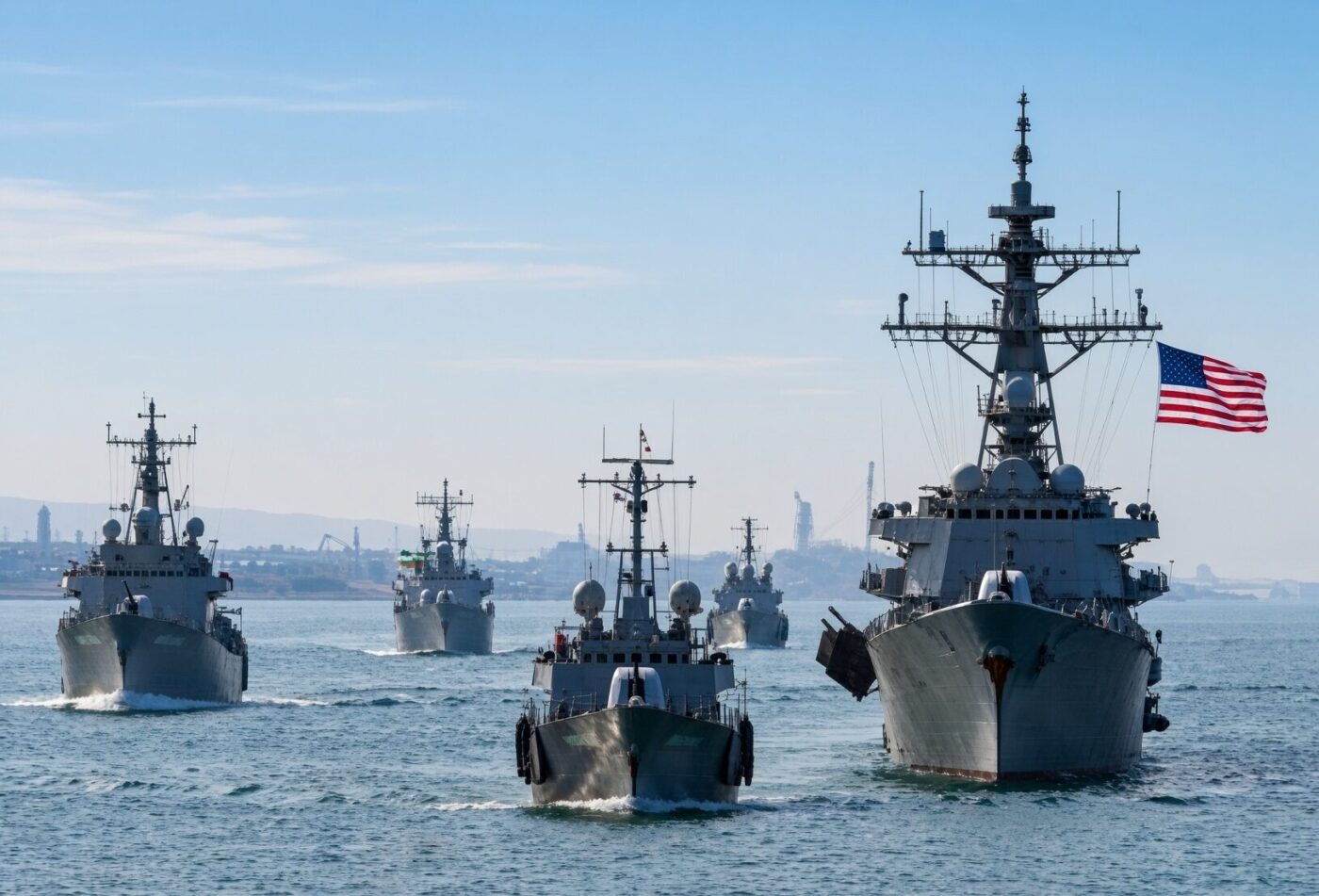
For the first time, the US Navy has deployed an uncrewed surface vessel (USV), or a sea drone, alongside a carrier strike group (CSG), accelerating the integration of cost-effective autonomous systems into high-end naval operations.

Speaking at an Army conference in Washington, DC, on October 14, 2026, the Acting US Navy Secretary Hung Cao announced that the Navy has deployed a Leidos USV with the USS Theodore Roosevelt Carrier Strike Group (CSG) headed to the Middle East.

“Right now, the Roosevelt carrier strike group just deployed on Oct. 8 with a medium-sized unmanned surface vessel,” Cao noted.

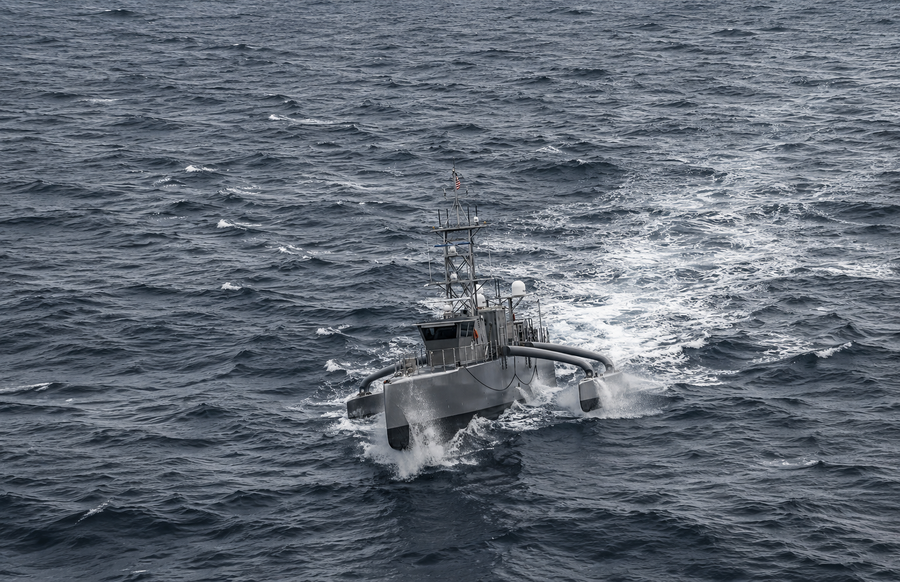
“This is the first carrier strike group to ever deploy with a large-sized unmanned surface vessel, and this is a force multiplier. Imagine having more guns out there,” he added. Notably, Cao did not name the sea drone, but media reports citing informed officials identified it as the Leidos Seahawk, a 145-ton, 42-meter-long medium USV reportedly built to sail long distances uninterrupted for months

Leidos describes the Seahawk as a medium-displacement unmanned surface vessel (MD-USV) with a composite trimaran hull. It is roughly 135–137 feet long, with a full-load displacement of about 145 tons, and a fuel capacity of around 14,000 gallons.

It is designed for extended autonomous operations with limited human intervention and uses Leidos’ Autonomous Vessel Architecture (LAVA) for navigation, perception, collision avoidance (COLREGs-compliant), and other functions.

“Seahawk is substantially larger than other US Navy USVs and has significantly increased capabilities compared to smaller USVs in terms of range, seakeeping, and payload capacity. Seahawk is designed to operate with minimal human involvement, providing a forward-deployed, rapid-response asset in the global maritime surveillance network,” Leidos stated.

The company reportedly delivered the Seahawk USV to the United States Navy in 2021.

The Seahawk will likely conduct electronic warfare missions and information, surveillance, and reconnaissance (ISR) operations rather than serve as an armed combatant. Notably, the carrier’s deployment to the Middle East comes as US President Donald Trump weighs fresh strikes on Iran.

Israel Reverses U.S. Apache Drawdown in Post-October 7 Policy Shift, Signs Deal For 12 AH-64E Helos

Earlier this month, he told Time magazine that the US military could ramp up bombing of Iran after the November 3 midterm elections.

The autonomous vessel Seahawk is pictured underway in the ocean.
The autonomous vessel Seahawk is pictured underway in the ocean (Photo Courtesy: Leidos)

The arrival of the USS Roosevelt would bring the number of American aircraft carriers available in the region to three by late October, joining the USS George H.W. Bush, USS George Washington, and the USS Boxer Amphibious Ready Group.

As for the Leidos USV, the Navy had already practiced at-sea refueling with the Seahawk vessel and integrated it during this year’s Rim of the Pacific exercise. However, moving this unmanned system from trials into real-world operations could mark a crucial step in shaping the US Navy’s future strategy.

Integrating USVs Into Combat 

The presence of the large autonomous vessel in a carrier strike group marks an important step in the US Navy’s future operations. Interestingly, it comes amid a growing presence of uncrewed systems in the ongoing Middle East conflict.

In June 2026, for instance, a Saronic Corsair drone boat operated by the US Navy’s Task Force 59 was used to locate and rescue two crew members after an AH-64E helicopter went down near the Strait of Hormuz.

Iran Hit Amazon. Russia Struck Kyiv’s Data Centers. Ukraine Struck Yandex. Can Such Attacks Trigger Article 51?

This first-of-its-kind rescue mission involving sea drones took about two hours, as the EurAsian Times reported at the time.

Separately, the US Navy used one-way attack sea drones in combat for the first time in July 2026 to strike coastal Iranian military targets.

The US Navy has admitted that unmanned vessels have been extensively deployed in the clearance of mines from the Strait of Hormuz, which has remained under a de facto closure imposed by Iran for over seven months.

These incidents signal a broader appetite within the US Navy to delegate crucial combat tasks to unmanned vessels.

For example, although CSGs are the centerpiece of American naval power projection, adversaries also view them as high-value targets. Therefore, introducing a USV could let the Navy deploy a medium-sized autonomous vessel closer to threats at sea, keeping sailors out of the danger zone.

Moreover, adding a USV to the carrier strike group would enhance the US Navy’s sensor coverage and maritime awareness, reducing dependence on crewed vessels.

Image for Representation

How Saab Turned Luxury Business Jet into Cutting-Edge AEW&C Aircraft as Sweden Unveils First GlobalEye

Cao’s remarks about having more firepower likely reflect the US Navy’s broader strategy to integrate uncrewed vessels with heavy ships.

In February this year, the Chief of Naval Operations, Adm. Daryl Caudle, presented his “Fighting Instructions” framework, outlining plans to employ a “hedge force strategy” that aims to leverage unmanned technology and develop a range of tailored options that fall outside the scope of the conventional carrier strike group model. 

Since the specifics of this strategy and its structure are currently still being worked out, the deliberate pairing of medium USVs with carrier strike groups may be an early expression of the approach Caudle underscored. The USV’s performance with the Theodore Roosevelt group could potentially inform how subsequent strike groups are configured, accelerating the path toward more medium USVs in the fleet.

The US Navy’s increasing integration of sea drones into established combat practices may have been influenced by Ukraine’s use of these systems to decimate the Russian Navy.

Ukraine has emerged as a pioneer in sea drone technology, showing how relatively simple, affordable technology can neutralize expensive naval assets. In fact, Iran itself has extensively deployed these vessels to launch frequent operations against the US as well as the tankers trying to transit the Hormuz Strait in violation of the Iranian blockade.

The US, for its part, wants to leverage the asymmetric advantage of autonomous systems in combat when facing adversaries that can threaten its state-of-the-art warships.

If the Seahawk demonstrates reliable integration, endurance, and utility, it may accelerate the Navy’s ability to field hybrid strike groups that combine the decisive power of a carrier air wing with the distributed, lower-risk presence of autonomous vessels.

Europe Is Rearming — and U.S. Wall Street is Writing the Checks, Including GE’s Nearly $12 Billion Deal

This assessment may, in turn, inform strategies for combat in other, more contested theatres, such as the Indo-Pacific, where the US faces a Chinese threat.

With a smaller but more advanced fleet, the US can use large numbers of attritable unmanned platforms for sustained surveillance, chokepoint control, and harassment without tying down manned ships.

Against that backdrop, lessons from this first operational pairing may shape concepts of operations (CONOPS), help tailor force packages, and inform the broader shift toward distributed maritime operations, all of which are meant to complicate targeting in a contested environment by near-peer adversaries.


The post First Time — A U.S. Carrier Strike Group Sails with a Medium USV as USS Roosevelt Leads the Way appeared first on EURASIAN TIMES.

  •  

How Saab Turned Luxury Business Jet into Cutting-Edge AEW&C Aircraft as Sweden Unveils First GlobalEye

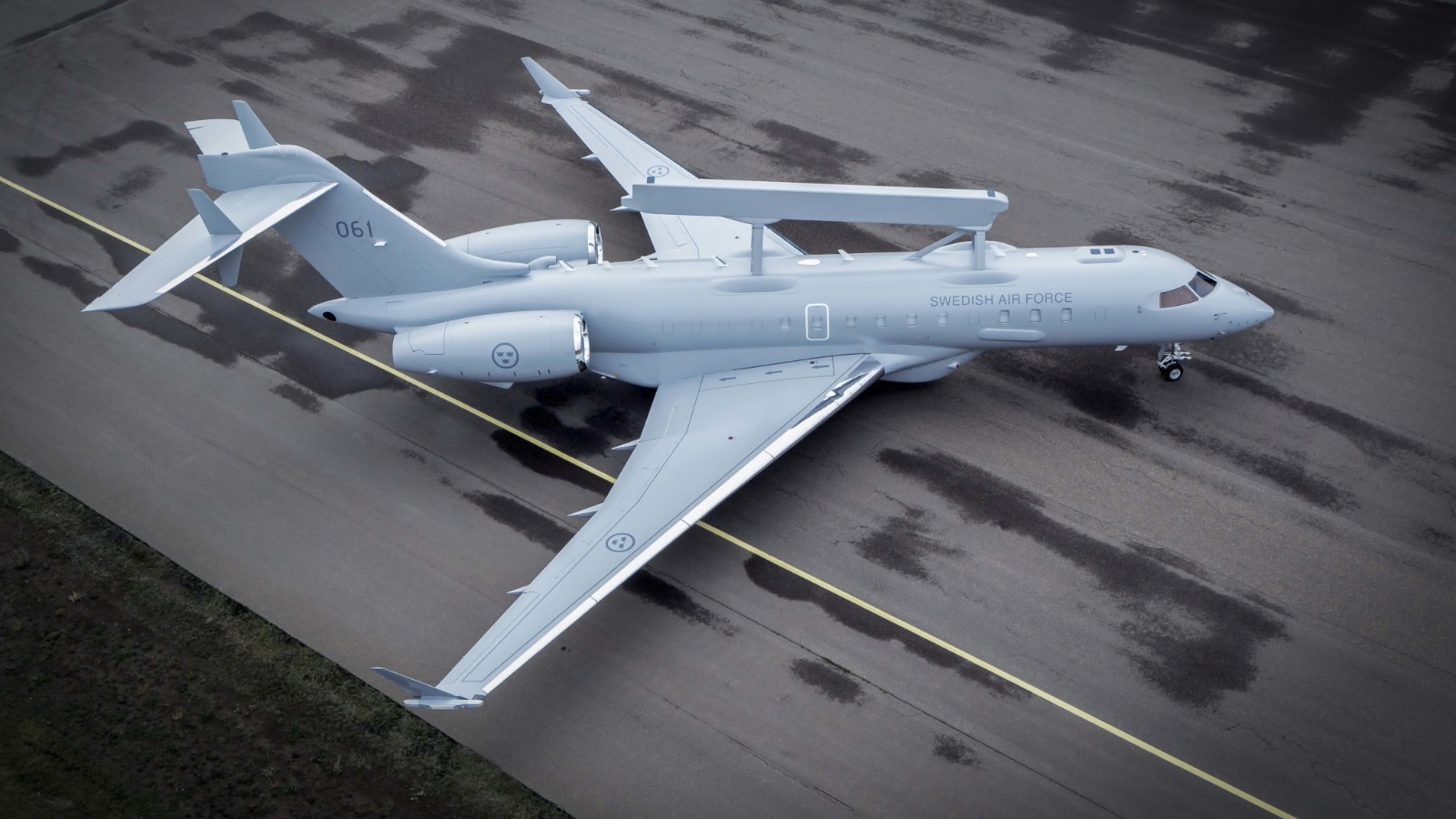
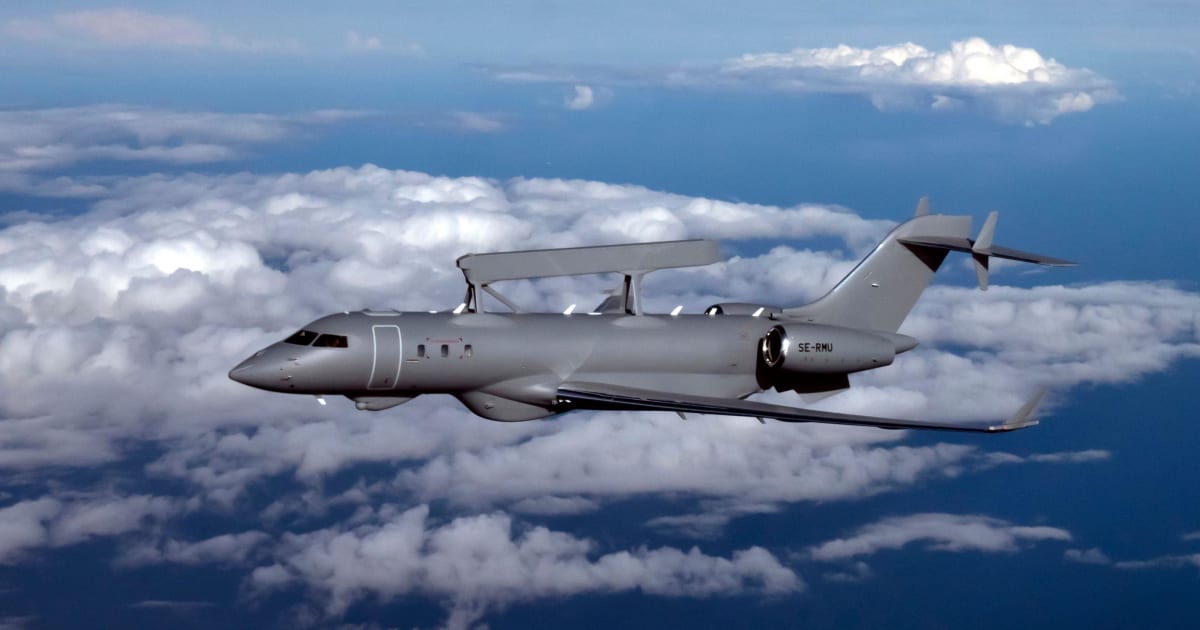
With the GlobalEye, Swedish defense manufacturer Saab has transformed the sleek, long-range luxury business jet into a cutting-edge airborne early warning and control (AEW&C) platform, creating one of the most remarkable transformations in military aviation.

Amid the global surge in GlobalEye’s popularity, Saab unveiled the first AEW&C aircraft for the Swedish Air Force (SwAF) on October 15.

The AEW&C aircraft will give the Air Force long-range surveillance capability, strengthen its operational picture across the air, land, and maritime domains, and bolster its overall combat capability.

“The presentation of Sweden’s first GlobalEye marks an important milestone for both Saab and the Swedish Armed Forces. As the program progresses towards delivery, GlobalEye will provide Sweden with a powerful capability for airborne surveillance and situational awareness,” Micael Johansson, President and CEO of Saab, said in the official statement.

The Swedish Defense Materiel Administration (FMV) ordered two GlobalEye AEW&C aircraft for about SEK 7.3 billion ($738.2M) in June 2022, making it the second customer after the UAE. Later, in 2024, it exercised an option for a third aircraft after it donated its older Saab 340-based ASC 890 aircraft to Ukraine. 

The manufacturer says the newly unveiled aircraft will now enter testing and verification before its first flight and delivery to the customer. Deliveries of these jets are expected to begin in 2027 and could conclude by or before 2029.

To speed the aircraft’s introduction into the Swedish Air Force, Saab is expected to deliver the first two GlobalEyes in an interim configuration and later upgrade them to full capability, while the third will arrive in the final configuration. However, neither Saab nor the Swedish Air Force has yet publicly detailed the differences between the two standards.

Notably, the unveiling of GlobalEye comes amid a rapid surge in orders.

For example, 11 NATO states announced in July 2026 that they would jointly procure Saab GlobalEye aircraft as NATO’s new Airborne Warning and Control System (AWACS). Meanwhile, France ordered the aircraft in December 2025, and Canada and the Netherlands are also moving quickly toward a purchase.

Saab also announced in late July 2026 that an undisclosed Middle Eastern state had ordered the GlobalEye, as the EurAsian Times reported. Although Saab has not officially disclosed the latest customer, it offered the aircraft to Saudi Arabia and Qatar last year.

GlobalEye’s success is striking: it is one of modern military aviation’s most ambitious conversion projects, transforming Bombardier’s ultra-long-range Global business jets into a multi-domain surveillance aircraft.

File: Saab unveiled GlobalEye for Sweden Air Force

The Enviable Transformation

By the mid-2010s, Saab had decades of experience with its Erieye radar family, which had flown successfully on platforms such as the Saab 340 and Embraer R-99. 

However, there was a catch: typically, these traditional AEW&C aircraft were large platforms with rotating rotodomes. This meant that although they were powerful, they were also expensive to operate. Furthermore, they required long runways and were becoming increasingly vulnerable in modern threat environments.

After 0-for-8 Tailhook Failures, F-35C Completes Landmark Arrested Landing Aboard USS John F. Kennedy

To simplify things, Saab scrambled to find a platform that offered superior capability at a lower cost. In the process, it concluded that a “high-performance business jet” offered higher altitude, endurance, and speed; lower operating costs; and the ability to operate from shorter runways. The company needed a platform that could carry a large, advanced radar while providing excellent crew conditions for long missions.

Interestingly, Saab’s previous surveillance platforms, such as the Saab 340, Saab 2000, and the  Embraer R-99, had one thing in common: they were regional commercial or military-derived airframes, not high-end luxury business jets. However, with the GlobalEye contours now planned, Saab turned to the Global 6000 family of luxury business jets.

“Saab’s engineers and technical experts searched comprehensively for the best platform on which to build GlobalEye. Saab’s decades of engineering know-how led them to the Bombardier Global 6000 and 6500 business jet aircraft platforms. These jets are optimally sized with class-leading flight range and endurance,” the manufacturer says on its website.

At the Dubai Air Show in November 2015,  the UAE announced a $1.27 billion contract with Saab for two aircraft under what was then called the Swing Role Surveillance System (SRSS), the program that became GlobalEye.

With this, the UAE became the launch customer for this now-coveted surveillance jet, and Saab officially launched the GlobalEye program in February 2016. The deal with the UAE reportedly covered two Bombardier Global 6000 business jets, which Saab would extensively modify with the new Erieye ER radar and other sensors. At the time, Emirati officials noted that they chose the Global 6000 after “a huge evaluation of different platforms.” The platform decision was part of the contract announcement itself.

The Global 6000 and Global 6500 were already ultra-long-range, twin-engine business jets designed for intercontinental VIP travel. These aircraft offered about 6,000 to 6,600 nautical miles of range, high cruise altitudes, and modern avionics.

Saab recognized that, with the right modifications, they could become ideal special-mission platforms.

Bombardier, a Canadian business jet manufacturer, delivered the Global 6000 or 6500 airframes to Saab in Linköping, Sweden, where they were transformed into one of the world’s most advanced surveillance aircraft.

GlobalEye AEW&C | Saab
Saab GlobalEye

Saab now describes the GlobalEye as a sophisticated, multi-domain AEW&C system that uses a variety of active and passive sensors to detect and identify objects long-range on land, at sea, and in the air.

Israel Reverses U.S. Apache Drawdown in Post-October 7 Policy Shift, Signs Deal For 12 AH-64E Helos

It improves situational awareness and enables early threat detection by providing Air Force, Army, and Navy units with access to real-time information. According to Saab, the GlobalEye “combines excellent flight performance with low maintenance costs” and can remain airborne for over 11 hours.

Saab’s Erieye ER radar, which delivers a significant performance leap over earlier Erieye versions using gallium nitride, is at the heart of this early warning aircraft. It reportedly increases the detection range by 70% against challenging targets.

Furthermore, even though Saab classifies this aircraft as an AEW&C, the Leonardo Seaspray 7500E radar and the FLIR (Forward Looking Infrared) Systems Safire electro-optical system, installed in pods beneath the fuselage, enable it to conduct both land and sea surveillance.

The system can identify small targets, like drones, and offer ground-moving target indication (GMTI), which is essential in contemporary warfare, particularly in the Middle East, where the usage of inexpensive, one-way attack drones has been observed to increase exponentially.

Moreover, GlobalEye excels at identifying low-observable, stealthy threats such as drones and ballistic and hypersonic missiles, even in contested environments with heavy electronic jamming.

GlobalEye can collect, analyze, and distribute data to all authorities and resources, including airborne forces. It also facilitates efficient information exchange between platforms. It can also manage and guide other assets, such as fighters, and direct them on when and where to act—a critical requirement in modern, networked combat.

GlobalEye succeeds by combining proven commercial airframe efficiency with Saab’s expertise in radar, systems integration, and multi-domain operations.

Compared with many larger dedicated advanced early warning platforms, it offers lower lifetime costs, greater operational flexibility, and the ability to produce a comprehensive real-time image for national authorities and combined forces, whether in high-intensity war, crisis response, or peacetime monitoring.

Top USAF General Reveals NATO Plan to Fight Russia — But it is Designed for Containment, Not Decisive Defeat

It wouldn’t be an exaggeration to say that developing the GlobalEye has allowed Saab to re-enter the global AEW market, building on the success of its previous early warning aircraft.

More importantly, what began as a luxury business jet for executives has become one of the most capable and sought-after airborne surveillance systems of its generation, thanks to Saab’s vision and engineering.

The post How Saab Turned Luxury Business Jet into Cutting-Edge AEW&C Aircraft as Sweden Unveils First GlobalEye appeared first on EURASIAN TIMES.

  •  

A Bird That Wouldn’t Migrate: How Ornithologist Sofia Rosenfeld Was Sentenced to Three and a Half Years in a Penal Colony for Two Donations

Sofia Rosenfeld has spent her life studying Arctic birds: traveling on expeditions to the Far North, following flocks of geese in a seaplane, and fighting to protect rare species. Now one of Russia’s leading ornithologists, a Doctor of Sciences in Biology, has been sentenced to three and a half years in a penal colony — for two 1,000-ruble donations to the Anti-Corruption Foundation (FBK). Rosenfeld partially admitted guilt: she explained that she had been unable to cancel the recurring payments because she was on an expedition without communications. T-invariant explains why the scientist refused to leave Russia, how the trial unfolded, and what Russian science stands to lose.

The main news about the lives of scholars during the war, videos, and infographics are available on T-invariant’s Telegram channel. Subscribe so you don’t miss anything.

Fifty-year-old Sofia Rosenfeld was taken into custody in the courtroom of Moscow’s Gagarinsky District Court. The scientist was accused of financing an “extremist” organization over two transfers of 1,000 rubles each, sent to the Anti-Corruption Foundation in August and September 2021. The FBK was designated an extremist organization in August 2021, after which donations to the foundation began to be treated as possible financing of extremist activity. The charge carries a range of penalties, from a fine and forced labor to three to eight years in prison.

Prosecutors asked for Rosenfeld to be sentenced to five years in a penal colony. She admitted guilt only in part: “I categorically reject the idea that, first, I share extremist views and, second, that I acted with criminal intent. When I decided to start supporting the FBK, I was motivated solely by the desire to fight corruption. I believe any public support in that struggle is needed. Even in my own work, in scientific research and conservation, I have seen the monstrous forms this evil can take. And it seemed to me that any help in fighting corruption was a good thing.”

Rosenfeld acknowledged that she had signed up for recurring donations to the FBK. When the foundation was designated an extremist organization, she was on a lengthy scientific expedition without communications; as soon as she returned, she canceled the subscription. Her lawyers submitted to the case file a letter in which Rosenfeld asked the foundation to stop the monthly payments. The court was not persuaded.

“They Put On Quite a Show”

Rosenfeld learned that a criminal case had been opened against her on December 5, 2025, shortly after returning from Israel, where she had been visiting her father.

“She was here with me in Israel. Sometime in the twenties of November, she went back to Moscow. Literally the next day, or the day after, they came to search her home and made her sign an undertaking not to leave. They did leave her passports, though — they just made copies,” Sofia’s father, Boris Rosenfeld, tells T-invariant.

During the search, law enforcement officers seized her phone and two laptops. Then came months of waiting. Rosenfeld continued to work and go on expeditions.

“The first hearing was scheduled six months later. But the witness did not show up, so it was postponed. The next one was postponed too. Then they read out the charges. Everything was very pleasant on the surface. Nice young women read the indictment; the wonderful investigator kept calling to ask how things were going, how her health was, what was new. It all seemed more or less decent. Nothing suggested that anything terrible was about to happen. Although I think everything had been decided long before. They put on quite a show,” recalls Sergei (name changed), a friend of Sofia Rosenfeld.

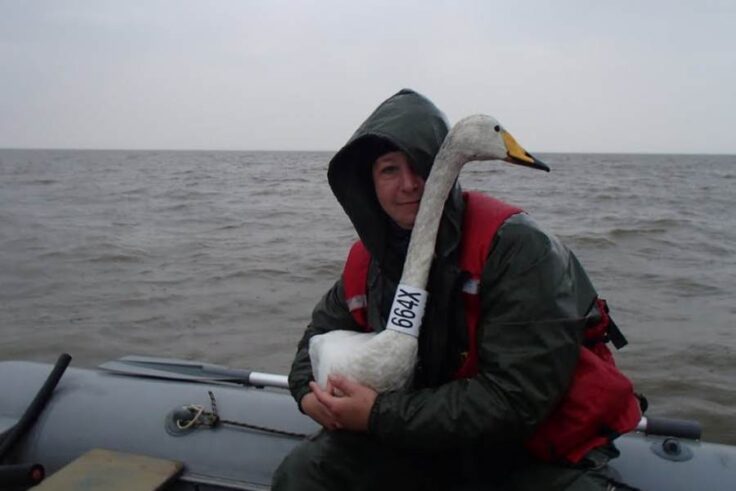
Bolvanskaya Bay, Nenets Autonomous Okrug. Whooper swan, 2017. Photo: Sofia Rosenfeld’s archive

Before every hearing, Rosenfeld packed a bag in case she was taken into custody directly from the courtroom.

“She knew a real prison term was possible. But she thought a fine or forced labor was much more likely. Her lawyers thought so too. That was their mistake. I assume there are general instructions for cases like these. Recently, this has already been the third case in which women were given actual prison terms,” Boris Rosenfeld says.

“Of course there was stress. But for some reason we went into the final hearing feeling fairly relaxed. Just before that, they had even allowed her to go on an expedition beyond the Arctic Circle, to the Polar Urals, to tag musk oxen. Television did a report about her. She only got back on October 2,” Sergei says.

“The last time we spoke was a few weeks ago. She wasn’t making any plans; she was simply waiting to see what would happen next. The hearings came one after another, and she arrived at each one with her bag packed. But they kept being postponed. The last one ended with her being put in handcuffs,” Rosenfeld’s friend and former university classmate, science journalist Ilya Kolmanovsky, tells T-invariant.

According to Rosenfeld’s friends, the court was unhappy that she had admitted guilt only in part.

“The judge and the prosecutor were extremely unhappy that Sonya had only partially admitted guilt. Her situation was this: she is a field biologist and spends six months or more at a time on expeditions. Most of them are in the Far North, under field conditions, with only satellite communications. She had all the evidence showing that when the FBK was designated an extremist organization, she was away on an official expedition — the institute had confirmed it. But none of that mattered to the court. Her lawyer even asked: why is she the one being blamed? The banks processed the transfers while knowing that these payments had been deemed criminal, even though they are perfectly capable of blocking unwanted or suspicious transactions and routinely do so in other cases. Why are there no questions for the bank? The judge simply let that pass. You could see that long statements irritated him. It looked as though none of the defense arguments had any bearing on his decision: the instruction had already been given, and the circumstances of the case did not interest him,” says Anna (name changed), a friend of Sofia Rosenfeld.

“If she had admitted guilt in full, they might have knocked a couple of months off. There were three sentences like that this week. Before this, they had left women alone. I think now everyone is trying to prove their loyalty. I can see no other reason for such terrifying sentences, literally over ‘three ears of grain,’” Sergei says.

Rosenfeld is currently being held at Moscow’s Pechatniki pretrial detention center. She was not allowed to take her packed bag from the courthouse, so at first she was left without her personal belongings.

“Geese Are My Thing”

Sofia Rosenfeld is a Doctor of Sciences in Biology and a senior research fellow at the Russian Bird Ringing Centre of the Severtsov Institute of Ecology and Evolution of the Russian Academy of Sciences. She is one of the best-known specialists in Arctic waterfowl.

Rosenfeld has said that she knew she would become a biologist when she was five. She grew up in Moscow: her father, Boris Rosenfeld, is a mathematician; her mother was an engineer; and her grandfather, Iosif Rosenfeld, was an academician and a Doctor of Sciences in Chemistry. Sonya attended a French-language specialist school. In the late 1980s, the family moved to Israel, but a year and a half later, 15-year-old Sofia returned to Moscow.

“I did not think I had the right to keep a 15-year-old person somewhere by force. When we were leaving, she said she did not want to go. And really, why should she leave? Everything was fine: she had friends at school, and it was a good French school. Why the hell are you going anywhere at all? You have everything: an apartment, a car, jobs. I worked at the Academy of Sciences. And I told her: ‘Listen, we can’t leave you here alone. But if you want to come back, I won’t stand in your way.’ I promised her that. And a year and a half later she really did return. Of course we were worried, especially during the coup attempt. It was 1991. Yes, those were lively times. But afterward everything was fine,” Boris Rosenfeld recalls.

Current videos about science during the war, interviews, podcasts, and streams with prominent scholars are available on T-invariant’s YouTube channel. Become our subscriber!

“Her parents persuaded her to go for at least a year, just to see what life there was like. She went. And a year later she packed a suitcase and said, ‘I’m leaving. I don’t want to abandon my country at a difficult time.’ She came back, finished school, and entered the biology department. She is an extraordinarily determined person,” Anna says.

In Moscow, Sofia lived with her grandmother and aunt and, by her own account, was constantly bringing animals home. In addition to a dog, the apartment housed snakes, frogs, fish, and birds. In 1993, Rosenfeld enrolled in the biology faculty at Moscow State University, specializing in zoology.

“We met in our first year. I heard about her before I saw her: people in our cohort said there was an unusually remarkable person studying with us. It was obvious that there were students, and then there was someone you could already tell was a scientist. For her, science was a deep practice, a form of service,” Ilya Kolmanovsky recalls.

At university, Rosenfeld became interested in photography: she wanted to photograph birds in the Arctic. She also played guitar, studied languages, and competed professionally in show jumping. But Arctic birds had been her main passion since her student years.

“Geese are my thing. These birds amazed me because their social behavior is unique. Geese are like people. All geese, brants, and swans are monogamous; their pairs remain together for many years, sometimes for life. Young birds always make their first migration with their parents, who show them where to fly. Those family ties can also last for years,” she once explained.

Rosenfeld began going on field placements in the Arctic while she was still a student.

“She was the master of those immense open spaces, where there is not a single person for thousands of kilometers. She could go somewhere in Kazakhstan and sleep in a tent when it was minus 16 at night in spring. And then see 15,000 geese through binoculars that no one before her had seen. Make a discovery — find out that a huge population stops there during migration. She is a figure of enormous stature. From the first day, it was clear that she was dealing with something extraordinarily significant. And that is what inspires such deep respect in anyone who comes into contact with her,” Kolmanovsky says.

In 1998, Rosenfeld began postgraduate study at the Severtsov Institute of Ecology and Evolution of the Russian Academy of Sciences, where she has worked ever since. Her main research areas are the ecology and migration of waterfowl, as well as the conservation of migratory birds. During migration, birds travel tens of thousands of kilometers and cross the borders of countries with different conservation laws.

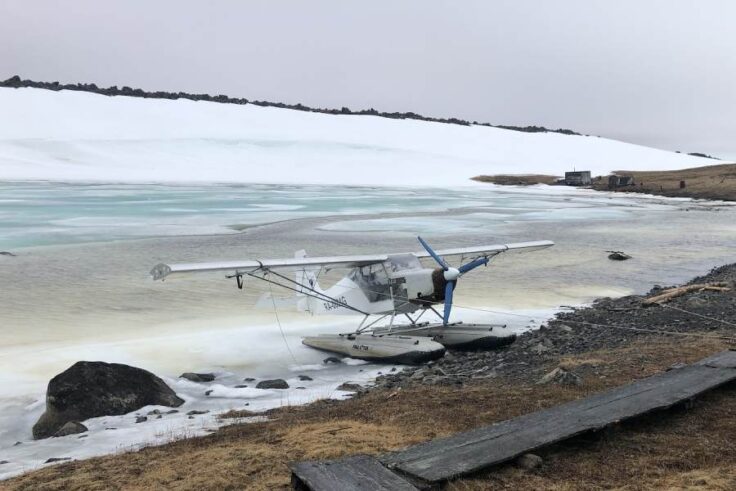
Since 2016, Rosenfeld and her colleagues have literally followed bird flocks in a homemade seaplane, photographing and counting them. The light aircraft can fly at roughly the same speed as the birds and can take off from and land on water, ice, and small clearings. The resulting data allow scientists to estimate population sizes, identify threats to their survival, and develop recommendations for the protection of migratory species.

Homemade Sterkh-S1 seaplane in Meduza Bay on the Taymyr Peninsula. Photo: Sofia Rosenfeld’s archive

“Sonya devoted her whole life to migratory birds. She literally flew after them in an airplane. She is an enormous expert in this field. That is the kind of person she is. There was no point talking politics with her. Of course she understood everything — all the terrible injustice around her. But her priority was migratory birds. That is what she lives for, and she can talk about nature for hours,” Andrei Rostovtsev, a friend of Sofia Rosenfeld’s father and co-founder of the independent online community Dissernet, tells T-invariant.

“She is a very well-known biologist. She worked on joint projects in the United States and Canada, and French researchers took part in her expeditions. She gave talks at all the most important conferences in her field. Sonya is devoted to wildlife conservation; she is a real patriot, not a fake one. She fought to keep every rare animal species in the Red Data Book and to remove exemptions from hunting laws. In the end, she managed to convince the State Duma that she was right. She is an extraordinary fighter,” Anna says.

Rosenfeld was the first to introduce systematic monitoring of migratory birds. Previously, their numbers had been estimated approximately: researchers counted individuals in a particular area and then extrapolated the figure to the whole territory. Accurate counts, however, are essential both for studying the spatial ecology of species and for preserving their populations, explains Alexandra Panyutina, a research fellow at Tel Aviv University’s School of Zoology: “Suppose you have a major gathering site for migratory birds on an ocean coast, and it is a key site. If something is disrupted there, it will affect bird populations across many countries, over an enormous area. Disrupting migration routes and stopover sites changes the distribution and abundance of a species. That is why research in this field is extremely important.”

Waterfowl are a difficult group to study: they are hunted, which affects population size and reproduction. Many species also live in remote northern regions where fieldwork is difficult.

“There is a strong Russian group working on shorebirds. And there are the people we used to call the ‘goose people.’ That’s it. Sonya is the intellectual architect of all this work on waterfowl. A person at her level cannot be replaced. She is the one who designs the research; the concept of the entire project exists in her head. You cannot replace her with a robot. Scientific niches do not automatically fill themselves when someone drops out. And an education alone is not enough — you have to understand the current realities of a specific problem and know who is doing what around you. And of course, in three and a half years no one will fill that niche,” Panyutina says.

[[socialnetworks]]

Sofia Rosenfeld had major plans for the coming months: filming a documentary titled Geese of Russia and working on an atlas of geese.

“It is a complete atlas, with descriptions, illustrations, and maps. Every species of goose found in Russia is supposed to be included. She left us all her contacts. We have to finish this work without her,” Sergei explains.

“You Can’t Study Geese from Prison”

Rosenfeld’s friends and colleagues say she categorically refused to leave Russia.

“There are things on which she is absolutely unbending. Leaving is one of them. For her it was completely non-negotiable. She understood all the risks, but nothing was more frightening than leaving and ending up unable to return to the subject of her research. Her science cannot be done anywhere else, because the species she studies live only in the Russian Arctic,” Kolmanovsky says.

Alexandra Panyutina tried more than once to speak to Rosenfeld about leaving Russia, but Rosenfeld avoided the subject.

“To me, the situation looked completely clear from the start. But throughout all this time I never managed to talk to her about it. She was very afraid of a provocation. Especially because her lawyers were telling her the outlook was optimistic: she was only under a travel restriction, and she was a woman and a Doctor of Sciences,” Panyutina says.

According to Panyutina, serious research on waterfowl migration can now be carried out in Russia and Canada.

“Until fairly recently, you could work freely in Russia. In most other countries, that is not the case. Scientists are hemmed in by restrictions on every side — any work requires an incredible number of permits, licenses, and special funding tied to specific tasks. And moving to another country is almost always a huge step down for a scientist. Here you are a leading specialist; there, broadly speaking, you are nobody. You start out as an assistant in someone else’s lab. No one is going to give you a laboratory from scratch. It is very difficult to earn the chance to conduct your own research. But then again, you can’t exactly study geese from prison either,” Panyutina emphasizes.

The administration of the Severtsov Institute of Ecology and Evolution of the Russian Academy of Sciences has not commented on Sofia Rosenfeld’s sentence.

“They gave her a good character reference in court. But after the sentence they decided that saving their own skin came first. I think, of course, they will fire her. How could they not, if she is not showing up for work? They will. Maybe they will wait for the appeal,” Boris Rosenfeld says.

Alexandra Panyutina does not have high hopes for the appeal. In her view, Rosenfeld’s case is far from the last example of the political persecution of scientists.

“Fortunately, the FSB has not come for biologists yet. In physics, things are already very bad. I do not know a single sane person who would choose to work on hypersonics today. You would have to be suicidal. In Sonya’s case, we cannot speak of her being persecuted as a scientist. We are talking about the persecution of a citizen who cares about the fate of her country. More than that, she became a victim of circumstances in the purest sense. When the FBK was banned, she was on a remote expedition without communications and physically could not only not cancel the donations — she could not even learn that they had been prohibited. As soon as she returned, she canceled all the payments. In other words, she did not violate the law currently in force in the Russian Federation. There is some hope that on appeal the court will take into account the major scientific significance of Sofia’s work and her important role in the Russian Academy of Sciences,” Panyutina says.

“It seems to me that today this state is devouring everything living, inside and out. The regime sees a threat in people who can put two and two together and are fairly uncompromising about it. Scientists have things they value above everything else: science, nature, geese, zoology. Many people can compromise; scientists can be extraordinarily stubborn in that respect. What will happen to Russian science next? I think its future is what the late ayatollah called a ‘jihad of knowledge’ — when every scientist must prove their usefulness to the Islamic Revolution in its struggle against the West. Now every scientist, every field of science, has to prove its usefulness in the war Russia has declared on civilization,” Kolmanovsky says.

According to Haaretz, Israel declined to intervene in Rosenfeld’s case, even though she holds an Israeli passport. After she was charged, she sought assistance from the Israeli Embassy in Moscow, but was told that the Israeli authorities could not intervene in decisions by Russian law enforcement because she also holds Russian citizenship.

The post A Bird That Wouldn’t Migrate: How Ornithologist Sofia Rosenfeld Was Sentenced to Three and a Half Years in a Penal Colony for Two Donations appeared first on Т-инвариант / T-invariant.

  •  

What the Falling Leaves Taught Thoreau

This is an edition of Time-Travel Thursdays, a journey through The Atlantic’s archives to contextualize the present. Sign up here.

Published in the October 1862 issue of The Atlantic, Henry David Thoreau’s essay “Autumnal Tints” arrived in a season of death. The Civil War was well into its second year, and copies of the magazine began reaching readers shortly after the Battle of Antietam, on September 17, a day with the grim distinction of being the single bloodiest of the conflict. Thoreau himself was already gone, having died four months earlier, a casualty not of war but of tuberculosis.

Thoreau’s essay makes no connection between the fall and the conditions of fighting, as the poet John Greenleaf Whittier did in “The Battle Autumn of 1862,” in the same issue. Instead, Thoreau’s work is a written version of what he’d initially imagined as a visual book—one in which he would compile the leaves of all the trees around him and follow their progression through the colors, from green to brown. (The magazine included a simple engraving of a  scarlet-oak leaf that he had rendered.) He had first drafted “Autumnal Tints” as a lecture in the 1850s, before the war’s start, and delivered a version of it in what would be the final public talk of his life. The event was far from a resounding success—a local newspaper deemed it “dull, commonplace and unsatisfactory”—and making the trip to Waterbury, Connecticut, in the bitter cold of December 1860 had worsened an illness from which Thoreau would never recover. The revised copy that appeared in The Atlantic gave the story new and enduring life.

“If I were to live, I should have much to report on Natural History generally,” Thoreau wrote in a March 1862 letter, a few months before his death. As it was, weak and barely able to breathe, he could do little more than adapt some of his lectures into essays for The Atlantic with the help of his sister Sophia. The enterprise marked a reconciliation with the magazine. In 1858, the first installment of his “Chesuncook” essay had appeared in the June issue, minus one beloved sentence about a fallen pine tree: “It is as immortal as I am, and perchance will go to as high a heaven, there to tower above me still.” He was incensed when he found the line unceremoniously axed from the printed copy. “Is this the avowed character of the Atlantic Monthly?” he demanded in a letter to the editor, James Russell Lowell. “I should like an early reply.” No reply, early or late, was forthcoming. Making matters worse, neither was Thoreau’s payment, which he’d already deemed lower than what he deserved. It took two additional letters to secure the $198 he was due.

The arrival of James T. Fields as The Atlantic’s editor in 1861 cleared the way for new contributions from Thoreau. Fields had first printed Walden seven years earlier at his publishing house, and he suggested another collaboration. Thoreau agreed, on much more favorable financial terms than most of the magazine’s other contributors, and on the condition that “no sentiment or sentence be altered or omitted without my consent.”

As Thoreau prepared the manuscripts for Fields, he confessed to a friend an inclination to expunge some of the humor from his writing, noting that “I cannot bear the levity I find.” But much levity does remain in “Autumnal Tints.” It is, on the whole, a joyous celebration of the season, and an invitation to “wild delight.” Through his observations, he divined that “man’s spirits should rise as high as Nature’s,—should hang out their flag, and the routine of his life be interrupted by an analogous expression of joy and hilarity.” As he worked through a catalog of trees and plants, he contrasted his own careful appreciation of the natural world around him (“The expression of this grass haunted me for a week”) with the bustle of his neighbors amid the busy occupations of the harvest. Stopping to take in the brilliant hues of the elms lining the Concord Common, he wondered “if there is any answering ripeness in the lives of the men who live beneath them.”

Death, however, is never far from “Autumnal Tints.” Keenly aware of his own imminent demise as he revised this manuscript for publication, Thoreau saw his mortality everywhere in the season. Walking on dead leaves in the forest, he imagined the setting as a grand and consecrated cemetery. “They that soared so loftily,” Thoreau wrote of the leaves, “how contentedly they return to dust again, and are laid low, resigned to lie and decay at the foot of the tree, and afford nourishment to new generations of their kind, as well as to flutter on high! They teach us how to die.” Thoreau, still seeking joy on the verge of his own death, had learned the lesson well.

© Illustration by The Atlantic. Source: Ernst Haas / Getty.

  •  

After 0-for-8 Tailhook Failures, F-35C Completes Landmark Arrested Landing Aboard USS John F. Kennedy

The US Navy F-35C Lightning II aircraft made its first-ever arrested landing and takeoff aboard its newest Ford-class aircraft carrier. This milestone marks a major step for the US jet that initially struggled with hook-related flaws that complicated landings during ground tests.

On 13 October, an F-35C from Air Test and Evaluation Squadron (VX) 23 (“Salty Dogs,” NAS Patuxent River) made the first arrested landing aboard the Pre-Commissioning Unit (PCU) John F. Kennedy (CVN-79).

The aircraft reportedly used the unique EMALS and AAG electromagnetic launch-and-recovery systems to perform arrested launches and recoveries from CVN-79 as part of Aircraft Compatibility Testing (ACT).

ACT lets engineers examine how the ship’s equipment interacts with specific aircraft types while gathering data to confirm those systems function as intended.

The US Navy released photos of the event showing two F-35C aircraft with tail numbers 401 and 403—one landing on the carrier deck, and the other flying with an inert Joint Direct Attack Munition (JDAM) bomb carried externally. Later, another set of images and a video were posted on social media, showing the F-35C launching from the deck of the John F. Kennedy on the second day of ACT.

The US Navy took the preliminary acceptance of the carrier on 29 September 2026, after sea trials the previous month. Preliminary acceptance allows at-sea testing, training, and proficiency building before the carrier is commissioned and put into service.

This arrested landing and subsequent catapult launch marked the first time any F-35C had operated from a Ford-class ship, the largest and most advanced fleet of aircraft carriers in the American armory.

The lead ship, USS Gerald R. Ford (CVN-78), has never embarked the F-35C for sustained operations because the carrier was reportedly delivered without the full set of modifications needed to sustain stealth-fighter operations due to cost-saving measures.

Earlier in June 2019, former Navy spokesman Capt. Daniel Hernandez said that although Ford-class carriers were built to launch and recover the F-35C fighter jet, they still needed upgrades such as stronger jet blast deflectors to protect the deck from hot exhaust during launches, as well as designated areas for aircraft operations.

Instead of the F-35C, the USS Gerald R. Ford hosts air wings mainly equipped with F/A-18E/F and Growler variants for its current combat posture.

The US Navy has flown the F-35C only from its Nimitz-class carriers so far. The aircraft completed its initial at-sea testing aboard the USS Nimitz in November 2014. USS Carl Vinson was the first to deploy the jet operationally, and USS Abraham Lincoln was the first to use it in combat.

However, the House Armed Services Committee’s Seapower and Projection Forces Subcommittee later ordered in FY2020 that the Navy must not accept the CVN-79 USS John F. Kennedy aircraft carrier until it can embark the F-35C. This makes the latest arrested landing and takeoff special.

Image
File: A US Navy F-35C makes an arrested landing on the deck aboard John F. Kennedy

This test is a key step in validating F-35C integration with the Ford class, especially because these carriers use electromagnetic catapults and advanced arresting equipment, replacing the Nimitz class’s steam-powered launch and conventional arresting systems.

Interestingly, however, this key milestone comes as US President Donald Trump has ordered the Pentagon to redesign a new aircraft carrier to replace electromagnetic catapults—designed for finer control, reduced airframe stress, higher sortie rates, and better support for a wider range of aircraft—with steam catapults.

In fact, the President signed a national security memorandum in August, giving the Pentagon leaders two months to come up with “a plan on the required measures to replace the Electromagnetic Aircraft Launch System and Advanced Weapons Elevators with steam and hydraulic systems for the construction of” the USS Doris Miller, also a Ford-class aircraft carrier.

Nonetheless, putting F-35C jets on USS John F. Kennedy is a major breakthrough for the US Navy’s upcoming combat posture as regional security threats multiply across theatres. The F-35C Lightning II brings stealth, advanced sensors, sensor fusion, and long-range strike capability that older fighters, such as the Super Hornet, lack.

File: F-35C aboard John F. Kennedy carrier

The F-35C’s Leap is Admirable

More than a decade ago, the F-35C struggled with its arresting hook system (AHS), which had a well-documented design issue, as reports in 2012 noted, citing a leaked JSF Concurrency Quick Look Review dated 29 November, 2011.

The report noted that the stealth fighter couldn’t board a carrier because of these tailhook design issues.

It stated that the F-35C failed to engage the MK-7 arresting gear during particular tests at NAWC-AD (Naval Air Warfare Center – Aircraft Division) Lakehurst, with a poor score of 0 successes in 8 attempts.

This was despite testing at a regular airport, not a real carrier, where an aircraft may face inclement weather, a pitching deck, adjacent obstructions, low fuel, and no alternate airfields, among other challenges.

At the time, reports noted that the core issue was the short longitudinal distance—about 7 feet—between the main landing gear tires and the lowered tailhook point. Low-observability, or stealth, requirements drove this geometry, forcing the Arresting Hook System into a recessed bay with doors to preserve the aircraft’s outer mold line and minimize radar cross-section, according to the reports.

For comparison, the F/A-18 placed the main landing gear-to-tailhook distance at about 18.2 feet. Additionally, the tailhook point design had limited ability to scoop low-positioned cables.

A Lockheed Martin official later said the company traced the F-35C’s trouble catching a carrier’s arresting gear wires to the tailhook design. “The good news is that it’s fairly straightforward and isolated to the hook itself,” said Tom Burbage, the F-35 program manager at the time. “It doesn’t have secondary effects going into the rest of the airplane.”

Burbage said that the rest of the tailhook system design, including the bay and doors that hide the device and other auxiliary hardware, was sound. “What we are trying to do is make sure that we got the actual design of the hook is optimized so that it in fact repeatedly picks up the wire as long as the airplane puts itself in position to do that.”

He explained that the fundamental limitations of creating a stealth fighter also caused the hook issue, adding that the company faced the rare challenge of designing the first-ever naval stealth fighter jet with a tail-hook that had to be concealed when not in use.

He also noted that the tail hook had to be installed farther forward on the jet’s ventral surface than on other naval aircraft because it had to fit within the F-35’s outer mold line. As a result, the hook behaved differently than it did on previous fighters like the F/A-18.

The way the wires react as the jet passes over them is a dynamic factor in the F-35, and the wire responded in a sine wave pattern.

“The time differential between when the main gear rolls over the cable and the time the hook picks up the cable on a more conventional airplane is more time for that wave to damp out,” the spokesperson was quoted as saying. “In the case of the F-35, one of our design constraints is that the hook just has to be closer to the main landing gear than on a conventional aircraft because of the requirement to hide it inside the airplane,” he added at the time.

Later, engineering investigations identified three primary factors: the aircraft’s constrained geometry, a suboptimal hook-point shape, and inadequate hold-down performance. Additionally, it found that a faulty or inadequately validated wire-dynamics simulation model contributed to the original design assumptions.

The Joint Strike Fighter program addressed the issue by redesigning the hook point and improving the hold-down damper, along with other refinements such as improved upstroke damping and strength. The revised system underwent successful shore-based testing, including dozens of roll-in arrestments, enabling the first at-sea arrested landings on USS Nimitz in late 2014, followed by a rigorous testing regime.

Notably, Ford-class ships use the newer Advanced Arresting Gear (AAG) rather than the legacy MK-7 hydraulic system. However, the successful trap and launch close the loop on more than a decade of work that began with the original hook’s total failure.

As the EurAsian Times previously explained, the F-35C offers significantly greater range over other F-35 variants, larger internal weapons bays, and superior endurance, making it ideal for long-range operations from the vast ocean.

These stealthy warplanes are nearly invisible to enemy radars and can penetrate even the most advanced air-defense systems. They have advanced sensor fusion to create a shared battlespace picture for the entire air wing and can conduct precision strikes or intercept threats, as demonstrated by the Iranian drone shootdown earlier this year.

The F-35C can carry over 5,000 pounds of internal weapons or over 18,000 pounds of combined internal and external weapons. This lets the US Navy use external armaments to increase lethality when needed or operate in stealth when required.

Not just that, the aircraft can also operate as an intelligence, surveillance, and reconnaissance (ISR) asset, sharing information with all networked ground, sea, and air assets in the battlespace

The post After 0-for-8 Tailhook Failures, F-35C Completes Landmark Arrested Landing Aboard USS John F. Kennedy appeared first on EURASIAN TIMES.

  •  

Netanyahu orders investigation and prosecution of Israeli soldiers in NAZA

Israeli directors Yuval Abraham and Rachel Szor pose with the Special Jury Prize Award for Naza at the Winners Photocall at the 83 Venice International Film Festival 2026. Photo by Marilla Sicilia/Archivio Marilla Sicilia/Mondadori Portfolio via Getty Images

This article was originally published by Truthout on Oct. 14, 2026. It is shared here under a  Creative Commons (CC BY-NC-ND 4.0) license.

Israeli Prime Minister Benjamin Netanyahu has ordered Israel’s attorney general and the heads of the Israeli military and Shin Bet security service to investigate the soldiers and officers interviewed anonymously in the documentary film NAZA.

Netanyahu called Sunday for the agencies to identify “all those who are involved or appear in the libel film” and to prosecute them for “serious information security offences, criminal defamation, and harming Israel’s diplomatic and security interests.”

In a letter to IDF Chief of Staff, the head of the Shin Bet, and Israel’s attorney general, Netanyahu decried the film for “present[ing] a false, misleading and biased narrative that defames the State of Israel and the IDF around the world and severely damages Israel’s standing.”

The film NAZA features anonymous interviews with 24 Israeli soldiers and officers involved in remote mass killings of Palestinians in Gaza over the past three years. The soldiers’ faces are obscured and voices are altered for anonymity as they speak with journalist and director Yuval Abraham on rooftops in Tel Aviv.

NAZA reveals how Israel’s AI-based surveillance systems have been used to facilitate and execute remote killings of thousands during Israel’s genocide in Gaza. The film’s title is a Hebrew military acronym for collateral damage – as in, the number of Palestinian civilians deemed acceptable to kill in a bombing with a military target. In one instance, a soldier tells director Yuval Abraham that the military approved the killing of 500 Gazans for one target.

The film and its directors have faced attacks by the Israeli government since its world premiere in September at the Venice Film Festival. Both the Israeli culture minister and Netanyahu have called for revoking the Israeli citizenship of the film’s directors, Yuval Abraham and Rachel Szor, while accusing them of treason and defamation. The IDF chief called the film a “blood libel” and “an attack on the State of Israel.”

Upon the film’s premiere in the U.S. in late September, Netanyahu compared NAZA to “launching dozens of ballistic missiles at Israel.”

Several Israeli civil society organizations, including human rights group B’Tselem, criticized the attacks on the filmmakers, and called for “an end to the wave of incitement and threats of violence against them.”

Abraham and Szor produced No Other Land, the 2024 documentary focused on Israel’s displacement of Palestinian villages in the West Bank, along with Palestinian activist and journalist Basel Adra and Palestinian researcher and photographer Hamdan Ballal. After the film won major international awards, including an Academy Award, members of the film’s Palestinian crew were attacked by both Israeli settlers and soldiers.

Earlier this month, Israel put forward a hastily-produced rival film to counter NAZA; last week, the Israeli government announced that it was awarding the filmmakers “for their contribution to Israeli public diplomacy.”

The Guardian, which produced the film, has pushed back on the Israeli government’s attempts to discredit NAZA. On October 1st, a Guardian spokesperson said that “The process of assessing the credibility of the testimonies was rigorous. It included leaked classified documents, detailed verification of specific strikes and corroboration via a wider pool of confidential journalistic sources who did not appear on camera in the film.”

The Guardian added that the team that produced the film interviewed “more than 100 sources familiar with IDF systems used in the war in Gaza, including senior-ranking commanders directly involved in the authorization of strikes.”

Much of the material in the film had already been published in reports at The Guardian, +972 Magazine, and Israel’s left-wing publication, Local Call.

In a 2024 piece co-published by +972 Magazine and Local Call, Yuval Abraham explained how AI systems like “Lavender” and “Where’s Daddy” identified low-ranking Hamas and Islamic Jihad operatives as military targets. After October 7, 2023, Israel’s military decided that these tens of thousands of people could be bombed inside their homes with their families – even tracking and monitoring their children in order to strike their homes. In NAZA, one soldier spoke about using the gruesomely named “Where’s Daddy” AI system to track a 12-year-old girl before killing her. According to Abraham, the Israeli military was also aware that much of the AI systems’ data was also faulty – some 10-15 percent of the people identified as targets were not militants or operatives whatsoever.

In an interview, Abraham explained that NAZA also reveals the extent of the dehumanization of Palestinians within Israeli society – including among the self-identified Israeli “center-left,” which disproportionately took part in the aerial bombardment campaign on Gaza. The aerial bombardment campaign has constituted “some of the most heinous crimes in Gaza,” Abraham argued, as it led to the killing of thousands of Palestinian toddlers in their homes – and it was led largely by members of the center-left opposition against Netanyahu.

  •  
❌