❌

Reading view

Supreme Court Will Hear Case on "Facially Neutral" Discrimination Against Asian Students in Admissions to Public Magnet Schools

NA

Today, the Supreme Court decided to hear Association for Education Fairness v. Montgomery County Board of Education, a challenge to "facially neutral" discrimination against Asian applicants to selective public magnet schools in Montgomery County, Maryland. The admissions criteria are, on their face, racially neutral. But evidence indicates they were likely adopted for the purpose of reducing the percentage of Asian students in entering classes. More specifically, the case addresses the issue of "[w]hether a plaintiff challenging a facially neutral admissions policy as racially discriminatory must establish that the targeted racial group suffered an aggregate disparate impact relative to its share of the applicant pool." This issue is increasingly important since the Supreme Court banned most explicit racial discrimination in college admissions (and, by extension, school admissions) in SFFA v. Harvard (2023).

The lower court ruled that, even if there is evidence that a facially neutral admissions policy was enacted for the specific purpose of reducing the number of admitted students from a specific racial or ethnic group, it must still be upheld so long as the percentage of admitted students from that group is as high or higher than the percentage of applicants from that group.

The case is similar to (and based on) Fourth Circuit decision in Coalition for TJ v. Fairfax County School Board, which the Supreme Court refused to take in 2024 (though three conservative justices indicated they did want to hear it) [my wife Alison was one of the attorneys representing the plaintiffs in that case]. The present case is also from the Fourth Circuit. In my view (see here and here), the earlier Fourth Circuit decision is badly wrong and would - if the same approach were adopted by the Supreme Court - license all kinds of invidious, unconstitutional discrimination against Asians and other minorities:

Longstanding Supreme Court precedent holds that evidence of unconstitutional motivation for "facially neutral" policies shifts the burden of proof to the government to show that they would have enacted the same policy even in the absence of illicit motives. If they fail to prove that, then the policy must be subjected to strict scrutiny, which it would be unlikely to survive. In the TJ case, the Fourth Circuit majority opinion by Judge Robert Bruce King holds that even the most blatant discriminatory motivations do not trigger strict scrutiny so long as the group being targeted for discrimination by "facially neutral" means  is still represented in proportion to its percentage of the relevant population (or more). Under the new admissions policy, Asians were still 54% of accepted applicants (as compared to 73% under the old one). Since that is still higher than the Asian percentage of the applicant pool, evidence of discriminatory intent becomes irrelevant….

I and others have previously compared today's anti-Asian discrimination in selective educational institutions to discrimination against Jewish applicants in earlier eras.  Under the Fourth Circuit's reasoning, old-time policies using facially neutral means to reduce the percentage of Jewish students at elite universities would be perfectly legal, so long as Jewish applicants were admitted in the same [or higher] percentages as other groups. And that would be true no matter how extensive the evidence that the new policy was motivated by anti-Semitic prejudices, or that Jewish applicants had to have stronger academic records to be admitted than those required of gentiles.

The same point applies to all kinds of discrimination against racial, ethnic, and religious minorities. So long as facially neutral means are used and the overall success rates of different groups are similar, this reasoning would allow even the most blatant discriminatorily motivated policies intended to reduce the participation of some groups for the benefit of others. There are many situations where members of some minority groups are "overrepresented" in educational institutions, government contracting, and elsewhere, relative to their percentage of the applicant pool or of the general population. Jews, Muslims, Asians, atheists, and Mormons are obvious examples of groups that fit that bill in a variety of educational and professional settings.

If a federal or state government adopted a seemingly neutral policy to try to reduce the percentage of blacks among professional football or basketball players, that too would pass muster, so long as the percentage of blacks in the the relevant pro sports leagues remained at least as high as the percentage of blacks among those seeking employment as players…. Progressives and others inclined to support today's decision should consider whether they are really willing to live with these troubling implications.

Since I wrote the above, the ideological valence of anti-Asian discrimination in education has shifted somewhat. For a long time, many left-wingers defended such discrimination (along with discrimination against white applicants) on the grounds that it is necessary to achieve "diversity" and compensate Blacks and Hispanics for the history of discrimination against those groups. Most conservatives condemned it because it violates principles of constitutional color-blindness.

During the second Trump Administration, however, right-wing nativists have increasingly defended discrimination against Asian immigrants on such ridiculous grounds as that they work too hard (thus making it too difficult for whites to compete with them), or even that they undermine the supposed value of racial "homogeneity." The political right actually has a long history of anti-Asian bigotry. But recently the problem has gotten much worse, after a period in which it was diminishing because conservatives (rightly) condemned such discrimination as a violation of color-blindness. The growing anti-Asian bigotry among right-wing nationalists is similar to and linked with their growing tendency towards anti-Semitism. Indeed, as many commentators have pointed out, the two prejudices are similar in many respects. Both Asians and Jews are condemned for supposedly working too hard, emphasizing academics too much relative to other activities, and supposedly dominating various business and intellectual fields.

The left-wing rationales for anti-Asian discrimination are little better than the right-wing ones. If you truly value diversity, it makes no sense to disfavor Asian applicants as a class. They add as much or more to diversity as any others. Indeed, as I have pointed out before, lumping all Asians in one category makes no sense, as this group includes a vast range of different ethnicities and cultures, covering more than half the world's population.

The compensatory justice rationale for anti-Asian discrimination collapses under the weight of the fact that many Asian groups have themselves faced extensive discrimination at various times in American history. Discrimination against Chinese and Japanese by federal and state governments has a long and sordid history, of which Japanese internment during World War II is just one particularly awful example.

It is important to recognize that "facially neutral" policies adopted for the specific purpose of excluding particular racial or ethnic groups differ from those that merely have an unintended disparate impact. The former are deliberate efforts to discriminate on the basis of race, whereas the latter are probably inevitable in a diverse society where groups differ from each other in various ways. For example, laws banning violent crime disproportionately affect any group which is, on average, younger than others, since young people (especially young men) have much higher crime rates than older ones.

The Constitution at least presumptively bars racial discrimination by government, whether motivated by left-wing objectives or right-wing ones. And such discrimination is forbidden even if cloaked in "facially neutral" garb. Otherwise, the government could easily discriminate against virtually any group simply by targeting some characteristic that correlates with group membership. Hopefully, the Supreme Court will recognize that and rule the right way in this case.

NOTE: The plaintiffs in this case are represented by the Pacific Legal Foundation, a public interest group that was my wife's employer until recently. As noted above, she helped represent the plaintiffs in a previous case (also litigated by PLF), on which the lower court ruling in this case was based. She is not one of the attorneys in this case, and is no longer with PLF.

The post Supreme Court Will Hear Case on "Facially Neutral" Discrimination Against Asian Students in Admissions to Public Magnet Schools appeared first on Reason Magazine.

  •  

Supreme Court Will Hear Necessary and Proper Clause Case on Federal Law Banning Home Distilleries

A whiskey distilling set up in front of the preamble to the United States Constitution
Illustration: Lex Villena; Ioannis Syrigos

Today, the Supreme Court decided to review the case of Department of Justice v. McNutt, which challenges a federal law banning home distilleries. The key question in the case is whether the law in question is justified by the combination of the tax power and the Necessary and Proper Clause (which gives Congress the power to make laws "necessary and proper" for executing other powers granted to the federal government). This is likely to be most important Supreme Court Necessary and Proper Clause decision since at least NFIB v. Sebelius (2012), which ruled that a "proper" power permissible under the Clause is one that is "ancillary" to the implementation of an enumerated power; it cannot be a "great, substantive and independent" power. This case is likely to further clarify the meaning of "proper," perhaps by explicating in more detail what counts as a "great…and independent" power.

In the lower court decision in this case, the Fifth Circuit ruled that the law is not "proper" and even that it isn't "necessary." There is also a Sixth Circuit decision that went the other way, thereby creating a circuit split.

As explained in my earlier posts on the Fifth and Sixth Circuit decisions (linked above), I think this law is not "proper," and I hope the Supreme Court strikes it down. I summarize the reasons why in my post on the Fifth Circuit ruling:

The Fifth Circuit… concludes that the law in question exceeds Congress' authority under the Necessary and Proper Clause, which grants the power to makes laws "necessary and proper" for carrying into execution other federal powers. I think the court is right that the law in question is not "proper." The Supreme Court, in NFIB v. Sebelius(2012), ruled that a "proper" power permissible under the Clause is one that is "ancillary" to the implementation of an enumerated power. It cannot be a "great, substantive and independent" power. See my analysis in this article. The power claimed here is clearly "great and independent." As Judge [Edith] Jones notes, "[u]nder the government's logic, Congress may criminalize nearly any at-home conduct only because it has the possibility of concealing taxable activity."

I elaborated further in the post criticizing the Sixth Circuit decision:

[T]he Sixth Circuit is badly wrong to conclude that the law is "proper." As explained in  my earlier post, the Supreme Court, in NFIB v. Sebelius (2012), ruled that a "proper" power permissible under the Clause is one that is "ancillary" to the implementation of an enumerated power. It cannot be a "great, substantive and independent" power. The power to ban any home-based activity that might serve a substitute for taxable activity outside the home is clearly a "great and independent power." As Judge Edith Jones explains in the Fifth Circuit ruling, "[u]nder the government's logic, Congress may criminalize nearly any at-home conduct only because it has the possibility of concealing taxable activity."

The Sixth Circuit tries to address this point by claiming alcohol is somehow special….

This distinction between alcohol and all other commodities is totally arbitrary. The same reasoning could justify banning home production of anything else that is more easily taxed if produced outside the home. And there is a long history of home production of all kinds of other commodities taxed or severely regulated by the government, ranging from cigarettes to illegal drugs, to pornographic videos.

While Judge Edith Jones (author of the Fifth Circuit decision) is one of that circuit's most conservative judges, the ruling was also joined by liberal Obama appointee Judge James Graves. On the other hand, the Sixth Circuit decision was written by prominent conservative Judge Raymond Kethledge. We shall see if the Supreme Court also divides on this issue in a way that cuts across conventional ideological and jurisprudential lines.

As noted in my post on the Fifth Circuit case, I think Judge Jones is not persuasive in arguing that the home distillery ban isn't "necessary," as well as improper. That argument is unlikely to prevail under the Supreme Court's expansive definition of "necessary, "  dating back to McCulloch v. Maryland (1819), where Chief Justice John Marshall famously ruled that "necessary" includes any measures that may be "useful" or "convenient" for implementing an enumerated power.

As also noted in my posts on the two lower court rulings, I think the government has a better argument that this law is authorized by the Supreme Court's badly misguide precedent on federal power under Commerce Clause (which grants Congress power to regulate interstate commerce). But the Supreme Court is apparently not going to review that issue. The question presented submitted to the Court in McNutt is limited to the Necessary and Proper Clause.

The post Supreme Court Will Hear Necessary and Proper Clause Case on Federal Law Banning Home Distilleries appeared first on Reason Magazine.
  •  

Who is the Guardian of the Constitution?

Dominic Cummings is right, says Professor James Alexander: the idea that civil servants are the 'guardians of the constitution' is pernicious in the extreme. But who then should play such a lofty role?

The post Who is the Guardian of the Constitution? appeared first on The Daily Sceptic.

  •  

Steve Vladeck's "Hard Questions About Court Expansion"

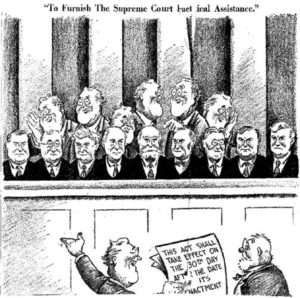
Cartoon criticizing Franklin D. Roosevelt's 1937 court-packing plan. (NA)


Georgetown law Professor Steve Vladeck is one of the leading critics of the conservative majority on the Supreme Court. But in an insightful recent post on his substack, he outlines key reasons why "court expansion" is a bad response to its flaws. The cure is likely to be worse than the disease:

[I]t seems to me that those who are fully onboard the expansion-or-bust train should have to do more than simply assert that having four new Democratic appointees on the Court in 2029 would be a self-evidently "good" thing. If nothing else, proponents of expansion should have to answer the following four questions:

  1. How do we avoid touching off a race to the bottom, where each time one party controls the House, Senate, and presidency, it expands the Court to ensure an ideologically and politically sympathetic majority?
  2. If a race to the bottom is unavoidable, how do we avoid further (and potentially fatal) erosion of public confidence in the Court—which will quite transparently be little more than a lever of power for whichever party last had such a trifecta?
  3. If eroding public confidence in the Court is a feature, and not a bug, how do we insulate against the same erosion of public confidence in lower federal courts?
  4. What is the case for why expansion is a better way to achieve the desired reforms than alternatives that would (or, at least, should) avoid many of these forward-looking concerns?

He adds that court-packing could easily "permanently undermine judicial review as an institution." The rest of his piece (which is behind a paywall) offers far from reassuring answers to these questions.

I have offered similar criticisms of court-packing in a long series of articles and blog posts, most recently in a June Lawfare article  where I explained (among other things) why the Supreme Court's recent decision in Louisiana v. Callais doesn't justify packing, and in a July UnPopulist article critiquing a court-packing proposal advanced by Andy Craig. In these pieces, I explain why the Court's record of checking dangerous abuses of government power - though not without serious flaws - is considerably better than many critics claim. In addition, I argue that court-packing is likely to undermine effective judicial review - not only by the Supreme Court, but also by lower courts.

Like Vladeck, I think some of the issues that concern critics of the Court can be more effectively addressed in other ways. For example, in the Lawfare article, I explain how Congress can fix the flaws of the Callais decision by banning or restricting gerrymandering. It could also enact a binding ethics code for the justices. Justice Alito was wrong to suggest otherwise, back in 2023. That said, if your main goal is a sweeping reversal of much of the Court's recent jurisprudence, there may be no easy way to achieve that quickly without court-packing or something like it. I would argue that any benefits that might achieve are outweighed by the enormous costs of destroying judicial review.

In addition, if your objection to the Court's recent decisions is that they often don't do enough to constrain unconstitutional actions by other branches of government or by the states, court-packing is likely to make that problem worse, not better. Destroying judicial review won't enforce tighter constitutional constraints on the executive or bring back Roe v. Wade. To the contrary, it would largely destroy any hope of doing so.

In another recent piece, I assessed "non-packing" rationales for increasing the size of the Supreme Court. There, I argue that these rationales are mostly weak; and, to the extent they have merit, there are better ways to address them than an expansion that amounts to court-packing. I even outline possible ways to increase the size of the Court without creating an opportunity for court-packing (this would require allowing the party that doesn't hold the White House to pick some of the new justices).

The post Steve Vladeck's "Hard Questions About Court Expansion" appeared first on Reason Magazine.
  •  

Don’t let Musk and the billionaires buy America’s elections

On a recent episode of the Bulwark podcast, journalist Ron Brownstein described the election as a contest between “the wave versus the wall.” The wave being voter anger and President Donald Trump’s plummeting popularity. The wall being structural impediments to voters’ voices, such as gerrymanders and the Republican Party’s stark spending advantage. Now we know […]

The post Don’t let Musk and the billionaires buy America’s elections appeared first on Asia Times.

  •  

Indian Supreme Court demands government answers on voter purge

As one advocate warned India’s Supreme Court on Monday that “this country will burn” unless action is taken to stop what thousands of protesters have denounced as an illegal purge of voters by the head of the Election Commission of India, the court demanded accountability from Prime Minister Narendra Modi’s government. Chief Justice Surya Kant […]

The post Indian Supreme Court demands government answers on voter purge appeared first on Asia Times.

  •  

Big Oil fears the evidence of its deliberate climate lies

No one knows how the US Supreme Court will rule in Suncor v. Boulder, the case that will kick off the court’s fall term next week and will likely decide whether the city and county of Boulder, Colorado, will be able to put oil giants ExxonMobil and Suncor Energy on trial for deceiving the public for decades about the climate harms of fossil […]

The post Big Oil fears the evidence of its deliberate climate lies appeared first on Asia Times.

  •  

‘Major win’ for democracy as Supreme Court rejects Trump attack on mail-in voting

An election worker processes mail-in ballots at the Los Angeles County Ballot Processing Center during California's state primary election in the City of Industry, California, on June 2, 2026. Photo by Patrick T. Fallon / AFP via Getty Images
Common Dreams Logo

This story originally appeared in Common Dreams on Sep. 14, 2026. It is shared here under a Creative Commons (CC BY-NC-ND 3.0) license.

The US Supreme Court on Monday night rejected a bid by the Trump administration to keep onerous US Postal Service rules for mail-in ballots in place, which voting-rights defenders said risked depriving millions of people of the franchise in this year’s midterm elections.

After a back-and-forth legal battle over the USPS rules that dragged on for months, the nation’s highest court issued the 7-2 ruling without elaborating on its legal reasoning, though right-wing Justices Samuel Alito and Clarence Thomas issued dissents in favor of President Donald Trump’s side.

The ruling in USPS v. California was in response to a legal challenge brought by the League of Women’s Voters, the attorneys general of numerous states, and others who argued that newly-announced rules by the Postal Service regarding mail-in ballots, changes prompted by an executive order issued by Trump, would prevent people from having their ballots counted and cause chaos for those trying to administer this year’s elections.

A victory for democracy, a defeat for election deniers. https://t.co/MKjfKmgyTv

— David Crowley (@DavidCCrowley) September 15, 2026

In response to the ruling, the plaintiffs’ legal team said the decision was “a critical step to ensuring free and fair elections this November by maintaining access to mail voting for millions of eligible voters across the United States and lifting the dire threat that the Postal Service would disenfranchise them.”

“Mail voting is safe, secure, and reliable—and the Trump administration has presented no evidence to the contrary, as the courts have repeatedly recognized,” the statement continued. “We will remain vigilant in countering threats to free and fair elections and ensuring that every eligible voter is able to cast a ballot and have it count.”

“Today’s decision is a victory for our democracy and a powerful affirmation of the rule of law,” said California Attorney General Rob Bonta in a statement. “The stakes in this litigation could not have been higher.”

Virginia Kase Solomón, president and CEO of Common Cause, was among the other pro-democracy advocates who welcomed the decision.

“Today’s decision is a major win for the millions of everyday Americans who count on vote-by-mail—our seniors, service members, busy parents, rural voters, and voters with disabilities,” said Solomón in a statement. “Vote-by-mail is safe, proven, and vital; even the president uses it. This executive order was a blatant power grab designed to silence voters and undermine our elections, but it failed because the people and the law were on our side. Our Constitution is clear: states run our elections, and voters choose their leaders—not the other way around. No administration can strip the people of their power.”

Michael McNulty, senior policy director for Issue One, a nonpartisan group that works to defend free and fair elections, also welcomed the ruling, but said vigilance would still be necessary going forward.

“The fight to preserve states’ authority to administer elections is far from over,” warned McNulty.

“President Trump continuously and falsely claims fraud in mail-in voting without evidence,” he added. “Despite voting multiple times with this method, he remains obsessed with centralizing control over elections to tilt the playing field. However, for now, one piece of that centralization effort is blocked, and it ensures that mail-in voting for the midterms won’t be disrupted.”

  •  

A Mississippi Death Penalty Jury Was Seated. With One Black Juror.

Earlier this year, the US Supreme Court heard an appeal from death row inmate Terry Pitchford, who was denied relief by the Mississippi Supreme Court after his attorneys claimed Black people were illegally struck from his jury. Investigative reporter Hannah McAlilly delves into the case, and into the wider problem of racial prejudice in the selection of juries in Mississippi:

A prosecutor struck a Black woman for having “red dyed hair” and in another, a prosecutor struck a Black man because he had “a ponytail, a sort of strange hair design.” That prosecutor told the judge he was concerned the juror might identify too closely with the defendant, who also was of a similar age. “Both have unusual hair styles,” the prosecutor said. 

Prosecutors struck Black jurors who, they said, seemed angry, irritated or inattentive. A Black woman was struck because the prosecutor didn’t like her “vibe.” Another, who worked a night shift before showing up to jury selection, was struck for being “fidgety” and looking “angry.” Another was struck because she “frowned a lot.” 

  •  

Supreme court rejects early hearing in PTI founder’s hospital case

Dr. Uzma Khan sought an urgent hearing of her contempt petition over the government’s decision to transfer the PTI founder to PIMS instead of Shifa International Hospital.

The post Supreme court rejects early hearing in PTI founder’s hospital case appeared first on BOL News.

  •  
❌