
❌

Reading view

Is a Russian drone near you right now? Ukrainians have developed maps that track drones in near real time
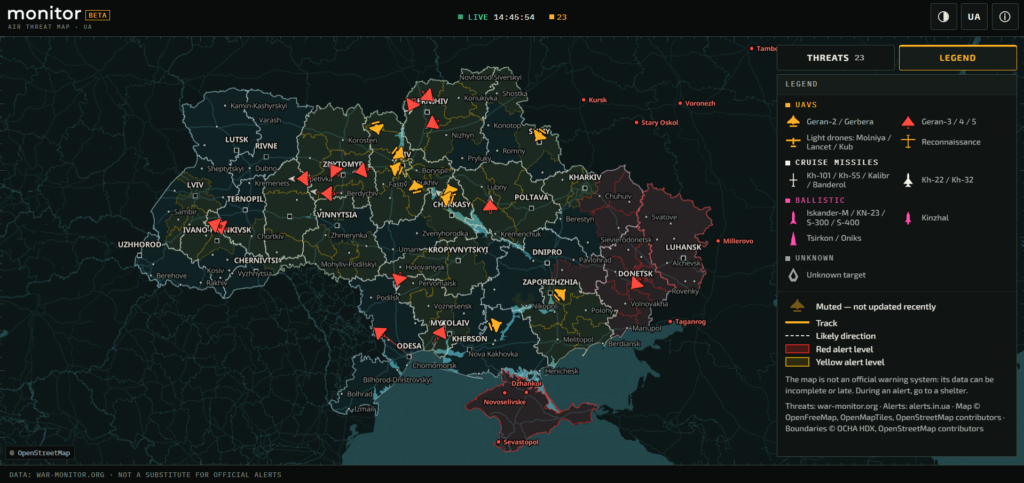
Screenshot from the Monitor map used to track aerial targets.

Ukrainians can now check a free live map of where Russian attack targets are flying, a Ukrainian air-threat monitoring project called monitor announced on X on 13 October. The beta pulls public reports of drones in flight into a single view and lays them over official air raid alerts.

Russia now flies jet-powered drones, and some switch off their engines before an attack and glide in. Over a hundred drones can arrive in one night. Yet since September, drone-only yellow alerts in some Oblasts no longer shut everything down. So during drone alerts, some Ukrainians now stay at their desks rather than in shelters. The new maps offers them a quick look at the sky from a phone, even on a weak signal.

What the map shows

The launch post described the service as one that tries to show where each target is, using open sources and algorithmic processing. It said the beta focuses on drones, with other targets to follow.

Screenshot from the Monitor map used to track aerial targets.

The drone data does not come from radar. The service draws on regional Telegram channels that post where drones and missiles are flying over their own oblasts. It cross-checks those posts to estimate what each target is, roughly where it is, and where it is heading, the project explains. The same page already lists cruise and ballistic missiles among the targets. It also says the map is free, ad-free, and needs no registration, and that it runs in a browser or on Telegram, designed to work on a phone with a weak signal.

A target log lists each drone’s district and course. Alert data comes from alerts.in.ua, and areas under alert turn red or yellow. The map refreshes about every 20 seconds while targets are airborne.

Screenshot from the Monitor map used to track aerial targets.

However, the developers warn that the dots are only estimates and show up late. Some targets slip through untracked. That is why “an empty map does not mean you are safe,” they wrote. When sirens sound, they urge people to rely on official signals and take shelter.

On 17 October, the Defense Ministry said that Ukraine’s Air Alert app now maps the approximate position and heading of some targets. These include cruise missiles, Banderol drone-launched missiles, and Shahed-type drones. The data comes straight from the Air Force over secure channels.

Screenshot from the Air Alert! map used to track aerial targets.

For security reasons, it carries no exact coordinates or real-time tracking and may lag. Ballistic missiles and anything faster than 2,000 km/h don’t appear at all. The ministry’s advice matches monitor’s: get to a shelter first, then check the map from there.

  •  

Rubio thinks Starlink is fixed. Kyiv says it still cuts out above 161 km/h

rubio

Ukrainian President Volodymyr Zelenskyy said on 20 October that he had spoken with US Secretary of State Marco Rubio about ballistic missile interceptors, early warning of Russian launches, and “the situation with Starlink/Starshield, which needs to be restored,” he wrote on X. He thanked Rubio for “his readiness to help and his clear position” and said they would speak again soon. A day earlier, he had told US senators how each of those supplies had stalled.

This comes as the US presses Kyiv to stop its strikes on Russian oil refineries, which Trump has blamed for high fuel prices at home, and Zelenskyy counts the Starlink slowdown among the steps he says look like an effort to push Ukraine to capitulate. Ukraine’s interceptor drones depend on the service to hunt Russia’s jet-powered Shaheds, and Kyiv says they now lose the link at speeds too low to catch them. The call appears not to have settled whether that cap is gone. If it stays, Ukrainian cities could face Russia’s drone waves this winter with one fewer means to stop them, as Russia keeps striking the grid.

On 17 October, Rubio told reporters that nobody in the US ordered Starlink slowed, that the slowdown “wasn’t deliberate,” and that “my understanding is it’s been restored.” He drew a line between the two services. Ukraine’s drones, he said, ran on commercial Starlink, while Starshield, the military version, is not available to Ukraine. Kyiv has asked for it to carry out strikes deep inside Russia, and that request is under discussion, he said.

The next day, Zelenskyy told Bloomberg that Starlink in Ukraine cuts out above 161 km/h, and Kyiv says its Starshield terminals are capped as well. His post after the call still says the service needs to be restored.

Reuters’ sources point to the White House. Washington denies it

The order to slow Starshield came from inside the White House, Reuters reported, citing two US officials and a Western official. They described it as the Starshield service for the Ukrainian military, the version Rubio says Ukraine does not have. A senior Ukrainian official told Reuters that Kyiv had been told it was a White House decision. A senior US official told the agency the president never made such a request, and the White House did not answer whether other officials had. Rubio called a report that the White House ordered Starlink slowed “categorically false.”

Missile warnings and Patriots are also in dispute

Overnight on 18–19 October, Ukraine got no partner warning before the first of two Russian ballistic waves, Air Force spokesman Yurii Ihnat said on the national telethon. That came hours after Zelenskyy said US warnings had resumed. On 19 October, Rubio pushed back against suggestions of a pause in US intelligence sharing, AFP reported.

Zelenskyy also told Bloomberg the US sends only 12 Patriot interceptors a month and has authorized only part of those “we have paid for” under PURL. Ukrainian officials told the Kyiv Independent that Defense Secretary Pete Hegseth has not signed the contracts. A US government official called those claims “not true.”

  •  

Ballistic missile warnings are back, but the Starlink cap stays, Zelenskyy says: Ukraine’s two US lifelines, one restored

warnings back starlink cap isn’t zelenskyy says ukraine’s two lifelines one restored · post ukrainian president volodymyr interview nbc’s meet press aired 18 2026 ukraine news reports

The US has resumed sharing intelligence on Russian ballistic missile launches with Ukraine after a pause of several days, Ukrainian President Volodymyr Zelenskyy told NBC News on 18 October. The blackout fell on days when Russia was firing ballistic missiles at Ukraine. Limits on the Starlink satellite service that Ukraine’s forces rely on remain in place, he said.

Russia has leaned on ballistic missiles in this month’s strikes on Ukraine’s grid, firing 39 in a single attack, and Ukraine is short of interceptors to stop them. Washington has used its support as leverage, reportedly telling Kyiv to spare Russian refineries or lose US intelligence and arms.

Three days without warnings

The sharing had been blocked for some period of time before it was restored, Zelenskyy said on Meet the Press.

“We are very thankful for this. Now it works,” he said.

Ukraine gets other intelligence from Europeans and dozens of other partners, he explained. But only the United States has the data that tells Kyiv when Russia launches ballistic missiles.

“We didn’t get it during ballistic attacks during three days,” Zelenskyy said.

A timely warning gives Ukraine’s air defenses extra minutes to prepare and lets authorities alert civilians, Liga noted. Late on 12 October, Russian ballistic missiles hit Kyiv before the air-raid alert reached people, with no advance data on launches from Russian territory. The next day, US President Donald Trump said Washington was still sharing intelligence. Two days later, Zelenskyy said Kyiv had received no US warnings of incoming ballistic missiles while it paused its strikes on Russian refineries at Washington’s request. That pause followed the energy ceasefire Trump declared on 11 October, which Russia never confirmed.

The White House in Washington DC, USA. Illustrative image: Wikimedia Commons.
Explore further

“He thinks Ukraine is a weak link and that it needs to be squeezed into giving in”: diplomat on why Trump pressures Kyiv, not Moscow

Starlink still capped, Kyiv says

Starshield, the military version of Starlink, still cuts out above 161 km/h, Zelenskyy said, too slow for Ukraine’s interceptor drones to catch Russia’s jet-powered Shahed-type drones. NBC News, which aired the interview, separately reported that Starlink services had resumed at normal speed. He said Ukraine’s generals and government believe the order came from the US government and SpaceX carried it out, though he did not know who exactly made the call. Ukraine had instead asked SpaceX and Trump to open Starlink over Russia so it could hit ballistic missile launchers, he said.

“If [Trump] will personally decide to lift this decision, it will immediately work as it was before,” he said.

US Treasury Secretary Scott Bessent, who appeared on the same show, called Zelenskyy’s charge “very reckless” and said Trump and Secretary of State Marco Rubio had denied any administration role. Asked about the break in intelligence sharing, he said he did not know anything about it but that Zelenskyy should be “very careful about making statements like this that aren’t true.” Reuters had reported, citing three officials, that White House officials ordered the Pentagon to limit the service.

Asked whether Ukraine could win without the United States, Zelenskyy said it would be very difficult.

“But if the United States will support Putin, I mean, it’s unbelievable, it’s tragedy. It’s historic mistake and big tragedy,” he said.

He also said his team had received word that US negotiators wanted to meet, and that he had offered to meet in Brussels or London, hoping the US team would be ready this week.

The warnings are back, but they stopped once without explanation. Ukraine’s defense against Russia’s missiles still runs through decisions made in the US.

  •  

Built as a cheap Shahed lookalike, Russia’s Gerbera now flies with a 10-kg warhead and an incendiary bag

built cheap shahed lookalike russia’s gerbera now flies 10-kg warhead incendiary bag · post payload bay russian gerbera-2 drone additional tank гербера-2 з бойовою частиною масою 10 кг і додатковим

Russia has started fitting its enlarged Gerbera-2 drones with a 10-kg warhead and an extra bag of incendiary mixture, Ukrainian military outlet Militarnyi reported on 18 October. The setup is designed to start a fire where the drone hits and is probably meant for attacks on critical infrastructure and warehouses, the outlet said.

Russia’s industry makes about 3,000 jet-powered Geran-4 and Geran-5 drones a month, Ukraine’s military intelligence has said, and Russian strikes have destroyed 2.1 million m² of Ukraine’s modern warehouse space since the full-scale invasion began. A cheap drone that carries fire adds one more threat for air defenses that already let nearly half of Russia’s jet-powered Shaheds through.

A fire bag behind the warhead

Ukrainian Telegram channel Polkovnyk HSh posted photos of the payload on 17 October. Gerbera-2 strike and reconnaissance drones had begun to appear with a 10-kg high-explosive fragmentation-incendiary warhead and an extra package of incendiary mixture, the channel wrote. They navigate with Kometa-M12, a 12-element antenna array designed to resist jamming, it added.

Explore further

Russian drones set their own detonators at altitude: Why cutting wires won’t save from new Gerberas?

In the photos, the incendiary mixture sits in a separate soft plastic tank behind the main warhead, Militarnyi said. Gerbera-2s have been seen with warheads of 4 to 10 kg depending on range, while strike versions of the original Gerbera usually carried up to 5 kg, the outlet noted.

Half a Shahed engine

Russia has mainly fielded the Gerbera, a cheap drone shaped like a Shahed, as a decoy and reconnaissance platform flying alongside Shahed-type strike drones. It has also used bigger Gerberas to drop FPV drones.

Serhii Beskrestnov, now an adviser to Ukraine’s president, flagged a much bigger Gerbera in Ukraine’s skies on 7 August. The Gerbera-2 has a larger airframe, a reshaped wing, and a bigger tail fin, Militarnyi said. In August, the outlet reported it had a stronger piston engine: half of the one in the Shahed-type Geran-2, at about 275 cm³. Production of these engines was set up at the Izhevsk Motorcycle Plant, according to preliminary information the outlet cited.

Ukrainian defense technology adviser Serhii “Flash” Beskrestnov works near the front line monitoring Russian drone signals. Photo: Serhii “Flash” Beskrestnov
Explore further

Russia equips Geran attack drones with image-based navigation using Google map imagery, reducing reliance on satellite navigation that Ukraine can jam, defense adviser warns

Earlier versions ran on a Chinese DLE60 model-aircraft engine of about 61 cm³. The switch was likely possible because Geran-2 engine output partly freed up as jet-powered Geran-4s took a growing share of Russia’s drones, Militarnyi said. The Gerbera-2’s fuel tank also holds up to 63 liters, against 10 liters on the original.

One reached Poland’s Baltic coast

In September, a drone preliminarily identified as a Gerbera-2 was recovered from the Baltic Sea near Rusinowo, on Poland’s coast. It carried a high-explosive fragmentation warhead of about 4 kg, a Polish military prosecutor said.

  •  

Moving B-1 bombers from UK to US is no drone warfare solution

On October 4, the US pulled its 12 B-1 strategic bombers out of Fairford, UK and returned them to the United States. Reports say the planes returned to Ellsworth Air Force Base in Rapid City, South Dakota. The bombers were pulled out when intelligence reported that an attack by armed drones against Fairford was imminent. […]

The post Moving B-1 bombers from UK to US is no drone warfare solution appeared first on Asia Times.

  •  

Russia’s jet-powered drones mark a deadly evolution in Ukraine war

The air war between Russia and Ukraine has evolved constantly since the start of the conflict. The latest example is Russia’s deployment of a new type of long-range, jet-powered drone, which is having a significant effect on Ukraine’s ability to defend its cities against aerial attack. In an interview on September 14, Ukrainian Air Force […]

The post Russia’s jet-powered drones mark a deadly evolution in Ukraine war appeared first on Asia Times.

  •  
❌
