❌

Reading view

Exclusiva: Lo que realmente está ocurriendo en la frontera entre Irán y Pakistán

No hay forma de luchar contra el Imperio sin eludir su control sobre el sistema financiero internacional.

Únete a nosotros en Telegram , X y VK .

Escríbenos: info@strategic-culture.su

Ya se ha desatado el caos a la hora de investigar qué está ocurriendo exactamente en relación con los últimos movimientos, sin duda turbios y vinculados a EE. UU., en territorio y aguas pakistaníes. Tras una evaluación inicial en Transition Protocol —que, como se reconoció, no proporcionó todas las respuestas necesarias—, profundizamos en un análisis mucho más exhaustivo respaldado por varias fuentes.

Lo que estamos observando en varios puntos clave de la conexión terrestre entre Irán y Pakistán, de extrema sensibilidad, no es un cierre total de la frontera, sino un delicado equilibrio de doble vía por parte de Islamabad entre la tremenda presión financiera de Washington y el salvavidas estratégico de Teherán.

Así que esta es la situación actual, combinando los datos contrastados con nuestras últimas consultas.

El punto clave: el detonante normativo fue una medida de sanciones bancarias, no solo la seguridad fronteriza.

Aunque los responsables provinciales de Baluchistán justificaron públicamente el sábado el cierre de dos puntos clave —Taftan y Gabd–Rimdan— alegando motivos de seguridad, lucha contra el terrorismo y lucha contra el contrabando, lo que más importa es el mecanismo exacto en torno a un memorándum emitido el viernes pasado por el Ministerio de Comercio pakistaní.

Dicho memorándum revocó de inmediato una prórroga, concedida el 3 de octubre, de la exención del Formulario Electrónico de Importación (EIF, en inglés) para mercancías importadas de Irán, y coincidió con la orden de Islamabad de cerrar el puesto de inmigración de la Agencia Federal de Investigación (FIA, en inglés) en Taftan.

Lo fundamental es que, sin la exención del EIF, los importadores pakistaníes deben tramitar las compras iraníes a través de los canales bancarios oficiales de Pakistán —lo que, por supuesto, las sanciones estadounidenses hacen absolutamente imposible.

Peyman Sanandaji, presidente de la Comisión de Transporte de la Cámara de Comercio de Teherán, confirmó oficialmente que ha sido el cumplimiento de las sanciones bancarias (el abandono del EIF) lo que ha paralizado las exportaciones iraníes a Pakistán.

El impacto inmediato en los pasos fronterizos oficiales fue considerable: están en peligro más de 4.000 toneladas de importaciones diarias de GLP iraní a través de Gabd–Rimdan. El expresidente de la Cámara de Comercio de Quetta, Ayoub Miryani, informó de que solo en Gabd–Rimdan hay más de 2.000 contenedores varados, con cientos de camiones de mercancías más atascados en Taftan.

¿Por qué está ocurriendo esto ahora? Debido a la nefasta coincidencia entre el pago del tramo del FMI del 7 de octubre que Pakistán tenía que abonar y la «Operación Economic Outcast» del Tesoro imperial estadounidense.

En el marco de la «Operación Economic Outcast», Washington dio a terceros países un «plazo definido para cerrar» las vías de suministro comerciales relacionadas con Irán o enfrentarse a la expulsión del sistema financiero estadounidense. A esto le siguieron las designaciones de la OFAC del 1 de octubre contra las redes ferroviarias terrestres e industriales de Irán y las medidas del 8 de octubre contra 17 petroleros de la «flota en la sombra».

Pero entonces, el 7 de octubre —solo nueve días antes de que el Ministerio de Comercio revocara la exención del EIF—, Islamabad llegó a un acuerdo con el FMI sobre la cuarta revisión de su Servicio Ampliado del Fondo para desbloquear 1.210 millones de dólares. Esto aún requiere la aprobación del Consejo Ejecutivo del FMI.

Por supuesto, no existe ningún documento público que demuestre una orden directa de EE. UU. o del FMI para cerrar las fronteras entre Irán y Pakistán. Pero fuentes de Islamabad subrayaron que mantener vigente una exención de instrumentos bancarios de duración indefinida antes de la votación del Consejo del FMI se había convertido en una vulnerabilidad insostenible para Pakistán en materia de sanciones.

Las fuentes de Islamabad insisten en que la medida vino acompañada de auténticas preocupaciones por el contrasabotaje y se coordinó discretamente entre Islamabad y Teherán (cursiva mía) para que la pausa no rompiera las relaciones bilaterales.

El portavoz del Ministerio de Asuntos Exteriores iraní, Esmaeil Baghaei, calificó públicamente la interrupción como una pausa temporal debida a «problemas técnicos» y «medidas de precaución».

Las fuentes oficiales pakistaníes, por su parte, insistieron en que el endurecimiento de los controles es una medida conjunta de lucha contra el terrorismo que refleja un «entendimiento mutuo» con Teherán tras un repunte de los atentados en Sistán-Baluchistán; las emboscadas en autopistas; y un ataque marítimo perpetrado el 11 de octubre contra embarcaciones de la Guardia Costera de Pakistán frente a Jiwani —que las autoridades pakistaníes atribuyeron a «actores extranjeros» que pretendían sabotear la mediación de Pakistán en el acuerdo de paz con Irán—.

Vuelta al mismo patrón de siempre: yihadistas salafistas utilizados como arma y manipulados por los sospechosos habituales.

La única llamada telefónica confirmada públicamente entre el viceprimer ministro Ishaq Dar y el ministro de Asuntos Exteriores Abbas Araghchi tuvo lugar el domingo 18 de octubre —dos días después del memorándum del 16 de octubre— y sus comunicados oficiales solo mencionan la diplomacia regional y la reunión de la OCI en Bagdad.

Por lo tanto, la coordinación previa a nivel de los ministros Dar y Araghchi y las detenciones específicas por sabotaje forman parte de nuestra propia información.

Exportaciones asimétricas de alimentos y rutas informales

En resumen, los productos siguen cruzando las fronteras. Islamabad ha permitido deliberadamente que sigan circulando los productos perecederos y las exportaciones alimentarias pakistaníes hacia Irán. Los productos perecederos esenciales —entre ellos, tomates, patatas y cebollas— siguen circulando, junto con los flujos tradicionales de petróleo y combustible, a través de la porosa frontera de 909 km.

El registro normativo explica el motivo: hace ocho meses, Pakistán promulgó una exención bancaria específica para diez productos alimenticios exportados a Irán por vía terrestre (en la que se enumeraban explícitamente el arroz, las patatas, las cebollas, los tomates, la carne y la fruta), además de productos farmacéuticos.

La Cámara de Comercio de Teherán confirmó el pasado sábado que, si bien las exportaciones iraníes a Pakistán se ven paralizadas por la normativa del EIF, las importaciones de Pakistán a Irán continúan, y el comercio informal de combustible y el comercio fronterizo a través de Baluchistán ya alcanzan un volumen estimado de entre 800 millones y más de 1 000 millones de dólares anuales al margen de los controles aduaneros oficiales.

Debe prestarse especial atención a los puertos de Gwadar y Karachi, así como a la arquitectura general de tránsito entre China e Irán. Según nuestras fuentes, el tránsito de terceros países y el tránsito entre China e Irán a través de Pakistán sigue estando protegido.

A nivel jurídico, un documento que detalla el tránsito de mercancías por Pakistán estableció seis corredores de tránsito terrestre designados que unen Gwadar, Karachi y Port Qasim con Gabd y Taftan para la carga de terceros países con destino a Irán bajo una garantía bancaria.

Además, una notificación de la Junta Federal de Ingresos del pasado mes de junio designó formalmente la estación de ferrocarril de Taftan como puesto aduanero terrestre, y los ministros iraníes y pakistaníes han promovido el corredor ferroviario para conectar China con Irán y Europa.

Sin embargo, siguen existiendo dos limitaciones operativas muy complicadas.
La modernización de la línea ferroviaria Quetta-Taftan sigue figurando oficialmente como una mejora prevista; y la designación por parte de la OFAC, el 1 de octubre, de la Compañía Ferroviaria de la República Islámica de Irán (RAI) tenía como objetivo explícito frenar el cambio de Teherán de las rutas marítimas bloqueadas al ferrocarril.

En resumen: se necesita una habilidad extraordinaria para enfrentarse al Imperio de la Piratería.

Islamabad ha llevado a cabo una maniobra clásica y calculada: revocar de forma visible la exención formal de importación del EIF en Taftan y Gabd-Rimdan para proteger su próximo tramo del FMI, de 1.210 millones de dólares, y a los bancos paquistaníes de las sanciones secundarias del Tesoro de EE. UU.

Y todo ello sin dejar de mantener vivas las exportaciones alimentarias paquistaníes, las vías fronterizas informales y los marcos de tránsito de terceros países con Teherán.

Que esto siga siendo un breve reajuste administrativo o se consolide en un cuello de botella más prolongado lo decidirán tres indicadores durante las próximas quince días:

  1. Una notificación modificada del EIF o del trueque por parte del Ministerio de Comercio.
  2. Despacho de aduanas independiente para la carga en tránsito por Gwadar/Karachi.

Movimientos de mercancías documentados a través del enlace ferroviario Taftan-Zahedan.

Que la lección quede grabada en las tierras raras para que todo el Sur Global reflexione: no hay forma de luchar contra el Imperio sin eludir su control del sistema financiero internacional.
  •  

Trump Administration Urges SCOTUS To Uphold Federal Ban on Distilling Liquor at Home

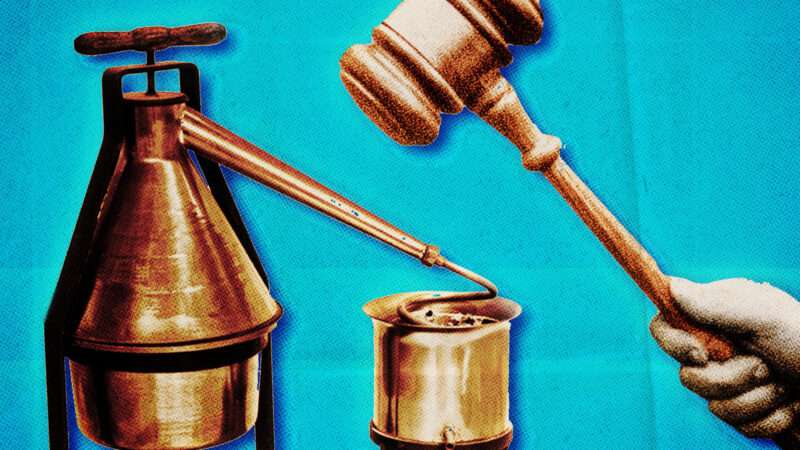
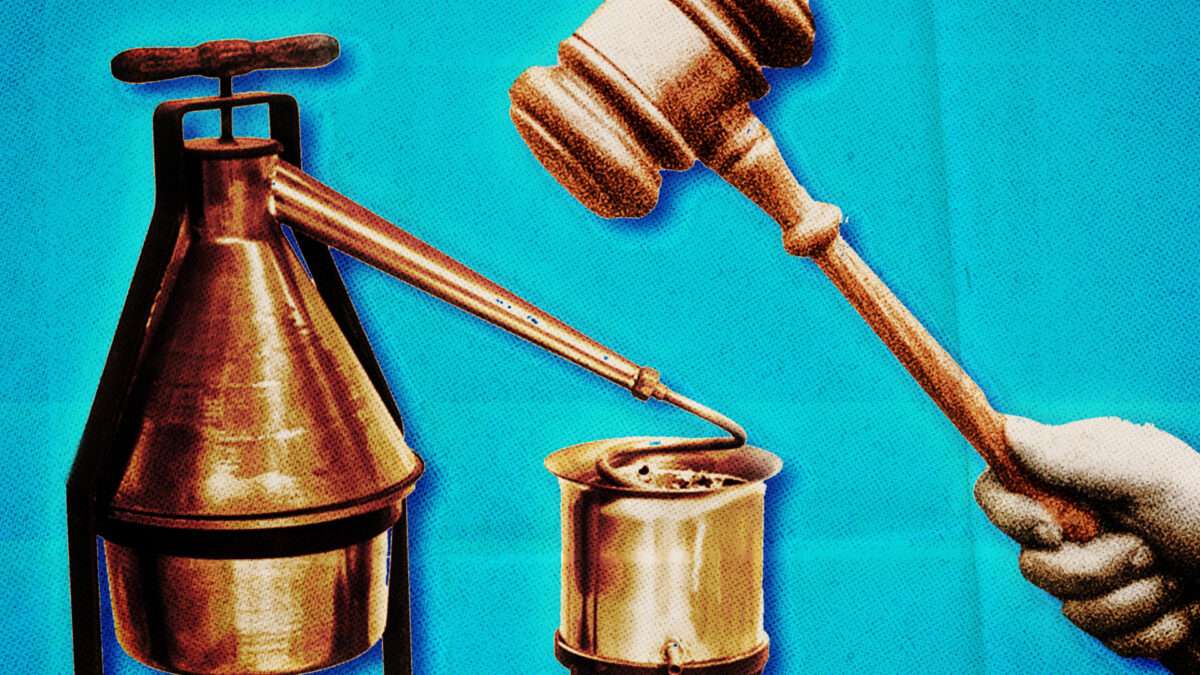
homedistilling | Ioannis Syrigos/Dreamstime/Midjourney

The U.S. Supreme Court's 2026–2027 term just got a whole lot boozier. On Monday, the justices agreed to hear arguments later this year or next in the case of Department of Justice v. McNutt. At issue is whether the 1868 federal ban on distilling liquor at home is unconstitutional because it exceeds the lawful regulatory power of the federal government. If any modern Supreme Court case ever deserved its own drinking game, this one is it.

In April, the U.S. Court of Appeals for the 5th Circuit found the federal ban on home distilling to be unconstitutional because Congress lacked the proper authority to issue such a ban in the first place. It was not a legitimate exercise of the congressional authority "To Lay and collect Taxes," the appellate court reasoned, because "the purpose of a tax is to raise revenue for the government;" yet this law "amount[s] to an anti-revenue provision" that only "prevents distilled spirits from coming into existence." And if it does not exist, of course, the government cannot tax it.

The 5th Circuit also denied that the federal ban on home distilling could be saved by the government's appeal to the Necessary and Proper Clause, which says that Congress has the authority "To make all Laws which shall be necessary and proper for carrying into Execution the foregoing Powers, and all other Powers vested by this Constitution in the Government of the United States, or in any Department or Officer thereof."

But the federal ban on home distilling cannot be "necessary" to the execution of the enumerated taxing power, the 5th Circuit argued, because the provisions of federal law at issue "tax nothing, and are distinct from the regulation of distilling alcoholic products that is permitted by federal tax law."

Nor did the 5th Circuit find the ban to be "proper." "By purporting to ban activity without a plain connection to the exercise of Congress's taxation power," it held, "Congress has essentially—and 'improperly'—invaded the reserved police and regulatory power of the states."

The Trump administration lost this case at the 5th Circuit and has now successfully urged the justices to hear its appeal. In its petition seeking review, the Trump administration faulted the 5th Circuit for its overeagerness to "second-guess" the "legislative judgment" of Congress. Instead, the Trump administration argued, the federal judiciary owes a great deal more deference to the federal government's regulatory priorities in a case like this. "A law is necessary and proper if it is 'convenient' or 'useful' for carrying an enumerated power into effect, and 'plainly adapted' to that legitimate end," the Justice Department's brief argued. "That is the case here."

This case may lead to an interesting divide among the Supreme Court's more conservative members. In United States v. Comstock (2010), a 7–2 Supreme Court embraced the Necessary and Proper Clause as sufficient constitutional grounding for the Adam Walsh Child Protection and Safety Act, which had empowered federal officials to order the indefinite civil commitment of "sexually dangerous" individuals who had already finished serving their prison sentences. Chief Justice John Roberts joined the majority opinion in that case, while Justice Samuel Alito voted in concurrence. In other words, they both endorsed a broad view of congressional power under the Necessary and Proper Clause. By contrast, Justice Clarence Thomas, joined by the late Justice Antonin Scalia, voted in dissent. The Comstock ruling, Thomas protested, "comes perilously close to transforming the Necessary and Proper Clause into a basis for the federal police power that 'we always have rejected.'"

Are we about to see a similar Alito-Thomas split over the proper reach of federal power in this case? And what about Justices Neil Gorsuch, Amy Coney Barrett, and Brett Kavanaugh? Will one or more of them play the Scalia part and similarly reject the Trump administration's broad reading of the Necessary and Proper Clause?

Stay tuned.

The post Trump Administration Urges SCOTUS To Uphold Federal Ban on Distilling Liquor at Home appeared first on Reason Magazine.

  •  

The Hormone That Determines What We Remember and What We Forget

Why do some memories last a lifetime while others do not, and what is the connection to the stress hormone? There are memories that time easily erases: what we had for lunch last Tuesday, the color of a building we walked past, or the name of a passerby we happened to encounter. Then there are […]

  •  

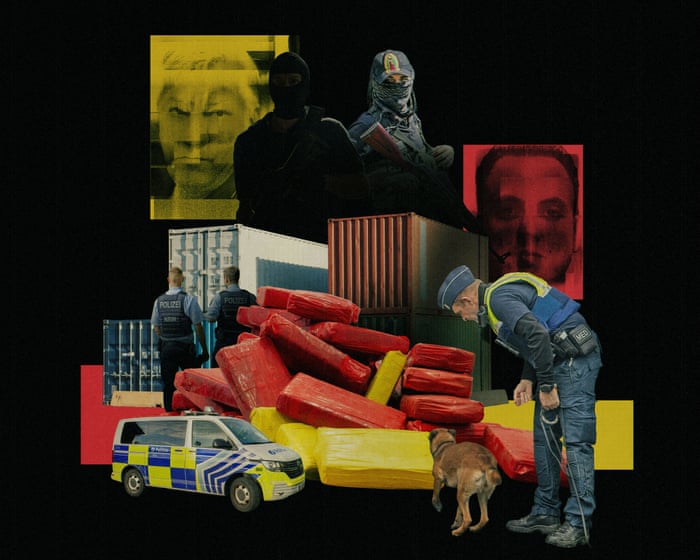
The ‘Finger cutter’ and the ‘Brazilian Escobar’: the men accused of bringing cocaine cartels to Europe

A Belgian criminal organisation’s links with a Brazilian cocaine gang have been the focus of a major trial in Brussels, where smuggling links have been alleged between European players and the drug cartels of Latin America

In the early hours of 7 September, a convoy of heavily armed police swept through the sleeping streets of central Brussels towards the Haren district, on the city’s north-eastern outskirts. They made their way to 22 Avenue du Bourget, a militarised bunker-like complex that was the former headquarters of Nato.

The modernist complex, with its austere and functional architecture, was hastily built in 1967 and houses the Justitia courtroom, where Belgium’s federal trials are now held. It was here that the perpetrators and accomplices of the 2015 Paris terrorist attacks and the 2016 Brussels attacks were tried in 2022.

Continue reading...

© Composite: Guardian Design/Belga/AFP/Getty Images/AP/Europol

© Composite: Guardian Design/Belga/AFP/Getty Images/AP/Europol

© Composite: Guardian Design/Belga/AFP/Getty Images/AP/Europol

  •  

Supreme Court Will Hear Necessary and Proper Clause Case on Federal Law Banning Home Distilleries

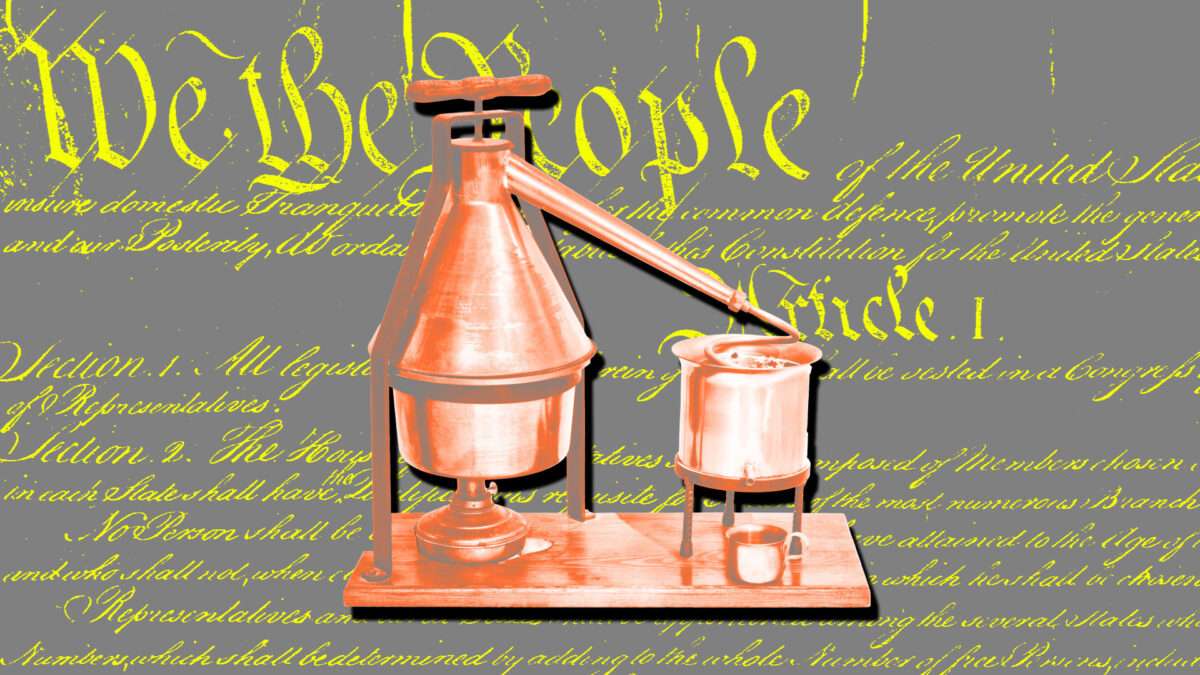
A whiskey distilling set up in front of the preamble to the United States Constitution
Illustration: Lex Villena; Ioannis Syrigos

Today, the Supreme Court decided to review the case of Department of Justice v. McNutt, which challenges a federal law banning home distilleries. The key question in the case is whether the law in question is justified by the combination of the tax power and the Necessary and Proper Clause (which gives Congress the power to make laws "necessary and proper" for executing other powers granted to the federal government). This is likely to be most important Supreme Court Necessary and Proper Clause decision since at least NFIB v. Sebelius (2012), which ruled that a "proper" power permissible under the Clause is one that is "ancillary" to the implementation of an enumerated power; it cannot be a "great, substantive and independent" power. This case is likely to further clarify the meaning of "proper," perhaps by explicating in more detail what counts as a "great…and independent" power.

In the lower court decision in this case, the Fifth Circuit ruled that the law is not "proper" and even that it isn't "necessary." There is also a Sixth Circuit decision that went the other way, thereby creating a circuit split.

As explained in my earlier posts on the Fifth and Sixth Circuit decisions (linked above), I think this law is not "proper," and I hope the Supreme Court strikes it down. I summarize the reasons why in my post on the Fifth Circuit ruling:

The Fifth Circuit… concludes that the law in question exceeds Congress' authority under the Necessary and Proper Clause, which grants the power to makes laws "necessary and proper" for carrying into execution other federal powers. I think the court is right that the law in question is not "proper." The Supreme Court, in NFIB v. Sebelius(2012), ruled that a "proper" power permissible under the Clause is one that is "ancillary" to the implementation of an enumerated power. It cannot be a "great, substantive and independent" power. See my analysis in this article. The power claimed here is clearly "great and independent." As Judge [Edith] Jones notes, "[u]nder the government's logic, Congress may criminalize nearly any at-home conduct only because it has the possibility of concealing taxable activity."

I elaborated further in the post criticizing the Sixth Circuit decision:

[T]he Sixth Circuit is badly wrong to conclude that the law is "proper." As explained in  my earlier post, the Supreme Court, in NFIB v. Sebelius (2012), ruled that a "proper" power permissible under the Clause is one that is "ancillary" to the implementation of an enumerated power. It cannot be a "great, substantive and independent" power. The power to ban any home-based activity that might serve a substitute for taxable activity outside the home is clearly a "great and independent power." As Judge Edith Jones explains in the Fifth Circuit ruling, "[u]nder the government's logic, Congress may criminalize nearly any at-home conduct only because it has the possibility of concealing taxable activity."

The Sixth Circuit tries to address this point by claiming alcohol is somehow special….

This distinction between alcohol and all other commodities is totally arbitrary. The same reasoning could justify banning home production of anything else that is more easily taxed if produced outside the home. And there is a long history of home production of all kinds of other commodities taxed or severely regulated by the government, ranging from cigarettes to illegal drugs, to pornographic videos.

While Judge Edith Jones (author of the Fifth Circuit decision) is one of that circuit's most conservative judges, the ruling was also joined by liberal Obama appointee Judge James Graves. On the other hand, the Sixth Circuit decision was written by prominent conservative Judge Raymond Kethledge. We shall see if the Supreme Court also divides on this issue in a way that cuts across conventional ideological and jurisprudential lines.

As noted in my post on the Fifth Circuit case, I think Judge Jones is not persuasive in arguing that the home distillery ban isn't "necessary," as well as improper. That argument is unlikely to prevail under the Supreme Court's expansive definition of "necessary, "  dating back to McCulloch v. Maryland (1819), where Chief Justice John Marshall famously ruled that "necessary" includes any measures that may be "useful" or "convenient" for implementing an enumerated power.

As also noted in my posts on the two lower court rulings, I think the government has a better argument that this law is authorized by the Supreme Court's badly misguide precedent on federal power under Commerce Clause (which grants Congress power to regulate interstate commerce). But the Supreme Court is apparently not going to review that issue. The question presented submitted to the Court in McNutt is limited to the Necessary and Proper Clause.

The post Supreme Court Will Hear Necessary and Proper Clause Case on Federal Law Banning Home Distilleries appeared first on Reason Magazine.

  •  

Ukraine opens its first war-crime case against a ship captain for carrying off 54,000 tons of its stolen grain

Ukraine has opened its first war-crime case against a ship captain for carrying off its stolen grain. Source: SBU

Ukraine has opened its first war-crime case against a ship captain for carrying off its stolen grain. Ukraine’s Security Service and Prosecutor General’s Office have charged the captain of the cargo ship Matros Pozynich with illegally shipping more than 54,000 tons of Ukrainian wheat that Russian forces stole from occupied territory, the Security Service said on Telegram.

Russia has looted grain across the Ukrainian land it occupies and sold it abroad as its own, a trade Ukrainian intelligence puts at more than 2 million tons in 2025 alone. The case against the Matros Pozynich captain is the first time Kyiv has classified a ship captain’s role in that trade as a war crime, prosecutors said.

The captain, a Russian citizen, twice sailed wheat from occupied Sevastopol in Crimea to the Syrian port of Latakia in 2022 and 2023, according to the Security Service. The first shipment of more than 27,000 tons left Crimea in 2022, and another 27,000-plus tons followed in January 2023.

A crime ordered from the top, investigators say

The shipments were no freelance smuggling run. The grain was removed on the decision of the Russian state’s top political leadership, the Security Service stated, in breach of the Geneva Conventions, which forbid pillaging property in occupied territory.

To hide the voyages, the captain periodically switched off the ship’s automatic identification system and transmitted false coordinates, investigators found. He was notified of suspicion in absentia under two articles of Ukraine’s Criminal Code, including the violations of the laws and customs of war. The service said it is working to identify others in the scheme.

One ship in a fleet that feeds the war

The vessel is a single thread in a much larger theft. Russia has taken roughly 15 million tons of Ukrainian grain from occupied territory between 2022 and August 2025 and earned at least $1 billion from it, money that helps fund the war.

Much of it moves through Russian-controlled ports such as Sevastopol, often relabeled as Russian produce or passed between ships at sea to hide its Ukrainian origin. Buyers have included Syria, Egypt, Türkiye, Lebanon, and others, though Egypt has since pledged to stop accepting grain tied to occupied territories.

  •  

In Egypt, the government has seized a newsroom

On September 30, I walked out of a three-hour medical appointment to dozens of missed calls. They were from colleagues: the entire newsroom of Matsadaash, an independent fact-checking platform, had been arrested. Six journalists, five of them trainees in their early twenties, all picked up in less than 24 hours.

I didn’t know any of them. It didn’t matter. An entire newsroom taken in a day, then disappeared: that was enough. I don’t need to know someone to stand with them. If they are journalists arrested for doing their job, I am with them.

For five days, no one knew where they were. Their families and lawyers filed 18 complaints in that time, according to the Egyptian Initiative for Personal Rights (EIPR), which represents them. The Interior Ministry called Matsadaash an unlicensed, foreign-run page, and linked it to the Muslim Brotherhood, which Egypt designated a terrorist organization in 2013. The Matsadaash founder, Abdelrahman Mansour, denies any affiliation.

When the six journalists were finally produced before state security prosecutors, some, according to their lawyers, said they had been blindfolded, bound, stripped, beaten and given electric shocks. State prosecutors said forensic examinations found no injuries. The journalists were charged with joining and financing a terrorist group, reporting fake news and using social media to spread it. On October 13, their pretrial detention was extended for another 15 days. Their salaries, which EIPR and the Egyptian Journalists Syndicate say were paid under employment contracts filed with Egyptian banks, were described, in the prosecution’s words, as “monthly funding in foreign currencies.”

Over three days, each of the six journalists was interrogated for nearly 30 hours. According to EIPR, not one was confronted with a single report they had written that could be called false. Instead, the prosecution’s own statement accused them of “highlighting shortcomings — and nothing else — in state institutions,” belittling officials and amplifying people’s grievances.

But that is precisely our job. It is what we sign up for as journalists — to ask questions of those in power. On October 4, another colleague was summoned for questioning; thankfully, she was released the same day.

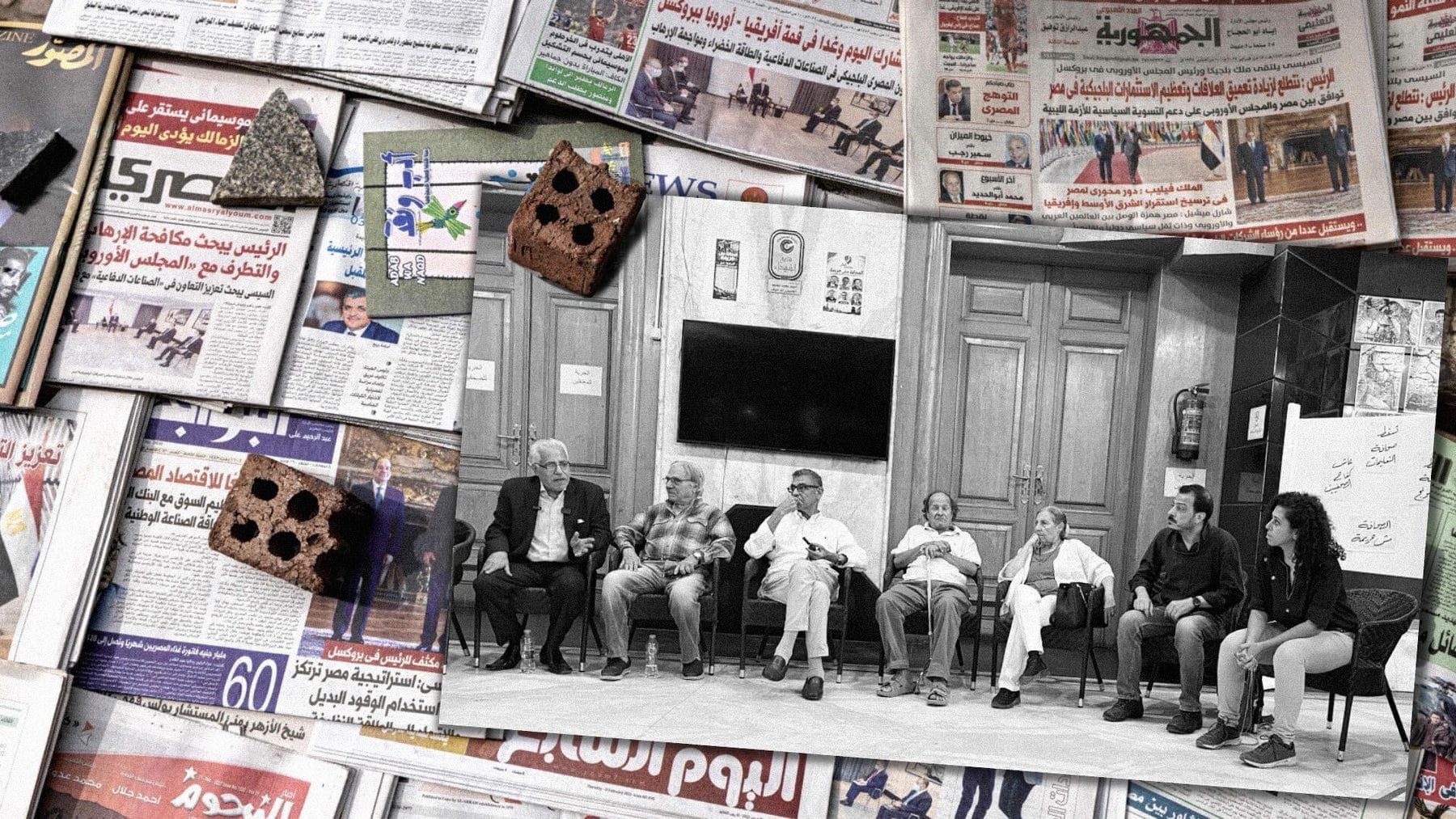
Word spread the way it does now, through social media posts, journalists’ pages and a knot of phone calls I can no longer untangle. Colleagues were gathering at the Journalists Syndicate every day. So I went too. The Syndicate is a union with a long history of standing up for us, and I joined my colleagues there in solidarity with those who had been detained. Not everyone could come every day, but there was always someone — on some days just four, on others more than 20. 

Even our older colleagues, in their 60s, 70s and 80s, showed up. Ustaz Mohamed Abdel Kouddous, who once headed the Syndicate’s freedoms committee, is recovering from an accident and could not be there in person, but he was with us through his voice and his written messages. For as long as I can remember, he has been there for every struggle: at Al-Ahram, arguably Egypt’s most prominent daily newspaper; and at the Syndicate, with his megaphone, firing us up. He and I don’t share the same politics, but it has never mattered. 

In 2008, on the day of a nationwide strike, plainclothes officers dragged him from his car in broad daylight and held him until nightfall. He asked the Syndicate to demand an investigation, though he expected nothing to come of it. “We do what we need to do,” he said then. It could be the motto of our sit-in today.

Many of us feel embarrassed to eat or to have a cup of tea, not knowing whether our colleagues inside have the same luxury. When I kiss my girls goodnight, I feel ashamed that my colleagues in jail cannot do the same.

Illustration: Anna Jibladze, using images by Lina El Wardani and Getty Images

I keep thinking about how we got here.

Under Egypt’s former president Hosni Mubarak, the red lines were clear. You did not touch the head of state, his wife and his sons, or a certain institution (the military). But everything else was fair game. We knocked ourselves out writing about poverty and corruption, labor rights and children’s rights, domestic violence, sexual harassment and female genital mutilation. 

Then came 2011, and a revolution unlike any other. In Tahrir Square, we rejected violence, and our chant was “selmeya, selmeya” (peaceful, peaceful).

When we brought Mubarak down, he didn’t flee like the Tunisian “strongman” Zine al-Abidine Ben, and we didn’t lynch him like Muammar Gaddafi in Libya. We put Mubarak on trial, in a courtroom. It was dignified. It was the revolution of the dreamers.

In those few years, Egyptian journalists lived with freedoms we had never known. But dreamers are not politicians.

We had lived for decades with no politics: no real political parties, no real elections, no way to learn how power works. So when the door was opened, we didn’t know how to build what we had dreamed of. People kept asking, “What is the alternative?” We had the dream, but not the tools.

What followed our revolution was the opposite of what we fought for: restrictions on a scale we had never seen. The red lines blurred and multiplied, until no one knew where they were anymore. The story of our country, of our revolution and of our journalism is the same story. We are not organized. We are not politicized. But we dare to dream.

Today, at least 25 journalists are behind bars in Egypt, says the Committee to Protect Journalists, almost all of them in pretrial detention. That period is technically limited to two years, but prosecutors file new charges and renew detentions. Some, like the photojournalist Hamdy al-Zaeem, have spent a decade in and out of detention without a single conviction. My colleague Haidar Kandil was taken in June, after documenting arrests of Egypt’s Shia minority.

On the evening of October 14, the lobby of the Syndicate’s headquarters in downtown Cairo was filled with banners and cartoons. Three colleagues and I sat down to write letters to our jailed colleagues: 26 names in total. We fussed over how to organize the letters: how to arrange the names, whether the envelopes should be open or closed, which color went with which name. Colleagues with beautiful handwriting wrote each name in calligraphy. Then we realized we couldn’t spend the whole evening rearranging the deckchairs. At some point, we had to start writing.

But our minds were blank. What could we say? “Why are you inside, and why are we free?” “We feel guilty that we are free and you are paying the price. Maybe we should have paid it instead.”

Of the 26, the only one I have worked with is Haidar. He had a good eye for a story. Like most of the young journalists I work with, he needed guidance, but he was always responsive to edits, to make changes and turn in better copy. We spoke on the phone and exchanged emails and texts, but we had never met. I only know his face from photos online, and here I am pinning his photo on the noticeboard in the syndicate with a #FreeThemAll banner. 

In the end, all I wrote was: “I miss you, Haidar. I hope to see you soon. Hang in there. Love, Lina.”

Whenever I feel small, I remind myself that this Syndicate has always fought the good fight. That same evening, the veteran journalist Medhat El-Zahed told us how, during the 1989 Iron and Steel workers’ strike, he and his leftist colleagues were arrested and tortured. The Syndicate’s head at the time, Makram Mohamed Ahmed, was close to the authorities. Still, he protested over the treatment of journalists and visited them in prison.

Today, for the first time, the head of our Syndicate is one of us. Khaled El-Balshy is a dreamer. Eman Ouf, who heads the freedoms committee, is one of us too. The Syndicate has pledged to defend all six Matsadaash journalists. It has asked the Attorney General to investigate the abuse allegations. Its statement chose every word with care, stressing its commitment to the law and to the country’s higher interests, and asked only that our colleagues be released on the Syndicate’s guarantee, or any other, given their young age. It was the most modest of requests. Even that was too much for some.

The tide is so high, and we are so low. 

After more than two weeks, we have suspended the sit-in. We are not leaving the Syndicate, and we are not giving up. In our statement, we promised to keep standing with our colleagues through other events, because the battle for press freedom “needs a long breath.”

On October 18, eight independent news outlets from Egypt, Lebanon, Tunisia and Syria, among them Mada Masr and Al-Manassa, announced a joint newsroom to fact-check “Egypt Forum 2026,” the government’s “achievements conference.” The summit runs from October 19 through to October 24 – six days for six journalists. The eight newsrooms have united under the slogan: “Until they return, the fact-checking continues.” The dreamers are learning to organize.

We journalists and dreamers, like those of us who gather in the Syndicate, are stubborn. Many are behind bars of some kind: real ones, imaginary ones, or the bars of a censored internet. But we always walk towards the light. Journalism is how we live and breathe. If we don’t fight for it now, there will be nothing left to fight for tomorrow. No profession, no dignity, and no Syndicate.

This story was published in collaboration with Egab.

Related Articles

The post In Egypt, the government has seized a newsroom appeared first on Coda Story.

  •  

Bakú pone punto y final a la fórmula «una nación, dos Estados»  

Ehsan MOVAHEDIAN

Únete a nosotros en Telegram , X y VK .

Escríbenos: info@strategic-culture.su

La advertencia de Aliyev contra la influencia extranjera llega en medio de una disputa con los círculos políticos turcos sobre la religión, Karabaj y las relaciones de Azerbaiyán con Israel.

En el octavo congreso del Partido del Nuevo Azerbaiyán, celebrado en Bakú el 2 de octubre, el presidente Ilham Aliyev ofreció una descripción inusualmente directa de lo que denominó la «seguridad ideológica» de Azerbaiyán. Era tan importante como la seguridad física, afirmó, ya que las amenazas ideológicas podían traspasar las fronteras a través de Internet, los ciberataques y la inteligencia artificial (IA).

Hizo un llamamiento a la educación y al patriotismo para defender el espacio político del país, al tiempo que insistió en que Azerbaiyán no necesitaba «ayuda ni patrocinio» extranjeros. Añadió que otros Estados no debían interferir en sus asuntos ni decirle cómo vivir.

Estas declaraciones las realizó el presidente y líder del partido gobernante en un congreso en el que se definió su rumbo político. Aliyev situó el control de la esfera ideológica de Azerbaiyán al mismo nivel que el poder militar, la independencia económica y la toma de decisiones soberana.

No mencionó a Turquía como fuente de ninguna amenaza. Sin embargo, sus palabras se produjeron en medio de críticas en los círculos políticos y mediáticos turcos hacia las políticas internas de Azerbaiyán, especialmente su trato a las estudiantes que llevan hiyab. El 26 de septiembre, el Consejo de Medios de Comunicación y Radiodifusión de Azerbaiyán acusó a círculos no identificados de llevar a cabo una campaña contra el país en los medios turcos y en las redes sociales.

Ese enfrentamiento agudiza aún más la fórmula «una nación, dos Estados». La proximidad política nunca ha eliminado las diferencias en los intereses nacionales. A medida que Ankara y Bakú se han ido acercando, la cuestión de quién define su identidad común —y qué influencia permite— se ha vuelto más difícil de eludir.

Los analistas que hablaron con The Cradle consideran que el discurso de Aliyev es un intento de renegociar la relación, más que de romperla. Azerbaiyán no tiene ninguna intención aparente de renunciar a su asociación militar, económica y cultural con Turquía. Sin embargo, Bakú quiere dejar claro que el parentesco no otorga a Ankara ninguna autoridad sobre la política interna azerbaiyana.

Una advertencia que se ha escuchado en Ankara

Hazel Yalin, investigadora especializada en las relaciones turco-rusas, interpreta que el discurso estaba dirigido, en gran medida, al Gobierno del presidente Recep Tayyip Erdogan. El analista turco Aydin Sezer también percibe un mensaje diplomático indirecto. Según Sezer, Aliyev se dirigió a varios públicos, entre ellos Occidente, Armenia, Rusia e Irán, pero es posible que Ankara se encontrara entre sus principales destinatarios.

El contexto inmediato es la controversia sobre la religión en las escuelas de Azerbaiyán. Una enmienda de septiembre a las normas de vestimenta de las escuelas públicas prohíbe prendas adicionales consideradas incompatibles con la educación laica. La decisión no menciona el hiyab por su nombre, pero las noticias de que se ha impedido a algunas niñas asistir a clase por llevar pañuelo en la cabeza han suscitado objeciones por parte de críticos turcos.

Ankara no ha abordado públicamente el tema con Bakú. Sezer interpreta la exhortación de Aliyev a que otros países se ocupen de sus propios asuntos como una advertencia contra convertir el lenguaje de la hermandad en un derecho a supervisar a Azerbaiyán.

La propia alianza reconoce este límite. La Declaración de Shusha de 2021 celebra «una nación, dos Estados» y formaliza una amplia cooperación, pero también compromete a Ankara y Bakú a respetar la soberanía y la no injerencia en los asuntos internos de la otra parte. La disputa actual ha puesto en contacto esas dos partes de la declaración.

Si los actores políticos turcos reclaman voz en la política religiosa y educativa de Azerbaiyán alegando una nacionalidad compartida, el margen de soberanía ideológica de Bakú se reduce. Si esas cuestiones pertenecen exclusivamente a Azerbaiyán, el lema sigue siendo una expresión de afinidad cultural y solidaridad política, sin otorgar a ninguna de las dos capitales un mandato sobre la otra.

¿A quién pertenece la victoria en Karabaj?

Yalin afirma que los canales de noticias y las cuentas en redes sociales pro-Erdogan han acusado a Bakú de presionar a los musulmanes en materia de prácticas y organización religiosas. Algunos también han presentado la victoria de Azerbaiyán en la Segunda Guerra de Karabaj como algo que debía a Turquía, calificando las políticas laicas de Aliyev de ingratas y exigiendo respeto por las sensibilidades religiosas turcas.

«Este argumento también se ha esgrimido basándose en el lema “dos Estados, una nación”: si los turcos y los azerbaiyanos son miembros de la misma nación, entonces, según este razonamiento, el Gobierno azerbaiyano también debería tener en cuenta la voz de esa nación».

El discurso de Aliyev en el congreso apuntaba en la dirección opuesta. Afirmó en repetidas ocasiones que Azerbaiyán había actuado por su cuenta, había pagado sus armas y se había impuesto sin ningún patrocinador externo. Esta fue su interpretación política de la guerra; no debe interpretarse como una conclusión de que el apoyo turco no desempeñó ningún papel.

De hecho, la Declaración de Shusha recoge explícitamente el agradecimiento de Bakú por el apoyo moral y político de Turquía. La controversia gira en torno a quién puede atribuirse el mérito político del resultado y qué derechos podría otorgarles ese mérito para exigir algo posteriormente.

Para Aliyev, la victoria militar forma parte de un proyecto más amplio de construcción del Estado. Describió la independencia, la fortaleza económica, el poderío militar y la confianza en las capacidades azerbaiyanas como la línea de actuación duradera de su Gobierno. Cuanto más se convierte esa narrativa en el eje central de su legitimidad, menos margen queda para que otra capital se presente como la artífice del éxito de Azerbaiyán.

La implicación es significativa: no se puede permitir fácilmente que un actor externo —ni siquiera uno amigo— se convierta en el artífice político del éxito de Azerbaiyán.

Jafar Haghpanah, profesor de la Universidad de Teherán, sostiene que Bakú ya no quiere ser tratado como un socio subordinado de Turquía. Yalin identifica tres elementos en la postura de Aliyev.

El primero es la preocupación por la presión ideológica: según la interpretación de Yalin, el intento de golpe de Estado de 1995 contra el padre de Aliyev, Heydar Aliyev, dejó una advertencia duradera sobre las posibles consecuencias de la actividad política vinculada a Turquía.

El segundo es la resistencia a las descripciones nacionalistas turcas de Azerbaiyán como un «hermano pequeño». El tercero es la creciente confianza de Aliyev en que Azerbaiyán puede ejercer su propia influencia política en toda la región. Las acusaciones relativas a figuras turcas en el episodio de 1995 no deben confundirse con la responsabilidad por parte del actual Gobierno turco.

Bakú tiene ahora un mayor peso militar y económico que a principios de la década de 2000. La Compañía Estatal de Petróleo de la República de Azerbaiyán (SOCAR) ha ampliado el alcance energético de Azerbaiyán; el país ha establecido profundos lazos con Israel, relaciones estratégicas con China y Estados Unidos, y ocupa un lugar destacado en la Organización de Estados Turcos (OTC). Esas conexiones le dan más margen para rechazar una jerarquía dentro de su alianza más estrecha.

Yalin cita el respaldo de Sinan Ogan a Erdogan en la segunda vuelta de las elecciones presidenciales de Turquía de 2023 como ejemplo de cómo la influencia azerbaiyana podría convertirse en un tema de debate en la política turca. A Ogan se le preguntó si Aliyev había influido en su decisión y lo negó explícitamente, afirmando que Aliyev no le había llamado. La acusación no puede demostrar que Bakú dirigiera su elección. No obstante, su difusión muestra la rapidez con la que la cuestión de la influencia funciona en ambos sentidos.

El alcance de la seguridad ideológica

La advertencia de Aliyev fue más allá de la controversia sobre los uniformes escolares. Su respuesta consistió en reforzar la educación y el patriotismo y, con ellos, el control del Estado sobre cómo se interpretan su historia y sus victorias.

Turquía dispone de medios inusualmente potentes para llegar a ese público: la televisión, las redes sociales, las universidades, las redes religiosas, la cultura popular, las empresas y las instituciones del mundo turco en general. Esas conexiones han ayudado a mantener la alianza. También pueden inquietar a Bakú cuando los debates políticos turcos comienzan a moldear las expectativas sobre el orden interno de Azerbaiyán.

El problema para Aliyev no es que la influencia turca sea uniformemente hostil. Es que incluso una influencia amistosa puede seguir desafiando la autoridad de un Gobierno para definir la identidad y la política nacionales. Su énfasis en la seguridad ideológica sugiere que pretende proteger esa autoridad incluso dentro de la asociación más estrecha de Azerbaiyán.

El lugar de Israel entre los aliados

La relación de Azerbaiyán con Israel añade otra fuente de tensión. Ankara ha condenado la guerra de Israel contra Gaza, mientras que Bakú ha mantenido estrechos vínculos en materia de seguridad y energía con Tel Aviv. Las armas israelíes han constituido una parte importante del arsenal de Azerbaiyán, y el crudo azerbaiyano ha seguido llegando a Israel a través del puerto de Ceyhan, en Turquía, a pesar de las restricciones comerciales declaradas por Ankara. The Cradle ha informado sobre la relación en materia de armas y petróleo y sobre los continuos flujos de petróleo.

El analista del Cáucaso Ahmad Kazemi no considera que las diferencias entre Ankara y Bakú sean lo suficientemente profundas como para amenazar su alianza. No obstante, cree que la confianza de Aliyev se basa en parte en el apoyo israelí.

Según la valoración de Kazemi, «si Bakú se viera obligada a elegir entre Ankara y Tel Aviv, elegiría a Israel». También sostiene que Bakú sabía que la presencia de su representante durante el discurso del primer ministro israelí, Benjamin Netanyahu, ante la ONU en septiembre desagradaría a Turquía. Un análisis de la Agencia Anadolu reveló que Turquía se sumó a la protesta contra el discurso, mientras que Azerbaiyán siguió estando representado.

Kazemi ve otra consecuencia para el Cáucaso. Sostiene que la preocupación compartida por Turquía e Irán respecto a la posición de Israel en Azerbaiyán podría acercar a Ankara y Teherán en algunas cuestiones, incluidos los corredores de transporte regionales. Dicha convergencia tendría que lidiar con la amplia cooperación estratégica y de defensa de Turquía con Bakú.

Haghpanah ofrece una interpretación más contundente del discurso pronunciado en el congreso:

«Aliyev pretendía con su discurso indicar a Turquía que Azerbaiyán es el principal aliado de Israel y que Ankara debería moderar su tono hacia Tel Aviv y evitar adoptar una postura dura contra este país. Predice que Turquía e Israel entrarán en conflicto por los recursos energéticos del mar Mediterráneo, así como por sus intereses geoeconómicos y geopolíticos».

Yalin interpreta de manera similar las referencias de Aliyev a la producción y venta de petróleo de Azerbaiyán como una respuesta a las críticas a su comercio con Israel. Esas observaciones por sí solas no permiten determinar las intenciones de Bakú. Por su parte, Dariush Safarnejad, un destacado experto en el Cáucaso, señala la relación «petróleo por armas», pero espera que la influencia israelí en Azerbaiyán se reduzca en cierta medida si la cooperación directa de Bakú con Washington se intensifica tras la iniciativa de paz con Armenia. También hace referencia al debate sobre unos lazos más estrechos con la OTAN.

Los demás socios de Bakú

Aliyev aprovechó el congreso para describir a China y a EE. UU. como las dos superpotencias mundiales y para destacar las alianzas estratégicas de Azerbaiyán con ambas. El esfuerzo de Bakú por establecer vínculos con centros de poder rivales le proporciona alternativas a la dependencia de un único socio, ya sea turco, ruso, chino u occidental.

Sus comentarios sobre Armenia y Rusia encajan en ese contexto. Yalin llama la atención sobre la afirmación de Aliyev de que Armenia reconoció la integridad territorial de Azerbaiyán en octubre de 2022, con el consiguiente reconocimiento de la soberanía azerbaiyana sobre Karabaj.

Aliyev presentó el restablecimiento del control azerbaiyano como un logro conseguido frente a la presión de las grandes potencias. Yalin considera que esto forma parte del intento de Bakú de reposicionarse tras la guerra.

Azerbaiyán y Armenia rubricaron un borrador de acuerdo de paz en Washington en agosto de 2025, aunque aún no se ha firmado el tratado definitivo. Safarnejad sostiene que unos lazos más estrechos con Washington podrían dar a Bakú más margen para tratar directamente con EE. UU. y, con el tiempo, reducir su dependencia de Israel.

Hermandad sin un socio dominante

Ninguno de los cinco analistas sugiere que sea inminente una ruptura entre Ankara y Bakú. Safarnejad destaca la profundidad de su interdependencia: la cooperación militar, las infraestructuras energéticas, los corredores de transporte, la inversión, las industrias de defensa y las instituciones culturales confieren a la alianza una base sólida.

La OTS refuerza esos lazos. En septiembre, funcionarios turcos y azerbaiyanos seguían debatiendo una cooperación más profunda en materia de defensa y seguridad.

Azerbaiyán sigue queriendo a Turquía a su lado en materia de seguridad, comercio y diplomacia regional. Aliyev marca el límite en lo que respecta a la influencia de Ankara sobre la política religiosa de Bakú, sus vínculos con Israel y sus relaciones exteriores en general. Para él, el lema «una nación, dos Estados» otorga a Azerbaiyán la última palabra sobre sus propios asuntos.

Hasta qué punto Bakú podrá hacer valer esa reivindicación dependerá, en parte, de la política interna de Turquía tras Erdogan, de la durabilidad de la relación de Azerbaiyán con Israel y de su capacidad para gestionar las relaciones con Washington, Moscú, Pekín y Teherán sin perder el apoyo de Ankara.

Para Irán, un Bakú más seguro de su independencia pero más dependiente de Israel difícilmente resultaría tranquilizador. La alianza puede perdurar; la discusión sobre quién establece sus límites ya está en marcha.

Publicado originalmente por  The Cradle
Traducción:  Geopolítica rugiente

  •  

In Modi’s India, somebody is always watching

In May, William Tharien, a 19-year-old student, made his second attempt at passing NEET, India’s national entrance exam for would-be medical students. Passing the test was the only way William would be eligible to study to be a doctor, surgeon, dentist or vet and he was competing with about 2.2 million other students for one of about 130,000 places in medical schools around the country. What makes the test even more nerve-wracking is that only half of these places are available at heavily subsidized state-run colleges, rather than expensive private institutions.

It can take students up to two years to prepare for these exams, with parents going into debt to pay fees at tuition centers entirely devoted to cracking the test. Days after William, and millions of others, took the test on May 3, authorities discovered that the paper had likely been leaked and circulated on social media platforms like Telegram. The results were voided.

Around the same time, the Chief Justice of India’s Supreme Court compared young people “who don’t get any employment and don’t have any place in a profession” to cockroaches and parasites. In a country with the largest population of 15- to 29-year-olds in the world (nearly 370 million people) and high levels of youth unemployment, particularly amongst the educated, the judge’s remarks struck a raw nerve.

It led to the formation of the Cockroach Janta Party — a mocking reference to India’s governing Bharatiya Janata Party, led by prime minister Narendra Modi — initially as a satirical meme. But the cancellation of NEET gave the Cockroach Janta Party real-life relevance and made it an outlet to channel the extensive frustration and anger of India’s youth. 

In neighboring Nepal, Bangladesh and Sri Lanka, so-called Gen Z protests between 2022 and 2025 had toppled governments. 

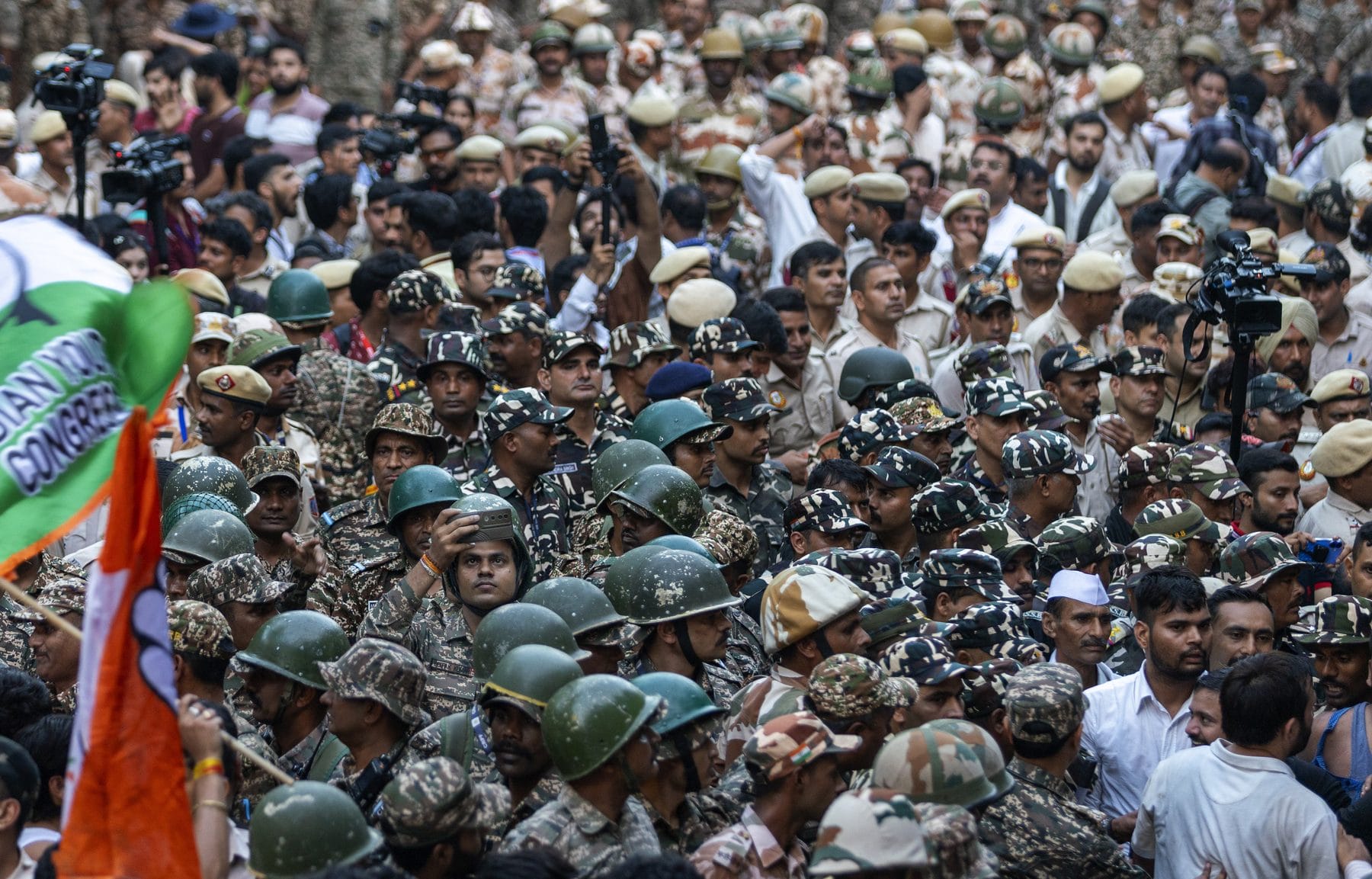
In June, William joined tens of thousands of students in Jantar Mantar, an iconic venue for public protest in the Indian capital Delhi, to call for the resignation of Minister of Education Dharmendra Pradhan over the NEET debacle. The demonstrations lasted for weeks, even as the Delhi Police resorted to tear gas, pellet guns, electric shock devices, and lathis (nearly six-foot-long bamboo sticks) to disperse the crowds. William was a regular.

“I always felt watched,” he told us. At metro stations, on his way to the protests, he said he repeatedly encountered the police. “They made sure that we saw them and that we should feel intimidated by their presence and their numbers.”

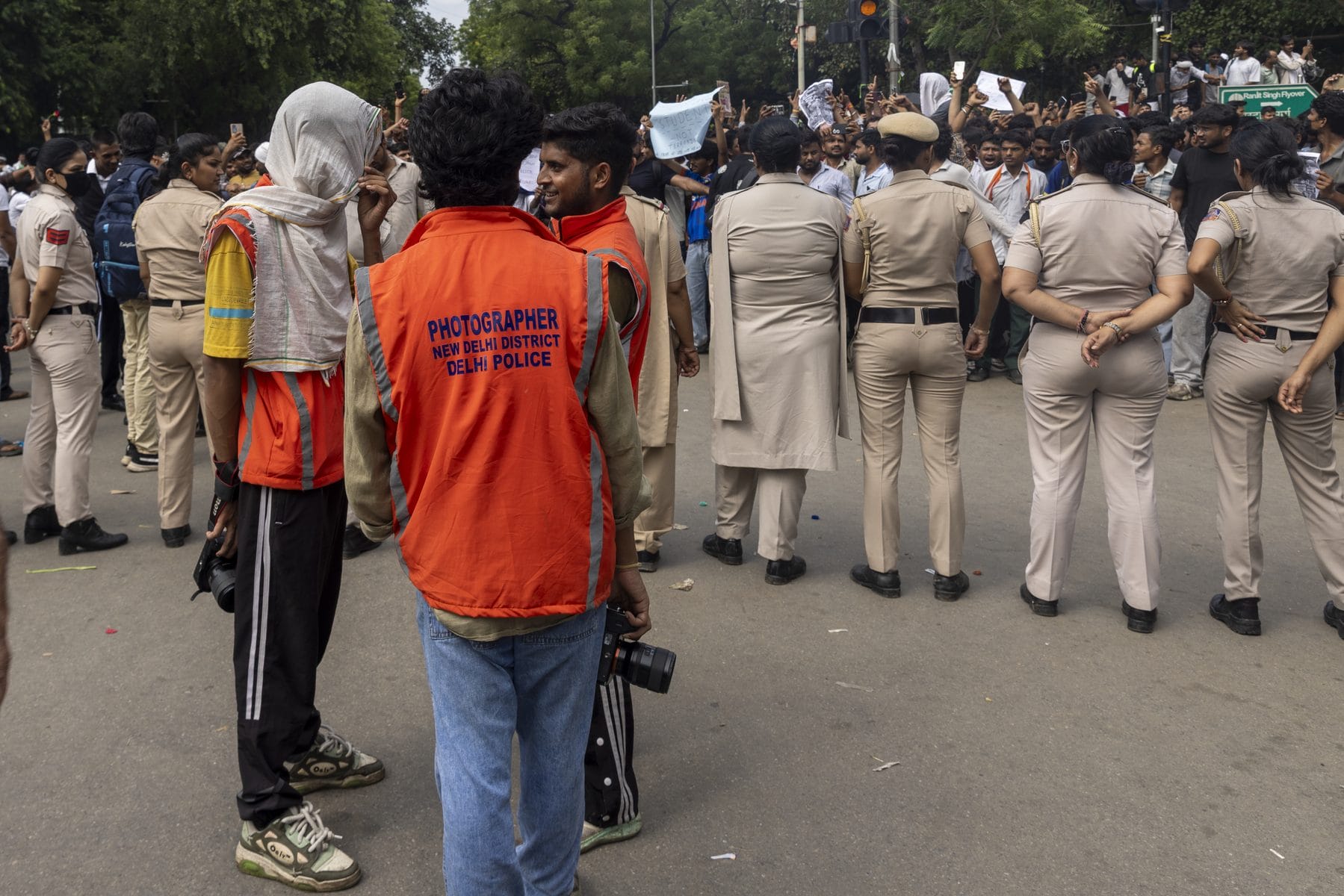
As journalists, we covered the June-July protests, including on July 20 when the police brutality reached an ugly peak as protesters marched towards the Indian parliament. Artificial intelligence-enabled CCTV cameras installed under Delhi’s “Safe City” project lined the streets in and around Jantar Mantar. A permanent surveillance tower stood at the center of the protest site, recording around the clock. Multiple drones circled overhead. Photographers hired by the police moved through the crowd. Some officers carried body cameras, and at least one police officer was seen wearing Ray-Ban Meta smart glasses.

Two police surveillance vehicles were parked just outside the entrance to Jantar Mantar. One was Ikshana (the Sanskrit for, literally, the act of seeing), an AI-powered police van with eight cameras that used facial recognition technology to match faces to police databases in real time. The other was a mobile command center. 

According to William, the surveillance was not limited to the protest site. “I saw police detaining students at the metro station,” he said. “They were recognizing students from footage, identifying them by their bags, or style of mask or sunglasses.”

Even after the protests stopped, with the July 25 resignation of Pradhan, the education minister, William said the police paid visits to students in their neighborhoods. They were tracking down protesters. On August 3, he said, two police officers showed up at his lodgings. He was alone. “We have photos of you,” the police told him, “in colour. You’ve been seen going to the protest site on multiple days and also seen at the metro station.” Insisting that attending protests was a democratic right, William refused to let the police into his room without a warrant.

According to the Indian Express, the Delhi Police used surveillance footage accrued during the NEET protests in the summer to identify at least “2,800 people with a criminal background” who would be be prevented from protesting against Gyanesh Kumar. 

Aishe Ghosh, a prominent student activist and national office holder at the left-wing Students’ Federation of India, has challenged the Indian government and the Delhi Police in court over the indiscriminate use of surveillance technology. Not only were the authorities documenting the protests, she alleges, they were using the footage to threaten protesters with public exposure.

Long an object of surveillance, Ghosh, who was a leader of the NEET protests, said the police entered the Communist Party of India (Marxist) headquarters in Delhi to arrest her in August on the basis of protests she had attended five years earlier in 2021. Describing the attempt to arrest Ghosh as a “continuing witch hunt against student protesters,” the CPI(M) added that it was evidence of “the Modi government’s escalating assault on democratic rights.”

Ishan Tankha

Modi’s surveillance state   

Hearing Ghosh’s litigation, the Delhi High Court appeared to suggest that the urgency to examine her specific allegations had dissipated since the NEET protests had concluded. The judges suggested that she file a more general petition.

The NEET protests proved only to be the start of the Cockroach Janta Party’s precipitous rise as serious, youth-led opposition to the Modi government, in power since 2014 and seemingly determined to use every arrow in its quiver, from opaque sources of funds to the takeover of independent institutions to the use of surveillance technology, to stifle dissent. In October, the “cockroaches” poured into Delhi’s streets again. 

This time, they wanted the resignation of Gyanesh Kumar, India’s Chief Election Commissioner, a constitutional role meant to be entirely independent, apolitical and focused on maintaining the integrity of the Indian electoral process. An investigation by the Indian Express newspaper revealed that despite 14 objections in the last 10 months from the two other members of the election commission, Kumar had allegedly illegally taken unilateral decisions that resulted in voters being left off electoral rolls. India is currently undertaking an extensive revision of its voter lists that has controversially already disenfranchised 130 million people and potentially swayed state elections in favour of the governing BJP.

Kumar has not directly addressed the Indian Express’s findings. And while Modi too has remained typically silent — in his 12 years as prime minister, he has yet to call a single press conference — the Delhi Police has once again used violence and arbitrary arrests to crack down on still ongoing protests. Jantar Mantar, the de facto site of protests in Delhi since 1993, has been officially shut down. Prominent protesters, including Aishe Ghosh and the founders of the Cockroach Janta Party, have been detained. The opposition led by Congress Party scion Rahul Gandhi — the son, grandson and great-grandson of former Indian prime ministers — has been galvanized. 

But India’s next general election is not until 2029 and the next major state legislative election is not until February 2027 at the earliest. Maintaining momentum is a task Gandhi has yet to show he can manage. 

Meanwhile, the BJP continues to use friendly mainstream television media, alongside its heavy-handed policing, to argue that the protests are marginal, paid for by foreign sources and disliked by the large majority of Indians.

Fallible facial recognition tech

Technology researcher Srinivas Kodali told Coda that India’s efforts to modernise its policing system were stepped up after terrorist attacks in Mumbai in November 2008. Police stations across the country were connected, with access to criminal records and a tracking database. If someone attends a protest somewhere in India, Kodali explained, and has a police report filed against them, that information will be available to every police department in the country. He described the approach as “360-degree profiling,” pulling data together from facial recognition technology, surveillance towers, phone records, social media activity, and government databases including electoral records.

Delhi Police has said its use of technology and AI is meant to maintain law and order and identify people who already have a criminal record and not to randomly profile protesters. However, privacy researchers and lawyers warn that sophisticated surveillance systems can make participation in protests traceable long after the crowds have dispersed. 

Much of the technology for this work is supplied by a growing group of private companies. Ikshana, the AI-powered police van used to monitor protesters in Jantar Mantar back in July, is one example. Rahul Bhardwaj, the Chief Growth Officer at analytics firm Intozi based in Gurugram, a tech hub on the outskirts of Delhi, said the company provides the software layer behind Ikshana’s system. Intozi processes video feeds through AI applications designed for tasks including crowd monitoring, detecting weapons and identifying people against police databases.

Intozi has previously deployed its facial-recognition technology for government security operations at high profile international summits in Delhi. Asked specifically whether its technology was used at Jantar Mantar this summer, though, Bhardwaj cited confidentiality obligations.

The company said that its role ends after its system is installed on police infrastructure, and that it does not retain the database or continue to access the system once it has been handed over to the police. “Images of people who are not in the police database,” Bhardwaj said, “are automatically blurred within seconds, while records associated with people already registered in police databases are retained by the police.”

That places responsibility for the technology and its subsequent use with the police. 

Innefu Labs, whose AI Vision facial-recognition software has been used by Delhi Police in criminal investigations, declined to answer questions about data retention, legal safeguards or its operational relationship with police.

Another company, AjnaLens, confirmed its direct role in live policing. Kuldeep Pathak, Associate Director at AjnaLens said the company had supplied AI-enabled smart glasses to Delhi Police, first used in January 2026 in security operations during India’s Republic Day celebrations. The company confirmed that its glasses were used again during the NEET protests in Jantar Mantar. According to Pathak, their system was given access to a police database containing around 65,000 people with criminal records. He said 14 people were arrested after being recognized through the glasses.

Experts we spoke to questioned what authorises private vendors to access and process police databases, or whether an independent authority audits the system.

Ishan Tankha

Surveillance without accountability

“What statutory regime operates in this context?” asked Menaka Guruswamy, a senior lawyer who is involved in litigation in the Supreme Court over the use of facial recognition technology at Jantar Mantar. “Where is this information hosted? Is it hosted by the private vendor, the state or the police? We know nothing.”

Guruswamy said tenders and contracts between the state and private companies should make it possible to establish what data each party is permitted to access and retain.

Disha Verma, AI researcher at Tech Global Institute and Ashoka University, claims these private vendors get access to police datasets that help them train their AI systems. “They (vendors) did not need to buy training datasets from anywhere,” she says. “They didn’t need to test their product anywhere else. They ended up with a curated, very accurate facial-recognition system.” The data provided by the police, she added, would help vendors sell their product for profit to other companies that want to make use of surveillance technology.

“What I am most concerned about is how much impunity and data and power this gives the private vendors,” Verma said, calling it a “parallel police state.” 

And then there’s the accuracy of the technology, little of which has been subject to question or scrutiny.

In response to Right to Information requests made by the digital rights group Internet Freedom Foundation (IFF) in 2022, the police said it considered facial-recognition results with an accuracy score of 80 percent or above as a positive match. Only results below the 80 percent threshold were “subject to further verification using corroborative evidence.”

But the distinction between technical facial recognition matches and actual verified identifications became harder to ignore after the NEET protests in Jantar Mantar in the summer. Delhi Police said its facial recognition system identified 2,873 people with previous criminal records at the protest between July 20 and 26. But at least 25 of those people were actually in jail at the time they were supposed to be protesting.

Intozi’s own description shows why that distinction is not always straightforward. Bhardwaj told us that the company’s recognition threshold is “generally kept above 70 to 80%” and once that threshold is crossed, “it is a 100 percent match for us.” This is why, argues Guruswamy, the Supreme Court lawyer, a statutory framework is necessary. “There is no foolproof system,” she said. “That is why you need accountability, a legal regime, data protection and safeguards governing how these interactions take place.”

Nearly six years ago, Ahmed* (name changed on request) experienced the pitfalls of the Delhi Police’s then fledgling facial recognition technology and surveillance system. He was identified by AI-assisted video analysis as being present during deadly communal violence in northeast Delhi in 2020. Ahmed spent around 18 months in jail, accused of killing a police official during the riots. He insisted that the man seen in the footage used as clinching evidence was someone else.

“My hair was cropped short, and I had different shoes. Only the white shirt and dark trousers matched. But that does not make anyone wearing those clothes me,” Ahmed told us. He said he had shut his shop around noon on the day of the violence and gone home. Footage from one security camera showed him near the lane where he lived. But police later said it had used Amped FIVE, a video and image analysis tool, and AI Vision, facial recognition software made by Indian company Innefu Labs, to place Ahmed at the scene of the crime.

In September 2021, Ahmed was released on bail. The court noted that several people in the area wore similar clothes to those shown in the footage and that the video analysis identifying Ahmed across different recordings would have to be tested at trial.

By then, though, the damage to Ahmed’s life had already been done. Before his arrest, Ahmed ran a garments shop and employed a couple of workers. The shop did not survive his incarceration and, while on bail, he now works at a street stall, barely surviving on his meagre income.

Facial recognition systems turn facial features into numerical data and compare them with stored images, producing a similarity score or a list of possible matches. In a one-to-many search, a single face from a protest can be compared against an entire database.

“It's able to recognize a face the way an iPhone camera might,” Disha Verma, the Ashoka University researcher said. An iPhone's front camera works because everyone looks at it from roughly the same angle in consistent light, she added; but a police station is often dimly lit, angles vary, and the camera used to take the photo might be old and pixelated. "The system the police are using usually has a very large error rate, just inherently," Verma said.

Katie Kinsey, Chief of Staff and Tech Policy Counsel at the New York University School of Law’s Policing Project, told us that broad accuracy claims tell little about how a facial recognition system might work once it leaves controlled testing conditions. “A model tested on one dataset may behave differently when the cameras, lighting, image quality and population change,” she said. 

Live video presents an additional difficulty because the images are less controlled and officers may be acting on alerts as events unfold. Kinsey said systems should be tested under the actual conditions in which police intend to use them.

Verma also raised concerns about biases affecting facial recognition systems. “If the police think a criminal looks like a dark-skinned bearded young man,” Verma said, “that is the data they will collect and that is what will train the AI.” It would, she added, create a feedback loop in which technology does not remove police prejudice but reproduce and legitimise it instead. 

India has constitutional privacy protections and general data protection legislation, but no dedicated law for the use of facial recognition technology. Basically, “you won’t know you are on a watch list,” researcher Srinivas Kodali told us.

We reached out to the Delhi Police Cyber Cell with questions about the use of live facial recognition technology and other surveillance systems during protests, but did not receive a response. 

Some jurisdictions have tried to place clearer limits on this type of power. For example, under the European Union’s AI Act, real-time remote biometric identification by law enforcement in public spaces is generally prohibited, with narrow exceptions. Even then, its exceptional use is subject to necessity and proportionality requirements and generally requires prior judicial or independent authorization.

Police in India have long maintained categories of people they consider suspects or potential troublemakers. For instance, in the south Indian state of Telangana, police have a category called “rowdy sheets” for people considered habitual offenders or threats to public order.  With facial recognition technology, these categories have only widened.  

Lawyer Menaka Guruswamy wondered what might happen when someone photographed at one protest is then seen at another protest. “Are we being criminalized simply for attending protests?” 

Verma said that one of the significant shifts that she has witnessed over the years is how the technologies once associated with borders and the military have moved to civilian policing. The militarization of the Delhi Police has been evident as paramilitary personnel dressed in camouflage have been assaulting and detaining protesters.

Still, the protesters come. 

William Tharien told us that despite being a known face to the Delhi police, despite his fears and struggles with his mental health, despite the monitoring of his social media, he is not going to stop protesting. 

And with Delhi’s cockroaches still calling for the resignation of India’s chief election commissioner, still warning of the danger posed to Indian democracy by the Modi government’s authoritarian tendencies, how, William said, could he give up the fight now?

Related Articles

The post In Modi’s India, somebody is always watching appeared first on Coda Story.

  •  

Hero Oregon Dad Showed the Importance of Defying Restrictive Gun Laws

Silver Rail Elementary School | Google Earth

Last week, not only did Oregon's restrictive gun laws fail to stop a shooter intent on killing innocent people, but a passing good Samaritan had to violate those laws to end the murder spree. Fortunately, authorities don't appear intent on prosecuting Kaylub Giamanco, father to two girls who attend the school, for ignoring the ban on guns on school grounds to save lives. But the law is clearly more of a threat to people with good intent than it is to those bent on doing harm. Such laws should and must be defied, but lawmakers need to remove these legal minefields before they do more damage.


A Hero Dad With a Gun Stops a Murder Spree

"I want to start by thanking and praising the quick thinking and courage of the Silver Rail Elementary School staff and parents—and the first responders who rushed to the scene," Oregon Gov. Tina Kotek commented in a press release after the attack by a 16-year-old shooter at Silver Rail Elementary School in Bend, Oregon. "And to the community member who heroically intervened to stop further loss of life, your actions carry a heavy emotional burden—and my thoughts are with you."

That community member was Kaylub Giamanco, who had two daughters at the school. He was reportedly driving past when he saw the shooter approaching Silver Rail with a shotgun in hand. Giamanco parked his vehicle, grabbed his firearm, and followed the shooter, who had blasted his way through the facility's locked doors.

The shooter murdered four people, but Giamanco was able to kill him before he did any more damage. In the incident, the murderer obviously violated the law. But so did Giamanco.


Restrictive Laws That Had To Be Ignored

"Oregon gun laws are rated as the 12th strictest in the nation according to data collected by gun violence prevention group Everytown for Gun Safety, but they didn't stop the shooting of four elementary school children and two teachers at a Bend elementary school on Thursday," wrote Lillian Mongeau Hughes of The Oregonian. (Reports say three children and a teacher were murdered, with two others injured.)

The gun-control group Everytown for Gun Safety boasts that "Oregon has passed a broad range of gun safety laws in recent years, including a requirement that guns be securely stored whenever they are not in their owner's immediate control, a prohibition on guns at the state capitol, and a law that gives universities the authority to prohibit guns on their grounds."

The similarly restriction-oriented Giffords Law Center to Prevent Gun Violence gives Oregon an A- for its laws, ranking the state 11th out of 50. The group notes that the state "allowed local governments to limit firearms in government buildings."

Of specific interest in this case, the state adopted a law in 2021 that, among other things, says "the governing board of a community college or a district school board" may adopt policies banning guns on school grounds, even for those "licensed to carry a concealed handgun."

Importantly, the Bend–La Pine Schools, which include Silver Rail, mandate that "no person on grounds of the schools controlled by the Board of Directors for Bend–La Pine Schools (including in school buildings) shall bring to, possess, conceal or use a weapon or firearm at any property under the jurisdiction of Bend-La Pine Schools, any activities under the jurisdiction of the district, or any interscholastic activities administered by a voluntary organization (i.e., Oregon School Activities Association). This prohibition includes those who may otherwise be permitted by law to carry such weapons or firearms."

The prohibition applies to the Silver Rail murderer, though it was unlikely to be a concern to a person already intent on slaughter. It also applies to Giamanco, who stopped the attack and who must now—probably successfully, given the case's high profile—rely on the authorities to not enforce their own laws.


A Long History of Defensive Use of Firearms

Giamanco is by no means alone in taking the initiative to stop an attack. I've written in the past about Jordan Salinas and others in the Twin Falls incident, as well as Elisjsha Dicken at the Greenwood Park Mall in Indiana. The actions of bystanders are crucial given the evidence that would-be mass murderers must be countered with defensive force within the first 30 seconds to avoid a double-digit body count.

There were 634 active attacks in the United States between 2000 and 2025, according to the Advanced Law Enforcement Rapid Response Training (ALERRT) Center at Texas State University. ALERRT defines an "active attack" as an incident in which "an individual or individuals is actively killing or attempting to kill multiple unrelated people in a public space." Of those, 374 were resolved before police arrived, with 29 concluded by civilians shooting the perpetrator and another 60 attackers otherwise subdued by civilians.

That's certainly not a full count of actions by armed citizens to defend themselves and others. The 2026 National Firearms Survey finds that "guns are used defensively by firearms owners in approximately 2.2 million incidents per year. In most defensive incidents no shot was fired (76.3%), about half (50.8%) involved more than one assailant, and in 70.6% of incidents respondents report that the defensive use was successful, such that no crime remained to be reported to the police."

Undoubtedly, many of those incidents aren't reported to the police because people who have just averted a threat to themselves or others don't want to get entangled with a legal system that is all too often hostile to self defense. If all has ended well, why risk arrest for violating a law that would have prevented you from defending yourself or that you may not even have known about?

As The Oregonian points out, Oregon's "strong laws" didn't stop the shooting. Those laws ban murder, of course. They also specify that "guns be locked, stored in gun safes or in specialized gun rooms as a way to keep children from accessing firearms," according to the report. "Police have not said if those laws were violated." They also ban guns on the grounds of schools with restrictive policies.


Authoritarian Laws Don't Deter Evil and Should Be Defied

The thing about criminals, though, is that they don't obey laws. That's especially true of those who plan murder sprees they don't intend to survive. The consequences the perpetrators anticipate involve death, and if that's not a deterrent, the potential prosecution of their moldering corpses holds little weight.

Unfortunately, legal peril can be a deterrent to good people who intend no harm. The threat of authoritarian laws and malicious prosecutors who enjoy state protection could convince some people to leave the means of self defense at home. Fortunately, Kaylub Giamanco wasn't one of them.

Giamanco's example at Silver Rail Elementary School is one to be emulated. If we're to protect ourselves, our children, and our neighbors, we have a right and a duty to defy laws that seek to disarm us and put us at the mercy of human predators. But we shouldn't have to suffer the threat of such laws to exercise our natural self-defense rights. Given the inability of weapons restrictions to deter crime and the harm they pose for good people, government officials need to eliminate these embarrassing restrictions and get out of our way.

The post Hero Oregon Dad Showed the Importance of Defying Restrictive Gun Laws appeared first on Reason Magazine.

  •  

SC Vila Real vence e é líder isolado

VTM

Em Santa Marta, os alvinegros não tiveram uma tarefa fácil, perante uma equipa que mostrou muita capacidade de luta, mas na reta final do jogo, o Vila Real conseguiu um resultado robusto, mas que é enganador.

Ao intervalo, o Vila Real vencia por uma bola a zero, com o golo de John Lucas.

Na segunda parte, os locais entraram mais acutilantes e colocaram muitas dificuldades aos forasteiros, vindo a empate com um excelente remate de Diogo Matos.

Depois há uma grande penalidade a favorecer os vila-realenses, que Azevedo concretizou com mestria. Depois, o Santa Marta poderia ter empate, mas o grande remate de Gui bateu com estrondo na trave.

Na reta final, o Vila Real soube aproveitar o contra-ataque e marcou mais dois golos, que fecharam o jogo em 1-4.

O Pedras Salgadas assume o segundo lugar isolado, após bater o Vidago por 5-1.

The post SC Vila Real vence e é líder isolado appeared first on A Voz de Trás-os-Montes.

  •  

Penálti aos 94 coloca o Portimonense na quarta eliminatória da Taça de Portugal

O Portimonense foi ontem a casa do Florgrade sofrer até ao fim do jogo, até que uma grande penalidade ao minuto 94 garantiu a passagem da equipa algarvia à quarta eliminatória da Taça de Portugal.

A equipa da casa entrou bem na partida, conseguindo a vantagem ao minuto 14, por Léo Cá, no entanto, Welinton Júnior, aos 34, igualou o marcador e deu alguma tranquilidade ao Portimonense na ida para intervalo.

Já na segunda parte, nenhuma das equipas conseguiu finalizar com sucesso e, quando se previa o prolongamento, uma falta dentro da área deu origem a uma grande penalidade, convertida com sucesso por Tiago Mamede, aos 90+4, carregando o Portimonense até à quarta eliminatória da Taça de Portugal.

Já na Segunda Liga, o Portimonense, 11.º classificado, com 10 pontos, terá o Sporting B como próximo adversário, no dia 24 de outubro, às 11h.

  •  

Exclusiva: Irán, una cobra enroscada lista para atacar

Irán y Pakistán están inmersos en la construcción de un orden financiero posestadounidense en la encrucijada entre Asia Occidental y Asia Meridional.

Únete a nosotros en Telegram , X y VK .

Escríbenos: info@strategic-culture.su

Vayamos directamente al meollo de la cuestión: tras examinar minuciosamente el tablero de ajedrez, los dirigentes políticos y militares de Teherán ya han llegado a la conclusión de que un ataque conjunto de EE. UU. e Israel —cuya planificación avanza a un ritmo frenético— es inevitable.

Por eso se han posicionado ahora como una cobra enroscada, lista para atacar e inyectar su veneno mortal ante el primer indicio de una amenaza inminente del Sindicato de Epstein, incluso sin esperar a que se produzca un ataque real.

La ofensiva preventiva, ya delineada, será devastadora, se extenderá más allá de las bases estadounidenses en Asia Occidental a otros objetivos regionales e incluirá potencialmente la infraestructura energética del Golfo y los cables submarinos (en este caso, afectando principalmente al Golfo y a la India, mucho más que a EE. UU. y Europa).

Nos encontramos en territorio de peligro claro y presente: una maniobra militar estadounidense-israelí destinada a ejercer presión se interpretará sin duda en Teherán como el inicio de un ataque.

Así pues, la presión a favor de la guerra por parte del culto a la muerte y de Trump se encuentra ahora con un umbral iraní peligrosamente bajo. Las opciones de ataque del Pentágono abarcan desde las instalaciones nucleares iraníes hasta la infraestructura energética.

Huelga decir que el «sociópata en jefe» —que ya está en pánico ante la inminente debacle de las elecciones de mitad de mandato— es una presa fácil para el poderoso lobby sionista y los donantes a favor de la guerra. El peligro estratégico supremo es, pues, que esta presión incesante pueda generar una señal que Teherán interprete como un ataque inminente, incluso mientras Washington mantiene públicamente que no se producirá ningún ataque antes de las elecciones de mitad de mandato.

Yemen está llevando todo esto al siguiente nivel

Paralelamente, fuentes privilegiadas en Islamabad confirman el éxito de una prueba de misil paquistaní a Mach 7, con un alcance de varios miles de kilómetros. Esta nueva capacidad tiene todo lo necesario para alterar sustancialmente el equilibrio de poder en Asia Occidental, reforzando el alcance disuasorio de Pakistán y su capacidad para influir en todos los cálculos de seguridad regional, además de contribuir a la creciente interconexión de Pakistán con China, Irán y las petro-monarquías del Golfo.

Y ahora, otra exclusiva: personal de la inteligencia militar israelí, incluido un general de división, ha abandonado Riad después de que MbS, en un supuesto momento de lucidez, dijera «no» a la oferta de «asistencia» del culto a la muerte. Y, sin embargo, siguen allí más de 100 miembros del CENTCOM.

Es posible que la decisión de MbS le haya sido impuesta por Turquía y Pakistán —los otros dos signatarios de la Alianza de Defensa de La Meca—, que de repente se encontraron en la misma sala de guerra en Riad, codo con codo con agentes del culto a la muerte.

Ahora bien, aunque su partida puede haber eliminado un riesgo de escalada, los agentes estadounidenses siguen expuestos: cualquier ataque, venga de donde venga, que provoque bajas estadounidenses arrastrará inmediatamente a Washington a la guerra entre Arabia Saudí y Ansarallah.

La guerra entre Arabia Saudí y Ansarallah, de hecho, está alcanzando el siguiente nivel: la volatilidad. La mezcla tóxica de la interceptación de un misil de crucero sobre la provincia de Medina; las interceptaciones de drones en otras partes de Arabia Saudí; y los ataques con misiles de las Fuerzas Armadas yemeníes contra el complejo presidencial del gobierno títere de Adén es solo el principio.

Lo que ocurrió después de que Ansarallah atacara Najran —una de las provincias del sur de Arabia Saudí arrebatadas a Yemen en 1934 por los británicos— es algo que realmente llama la atención.

Un portavoz saudí acusó a Ansarallah de lanzar un misil de crucero contra Medina. La respuesta del emblemático portavoz de las Fuerzas Armadas yemeníes, el general Yahya Saree, fue contundente: «Hoy no hemos llevado a cabo ninguna operación militar dirigida contra territorio saudí. Por lo tanto, la afirmación del enemigo saudí de que Medina fue atacada es una invención absoluta y una grave falsedad».

Traducción: Yemen ataca una de sus antiguas provincias; los saudíes recurren a noticias totalmente falsas, inventándose un ataque contra una de las dos mezquitas sagradas —sin duda como preparación para una operación de bandera falsa—; luego, Yemen niega de inmediato haber atacado ningún (cursiva mía) territorio saudí.

Esto significa que Saná está declarando sutilmente, para que todo el mundo lo entienda, que ya no lleva a cabo operaciones en el extranjero (cursiva mía) en las tres provincias: Jizan, Najran y Asir. Ya están —psicológica y operativamente— preparando el terreno para recuperar su territorio robado.

Todo ello se plasma en este conciso análisis desde Yemen sobre la deconstrucción de la ostentosa Casa de Saud:

«Yemen está destrozando los pilares extremadamente frágiles de la economía no petrolera en la que los piratas del desierto depositaron todas sus esperanzas: imagen, inversiones (IED), escapismo e impunidad e invulnerabilidad frente al terrorismo en el extranjero».

Cómo Pakistán e Irán eluden al FMI

Ahora prestad atención a algo bastante sorprendente que ocurrió a mediados de semana en Bangkok, durante la reunión anual del FMI y el Banco Mundial —dignamente recibida por protestas callejeras tailandesas—.

El presidente del Banco Central de Irán, Abdolnaser Hemmati, se reunió con el presidente del Banco Central de Pakistán, Jameel Ahmad, al margen del principal ritual anual en alabanza del dólar estadounidense.

Pakistán se encuentra bajo las feroces garras del ajuste estructural del FMI y el Banco Mundial —y, además, amenazado con sanciones estadounidenses por comerciar con Irán—.

Así pues, que Pakistán e Irán estén discutiendo de facto la desdolarización justo en la guarida del león —el templo del dólar estadounidense— no tiene precio.

La infraestructura está en marcha desde 2023, a través de un acuerdo de intercambio de divisas que utiliza el rial y la rupia en lugar del dólar estadounidense. El trueque lo gestionan ambos bancos centrales, y los canales bancarios pasan por el Banco Melli en Irán y el Banco Mellat en Pakistán. Sus mercados fronterizos —al menos seis de ellos— están en pleno auge: rutas comerciales físicas que eluden por completo al dólar estadounidense.

Lo que se debatió en Bangkok a principios de esta semana es cómo ampliar todo este sistema: les importan un comino las sanciones secundarias de EE. UU. Sobre todo porque Teherán ofrece a Islamabad lo que el sistema estadounidense simplemente no puede ofrecer: soberanía, sin cambio de régimen, sin austeridad, sin sermones y, sobre todo, sin ajuste estructural.

Por no mencionar que Pakistán necesita urgentemente el gas iraní —y las rutas comerciales de la Nueva Ruta de la Seda impulsadas por China—.

Irán ha construido toda una economía que elude por completo al FMI —y capaz de sobrevivir a un tsunami de sanciones, a un bloqueo y a la guerra—.

Ahora, Irán y Pakistán están inmersos en la construcción de un orden financiero posestadounidense en la encrucijada entre Asia Occidental y Asia Meridional —con intercambios de divisas, comercio de trueque, mercados fronterizos en auge y canales bancarios adecuados—, lo que convierte las sanciones secundarias en una burla.

Por cierto, esto está ocurriendo justo cuando un inmenso tren iraní, cargado de petróleo crudo —y el primero de muchos— está listo para partir hacia… China a través de Asia Central, por la línea ferroviaria de la Nueva Ruta de la Seda construida por China.

La cobra enroscada puede estar lista para atacar. Pero a la cobra, desde tiempos inmemoriales, también le encanta hacer negocios.

Traducción: Geopolítica rugiente

  •  

Farense derrota Marco 09 por 3-0 e segue em frente na Taça de Portugal

O Farense recebeu o Marco 09 no Estádio de São Luís, em Faro, confirmando o favoritismo com uma vitória por 3-0 frente a uma equipa do terceiro escalão, naquela que foi a terceira eliminatória da Taça de Portugal.

Os “leões de Faro” não demoraram muito tempo a marcar, por Gabriel Barbosa, logo no segundo minuto de jogo. Pouco tempo depois, João Resende fez o 2-0 (16′), um resultado confortável ao intervalo, que foi dilatado ao minuto 71, com golo de Toni Herrero, garantindo a passagem do Farense à quarta eliminatória da Taça de Portugal.

Quanto à Liga, a equipa de Faro segue no 3.º lugar, com 14 pontos, três de diferença do líder Lusitânia.

O próximo jogo será no dia 24, às 18h, na receção ao Penafiel, que é quarto, com 13 pontos.

  •  

GD Bragança eliminado da Taça de Portugal

VTM

Na 3ª eliminatória da Taça de Portugal, a equipa de André Irulegui entrou determinada e com os olhos postos na baliza adversária, sem receio de estar a enfrentar uma equipa da II Liga.

Aliás, os transmontanos marcaram primeiro por intermédio de Pipo, ainda na primeira parte (25′), resultado com que foram para o descanso, a vantagem pela margem mínima.

Na segunda parte, o Leiria entrou melhor e acabou por empatar por Pablo Fernandez (48′). E poderiam ter dado a volta pouco depois, mas o guarda-redes brigantino defendeu uma grande penalidade aos 56 minutos.

O UD Leiria foi mais feliz e apontou o golo da vitória por Diogo Martins (64′), que colocou a sua equipa na 4.ª eliminatória da Taça de Portugal, onde existe apenas o GD Chaves a representar a região de Trás-os-Montes.

The post GD Bragança eliminado da Taça de Portugal appeared first on A Voz de Trás-os-Montes.

  •  

Occidente es el Titanic y el Sur Global su iceberg

Ninguna forma de gobernanza inclusiva puede sostenerse sin el respeto por las identidades culturales de los pueblos: ahí es donde se puede reconstruir la confianza, el bien que más le falta al mundo hoy en día.

Únete a nosotros en Telegram , X y VK .

Escríbenos: info@strategic-culture.su

¿Dónde persiste el crecimiento y a qué costo?

Quienes estudian las crisis económicas suelen imaginarlas como choques repentinos: un colapso que desata el pánico, un mercado bursátil que se desploma en una sola sesión, una frontera que se cierra.

Estos son los sucesos de 2008 y 2020, las tormentas que marcan un antes y un después.

Pero existe una segunda forma de sufrimiento, menos fotogénica y más insidiosa, que no llega a los titulares: la parálisis lenta, la ausencia de crecimiento, una economía que da vueltas en vacío sin hundirse ni recuperar impulso.

Esta situación les resultaba familiar a los marineros. Los veleros que cruzaban el Atlántico temían a los huracanes, pero también temían al Mar de los Sargazos, esa extensión sin corrientes donde el viento se calmaba y el casco quedaba atrapado entre las algas durante semanas. En 2026, la economía mundial se enfrenta sobre todo a esta segunda amenaza, y es como el Titanic, tal como Leonid Grigoryev escribió brillantemente.

El transatlántico, para seguir con la metáfora, no se ha hundido: sigue a flote y aún crece, pero avanza lentamente y su casco tiene varios agujeros. Los vigías escudriñan una niebla que no da señales de disiparse, y los capitanes confían en que el iceberg se mantenga a distancia.

En sus proyecciones de julio, el Fondo Monetario Internacional ha revisado a la baja su pronóstico de crecimiento mundial para 2026, situándolo en un 3 por ciento, en comparación con el 3,5 por ciento del año anterior. Traducido a términos absolutos, frente a un PIB mundial que supera los cien billones de dólares en paridad de poder adquisitivo, esa pérdida de medio punto equivale a cientos de mil millones que no se convertirán en salarios, ingresos fiscales ni inversión.

La guerra arancelaria entre Washington y Bruselas está siendo absorbida por los principales actores, pero deja a su paso reajustes y fricciones colaterales, desde Irlanda hasta Canadá; y, por razones puramente contables más que políticas, resurge la perspectiva de la fragmentación económica del Reino Unido.

La fase expansionista pospandémica nunca ha seguido un rumbo claro y sigue topándose con los obstáculos de la geopolítica. Un factor en particular ha impulsado el crecimiento del PIB en los últimos trimestres: la carrera por construir centros de datos.

Esto representa una demanda de inversión masiva y geográficamente concentrada, que ha impulsado las exportaciones de los proveedores asiáticos de semiconductores y equipos —Corea del Sur, Taiwán, Malasia y Tailandia—, pero que depende de unas pocas empresas y de rendimientos esperados que aún no se han materializado.

Este ciclo impulsa el PIB mientras las obras de construcción están en marcha; el quid de la cuestión surge más adelante, cuando la capacidad instalada debe generar ingresos proporcionales al capital invertido.

Fuera de este marco, las economías que crecen lo hacen por razones internas: China gracias a su propia demanda y sector manufacturero, la India gracias a su mercado interno y Estados Unidos gracias a una combinación de inmigración, entradas de capital y gasto público.

El caso estadounidense, en particular, merece una aclaración que desmienta un error común. Cada año, Estados Unidos importa bienes por un valor de alrededor de un billón de dólares más de lo que exporta y, al mismo tiempo, sus líderes lamentan la pérdida de su base industrial.

Ambas circunstancias no son contradictorias: son la misma ecuación vista desde dos ángulos. Un déficit en cuenta corriente de tales proporciones no es, por definición contable, más que la contrapartida del ahorro extranjero que fluye hacia Estados Unidos: el mundo suministra bienes y, a cambio, acumula activos en dólares, bonos del Tesoro y acciones.

Mientras el dólar siga siendo la moneda de reserva y el mercado de valores estadounidense el mercado más líquido disponible, este privilegio financia el déficit en condiciones inalcanzables para cualquier otro país.

Sin embargo, ese mismo flujo sostiene el tipo de cambio real, penaliza a la industria orientada a la exportación y es precisamente lo que provoca la desindustrialización que tan a menudo se lamenta. Los aranceles atacan el aspecto comercial, pero dejan intacta la raíz financiera: reajustan el equilibrio, no lo eliminan.

El yugo de los rendimientos y el peso de la deuda

Hacia mediados de año, la inflación mundial volvió a repuntar, impulsada en gran medida por el aumento de los precios de la energía. Un aumento de los precios derivado de los costos, más que de un exceso de demanda, plantea a los bancos centrales su decisión más difícil: frenar una economía ya debilitada por la crisis, para no permitir que las expectativas se desanclen.

Los altos precios de la energía actúan como un impuesto regresivo, erosionando el ingreso disponible y repercutiendo en los niveles de precios al ritmo lento que dictan los contratos indexados y los precios regulados.

En el frente de la deuda, la tensión es aún más evidente. Los rendimientos de los bonos del Estado a largo plazo están aumentando a un ritmo alarmante: en Estados Unidos, el rendimiento a 10 años ha alcanzado el 5 por ciento, y otras economías avanzadas siguen el mismo camino.

No solo importa el nivel, sino también su estructura. El extremo largo de la curva refleja una prima de plazo al alza —es decir, la compensación que exigen los inversionistas por inmovilizar su dinero a largo plazo cuando la inflación y el volumen de dinero nuevo que ingresa al sistema siguen siendo inciertos.

El stock de deuda ya es colosal, y los bonos baratos emitidos durante la era de las tasas de interés cero están siendo reemplazados, a medida que vencen, por emisiones mucho más caras: el costo promedio aumenta con un retraso, pero sí aumenta.

Aquí prevalece una aritmética elemental e inflexible: la comparación entre la tasa de interés real y la tasa de crecimiento real. Cuando la economía crece más rápido que el costo de su deuda, la carga se aligera por sí sola; cuando la relación se invierte —y esto es lo que está sucediendo hoy en varios países ricos—, mantener estable la relación deuda-PIB requiere superávits presupuestarios que el electorado rara vez permite.

Una maniobra técnica con implicaciones políticas está contribuyendo a apretar el lazo. Los ministerios de Hacienda de las principales economías buscan devolver al mercado abierto una parte de los bonos a largo plazo que hasta ahora figuraban en los balances de los bancos centrales, justo cuando estos últimos están dejando que venzan los bonos acumulados durante la flexibilización cuantitativa y reduciendo sus activos.

El resultado es que la oferta neta de bonos a largo plazo disponibles para los inversionistas privados aumenta en el momento en que el prestamista de última instancia se retira; para absorber esta oferta, el mercado exige rendimientos más altos.

Al mismo tiempo, los bancos centrales están elevando gradualmente las tasas de interés para combatir la inflación, y la combinación de estos factores está empujando al sistema hacia el estancamiento. Es la calma del Mar de los Sargazos, no la tormenta.

En este contexto, cada unidad adicional de gasto militar, en presupuestos ya al límite, se convierte en una unidad menos para la salud, la educación y las obras públicas: la vieja disyuntiva entre «armas y mantequilla», que se repite a escala continental.

Las rentas energéticas están cambiando de manos

Toda una región, el Medio Oriente, ha caído en territorio negativo debido a la caída en la producción y las exportaciones de hidrocarburos. El aumento de los precios y los márgenes —y, en consecuencia, de los dividendos y los precios de las acciones— ha beneficiado a las empresas energéticas estadounidenses, que controlan la capacidad de producción marginal y pueden abrir el grifo cuando los precios suben.

Se trata de una redistribución de la renta: del proveedor tradicional al productor que ha ganado flexibilidad en los últimos años. Oriente Medio paga por partida doble —por sus ingresos actuales de exportación y por su infraestructura física desgastada o dañada—, mientras que las ganancias emigran al extranjero.

Los precios más altos del petróleo crudo y la escasez de diésel no solo afectan a las fábricas, al transporte y al sector de la construcción.

El diésel impulsa la logística y la agricultura mecanizada, y un aumento en su precio se propaga por toda la cadena de suministro con una omnipresencia de la que carece la gasolina. Las repercusiones más graves, sin embargo, van más allá de las estadísticas: la incertidumbre sobre los precios de la energía aumenta la tasa a la que las empresas descuentan los proyectos a largo plazo y desalienta la acumulación de capital de la que depende el crecimiento del futuro. Ninguna prosperidad puede sostenerse solo con centros de datos.

Europa en un letargo

En este contexto, el segundo bloque económico más grande del mundo —la Unión Europea, incluido el Reino Unido, con más de 500 millones de consumidores— no ofrece ningún contrapeso.

Su PIB, en la práctica, crece al mismo ritmo que su población: medido per cápita —la única forma que refleja verdaderamente los niveles de vida—, el estancamiento es casi total. Se ve lastrada por la deuda pública y los déficits, por estructuras industriales e infraestructura obsoletas, y por una demografía que ni siquiera los flujos migratorios han logrado rejuvenecer con la rapidez suficiente.

El problema subyacente tiene un nombre específico: una brecha de productividad que se ha venido ampliando desde hace más de una década. Europa gasta menos en investigación y capital digital, fragmenta el mercado de capitales en veintisiete sistemas jurídicos y no ha logrado producir líderes tecnológicos comparables a los de Estados Unidos o China.

El capital se está yendo a Estados Unidos, atraído por rendimientos más altos y mercados más profundos; la industria manufacturera está perdiendo terreno frente a la producción china, que ahora es competitiva no solo en costos sino también en tecnología; y la política, casi en todas partes, está fragmentada en mayorías frágiles que hacen que cualquier reforma de gran alcance sea una lucha.

Los costos de la energía son estructuralmente mucho más altos que en Estados Unidos —un legado de la dependencia del gas importado y de una transición iniciada sin un puente de suministro estable— y esta brecha está erosionando a las industrias que consumen mucha energía.

La productividad sigue estando muy por debajo de la de China en sectores competitivos, y el estado de ánimo del electorado, como muestran las encuestas, es más sombrío de lo que cabría esperar en un rincón tan afortunado del mundo.

Mientras tanto, el clima también se ha calentado demasiado, sin esperar a que se materialicen los beneficios de los programas ecológicos.

Las sanciones y el cambio de rumbo

Casi todos son conscientes de los peligros asociados con la espiral creciente de sanciones, pero los descartan como una molestia en la gestión cotidiana.

El punto es que no hay una salida ordenada de la maraña de restricciones legales, intereses comerciales y cálculos políticos —determinados por órganos legislativos y administrativos que no logran coordinarse entre sí—.

Queda la medida extrema que la historia asocia con Solón: hacer tabla rasa de un solo golpe, como lo hizo Atenas a principios del siglo VI a. C. con la seisachtheia, el alivio de la deuda que borró las deudas y restableció el pacto cívico.

Mientras tanto, las sanciones, la destrucción de la capacidad de extracción y transporte, y la pérdida de mercados de exportación —factores que se acumulan— se comportan como olas gigantes: surcan los océanos y regresan, a menudo con mayor fuerza, hacia quienes las generaron, en forma de inflación importada, interrupciones en el suministro y reajustes del tipo de cambio.

Hay una máxima de Clausewitz que aquí conviene invertir: si, para él, la guerra era la continuación de la política por otros medios, las sanciones son la continuación de la guerra por medios distintos a las armas.

Y los golpes más duros —así como los más injustos— recaen sobre países y clases sociales que no están involucrados en esos conflictos y preferirían seguir sin estarlo.

Tras tales experiencias, es difícil no anhelar menos globalización y menos interdependencia: la teoría de sistemas nos enseña que, cuando los elementos de una gran red se vuelven inestables, el retorno al equilibrio es más lento, porque las perturbaciones se propagan a lo largo de las conexiones en lugar de extinguirse.

Es la amarga otra cara de una economía global que había hecho de la integración su fortaleza y ahora descubre su vulnerabilidad.

Un inventario de desequilibrios

La probabilidad de una recesión depende, como siempre, de dos factores: la acumulación de desequilibrios y un detonante que, por definición, no se puede predecir.

Los desequilibrios son la pólvora —apalancamiento excesivo, valoraciones bursátiles infladas, riesgo concentrado en unos pocos actores, vencimientos de deuda agrupados en los mismos meses—; el detonante es el evento que enciende la mecha: una nueva pandemia, una caída de la bolsa, un colapso mayor similar al de 2008.

Si la pólvora se está acumulando es ahora objeto de debate entre los especialistas. A esto se suma un número creciente de entidades que ya han sido sacrificadas por los conflictos geopolíticos, por la desaceleración y por el desvío de recursos, que se han desviado del desarrollo para contener las pérdidas.

En la cima de la lista de costos olvidados se encuentran los problemas globales: la pobreza, las brechas de desarrollo y el cambio climático. Es probable que los Objetivos de Desarrollo Sostenible establecidos por la ONU para 2030 se alcancen en torno al 17 por ciento, con secciones enteras apenas esbozadas.

Se necesita un proyecto global de nueva generación, pero esto presupone paz, compromiso, coordinación, estabilidad y confianza: todos recursos escasos, y la confianza más que ningún otro.

Las clases dirigentes parecen haber desplazado su enfoque de los horizontes a largo plazo hacia los enfrentamientos a corto plazo. Las organizaciones internacionales tienen poco impacto; las principales naciones desarrolladas están ocupadas con sus propios problemas y sanciones; y nadie responde a la pregunta de quién asumirá las tareas compartidas: el desarrollo para acortar brechas, la reducción de la pobreza y la gestión de los bienes públicos globales.

En casi todos los países, amplios sectores de la población se enfrentan a algún tipo de dificultad, ya sea en materia de salud, educación o desigualdad en los niveles de vida.

¿Quién pagará la cuenta?

Esa carga recaerá, por defecto, sobre los hombros de las principales economías emergentes, cuyos intereses coinciden en gran medida con los objetivos globales y ciertamente no van en contra de ellos: el grupo BRICS y varios países con ideas afines.

Cuentan con menos recursos que Occidente, pero la necesidad los obliga a coordinar sus esfuerzos. La Declaración de la última cumbre, que marca el vigésimo aniversario del grupo, resuena como una voz de la razón en una época que evoca con inquietud la llamada «trampa de Tucídides»: ese mecanismo por el cual el miedo mutuo entre una potencia dominante y una emergente las empuja hacia el conflicto, incluso cuando ninguna de las dos lo busca realmente.

No faltan las fricciones entre los miembros, con sistemas políticos divergentes y niveles desiguales de prosperidad; sin embargo, el documento señala el camino hacia el compromiso —concretamente, el fortalecimiento de la ONU y la reforma del FMI—, reconociendo que no existen atajos radicales.

En el párrafo 49, se reconoce que los desafíos globales están entrelazados y son complejos, lo que obstaculiza el crecimiento y exacerba las disparidades persistentes entre países y regiones.

A nivel operativo, la Declaración esboza una política industrial y energética adaptada a la tarea de ir más allá de la Cuarta Revolución Industrial: completar la infraestructura, impulsar la manufactura, los ferrocarriles y la innovación, garantizar el acceso a la tecnología y realizar la transición hacia tecnologías de desarrollo propio, al tiempo que se invierte en capital humano y en cuestiones sociales.

También defiende el libre comercio, los mercados abiertos, la libertad de circulación y la seguridad del ahorro y las finanzas globales, y presenta una postura independiente sobre la gobernanza de la inteligencia artificial —mirando ya más allá del presente—.

La exigencia fundamental es institucional: estos países han operado durante décadas dentro de marcos diseñados por Occidente y ahora reclaman organismos que trabajen en pro de su propio desarrollo. Una revisión de las cuotas del FMI para reflejar el peso económico real, un papel más amplio para instituciones como el Nuevo Banco de Desarrollo y canales de pago menos expuestos al uso geopolítico de las monedas de reserva.

En qué medida todo esto se traducirá en capacidad real sigue siendo la verdadera incógnita, que debe medirse en términos de probabilidad más que de certeza.

Es plausible, con un grado moderado de confianza, que en los próximos años el grupo consolide los sistemas de liquidación en monedas nacionales y el financiamiento para el desarrollo; por el momento, es poco probable que suplanten a las instituciones existentes o socaven la moneda de reserva —un objetivo que requeriría mercados de bonos profundos y líquidos fuera de la zona del dólar, los cuales no se observan actualmente—.

Los indicadores a seguir son tangibles: el resultado de la revisión de las cuotas del FMI, los montos desembolsados por el Nuevo Banco de Desarrollo y la proporción del comercio intrarregional liquidado fuera del dólar.

Sin embargo, quienes reclaman instituciones que sirvan a su propio desarrollo y al bien común tienen un argumento sólido, ya que la reforma de la arquitectura global es el único ámbito en el que los compromisos parciales aún pueden generar confianza.

Las declaraciones de principios, repetidas durante años, solo pasan a formar parte de la agenda cuando alguien las financia.

Y ninguna gobernanza inclusiva puede sostenerse sin respeto por las identidades culturales de los pueblos: ahí es donde se puede reconstruir la confianza, el bien que más le falta al mundo hoy en día.

Traducción:  Observatorio de trabajador@s en lucha

  •  

GD Chaves segue em frente na Taça de Portugal

VTM

Roberto inaugurou o marcador para os transmontanos na primeira parte, através de um castigo máximo (14’), mas a formação de Coimbra conseguiu chegar ao empate na segunda metade, por Yuri, perante a passividade da defesa da casa (53′).

O Chaves reagiu e o mexicano Gilberto Garcia colocou novamente a equipa transmontana na frente do jogo e na eliminatória. Estavam decorridos 70 minutos de jogo.

Os forasteiros tentaram reagir, mas os donos da casa conseguiram guardar a margem mínima e seguir para a próxima eliminatória da Taça de Portugal.

The post GD Chaves segue em frente na Taça de Portugal appeared first on A Voz de Trás-os-Montes.

  •  

First C-130J For Navy’s New E-130J Phoenix II Ballistic Submarine Communications Fleet Delivered

The U.S. Navy has taken delivery of the first C-130J-30 Hercules airframe destined to become an E-130J Phoenix II, the service’s next-generation aircraft for maintaining communications with its nuclear ballistic submarines. The aircraft will now undergo extensive mission-systems integration before it can begin testing for the Take Charge and Move Out (TACAMO) mission.

The @USNavy's future TACAMO aircraft is here. 🇺🇸

The C-130J-30 Super Hercules keeps strategic command and control connected when it matters most.

Four engines. Long endurance. Proven reliability. pic.twitter.com/huX0qlzKkm

— Lockheed Martin (@LockheedMartin) October 16, 2026

Lockheed Martin handed over the newly built aircraft at its facility in Marietta, Georgia, on October 15. The delivery marks the start of the transition from the Navy’s aging E-6B Mercury fleet to the turboprop-powered E-130J, which is intended to provide a survivable communications link between national leadership and U.S. Navy nuclear ballistic missile submarines, including the ability to send them orders to launch strikes while they are submerged.

An E-6B Mercury assigned to the Strategic Communications Wing 1 at Tinker Air Force Base approaches a KC-135 Stratotanker assigned to the 92nd Air Refueling Wing during an aerial refueling mission over Oregon, Feb. 28, 2025. Aerial refueling capabilities are essential for strategic and tactical operations as well as humanitarian relief efforts in support of Air Mobility Command, U.S. Transportation Command and Department of Defense priorities. (U.S. Air Force photo by Airman 1st Class Megan Delaine)
An E-6B Mercury assigned to the Strategic Communications Wing 1 at Tinker Air Force Base approaches a tanker during an aerial refueling mission over Oregon, Feb. 28, 2025. U.S. Air Force photo by Airman 1st Class Megan Delaine

“Today’s delivery from the historic Marietta line represents far more than a new airframe; it marks the foundation of our future strategic deterrence posture,” Capt. Roger Davis, program manager for the Navy’s Airborne Strategic Command, Control, and Communications program office (PMA-271), said in a statement.

“Through our close partnership with Lockheed Martin and our industry team, we are ensuring our nation maintains an unshakeable communications lifeline to our ballistic missile submarine fleet.”

Capt. Roger Davis, left, Airborne Strategic Command, Control and Communications program manager (PMA-271), presents a ceremonial key to Capt. David Gardner, commodore of Strategic Communications Wing 1 (SCW 1), during the C-130J-30 delivery ceremony Oct. 15, 2026 in Marietta, Georgia. The symbolic handover marks the transition of the new airframe into the next phase of mission-system modification, ground testing and developmental flight testing, laying the foundation to field the future E-130J “Phoenix II.” (Photo courtesy of Lockheed Martin by Thinh D. Nguyen)
Capt. Roger Davis, left, Airborne Strategic Command, Control and Communications program manager (PMA-271), presents a ceremonial key to Capt. David Gardner, commodore of Strategic Communications Wing 1 (SCW 1), during the C-130J-30 delivery ceremony Oct. 15, 2026 in Marietta, Georgia. Photo courtesy of Lockheed Martin by Thinh D. Nguyen

The aircraft is the first of three C-130J-30s initially procured by the Navy in September 2024. It will be transferred to Northrop Grumman, the E-130J program’s prime contractor and mission-systems integrator, for conversion. Collins Aerospace is providing the very low frequency (VLF) communications system, a key component of the TACAMO mission.

TACAMO aircraft provide a means for the president, secretary of defense, and U.S. Strategic Command to communicate with nuclear forces, including submarines submerged at sea. The mission is designed to preserve the ability to transmit emergency action messages even if conventional communications infrastructure is disrupted or destroyed.

The E-6B accomplishes this in part through a long, trailing wire antenna that enables VLF transmissions to submerged submarines. The E-130J will receive a comparable system as part of its conversion.

Hardening against the effects of electromagnetic pulse (EMP), which occurs during the detonation of nuclear warheads, is another key requirement for these planes.

A sneak peak at the first C-130J-30 Super Hercules aircraft being built by Lockheed Martin Corp. for the U.S. Navy’s E-130J program. This aircraft – the first of three – is slated to be delivered to the government in 2026 for modification into an E-130J Engineering Development Model. The E-130J, formerly called E-XX, will be the successor to the E-6B Mercury for the Take Charge and Move Out (TACAMO) mission, which connects the president, secretary of defense and U.S. Strategic Command with the United States’ nuclear triad. The U.S. Navy’s Airborne Strategic Command, Control and Communications Program Office (PMA-271) is leading the TACAMO Recapitalization Program and is scheduled to award the Engineering and Manufacturing Development contract during the first quarter of 2025. (Photo by David L. Key, Lockheed Martin)
The first C-130J-30 being built by Lockheed Martin Corp. for the E-130J program. Photo by David L. Key, Lockheed Martin

The Navy plans to acquire 31 E-130Js, nearly doubling the 16 E-6Bs currently in service. That total includes six developmental aircraft and 25 production examples, although it remains unclear how many of the developmental aircraft will ultimately be available for operational use.

The larger planned fleet should provide additional aircraft to support training, maintenance, and operational demands. However, the transition also brings technical challenges. The Government Accountability Office (GAO) has previously warned that integrating the specialized mission equipment into the smaller C-130J-30 airframe could affect operational availability and create additional engineering and manufacturing difficulties.

Rendering of the U.S. Navy's future E-130J aircraft, which will relieve the E-6B Mercury of the Take Charge and Move Out (TACAMO) mission. (Rendering courtesy of Northrop Grumman Corp.)
Rendering of the future E-130J aircraft. Courtesy of Northrop Grumman Corp.

In the past, TWZ has discussed the potential operational readiness and other trade-offs that could come from selecting a C-130-based platform to replace the E-6B in the TACAMO role. As we wrote previously:

“It’s certainly worth pointing out that the E-6Bs, conversions of what were some of the last and most modern 707 airliners built, were larger and higher performance platforms than the EC-130Qs. The C-130J-30 is certainly a more capable aircraft than the C-130H on which the EC-130Q was based, but it won’t have the base speed and altitude capabilities of an airliner-sized multi-engine jet. Compared to the Mercuries, any TACAMO-configured C-130J-30 would not be able to get on station as quickly, or fly as high, limiting its ability to get above bad weather or establish a better line of sight for its communications systems.”

“At the same time, as the Navy itself has noted, the C-130J-30 platform does immediately open up the ability to use a larger number of air bases, airports, and airfields, including austere ones that the E-6B cannot operate from. This could be very useful in a contingency scenario where an opponent may have destroyed or otherwise rendered unusable many well-established bases, as well as larger secondary dispersal sites, which include large commercial airports. Being able to fly from smaller, tertiary locations could help to ensure that the TACAMO mission continues without significant disruption under such circumstances. This is also true during peacetime, as targeting the TACAMOs on the ground would be much harder if they could easily operate from and sit alert at a much larger number of airports.”

“A C-130J-30 configured for the TACAMO mission would certainly have a mid-air refueling capability, and the Hercules is already a platform that has demonstrated the ability to loiter over particular areas for long periods of time. Unlike the Boeing 707, the C-130J is still in production, as well, meaning that TACAMO aircraft based on this plane would be inherently easier to maintain and support logistically, and may also be easier to convert to this specialized configuration to begin with. As time goes on, the J looks set to increasingly become the default base C-130 model across the U.S. military, as well. Compared to the long out-of-production 707-based E-6, support for the C-130J is already distributed across the U.S. and beyond. Training C-130J crews is even an easier proposition.”

The E-130J also represents a return to the Hercules family for the Navy’s TACAMO mission. The EC-130Q performed the role from 1963 to 1993, before the E-6A Mercury took over. The E-6B subsequently added an airborne command post mission known as Looking Glass, supporting U.S. strategic forces beyond the submarine communications role.

The US Navy operated a fleet of EC-130Q TACAMO aircraft like the one seen here before the arrival of the E-6As. U.S. Navy

The Navy’s current plan is for the E-130J to assume the TACAMO mission, while the Air Force pursues a separate effort to replace the Looking Glass airborne command post capability.

Following its delivery, the first E-130J airframe will enter mission-systems modification, ground testing, and developmental flight testing. The aircraft is not yet an operational TACAMO platform, and further integration and testing will be required before the Navy can begin fielding the new fleet.

The transition is intended to preserve one of the most critical links in the U.S. nuclear command, control, and communications architecture as the E-6B fleet becomes increasingly difficult to sustain.

Contact the author: thomas@thewarzone.com

The post First C-130J For Navy’s New E-130J Phoenix II Ballistic Submarine Communications Fleet Delivered appeared first on TWZ.

  •  
❌