❌

Reading view

Supreme Court Will Hear Necessary and Proper Clause Case on Federal Law Banning Home Distilleries
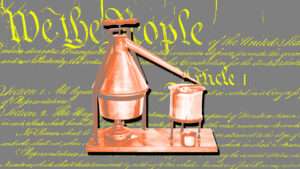
A whiskey distilling set up in front of the preamble to the United States Constitution
Illustration: Lex Villena; Ioannis Syrigos

Today, the Supreme Court decided to review the case of Department of Justice v. McNutt, which challenges a federal law banning home distilleries. The key question in the case is whether the law in question is justified by the combination of the tax power and the Necessary and Proper Clause (which gives Congress the power to make laws "necessary and proper" for executing other powers granted to the federal government). This is likely to be most important Supreme Court Necessary and Proper Clause decision since at least NFIB v. Sebelius (2012), which ruled that a "proper" power permissible under the Clause is one that is "ancillary" to the implementation of an enumerated power; it cannot be a "great, substantive and independent" power. This case is likely to further clarify the meaning of "proper," perhaps by explicating in more detail what counts as a "great…and independent" power.

In the lower court decision in this case, the Fifth Circuit ruled that the law is not "proper" and even that it isn't "necessary." There is also a Sixth Circuit decision that went the other way, thereby creating a circuit split.

As explained in my earlier posts on the Fifth and Sixth Circuit decisions (linked above), I think this law is not "proper," and I hope the Supreme Court strikes it down. I summarize the reasons why in my post on the Fifth Circuit ruling:

The Fifth Circuit… concludes that the law in question exceeds Congress' authority under the Necessary and Proper Clause, which grants the power to makes laws "necessary and proper" for carrying into execution other federal powers. I think the court is right that the law in question is not "proper." The Supreme Court, in NFIB v. Sebelius(2012), ruled that a "proper" power permissible under the Clause is one that is "ancillary" to the implementation of an enumerated power. It cannot be a "great, substantive and independent" power. See my analysis in this article. The power claimed here is clearly "great and independent." As Judge [Edith] Jones notes, "[u]nder the government's logic, Congress may criminalize nearly any at-home conduct only because it has the possibility of concealing taxable activity."

I elaborated further in the post criticizing the Sixth Circuit decision:

[T]he Sixth Circuit is badly wrong to conclude that the law is "proper." As explained in  my earlier post, the Supreme Court, in NFIB v. Sebelius (2012), ruled that a "proper" power permissible under the Clause is one that is "ancillary" to the implementation of an enumerated power. It cannot be a "great, substantive and independent" power. The power to ban any home-based activity that might serve a substitute for taxable activity outside the home is clearly a "great and independent power." As Judge Edith Jones explains in the Fifth Circuit ruling, "[u]nder the government's logic, Congress may criminalize nearly any at-home conduct only because it has the possibility of concealing taxable activity."

The Sixth Circuit tries to address this point by claiming alcohol is somehow special….

This distinction between alcohol and all other commodities is totally arbitrary. The same reasoning could justify banning home production of anything else that is more easily taxed if produced outside the home. And there is a long history of home production of all kinds of other commodities taxed or severely regulated by the government, ranging from cigarettes to illegal drugs, to pornographic videos.

While Judge Edith Jones (author of the Fifth Circuit decision) is one of that circuit's most conservative judges, the ruling was also joined by liberal Obama appointee Judge James Graves. On the other hand, the Sixth Circuit decision was written by prominent conservative Judge Raymond Kethledge. We shall see if the Supreme Court also divides on this issue in a way that cuts across conventional ideological and jurisprudential lines.

As noted in my post on the Fifth Circuit case, I think Judge Jones is not persuasive in arguing that the home distillery ban isn't "necessary," as well as improper. That argument is unlikely to prevail under the Supreme Court's expansive definition of "necessary, "  dating back to McCulloch v. Maryland (1819), where Chief Justice John Marshall famously ruled that "necessary" includes any measures that may be "useful" or "convenient" for implementing an enumerated power.

As also noted in my posts on the two lower court rulings, I think the government has a better argument that this law is authorized by the Supreme Court's badly misguide precedent on federal power under Commerce Clause (which grants Congress power to regulate interstate commerce). But the Supreme Court is apparently not going to review that issue. The question presented submitted to the Court in McNutt is limited to the Necessary and Proper Clause.

The post Supreme Court Will Hear Necessary and Proper Clause Case on Federal Law Banning Home Distilleries appeared first on Reason Magazine.

  •  

Trump Loses Yet Another Sanctuary City Case—This Time Against New York City

NA

Yesterday, in United States v. City of New York, yet another federal court ruled against the Trump administration in a sanctuary city case. "Sanctuary" jurisdictions are state and local governments that restrict their law enforcement agencies and other employees from assisting federal immigration enforcement and deportation efforts in various ways. In this case,  Judge Reyes of the US District Court for the Eastern District of New York upheld New York City laws restricting local law enforcement information-sharing and other assistance to federal immigration enforcers.

The court ruled that federal law does not preempt these policies, and that if if it did, there would be a violation of the anti-commandeering requirements of the Tenth Amendment:

Even were the Court to find that the United States has standing and the challenged provisions are preempted—both answered in the negative above—United States' claims would still fail because the anticommandeering doctrine of the Tenth Amendment to the Constitution of the United States precludes relief.

"The powers not delegated to the United States by the Constitution, nor prohibited by it to the States, are reserved to the States respectively, or to the people." U.S. Const. amend. X….

The United States argues it is "not seeking to compel participation in immigration enforcement … but rather to remove Defendants' express and implicit obstacles to the Executive's duty to carry out its immigration enforcement duties…." New York City replies "if accepted, [the United States' claims] would require the City to affirmatively assist the federal government in enforcing immigration laws in violation of the Tenth Amendment's anticommandeering doctrine…." New York City is correct, at least partially.

The United States seeks injunctive and declaratory relief to preempt the challenged provisions… If the challenged provisions were struck, while New York City would not be obligated to carry out federal immigration enforcement, they would be barred from prohibiting their agencies and employees from engaging in federal immigration enforcement by expending personnel, property, and other resources to (1) detain individuals and (2) implement inter-agency information-sharing, including disclosing personally identifiable information, all potentially in violation of state law. And of course, there is nothing within federal law that obligates states to participate in federal immigration enforcement or compels states to comply therewith.

The United States' preemption arguments amount to nothing more than a backdoor around the Tenth Amendment and rest on a false distinction between (a) compelling local governments' participation in federal immigration enforcement and (b) prohibiting local governments from dictating how their personnel and other resources may be utilized towards federal immigration enforcement….. "

The basic principle—that Congress cannot issue direct orders to state legislatures—applies" to commands for "affirmative action" and the imposition of "prohibitions." Murphy [v. NCAA], 584 U.S. at 455 (citation modified). If states cannot remain free to control their agencies and employees to resist federal immigration enforcement, which is within states' constitutional prerogatives, the Tenth Amendment anticommandeering doctrine means nothing.

This reasoning is correct. And it is notable that this ruling - like many others protecting sanctuary cities - relies heavily on the Supreme Court's 2018 anti-commandeering decision in Murphy v. NCAA, written by Justice Samuel Alito (probably the Court's most conservative justice), and joined by all the other conservatives then on the Court. In that case, the Court emphasized that the anti-commandeering doctrine bars Congress from dictating the actions of state and local legislatures, regardless of whether the dictation takes the form of an affirmative mandate, or a prohibition against legalizing or barring something under state law.

Judge Reyes also rejects the administration's argument under the "intergovernmental immunity" doctrine, which bars states and localities from directly regulating federal agencies or "discriminating" against them. Like the court in the recent case of United States v. New Jersey, he correctly emphasizes that there can be no discrimination when there is no other comparable activity that gets more favorable treatment under the sanctuary jurisdiction's policies:

"Differential treatment is critical to a discrimination-based intergovernmental immunity claim." New York, 814 F. Supp. 3d at 282….; "[A] comparator is necessary." New York, 810 F. Supp. 3d at 353. The United States discrimination claim fails for lack of a comparator.

The United States does not and cannot identify a similarly situated entity. State and local agencies and their officers do not enforce immigration law, nor do members of the public…  As the United States concedes, the Federal Government holds the "exclusive charge of enforcing immigration law…."  Not only are other federal law enforcement agencies with different charges differently situated, "[f]or a state law to unconstitutionally discriminate against the federal government, it must treat comparable classes of federal and non-federal employees differently, not different classes of federal employees." Illinois, 796 F. Supp. 3d at 534

I would add that, as I explained in a recent post, the entire antidiscrimination element of the intergovernmental immunity doctrine is dubious, and should probably be overturned by the Supreme Court:

[T]he whole doctrine of intergovernmental immunity strikes me as bogus, judge-made law. There is no provision in the Constitution requiring it. And the federal government is not some historically oppressed minority group protected by the antidiscrimination provisions Fourteenth Amendment. Where state and local governments are otherwise free to refuse to help the feds, that autonomy should not be forfeited merely because they choose to support potentially similar activities by state or local governments, or by the private sector. Obviously, a district court cannot refuse to obey Supreme Court precedent in this field. But I hope the Supreme Court might someday reevaluate that precedent.

This is just the most recent of a long line of defeats for Trump in sanctuary city cases, in both his first and second administration. Judge Reyes cites close to a dozen such cases over the last year alone.  I summarized this jurisprudence more fully in a post covering three other recent sanctuary cases, last month:

In cases where the administration has tried to directly coerce states and localities into cooperating, courts have rightly ruled this violates the Supreme Court's "anti-commandeering" precedents, a series of decisions reached primarily by conservative justices, which hold that the federal government may not force state and local governments to help enforce federal law or carry out under federal purposes. In cases where Trump has sought to withhold federal funds from sanctuary jurisdictions, courts have (also rightly) ruled that the executive cannot impose conditions on federal grants that were not authorized by Congress and (in some cases) that the Trump conditions are unconstitutionally coercive. For my analyses of Trump II court decisions on these issues, see here, here, and here.

My 2019 Texas Law Review article surveying and assessing litigation arising from Trump's first-term attacks on sanctuary jurisdictions. There and in other writings, I also explain why immigration sanctuaries (and conservative gun sanctuaries) are beneficial, and help protect our constitutional system. See also my February 2026 Dispatch article, "In Defense of Sanctuary Cities," which provides an overview of these issues, and defends sanctuary jurisdictions on both constitutional and policy grounds.

Yesterday's ruling may be appealed. But if so, it is unlikely to be overturned.

Trump has posted a few rare wins in sanctuary cases with unusual facts, such as in the Contracts Clause case I analyzed in the September post. But, such cases are highly exceptional. And, as explained in the September post, the Contracts Clause decision has various flaws, and would not greatly impede sanctuary jurisdictions even if it survives on appeal.

Overall, Trump has been losing these kinds of cases so much that he might even get tired of losing.

The post Trump Loses Yet Another Sanctuary City Case—This Time Against New York City appeared first on Reason Magazine.

  •  
❌