The UK announced on Tuesday that its military will fly Typhoon fighter jets over Saudi Arabia on “defensive missions” to help repel attacks from Yemen’s Ansar Allah, also known as the Houthis, marking an escalation of British involvement in the war. “The UK will fly defensive counter-air missions to support the protection of Saudi cities […]
Saudi airstrikes struck two fishing boats off the coast of Yemen on Tuesday, killing at least eight fishermen, according to Yemeni media. According to the SABA news agency, vessels were struck off the al-Kadha coast in the Dhubab district of Yemen’s southwestern Taiz province near the Bab el-Mandeb Strait, an area that was under the […]
US special envoy Tom Barrack conceded that a “ground kinetic” battle in Yemen by the US “seems fruitless” during a talk at the Global Security Forum in Qatar on 20 October.
“I think the president’s been clear that he supports Saudi Arabia and the backing that they need logistically he will supply. But America getting involved in a ground kinetic battle somewhere else seems fruitless.”
Barrack is Washington’s ambassador to Turkiye and special presidential envoy for Syria and Iraq.
He admitted that military force has failed in Yemen and that Riyadh is in a “very difficult position.”
“These kinetic reactions have never worked. It doesn’t work. It’s probably not likely that it’s going to work,” he said.
Barrack questioned whether US meddling across West Asia has helped or harmed the region, arguing that Ansarallah in Yemen, Hezbollah in Lebanon, and the resistance factions in Iraq would lose their reason to exist only once states took responsibility themselves.
He pressed for talks between Riyadh, Sanaa, and regional mediators, urging regional capitals to build their own alliances instead of leaning on Washington.
He went further, admitting that the US has had a hand in 23 regime changes across the region, none of which achieved their aims.
He declined to say whether the US-Israeli war on Iran launched on 28 February was a mistake, while conceding that it had unleashed unintended consequences across the region.
The admission comes as the Saudi-led coalition presses on with airstrikes on Yemen, drawing retaliatory missile and drone strikes by the Yemeni Armed Forces (YAF) on the kingdom.
Riyadh has turned to its defense partners under the Mecca pact, including Pakistan and Turkiye, after Washington declined its requests for direct US intervention against Yemen.
Barrack’s remarks follow Washington’s failed bid to subdue Yemen by military force, with more than 1,000 US airstrikes between March 2024 and April 2025 unable to halt Yemeni naval operations waged in support of Gaza, forcing the US into an Omani-brokered ceasefire with Sanaa in May 2025.
The campaign cost Washington $1 billion in its first three weeks alone, as Yemeni forces downed 17 MQ-9 Reaper drones and the US lost two F-18 fighter jets.
Ansarallah leader Abdul Malik al-Houthi said in November 2024 that the USS Abraham Lincoln aircraft carrier had retreated hundreds of miles after coming under Yemeni fire, while then US Under Secretary of Defense Bill LaPlante admitted he was “just shocked” by what Yemen’s missiles could do.
Europe fared no better, with Rear Admiral Vasileios Gryparis, commander of the EU’s Operation Aspides, telling Bloomberg in June 2024 that his Red Sea fleet needed to more than double in size and that US–UK strikes on Yemen were “not contributing to the solution,” after France withdrew one of his frigates citing the threat level.
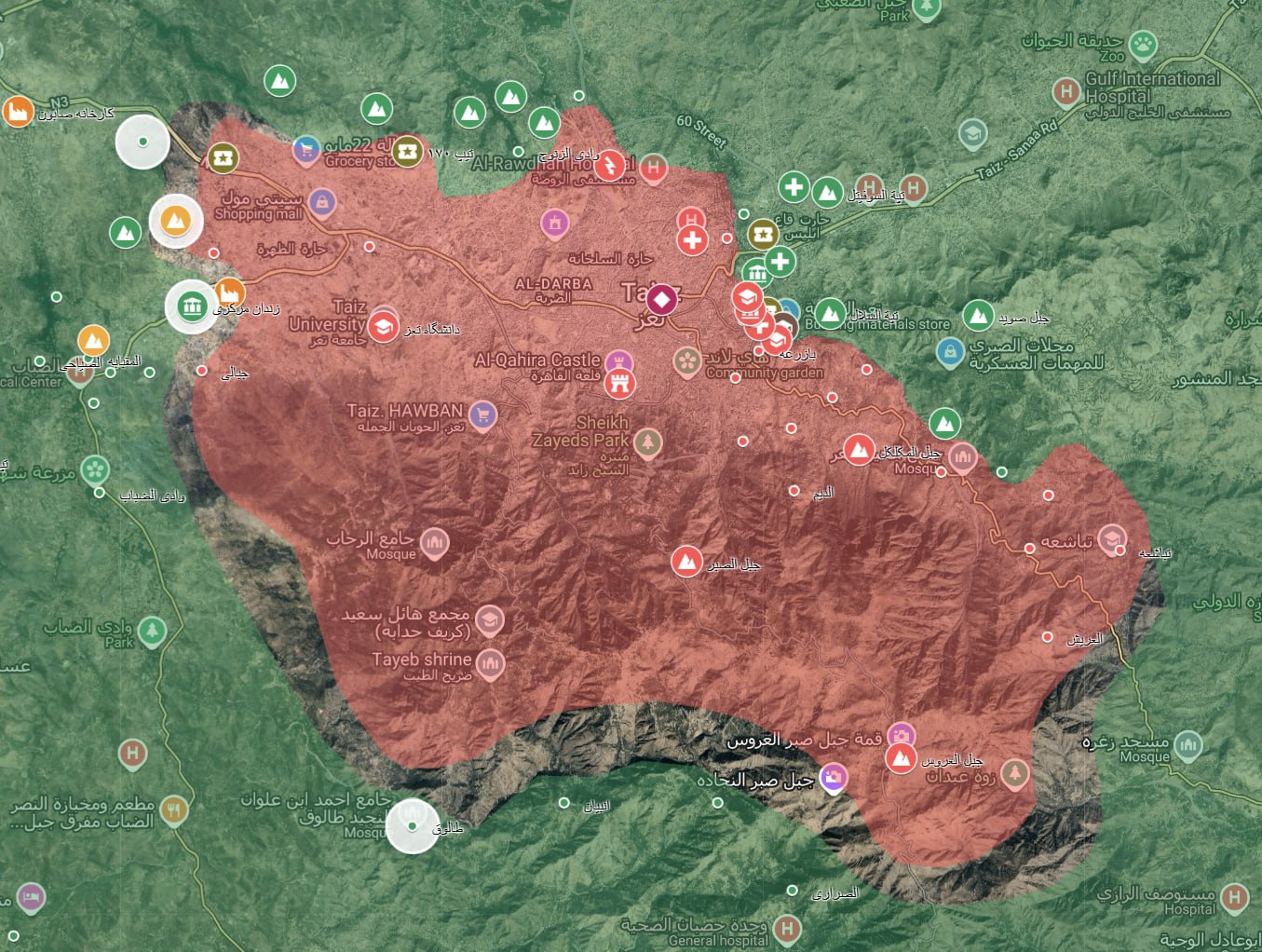
Yemen’s Houthis (Ansar Allah) on October 20 released combat footage that they said showed their fighters capturing Jabal Han, a strategic mountain west of Taiz, following an assault involving artillery and tank fire.
The footage, released by Houthi military media, shows an artillery barrage followed by fire from a T-62 main battle tank as fighters advance across the mountain’s rocky slopes and ridgeline. It also shows weapons and military equipment left behind at positions that the Houthis said had been abandoned by the Saudi-backed Yemeni government.
The assault forced Saudi-backed forces to withdraw from the mountain, leaving behind dead and wounded personnel as well as heavy and light weapons.
Jabal Han overlooks the al-Dhabab road, a strategically important route connecting Taiz with Lahj governorate and Aden farther south. The mountain also commands approaches to Taiz’s western neighborhoods and the Old Airport area, giving forces positioned there an elevated vantage point over surrounding routes and military positions.
Click to see full-size map.
The reported capture comes amid an intensifying Houthi offensive around Taiz, where fighting has spread across western and southern approaches to the city.
Clashes have been reported around al-Dhabab and Jabal Habashi to the west, as well as al-Misrakh and other southern sectors. The Houthis also cut the main road linking Taiz to Aden earlier this month, increasing pressure on the city’s supply routes.
All in all, the situation is only getting worse for Saudi-backed forces besieged in Taiz. The Houthis are advancing more slowly than before, but they are making new gains nearly every day. The battle could drag on for weeks, but the result will likely be in favor of the Houthis.
Fighters of the Bratstvo Battalion, part of the Timur Special Unit of Ukraine’s military intelligence agency (HUR), captured three Russian servicemen and gave first aid to one of them, HUR reported on 19 October. They also found and destroyed Russian sabotage groups, HUR said, adding that counter-sabotage operations in the Zaporizhzhia direction are ongoing.
Russian forces have spent months trying to get closer to Zaporizhzhia, one of Ukraine’s largest cities. They may try to use the dried-up bed of the Kakhovka Reservoir to infiltrate north toward it as autumn fog and dense vegetation set in, the Institute for the Study of War reported on 26 September. Ukrainian troops are now clearing the area of Russian saboteurs trying to get into the rear of Ukrainian positions, according to HUR.
HUR’s video shows the fighting and the captures, with one dead Russian soldier blurred. At the end, a captured Russian says two of the three men in his group were killed by a “Baba Yaga,” the nickname Russian troops use for Ukraine’s heavy bomber drones.
HUR described what the Russian groups are trying to do:
“Using small sabotage groups, the enemy is attempting to penetrate deep into the rear positions of Ukraine’s Defense Forces, build up forces to destabilize the situation, disrupt logistics, and neutralize Ukrainian defenders’ combat crews.”
Russia seeks to bring the front closer to Zaporizhzhia
Russia’s objective in the Zaporizhzhia direction is to advance within artillery range of the city, hold forward positions, and protect its rear from Ukrainian strikes, the Institute for the Study of War noted.
In January, Russian forces were trying to capture Stepnohirsk and advance along the shore of the former Kakhovka Reservoir toward Zaporizhzhia. Taking the settlement would let Russian troops place long-range artillery or fiber-optic drones there to strike the city’s outskirts, Southern Defense Forces spokesperson Vladyslav Voloshyn told Ukrinform on 14 January.
Explore further
Russia drained the Kakhovka Reservoir. Now it hides in the dry bed to creep toward Zaporizhzhia
On 22 September, Anastasiia Shevchenko, spokesperson for the Southern Forces Group, said there were no signs of preparations for a direct offensive on Zaporizhzhia and that Russian forces lacked the troops and means to advance directly toward the city.
Dense vegetation and limited visibility: combat on the reservoir bed
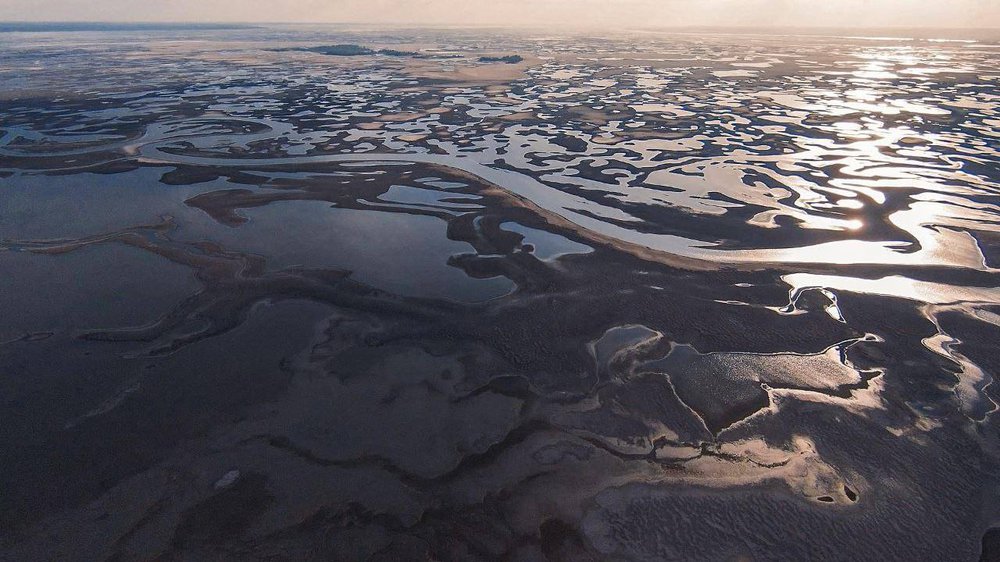
The Kakhovka Reservoir was a vast artificial body of water on the Dnipro River in southern Ukraine that supplied water to millions of people, as well as to agriculture and industry. On 6 June 2023, Russian forces blew up the Kakhovka Hydroelectric Power Plant, the Southern Operational Command reported.
The bed of the Kakhovka Reservoir has nearly dried out after the dam was destroyed on 6 June 2023. Photo: Maksym Pavlovsky/Dumska
After the dam was destroyed, the bed of the former reservoir quickly became overgrown with willows, poplars, and shrubs, creating a new battlefield. Ukrainian troops have fought there before.
In November 2025, fighters from the same Bratstvo unit carried out a reconnaissance and sabotage operation 7 kilometers from the shoreline of the former reservoir, HUR said. They found and eliminated Russian troops, then raised the Ukrainian flag over the islands there and took control of the area.
In April, the Bratstvo unit’s chief of staff, who goes by the call sign “Dyviziia,” described the conditions on an earlier raid across the reservoir bed:
“You’re just constantly moving through these thickets, with no way to figure out which direction to go. You can literally see everything just two meters ahead of you.”
Mohammed bin Salman is learning a lot about being a leader, although it is the Houthis who are giving him the lessons. The first one is that in the Arab world all promises of military support from neighbours are worthless. The second: only Iran has the power to stop the war in Yemen.
It’s hard to define Donald Trump’s legacy in the Middle East when, since the end of February this year, everything seems to point to him and the U.S. being a huge loser in a war against Iran. But one decision he did make more recently can be considered quite smart: not to hit the Houthis.
This group in Yemen has cultivated the model of how to stay in power even in the face of airstrikes from the U.S. They remain in mountainous regions, scattered as much as possible, and are the toughest fighters in the entire region. Trump’s decision in March 2025 to halt his own bombing campaign against them was probably the smartest thing the Donald has done in the region. He knew that they were just too tough, too resilient, and the price of U.S. shipping being hit in the Red Sea was just too great.
Tough times now for Saudi Arabia’s young crown prince, Mohammed bin Salman, who can’t be sleeping very well at night – if he is getting any sleep at all. His own decision back in 2015 to launch a bombing campaign against civilians mainly in Sanaa (and often wedding ceremonies) might be one he is regretting now. The Crown Prince’s own air force is still bombing the Houthis, but this time along the coastline in a bid to break their stranglehold on the Bab el-Mandeb straits. But the response by the Houthis – to bomb the living daylights out of Saudi Arabia’s main airport in Riyadh – has not only shocked leaders of the entire region but underlines a point that media based in Dubai, too used to writing flattering copy about the Crown Prince, might not make: the fate of this young country, with its young leader, is balancing on the edge of a knife. Many experts point out why the Crown Prince is so paranoid about security and the threat of a coup d’état by pointing out that it is only a matter of time before one of these Saudi pilots drops his payload on the Crown Prince’s palace instead – which would be the tinderbox moment for a regime to fall, for a leader to slip away in the dead of night and arrive perhaps somewhere in London, Tangiers or even California. While MbS is fretting about the state of the war with the Houthis, which is not going at all well, his main worry is not that this group enters KSA and does anything politically to destabilise the country. It is rather that the lack of confidence within the royal family – by enough princes – reaches a tipping point and he is either assassinated or given the opportunity to flee at a moment’s notice. The attack on the airport was really such a tipping point, as it showed not only how MbS’s leadership and the poor decisions he makes are evident (the airport should have been closed months ago, but it would look like a defeatist move) but also how vulnerable the entire country is to any attack by the Yemeni group. Such a vulnerability is the issue, given that it was the young Crown Prince himself who upped the ante with the conflict with the Houthis – and he has hundreds of princes whom he locked up in a five-star hotel and held hostage while extracting huge amounts of money from, as one of his first policy initiatives as leader, who all hold mock reverence to him as the country’s leader. But for how long?
“This could turn out to be existential for Bin Salman,” argues London-based MENA commentator Sami Hamdi. “UAE and Houthis are hammering him in Yemen, Trump has taken his money and turned his back on him, Netanyahu is violating him by insisting on an official invite for help (normalisation), his best friend Turki Al Sheikh continues to fleece him with unprofitable boxing matches and never-ending raves, and his international allies refuse to fight for him and are pushing him towards a deal that will be interpreted by all as a humiliation for him.”
Solitude seems to come with the job of being MbS in Saudi Arabia – a country always appearing to be on the cusp of being great and significant but never quite managing it. Recently MbS carved out the reputation of being a dynamic regional leader who allowed pop concerts with scantily clad Western performers, while his own mega-projects in the desert quietly get wound down, barely leaving the drawing board.
The real lesson of the Houthis for MbS is that they are simply too tough – and even Turkey and Pakistan, who presented themselves as allies for Riyadh militarily, are remarkably quiet. Some would even go as far as to call it a betrayal of the Arabs.
“Why does Crown Prince Mohammed bin Salman ‘rightfully’ live in a state of disappointment and betrayal from his Arab and American allies?” asks the legendary Egyptian journalist and geopolitical hack Abdel Bariatwan. “Where is Turkey and Pakistan, and where is the Mecca alliance? Isn’t it a disgrace that Iran is the only one volunteering to mediate to stop the war?” he asks.
Yemen’s Houthis (Ansar Allah) announced on October 19 that they had carried out six operations against Saudi oil facilities, airports and military installations over 48 hours, claiming fires at energy sites, disrupted air traffic and casualties among Saudi forces.
Brig. Gen. Yahya Saree, the Houthis’ military spokesman, said in a statement that the operations involved “a large number of ballistic and cruise missiles and drones.” The targets included Saudi Aramco facilities in Yanbu, the Shaybah oil field, King Khalid International Airport in Riyadh, Abha International Airport and several military installations.
Saree noted that the operation against Aramco facilities in the Red Sea port city of Yanbu was carried out in two phases and caused “large fires” at the targeted sites. A separate strike on the Shaybah oil field also scored a direct hit and sparked fires, he added.
The third operation targeted King Khalid International Airport in Riyadh in three phases. Saree described the strikes as accurate and direct but did not specify any resulting damage.
The fourth operation targeted Abha International Airport, Saudi radar installations in the al-Hisn and al-Rahma mountains, and Khamis Mushait air base. Saree claimed the strikes disrupted air traffic at Abha airport and damaged the air base.
The fifth operation struck a camp belonging to the Saudi naval task force, killing and wounding Saudi personnel, according to Saree. The sixth targeted a Saudi radar installation at Bir Askar, which he said was destroyed.
On the Saudi side, the Saudi-led coalition said a day earlier that its air defenses intercepted and destroyed two ballistic missiles fired toward Khamis Mushait and a drone in the Riyadh region. Saudi Civil Defense separately reported that a projectile fired by the Houthis landed in a residential area of Najran province, wounding six people.
Saree also accused Saudi Arabia of carrying out more than 200 airstrikes and missile attacks against civilian sites in Sanaa and other Houthi-held areas during the same 48-hour period, causing dozens of deaths and injuries, most of them among women and children.
The spokesman said the total number of Saudi airstrikes and missile attacks since the escalation began had exceeded 2,700.
Vowing to continue the campaign, Saree said Yemen would not submit to Saudi Arabia and threatened “wider operations, harsher strikes and more severe targeting.”
“We will continue our military operations deep inside Saudi territory and enforce the equation of blockade for blockade, escalation for escalation,” he said, adding that the attacks would continue until Saudi military operations and the blockade against Yemen ended.
The Houthis’ latest operations show that the conflict is escalating, and despite taking some serious losses, Saudi Arabia and its allies in Yemen do not seem to be planning to take a step back.
Egypt’s Civil Democratic Movement rejected any involvement of the Egyptian armed forces in a regional war on behalf of any side, insisting that Cairo make its decisions independently of foreign influence.
The movement said Monday that no outside party should dictate Egypt’s position, arguing that the country’s most important role lies in pursuing “wise mediation to establish peace.”
Turning to domestic affairs, the movement called on civilian opposition groups, its own members included, to begin preparing for the presidential election scheduled for 2030. The call follows President Abdel Fattah el-Sisi’s recent statement that his presidency will end in 2030 and that the matter of constitutional changes to alter that timeline is “completely settled.”
Parliament postpones debate on troop deployment
The statement comes as Egypt’s parliament has yet to take up a proposal to authorize the president to send troops abroad. Lawmakers adjourned an emergency session devoted to discussing support for Saudi Arabia, and deliberations were due to resume on Monday. The debate was postponed again on Monday, this time until October 26.
The session was convened at el-Sisi’s request after he said Cairo would take any action Saudi Arabia asks of it to defend its security and sovereignty.
Yemen’s Sanaa-based Parliament Speaker Yahya Ali al-Ra’i had urged Egypt’s parliament on Saturday not to let the country be drawn into the Saudi escalation, saying such a step would contradict Egypt’s historical role in defending Arab causes.
Yemeni scholars welcome Al-Azhar initiative
Separately, Al-Azhar urged the urgent formation of a mediation committee bringing together respected figures from across the Muslim world. It said the committee should start work immediately to end conflicts and wars in the Arab region, defuse crises, and bridge differences between the parties involved.
The Association of Yemeni Scholars, in turn, reaffirmed its commitment to engaging constructively and in good faith with the invitation extended by the Grand Imam of Al-Azhar, expressing appreciation for the Islamic values and principles it conveyed.
The association also declared Sanaa’s readiness to host the committee proposed by the Grand Imam, comprising respected and wise figures from across the Arab and Islamic worlds.
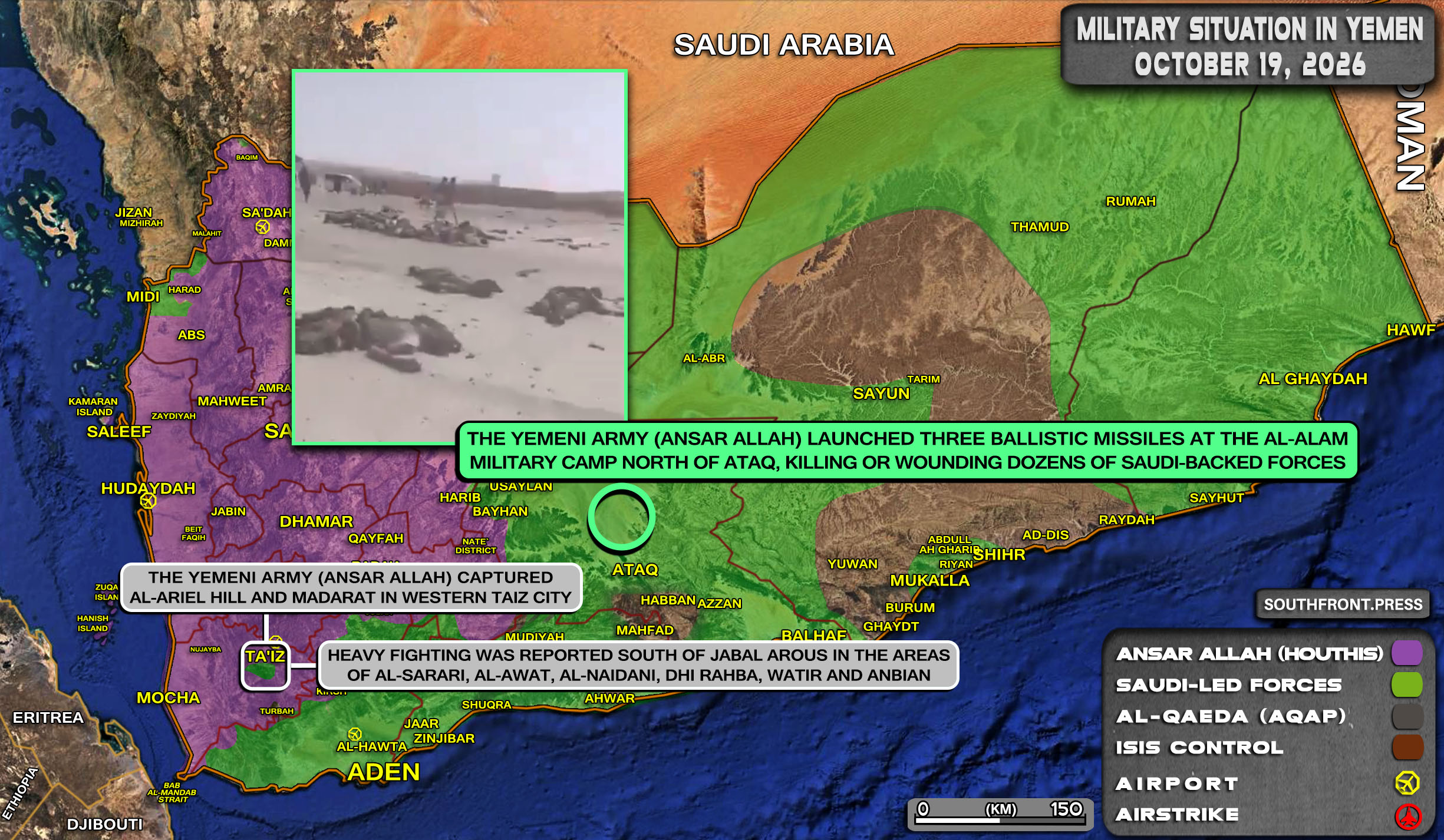
The Yemeni army (Ansar Allah) captured Al-Ariel hill and Madarat in western Taiz city;
Heavy fighting was reported south of Jabal Arous in the areas of al-Sarari, al-Awat, al-Naidani, Dhi Rahba, Watir and Anbian;
The Yemeni army (Ansar Allah) launched three ballistic missiles at the al-Alam military camp north of Ataq, killing or wounding dozens of Saudi-backed forces.
The Ansar Allah-led Yemeni Armed Forces announced on Monday that its forces attacked the al-Alam camp in Yemen’s south-central Shabwa province, which it described as being run by “Saudi officers.” The local authority told Reuters that there were significant casualties, reporting that 53 people were killed and more than 200 were wounded. The report described […]
Yemen’s Houthis (Ansar Allah) said on October 19 that they had repelled a large-scale attack by Saudi-backed government forces in eastern al-Jawf province, destroying and damaging military vehicles and seizing weapons during the fighting.
The Houthi military media unit released footage showing the group’s fighters engaging the attacking force at varying distances, using machine guns, artillery, rocket-propelled grenades and anti-tank guided missiles to target personnel and vehicles.
The attack was supported by Saudi warplanes and involved a coordinated advance toward Houthi positions and deeper into territory under their control. Houthi fighters, however, halted the push using prepared defensive positions.
The footage showed several vehicles being struck or left disabled, while Houthi fighters captured a range of weapons and military vehicles.
According to the Houthi military media report, the attacking force eventually withdrew, leaving dead and wounded fighters behind.
The attack in al-Jawf may have been intended to divert Houthi forces and resources from the fronts around Taiz and Bab al-Mandab, where the group has made recent advances against Saudi-backed forces. By applying pressure on a separate front in the northeast, the government side may have sought to stretch the group’s forces and disrupt their ongoing operations in the southwest.
At least 18 people were killed on October 19 when missiles struck a government military training camp in Yemen’s Shabwa province in an attack later claimed by the Houthis (Ansar Allah), four government and medical sources told Reuters.
At least three ballistic missiles hit Al-Alam camp during morning training, according to the sources cited by the news agency.
China’s Xinhua news agency reported a higher death toll, saying at least 25 soldiers were killed and more than 30 others were wounded. Xinhua cited a government military official and a local medical source.
A Houthi military source later told the Saba news agency that the group had targeted troop concentrations at the camp, claiming dozens of people were killed or wounded.
The deadly strike comes amid escalating fighting between the Houthis, who control the capital, Sanaa, and much of northern Yemen, and forces backing the internationally recognized government.
Saudi-backed government forces launched a counterattack earlier this month to recapture Houthi-held territory, regaining ground near the strategic Bab al-Mandab Strait, a key shipping chokepoint at the southern entrance to the Red Sea. However, the counterattack has largely failed.
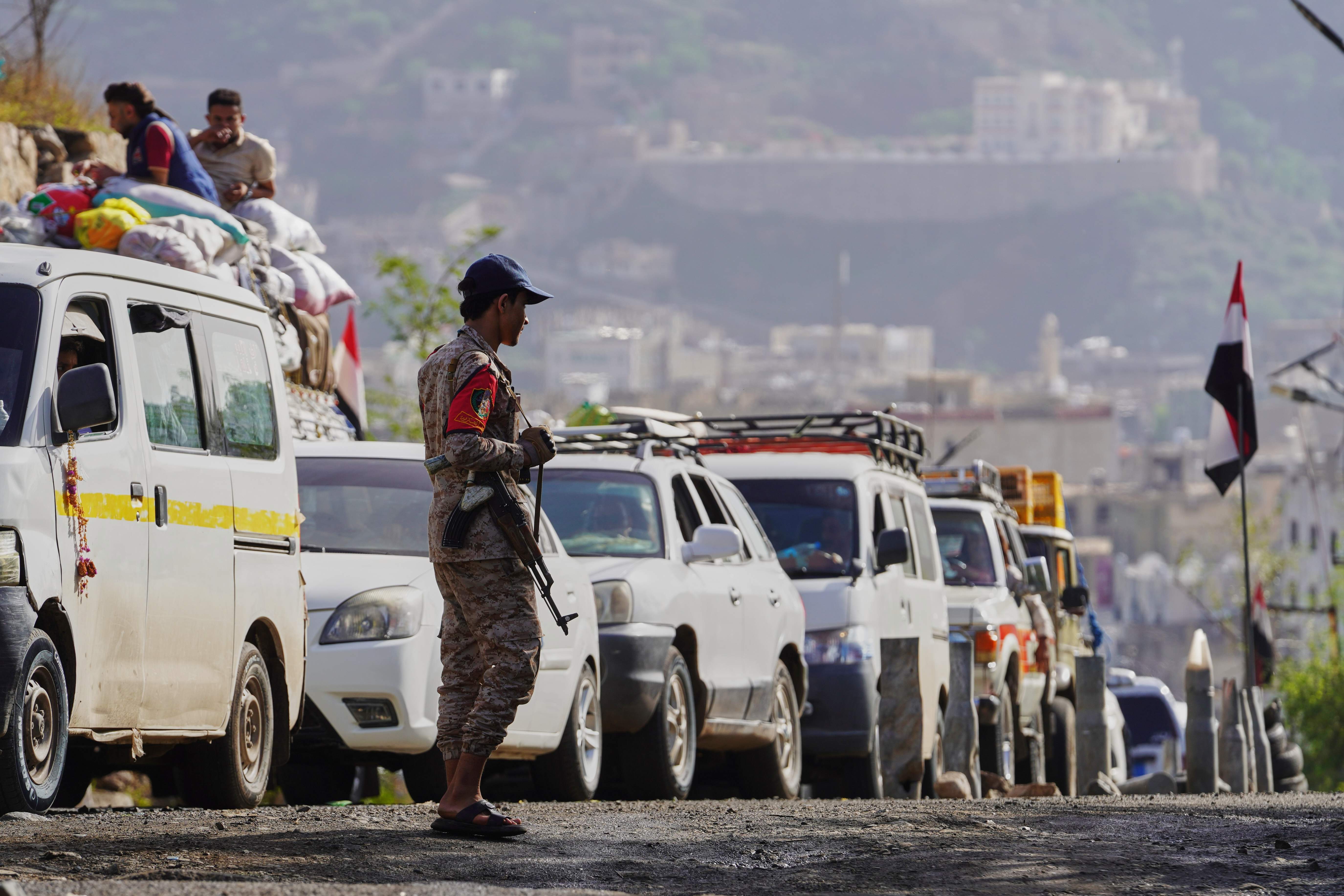
Meanwhile, in the province of Taiz, the Houthis managed to place Saudi-backed forces under a tight siege. The group’s fighters are now advancing there slowly but steadily.
The latest strike was a demonstration of the Houthis’ military and intelligence capabilities, which are far superior to those of Saudi-backed forces.
Yemen has condemned the international community’s silence on Saudi Arabia’s ongoing aggression and blockade, saying it emboldens Riyadh to continue its atrocities.
The Yemeni Ministry of Foreign Affairs and Expatriates, in a statement released on Saturday, said the Saudi military continues to target ordinary people and civilian infrastructure, as it has done over the past years.
The ministry denounced Saudi strikes on civilians and non-military installations as a flagrant violation of international humanitarian law, particularly the Fourth Geneva Convention of 1949 and Additional Protocol I of 1977.
In the latest attack, a series of Saudi airstrikes targeted a residential neighborhood in the Maqbanah district of Yemen’s southwestern Ta’izz province, killing nine civilians, including a woman and a girl, and injuring 16 others.
The statement also censured the deafening silence of the international community, which claims to uphold human rights while lecturing others about them.
It noted that such an approach would offer Saudi officials the carte blanche to keep on their brutalities, and would make the international community complicit in Riyadh’s crimes and aggression.
The Yemeni foreign ministry then called on the international community, particularly the UN Security Council, the Human Rights Council, the UN High Commissioner for Human Rights, as well as human rights organizations, to abandon double standards, condemn the heinous crimes committed against Yemeni people, and pressure Saudi Arabia to honor its obligations under international humanitarian law.
The ministry finally emphasized that Saudi atrocities would not go unpunished, and that the House of Saud, “whose hands are stained with blood and whose fingers with guilt,” would be held accountable.
On July 20, the Sana’a government announced a maritime blockade against Saudi Arabia in response to “an unjust and oppressive siege” on Yemen for almost 12 years.
Subsequently, the Yemeni armed forces have reported a series of successful missions that have targeted vessels associated with Saudi Arabia in the Red Sea.
In March 2015, Saudi Arabia and its allies imposed a blockade on Yemen, initiating a comprehensive military offensive that received support in terms of military, political, and logistical assistance from the United States and several Western countries.
Tens of thousands of Yemenis have lost their lives; however, Saudi Arabia has failed to achieve its primary goal of reestablishing a puppet government that served its interests.
The United Arab Emirates has reportedly agreed to resume funding selected forces in southern Yemen fighting the Yemeni Armed Forces, while Saudi Arabiahas agreed to provide air cover for those forces, according to sources in Yemen.
The reported arrangement signals a possible thaw in relations between Riyadh and Abu Dhabi after months of disagreement over the scope of each other’s political influence in Yemen.
The renewed coordination comes as the Yemeni Armed Forcescontinues to make gains and Saudi Arabia faces repeated drone and missile attacks targeting its territory, airports, and energy infrastructure.
Gulf rivals reconsider their positions
Southern forces, particularly the Giant Brigades, were previously trained and funded by the UAE and are considered among the more effective formations in the fragmented coalition opposing the YAF. Abu Dhabi withdrew its involvement in Yemen in January, cutting off financial support to forces it had backed, following pressure from Saudi Arabia.
The reported agreement suggests that advances by the YAFare prompting rival Gulf powers to reconsider their differences. However, neither Saudi Arabia nor the UAE has responded to a recent demand by southern separatists for an independence referendumthat would restore the borders in place between 1967 and 1990, when Yemen was divided into two states.
The Southern Transitional Council (STC) has also yet to agree to deploy its forces beyond the boundaries of the former South Yemen. Saudi approval of a referendum could potentially remove that restriction, although no such agreement has been announced.
Attacks on Aden intensify pressure
The Aden government announced a counteroffensive last week aimed at retaking Sanaa. The campaign achieved limited gains around Majzar near Marib and the Bab al-Mandab Strait, but was met with a sizeable retaliation by Sanaa’s forces.
On Friday, two missiles struck Aden airport;Information Minister Moammar Al-Eryanisaid the missiles landed about 500 meters from the Yemenia Airways aircraft and roughly 100 meters from the runway’s midpoint. No casualties were reported.
The attack followed a strike on a presidential palace in Aden that killed at least five people and wounded 16, further underscoring the risks facing the Gulf-backed south.
Relations between the STC and Riyadh remain strained. STC leader Aidarous al-Zubaidi fled to Abu Dhabi in January after an unsuccessful attempt by the council to assert control across southern Yemen and announce a referendum on independence within two years.
Saudi Arabia subsequently bombed UAE arms shipmentsintended for STC forces. Abu Dhabi then announced its withdrawal from Yemen, while the Saudi-backed government said it would seek to prosecute Zubaidi for treason.
Egypt and UK face decisions over military support
Regional involvement is also expanding beyond the Gulf rivals. Egyptian President Abdel Fattah el-Sisihas called for an emergency parliamentary session to authorize possible military action to “defend” Saudi Arabia if requested, while emphasizing that Egypt would not undertake offensive operations.
Sanaa’s Parliament Speaker Yahya Ali al-Ra’i warned Egypt against a potential involvement in the Saudi military aggression against Yemen, urging Cairo not to allow itself to be drawn into a confrontation that serves Riyadh’s policies.
In an urgent letter to Egyptian Parliament Speaker Hisham Badawi, al-Ra’i expressed serious concern that developments could lead to Egyptian military participation alongside Saudi Arabia, stressing that such a move would contradict Egypt’s historical role in defending Arab causes.
In the UK, discussions continue over a Saudi request for additional military assistance. London has deployed an RAF Voyager aerial refueling aircraft, but some Arab officialsare pressing for further support.
The prospect of deeper British involvement raises legal concerns. In 2019, the UK Court of Appeal ruled that the government had acted unlawfully in granting arms export licenses during the previous Saudi bombing campaign in Yemen in 2015–2016. The Campaign Against Arms Trade argued that officials had failed to properly assess potential violations of international humanitarian law, prompting revisions to export licensing procedures.
Sanaa’s resistance against Saudi aggression followed a brutal, years-long siege that caused one of the worst famines in modern history. The Ansar Allah government has made clear that their fight against Saudi Arabia will not cease so long as Riyadh continues to escalate it even further.
The Yemeni Armed Forces forces have remained firm in their resistance under the banner of a military equation: blockade for blockade and escalation for escalation.
Der israelische Premierminister Benjamin Netanjahu erklärte in einer Wahlkampfbotschaft auf X, Israel müsse seine wichtigen „Aufgaben an allen Fronten“ in den kommenden zwei Jahren abschließen, solange Donald Trump als US-Präsident im Amt ist: „Uns bleiben noch zwei Jahre der Amtszeit meines Freundes Donald Trump, und genau in dieser Zeit müssen wir unsere wichtigsten Aufgaben an […]
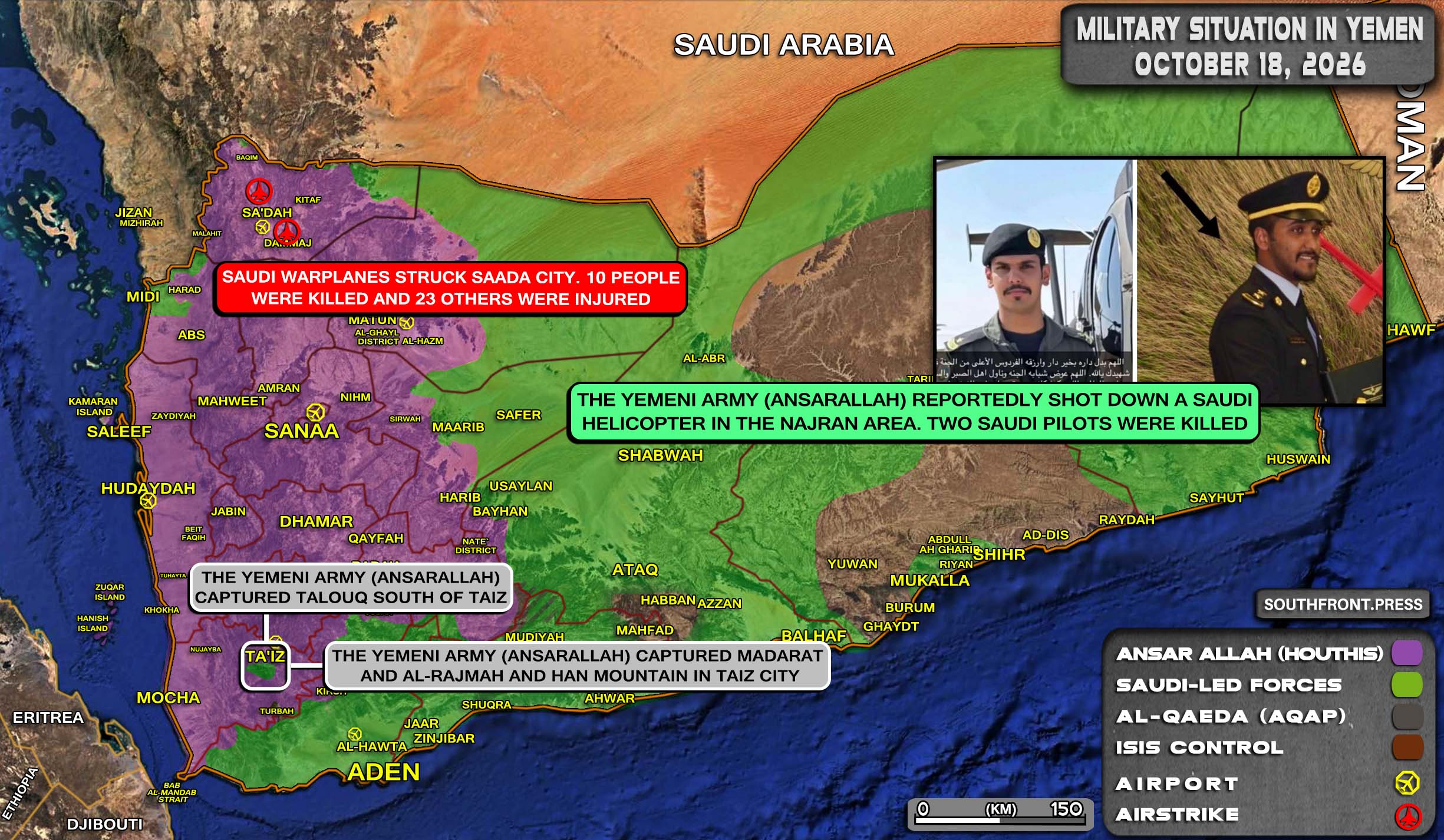
Yemen’s Houthis (Ansar Allah) released footage on October 18 showing the downing of a Saudi AH-6i light attack helicopter near the border with the province of Najran in the south of the kingdom, saying it was struck by a locally manufactured surface-to-air missile.
The footage’s accompanying caption said the helicopter was targeted while carrying out what the group described as hostile operations near Najran.
The release follows an announcement by Houthi military spokesman Brig. Gen. Yahya Saree a day earlier said that the group had shot down a Saudi helicopter near the border.
Saree initially identified the helicopter as an Apache, saying it had been brought down while targeting Houthi positions along the border. The footage’s caption, however, identifies it as an AH-6i, a light attack and reconnaissance helicopter operated by the Saudi Arabian National Guard.
Saudi Arabia’s military coalition confirmed earlier that an AH-6i helicopter belonging to the National Guard had crashed in Najran, killing both officers aboard.
Coalition spokesman Maj. Gen. Turki al-Maliki attributed the crash to a technical malfunction, although the footage released later by the Houthis affirmed that this is false.
The AH-6i, also known as the Little Bird, is a compact armed helicopter designed for reconnaissance and light attack missions. A 2014 U.S. contract for 24 helicopters, initial spare parts and ground support equipment for Saudi Arabia was valued at $234.7 million, an average of about $9.8 million per helicopter across the package.
Today is World Menopause Day – a day to convince women over 40 that yet another aspect of ordinary life needs to medicalised. It's time to stop the grift, says Joanna Gray.

 Login