Brazil election puts unprecedented Indigenous ministry at risk if Flávio Bolsonaro wins


The annual Emma Crawford Coffin Races and Festival is returning to Manitou Springs this weekend.
The event, which takes place on October 24, kicks off at 10 a.m. when the Fan Zone and coffin staging begins.
Previous Coverage: Thousands gather in Manitou Springs for 31st anniversary of the Emma Crawford Coffin Races Thousands gather in Manitou Springs for the 31st anniversary of the Emma Crawford Coffin RacesThe parade starts at noon followed by the popular coffin races.
Started in 1995, the Manitou Springs Chamber of Commerce held the first coffin races in the nation to honor Emma Crawford, a beloved resident who died in 1891.
According to the events website:
In 1929, after years of harsh winters and spring rains, Emma and her coffin came racing down the mountainside. The young children who happened upon her remains found only the casket handles, a nameplate, and a few bones.Last year marked the 31st anniversary of the famed event.
For details and more information, click here.
___
____
Watch KOAA News5 on your time, anytime with our free streaming app available for your Roku, FireTV, AppleTV and Android TV. Just search KOAA News5, download and start watching.
Dominic Cummings is right, says Professor James Alexander: the idea that civil servants are the 'guardians of the constitution' is pernicious in the extreme. But who then should play such a lofty role?
The post Who is the Guardian of the Constitution? appeared first on The Daily Sceptic.
Updated at 5:17 p.m. ET on October 16, 2026
Dear Kelly Clarkson,
Miss Clarkson. I have read that you wanted a bird but were not permitted to obtain it. Well, I am in possession of a bird and do not want to be. Perhaps we could come to a mutually beneficial arrangement.
In brief: There is a bird in here. Specifically, a raven. It sits, croaking, uninvited, on my bust of Pallas. (I would also be happy to give you the bust of Pallas. It is a tasteful bust; my only qualm with it is that it reminds me of my lost Lenore.) I didn’t ask the bird to be here. To the contrary, I would like nothing more than for it to depart. I have asked it to do so, first politely, and then rudely. But nothing. The raven will not budge.
When I read of your encounter with the store Art of Play I felt the only hint of hope I had felt for quite some time. I thought: This woman needs a bird. I have a bird. I will tell her the situation, and we can wring some triumph out of this whole miserable thing.
How did I come by this bird? Oh, the usual way. I’m sure you know the feeling. It’s a midnight dreary. You’re pondering, weak and weary, many and many a quaint and curious volume of forgotten lore. You are thinking of your lost Lenore. Then you hear a tapping, as of someone gently rapping, rapping at your chamber door? Well, this happened to me recently. But it wasn’t someone. It was a bird. And now the accursed thing will not depart!
I want to be rid of the bird. And you want a bird. I understand that the bird in which you expressed interest is a windup bird. Well, this raven certainly winds me up. Is that anything? I understand that the bird in which you were interested is named Molly. My raven could be named Molly. You could call it anything if only you would take the demonic thing out of here!
Before you object that the kind of bird you want is inanimate, whereas mine is clearly a live bird, I have considered this, and I think that the main objection people have to a live bird indoors is that the bird will fly around disruptively and try to escape. Well, the raven does not do that. I wish it would. I have opened the casement. I have said, “Shoo, bird.” I have said sterner things, things that I now regret. But the raven does not budge. It just sits there and says, “Nevermore,” at intervals.
Also, its sable hue would go with anything. Looking at this bird from an interior-design perspective, I think it would fit any room, especially if I included the bust, which, again, I am willing to do.
Do you need to feed it? I have not gotten that far with the bird. So far, it has not eaten anything. I think maybe it sustains itself by other means. It just sits there saying, “Nevermore.”
Make no mistake, I am not offering you a free bird because I doubt your ability to pay. I am offering you a bird because I hate the infernal creature and want it out of my sight! But I would accept your money. Using that money, I could perhaps even get rid of the beating heart that seems to be stuck under my floorboards.
I eagerly await your response.
Sincerely,
EAP
In his eagerness to respond to Kelly Clarkson, Edgar Allan Poe initially misstated the location of the beating heart. It is under his floorboards, not in his wall. Alexandra Petri knows this, as you can see if you read the Poe chapter of her book, where she gets this detail right.

© Illustration by Akshita Chandra / The Atlantic

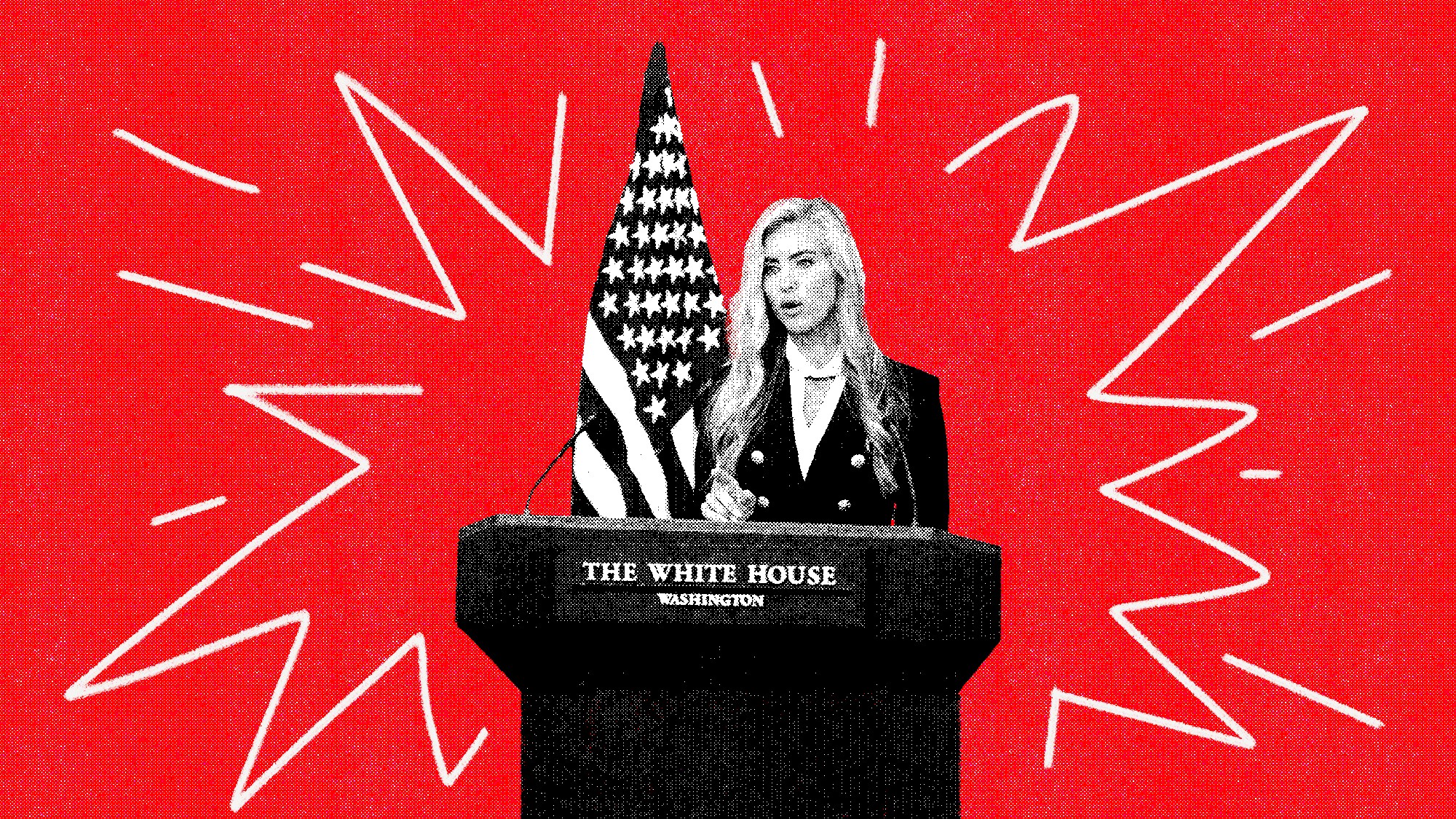
I’m your new press secretary, Katie Zacharia! You may know me from my appearances on Fox News; I am pretty sure that is how the president knows me. That is how he identifies all possible candidates for jobs: turning on the TV and pointing. My successor will be a Kalshi commercial.
I also might be a lawyer! Where did I pass the bar, you ask? After I moved to China. No further questions! (See, I am getting into the press-secretary spirit already.)
When you consider that this is my first time reading words out loud, today was actually a pretty impressive performance. I swear that I have seen a sentence before, and I know where one stops and. Starts. And whether? To speak. With a rising inflection? This lends an air of trepidation to every one of my prepared words, as though saying any one of them aloud might cause a trapdoor to open beneath me.
I’m bringing a kind of “unlicensed bus driver” energy to this speech: unsteady at best, with many seemingly random stops in unexpected places. Just call me Vote by Mail, because my delivery is raising a lot of questions in the White House.
I am excited for this job because—well, let me use my exact words: “I get to do what I was doing on the outside already, which was hoping to amplify, multiply, and expand upon President Trump’s incredible agenda for the American people. And what I hope to do in this position is to take that into an official capacity and only build on, only amplify, and only multiply, to the extent possible, all of the wins he’s making for Americans, for, for Americans to understand how much has changed in this brief period of time—what he’s been able to accomplish. My goal is to be able to communicate that in complete tandem with the president, as he is his own best spokesperson and will absolutely be leading the way as with that.”
So there you have it. Wasn’t it Dan Quayle who once said that “verbosity leads to unclear, inarticulate things”? I assume he meant that positively!
Am I enjoying this job? In a word: no. I thought there would be more saying “HOW DARE YOU” to people asking questions, which I felt equipped to do. By the way, how do you think this is going so far? I have referred to my husband as “my president” only one time! That’s good, right?
Let me preempt some of your questions for me. No, this is not spoken-word poetry. No, I am not what turns up when you Google woman who has just seen the letters of the alphabet for the first time and is frightened of all of them. No, I am not a malfunctioning AI. Did you see me drink water even a single time? Yes, I am the best person for the job, provided the job does not involve reading any more words or answering any more questions.
This is the kind of meritocracy we’ve come to expect from the Trump administration. As Pete Hegseth and I like to say, it’s not meritocracy if it doesn’t include me.
No further questions! And look at that—it’s been 14 whole minutes already. That’s time! Good thing I will never have to do this again.

© Illustration by The Atlantic. Source: Tom Williams / CQ-Roll Call / Getty.

“Cannibal capitalism” in Spain, where hundreds of thousands are in the streets demanding an end to the country’s housing crisis that Madrid-based journalist and Canal Red analyst Irene Zugasti says killed 87-year-old Maricarmen Abascal. Zugasti joins Zoe Alexandra and Rania Khalek to explain why more than 1,500 tents now fill Madrid’s Puerta del Sol and unions have called a general strike for November 11 – Spain’s first since 2012: “If we hadn’t been in the streets, Sánchez would have done nothing.”
Zugasti explains why Spain’s housing crisis isn’t about a shortage of homes, but about who owns them, and why Prime Minister Pedro Sánchez called snap elections now, after the right defeated his emergency measures meant to stem the uprising. She says the movement is inseparable from a wave of youth-led revolts across Europe, from student strikes against rearmament and conscription in Germany to French students taking the streets of Paris. And with just 50 days until Spain votes, Zugasti says the choice Sánchez is selling may not be enough to stop the far right without a mass movement behind it.
Watch full episodes of BT Live, join breakthroughnews.org as a member today!
#breakthroughnews
******
Rough transcript follows:
[Host:] Spain has seen massive protests over the past several weeks. Hundreds of thousands of people have taken to the streets to demand urgent measures to address the country’s housing crisis. These protests were sparked in large part by an 87-year-old woman, Mari Carmen, who had been fighting eviction from the home where she had lived for more than 70 years. On September 23, she was forcibly evicted from that home and passed away two weeks later, on October 7.
Mari Carmen’s struggle prompted a nationwide debate about the housing crisis, with activists in the streets demanding measures such as a ban on evicting vulnerable tenants, limits on short-term and room rentals, and a rent freeze. Spanish Prime Minister Pedro Sánchez capitalized on this energy and attempted to push through modest housing reforms in Parliament, but both measures were defeated by the right. In response, Sánchez called for snap elections, which are set to take place at the end of November. So, the political situation in Spain is very heated right now.
Here to break down what has been happening and what to expect from the upcoming snap elections is Irene Zugasti, a journalist and analyst with Canal Red.
[Irene Zugasti:] Hello, Rania. I’m so happy to be here with you at BreakThrough News. Hello from Madrid.
[Host:] We’re very excited to have you here. Your show is incredible, and we’re excited that English-speaking audiences can hear your insight and analysis. A lot is happening in Spain right now, and we have a lot to catch up on and explain to our viewers. As I said in the introduction, mass protests have been taking place, sparked by Mari Carmen’s eviction, but they have also ignited latent anger over the housing crisis. Walk us through how this situation evolved. What is the state of the housing crisis in Spain? How did it get this way? And how did an elderly woman’s struggle against eviction bring hundreds of thousands of people into the streets?
[Irene Zugasti:] I could say that we’re not getting bored in Madrid or Spain these days. We have a lot on the table. But let me introduce Mari Carmen’s story, because some people may not know it. Mari Carmen’s story isn’t unique. There are thousands of Mari Carmens in Spain, but she became a symbol because she embodied the injustice that millions of people in my country—and in many other countries in Europe—face every day.
She was an 87-year-old woman who had lived in the same flat in central Madrid for decades, perhaps 50 years or more. Her parents rented the flat, and she had paid the rent every single month of her life. But eight or 10 years ago, an investment fund—a “vulture fund,” as we call them—bought the whole building. Her rent rose from around €500 a month to €2,650. Obviously, she couldn’t afford that. The goal was to force her out so they could buy the whole building and turn it into high-end luxury flats.
She couldn’t afford the rent. She was elderly, had a disability, and lived alone. She got in touch with the tenants’ union, the housing-rights movement, which is amazing. They helped her with the eviction process, found her a lawyer, supported her, and tried to stop the eviction whenever the police came to her home. They took direct, nonviolent action, blocking her door so the police couldn’t get through.
But finally, on September 23, two or three weeks ago, the police broke down her door. They had to carry her out on a stretcher because she was too old and too frightened to walk. That image was shocking for millions of people in Spain. They thought, “What the hell? How can an 87-year-old woman be taken out of her family home, almost dying, because an investment fund wants to do business with a house that has been her family home?”
From her hospital bed, she recorded a very moving video saying that what had happened to her should inspire people to fight and not stop fighting. Unfortunately, she died on October 7, after 15 days in the hospital.
The day after the eviction, the tenants’ union and many other political organizations—including youth organizations, housing-rights groups, anti-racist movements, and communist and socialist groups—decided to camp in central Madrid, in Puerta del Sol. Today, there are more than 1,500 tents and thousands of people organized there. It’s like a little city, a community. They’re demanding real measures and doing politics there.
Before I continue, I wrote down some figures about the housing crisis, because I’m not sure people have a sense of its scale. The problem isn’t limited to the Global North, but in Spain it’s extreme. It’s not a housing problem; it’s a problem of who owns the houses. The housing crisis is the country’s number-one problem in official polls, year after year. It reflects the failure of capitalism itself, as well as problems with wages, working conditions, and growing inequality.
To give you the full picture: the average age at which people leave home in Spain is 30. It’s hard to live with your parents until you’re 30. Renters earn around €20,000 to €25,000 a year. Landlords who own multiple properties—three, four, five, seven, or 10 houses—earn almost four times as much. Their income comes directly from renters’ pockets. The richest 10% of the country owns more than 40% of all housing wealth in Spain. Large landlords are becoming a majority. Those who own more than 10 properties are effectively taking our wages and salaries.
Imagine that you or I want to live alone in an ordinary flat in Madrid. We would have to spend 98% of our take-home pay—of the average gross salary—to do that. It’s impossible to have a life like that. My country is splitting in two: those who have nothing and those who are accumulating more and more. The gap is growing faster and faster. It’s cannibalism—it’s cannibal capitalism.
Some people say the problem is that we need to build more houses. No, that’s not the problem. There are houses for everyone. There are more houses than ever; the issue is that they’re concentrated in fewer hands. It’s not a crisis of supply. Housing is no longer treated as a human right, even though it’s written into our Constitution. Houses have become financial assets.
Let me end with this: the tenants’ union and the people in the squares are saying that Mari Carmen didn’t die; she was killed. She was killed by this whole machinery: the vulture fund, the courts that ordered her eviction, the police who broke into her home and took her out, and politicians such as Pedro Sánchez, who did nothing and said, “We aren’t strong enough to change the law in Parliament. This is a very difficult, complex problem because many people with different situations are involved.” Come on—you all killed her.
And just as you killed her, many people are suffering and dying. Two people have died by suicide because of evictions in the last two weeks. Many people are dealing with serious mental health problems because they know they may be kicked out of their homes in a couple of weeks. How can you be a healthy person in that situation? You become completely sick. That’s what’s happening. It’s a crisis of capitalism itself, not just a housing crisis.
[Host:] I like the way you described it as cannibalism. In so many ways, that’s what capitalism leads to. I want to ask you to elaborate, because you mentioned the encampment in central Madrid. Yesterday, on Spain’s national holiday, there was a confrontation at Puerta del Sol between far-right activists and people demanding housing reform. Can you talk about the encampment and what happened yesterday?
[Irene Zugasti:] The encampment is beautiful. I wish you could visit it. I think it’s one of the most beautiful things that has happened in Spain in the last five or 10 years, along with the Palestine movement and the feminist strikes.
It began around September 26 or 27, after Mari Carmen’s eviction. It’s in front of the headquarters of Isabel Díaz Ayuso, who leads the right-wing regional government in Madrid. That location is symbolic. In just a few days, the encampment became a small community. They organized an assembly and teams working on different issues, including security, mediation, law, and anti-racism. A lot is happening in that square. They’ve achieved things: every morning, they go out and try to stop an eviction. They’re putting pressure on the government and calling for a general strike.
It’s not just people organized around tenant unions. There’s a large socialist movement, too. People are discussing questions such as whether to expropriate the funds and how to lower rents or impose rent control. The people there are very young. The average age may be 20 or 25, and they’re speaking in terms of class war, which hasn’t been very common in recent years in Spain.
They’ve been criminalized using the same playbook you’ve seen in the United States under Trump: counterterrorism rhetoric and attacks on Antifa. They’ve been accused of being terrorists and having weapons because they were cutting sandwiches with knives. They’ve also been accused of harboring pro-Palestinian radical organizations—which we probably do, of course. The framing is that they’re communists, radicals, and troublemakers. But they represent the feelings of millions of people.
What happened yesterday? Every year, Madrid has an awful event: the October 12 parade for the national day. It celebrates what’s called the “Conquista” of the Americas—the conquest and genocide of Indigenous people—and includes military parades, the king, the president, ministers, and so on.
Many people who came to the parade were fascists. They decided to go attack the encampment in Puerta del Sol because it’s nearby. They came with the aim of attacking the people there. What kind of patriots are you? What kind of national project, what kind of Spain and Hispanidad, do you want to build? If your plan for your national day is to attack people asking for housing rights and social justice, that’s Spanish nationalism at its worst.
The beautiful thing—and I was there and saw it myself—was that people formed a human chain around the camp, chanting, “Here we are. We’re anti-fascists. Here we are.” They were saying, “We’re ready. This is a peaceful protest, but we’re not going to allow these people to break up and destroy what we’ve been building for two weeks here in Madrid.”
They didn’t wait for anyone to protect them. They organized themselves and protected the square. There are many young people, but also older activists and people who are curious, strolling around and talking with the activists. Artists are performing. There are many things happening there, and security matters.
At the end of the day, the fascists spent hours walking around and trying to intimidate people, but eventually they left. It’s important and interesting because that’s basically the project of the Spanish right and far right. They align themselves with Trump’s international far-right movement. They’re violent and irrational, and they decide that their enemy is people fighting for justice and rights. That’s it.
[Host:] It’s quite poignant that fascists are attacking people who are simply asking for housing. That’s where their class interests lie. If you wanted any more clarity, that’s what it is. In a way, it’s helpful for us—but terrifying at the same time.
This struggle hasn’t remained confined to the streets. After these weeks of protests, Pedro Sánchez proposed two bills—albeit very lukewarm ones—to address the housing crisis. As I said earlier, they were defeated in Parliament. After the defeat, he called for snap elections on November 29. This has been controversial. Many people have speculated that the far right could make significant gains in the election. What’s your assessment of where Spain stands politically heading into the elections? And what are the other major issues on people’s minds besides housing?
[Irene Zugasti:] I would say Pedro Sánchez—I don’t like him, but he’s a smart guy. He made some calculations. The majority in Congress isn’t simply a question of right versus left. If you consider Pedro Sánchez to be somewhat left-wing, the majority is made up of landlords and capitalists. There are capitalists on the left and on the right.
It’s true that this bill—a bare-minimum decree—was proposed after the encampment and demonstrations, because of pressure from people in the streets. If we hadn’t been in the streets, Pedro Sánchez would have done nothing. He saw the situation and thought, “Now’s the moment. I’m going to propose a bill.” But of course, he knew neither of the two bills would pass. The right wing wouldn’t support them, and they were put together very quickly, without debate.
Even though the watered-down decree would have banned evictions of vulnerable people in certain cases and tried to extend rental contracts for a couple of years, it did nothing to address the key problem. The housing market has to be intervened in on behalf of working people, not landlords and capital. The market is already being intervened in, but on behalf of capitalists. That’s the only real way to stop this inequality, which is costing people’s lives, like Mari Carmen’s.
Without pressure in the streets, Pedro Sánchez wouldn’t have done this. He’s a handsome reformist, very socially liberal, and he shines in Europe because Europe is so sad, fascist, ugly, and terrible. He’s the lesser evil. A very handsome lesser evil. But he’s far from what a party that calls itself the Socialist Workers’ Party should be doing about this problem.
What little he has done has been aimed at not upsetting renters—I mean, landlords, the owner class. Every time he made a small improvement in rental conditions, he offered tax breaks and incentives for landlords. He never touched property ownership or the dynamics of enrichment in Spain.
The snap election is happening because Sánchez is smart. He turned the defeat in Congress and the anger in the streets into a campaign. He’s saying, “It’s now or never.” If he waits a few months, the far right—with all these Trump-inspired groups and powers now helping the Spanish right, which is already very strong—could take everything. But if he calls elections now, the debate might be about housing or the far right; about him or barbarism.
He’s smart because he has a chance, although a small one. I’ve been obsessively studying the numbers: how votes might go in each region, territory, and city, and whether we can get a small majority. It’s difficult. The results could be similar to those in Colombia or Peru, and the far right is getting stronger. That’s why we have 50 days to go.
There’s also a real, transformative left, an institutional left that is more radical on its terms, and they’ll run in the elections. But even with Sánchez’s Socialist Party and the parties to its left—the real left—the numbers are still very difficult. We have to vote in 50 days, and everyone is a bit anxious because we’ve seen what’s happening in Latin America and in many other countries in Europe. We’ve seen it here, too.
We’re hoping that the general strike organized by the people in the streets, the unions, and the social movements might be a game changer. Maybe it will make people feel that they have a chance to change things. But we’ll see what happens.
[Host:] On that note, as we wrap up, Spanish trade unions representing millions of workers have announced a general strike for November 11. Alongside demands concerning working hours, wage increases, health and safety in the workplace, the eradication of precarious employment, and progress in collective bargaining—all important issues—the unions have also brought housing into the strike. What do you make of this call to strike? Do you see momentum continuing in the streets in the coming days and weeks?
[Irene Zugasti:] My generation—we millennials—are very excited. This is something we thought we would never see again. It’s the first general strike since 2012. There was a feminist strike, but it wasn’t the same, because this is a classic labor strike, even though it was born outside the workplace. It began in the neighborhoods and in the squares, in response to the housing problem.
The smaller unions—the housing-rights unions and more leftist, activist unions, rather than the big ones—are the ones that have pushed them to act. The question is what the strike’s political framework will be. Whatever happens, it’s going to be historic. I’m very optimistic because I’ve never seen so many people talking about a strike in 10 or 15 years. There are strike committees organizing in neighborhoods, universities, schools, and workplaces. That’s always good—like going to the gym. It’s good to exercise.
The demands are still being decided and debated. Of course, they include wages and rent: cutting rents by 50%, getting permanent rental contracts, and expropriating the vulture funds. But many other things are on the table. For example, rearmament is an issue in Europe. I saw your interview with Bolenko; he explains it brilliantly. Europe is preparing for war at the expense of social spending, housing rights, social security, public health, and public education, with NATO’s target of 5% of GDP for each member state.
That’s closely related to the housing crisis. The amount of money the Spanish government spent just this month buying weapons from the United States and Israel is the same amount it promised to spend over the next five years on social housing. One month versus five years. They invest 10 times more in producing things to kill people than in building housing so people can live. It’s crazy.
I think one of the strike’s other goals is to connect struggles across Europe. In Germany, students are holding school strikes against military service and rearmament. In France, people are mobilizing for public education and other social rights. In Spain, the issue is housing. If you put these struggles together, maybe this awful Europe—which is the whole drama—has a chance to change things.
It’s the youngest people who are telling us, “This is over. We’re the generation that has faced the worst of this late-capitalist period, and we don’t want to be discussed as if other people can define who we are and what we want. We know this is a class war. We want to build up minorities and hegemonies to change things in the streets and maybe in institutions, too.” They’re still organizing, but they’re challenging the old structures because those structures have failed them.
They’re the real no-future generation, and they’re proving that they have tools, knowledge, and the ability to organize themselves much better than many people thought. We’ve read a lot about how the youngest generations are far-right and more conservative than ever. That’s not true. Look at Paris. Look at Madrid. There’s hope there. I’m speaking like a grandmother—no, I’m not. I still think I’m young, but I have a lot of hope in them.
[Host:] I think that’s the right direction. It’s quite impressive to see the streets of Europe filled with young people demanding change. We’ve followed the situation in France very closely, as well as the student strikes in Germany and the movement in Spain. It’s very inspiring. I think young people, including you, can turn Europe around in the right direction. Thank you so much for joining us. This has been an absolute pleasure.
[Irene Zugasti:] Let me send my solidarity to you and your colleagues at BreakThrough News. I know your government is also targeting you because you’re doing brilliant journalism. Solidarity from Madrid, from all my colleagues.

As he charges head first into the Brexit debate, Andy Burnham resembles no one so much as Donald Trump, says Prof James Alexander: cause a stir via wild assertions, the better to give cover to what you really want to do.
The post Brexit Does Not Mean Brexit appeared first on The Daily Sceptic.
The Social Reckoning, Aaron Sorkin’s sequel to The Social Network, is now in theaters. I, for one, think that making a whole new movie is not the best way to tell the continuing story of Mark Zuckerberg and Meta. Why not do instead what Zuckerberg himself is doing—take the social network we have and just make it worse? Below, please find my script for the revised The Social Network. (Aaron Sorkin, you are welcome to use any of this if you want to make a third movie!)
Sean Parker, from Napster: A million dollars isn’t cool. You know what is?
Mark Zuckerberg: A million dollars—donated to Donald Trump’s inauguration fund?
*
Mark Zuckerberg’s ex Erica: You’re going to go through life thinking that girls don’t like you because you’re a nerd. And I want you to know, from the bottom of my heart, that that won’t be true. It’ll be because of the pervert glasses.
*
The Winklevoss twins are rowing in a tank. We pan out to reveal that Mark Zuckerberg is right behind them, working out just as hard.
*
Mark Zuckerberg: Eduardo, I need the code you used for ranking chess players.
Eduardo Saverin, Facebook’s co-founder: Sure.
Mark Zuckerberg: We’re ranking women. And then we’re going to build a whole network around this. And then to keep people on that network we’ve built, we’ll create a black-box algorithm that pushes rage-inducing—sorry, “borderline”—content onto users’ feeds to drive engagement, even if it fuels the rise of conspiracy theories, misogyny, and violence.
Eduardo Saverin: Can we go back to the ranking-women part?
*
Mark Zuckerberg sits at his computer, reloading the screen again and again. Yup, the policies that formerly flagged dehumanizing speech about protected characteristics have been successfully removed in time for Trump’s second term! Also, Erica has not added him as a friend yet.
Erica: Dating you is like dating a StairMaster.
Mark Zuckerberg: Sounds excellent. An experience lots of people will want to have. Actually, that’s an idea. Why shouldn’t everyone you interact with be a robot? I am writing this down.
*
(Mark Zuckerberg scribbles on a window) Buy … Vine … then … destroy … it.
*
The Justin Timberlake character: A million dollars isn’t cool. You know what is?
Mark Zuckerberg: Floating leglessly in a joyless void.
The Justin Timberlake character: Um.
Mark Zuckerberg: Having a hole in you that nothing can fill, absolutely nothing, no amount of money, no amount of power, no amount of mixed martial arts, so that when the business that has made you billions of dollars but has cost other people their lives and sanity comes under any kind of scrutiny or attempts at regulation, you feel like you’re the victim.
Sean Parker: I was going to say “a billion dollars.”
Mark Zuckerberg: (staring dead-eyed into the camera) A billion dollars won’t fix anything.

© Illustration by The Atlantic. Source: Merrick Morton / Columbia Pictures / Everett Collection.
We're in the middle of a vast argument about what is normal, says Prof James Alexander. Is Elon Musk right that what is now called 'far Right' was normal 10 minutes ago, or should we be listening to the 'lunatic Left'?
The post The Great Debate About Whether the Radical Right or the Lunatic Left is “Normal” appeared first on The Daily Sceptic.

ICE is funded through 2029, the Pentagon budget is at record highs – and plenty of Democrats voted for both. So what does winning Congress actually change?
With an ad spend set to hit $11.6 billion and record dark money pouring into the 2026 midterms, BreakThrough News editor-in-chief Ben Becker joins Zoe Alexandra and Rania Khalek to break down what’s really at stake on November 3. He lays out how billionaires and untraceable super PACs are buying the election, the threat of Trump deploying ICE at the polls, and why a likely Democratic majority is unlikely to claw back DHS funding or end Trump’s war on Iran – recalling how Democrats failed to pass comprehensive immigration reform or universal childcare the last time they held power.
And with self-proclaimed socialists like Zohran Mamdani saying Gaza’s a genocide while capitulating to pro-Israel pressure, Becker warns of the Democratic Party’s history of co-opting mass movements – while arguing the pattern reveals real radicalization across US society. And he makes the case for what comes next, pointing to mobilizations now in the streets of France and Spain, and January’s general strike in Minneapolis.
Watch full episodes of BT Live, join breakthroughnews.org as a member today!
#breakthroughnews
******
Rough transcript follows:
[Speaker 1:] With record amounts of dark money pouring into the midterms, and ICE sitting on tens of millions of voter records—records that documents show it tried to share with Peter Thiel’s Palantir—Washington is bracing for an ugly fight over who controls Congress. But for the millions of Americans living in fear of ICE raids, struggling to make rent, or trying to afford fruits and vegetables, how much are their daily lives impacted by the outcome of these midterms? Now that I’m back in the States, I see just how much the price of everything has gone up.
Democrats are running on stopping Trump, but this is also a party that helped push the military budget toward record highs. ICE is already funded through 2029, thanks to a $75 billion windfall Congress handed it last year. So what could—or would—a Democratic majority actually change?
To break it all down, we’re joined by our very own Ben Becker, editor-in-chief of Breakthrough News. Ben, it’s great to have you back on the show.
[Speaker 2:] Thanks for having me. Happy to be back.
[Speaker 1:] These midterms, as I mentioned, are set to break election-spending records. It’s actually insane how much money is pouring in. You’ve got super PACs, the tech and finance industries, and dark-money donors funneling so much cash into ads and races to basically control the outcome like never before.
At the same time, as I mentioned, ICE has been combing through tens of millions of voter records in the name of hunting noncitizen voters, as they call them. With all that in mind, what kind of election is this shaping up to be? Do you think the bigger threat is that money is buying the outcome, or that the state apparatus is being set up to police the vote? Perhaps those two things aren’t mutually exclusive. Either way, none of this sounds very democratic.
[Speaker 2:] It’s sort of like asking, “Would you prefer to die by being hit by a bus, or through long-term cancer?” I think there really are two different things there: the long-term erosion of an already fairly restricted democracy. We shouldn’t pretend that the United States had a shining democratic tradition, given the history of Jim Crow and slavery, the disenfranchisement of millions of undocumented workers, and the largest prison population in the world. All these things were already existing.
Then, after Citizens United, came the infusion of billions of dollars in dark money. The crypto industry, the AI industry, AIPAC, or whoever can give money to nonprofits, which then give money to a super PAC with some shady name that was just started. Literally billions of dollars are going into campaign ads, and nobody knows who’s behind the money. The organizations are basically untraceable.
According to some estimates, around $10 billion will be spent just on these midterm elections, with about 20 billionaires—just 20 individuals—making up one-eighth of all that spending. That’s over a billion dollars. Eighteen of the 20 are Republicans, and two are Democrats. They’re pouring enormous sums of money into going after candidates they don’t like. We’ve seen huge amounts of money spent in some of these key races. That’s obviously a huge threat to any kind of equality or democracy. Some have called it “the best democracy money can buy.” We might want to revise that to “the worst democracy money can buy.”
Then you have Trump’s very particular, immediate threats—which would be like being hit by the bus, so to speak: seizing the ballots, potentially taking control of the count, and deploying ICE agents at ballot stations to scare off people from immigrant communities. There are people in his corner calling for him to declare a state of emergency or invoke the Insurrection Act, or who knows what. I think there’s a whole variety of new threats on top of this long-term erosion, or takeover of the whole electoral system by the billionaire class.
[Speaker 1:] Another element of this month leading up to the midterm elections is that a lot of people have spoken about the very real possibility that Democrats might take back either the House and the Senate, or just one of the two. Let’s say Democrats do manage to win one of these two bodies, or win the majority. ICE’s $75 billion budget is locked in through 2029. The House just passed a record defense bill, and Trump is asking for $1.5 trillion for the Pentagon next year. Suffice it to say, plenty of Democrats voted for these budgets.
If Democrats take the House, does any of that change? Are they able to claw back ICE funding, cut the military budget and the war in Iran, or end the genocide in Gaza? Can they stop health care prices from skyrocketing, and address all these issues that everyday voters in the United States are raising? How do you see it playing out, given the way the Democratic Party has behaved in the past when it has taken back power?
[Speaker 2:] Can they do those things? They could do a lot of them, actually, or at least make life very difficult for the Trump administration and its agencies. They could wage a very persistent struggle to defund ICE. They could create a major obstacle to that enormous war budget, the largest in human history. They could do a lot of things.
The better question is: What will they do? I think both questions are important. We shouldn’t rule out the possibility that they can do these things, because that’s part of holding politicians accountable. If you’ve already internalized that they’ll do nothing in support of the people, that kind of lets them off the hook when they do nothing for the people. I think it’s important to point out concretely how they can do certain things, pass certain bills, and use certain authorities.
But will they? I don’t think any of those things are fundamentally going to be stopped or reversed by the Democratic Party. The party is built on a coalition that includes progressive politicians, people who come from the labor movement, and people who are more tied to working-class demands. But it’s also a coalition with huge sections of corporate America. It’s deeply integrated into the same national security state and military-industrial complex. It takes huge amounts of money from those same industries that give to the Trump administration.
This coalition doesn’t have a cohesive program in defense of the working class, the immigrant community, or anyone in particular that it can hold politicians accountable to. Even having a majority doesn’t really mean that much when you think about it.
If we were having this conversation six years ago, right before Joe Biden came into office, remember, he came in with the House, a very narrow majority in the Senate, and the White House. What was the Build Back Better plan? A lot of the reforms Biden promised, if they had actually gone through, would mean we wouldn’t be dealing with many of the issues we’re dealing with today. For instance, there was universal child care, free community college, paid maternity leave, and comprehensive immigration reform—one of the things the Biden administration promised. There was also voting-rights legislation that would have made it harder for Trump to carry out many of the attacks he’s currently making on voting rights by strengthening federal protections for voting rights.
None of those things came to pass. You can say, “Oh, it was the Republicans,” but it was also Joe Manchin, the Democrat from West Virginia, and Kyrsten Sinema, the Democrat from Arizona, along with a whole assortment of other Democrats who realized they had strategic leverage they could use to block the bills. It’s not like the progressive section of the Democratic Party went to war with those more conservative sections. They blocked all the bills, then cashed out. They all got jobs in the private sector and made tens of millions of dollars, including Joe Manchin and Kyrsten Sinema.
They’re gone now, but we have John Fetterman and other Democrats. I think it’s an illusion to think that having a numerical majority is somehow going to deliver a lot of those things.
And if we’re just being honest, a lot of the political climate against immigration and immigrants was contributed to by the Democrats. The Democrats have also taken huge amounts of money from big tech, so I don’t think we can expect them to stand up to the AI and crypto industries. They’re obviously tied into the military, as we’ve said before. In a way, their biggest frustration with Trump’s Xi meeting was that Trump was too friendly to China.
I think people are going to go to the polls because they hate the Trump administration, for good reason, and the Democrats are going to be the main beneficiaries of that mass opposition to Trump, whose poll numbers are so low right now. But that doesn’t necessarily mean anything will fundamentally change with an incoming majority in the House or Senate.
Back when Joe Biden was running for president in 2020, what was it? He said, “Nothing will fundamentally change.” That’s what he was saying to a group of corporate donors.
[Speaker 1:] Promise. He delivered on that promise.
[Speaker 2:] He did. Yes, he did.
[Speaker 1:] There are some major differences this time around. Suddenly, you’ve got winning Democratic candidates calling themselves socialists, talking about affordability and billionaires, and even saying the word “genocide” about Gaza. The issue of Palestine has come to define so many races across the country. These are things that would have gotten you run out of the party a few years ago. It still stands to be seen, because the party is trying to run some of those people out. But the base of the party clearly wants a lot of this, right?
How do you interpret this shift? Do you see it as a very real shift when people in this party use this language, or is the Democratic Party doing what it’s always done—absorbing energy from the left, in this case from the Palestine movement, to get out the vote, with the real risk that they’ll shelve it once they’re in power?
[Speaker 2:] I think both things are true, and you’re right to note the historical precedent. Dr. King was actually the most hated man in America for a lot of his life, career, and activism. You wouldn’t know it because, once he was dead and the civil-rights reforms were passed, the Democrats in particular—but ultimately both parties—would quote him and co-opt him and the civil-rights movement they had totally opposed.
The same was true with the labor movement and with movements throughout U.S. history. One element of successfully shifting mass consciousness is that elements of the elite then co-opt your message, soften it, dilute it, water it down, and try to gut it of its radical content. In a way, it’s definitely a measure of success. Something is really taking place at the level of the base of society.
I also think you’re right to say that the Democrats don’t intend to deliver on that mass sentiment, nor are they structurally able to. Support for Israel is infused at every level of the U.S. ruling class, from the national security state to big tech companies, financial institutions, and higher education institutions. It’s not just a matter of what someone says on the House or Senate floor, or even this or that bill that’s passed. The same is true of the wars abroad. There’s a tendency toward war that grows regardless of what Congress is doing. For many decades, Congress has done nothing to stop the war machine, and the president has seemingly limitless authority to wage undeclared wars.
I think you’re right to say there’s a level of co-optation, but I think there’s a positive spin on it, too. Being pro-Palestine, as you said, made you somehow unelectable 10 years ago. That was the mainstream wisdom. But if you look at the polls now, there’s been a total reversal. Only 10 or 15 years ago, a majority of the country was absolutely in support of the state of Israel. Now, among Democratic voters, support for Israel is under 20%. Two out of every three Democrats say they have a more favorable opinion of the Palestinian cause.
The same goes for socialism. What’s interesting about the polling around socialism is that, I think, 32 million or so young people have a favorable opinion of it. But you’re also starting to see changes among independents and people who are a little bit older. The favorable rating of capitalism is going down dramatically, including among independents, who are considered the swing voters. A lot of this traditional political thinking—that words like “Palestine” and “socialism” made you toxic—is no longer true. People are losing confidence and trust in the U.S. capitalist system, and they’re no longer going to be turned off by these scare words and scare tactics from the past.
I think the danger of co-optation is real, and obviously socialism also can’t be achieved at the ballot box under a system totally dominated by big business, Wall Street, and the big banks. On the other hand, we should emphasize that there’s a growing radicalization, or politicization, of people across society, of all ages, who are starting to think about new ideas. There’s a positive reading of that.
[Speaker 1:] No, definitely. I think that’s reflected in the interview we did earlier with Danielle Wono about what we’re seeing take place across France as well.
Ben, for people who are watching who are angry, broke, or scared, what’s really at stake on November 3 in these primaries? What should they be doing beyond voting, whichever party comes out on top after November 3? As you said, socialism isn’t voted in at the ballot box, and both of these parties receive significant funds from the capitalist ruling class. What really comes next, and what’s at stake on November 3?
[Speaker 2:] To underscore the point, whether or not you have this or that person in Congress, all the main decisions in your life—who sets the rent, the cost of groceries, the job opportunities that are available, who’s going to introduce artificial intelligence—are basically in the hands of a few corporations. That’s what I meant when I said it can’t be introduced at the ballot box: all these fundamental economic decisions are made privately. There are people taking votes on them, but it ain’t you. It’s boards of directors making those decisions. In that sense, if you really want to change the economic reality, you have to change the economic system. You can’t just change it by voting on November 3.
I think what’s happening in France and Spain is extremely important right now. You’re seeing young people who are upset about the erosion of social services and public schools and the rising cost of rent taking to the streets. They’ve inspired people from all walks of life to take to the streets. It’s really become a kind of rebellion against the political status quo.
We’ve seen that here in Minnesota. In January, we had a general strike for the first time in decades. It was that mass movement in the streets that really pushed back against ICE and the Trump administration. It led to the firing of Bovino and Kristi Noem. It didn’t make ICE disappear, but it did lead ICE to change its tactics.
There’s obviously this latent power of the people in the streets that’s starting to become manifest in Western Europe, and that has been seen in the United States. I think the question is whether these elections open the door for more people to exercise their free-speech and assembly rights, organize, and exercise their rights in the workplace, including withholding their labor. How are these elections won? People might say, “Look, Trump has taken a devastating blow because he probably will lose, and the Republicans will lose.” Does this make people feel more emboldened to organize? It wasn’t the Democrats who really did anything these last two years to restrain the Trump administration.
If you’re looking for them to do something they’ve never done before, that’s a form of insanity: expecting the same result from the Democratic Party. But there is a tradition of mass action pushing back against the far right. Ultimately, what happens in the election isn’t the main thing. Even in France, what if the far right wins the elections? That’s a distinct possibility while young people are in the streets.
Both things can be true at once: there’s growing polarization, and we just have to accept that reality and try to learn from it. I don’t think it’s going to stop, regardless of the outcome on November 3.
[Speaker 1:] Ben Becker, editor-in-chief of Breakthrough News, I really appreciate your analysis. Of course, we’ll be coming back to you as we get closer to the midterms, because this will continue to develop. The horse race always—I really appreciate what you’re saying—becomes the central story. The drama and the various personalities distract from the broader systemic problems we have. Thank you so much. I really appreciate your analysis.
[Speaker 2:] Thanks.


French students shut down 1,800 schools and brought more than 450,000 people to the streets Tuesday, as the nationwide youth revolt grows against Macron austerity. Danièle Obono, La France Insoumise MP in the French National Assembly, joins Zoe Alexandra and Rania Khalek to unpack how one protest in Saint-Denis over teacher shortages and overcrowded classrooms has transformed into a movement that’s shaking Paris to its core.
Obono lays out a decade of neoliberal attacks on public education under Macron’s austerity agenda, and explains why the viral video of Saint-Denis Mayor Bally Bagayoko shielding students from riot police has transformed him into a symbol of solidarity for young and working-class people across France. And she responds to Trump’s claims that immigrants and Islam are behind the rebellion; Obono argues that a growing movement of working-class youth from diverse neighborhoods singing “La Marseillaise” and demanding their rights is the only answer to the far right:
“We tell Donald Trump to mind his own business. We have absolutely no lessons to learn from him.”
Watch full episodes of BT Live, join breakthroughnews.org as a member today!
******
Rough transcript follows:
[Speaker 1:] Massive student protests have been taking place across France, where students are mobilizing for the right to education and against austerity measures undermining it. Roughly 1,800 high schools shut down on Tuesday, October 7, as students, supported by trade unions, families, and progressive politicians, took to the streets. According to trade unions, over 450,000 people participated in protests across the country. Students at 90% of French universities also organized actions that same day, adding even more weight to this historic mobilization.
The students’ main demands include urgent measures to address the critical situation in French schools: staffing, class sizes, and the condition of school buildings. They are basic demands to make education dignified and high-quality. These protests made international headlines, and even Donald Trump commented on them, which we’ll get to in this interview. The protests are expected to continue.
To talk about the significance of these protests and what they mean for the progressive camp in France, we’re very lucky to be joined by Danielle Obono, a deputy in the French National Assembly with La France Insoumise. Danielle, welcome to the show.
[Speaker 2:] Hi, thank you for having me.
[Speaker 1:] We’re so excited you’re with us. A lot of people in the United States have seen videos of the protests, but perhaps aren’t fully aware of why people have been taking to the streets. Can you tell us about the underlying causes and motivations for these protests? What is the situation of public education in France? And how did almost 2,000 high schools organize to shut down on Tuesday?
[Speaker 2:] The situation is very difficult for students. This historic nationwide movement actually started in a small high school near Paris. At first, teachers—and then teachers and students—decided to mobilize to protest the lack of staff, the condition of the buildings, the overcrowded classrooms, and, overall, the inequalities between schools and teachers. They went on strike, and then the students decided to join in and help their teachers. They blocked the whole school.
That’s how it started. Through social media, they shared videos, and students in other places recognized the same situation. This is also something that has been happening over the past two or three years. You could see videos on social media of teachers showing the appalling state of their classrooms, and students showing the very bad food they had at school, and things like that.
That’s really what sparked the movement. The root cause is ten years of Macron attacking public schools and public education in France, which used to be of a very high standard and accessible to every segment of society. In France, schools are really a symbol of the French Republic and of equality, and a way to access citizenship. It means a lot to people, and people really love public schools.
Over the past ten years, neoliberal policies have attacked this public school system. Macron, an overzealous neoliberal, has been hell-bent on privatizing it and turning it into a market. I think that’s why this movement sparked and happened: because of this decade-long rule by Macron and his attack on social services, especially public education.
[Speaker 1:] There’s a video circulating of the mayor of Saint-Denis, Bally Bagayoko, in the middle of Tuesday’s protest, protecting students from riot police. I’m sure you’ve seen it. Why did Bally’s actions—and the fact that he, along with other left-wing politicians and trade unionists, was on the streets with young people—have such a big impact?
[Speaker 2:] I think there are two reasons. The first is Bally Bagayoko himself, who is the new mayor of Saint-Denis. Saint-Denis is the second-largest city in the Paris region, next to Paris. It was a huge win for us that he won the election. He was immediately attacked because he is a Black Muslim mayor from La France Insoumise. That also created a lot of solidarity among young people, working-class people, and many others in France.
But beyond Bally himself, La France Insoumise members, especially elected officials, have supported the movement from the very start. Two of our MPs went to the first high school that sparked the whole movement. That’s also how it spread in videos: the students welcomed them and started asking us to come support the movement. Then, when the police started attacking the students, we went there to protect them.
Unfortunately, we’ve become used to police brutality and the police attacking social movements. That’s how Macron has dealt with social unrest in the country. We’ve always been part of the movement and supported it. As elected public officials, we go to demonstrations to protect protesters. When they’re arrested or detained, we go to the police stations and make sure everything is all right.
That’s why you could see many of us at the protests. We believe we have to be there to protect the protesters, especially because they’re very young high school students. There’s been a lot of police brutality targeting those young students.
That’s the context of this moment you see, and I think it’s very symbolic of what’s been happening in France: the brutality of the Macron regime, and who is standing beside the people and the students. We are side by side, and now we’re joined by elected officials who have been doing the same thing we’ve been doing.
[Speaker 1:] It’s a really powerful image. As you said, it encapsulates this feeling of the people versus this neoliberal regime. We know that, in addition to protracted social unrest, there have been numerous protests against Macron’s austerity measures. This is happening at a time when his government is facing pressure on the streets and a crisis of institutional legitimacy.
We know that in 2024, when the left-progressive alliance led by La France Insoumise, the New Popular Front, emerged as the largest group in Parliament, Macron blocked it from appointing a prime minister. That seems completely against democracy and the will of the people. Given this institutional crisis, how do you see the high school students’ protests connecting to the broader societal rejection of Macron’s government? And what do you see as an institutional path forward?
[Speaker 2:] The student protests have already spread. On October 6, the call to action was supported by trade unions. That’s one reason so many people came out: parents are taking to the streets with their kids, and grandparents, too. There are lots of videos of elderly people supporting the youth.
It’s already a mass movement, supported by a majority of people in France. It shows how young people are expressing all their anger and opposition to the Macron government. On the demonstrations, you can see posters saying “Macron out,” and another very important slogan is against the far right.
As you pointed out, back in 2024, when we won the election, Macron betrayed the results of the democratic process. The reason he did that was that they wanted the far right to win. Macron himself had decided to call a snap election after the European election, where the far right came first. He said, “Okay, let’s have a snap election and give them power,” but it didn’t happen because the people said, “No way.” We actually won.
This has been going on for years. Young people, especially, have been witnessing everything happening. They’ve also been witnessing what’s going on all over the world, especially the genocide in Gaza. You can see a lot of Palestinian flags and posters at the demonstrations, with people saying, “Give money to the schools, not to fund genocide.” There’s a mass politicization process among young people that is already shaking power.
We are at the end of ten years of Macron in power. Next year will be the presidential election, and a lot of young people—those who are on the streets now—will be voters. They’re calling for an end to Macron, opposing the far right, and many are supporting our movement. At the start of the movement, a lot of media said we were manipulating students, which was very condescending. They thought the students couldn’t have started the movement on their own.
There are two institutional fights we’re going to take on now as members of Parliament. The first is the budget. We’re starting to debate it, and the Macron government had planned to reduce the education budget even further. I think it will be very difficult for them to do that, since the movement is still going on and there will be a lot of pressure. The combination of people in the streets, young people striking, and us battling in the National Assembly will be very interesting to build on over the next month or so, as we head toward the presidential campaign.
The campaign is about the themes being discussed now. I also think it’s interesting that this began with the far right and a lot of xenophobic and racist media discourse. We’ve been countering that with issues like the cost of living, and we’ve been quite successful. This counter-narrative is becoming stronger because of the students’ demands. That’s what we’re talking about, and that’s what the media have to ask the government and everyone about.
I think it’s also very important ideologically that the discourse and narratives center working-class, anti-racist, and solidarity messages.
[Speaker 1:] U.S. President Donald Trump and other cabinet members have made very disparaging comments about the protests, saying that France is enveloped in chaos because there are so many, quote-unquote, illegal immigrants, and that Islam is taking over the country. What do you make of this narrative, and what is your response to Donald Trump?
[Speaker 2:] We would say to Donald Trump that he should mind his own business. We have absolutely no lessons to take from him.
But I think it’s interesting to see how racist, racialized narratives are something the right wing and the far right have been trying to promote here, too. That’s especially because the people who started this movement are from poor, working-class neighborhoods, where there are a lot of people from immigrant backgrounds.
I think it’s all the more powerful because those young people are saying, “We demand equality. We demand to be treated as citizens, not second-class citizens.” When we came to the protest, they started chanting “La Marseillaise,” which is very powerful because they were reclaiming this revolutionary history, but also this French identity, which is very revolutionary—the revolutionary side of laïcité. It was the best answer to people like Donald Trump and the far right and right-wing people: those leading the movement are very diverse, and there’s a lot of solidarity.
It was also interesting that more well-off students—young people studying in high schools in central Paris that are a little wealthier—started protesting in solidarity with students in poorer neighborhoods. You see this coalition of young people reclaiming their rights and demanding equality. I think that’s the best answer to the far right and to the racist and xenophobic discourse against them.
Among the demands of university students, they’re also opposing some of the xenophobic measures implemented against foreign students, especially those from Africa, the Middle East, and elsewhere. So, yes, I think that’s the best thing young people can do right now to answer Mr. Trump.
[Speaker 1:] An extremely powerful response. Of course, he doesn’t speak for the people of the United States. We’ve seen young people across the United States consistently taking to the streets for the past two years, since he took office. I know they’ve also taken great inspiration from French youth. It’s a beautiful outpouring from young people across the world. I love to see it and hear it. Donald Trump is clearly frightened by the example the French people are setting for young people in his own country.
[Speaker 2:] If I may, I think those young students have also been very impacted by the protests they watched on U.S. campuses against the genocide. You can see it in the posts. There’s also been a youth movement in Nepal over the past couple of years, and now, in Germany, students are opposing the war. They’re also leading mass movements.
I think it’s very inspiring because you see young people connecting the dots between their situation at home and a sense of internationalism and solidarity with people all around the world. It’s very inspiring, and it’s a powerful movement. It’s great to be part of it here, and also to feel this sense of an international anti-austerity, anti-imperialist movement led by young people.
[Speaker 1:] Amazing. Incredible. Danielle, thank you so much for joining us here on BT Live. We’re very excited to have you back on soon and see how Macron’s government weathers this youth-led storm.
[Speaker 2:] Thank you.

As Apple gears up for one of the biggest launches in its history — its first foldable iPhone Duo, hitting stores October 23rd— former employees are asking you to say no to blood tech.
Apple is deeply embedded in Israel, says Tariq Ra’ouf, a Palestinian writer who worked for more than a decade in Apple retail before he was fired in 2024 for speaking out against the company’s silence on Gaza. He joins Rania Khalek and Zoe Alexandra to break down Apple’s ties to Tel Aviv, including its extensive R&D centers in Israel and its $2 billion purchase of an AI startup founded by Unit 8200 veterans. He also explains the systemic discipline faced by pro-Palestine Apple workers — fired for wearing keffiyehs while the company matched employee donations to Friends of the IDF — and warns that having Israeli military intelligence veterans integrated into the supply chain of the world’s most popular devices should terrify every consumer.
Ra’ouf also lays out how the minerals in your iPhone connect the company to genocide in Congo, why organizers are calling for pickets at Apple stores on launch day – and how customers and workers can and should get involved.
Watch full episodes of BT Live, join breakthroughnews.org as a member today!
#breakthroughnews
******
Rough transcript follows:
[Host:] Apple is gearing up for one of the biggest launches in its history, as I’m sure many have heard, with the iPhone Duo. It’s the company’s first foldable phone, which is hitting stores later this month with a starting price of $2,000, which is just wild. But a group of former Apple employees is asking you to skip the line. Their message is: “Say no to blood tech.” Behind that sleek branding about privacy, human rights, and inclusion, Apple is deeply embedded in Israel. It employs around 2,000 people there across R&D centers in Haifa, Herzliya, and Jerusalem, where Israeli engineers help build the chips inside your MacBook. Israel actually hosts Apple’s second-largest R&D facilities outside the U.S., so that’s no joke. And in January, in the middle of the ongoing genocide in Gaza, Apple bought the Israeli AI startup Q.ai for close to $2 billion. I think that’s the second-biggest acquisition in Apple’s history. It’s a company whose founders include veterans of Israeli military intelligence—basically, a bunch of spies. For years, Apple’s employee donation program matched gifts to groups like Friends of the IDF and organizations funding illegal settlements in the West Bank. Activists say the minerals inside your iPhone are tied to the war in Congo. We’ll get into that, too.
Meanwhile, Apple workers who spoke out for Palestine say they were the ones who got punished. They were disciplined for wearing keffiyehs or Palestine pins on the shop floor, and in some cases they were fired. Our next guest is one of them. Zaid Rauf is a Palestinian writer who spent more than a decade at Apple Retail before he was fired in 2024 for speaking out against the company’s silence on Gaza. He’s lost 49 members of his family in the Gaza genocide, and he’s now a leading organizer with Apple’s Against Apartheid, which is calling for pickets at Apple stores on iPhone Duo launch day, among other things. Zaid, welcome to BT Live. It’s really a pleasure to have you on.
[Guest:] Hi. Thank you so much for having me. I’ve been screaming about Apple Zionism for years, so it’s nice to have people listen.
[Host:] Well, scream as loud as you want over here. We have so many questions for you. As I mentioned in the introduction, you spent over a decade at Apple. After October 7, as we’re about to reach the three-year anniversary, you spent months pushing the company internally on Gaza before you were fired in July 2024. Walk us through what you were raising internally that got you fired. And, if you can, please expand a bit on Apple’s complicity in the Israeli death machine.
[Guest:] On October 9, Tim Cook sent an email to the entire company with a headline saying “Israel,” refusing to acknowledge Palestinians or even pretend that we existed in any capacity. His heart went out to all the victims in Israel, but not to any of the victims in Palestine. That made me really upset. I sent him an email begging him to say something about the Palestinians within the company. I was really naive, thinking, “Man, this guy just doesn’t know. He has to treat us equitably,” right?
I got a message from my manager saying he’d read my email. I was like, “Great. Oh my gosh, this is amazing. Is he going to make a statement? Is there anything?” Nothing happened. He remained completely silent. After that experience, a few comrades and I decided to write an open letter demanding that Apple at least treat its Palestinian employees as equitably as it treats its Israeli employees, which I don’t think is a hard ask. We had over 400 current and former Apple employees sign that letter. Again, still no response, still nothing.
So we decided to create Apple’s Against Apartheid, which is dedicated to creating campaigns to educate people. We understand that if they’re not going to do anything internally, what’s required is external pressure and education, because people don’t understand just how deep Apple’s ties to Israel are.
To answer your question about its complicity: your introduction was spot on. Apple’s second-largest R&D center is in Israel. It was the first R&D center the company opened outside California. Apple has massive ties to the Israeli military unit 8200. A bunch of former Israeli spies who worked in Unit 8200 are involved. For people who don’t know what Unit 8200 is, it’s Israel’s IDF tech unit. They’re responsible for planning things like the pager attack in Lebanon. Apple has employees who served in Unit 8200 currently working at its R&D centers in Israel. Apple silicon chips—the M1 chips, the newly designed C1 modem, and the N1 chip for Wi-Fi and Bluetooth—are all currently designed by Israel. It’s a little outrageous to believe Apple thinks it can get away with staying so silent on Israel and Palestine, knowing how deeply complicit it is in all the violence Israel has perpetrated against the Palestinian people.
[Host:] As part of the advocacy you were doing within and outside Apple, hundreds of employees signed a letter in 2024 saying coworkers were being disciplined or fired for things like wearing keffiyehs, Palestine pins, or bracelets, while other causes were openly celebrated in stores. How systematic is this discipline faced by employees who speak up for Palestine? Is it individual managers who overreact and over-enforce, or is there a companywide line on what Palestinian identity is allowed to look like at Apple?
[Guest:] It’s so systemic. It goes all the way down to the attire rules—what you can wear at work. In 2024, they banned scarves because they didn’t want people wearing keffiyehs. They say you can’t wear a Palestine pin, a Palestinian flag pin, or even a bracelet, even though nothing in the handbook says you can’t wear a pin. They’ll say that to you because it’s a Palestine pin.
There was a comrade who had a Palestinian flag in his Slack icon, and a manager reached out to him: “Hey, you have to change your flag. It’s breaking policy.” The employee asked, “Okay, well, what policy am I breaking?” The manager said, “I’ll let you know when I find it.”
In November 2023, there was a Muslim Apple Slack channel, because the company has multiple diversity-group Slack channels. Zionists were coming into the Muslim Apple Slack channel and mass-reporting anything that mentioned Gaza or the genocide. Those messages were removed without Muslim employees being told why. They would come in and harass the Muslim employees. The Muslim employees weren’t going into the Jewish Apple Slack channel and doing the same thing. They were minding their own business and asking these people to leave them alone.
Instead of moderating and punishing the people who were harassing others, Apple closed down the Muslim Apple Slack channel, along with the Jewish Apple Slack channel, for over a year. The company refused to listen to Muslim employees begging for empathy, asking to be heard, and asking it to say something about the incredible losses the Palestinian, Arab, and Muslim communities were facing.
[Host:] That’s wild. In contrast, let’s talk about how Apple treats its Israeli employees and those who support Israel. I mentioned Apple’s matching program, which lets employees route company money to groups like Friends of the IDF and settlement-funding organizations. This year, Apple also spent close to $2 billion on the Israeli AI company Q.ai, whose founders come out of Unit 8200, as you mentioned. What does that tell us about where Apple stands when it comes to Israelis, and about the feelings people who support them are allowed to express and the material support they’re allowed to give to the Israeli military?
[Guest:] It’s so racist and dehumanizing that Israeli employees at the company are allowed to express any sort of genocidal view or racist rhetoric they want on their Slack channels or within company offices, and they don’t get reprimanded nearly as much as Palestinians or pro-Palestinian employees who talk about the empathy and grief they experience.
There are so many cases of Zionist employees harassing Muslim, Arab, and Palestinian employees, but so few cases of those Zionists actually getting reprimanded, fired, or facing any sort of repercussions for their racism. The viewpoint within the company is so inherently Zionist that anytime you send an email advocating for our people and educating people about Zionism and the harm it has done to Palestinians, managers and others will call you antisemitic because you’re being anti-Israel. That’s the company’s line: if you are anti-Israel, you are antisemitic. They’re really good at marketing themselves as a company that claims to care about the world, so few people are seeing the racism at hand.
[Host:] Really shocking stuff. October 23 is when the iPhone Duo is set to drop, and you and other activists are calling on people to picket Apple stores that day instead of lining up for these bizarre smart flip phones. You’re also tying Palestine to Congo, the minerals in every iPhone, and the violence perpetuated in Congo to physically make the iPhone. Why link those two genocides? What are you demanding from Apple? And what can Apple customers or workers watching right now do to support this campaign?
[Guest:] We started working with Congolese activists because we recognized that we’re going through the same struggle: imperialism, colonialism, and white supremacy. People are taking over our lands to take over the resources. Specifically, we’re working with Team Congo and Friends of the Congo to educate people about what’s going on and the depth of the ways Apple’s business practices—and the tech industry’s business practices generally—are negatively affecting the Congolese people.
We’ve reached a point where you can’t expect Apple to pass off the responsibility of ensuring that minerals are ethically sourced to third parties, because everyone who has studied these things can tell you they are not ethically sourced and that the communities mining these minerals are suffering. Apple is one of the tech companies with the ability to change its business and sourcing practices and teach the tech industry what it looks like to mine ethically. It has the power, money, and resources to do so.
Our demands when we ask people to picket Apple stores on the 23rd are that the company research, report, and remediate all the harms its business practices have on marginalized communities, publicly report its findings, and create a meaningful plan to remediate the harm. We want Apple to listen to the community. We have people ready to speak with Apple executives and tell them exactly how harmful its business practices are and how it can help the communities that are literally pleading for its empathy.
We want Apple to get out of the occupation. It has offices in occupied Jerusalem, and on its job website it lists those offices as being in Israel, which is against international law. We want the company to close its offices in occupied territory. Most importantly, we want it to clean up its supply chain and not abandon Congo. It needs to do better because it has the power to do so.
[Host:] I want to pull out a thread of something you mentioned earlier, when we were talking about the ways Apple is complicit in the Israeli death machine. You talked about the Unit 8200 Israeli military intelligence people staffing these R&D facilities in Israel for Apple. Obviously, we should all be very upset about the complicity of Apple and other tech companies in the genocide in Gaza. But having Israeli employees tied to the Israeli military and spy apparatus so integrated into the supply chain of a widely used device by people all over the world is quite frightening.
When you think about what you mentioned—the pager attacks—nothing like that has ever happened in history. It was like a terrorist attack, where a country infiltrated the supply chain to booby-trap electronic devices. I wanted to ask you to expand on why it’s so devastating and scary to have a country whose government is full of genocidal lunatics, willing to do things no other government in history has done to get its way, so integrated into a massive global tech company that builds our phones and computers.
[Guest:] It’s terrifying. The public should be worried, and there should be mass concern over the fact that Apple is filled with Israeli spies—spies who worked in Unit 8200 and worked on… I mean, the fact that Unit 8200 was behind Pegasus—sorry, that it was behind the Lebanon bombings—is so concerning. Then you have employees from the same unit at tech companies.
One thing I need to make clear: Netanyahu was on 60 Minutes, right? He brought out his little iPhone. He was like, “You see this device? We can penetrate any one of these devices.” People like to think that Apple is so secure and so ironclad compared to Android or Google. Pegasus was Israeli-made. The same people who made the Pegasus software made the software and hardware that you’re holding in your hand. Who’s to say? Then you have Netanyahu saying that they can penetrate any one of these devices. Are you joking? They’re basically telling you to your face that they have the ability to hack you whenever they want.
The whole thing in Lebanon is truly terrifying. If Apple wants to control any of this narrative, it has to distance itself from the apartheid ethnostate of Israel—the state that is committing a genocide and blew up a bunch of pagers. That took years; it wasn’t something they just did. Who’s to say these new phones, with an M1, C1, or N1 chip, won’t blow up in your face? There should be mass concern over the safety of these products because of their links to Israel.
[Host:] Well, Zaid, I really appreciate you coming on. I guess the last thing I could ask is: Can you remind people how they can get involved in learning more about this campaign or being a part of it?
[Guest:] Of course. If you’re interested in picketing your local Apple store, we’ve made it really easy. We’ve created flyers, chat lists, and posters. We’ve made it simple for you to print what you want, go to your local Apple store, and make some noise. Just go to applesagainstapartheid.com. You’ll find the resources and fact sheets. Follow us on Instagram if you want to stay updated whenever we add more resources. Stay up to date, because for as long as Apple has links to Israel, we’ll always be here to protest them.
[Host:] Thank you so much for joining us. We really appreciate you.
[Guest:] Thank you very much. Have a good one.

Today marks three years since October 7th, Al-Aqsa Flood and the escalation of Israel’s campaign to eliminate Gaza into a full-blown genocide. The world watched the livestream – and while that turned public opinion on its head, US policy hasn’t budged. Layan Sima Fuleihan, education director at The People’s Forum and an editor at 1804 Books, joins Zoe Alexandra and Rania Khalek to reflect on how Israel lost the hearts and minds of American voters – and how to turn that shift in consciousness into real power.
From Occupy Wall Street to the 2020 uprising for George Floyd, Fuleihan traces the Palestine movement through more than a decade of the mass rebellions that empowered it. She lays out key lessons from the past three years: radical change happens fast, repression can’t intimidate people out of solidarity, and Americans do care what their government does abroad. And she explains how, as Washington stays shielded from public opinion, both parties are equally culpable – and warns of the stakes of letting Democrats court pro-Palestine voters ahead of the midterms while the bombs keep falling.
Watch full episodes of BT Live, join breakthroughnews.org as a member today!


United Airlines has been sending military hardware to Israel on passenger flights, right under your feet.
A new report from the People’s Embargo for Palestine, the Palestinian Youth Movement, and others documents 2,761 shipments of military cargo to Israeli weapons manufacturers and military institutions, including Elbit Systems, Lockheed Martin Israel, Nevatim Airbase, and the Israeli Ministry of Defense. Belal Elsiesy, organizer with the PYM and the People’s Arms Embargo, joins Zoe Alexandra to break down the findings.
With cargo including F-35 bomb release units used to drop 2,000-pound bombs on Gaza, Merkava tank sights, and “hunter-killer” machine gunner sights destined for Elbit, Elsiesy argues civilian airports are a critical point of intervention. He also discusses what’s behind Elbit’s US rebrand as 26 Defense, how campaigns against Maersk and FedEx have targeted the weak links in Israel’s weapons supply chain, and why the airline’s silence on the #NoWeaponsOnUnited campaign is a good reason to act now.
Watch full episodes of BT Live, join breakthroughnews.org as a member today!
The recent comments from a Government Minister dismissing pubs and black Labradors as "far Right" only confirm that Labour is fast becoming an army of power-mad killjoys, says Alexander McKibbin.
The post Labour is Becoming an Army of Power-Mad Killjoys appeared first on The Daily Sceptic.