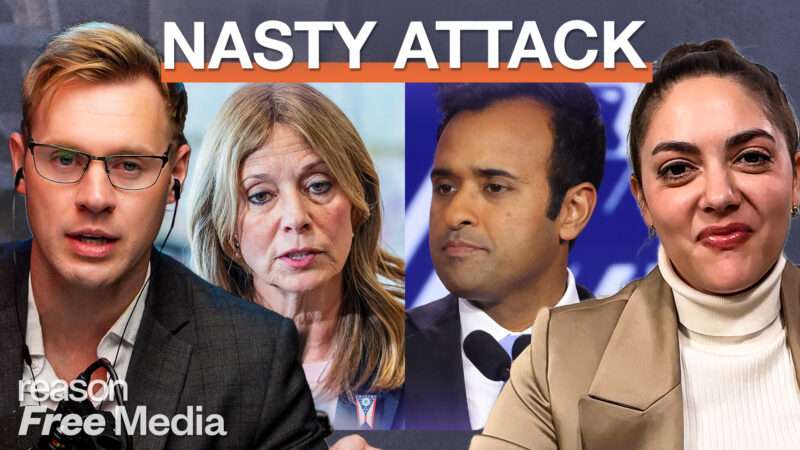
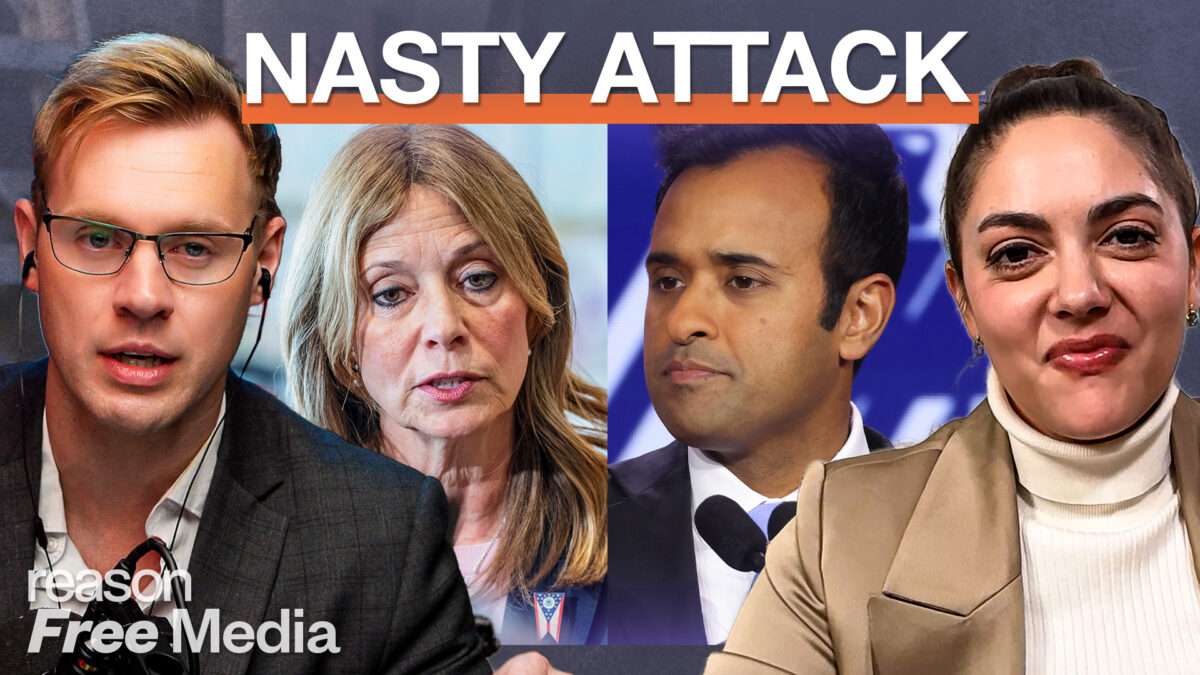
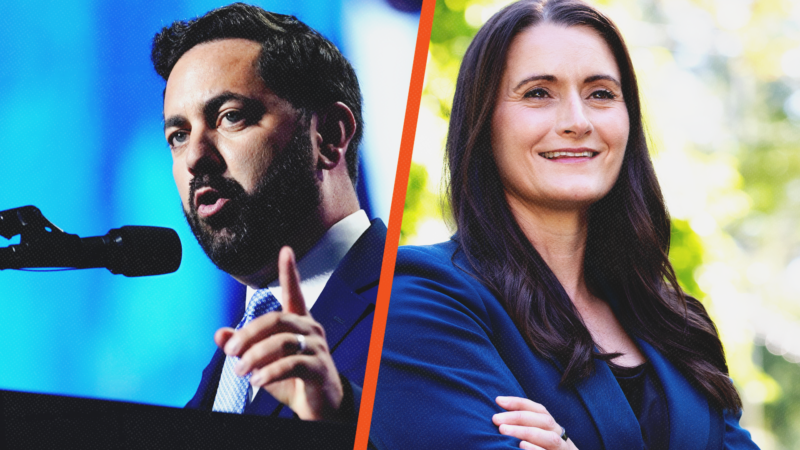
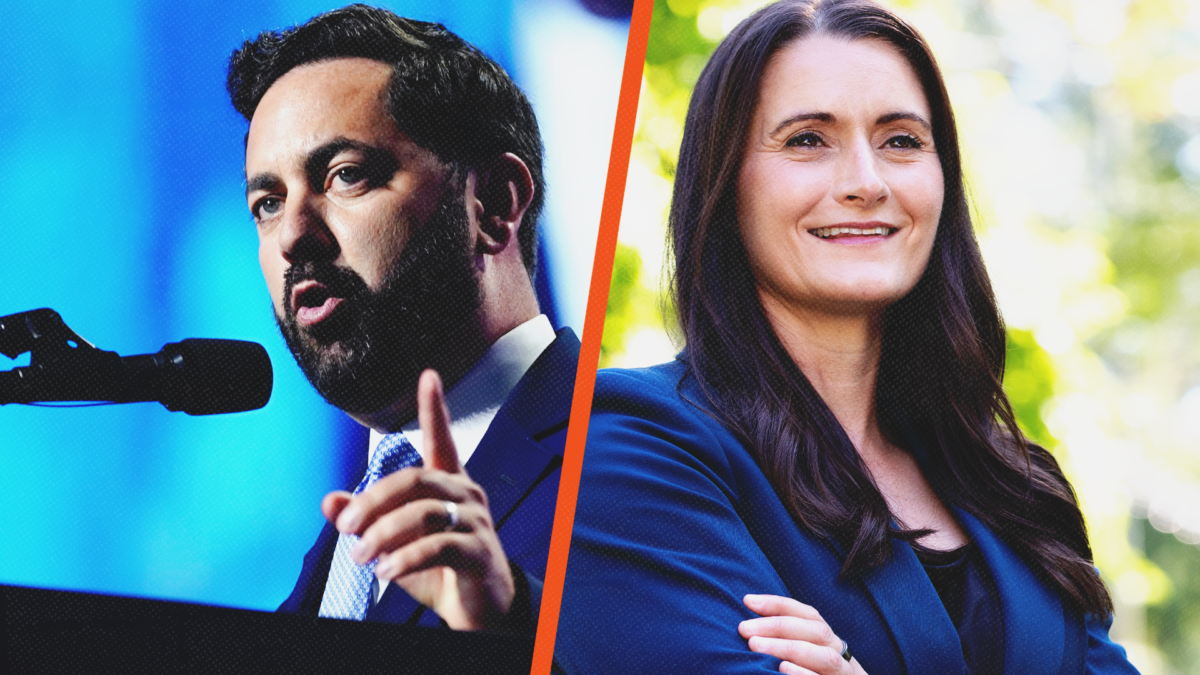
In this segment of Free Media, Reason Senior Editor Robby Soave and Daily Caller Editor in Chief Amber Duke discuss Vivek Ramaswamy's controversial attack ad against his opponent Amy Acton in Ohio's gubernatorial race.
If you enjoy Free Media, come watch Robby debate at our upcoming Reason Versus in Washington, D.C. Tickets are available here.
When Americans vote in the midterm elections next month, it seems likely that Democrats will see decisive victories across the country.
This trend seems likely to affect Georgia's two most high-profile races differently. Sen. Jon Ossoff, a Democrat, is running for reelection against Rep. Mike Collins, a Republican who represents the state's 10th congressional district, while in the race to replace Gov. Brian Kemp, former Atlanta Mayor Keisha Lance Bottoms faces Republican billionaire Rick Jackson.
Ossoff and Bottoms may both be Democrats, but their prospects look very different: A recent poll put Ossoff nearly seven points ahead of Collins, but Bottoms was a point and a half behind Jackson, trailing the senator from her own party by more than five points.
Democrats hope that if Ossoff does well enough, it will boost their other candidates. But it's worth asking why Bottoms, who was feted as a possible vice presidential candidate, is struggling to break even against someone with no prior name recognition, in a year expected to be a boon for her party.
It's possible that the crime and protests of 2020 could be weighing down Bottoms' candidacy in an otherwise auspicious year for Democrats.
Mayor Bottoms and the 'COVID Crime Wave'
Bottoms' single term as mayor of Georgia's capital city would be defined by summer 2020. Amid the COVID-19 pandemic, violent crime rose across the country, but it was worse in Atlanta—homicides were up 59 percent, while most other cities averaged 33 percent. Bottoms herself later called it the "COVID crime wave."
Then on May 25 in Minneapolis, a police officer killed George Floyd, an unarmed black man accused of passing a counterfeit $20 bill. Footage went viral, and protesters across the country took to the streets.
In some places, including Atlanta, protests turned destructive, and the police responded in kind.
Bottoms called for peace. "If you care about this city, then go home," she exhorted rioters in a news conference. "When you burn down this city, you're burning down our community."
She won bipartisan praise. "Your passion, your composure, your balance, has been really incredible," then-presidential candidate Joe Biden told her.
But just days later, Atlanta police officers shot and killed a black man, Rayshard Brooks, in a Wendy's parking lot. Protesters gathered the next day and burned the restaurant to the ground.
Meanwhile, after the district attorney announced charges against the cops involved in Brooks' shooting, more than 170 officers called out sick in protest. Bottoms admitted that officer morale "is down tenfold."
Then on July 4, less than half a mile away from the site of Brooks' death, protesters shot into a car, killing 8-year-old Secoriea Turner.
The crime spike persisted into 2021, and in May of that year, Bottoms announced that she would not run for a second term.
Officially, she said, it was "time to pass the baton on to someone else," though her announcement "came as the city faces a homicide rate topping that of this time last year—a historically deadly one in Atlanta," Henri Hollis wrote at the Atlanta Journal-Constitution.
Indeed, it seems the "COVID crime wave" had caught up with her: A September 2021 poll found that while 57 percent of city residents approved of the job she was doing, 53 percent also felt the city was on the wrong track, including 48 percent of Democrats. The top issue was crime, which 70 percent of respondents felt was headed in the wrong direction.
She later told New York that by stepping down, she was "putting my emotional and mental health first"—a worthy reason, though a bit odd since she now seeks an even higher office.
Then again, she also had higher aspirations. Bottoms was one of the first officeholders to endorse Biden for president in 2020, and she later made his shortlist of potential running mates. After the end of her term, she joined Biden's White House as director of the Office of Public Engagement, after which she moved over to the President's Export Council for the remainder of his term.
Bottoms announced her run for governor just four months after leaving Washington. And while she locked up the Democratic nomination easily, winning 56 percent of the vote among seven candidates, she didn't exactly fire up the base, and it seems like she just expected to coast to victory.
"It feels a lot like she gained the nomination…largely from name identification," progressive journalist Zaid Jilani tells Reason. "She really wasn't raising that much money or spending that much on television….It should be a high-profile race in many ways, but the ideas she's putting forward are fairly rehashed," and "she doesn't have that much creative advertising."
Rick Jackson's Deep Pockets and Shallow Record
Rick Jackson, meanwhile, seemed to come out of nowhere.
President Donald Trump endorsed Lt. Gov. Burt Jones in August 2025, and Jones led the Republican primary field at the end of that year.
While Kemp famously resisted Trump's efforts to subvert Georgia's presidential election results in 2020, Jones was a willing participant in the scheme.
"I've been the Trump guy since 2015, not '16," Jones bragged. "I've taken all the battle scars and everything else. I know who ran and hid during 2020 and everything else."
Then in February 2026, just three months before the primary, Jackson entered the race. He was a septuagenarian with no name recognition, but he was also quite wealthy, so he blanketed the state with ads to introduce himself to voters.
In six weeks, he spent over $30 million—"more than any candidate has ever spent in a primary race for Georgia governor, with more than two months before the May 19 election," wrote Jeff Amy of the Associated Press.
It worked: Jackson beat Jones in a primary runoff with 53 percent of the vote. By then, he had spent $108 million on his campaign while raising less than $400,000 from donors.
Jackson has made much of his background, as a child of poverty who entered the foster system at age 13 to escape a dysfunctional household. As an adult, he started in sales and worked his way up to entrepreneurship, starting Jackson Healthcare in 2000 and growing it to more than $1 billion in annual revenues. He is also a generous donor to charitable causes, particularly those relating to foster care.
But with no political record, Jackson can be hard to pin down on certain issues.
For example, one Jackson ad criticizes Bottoms for the rise of data centers in Atlanta, even though he has also spoken positively of their economic potential.
Georgia Democrats have tarred Jackson as a Trumpian election denier, singling out a comment he made at a campaign event: When asked if the 2020 election was stolen, Jackson replied, "That was totally ridiculous what happened in 2020 and our people really let us down." ("Just as Governor Kemp did, Rick acknowledges both Biden's win and that there were issues in the 2020 election that needed to be resolved in order to ensure Georgians have faith in our electoral system," a campaign spokesperson told CNN.)
During the primaries, he even took heat from both sides on abortion: Jones accused Jackson's company of working with Planned Parenthood, while Jackson himself seemed to suggest he wanted to change the state's abortion ban to remove exceptions for rape or incest. ("Rick believes we have a strong pro-life law in place and he wants to keep it as it is," his campaign said in a statement.)
And while he made Trump-like pledges, like to "make Georgia No. 1 in the nation for criminal deportations" and keep "the religion of woke ideology" out of schools, his platform calls for an "intelligent Medicaid expansion" in the state.
Jackson has also pivoted just over the course of the campaign.
He bragged in his campaign announcement video that he "donated a million bucks to Trump," and he's said that if elected, he would be "just like" Trump but "with a southern tone."
He said Trump had "no bigger supporter" than himself, and he could not name a single Trump policy he disagreed with. When Trump endorsed Jackson at a campaign rally in July, the candidate pointed to the president and said, "I'm going to be this man's favorite governor."
But like many other Republicans, Jackson has distanced himself from the president, whose approval rating is at an all-time low. The Atlanta Journal-Constitution reports that in campaign appearances, Jackson has stopped mentioning Trump directly, preferring to compare himself to Kemp, the sitting governor who remains popular.
He apparently also scrubbed all mentions of the president from his campaign website.
But one thing that has remained consistent in Jackson's campaign strategy is criticizing Bottoms' record as mayor.
Will the 'COVID Crime Wave' Sink Bottoms?
Some of Jackson's campaign ads feature grateful children who grew up in foster care and benefited from his philanthropy, but for the most part, they have targeted Bottoms over her record.
One ad, titled "Disaster," paints Bottoms' tenure as exactly that, with the city becoming practically unlivable during summer 2020.
"Keisha ended cash bail, gutted the corrections budget, let Atlanta burn, and unleashed a crime wave," Jackson wrote on X to accompany another ad. "Then she walked away."
"If Keisha wants to run from her record," according to a campaign email, "we're going to make sure Georgia remembers exactly what that record was."
Many Jackson ads, flyers, and mailers have featured images of Secoriea Turner, the 8-year-old girl killed by gunfire. (Turner's parents have asked Jackson's campaign to stop.)
But is it fair to blame everything on Bottoms? While Atlanta was worse than most, many major cities saw large homicide spikes: Chicago's murder rate climbed more than 50 percent that year, while New York City's went up nearly 40 percent. Murders in Columbus, Ohio, rose a staggering 67 percent.
Regardless, Bottoms was in charge at the time. And the attacks do seem to have an effect, as she's locked in a dead heat against Jackson.
Granted, Bottoms was never a particularly strong candidate. When she ran for mayor in 2017, she won the runoff election by fewer than 800 votes, even with the endorsement of the outgoing mayor.
Georgia also has not elected a Democratic governor in nearly three decades, though it has elected Democrats to the U.S. Senate three times since 2020 and seems poised to reelect one this year.
There's also the fact of Jackson's money, saturating the state with eight-figure ad buys while Democrats were spending only a fraction of that.
Of course, money alone can't buy a victory: Kemp defeated Stacey Abrams in each of the last two races for governor, despite being comfortably outraised and outspent each time.
But Bottoms currently trails Ossoff by five points in an election cycle expected to be quite beneficial to their party.
It seems the race will serve as an indicator of how fresh the summer of COVID-19 still feels for Georgians.
"To the kind of voter that Jackson is courting, it probably is true that had Democrats [instead] nominated the mayor of Macon [a smaller Georgia city], they would be in a stronger position than nominating the mayor of Atlanta, especially one who was in power during those years," Jilani tells Reason. "If he wins, it demonstrates that that is still a fairly potent line of attack."
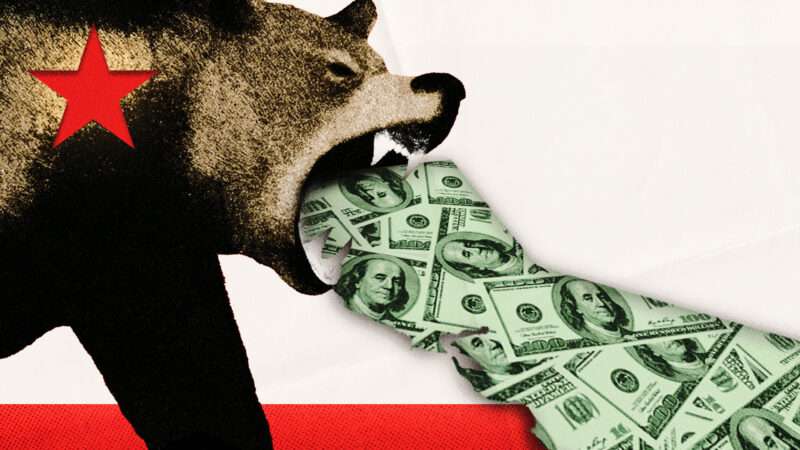
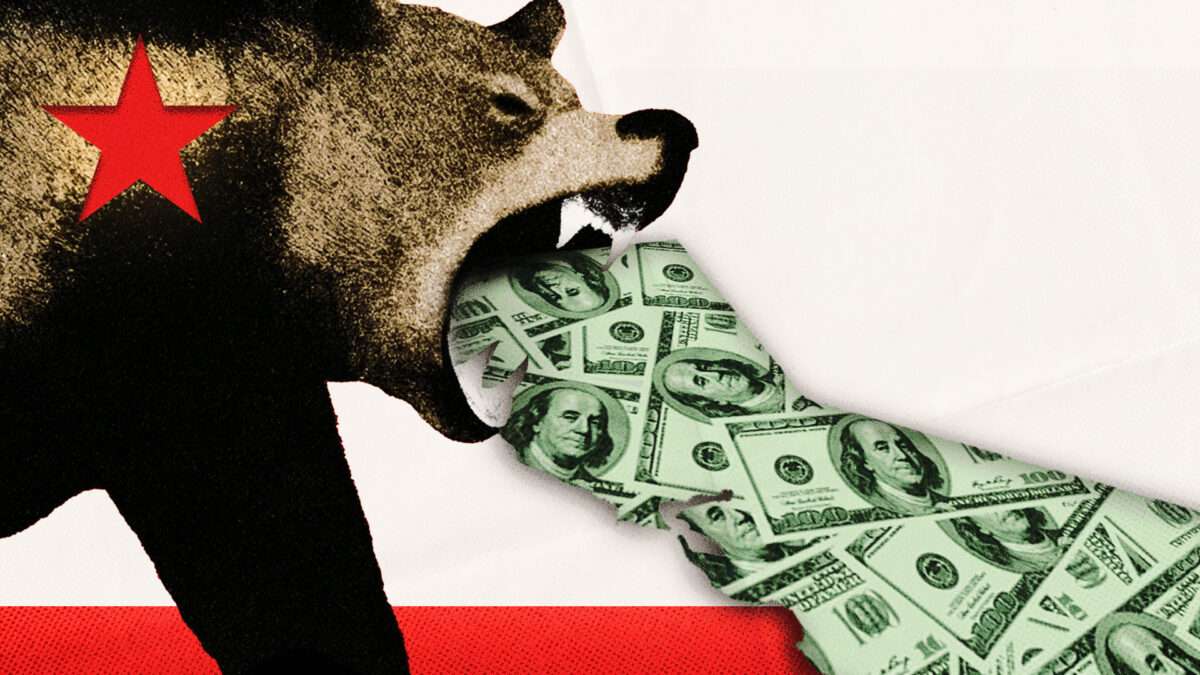
A proposed "wealth tax" on California's billionaires could backfire and cost the state tens of billions of dollars in the long run.
If the proposed tax drives wealthier residents out of the state, California could end up losing between $1 billion and $3.5 billion annually in income taxes, according to a working paper published this week. A pair of researchers at Stanford University warn that the state could end up losing an estimated $39 billion because of the consequences of the wealth tax.
"These findings suggest that the Billionaire Tax Act will not fulfill the primary functions for which it was designed," write researchers Benjamin Jaros and Joshua Rauh.
Voters in California will decide next month whether to impose the one-time, 5 percent tax when they vote on Proposition 40. The ballot measure is dividing Democrats—Gov. Gavin Newsom opposes it, while progressive Rep. Ro Khanna (D–Calif.) claims it is the "most important ballot initiative in America and a fight for the soul of our party."
And it's already spurring some billionaires to flee the state—including venture capitalist Peter Thiel and Google co-founder Larry Page. Including those two, the seven billionaires who have publicly said they are leaving the state represent more than $539 billion of the nearly $1.9 trillion aggregate net worth of California's billionaires, the researchers note.
With other departures likely happening more quietly, the new study estimates that the tax will generate about $30 billion, a far cry from the $100 billion that the tax's supporters expect. The "behavioral response" from billionaires in California "has eroded most of the projected tax base," write Jaros and Rauh.
That's still a pretty big pot of revenue. In the long run, however, the state is likely to lose out.
After running 100,000 simulations using different assumptions, the two researchers report that "85 percent of plausible outcomes produce a negative" result in state revenue.
Capital is always mobile, despite the best efforts of politicians. And if you were a billionaire living in California, why would you stick around?
Polls show voters are narrowly divided over Proposition 40. A Politicopoll published earlier this month showed 46 percent of voters plan to vote for the measure, while 43 percent oppose it. Voters were similarly divided when asked if they expected it to pass or not.
In the first round of Brazil’s elections on Oct. 4, 2026, Flávio Bolsonaro, of the right wing Liberal Party (PL), came in first with 47.03% of the valid votes, compared with 45.16% for the current leftist president and Workers’ Party (PT) candidate, Luiz Inácio Lula da Silva. The margin was just over 2.2 million votes, […]
With little more than two weeks to go until the midterm elections, it seems increasingly possible that the Democrats, already a big favorite to win control of the House of Representatives, will also take charge of the planet's most elite nursing home, the United States Senate, where the median age is 64 years old. RealClearPolitics' poll aggregator has moved control of "the world's greatest deliberative body" (as its members are grandiosely wont to call it) to "toss up," status and prediction markets are now breaking big toward a blue wave. As of this writing, Kalshi has its Senate odds at 63 percent for the Dems vs. 37 percent for the GOP; Polymarket is at 62 percent vs. 39 percent.
As gratifying as it might be to see unprincipled Trump enablers reduced to minority status after signing off on economy-wrecking tariffs, inhumane immigration detentions, and wars of choice, there's at least one good reason to dread a Democratic majority too: Sen. Elizabeth Warren, the Massachusetts progressive who is spending the run-up to the midterms freaking out over possible consolidation in the condiments business and accusing private equity firms of gutting such shopping-mall favorites as Claire's and Toys R Us. There's every reason to believe that a Senate run by Warren and other economic interventionists will waste time, money, and resources trying to prevent a world in which, per the X wag Iowahawkblog, "a panopticon conglomerate owns two brands of hot sauce."
On October 13, Warren posted this dire warning to X:
Hellmann's mayo McCormick spices Cholula hot sauce Frank's RedHot
What do these products have in common? One company could soon control them all.
I have concerns that McCormick and Unilever's $45 billion merger could increase YOUR grocery prices.
It's hard to think of a more competitive and varied market than the one for hot sauces, which is expected to more than double over the next decade. The barriers to entry are generally low, as are the key ingredients, and new entrants can easily market and sell online, avoiding the costs of buying shelf space in conventional supermarkets. Yet Warren is urging regulators at the Department of Justice and the Federal Trade Commission to halt mergers of both product makers like McCormick and Unilever and grocery stores like Kroger and Giant Eagle.
The latter complaint is particularly picayune. Kroger is one of the country's largest supermarket chains, operating around 2,800 stores under its own name as well as Harris Teeter, Ralph's, and others. Giant Eagle operates about 170 stores. This merger is no more the stuff of nightmares than a single company producing both Cholula and Frank's RedHot. If Warren gains more clout from being in the majority, expect her to butt in more and more on such mergers.
Making it harder for businesses to adapt is not a recipe for making goods and services more affordable. But Warren is keen to blame economic creative destruction not on "new forms of industrial organization that capitalist enterprise creates" (as Joseph Schumpeter would have it), but on pure greed. In a TikTok released earlier this month, she shows a poster board with corporate logos from once-thriving companies that she says have been "gutted" by "private equity" firms.
"Here's your local mall," she piously intones. "Now, private equity wants you to believe that Red Lobster went bankrupt because of their endless shrimp….They want you to believe that Claire's went bankrupt because teens stopped shopping at the mall." In Warren's telling, private equity firms magically take over thriving businesses and then strip them bare. The typical pattern is that private equity enters the picture after a business is failing.
Virtually all accounts of the decline of, for example, Red Lobster, note that the chain had been spiraling for several reasons before the private equity firm Golden Gate Capital got involved in 2014. As this CNN article notes, the chain, which started in 1968, had seen drops in sales as customer desires changed. Management compounded the difficulties with a series of bad decisions, including continuing various all-you-can-eat menu specials, before coming out of Chapter 11 bankruptcy last year.
Similarly, it's true that some teens still go to malls and get their ears pierced at Claire's. But anyone who has spent time in retail America over the past few decades knows that malls are no longer the destination that they once were. As CapitalOne Shopping Research documents, "in 1986, there were 25,000 malls, large and small, nationwide." By 2023, that number had shrunk to just 1,200. While some malls are coming back, most are not, and for reasons that have nothing to do with private equity. Online retails plays a role (though a smaller one than usually imagined, with e-commerce accounting for less than 20 percent of all retail sales). But mostly, it's that people today tend to want a different sort of retail environment. Anchor stores—think Macy's and J.C. Penney—are shadows of themselves, and younger people have less unstructured time in which to prowl food courts and arcades.
For politicians like Elizabeth Warren, though, there can be no financial gains or losses that aren't the result of shadowy, conspiratorial forces. If her party takes control of the Senate, her words will carry more weight. But it will be American consumers that ultimately shoulder the burden of an even-more-regulated economy. The market for hot sauces will almost certainly stay spicy, but many other parts will surely suffer.
The Democratic Socialists of America (DSA) candidates running for the House of Representatives and endorsed by NYC Mayor Zohran Mamdani are all but guaranteed to win their general elections this November, but that does not mean the midterm drama is over in New York. In the state's 17th congressional district, which includes the lower Hudson Valley, Democratic challenger Cait Conley, a combat veteran who served on the Biden administration's National Security Council, could unseat incumbent Republican congressman Mike Lawler in one of the most consequential races of the midterms.
The highly contested purple district voted for former Vice President Kamala Harris in the 2024 election while reelecting Lawler for his second term. Now, Lawler is attempting to win a third term as support for President Donald Trump wanes ahead of the midterms. As of Friday, The Cook Political Report lists the race, which could determine control of the House, as a toss-up.
If elected, Conley would have far more in common with the "Badass Women" coalition of security state and military veterans than with DSA types (think more Sen. Elissa Slotkin from Michigan than Darializa Avila Chevalier). As Judge Street Journal's Timmy Facciolanotes, "Conley's candidacy is testing the viability of a tactful centrism that rebukes left-wing positions like abolishing ICE or restricting weapon shipments to Israel." Lawler is also vying for moderates, pitching himself as "one of the most bipartisan members of Congress" and emphasizing his willingness to break with Trump occasionally while still welcoming Trump's support.
While Lawler and Conley certainly are not pure MAGA acolytes or DSA members, both have leaned into a tech-critical position, much like that of more radical populists like Lina Khan or Steve Bannon, revealing how pervasive anti-tech sentiment has become in mainstream politics.
This tech skepticism was on full display during an October 14 debate, when each candidate made the case for why they were the most equipped to regulate AI, insisting that the industry needs guardrails.
Conley said members of Congress do not want to regulate AI because "they want to look out for their billionaire and trillionaire backers like Elon Musk, who is pouring over $260 million into this midterm election." She then added that Musk backed Lawler in his 2024 race.
Lawler then accused Conley, who previously consulted for Primer AI, of being "the AI candidate for the AI industry."
While Lawler and Conley disagree on specific data center regulations (Conley supports Democratic Gov. Kathy Hochul's data center moratorium while Lawler supports local zoning control over data centers), neither wants to pitch themselves as an explicitly pro-data center candidate. During the debate, Conley claimed that, "On Mike Lawler's watch there have been five data centers built in Rockland County." Lawler has said that he had no say in the decision to build the data centers, and during the debate, he pointed out that the facilities were built for financial services. Lawler also attempted to attack Conley over data centers, slamming her in an ad for saying "we need data centers." Regardless of the candidates' specific policies on data centers, their attacks on one another demonstrate that cheerleading hyperscale data center development is a political liability. In their district, data center has presumably become a dirty term.
The candidates' tech-skeptical rhetoric did not end with unchecked data center development. After the debate, Reason asked both candidates about their positions on age-verification laws for social media and AI, since such regulations raise significant privacy and censorship concerns by age-gating the internet. Unsurprisingly, both Lawler, who votedfor the controversial KIDS Act, and Conley, who has proposed stricter age verification for AI tools, parroted platitudes about why such online safety regulations are necessary to protect children.
"We have watched how social media is literally hurting the mental health of children," Conley told Reason. "And when you talk about the power of AI and what that power could do, we have to regulate this."
Lawler gave a similar response, telling Reason that he respects free speech but that protecting children "is paramount."
This bipartisan consensus over social media regulation has long been brewing in Congress. The mainstream political conversations about AI and data centers, however, are relatively new this midterm election cycle. And it appears both Lawler and Conley have figured out which way Americans' sentiment toward AI is leaning, and they have waged their campaigns accordingly.
TEL AVIV — There is one country on earth where Donald Trump could plausibly win a national election, and he knows it. “I could run for Prime Minister,” he joked in May, claiming 99% approval here. No poll has ever shown that. But the joke landed because it is only half a joke. Thirteen days before […]

 Login