❌

Reading view

Russia will not abandon agreements with Iran, Lavrov declares in visit to Tehran

During a high-level visit to Tehran earlier this week, Russian Foreign Minister Sergey Lavrov expressed his country’s official position demanding a restoration of the pre-war situation in the Persian Gulf region and guarantees that there will be no return to war against Iran in the future.

Lavrov also claimed that his country was ready to assist in “searching for mutually acceptable solutions to resolve” the “artificial” crisis created by “unprovoked US-Israeli aggression” against Iran.

Later on Wednesday, Russian President Vladimir Putin repeated the offer of mediation during the visit of Steve Witkoff, the White House’s special envoy to the Middle East, to Moscow.

Lavrov, who visited Iran on Monday, October 18, also reiterated the Russian position that Iran’s responses to US aggression was justified and legitimate and claimed his country has provided whatever political and economic assistance it could to help it face the repercussions of the unlawful US-Israeli war.

Lavrov’s statement could be seen as a rebuttal to US President Donald Trump, who appreciated Russia’s supposed neutral role in Iran during the eight-month-long war.

Trump claimed it was a “positive” development that Russia did nothing to help and was even “laying off Iran” as the US is hitting Iranians economically and militarily.

Trump was forced to withdraw some of its sanctions on Russian energy exports, imposed from 2024, in his bid to secure an energy deal earlier this month.

Trump’s move is largely seen as an attempt to lower the impact of the rising gas prices on the prospects of Republican candidates before the upcoming midterm elections.

Lavrov, however, cited the Russian veto in the UN against the US attempts to justify its military aggression against Iran, providing humanitarian aid including medicine, other medical supplies and food during the war also claiming that such aid is continued to be “delivered regularly.”

Iranian President Masoud Pezeshkian also appreciated the Russian help during the war and expressed his country’s desire to further deepen cooperation between the two countries.

Iran and Russia signed and implemented a 20-year Comprehensive Strategic Partnership Treaty last year. The treaty has provisions of close coordination on issues related to economy, geo-politics, and security.

Lavrov pointed out the growing bilateral trade between the two countries in the last two years, despite the war and sanctions they are both facing. According to him, in the first eight months of the present year, the bilateral trade between Russia and Iran grew 10% in comparison to the same period last year.

Lavrov also informed that Russian scientists who were withdrawn from Iran’s Bushehr nuclear power plant during the war have started returning gradually.

Russia and Iran are closer than ever

Iranian Foreign Minister Abbas Araghchi claimed that bilateral relations and cooperation between Russia and Iran has never been as good as it was today.

While addressing a joint press conference with Lavrov in Tehran on Monday, Araghchi reiterated that both the countries maintain close cooperation and consultation on all regional issues, including Iranian relations with the US.

He claimed that the two countries agree that the instability and disruption in the Persian Gulf and the Strait of Hormuz is a result of unprovoked US-Israeli aggression and that they share the vision of a diplomatic solution to all outstanding conflicts.

Talking about their mutual understanding about regional issues, such as Lebanon and Palestine, Araghchi claimed that both Russia and Iran agree the “genocide of the Palestinian people and the Israeli regime’s dangerous expansionism in the region must stop.”

Lavrov alleged that some countries are trying to push the Palestinian issue to the background, which should not be allowed. He stated that both Iran and Russia would push for the implementation of all relevant UN resolutions because it is “crucial to intensify efforts to resolve the Palestinian issue.”

Lavrov also demanded an end to all Israeli hostilities in Lebanon and peace in Yemen, demanding the full implementation of all relevant UN resolutions and previous understandings.

Lavrov rejected US threats of secondary sanctions over its relationship with Iran, claiming “despite the challenging situation … Russia has no intention to abandon the implementation of economic and investment agreements with Iran.”

As a part of its ongoing war, the Trump administration had announced the complete economic isolation of Iran in August, threatening secondary sanctions against all the countries who still maintained economic relations with it.

Only a handful of countries, such as the UAE, have announced compliance with the US attempts to economically isolate Iran so far.

  •  

‘Palestine is about land’: Tanzania’s peasant farmers stand with Gaza and Havana

On the opening day of its National Smallholder Farmers’ Conference and 31st Annual General Meeting (AGM), held from September 29 to October 1, MVIWATA, Tanzania’s national network of smallholder farmers’ groups, set aside time during a program on land, seed, and markets to state solidarity with the peoples of Palestine and Cuba, with the ambassadors of both countries present in the hall.

“We, the members of MVIWATA, who have convened in Morogoro for our 31st Annual General Meeting, wish to give a brief statement in support of the people of Palestine and the Cuban people,” read Theodora Pius, MVIWATA’s head of program, opening the statement. The organization said it was “extremely angered by the ongoing genocide of the Palestinian people” and “frustrated to see an open silence on war crimes that happen every day against the people of Palestine by the State of Israel and its allies.” It said its solidarity was with all of Palestine, “not only in the Gaza Strip.”

The statement then turned to Cuba, denouncing more than 60 years of US-imposed blockade, it said, imposed because Cubans exercised their freedom to choose their own political system, and went on to articulate what the blockade now means: “no electricity, no fuel, no medicines, no food.” Despite this, the statement said that the Cuban people have continued to send their expertise (doctors above all) to support life in other countries.

The Cuban Ambassador, Yordenis Despaigne Vera, addresses delegates attending the National Smallholder Farmers’ Conference and the 31st Annual General Meeting of MVIWATA.

The Cuban Ambassador, Yordenis Despaigne Vera, thanked the smallholder farmers and described the current stage of the blockade as an energy war. United Nations agencies reinforce this characterization. By May, the Cuban people were living with daily blackouts of up to twenty hours, and more than 100,000 patients, including 11,000 children, were waiting for operations delayed by power cuts and shortages. Cuba’s own health ministry recorded infant mortality rising from 7.1 to 9.9 deaths per thousand live births between 2024 and 2025. The ambassador called the United States program “a silent genocide” and said Tanzania’s government and people had stood with Cuba throughout. A week earlier, at the UN General Assembly, Tanzania’s Vice-President had reaffirmed the country’s “unwavering solidarity with Cuba” against unilateral sanctions. Last October, the Assembly voted 165 to 7, with 12 abstentions, to demand an end to the blockade; Tanzania voted in favor.

The Palestinian ambassador, Salam Abu Sharar, addressed the room of farmers. Land, he said, is close to the hearts of the Palestinian people and of MVIWATA alike, and the question of Palestine “is not about religion; it is about land.” In a hall where the first working session opened with the words “land is life, land is not a commodity,” he spoke the delegates’ own language: the struggle of Tanzania’s peasants and the national liberation of Palestine are one struggle.

The Palestinian ambassador to Tanzania, Salam Abu Sharar with MVIWATA Chairperson Apollo Chamwela. Photo: MVIWATA

MVIWATA has been here before. Its AGM in Njombe in December 2023 condemned Israel’s genocide in Palestine. In July 2025, it hosted the youth of La Via Campesina in Morogoro, whose declaration ended with “Free Palestine!” Within days of that meeting’s close, Israeli forces bulldozed the seed multiplication unit of the Union of Agricultural Work Committees, the Palestinian farmers’ organization in Hebron, destroying more than seventy local varieties. The same year, MVIWATA and the International Association for Popular Cooperation ran an Africa Bioinputs School in Tanzania, with participants from thirteen countries, including Palestine, learning how farmers make their own fertilizers and pest controls.

On the conference’s final day, the Tanzanian farmers resolved to build their own bank of indigenous seed. In Hebron and in Morogoro, the seed is where the struggle over who feeds whom begins. MVIWATA Chairperson Apollo Chamwela told the ambassadors that the organization stood ready to do for Cuba what it had tried to do for Palestine: collect food if mechanisms for transporting it can be arranged.

MVIWATA is a membership organization of smallholder farmers, founded in 1993 and organized across mainland Tanzania and Zanzibar. It was a meeting with a government minister as its guest of honor. Its statement on Palestine and Cuba came in the same breath as its demands for land, seed, and dignified prices for its members’ produce at home. For these farmers, sovereignty over food and sovereignty over territory are one question, whether the territory is a village in Kilosa or a hillside in Hebron.

The hall closed the statement with a call and response. “Long live Palestine! Long live!” “Viva Fidel! Viva!” “Viva the resistance of the people of Palestine! Viva!”

Photo: MVIWATA

Jonis Ghedi-Alasow is the Coordinator of the Pan Africanism Today Secretariat. 

  •  

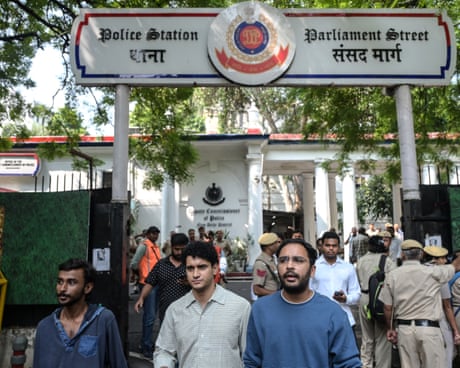
Indian court orders release of two leaders of Cockroach movement

Saurav Das and Ashutosh Ranka spent a week in jail after defying restrictions on protests in Delhi amid government crackdown

An Indian court has ordered the release of two leaders of India’s Cockroach movement who were jailed last week amid a mounting state crackdown on youth-led protests.

The two leaders of the Cockroach Janta party (CJP) movement, Saurav Das and Ashutosh Ranka, had spent a week in Delhi’s Tihar jail after being arrested by Delhi police last week.

Continue reading...

© Photograph: AFP/Getty Images

© Photograph: AFP/Getty Images

© Photograph: AFP/Getty Images

  •  

Reliance Jio opens India's largest-ever IPO, targeting $3.2 billion

Reliance Jio Platforms, the telecoms and technology arm of Indian billionaire Mukesh Ambani's conglomerate, opened India's largest-ever initial public offering on Wednesday, seeking $3.2 billion from investors. The listing is the second mega IPO to reach Indian markets within a month, arriving despite subdued broader equity trading.

  •  

Rubio’s Central Asia pitch is about more than minerals

US Secretary of State Marco Rubio arrived in Samarkand on October 19 with nearly 300 American business leaders, seeking to deepen US commercial ties with Central Asia. Washington’s renewed interest will matter less for how many agreements it produces than for whether American investment helps the region move beyond being merely a supplier of raw […]

The post Rubio’s Central Asia pitch is about more than minerals appeared first on Asia Times.

  •  

PTI demands whereabouts of Khyber Pukhtunkhwa’s CM and other detained leaders

Pakistan Tehreek-e-Insaaf (PTI), the main opposition party in the country demanded, on Monday, October 29, the whereabouts of several of its leaders, including the Chief Minister of Khyber Pakhtunkhwa (KP), Sohail Afridi, kept in “preventive detention” by the state.

The PTI has claimed that Afridi, Speaker of the Provincial Assembly Babar Saleem Swati, and at least six other members of the KP provincial assembly were “missing” since the dismissal of the elected government in the province on October 11.

Afridi and other PTI legislatures were arrested on October 11, hours after Pakistan’s federal government imposed a state of emergency and governor’s rule in the province.

Though the Pakistan government has maintained that the concerned leaders are all in preventive detention, it has neither produced them in court, disclosed their location, or allowed anyone to meet them.

The police has, meanwhile, filed fresh cases of violence and arson against Afridi and other PTI leaders, accusing them of being involved in May 2023 protests against the attempted arrest of the party’s leader and former Prime Minister Imran Khan.

Calling the arrest of its leaders an unprecedented and unconstitutional crisis, the PTI has filed several petitions in the courts for their release. On Monday it also demanded an urgent discussion on the matter in the National Assembly.

“The reported detention of elected representatives holding constitutional and parliamentary offices raises serious concerns regarding the functioning of democratic institutions, the representation of the people, and the protection of the rights and privileges of the elected representatives,” the PTI notice for the discussion in the NA says.

Act of political vendetta

The Afridi government in the state was dismissed by the federal government, led by Prime Minister Shehbaz Sherif, on October 11, over allegations of failing to maintain law and order and prevent terrorism.

However, the dismissal is linked to Afridi leading a “long march” of PTI supporters to the capital, Islamabad. The protesters were demanding the release of Khan, who has been incarcerated since August 2023 on various charges, including the misuse of power, corruption, and violence.

The PTI claims all the charges against Khan are fabricated and politically motivated and were part of the plan of the ruling parties and the armed forces to keep him out of national politics.

Afridi’s dismissal and arrest led to popular protests in different parts of KP in the last week and security forces fortifying the provincial capital Peshawar. The PTI has also alleged that its workers and offices have been attacked since the imposition of Governor’s rule.

At least five people were injured when security forces clashed with the protesters in Bara last week. Hundreds of others were arrested from different parts of the province for attempting to protest the dismissal of the only government led by the opposition party.

The PTI has also filed a petition in the Peshawar High Court against the federal government’s move to dismiss the state government in KP, calling it a violation of the popular right to choose their government and other constitutional provisions.

Its leaders reiterated their allegations about the Sharif government, calling it illegitimate and a stooge of the armed forces. They claimed that the KP government was the “only elected” government in the country and its dismissal was part of a political vendetta.

The PTI, along with other groups in the country have repeatedly alleged that the 2024 national elections were rigged to prevent Imran Khan from coming back to power.

  •  

Ghosts of ’97 haunt Prabowo as MSCI eyes Indonesia’s exit

2026, it is learning how quickly an index provider can show Southeast Asia’s biggest economy the exit, wreaking havoc on its stock market. The provider is MSCI, which may be about to follow through on its threat to downgrade Indonesian stocks to “frontier” status, or to something worse: a standalone market category. President Prabowo Subianto’s […]

The post Ghosts of ’97 haunt Prabowo as MSCI eyes Indonesia’s exit appeared first on Asia Times.

  •  

Food aid cut for half a million Palestinians in Gaza, as fatal Israeli strikes continue

At least eight Palestinians, including four children, were killed in Israeli assaults in different parts of the Gaza Strip over the last two days.

On Monday, October 19, Israeli forces launched drone strikes on north-central Gaza City and the southern city of Khan Younis, killing a Palestinian man and two children.

One day earlier, five Palestinians were killed and several others were injured in Israeli shelling and gunfire across the besieged enclave. This includes two children, who were shot dead by Israeli soldiers in separate attacks.

One of the slain children was identified as 13-year-old Tamer Soboh, who was killed in the northern city of Beit Lahia; the other was Misk al-Dalu, who died after Israeli troops opened fire at tents sheltering displaced people in al-Maghazi refugee camp in the central Gaza Strip.

Mass funerals continue as more people are recovered from beneath the rubble

Meanwhile, mass funerals remain common across Gaza as Palestinians dig through the rubble to recover the remains of their loved ones.

On Sunday, the remains of 75 Palestinians were buried in the Sheikh Radwan Cemetery in Gaza city, the majority of whom were children and women killed in Israeli airstrikes that targeted their homes during the three-year genocide.

Read more: Mass funeral held in Gaza, largest in history of Palestinian cause

WFP cuts aid to half a million Palestinians in Gaza

While mass killings are underway in the war-ravaged territory, the humanitarian crisis further deteriorates not only because of Israel’s continued blockade and restrictions on the entry of goods and supplies, but also because of measures taken by some organizations concerned with providing aid to the population.

On Monday, the United Nations World Food Program (WFP) announced that it will reduce food assistance in Gaza by around one-third due to shortage of funding. This means that 500,000 people will lose access to critical assistance.

It is worth noting that since the beginning of Israel’s genocidal aggression on Gaza, the WFP provided food assistance for up to 90% of families in the Gaza Strip.

  •  

Iran says its peace proposal is still on the table, warns the US and Israel against a ‘miscalculation’

Iranian Foreign Minister Abbas Araghchi reiterated that his country’s proposal to end the war with the US and to restart nuclear negotiations is “still on the table,” claiming the Iranian conditions are “completely clear” and “unchanging.”

Talking to Iranian state media on the sidelines of the 52nd session of the Council of Foreign Ministers of the Organization of Islamic Cooperation (OIC) in Baghdad on Sunday, October 18, Araghchi also said that Iran is currently studying the US response to its proposals.

If the US meets its conditions, “the Strait of Hormuz will be reopened on the sixth day, and negotiations will resume on the seventh,” Araghchi said. 

Though Araghchi did not talk about them explicitly, he reiterated that the Iranian conditions are the same as what the US had agreed to under the Islamabad Memorandum of Understanding (MoU), signed in June.

On several previous occasions Iran has made clear that if the US lifts its naval blockade, releases Iran’s foreign frozen assets, and ends the war on all fronts in the region, it will allow the Strait of Hormuz to open.

As per the MoU, in the first 60 days after the deal took effect both sides were to initiate negotiations over Iran’s nuclear program. However, the MoU expired in August after hostilities were resumed within weeks of its signing.

The US resumed its military strikes on Iran in July, leading the Iranians to reimpose their blockade in the Strait of Hormuz in response, reversing its decision to open it for navigation as per the MoU.

Tehran had claimed that it presented a plan to reopen the Strait to the US in September, in a brief meeting with its delegation during the annual session of the UN General Assembly. However, US President Donald Trump later declared he had rejected the Iranian proposals.

Beware of Israeli provocations

Araghchi also rejected the repeated threats of new strikes and economic isolation against his country, claiming that Iran will not bow to threats and will defend its strategic and economic interests.

Last week it was reported that Israeli Prime Minister Benjamin Netanyahu, who is facing a tough election at home, apart from planning to escalate war against Palestinians in the West Bank, also pressured Trump to resume the military strikes on Iran.

Read more: Netanyahu presses Trump to renew aggression on Iran ahead of Israeli elections

On the same day, Trump claimed that the US may attack some specific targets in Iran in order to disrupt its nuclear program. Media reports also claimed that the US is preparing to use the so-called “mother of all bombs” to again target Iran’s energy and nuclear infrastructure.

This is despite the fact that Trump has repeatedly boasted about “obliterating” Iran’s nuclear program during the joint US and Israeli airstrikes in June 2025.

Reacting to those reports, Araghchi warned both the US and Israel to learn from their mistakes and stay away from Iran to avoid consequences more severe than during the earlier wars.

“Last time you wanted to “finish the job” Iran emerged even stronger. Want to try your luck again? Be our guest. But be careful; we have unfinished jobs too,” Araghchi said in a post on X on Monday.

He claimed that Netanyahu is pressing for a fresh war simply because he wants to stay in power and out of jail over corruption charges he has been facing for years now, without thinking about consequences to Israel or the US.

In a similar reaction, the head of the Iranian armed forces Ali Abdollahi also claimed on Sunday that his country was waiting for their [the US and Israel’s] foolish decision and miscalculation. Any attack by them would invite “a response war more severe, distinct, and devastating than in the past,” Abdollahi claimed.

Abdollahi’s warnings were relayed by several other Iranian officials on Sunday.

It is reported that the US has spent billions of dollars in the last eight months of war on Iran. It has lost most of its military infrastructure in the Gulf countries in Iranian responses, with over a dozen of its soldiers killed and several dozen of its aircraft lost. The US also faced a severe shortage of crucial ammunition due to the war on Iran, forcing it to suspend the strikes midway.

  •  

South Korea: A growing national crisis and a strategic warning

Recent media reports projecting South Korea’s per capita GDP to surpass Japan’s have generated considerable excitement across the regional countries that see Korea as a role model. According to the IMF’s October 2026 projections, South Korea’s nominal GDP per capita could reach approximately $49,000 in 2027, compared with Japan’s $37,000-38,000. Its achievements in semiconductors, advanced […]

The post South Korea: A growing national crisis and a strategic warning appeared first on Asia Times.

  •  

What Australia could learn from SE Asia about managing China

Successive Australian governments have reacted with alarm at China’s influence-building activities in Southeast Asia and the Pacific. They have passed foreign interference laws, tightened foreign investment regulations, and regulated university collaborations with institutions overseas. They have executed a Pacific Step-Up and a plan for greater trade and investment with Southeast Asia. And they have tightened […]

The post What Australia could learn from SE Asia about managing China appeared first on Asia Times.

  •  
❌