❌

Reading view

France Is a Warning to California's Tax-the-Rich Crowd

Protest in France | Elise Cabane/ZUMAPRESS/Newscom

French economist Gabriel Zucman has come to California bearing a familiar French solution to a fiscal problem: another tax.

Once based at the University of California, Berkeley, Zucman is back and campaigning for Proposition 40, which would impose an allegedly one-time 5 percent tax on the net worth of Californians worth more than $1 billion. Zucman, who coauthored the proposition, estimates that the tax could raise about $100 billion and claims that 90 percent of the proceeds would go to health care.

The California Legislative Analyst's office is far more cautious, saying it would raise only "tens of billions" and could cause a long-term loss of income-tax revenue as wealthy people leave the state with the companies they created.

I've written plenty about why wealth taxes are economically destructive, administratively nightmarish, and unlikely to achieve anything close to what their advocates promise. But Zucman's prescription is wrong for a more fundamental reason, as his (and my) native country shows: Raising taxes to fuel ever-larger demands for government spending is a recipe for disaster.

Unless you've been living in a remote cave recently, you've likely seen all the protests and destruction in France. But do you know why it's happening?

As another economist, Paul Krugman, rightly noted back in 2017, "France offers a social safety net beyond the wildest dreams of U.S. progressives: guaranteed high-quality health care for all, generous paid leave for new parents, universal pre-K, and much more."

For decades, France has answered any perceived desire with government spending, then responded to the resulting fiscal problem by seeking new revenue sources. Today, French government spending consumes roughly 58 percent of gross domestic product (GDP).

Krugman gloated that France wasn't suffering social collapse and speculated that it was due to all the spending. He certainly can't say that anymore. In fact, he is now worried that France may be on the precipice of a debt crisis. The truth is that France hasn't done well for some time, even when Krugman cheered its spending.

One of the groups in the street today, young people, has faced widespread unemployment for a long time. The youth unemployment rate in France (ages 15-24) has hovered between 17 percent and 27 percent since 2000. In the second quarter of 2026, it was 21.6 percent, against 14.8 percent in the Eurozone and 9.9 percent in the U.S.

French people also pay some of the highest taxes in the developed world, and they're not happy with the return. The government already takes more than 52 percent of the country's output in revenue, runs deficits exceeding 5 percent of GDP, and has accumulated debt approaching 120 percent of GDP. Nonetheless, French students complain that the government is shortchanging schools, while everyone sees that it is shortchanging its army and police.

The students aren't wrong to feel left out. At The Two Cents Substack, Hoover Institution scholar Hanno Lustig calculates that, between 1995 and 2024, spending on social protection and health (most of which benefits older people) rose from 53.1 percent to 58.7 percent of all French government spending. The share devoted to education, defense, and public order fell from 15.2 percent to 13.7 percent. Transportation fell from 5.3 percent to 3.8 percent.

In other words, France has built an enormous welfare state, much of it devoted to older citizens, while letting other state capacities and basic services fall apart. As transfers of wealth swallow a larger share of the budget, everything else gets squeezed.

That is the fiscal ratchet Californians should worry about when Zucman tells them Proposition 40 is necessary to "save" health care. Proponents claim Washington "cut" Medicaid, but that language is misleading. California's deficit started long before any Washington spending reductions. Besides, federal Medicaid spending isn't falling—not even close. The Congressional Budget Office estimates it will reach $708 billion in 2026, 8 percent more than in 2025. What Washington did in the 2025 budget reconciliation law was reduce Medicaid's future growth relative to previous projections, partly by changing eligibility and enrollment rules and financing arrangements.

This is how the ratchet works. Once the government projects a spending increase, anything less becomes a cut. And once Washington fails to finance the entire projected increase, Californians are told that Sacramento must backfill the missing money. And how should it do that? Conveniently, by creating an entirely new tax.

France has run this experiment for decades. It has an incredibly generous welfare state paid for with very high taxes; it's even tried a wealth tax and has a value-added tax, yet somehow it's never enough. Its welfare state has not eliminated scarcity. It has merely transferred the job of rationing scarce resources to politicians.

Zucman looks at California and sees hundreds of billions of dollars of private wealth waiting to solve a public finance problem. Californians should look across the Atlantic and ask a different question: What happens after politicians decide that every spending adjustment can be delayed until tomorrow by finding another pot of private wealth?

France should not be sending California tax advice. It should be sending a warning.

COPYRIGHT 2026 CREATORS.COM

The post France Is a Warning to California's Tax-the-Rich Crowd appeared first on Reason Magazine.

  •  

Grassroots Revolt Targets Unpopular Property Taxes

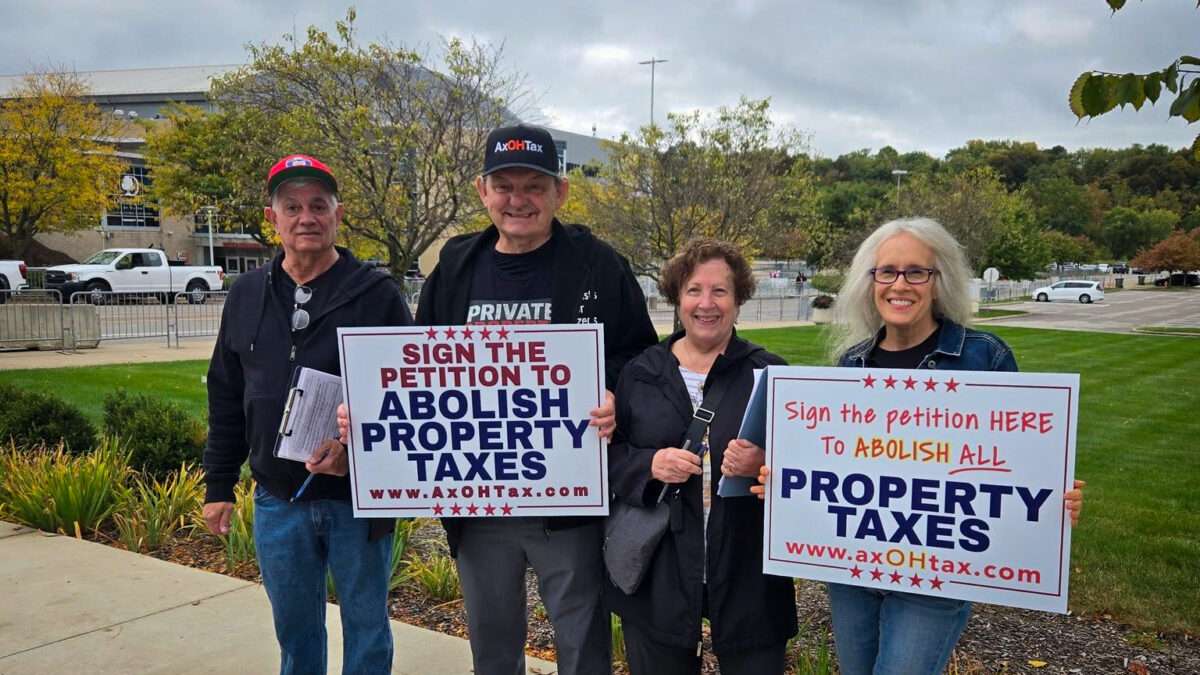
Four elderly protesters hold two signs that say "Sign the petition to abolish property taxes." | Denise DiFabio/Facebook

If you have to pay a regular fee to maintain control and use of a home or other parcel of property, do you really own it? Or are you just renting it from whoever collects the money? That's the question behind a growing movement against property taxes, which is winning support across the country and may see its next big test in the form of a proposed constitutional amendment on the Florida ballot that would significantly trim taxes on owner-occupied homes.


'Property Is the Foundation of Liberty'—and a Big Source of Tax Revenue

Advocates of reform understandably champion the inviolability of private property, which is threatened by continuously rising levies. Opponents predictably include people who fear reduced government revenues, but also those who worry that cutting property taxes will shift power to state governments at the cost of local autonomy.

"Property is the foundation of liberty," argues economist Vance Ginn. "It represents the right to the product of voluntary exchange, investment, and saving—not a privilege granted by government. To tax property again every year after it has been bought with after-tax income is to deny genuine ownership. Property taxes operate like an annual wealth tax or unrealized capital-gains tax, applied regardless of income or ability to pay."

Opposing Ginn's argument in the debate is the Tax Foundation's Jared Walczak, who is not so much a fan of property taxes as a believer that they suck less than the alternatives.

"Spending restraint can reduce property tax burdens," argues Walczak. "But with property taxes accounting for 70 percent of local tax collections nationwide and upwards of 90 percent in some states, any discussion of property tax elimination must grapple with revenue alternatives."

"It is axiomatic that whatever you tax, you get less of," he adds. "Taxing income means less income-producing labor and investment, for instance. But because land is an immobile asset, taxing property does less to distort market decisions than taxing income or even sales."

Walczak also points out that while property taxes are usually imposed by local governments, most alternatives to property taxes come at the state level. That would move power further up the political food chain, away from the property owners worrying about their tax bills.

To this, Ginn responds that governments at all levels cost more than they should and that "the moral and fiscal failure of property taxes lies not only in how the money is raised, but also in how much government spends."

That means the debate over property taxes isn't just a struggle between those who want to trim the state's take and those who prefer larger government, but also between anti-tax activists and their frequent allies among advocates of local power. In a piece this week on the groundswell against property taxes, Politico's Liam Dillon notes that "the uprising's most pitched battles are being fought in Red States where the issue has emerged as yet another dividing line on the right."


Localities Are Dependent on Taxing Property

The debate over property taxes is fierce partially because governments have come to rely so heavily on them. "In fiscal year 2023, property taxes comprised 28.9 percent of total state and local tax collections in the United States, more than any other source of tax revenue, despite being levied almost exclusively at the local (not state) level," Janelle Fritts wrote for the Tax Foundation.

Property taxes in the U.S. range from roughly half a percent to just under 2 percent of assessed home value. States that rely most heavily on them, like New Hampshire (1.5 percent in 2024) and Texas (1.4 percent in 2024), also tend to leave a lot of government responsibility in local hands that might be exercised at the state level elsewhere. It's worth noting that Cato's Freedom in the 50 States ranks New Hampshire as having the second least burdensome tax regime among states, with Texas in fourth place.

The lowest taxed states in property terms are Alabama (0.37 percent in 2024), Arizona (0.48 percent), Hawaii (0.29 percent), and Utah (0.48 percent). Some states, such as Illinois (1.88 percent in 2024) and New Jersey (also 1.88 percent), tax the hell out of many things to support large and intrusive governments. Hawaii, despite low property taxes, is ranked as the most tax-burdened state by Cato.

As mentioned above, economists tend to like property taxes because they are efficient, minimally distort economic decisions, and empower localities relative to state and federal authorities. But as Politico's Dillon emphasizes, "everyone who is not an economist seems to hate property taxes."


Homeowners Don't Like the Insecurity That Comes With Property Tax Bills

Property taxes rise with assessed property valuations that homeowners have no control over, as the market shifts with supply and demand. They require what feels an awful lot like an annual rent payment to keep a roof over people's heads many already paid for. That reduces the sense of security that owners feel in their homes, since their habitation remains conditional on meeting local authorities' demands. The bite of sales taxes can be reduced by buying less, and income taxes are dependent on earning paychecks, but property taxes (with some local exceptions) come due no matter what.

Soaring property valuations in recent years drove property tax bills higher for Americans who did nothing but remain at their established addresses, though localities can and sometimes do adjust tax rates to offset rising values. USA Today reported that "between 2019 and 2023, the median value of annual property taxes increased nearly 25%." That has energized the movement to cut or abolish the taxes.

Efforts to reform property taxes have been effective in more than a dozen states, according to Governing. Most of these efforts involved reducing taxes, though eyes are currently on Florida where Amendment 3, a proposed change to the state constitution, would incrementally raise the homestead exemption to $250,000. It also would require "the Legislature to prescribe a uniform procedure for counties and municipalities, for their respective levies, to increase the homestead exemption up to full assessed value," effectively abolishing property taxes on owner-occupied dwellings.

As a constitutional amendment, the measure requires 60 percent of votes to pass. Polling shows more support than opposition, but not necessarily at the supermajority level necessary for victory.

According to the Tax Foundation, in Florida, "the statewide average sales tax rate would have to rise from 7.02 to 15.34 percent to replace the property tax" with equivalent revenue. Rates could widely vary if localities implemented sales taxes instead of leaving them to the state.

Of course, that assumes state and local governments continue spending and providing services at the same level. But as economist Ginn points out, the problem lies not only in how property taxes raise money "but also in how much government spends." If the property tax revolt represents revulsion not just at the tax, but at the expense of large government, that may require less revenue to fund a smaller Leviathan.

The post Grassroots Revolt Targets Unpopular Property Taxes appeared first on Reason Magazine.
  •  

Trump's 50% Tariffs on Canadian Goods Illegally Rely on a Superseded Statute, a Lawsuit Argues

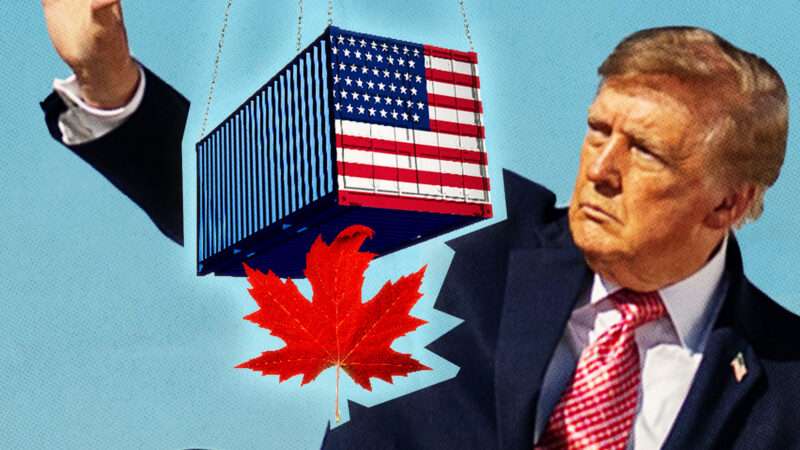
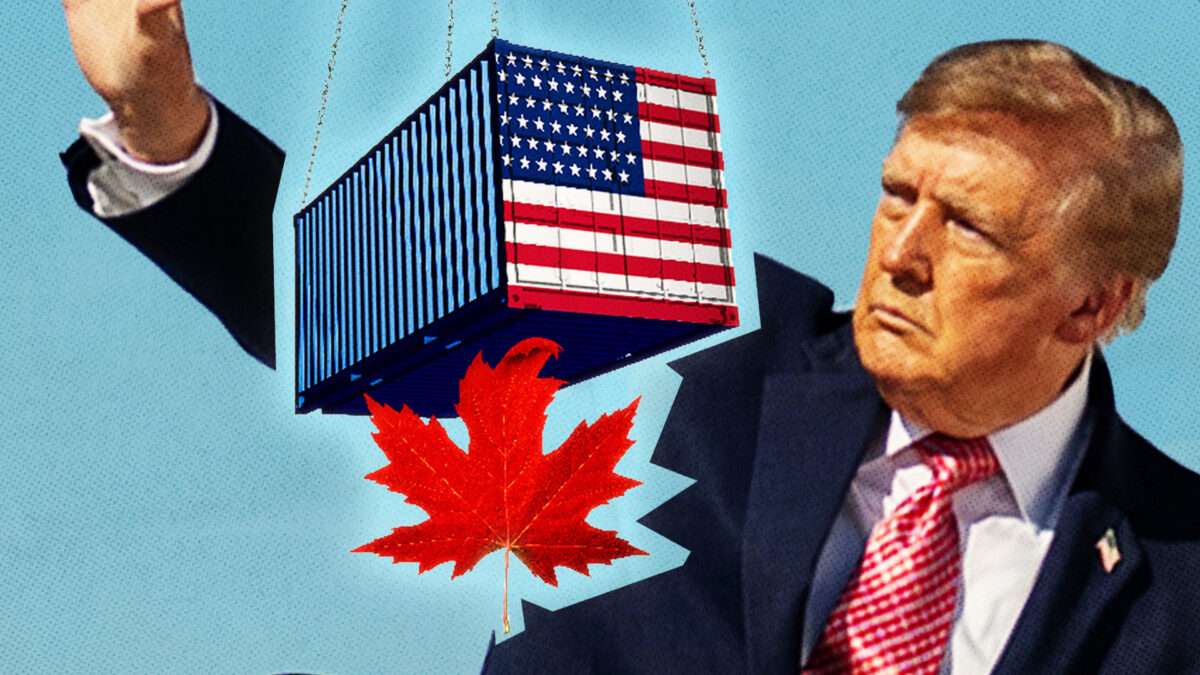
a shipping container and a maple leaf with President Donald Trump in the background | Molly Riley/B66/Avalon/Newscom/Skypixel/Dreamstime

Last July, President Donald Trump imposed 50 percent tariffs on various Canadian goods, a list he subsequently expanded to include additional imports, some of which he banned outright. His legal justification was Section 338 of the Smoot-Hawley Tariff Act, which Congress approved in 1930. Section 338 authorized tariffs in response to discriminatory trade practices. But in the 96 years since it was enacted, no president had ever used it to impose tariffs.

Why is that? According to a lawsuit that the Liberty Justice Center (LJC) filed on Tuesday in the U.S. Court of International Trade (CIT), the answer is clear: Section 338 was superseded by subsequent legislation that likewise targeted discriminatory trade barriers, beginning with the Reciprocal Trade Agreements Act of 1934 and culminating in Section 301 of the Trade Act of 1974. Section 301, the current remedy, includes requirements that Trump apparently sought to dodge by invoking Section 338 instead.

That maneuver is illegal, the LJC argues. "Congress already gave the executive branch a tool for responding to unfair foreign trade practices: Section 301, which requires an investigation, public comment and other safeguards," says Jeffrey M. Schwab, the LJC's director of litigation. "The administration cannot skip those protections by reaching for a 1930 statute that no president had ever used to impose a tariff."

Why not? "Where provisions in two acts are in irreconcilable conflict, the later act, to the extent of the conflict, constitutes an implied repeal of the earlier one," the lawsuit says. "Where a later act covers the whole subject of an earlier one and is clearly intended as a substitute, it operates similarly as a repeal. And a specific policy embodied in a later federal statute controls the construction of an earlier one even absent express amendment."

Even if Section 338 somehow survived congressional approval of contrary laws, the LJC adds, Trump's tariffs exceed the authority it grants. And if Trump's interpretation of Section 338 were correct, the lawsuit says, the provision would violate the nondelegation doctrine, which bars Congress from delegating its tariff power to the president without providing "an intelligible principle" to guide and constrain his exercise of it.

Trump's Section 338 tariffs, in short, are "the Administration's latest attempt to exercise, through a statute never designed for the purpose, the tariff power that the Constitution assigns to Congress." That pattern should be familiar by now.

Shortly after taking office in 2025, Trump claimed to have discovered a previously unnoticed delegation of extensive tariff authority in the International Emergency Economic Powers Act (IEEPA), a 1977 law that does not mention import taxes and had never been used to impose them. That claim was rejected by every court that considered it, and last February the Supreme Court ruled that IEEPA does not authorize tariffs at all.

Trump responded to that decision by immediately announcing similarly broad tariffs under Section 122 of the 1974 Trade Act, which addresses "fundamental international payments problems" caused by "serious United States balance-of-payments deficits." In May, the CIT ruled that the new tariffs were illegal because Trump had failed to "identify balance-of-payments deficits within the meaning of Section 122."

Trump then switched to Plan C, invoking Section 301 of the Trade Act, which authorizes tariffs in response to a foreign "act, policy, or practice" that is "unreasonable or discriminatory" and "burdens or restricts" U.S. commerce. He claimed that provision justified tariffs on 86 trading partners, accounting for nearly all U.S. imports, because they had failed to "impose and effectively enforce a prohibition on the importation of goods produced with forced labor." The CIT is currently weighing challenges to those tariffs, including an LJC lawsuit.

Trump's Section 338 tariffs have now added to the CIT's caseload. The LJC represents Gellert Global Group, an importer that was hit hard by those taxes after Trump added cheese to the list of disfavored Canadian goods. The lawsuit asks the CIT to certify a class of importers, numbering in "the hundreds, if not the thousands," that likewise have been clobbered by Trump's 50 percent tariffs.

Since Trump obviously is aware of Section 301, why did he resort to a never-used, seemingly obsolete provision to justify the tariffs on imports from Canada? As the LJC notes, Section 301 requires an investigation by the Office of the U.S. Trade Representative, "consultation with the foreign country concerned, notice, public comment, a hearing, and determinations within statutory deadlines." It also requires "that action be equivalent in value to the burden imposed, that duties be preferred over other import restrictions, and that actions terminate after four years absent a request for continuation and review."

Can Trump avoid those constraints by invoking Section 338 instead? The LJC thinks not: "Congress did not intend to leave in place a parallel authority that would allow the President to impose the same remedies, for the same conduct, free of every one of those safeguards."

Section 338 has been "impliedly repealed," the LJC argues. "At a minimum, Section 301 controls where, as here, the President seeks to respond to foreign practices within Section 301's scope, and the President may not impose duties in response to such practices while disregarding the procedures and limits Section 301 imposes. Because the President did not proceed under Section 301, the Section 338 Tariffs are unlawful whether or not Section 338 survives."

Even if you ignore subsequent legislation, the LJC argues, the Canadian policies that Trump cited when he announced the tariffs do not qualify as "discrimination" under Section 338. "Canada's motor vehicle surtax and its provinces' alcohol purchasing decisions are responses to tariffs that the United States imposed on Canada, not discrimination by Canada against the United States," it says. Trump also complained that Canada treats European cheese imports more favorably than U.S. cheese imports. But "when Congress enacted Section 338, a preference granted under a reciprocal agreement was not 'discrimination.'"

Section 338 "addresses discrimination: measures that single out United States commerce for worse treatment than the commerce of the world at large," the lawsuit says. "It is not a general authorization to impose tariffs whenever the President disagrees with a trading partner's policies, or whenever a trading partner responds to tariffs the United States has imposed on it."

Trump also was unfazed by Section 338's requirement that the president set duties to "offset" the costs imposed by discriminatory practices, which implies proportionality. Rather than attempt that, the LJC notes, Trump imposed "the statutory maximum rate of 50 percent without tying it to any measured burden."

As interpreted by Trump, the lawsuit warns, Section 338 authorizes the president to "impose tariffs of up to 50 percent on any products of any country that extends better treatment to any other country in any respect—including through any of the hundreds of preferential trade agreements to which the United States is not a party—or that responds to tariffs the United States has imposed on it." Yet Section 338 "contains no clear statement authorizing that power," contrary to the "major questions" doctrine, which applies to assertions of executive authority with "vast economic and political significance."

If Section 338 conferred the sort of unfettered authority that Trump is claiming, the LJC says, it "would supply no intelligible principle constraining the exercise of Congress's power to lay duties." His reading "would convert a narrow, fact-dependent provision into an effectively unrestricted delegation of Congress's tariff power," which would be "an unconstitutional delegation of legislative power."

This case "is not about the president," says LJC CEO Sara Albrecht. "It is about the presidency. No president should have the power to pull a dormant statute off the shelf and use it to impose sweeping tariffs or import bans without the limits Congress required."

The post Trump's 50% Tariffs on Canadian Goods Illegally Rely on a Superseded Statute, a Lawsuit Argues appeared first on Reason Magazine.
  •  

California's 'Wealth Tax' Could Cost the State $39 Billion

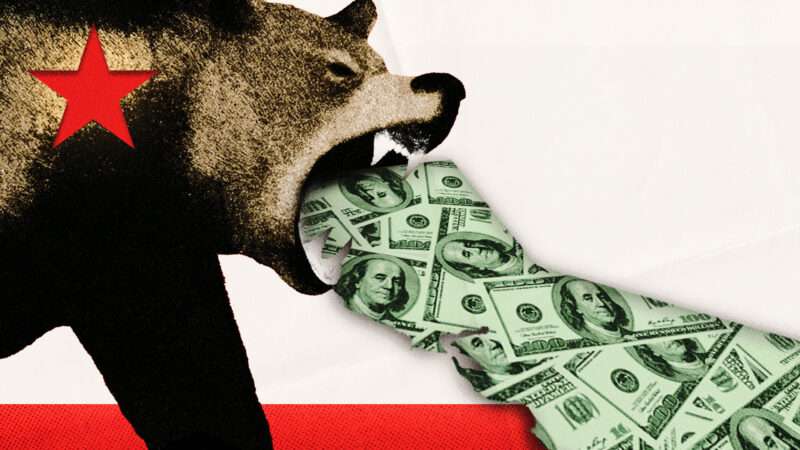
a bear vomits out U.S. dollars against the background of the California state flag | Helistockter/Dreamstime/Midjourney/Fatima Ruiz

A proposed "wealth tax" on California's billionaires could backfire and cost the state tens of billions of dollars in the long run.

If the proposed tax drives wealthier residents out of the state, California could end up losing between $1 billion and $3.5 billion annually in income taxes, according to a working paper published this week. A pair of researchers at Stanford University warn that the state could end up losing an estimated $39 billion because of the consequences of the wealth tax.

"These findings suggest that the Billionaire Tax Act will not fulfill the primary functions for which it was designed," write researchers Benjamin Jaros and Joshua Rauh.

Voters in California will decide next month whether to impose the one-time, 5 percent tax when they vote on Proposition 40. The ballot measure is dividing Democrats—Gov. Gavin Newsom opposes it, while progressive Rep. Ro Khanna (D–Calif.) claims it is the "most important ballot initiative in America and a fight for the soul of our party."

And it's already spurring some billionaires to flee the state—including venture capitalist Peter Thiel and Google co-founder Larry Page. Including those two, the seven billionaires who have publicly said they are leaving the state represent more than $539 billion of the nearly $1.9 trillion aggregate net worth of California's billionaires, the researchers note.

With other departures likely happening more quietly, the new study estimates that the tax will generate about $30 billion, a far cry from the $100 billion that the tax's supporters expect. The "behavioral response" from billionaires in California "has eroded most of the projected tax base," write Jaros and Rauh.

That's still a pretty big pot of revenue. In the long run, however, the state is likely to lose out.

After running 100,000 simulations using different assumptions, the two researchers report that "85 percent of plausible outcomes produce a negative" result in state revenue.

Other recent experiments with special taxes on wealth have backfired in similar ways. In response to a new wealth tax in Washington State, Jeff Bezos relocated to Florida, and iconic Seattle brand Starbucks shifted more of its corporate headquarters to Tennessee. Studies have shown that a "millionaires tax" in Massachusetts contributed to wealth moving out of that state.

Capital is always mobile, despite the best efforts of politicians. And if you were a billionaire living in California, why would you stick around?

Polls show voters are narrowly divided over Proposition 40. A Politico poll published earlier this month showed 46 percent of voters plan to vote for the measure, while 43 percent oppose it. Voters were similarly divided when asked if they expected it to pass or not.

The post California's 'Wealth Tax' Could Cost the State $39 Billion appeared first on Reason Magazine.
  •  

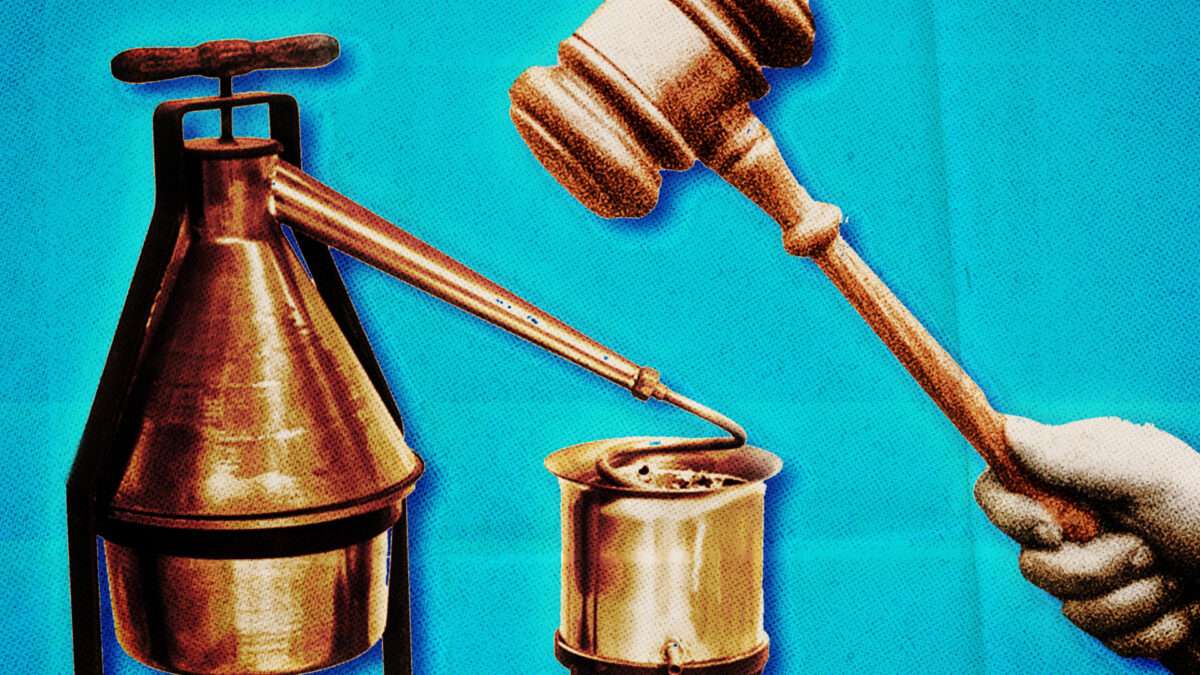
Trump Administration Urges SCOTUS To Uphold Federal Ban on Distilling Liquor at Home

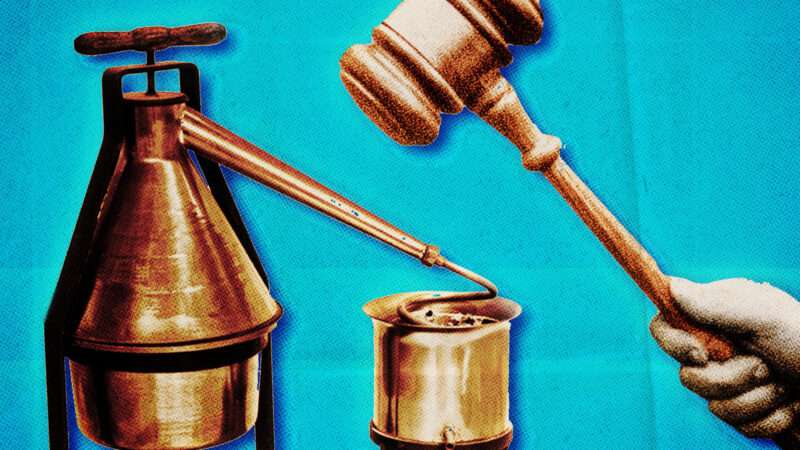
homedistilling | Ioannis Syrigos/Dreamstime/Midjourney

The U.S. Supreme Court's 2026–2027 term just got a whole lot boozier. On Monday, the justices agreed to hear arguments later this year or next in the case of Department of Justice v. McNutt. At issue is whether the 1868 federal ban on distilling liquor at home is unconstitutional because it exceeds the lawful regulatory power of the federal government. If any modern Supreme Court case ever deserved its own drinking game, this one is it.

In April, the U.S. Court of Appeals for the 5th Circuit found the federal ban on home distilling to be unconstitutional because Congress lacked the proper authority to issue such a ban in the first place. It was not a legitimate exercise of the congressional authority "To Lay and collect Taxes," the appellate court reasoned, because "the purpose of a tax is to raise revenue for the government;" yet this law "amount[s] to an anti-revenue provision" that only "prevents distilled spirits from coming into existence." And if it does not exist, of course, the government cannot tax it.

The 5th Circuit also denied that the federal ban on home distilling could be saved by the government's appeal to the Necessary and Proper Clause, which says that Congress has the authority "To make all Laws which shall be necessary and proper for carrying into Execution the foregoing Powers, and all other Powers vested by this Constitution in the Government of the United States, or in any Department or Officer thereof."

But the federal ban on home distilling cannot be "necessary" to the execution of the enumerated taxing power, the 5th Circuit argued, because the provisions of federal law at issue "tax nothing, and are distinct from the regulation of distilling alcoholic products that is permitted by federal tax law."

Nor did the 5th Circuit find the ban to be "proper." "By purporting to ban activity without a plain connection to the exercise of Congress's taxation power," it held, "Congress has essentially—and 'improperly'—invaded the reserved police and regulatory power of the states."

The Trump administration lost this case at the 5th Circuit and has now successfully urged the justices to hear its appeal. In its petition seeking review, the Trump administration faulted the 5th Circuit for its overeagerness to "second-guess" the "legislative judgment" of Congress. Instead, the Trump administration argued, the federal judiciary owes a great deal more deference to the federal government's regulatory priorities in a case like this. "A law is necessary and proper if it is 'convenient' or 'useful' for carrying an enumerated power into effect, and 'plainly adapted' to that legitimate end," the Justice Department's brief argued. "That is the case here."

This case may lead to an interesting divide among the Supreme Court's more conservative members. In United States v. Comstock (2010), a 7–2 Supreme Court embraced the Necessary and Proper Clause as sufficient constitutional grounding for the Adam Walsh Child Protection and Safety Act, which had empowered federal officials to order the indefinite civil commitment of "sexually dangerous" individuals who had already finished serving their prison sentences. Chief Justice John Roberts joined the majority opinion in that case, while Justice Samuel Alito voted in concurrence. In other words, they both endorsed a broad view of congressional power under the Necessary and Proper Clause. By contrast, Justice Clarence Thomas, joined by the late Justice Antonin Scalia, voted in dissent. The Comstock ruling, Thomas protested, "comes perilously close to transforming the Necessary and Proper Clause into a basis for the federal police power that 'we always have rejected.'"

Are we about to see a similar Alito-Thomas split over the proper reach of federal power in this case? And what about Justices Neil Gorsuch, Amy Coney Barrett, and Brett Kavanaugh? Will one or more of them play the Scalia part and similarly reject the Trump administration's broad reading of the Necessary and Proper Clause?

Stay tuned.

The post Trump Administration Urges SCOTUS To Uphold Federal Ban on Distilling Liquor at Home appeared first on Reason Magazine.
  •  

Supreme Court Will Hear Necessary and Proper Clause Case on Federal Law Banning Home Distilleries

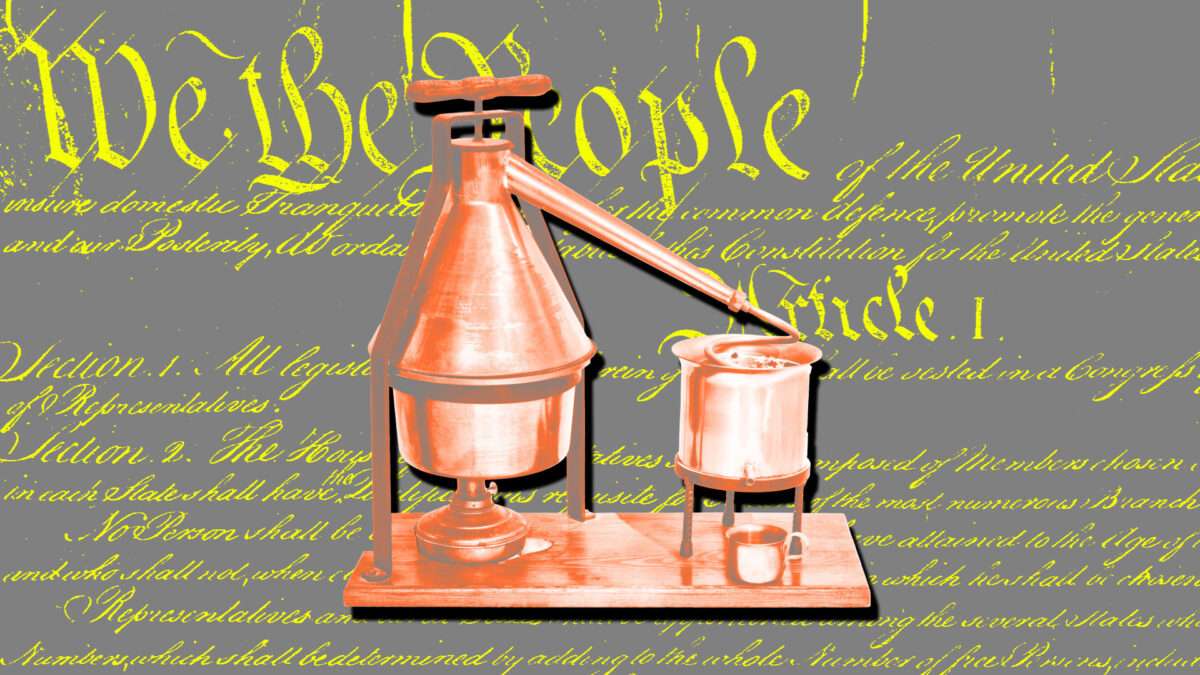
A whiskey distilling set up in front of the preamble to the United States Constitution
Illustration: Lex Villena; Ioannis Syrigos

Today, the Supreme Court decided to review the case of Department of Justice v. McNutt, which challenges a federal law banning home distilleries. The key question in the case is whether the law in question is justified by the combination of the tax power and the Necessary and Proper Clause (which gives Congress the power to make laws "necessary and proper" for executing other powers granted to the federal government). This is likely to be most important Supreme Court Necessary and Proper Clause decision since at least NFIB v. Sebelius (2012), which ruled that a "proper" power permissible under the Clause is one that is "ancillary" to the implementation of an enumerated power; it cannot be a "great, substantive and independent" power. This case is likely to further clarify the meaning of "proper," perhaps by explicating in more detail what counts as a "great…and independent" power.

In the lower court decision in this case, the Fifth Circuit ruled that the law is not "proper" and even that it isn't "necessary." There is also a Sixth Circuit decision that went the other way, thereby creating a circuit split.

As explained in my earlier posts on the Fifth and Sixth Circuit decisions (linked above), I think this law is not "proper," and I hope the Supreme Court strikes it down. I summarize the reasons why in my post on the Fifth Circuit ruling:

The Fifth Circuit… concludes that the law in question exceeds Congress' authority under the Necessary and Proper Clause, which grants the power to makes laws "necessary and proper" for carrying into execution other federal powers. I think the court is right that the law in question is not "proper." The Supreme Court, in NFIB v. Sebelius(2012), ruled that a "proper" power permissible under the Clause is one that is "ancillary" to the implementation of an enumerated power. It cannot be a "great, substantive and independent" power. See my analysis in this article. The power claimed here is clearly "great and independent." As Judge [Edith] Jones notes, "[u]nder the government's logic, Congress may criminalize nearly any at-home conduct only because it has the possibility of concealing taxable activity."

I elaborated further in the post criticizing the Sixth Circuit decision:

[T]he Sixth Circuit is badly wrong to conclude that the law is "proper." As explained in  my earlier post, the Supreme Court, in NFIB v. Sebelius (2012), ruled that a "proper" power permissible under the Clause is one that is "ancillary" to the implementation of an enumerated power. It cannot be a "great, substantive and independent" power. The power to ban any home-based activity that might serve a substitute for taxable activity outside the home is clearly a "great and independent power." As Judge Edith Jones explains in the Fifth Circuit ruling, "[u]nder the government's logic, Congress may criminalize nearly any at-home conduct only because it has the possibility of concealing taxable activity."

The Sixth Circuit tries to address this point by claiming alcohol is somehow special….

This distinction between alcohol and all other commodities is totally arbitrary. The same reasoning could justify banning home production of anything else that is more easily taxed if produced outside the home. And there is a long history of home production of all kinds of other commodities taxed or severely regulated by the government, ranging from cigarettes to illegal drugs, to pornographic videos.

While Judge Edith Jones (author of the Fifth Circuit decision) is one of that circuit's most conservative judges, the ruling was also joined by liberal Obama appointee Judge James Graves. On the other hand, the Sixth Circuit decision was written by prominent conservative Judge Raymond Kethledge. We shall see if the Supreme Court also divides on this issue in a way that cuts across conventional ideological and jurisprudential lines.

As noted in my post on the Fifth Circuit case, I think Judge Jones is not persuasive in arguing that the home distillery ban isn't "necessary," as well as improper. That argument is unlikely to prevail under the Supreme Court's expansive definition of "necessary, "  dating back to McCulloch v. Maryland (1819), where Chief Justice John Marshall famously ruled that "necessary" includes any measures that may be "useful" or "convenient" for implementing an enumerated power.

As also noted in my posts on the two lower court rulings, I think the government has a better argument that this law is authorized by the Supreme Court's badly misguide precedent on federal power under Commerce Clause (which grants Congress power to regulate interstate commerce). But the Supreme Court is apparently not going to review that issue. The question presented submitted to the Court in McNutt is limited to the Necessary and Proper Clause.

The post Supreme Court Will Hear Necessary and Proper Clause Case on Federal Law Banning Home Distilleries appeared first on Reason Magazine.
  •  

Indonesia should count the real cost of its mineral incentives

Every year, the Indonesian government forgoes taxes it could collect. Through tax holidays, rate cuts and exemptions, it courts investment while easing the burden on households and small businesses. Economists call this “tax expenditure” because giving up revenue is another way of spending public money. The Ministry of Finance expects it to reach 564 trillion […]

The post Indonesia should count the real cost of its mineral incentives appeared first on Asia Times.

  •  
❌