Have you ever seen a wildlife photograph so spectacular that you’ve wondered if it was even real? Enter “photography game farms”: captive facilities where photographers can create photographs of wild animals, which they can then sell to stock sites, magazines and enter into awards. Photographers like @MelissaGroo are trying to put an end to this industry. As well as concerns about the conditions animals are kept in, many argue that photographs created in these facilities can give viewers a false impression of wild animal behaviour, as audiences are unaware images are staged.This article was originally published on Mongabay
Scientists, on two separate occasions, have observed orcas ramming into heavy sunfish with such force that the boney fish literally explodes. But why? Scientists, at least currently, have no idea. They could be doing it to portion of food to feed the pod. Or they might just be doing it because they’re bored. Scientists plan to observe more such events to study and understand this behavior better. Watch this video to learn more.This article was originally published on Mongabay
What do snakes, poisonous frogs, and wind turbines have in common? Scientists tested whether warning color patterns inspired by nature could help birds avoid deadly collisions with wind turbines. In video-game-style experiments, great tits, distinctive small birds, were shown different blade designs, including a new pattern based on the bold visual colors used by some animals to deter predators. The birds hesitated longer and approached less often when warning patterns were present — especially the bio-inspired design. Scientists hope that copying nature’s own safety signs could help make wind energy safer for birds.This article was originally published on Mongabay
When researchers mapped almost 100,000 square kilometers of South Africa, or nearly 40,000 square miles, they only found 83 mature adults. They called their project the Free-Roaming Cheetah Census, and it’s the most comprehensive survey of cheetahs ever conducted in the region. The cheetahs that inhabit the unprotected areas here move naturally across borders, going between South Africa, Botswana, Namibia, and Zimbabwe. But farming, construction, development, and fences are making it harder for them to move around. Cheetahs need vast connected landscapes to survive. If they don’t mix with other cheetah groups, their genetic pool can be lost. There’s another big challenge for these animals: farmers. They sometimes kill cheetahs, because they believe cheetahs kill their livestock. But the researchers found that cheetahs hunt mostly wild prey. The species is currently listed as vulnerable, but the census suggests they should be reclassified as endangered in South Africa.This article was originally published on Mongabay
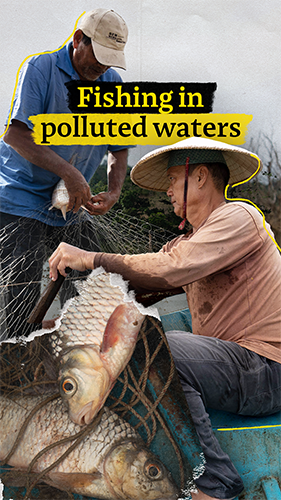
In a remote community in Malaysian Borneo, fishermen are facing an existential threat: their water source is being polluted. The fish they depend on is dying. Long Jawe village sits on the banks of the vast Bakun Reservoir. It is so remote that most residents only make the five-hour journey to the nearest town once a year, and visitors are rare. When the reservoir was created in the 1990s, the surrounding landscape was flooded. The community has since adapted to this enormous body of water, which is now crucial to their way of life, providing transport, food and livelihoods. But what happens when that water source becomes polluted? Join Conservation Entangled host Izzy Sasada as she travels to Long Jawe to investigate what could be behind the pollution.This article was originally published on Mongabay

 Login