❌

Reading view

Russia and Ukraine agree to local ceasefire in Oleshky amid deepening humanitarian crisis

People in Russian-occupied city facing severe shortages of food, water and electricity, with some reportedly surviving on weeds

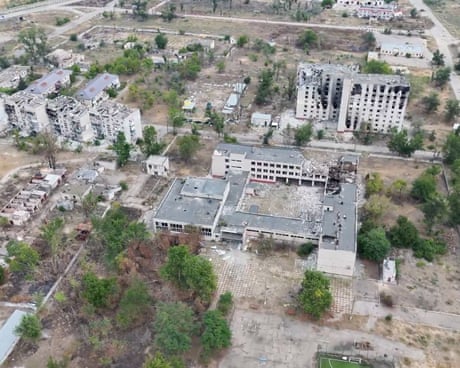
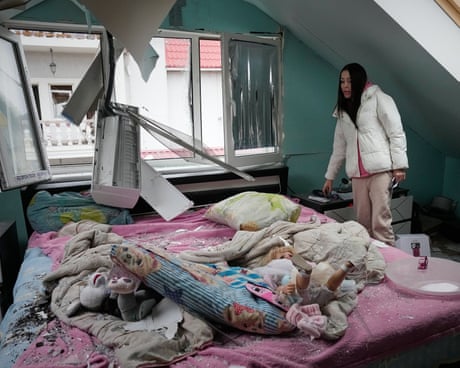
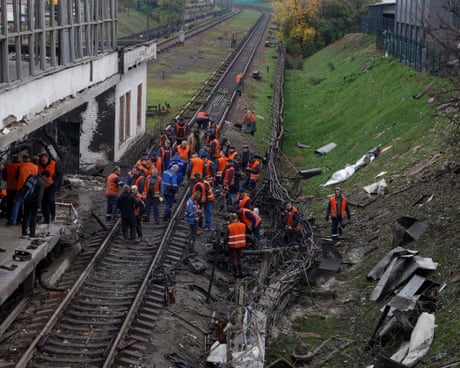
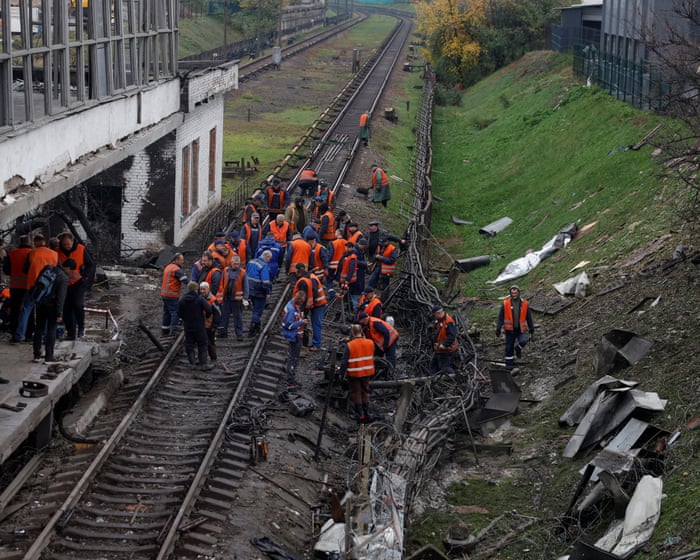
The White House has said that Russia and Ukraine have agreed to a ceasefire in the Russian-occupied city of Oleshky, where a deepening humanitarian crisis has left thousands of civilians struggling to survive.

In a statement on Friday, the White House said both sides had agreed to halt all military operations in the city from 27 October to allow humanitarian aid deliveries and preparations for the evacuation of civilians.

Continue reading...

© Photograph: 34th Separate Marine Brigade "Borysfen"/Reuters

© Photograph: 34th Separate Marine Brigade "Borysfen"/Reuters

© Photograph: 34th Separate Marine Brigade "Borysfen"/Reuters

  •  

Leaked trove reveals extent of far-right AfD’s efforts to court Trump and Maga allies

Exclusive: Documents show German party’s scramble to request support after president’s 2016 election win and co-leader’s pursuit of Steve Bannon

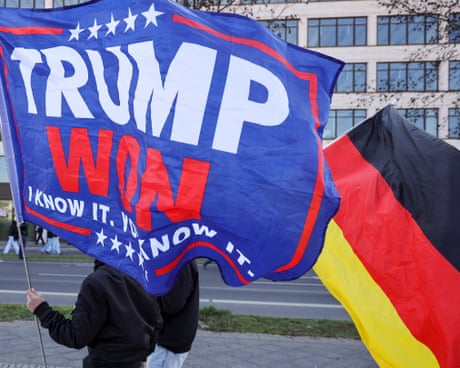
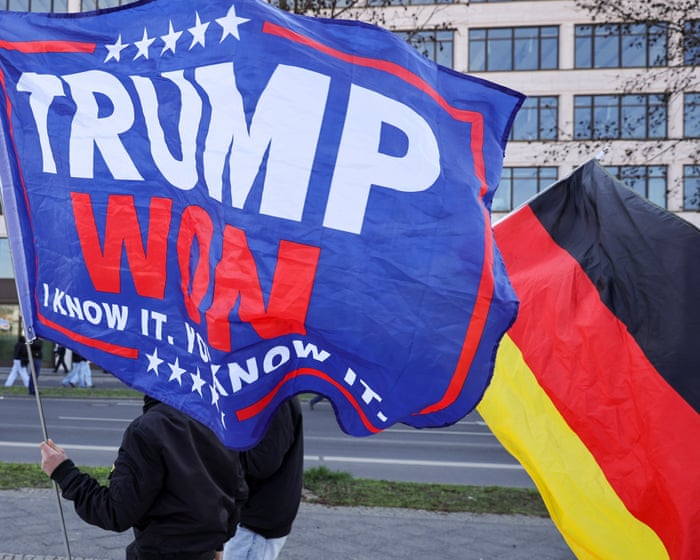
A data leak from Germany’s far-right German Alternative für Deutschland (AfD) has revealed the extent of efforts by the party to court Donald Trump and other leading figures in the Maga movement, stretching back more than a decade.

The trove reveals the pains the AfD took in wooing the president, whom they saw from the beginning as a potential ally, with senior party officials agonising over the wording of an obsequious congratulatory telegram when he was elected in 2016, which included the wish that his “hopes as a person be fulfilled”.

Continue reading...

© Photograph: Omer Messinger/Getty Images

© Photograph: Omer Messinger/Getty Images

© Photograph: Omer Messinger/Getty Images

  •  

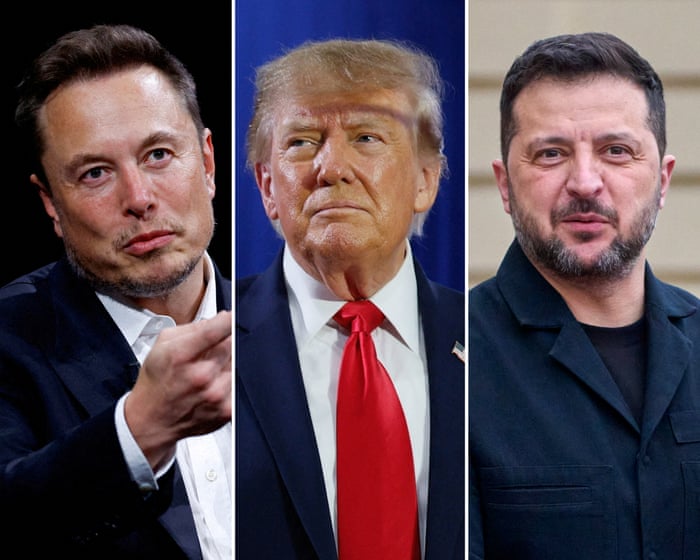
Trump, Musk, Zelenskyy: who is blaming who in the Ukraine-Starlink row?

A war of words has erupted over who is responsible for the restrictions on Starshield access in Ukraine

A war of words has erupted between the Trump administration, officials in Kyiv and Elon Musk over who is to blame for limiting Ukraine’s access to Space X’s military-grade version of Starlink.

The restrictions to Starshield have rendered many of the drones used by Kyiv to strike behind the frontlines inoperable and hampered air defence systems that stop Russian attacks, according to Ukrainian officials.

Continue reading...

© Composite: Reuters/Pool EPA/AP

© Composite: Reuters/Pool EPA/AP

© Composite: Reuters/Pool EPA/AP

  •  

‘America, this is a warning’: pro- Trump Maga media in a froth over Europe protests

Fox News and others have toed president’s line – seemingly hoping unrest abroad will make people vote Republican

Donald Trump sought to capitalize on the scenes of unrest in France, telling a crowd in Kansas on Monday that “migrants” and “communists” were responsible, and that the scenes were “what the radical ‘Dumocrats’ want to do to America”.

As Republicans struggle to convince voters across the country ahead of November’s midterm elections, Trump’s allies in the conservative media have followed suit, seemingly hoping that the scenes in France can scare people to the polls.

Continue reading...

© Photograph: Aurélien Morissard/AP

© Photograph: Aurélien Morissard/AP

© Photograph: Aurélien Morissard/AP

  •  

Russia bombards Kyiv with missiles hours after agreeing to resume talks with Ukraine

Experts say Russia is trying to destroy energy infrastructure before winter and US ‘appeasement and flattery’ will not achieve peace

Russia has carried out a massive “demonstrative” attack on Ukraine, bombarding Kyiv with ballistic missiles just hours after Vladimir Putin said he had agreed to resume trilateral negotiations after talks with the US envoy Steve Witkoff.

Overnight, Moscow pounded the Ukrainian capital, killing at least two people and wounding 22, including four children. Targets included the southern bridge over the Dnipro River, civilian houses, energy infrastructure, an ambulance station, office buildings and a clinic.

Continue reading...

© Photograph: Efrem Lukatsky/AP

© Photograph: Efrem Lukatsky/AP

© Photograph: Efrem Lukatsky/AP

  •  

Putin orders release of jailed American as he meets Trump envoy for Ukraine talks

Russia frees Stephen Hubbard after US request while Steve Witkoff praises Putin, wanted by ICC as war criminal, as a ‘humanitarian’

Vladimir Putin ordered the release of an American man from a Russian jail as he met Donald Trump’s envoy Steve Witkoff in St Petersburg on Wednesday for fresh talks on ending the war in Ukraine, amid increasingly close relations between Moscow and Washington.

Trump had previously asked Putin to free Stephen Hubbard, a 74-year-old former teacher who had spent more than four years in Russian jails on charges of fighting as a mercenary for Ukraine.

Continue reading...

© Photograph: Gavriil Grigorov/Reuters

© Photograph: Gavriil Grigorov/Reuters

© Photograph: Gavriil Grigorov/Reuters

  •  

Tech Billionaires and the New Struggle for Political Power

In his book The Nerd Reich, journalist Gil Durán examines how Silicon Valley’s wealthiest investors are extending their influence over American politics, democratic institutions and national sovereignty. His warnings come amid unprecedented political spending by technology billionaires and growing concern over private control of strategic infrastructure.

Elon Musk has contributed more than $276 million since July to Republican political causes ahead of the United States midterm elections on 3 November. Meanwhile, US Secretary of State Marco Rubio has said decisions over Ukraine’s access to SpaceX satellite communications rest with the company rather than the White House. Both developments demonstrate how private technological and financial resources can influence decisions traditionally associated with government.

For journalist Gil Durán, author of The Nerd Reich: Silicon Valley Fascism and the War on Democracy, published by Avid Reader Press in August 2026, the issue extends beyond campaign donations. In a recent interview, he argued that a group of Silicon Valley investors is using its financial influence and control of technology to challenge the authority of elected governments.

“We’re at a decisive stage of that race,” Durán said when asked about the contest between technology and democracy described by venture capitalist Peter Thiel. His argument is that wealth alone no longer satisfies some of the industry’s most influential figures; they also want a direct role in determining how societies are governed.

The ideological origins of billionaire power

Durán places Thiel at the centre of this movement. In a 2009 essay, The Education of a Libertarian, the PayPal co-founder wrote that he no longer believed freedom and democracy were compatible. He argued that technological innovation could allow individuals to escape the constraints of conventional politics.

Thiel subsequently clarified that he was not advocating disenfranchisement. His stated position was that majority rule often frustrated individual liberty. Durán, however, interprets the essay and Thiel’s subsequent political investments as evidence of a sustained interest in diminishing democratic constraints on private power.

The book also examines The Sovereign Individual, a 1997 work by James Dale Davidson and William Rees-Mogg that anticipated how digital currencies and technological change might weaken the power of nation states. Durán sees its influence in later arguments for privately organised alternatives to traditional government.

One example is The Network State, developed by entrepreneur Balaji Srinivasan. It proposes that online communities could acquire territory and eventually obtain diplomatic recognition. Advocates describe a voluntary model of political organisation; Durán regards the prospect of corporate-financed jurisdictions as a challenge to public accountability.

From venture capital to the White House

The relationship between Thiel and Vice-President JD Vance illustrates how venture capital can translate into political influence. Thiel supported Vance’s early investment career and contributed $15 million to a super PAC backing his successful 2022 Senate bid. Durán attributes much of Vance’s political ascent to that support, although voters, party endorsements and Vance’s own campaigning also shaped the result.

Musk’s latest contributions offer a more immediate example. His donations since July include $158 million to the Senate Leadership Fund and more than $76 million to America PAC. Such spending is lawful under the rules governing independent political committees, which cannot coordinate their expenditure with candidates.

Durán contends that similar pressures affect Democrats, arguing that wealthy donors can exercise influence across party lines. His criticism therefore concerns the political system’s dependence on private funding as much as any particular administration.

Technology as an instrument of strategic power

The consequences extend beyond elections. Ukraine’s dependence on satellite communications has exposed how a privately owned service can become essential to military operations. Restrictions affecting Starlink-related services have prompted competing accounts from US officials and SpaceX over responsibility for the decision. Rubio’s latest remarks point towards commercial control, while earlier reporting attributed the decision to Washington.

Artificial intelligence raises comparable questions of ownership and oversight. Durán argues that investors promoting transformative AI may also seek regulatory conditions that protect their substantial financial commitments. His prediction of a possible investment bubble remains a judgement, not an established outcome.

In Europe, the debate has immediate regulatory consequences. The EU’s Digital Services Act requires major online platforms to assess risks to elections and civic debate, while enforcement of important provisions of the AI Act began in August 2026. These measures address the influence of companies whose platforms and systems operate across borders.

Durán’s interpretation of Silicon Valley as a coherent anti-democratic movement remains contested. The entrepreneurs he discusses have differing interests, and their political influence does not itself establish a common plan to dismantle democratic government.

Their influence is nevertheless measurable in campaign finances, government contracts and control over infrastructure essential to national security. None of these forms of power requires holding elected office.

  •  

Republicans push back on Donald Trump’s wavering support for Ukraine

GOP lawmakers threaten to pull support for president’s agenda after Russia diesel deal and sanctions pause

A handful of Republicans have spoken out against Donald Trump’s softening stance on Russia, threatening to pull financial support for his agenda over his “embarrassing” handling of the Ukraine war.

Don Bacon, an outgoing congressman in Nebraska, condemned Trump’s actions – which include a stunning agreement to buy Russian diesel and the pausing of sanctions on Moscow – as “absolutely disgraceful” and accused the US president of cozying up to a “war criminal” in Vladimir Putin, his Russian counterpart.

Continue reading...

© Photograph: Brendan Smialowski/AFP/Getty Images

© Photograph: Brendan Smialowski/AFP/Getty Images

© Photograph: Brendan Smialowski/AFP/Getty Images

  •  

Trump attacks ‘migrants and communists’ as he tries to exploit France unrest

President at Kansas rally tries to turn protests into cautionary tale for US as Republicans face midterm losses

As Republicans confront mounting political headwinds ahead of November’s midterm elections, Donald Trump is attempting to turn unrest in France into a cautionary tale for American voters, recasting the demonstrations that began as student protests against crumbling schools and the soaring cost of living as evidence of the dangers of immigration and the erosion of western civilization.

At a rally in Kansas on Monday evening, Trump described France as a once-great nation that had been “conquered, looted, and burned to the ground by migrants, jihadists, and communists”.

Continue reading...

© Photograph: Kent Nishimura/AFP/Getty Images

© Photograph: Kent Nishimura/AFP/Getty Images

© Photograph: Kent Nishimura/AFP/Getty Images

  •  

The Guardian view on Trump and Putin: Ukraine’s future is not theirs to bargain away | Editorial

Russia wants America and China to decide Ukraine’s future without Kyiv. Europe must challenge this dangerous return to diplomacy of the strong for the strong

Does Vladimir Putin know exactly how to play Donald Trump? The history of chummy phone calls, high-profile meetings and attempts to bring Russia in from the cold certainly suggests that Moscow’s thuggish ruler has a hold on this American president. If Mr Trump agrees to negotiate Ukraine’s future with Mr Putin and China’s Xi Jinping without Ukraine at the table, he will have handed the Russian leader a victory before talks begin. The message will be that strongmen are ruling the world and determining the fate of weaker nations.

Ukraine has the right to determine its future. That right cannot be waved away by a self-serving Russian proposal, however much it indulges Mr Trump’s belief that world affairs should be settled by powerful men. The scales are falling from European eyes. Trumpian America is raising doubts about whether it will help deter aggression or even honour its Nato commitments. If Washington now rewards Moscow and pressures Ukraine to accept a raw deal, it would be a betrayal. European governments would wonder where America might be in the future when their own security is threatened.

Do you have an opinion on the issues raised in this article? If you would like to submit a response of up to 300 words by email to be considered for publication in our letters section, please click here.

Continue reading...

© Photograph: José Luis Magaña/AP

© Photograph: José Luis Magaña/AP

© Photograph: José Luis Magaña/AP

  •  

US gave us no warning of Russian strikes on Kyiv power plants, Zelenskyy says

Ukrainian president accuses Washington of ‘denial of reality’ in continuing row with Trump over apparent support for Moscow

Ukraine did not receive a warning from the US about an impending Russian missile attack on Sunday evening, Volodymyr Zelenskyy has said, reviving concerns that Washington is withholding intelligence to bully Kyiv into capitulating to Moscow.

Yuri Ihnat, a spokesperson for the Ukrainian air force, said on television on Monday morning that Ukraine had not received a warning before a Russian missile barrage hit power plants in Kyiv at about 11pm. Earlier, a Ukrainian government official had told the Guardian the US had not warned the capital about the impending missile strike.

Continue reading...

© Photograph: Valentyn Ogirenko/Reuters

© Photograph: Valentyn Ogirenko/Reuters

© Photograph: Valentyn Ogirenko/Reuters

  •  

Balkan countries show the dangers in obsession with ‘heritage’

I write from Dubrovnik, a historic and heavily touristed city on Croatia’s Adriatic coast. Visiting here and other parts of Croatia and its next-door neighbor Slovenia, I’m reminded that the Balkan countries used to be part of a bigger entity called Yugoslavia. Before that, some of the Yugoslavian countries were part of the Austro-Hungarian empire, […]

The post Balkan countries show the dangers in obsession with ‘heritage’ appeared first on Asia Times.

  •  
❌