In the UK, the BBC has been taking in public employees from government departments, and letting them work on news content, specifically “fact-checking” and drafting material for BBC News and its “fact-checking” arm, BBC Verify.
The secondments came from the Government Statistical Service, and took place over the past eight years, with 39 civil servants spending three or six months at the BBC, while their salaries were still paid by their own departments.
The Government Statistical Service is now advertising more of these secondments for 2027.
This was first reported by The Telegraphon October 17.
Meanwhile, the BBC is the same public service broadcaster that the government wants to give more money by introducing a “YouTube tax” – a plan to extend the license fee to streaming services.
And the same BBC is the one the government wants to push up people’s feeds on YouTube and other platforms, by making those platforms give it prominence in their algorithms. A green paper, “Watch this space: a new strategic direction for UK media,” is proposing this.
In the past, Reclaim The Net has reported about this plan, and how the US government said that this would mean “mandating that platforms algorithmically amplify government-preferred media.”
So, to sum it up: the government wants people to fund the BBC, wants the algorithm to favor the BBC, and has its own staff inside the BBC writing the fact-checks.
The subjects they worked on were “small boat” crossings of migrants, Covid, crime, migration, and life expectancy. The work of these civil servants, whose salaries were still paid by their respective government departments, was published under the bylines “BBC News” and “BBC Verify.”
This is how some of the secondees described their work on the Government Statistical Service blog.
One from the Home Office said she worked as “BBC Verify’s consultant statistician, fact-checking claims in heated election debates, ‘filing copy’ on interesting stories, and advising journalists.”
She also worked on “small boat arrivals and visa applications” and did “quality assurance on copies and charts before they were published to the online live page.”
Another from the Department for Business and Trade said, “One of my first tasks was drafting ‘copy'” on annual population statistics, “This was because they related to migration, which was always a topic of interest.” And: “My lines were then quickly pulled into a full article on the main site.”
That post, however, “was taken down after The Telegraph contacted the BBC” – and the BBC “has since insisted that those on secondment do not write copy.”
But the civil servant had just said that he did.
This secondee also worked on “fact-checking claims about crime rates among different nationalities that were dominating news cycles.”
Another civil servant seconded to the BBC analyzed data on “small boat migration” to see if the weather in 2022 meant fewer crossings: “In probably my proudest moment, this made it into an article on the front page and a TV piece.”
The job advert says that “Your salary for this professional development opportunity will continue to be paid by your parent department.”
The person they are looking for should have “the ability to influence decision making, working with credibility and proactively with customers to share knowledge and information.” They will also “be representing their department and the Government Statistical Service.”
The BBC’s own rules, however, say that “Our audiences must be able to trust the BBC and be confident that our editorial decisions are not influenced by outside interests, political or commercial pressures, or any personal interests.”
And: “External activities of individuals working for the BBC must not undermine the public’s perception of the impartiality, integrity, independence and objectivity of the BBC.”
A spokesman for the BBC said that “All BBC journalism and editorial decisions are made by BBC journalists and editors, in line with the BBC’s editorial guidelines, so these statisticians never make editorial decisions.”
But the corporation has also said it will now amend the bylines of the articles written by the civil servants to show their true jobs – something it will do only now, after The Telegraph asked.
Opposition politicians and others have been scathing in their criticism of the scheme, with Mike Wood, shadow Cabinet Office minister, saying that the BBC “must never allow a political agenda to influence BBC coverage via the back door.”
Danny Kruger, of Reform UK, was even more direct: “This is scandalous and looks dangerously as though the BBC has breached its own rules on impartiality.”
Oxford professor Carl Heneghan said, “If you have people writing for you with competing interests, it won’t be impartial. It is the government organisation you will be partial to. You will want to toe the line.”
The arrangement is so absurd that people would probably laugh at it if they heard it was happening in North Korea.
But it’s happening in the UK, and it’s not funny. The “journalists” in question were never identified as government employees to the readers, and the change of heart in that regard comes only now, after a newspaper investigated and reported about it.
If Douma, one of the highest-profile “proven” chemical attacks attributed to Syria’s former Bashar Assad government, has been shown to be fake, what does it say about new, undeclared Syrian chemical weapons that have supposedly been found?
It says we should be extremely skeptical about news of such discoveries.
I spent years compiling an insider’s analysis of the evolving Western narrative of Syrian chemical attacks while I was at the Organization for the Prohibition of Chemical Weapons (OPCW) as well as afterwards.
My conclusion was it is nigh impossible to prove a negative in this situation; to say there had never been a chemical attack by the Syrian government forces.
However, when it came to high-profile allegations of such attacks in the Syrian towns of East Ghouta, Khan Sheykhoun, Ltamenah, Saraqib and Douma, there were fatal flaws in the official narratives.
There were unmistakable signs, clear to us on the inside, of fabrication.
The Douma attack eight years ago appeared to be the last of a series of chemical allegations against the regime.
Yet the saga continues. The OPCW sent a new mission to Syria this May to try to find alleged, undeclared chemical weapons from the government of Bashar al-Assad, who was ousted in 2024.
Before examining the intentions and results of this mission, it is useful to review how the Western-backed OPCW handled its investigation into the 2018 chemical weapons attack in Douma, a suburb of Damascus.
I was an OPCW inspector on that mission and this is why I blew the whistle.
The Establishment Narrative
Just how much of the establishment narrative that blamed Assad for using chemical weapons be believed ?
Devised during the early part of the Western and Gulf-backed jihadist war to overthrow Assad a decade and a half ago – and built upon steadily by Western belligerents throughout the crisis – the story that Assad had “gassed his own people” was widely believed with mainstream media fully on board.
Doubters were glibly dismissed, including “official” dissenters such as some senior inspectors at the OPCW. I was among them.
The chemical allegations followed a well-oiled procedure. Armed opposition groups – who were seeking direct Western military intervention to support their effort to overthrow Assad – would raise the alarm online by posting slick images and videos of an alleged chemical attack.
These opposition groups, sometimes assisted by Western NGOs, would then bring supposed witnesses of these alleged attacks to Gaziantep in Turkey, where the OPCW would send fact-finding missions to interview them.
The OPCW would generally believe the opposition groups and their witnesses and accept items of supposed “evidence” handed over to them, sometimes months after the alleged attack. Until the Douma allegation in 2018, the fact-finding mission never got to the scene of any Syrian chemical attack after an initial attempt in 2014 went awry.
The fact-finding report would be secretly drafted under the direct control of OPCW top management, bypassing any procedural or technical oversight, and would conclude that it was “reasonable to believe” that a chemical attack had indeed taken place.
The follow-up investigations by the heavily politicized Joint Investigative Mechanism (J.I.M.), or by the later Investigation and Identification Team (I.I.T.), would suggest that “a reasonable person would believe” that the Syrian Armed Forces were responsible for the attack.
OPCW inspectors are not fools. Many of us saw what was going on, seeing the tight political control that the U.S. and to a lesser degree the U.K. exerted over anything to do with the Syrian file. But the draconian confidentiality regime in the OPCW kept everyone subdued.
The breakthrough came after the April 2018 Douma allegation.
For the first time, an OPCW team actually got to the scene of an alleged chemical attack, at the town of Douma, in southwestern Syria, about 10 kilometers (6 miles) northeast of Damascus.
We did our job thoroughly, and in doing so we identified serious flaws in the allegation.
OPCW Extreme Measures
The OPCW resorted to ever-escalating measures to bring things back on track. After trying to secretly modify the interim report by withdrawing it from publication and sneaking in the preordained conclusions that were required by influential delegations, senior OPCW officials went to extremes.
They removed all the team members who had gone to Douma and produced a flawed Fact Finding Mission report written by persons unknown, none of whom had much knowledge of what the Douma team had done.
The fact-finding report predictably found that “it was reasonable to believe” there had been an attack with chlorine in Douma. This was followed much later by the OPCW’s inevitable I.I.T. report that blamed the Syrian regime for the attack.
In reaching its conclusions, the drafters claimed, as usual, to have been informed by anonymous experts. The context in the reports was usually along the lines of the fact-finding mission (F.F.M.) “asked an expert about this and the expert said it was possible.” Many qualified experts and commentators, including me, consider this laughable.
The OPCW were going too far, and ultimately this led to the ongoing dispute where the two most senior and experienced inspectors in the F.F.M. team objected.
The drafter of the team’s interim report, Dr. Brendan Whelan (“Inspector B”), was one. I was the other. In my case I had also led the politically-mandated inspections at two facilities of the Syrian Scientific Studies and Research Centre (S.S.R.C.) suspected of harbouring illicit chemical weapons activities.
Here again, we did our work thoroughly and in drafting the S.S.R.C. inspection reports I made clear that there was nothing amiss in either of the facilities.
This didn’t stop the U.S., U.K. and France from conducting punitive missile strikes on Barzah S.S.R.C., on the basis of social media postings on the Douma allegation, even before the OPCW team had arrived at the incident scene.
Rather than another detailed analysis of the Douma scandal, suffice it to say, the official Douma narrative has been clearly and scientifically picked apart by many credible observers, including by Dr. Whelan and myself.
This has been widely reported, although predictably not much in the mainstream media.
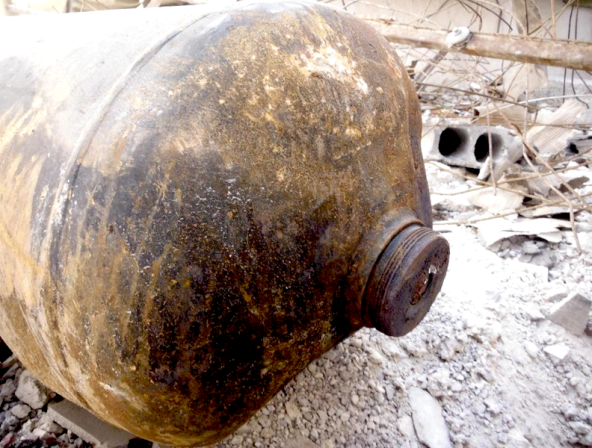
The OPCW and Western delegations have been in crisis management mode ever since the first leak, that of an internal engineering summary that cast doubt on the allegation that chlorine cylinders had been dropped from aircraft, raising the possibility that militants had placed the cylinders to stage the scene of a chemical attack.
I was the author of that report.
Nose of chlorine cylinder alleged to have smashed through a steel-reinforced concrete roof, April. 21, 2018. (OPCW, courtesy former Syrian government)
Worse still for the prevailing Douma narrative, Dr. Whelan recently won a legal case against the OPCW for their charges against him of confidentiality breaches.
In their submissions, the OPCW inadvertently admitted to suppressing the key toxicology assessment (incidentally by NATO specialists) that dismissed chlorine as the likely cause of death of deceased victims shown in images posted from the scene.
The OPCW has refused to engage in any discussion on the facts and scientific substance of the case, ever since concerns were first raised by Dr. Whelan and myself.
This intransigence to re-open the file is likely dictated by the needs of the three belligerent governments that subjected Syria to punitive missile strikes in retaliation for the supposed Syrian chemical attack even before the Douma F.F.M. had started work.
Any updated or corrected findings on Douma would be inconvenient.
The New OPCW Mission
Still apparently seeking to prove its case, the OPCW formed a new Syria mission in May aimed at “finding” alleged missing, un-declared chemical weapons.
At the end of May the mission reported finding 42 empty chemical weapons munitions; a launcher; bomb-mixing units; precursor-type containers; a facility whose contents were not revealed and thousands of pages of documents that are still being reviewed.
The mission also found 650 kg of “a chemical compound known to have been used by the former government for the production of nerve agents,” which the report does not name. It says an unknown quantity of hexamine, a legal chemical with wide industrial use, was found but it is not clear if this is the same compound as in the 650 kg.
In September, the Syrian government, now under the leadership of a former al-Qaeda and ISIS leader, began destroying the empty bombs, but not any of the chemicals that were found, presumably meaning none were banned.
Despite all the fanfare of these results being presented at a U.N. Security Council meeting last month, it appears that the new OPCW mission came up as empty as those bombs.
None of these discoveries does anything to prove that Assad ever used a chemical weapon, in other words, nothing to prove that I, along with other OPCW officials and countless observers and commentators who challenged the Assad chemical weapons narrative were wrong.
Presumably after all the effort in creating that narrative, Western governments and mainstream media that promoted the Iraq war and then the Syrian conflict to achieve regime change in that country, require a tidier ending than the mess they made of the Iraqi WMD story.
An early press release from the OPCW is telling. It shows what they were attempting to prove with this May mission, in particular two rather flimsy suggestions.
They report the discovery of some of the empty munitions,
“including the same type of aerial bombs that were used in chemical attacks in Ltamenah in March 2017 and Khan Shaykhun in April 2017.”
This refers to empty M4000 aerial bombs, declared by the Syrians as part of their stockpile.
Aside from the questionable Douma-like irregularitiessurrounding “evidence” used by the OPCW to conclude that sarin-filled M4000 bombs were used in those attacks, it’s important to mention something else.
The Syrians had clearly explained to us that 2,000 of these bombs, never filled, had been set aside to be “repurposed,” in other words to be filled with high explosive to turn them into conventional munitions. These could turn up anywhere.
A second questionable statement in the press release is,
“Rockets were also found, of the same type as those that were used in the Ghouta chemical weapons attack in August 2013.”
This relates to artillery rockets crudely modified with a large cylindrical payload container added at the front.
For a start, the U.N./OPCW report of Ghouta did not attempt to identify the perpetrators of that sarin attack, since it was not part of their mandate. The accusations against the regime have always been political, something the mainstream media happily took up.
The Most Credible Analysis So Far
The Ghouta sarin attack took place on Aug. 21, 2013 and according to Western sources killed more than 1,000 people in the Damascus suburb.
The most serious investigation of the Ghouta incident to date points to the attack being launched from opposition-occupied positions, and remains the most credible analysis of the attack.
The opposition forces allegedly responsible were from the al-Nusra Front, which conducted joint operations in 2013 in the Damascus area with the Liwa Al Islam opposition group. Al-Nusra were known to be in possession of sarin, according to reporting by Seymour Hersh, who wrote:
“In the months before the [Aug. 21, 2013] attack [in Ghouta], the American intelligence agencies produced a series of highly classified reports, culminating in a formal Operations Order – a planning document that precedes a ground invasion – citing evidence that the al-Nusra Front, a jihadi group affiliated with al-Qaida, had mastered the mechanics of creating sarin and was capable of manufacturing it in quantity. When the attack occurred al-Nusra should have been a suspect, but the administration cherry-picked intelligence to justify a strike against Assad.”
Indeed the U.N./OPCW team was in Damascus at the time of the attack in Ghouta because it was responding to an earlier request from the Syrian government to investigate chemical attacks against their forces.
The OPCW release also mentions a typical catch-all referring to “quantities of separately stored chemicals and related equipment, the nature of which is currently under technical analysis.”
There will always be suggestions of vague bits and pieces, rusty remnants that “may have been a part of” alleged undeclared elements of a chemical weapons program.
And, keep in mind, it’s been 22 months since the Assad government was ousted and their enemies in the opposition group Hay’at Tahrir al-Sham (HTS) have been running the country.
So far as I can see, the OPCW hasn’t found anything remotely close to the desired smoking gun. Anything real, I should say.
Partners in the Anti-Assad Chemical Narrative
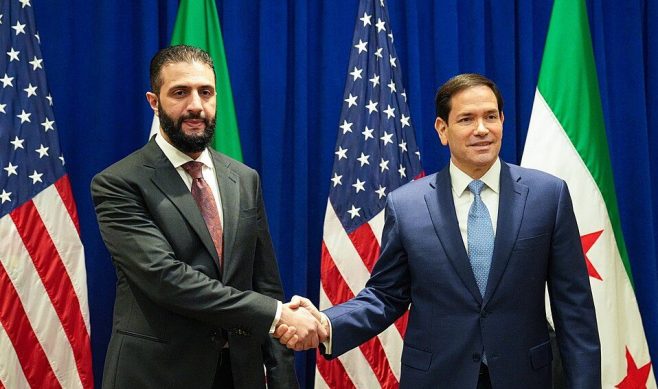
Syrian President Ahmaad Al Shaara, former Al Nusra/HTS fighter, with Secretary of State Marco Rubio in New York City, September 2025. (State Department Photo, Wikimedia)
We need to keep in mind how this is working. There are three partners in this latest endeavour on the anti-Assad chemical narrative.
First, we have the Western governments, belligerents in the Syrian conflict, which worked hard on building the chemical narrative to delegitimise the regime.
The U.K. government offered specialists to check out suspected sites in Syria to prepare them for the May mission in order to “assist” the current government in finding evidence of hidden chemical weapons.
That leads us to the second group, the government in Syria, reportedly eager to please their Western sponsors in return for economic favours. They are the Al-Nusra/HTS extremists who, in the case of Douma, fabricated the scene to raise a chemical false flag allegation against the Assad.
The third partner is the OPCW.
That means the various groups who have been on this mission are a) those who staged scenes of chemical attacks; b) those who directed them to do so (including Western intelligence agents who allegedly coached and assisted them); and c) the organisation that went along with the narrative and dutifully produced reports damning the Assad regime.
It may appear to the reader that I’m suggesting that the OPCW reports on Syrian chemical weapons will continue to be little more than propaganda, the usual sexed-up nonsense. Perhaps so. In disputing this, these assertions will be dismissed as conspiracy theories.
However, this argument is weakened because the source of the alternative narrative is the scientists and senior inspectors (many “Western”) from within the OPCW teams, including the Douma fact-finding mission and Scientific Studies and Research Centre inspections.
This is why Douma remains a key element in the debate. If they did it once (and doggedly stuck to their guns), they probably did it before.
Many serious and eminent observers are imploring the OPCW to conduct a review of the Douma case, including by the OPCW’s own Scientific Advisory Board.
I see this being done by credible, independent and neutral experts in the fields of chemistry, toxicology, metallurgy and engineering, overseen by the relevant professional institutes.
These experts would report their findings transparently, putting their names and reputations behind their analysis. This will clear up the Douma controversy, either demonstrating that it could have actually happened as alleged, or demonstrating the flaws in the OPCW reports.
Exposing a clear and deliberate fraud would seriously weaken the Western narrative on alleged Syrian chemical attacks. Therefore, in my view, it is not going to happen under the purview of the OPCW.
Ever.
I don’t mean to suggest that those calling for a review are unrealistically hopeful. But the risks of such a review are perhaps too high for it ever to be envisaged by the Western group that was aligned with the efforts on regime change in Syria — chiefly the U.S., the U.K. and France.
This does not mean it can’t happen. There is more than enough open-source material, as well as now-unclassified facts, images, analysis results and information available from the OPCW itself, from former OPCW officials and inspectors, and held by Member States, that would support a credible in-depth review.
The basis for expert analysis would be the material used in the fact-finding mission and I.I.T. reports themselves.
By now we know there isn’t any “smoking gun” evidence. If there had been, it would have been cited in the mission and I.I.T. reports.
Trust me, this study will bear clear results. My hope is that someone sufficiently curious and responsible will commission and fund it.
Ian Henderson served as an OPCW inspector from the establishment of the Chemical Weapons Convention in 1997, and was appointed as one of the first Inspection Team Leaders. An experienced chemical engineer with military experience, he led many of the more complex missions to more than 55 countries. After returning to a career in the chemical industry for 10 years he rejoined the OPCW in 2016 as part of the “rehire” scheme aimed at bringing back experienced inspectors. It was during this time that he became involved in the Syrian chemical weapons operations and, along with others, objected to the apparent influences of political control in the organization. He was suspended from the OPCW in May 2019 after the leak (by unknown others) of his dissenting engineering report on the Douma cylinders.
Yemeni missiles fired at Saudi Arabia are destroying oil facilities and airports across the country – drawing particular international outrage was the ballistic missile attack on Terminal 3 of King Khalid Intl. Airport, an attack that killed 13 and left another 307 injured. As is usually the case, the corporate media starts the clock where it chooses instead of looking at the context, a similar tactic that is used when reporting on Palestine.
On October 10, a missile fired by the Yemeni missile units of Sana’a’s Ansarallah-led government caused a mass casualty event at Riyadh’s main international airport. It then drew broad condemnation from governments around the world, grabbing headlines across the corporate media.
The Saudi-led coalition’s spokesman, Maj Gen Turki al-Maliki, then called the attack a “full-fledged war crime” and said that striking a civilian airport was a “cowardly terrorist attack”. The UN Secretary-General Antonio Guterres also weighed in and expressed his shock at what he called a violation of international law, urging the attacks to stop.
However, Guterres and various government officials never commented on Saudi Arabia’s airstrikes against Sana’a Intl. Airport on July 13, which broke the years-long ceasefire between Yemen and Saudi Arabia. Nor did Israeli Prime Minister Benjamin Netanyahu, who himself ordered airstrikes on Sana’a Intl. Airport in the Yemeni Capital of Sana’a last year.
Unpacking The Lies and Hypocrisy
While the Saudi leadership has attacked its airports to generate international sympathy, it has been launching airstrikes on Yemeni airports for over a decade.
On the first day of Saudi Arabia’s war against Yemen, on the 26th of March in 2015, airstrikes struck both Sana’a Intl. Airport and the neighboring Bani Hawat residential neighborhood, killing around 34 civilians, including children. Since then, the Saudi air force has carried out over 227 strikes targeting Yemeni airports.
The breakdown of the ceasefire, which was achieved through UN mediation back in 2022, came as a result of Saudi Arabia bombing the Yemeni Capital City’s main airport, in a bid to stop an Iranian civilian airliner from landing there. Riyadh has imposed a siege on Yemen – by land, air and sea – since 2015, even inflicting a man-made famine on the country.
Saudi Arabia is responsible for killing between 9,000 and 18,000 civilians inside Yemen. Schools, mosques, weddings, hospitals, and even funerals have been struck by the Saudi air force. In total, around 400,000 people have been killed as a result of the Saudi-led war on the country.
However, the international media coverage robs current events of both the historical and current context. Take, for example, the following headline published by Reuters, which is held up as the gold standard of Western journalism:
“Houthis fire missiles at Saudi Arabia, breaking years of calm,” read the headline. However, the story they were covering, admitted through their use of the video of Saudi Arabia’s strikes on Sana’a Intl. Airport, painted Yemen as the aggressor.
In reality, no political entity called the “Houthis” exists; the name of the Party that the corporate media refuses to correctly name is Ansarallah, which heads the government that rules over the majority of the Yemeni population and is based in the nation’s Capital City. Its opposition is called the Presidential Leadership Council (PLC), which was officially formed in the Ritz-Carlton hotel in Riyadh, Saudi Arabia, back in 2022. The PLC is a proxy of the Saudi government, and its leaders are all based inside Saudi territory, not Yemen.
The next obvious point to note here is that Yemen’s Armed Forces were responding with missile fire towards Saudi Arabia; they were not the aggressor. In retaliation for Riyadh’s decision to continue violently imposing its blockade on the country, it also declared a blockade on Saudi Arabia’s Red Sea ports.
To specifically address the point about the attacks on King Khalid Intl. Airport, it is important to note why this happened and that the Saudi authorities knew the dangers. In early October, Saudi Arabia conducted 1,000 airstrikes on Yemen, using 100 aircraft, while the forces back in Yemen attempted to launch a counter-offensive on the ground.
The Ansarallah-led government’s Armed Forces then announced, in response to the large-scale assault, that they would be imposing a no-fly zone over Saudi airspace. What proceeded to happen was a number of missile attacks on airports in order to shut them down; at first, these attacks caused no known casualties and were to serve as a warning.
As Saudi Arabia continued its airstrikes across Yemeni territory, the stakes were then raised and Riyadh’s main airport became the target. Missiles were at first fired into targets at the airport as a warning to close it down. The Saudi authorities ignored these warnings. On October 8, Yemeni missiles then struck aircraft while they were grounded at King Khalid International, which destroyed one commercial airliner, damaged two others, and killed 3 people.
Despite this attack and clear warnings to close the airport, the Saudis insisted upon keeping it open. On October 10, then came the mass casualty event that inflicted 13 fatalities along with hundreds of injuries amongst civilians.
Targeting a civilian airport is indeed a violation of international law. Yet, when Israel and Saudi Arabia bomb Yemeni airports, there is no outcry. Which brings us to the heart of this issue: why should it be expected that Ansarallah respect international law in this respect when there is no consequence for Saudi Arabia, Israel, or the United States, for that matter?
Riyadh is currently bombing targets throughout Yemen, using Israeli military intelligence support to do so. Meaning that the Saudis are being backed by a State that is committing genocide. On the other hand, the only State in the Arab World that invoked the Genocide Convention, imposing a blockade and firing munitions directly at Israel, was the Ansarallah-led government in Sana’a.
According to Western leaders, Israel and Saudi Arabia, Ansarallah is a terrorist organization. So why then did Saudi Arabia not close its airport as a precautionary measure, in order to protect civilians following the direct strikes on it and threats to go further? Does Riyadh not have the responsibility to protect civilian passengers?
Why is bombing a Saudi AirPort a terrorist act, but bombing Yemeni AirPorts hundreds of times is not even an issue capable of grabbing a headline? How can anyone expect international law to be respected, when the ones who claim to champion it the most selectively use it only when it favors them? These are simply common sense questions.
What Yemen is now doing is imposing the exact same reality on Saudi Arabia, as has been imposed upon it for over a decade. Only now, when the Israeli-backed Western ally is getting hit, is anyone even noticing.
In so many ways, the predicament of Yemen is like the situation in Palestine. Nobody batted an eye at the conditions in Gaza until the Hamas-led attack on October 7, 2023. Then the media framed the Palestinians as the aggressors.
The corporate media spoke of a “Hamas-run Gaza Health Ministry” in order to downplay the civilian death toll; similarly, in Yemen, they report on a “Houthi-run Yemeni Health Ministry”. Understanding the attacks on Saudi Arabia is simple if the context is applied. Either a negotiated settlement is to be reached to end this war, or it will continue until regime change on one side occurs.
– Robert Inlakesh is a journalist, writer, and documentary filmmaker. He focuses on the Middle East, specializing in Palestine.
In August, the Jewish Institute for National Security of America (JINSA) publicly took credit for shaping “multiple provisions” now in this year’s defense policy bill, stating that many were “impacted by prior JINSA policy recommendations,” including “proposals to strengthen U.S.-Israel defense industrial base integration” and “renew pre-existing joint U.S.-Israel programs.”
Among the provisions JINSA takes credit for is the controversial Section 219. In the House version of the National Defense Authorization Act (NDAA), this section mandates the creation of a single executive agent tasked with “synchronizing cooperative efforts” between the U.S. and Israel across nine basket categories, including AI, quantum technology, biotechnology, and virtually every category of weapons.
Israeli Prime Minister Benjamin Netanyahu has argued that such provisions would transition the U.S.-Israel security relationship from aid to partnership. But pro-Israel advocates have emphasized the leverage it would provide over Washington’s military policy.
Mark Dubowitz, the CEO of the pro-Israel Foundation for Defense of Democracies, appeared to reference this provision in an article arguing that the U.S. and Israel must “deepen their military, technological, intelligence and economic integration to such an extent that inflicting financial harm on Israel would also carry a significant cost for Washington.”
Other initiatives JINSA has advocated for likewise read like an Israeli government wishlist. They include a pending provision to “extend the existing War Reserve Stockpile Authority for Israel,” which provides a secretive and high-speed pathway for funneling weapons to Israel, as well as Abraham Accords provisions including “Improvements to Air and Missile Defense Acquisition” and a “United States-Abraham Accords Defense Cooperation Initiative.”
The policy wins JINSA is trumpeting are a result of its strong foothold within the military-industrial complex, and are perhaps one of the most overlooked aspects of the pro-Israel lobby. The group says it achieves these goals “by conducting both educational programs that build ties among American, Israeli and other Middle Eastern partner military leaders, along with in-depth research and actionable recommendations to influence U.S. policy.” JINSA’s “Our People” webpage includes a long roster of retired U.S. military officials.
One of JINSA’s most important programs, which has existed for more than four decades, is its “Generals and Admirals Program.” The initiative involves flying recently retired U.S. military officials to Israel. Many of the trip’s participants were already sitting on defense-industry boards when they went, while others joined soon afterward. At least 55 of the 83 alumni from the 2019–2026 G&A program cohorts (about 66%) have held or currently hold positions in the defense industry spanning board seats, executive jobs or advisory roles at defense contractors and defense-tech firms, or posts at defense-focused investment funds, consultancies and lobbying shops.
JINSA hopes that, when these former military officials return from Israel, they will use their credentials and defense industry power to become Israel’s advocates.
JINSA describes the program, founded in 1981, as “designed to ensure that the delegation is well briefed on the security concerns of Israel, as well as the key role Israel plays as a friend and ally of the United States.” The Helmsley Charitable Trust, which provided a 13 month grant for the program in 2017 worth $237,846, similarly says the purpose of the program is in part for participants to “return home to share publicly what they learned.”
The itinerary for the Generals and Admirals program includes meetings with Israel’s prime minister, defense minister, IDF chief of staff and the Director of Mossad. According to JINSA, after completing the program, “participants often engage on important policy initiatives through JINSA’s Gemunder Center for Defense and Strategy that strengthen…the U.S.-Israel security relationship.” JINSA CEO Michael Makovsky highlighted the program’s influence in 2014, calling U.S. generals and admirals “America’s most admired leaders, who remain very influential even after retirement.”
The JINSA program trains retired military leaders, many of whom go on to work in the defense industry, to be advocates for Israeli interests, both in their public writing and in their work behind the scenes.
A 2023 Quincy Institute report found that 80% of four-star officers who retired between June 2018 and July 2023 went on to work for the defense industry. Of the 32 officers tracked in the report, nine appear on JINSA’s participant lists, and seven of those nine retired officers hold industry lobbying or defense-tech roles. Gen. Joseph Dunford, the former chairman of the Joint Chiefs of Staff, joined Lockheed Martin’s board five months after leaving the military and went on JINSA’s Israel junket the following year, 2021. Adm. Michael S. Rogers, the former NSA director and head of U.S. Cyber Command, retired in 2018, became a senior adviser at the lobbying and public relations firm Brunswick Group in 2019 and went on the JINSA trip in 2021.
Gen. Hawk Carlisle participated in the 2019 delegation while serving as president and CEO of the National Defense Industrial Association, the war lobby’s leading trade group, and has served on the board of the U.S. subsidiary of Israel’s largest defense contractor, Elbit Systems of America, which was renamed Twenty-Six Defense in September. Some participants, such as retired Gen. Robert Magnus and Gen. Duncan McNabb, joined the board of Elbit America after their JINSA trips.
Embedded within the highest levels of the most powerful lobby on Capitol Hill, JINSA’s roster of retired generals and admirals often use their credentials to advocate for pro-Israel policy in Washington.
In 2010, when then-head of U.S. Central Command Gen. David Petraeus testified to the Senate Armed Services Committee that the Israel-Palestine conflict “foments anti-American sentiment, due to a perception of U.S. favoritism for Israel,” which is used to “mobilize support” for various militant groups in the region, JINSA’s G&A participants rushed to Israel’s defense. Responding to Petraeus, 30 ex-military leaders associated with the program put out an ad claiming that “a strong, secure Israel is an asset,” labeling the country, which has been deemed an apartheid state by numerous human rights groups, as “a democracy” that “shares our commitment to freedom, personal liberty and rule of law.”
In May 2018, a JINSA task force of retired senior officers chaired by Adm. James Stavridis released “Atlas Supported,” urging Washington to elevate Israel to “a top-tier ally” and invest jointly in next-generation military technology — the latter now a central purpose of Section 219. JINSA says the report was also the first to recommend moving Israel from the U.S. European Command to U.S. Central Command, which Trump then ordered on January 15, 2021. JINSA celebrated the fifth anniversary of Israel’s shift into CENTCOM this January by noting that the “Wall Street Journal recognized” it as “the only organization promoting this move,” and by featuring glowing tributes from JINSA G&A participants.
JINSA’s roster of retired military officials was once again mobilized in October 2026 to deny the findings of a trifecta of human rights groups and the U.N. that Israel committed a genocide in Gaza, praising what it called a “pattern of law-abiding IDF conduct in Gaza.”
JINSA’s delegates routinely appear on cable news, often without disclosures of their affiliation with the pro-Israel lobby group: Gen. Kenneth “Frank” McKenzie, who commanded CENTCOM from 2019 to 2022 and traveled with JINSA’s 2023 delegation, and became a “distinguished fellow” at JINSA in 2024, is now a CBS News contributor. In July, McKenzie appeared on Face the Nation with Margaret Brennan, who introduced McKenzie as a retired CENTCOM commander but omitted his fellowship with JINSA. In that appearance, McKenzie recommended Washington consider seizing Kharg Island. Ret. Vice Admiral Robert Harward, a member of JINSA’s “Iran Policy Project,” frequently appears on Fox News too, though his affiliation is generally disclosed.
One of the group’s most consequential efforts was to push the Trump administration to start a war with Iran, with a group of JINSA-aligned military leaders writing a March 2025 letter arguing that “U.S. support for Israeli action to prevent a nuclear Iran should be a top priority,” adding that “time is running out to stop its march to the bomb.” Sixty-six of the 79 signers of that letter appear on JINSA’s Generals and Admirals participant lists. Members of JINSA’s roster of retired military officials subsequently wrote open letters of support for the 12-Day War and the current months-long Iran War.
Harrison Berger is an independent journalist who has contributed to Drop Site News, The American Conservative, and The Nation. Previously, he was a researcher and producer for System Update with Glenn Greenwald. His work focuses on civil liberties and U.S. foreign policy. He holds a BA in Political Science and Russian Studies from Union College (NY).
International Center for 9/11 Justice – October 9, 2026
One year after Charlie Kirk’s assassination, independent journalist James Lee takes the stage to ask a difficult question: Are there still unanswered questions about what happened—and who gets to investigate them?
Speaking at the 9/11: 25 Years Later conference, Lee examines what he considers inconsistencies and unresolved issues in the case, including the handling of potential evidence, the rapid clearing of the crime scene, questions about the investigation, and the media’s portrayal of the events.
Lee also explores Charlie Kirk’s relationship with Turning Point USA, the organization’s reported shift in funding and political messaging, and Kirk’s publicly expressed frustrations over Israel and its influence on American politics. He raises allegations of possible foreign involvement, which remain unproven in this presentation, and calls for further scrutiny rather than unquestioning acceptance of any single narrative.
The speech expands into a broader argument about free speech, the First Amendment, citizen journalism, and the responsibility of independent researchers to scrutinize institutions and challenge powerful interests. Drawing parallels with the JFK assassination and 9/11, Lee urges audiences to keep asking questions and examining evidence.
Watch the full presentation and decide for yourself which questions deserve further investigation. The allegations and interpretations discussed are those of the speaker and should not be taken as independently verified findings.
Subscribe for more talks, investigative journalism, and presentations from the 9/11: 25 Years Later conference.
Ian Proud’s arrest by secret police at a London airport marks a new low in how far the deep state can go to control a false narrative. But it also shows a new level of fear.
As mad as it sounds, it does appear that Western European nations at least are preparing themselves to go to war with Russia at some point in the not-too-distant future. What is particularly worrying is there seems to be a distinct vacuum in all areas of what we could broadly call ‘media’ in questioning this narrative. Thirty years ago it was considered normal for journalists to be the source of vexing questions towards state actors and to generally be a pain in the arse as they questioned every decision made and every idea presented. It was our job to be anti-establishment and to take a very cynical view of “policy”. There was nothing remarkable about this. It was what we did. Being despised by the greater powers was part of the job; working anti-social hours and having few friends also came with it.
Today there are no journalists in what we call ‘mainstream’ media doing this. They have been replaced by younger, more social-media-savvy ‘content creators’ who believe that journalism is more or less a grammatical role, where the raw material is handed to you with all the information therein, and the role of the journalist is simply to refine it to the style of the day for mass consumption.
The danger of this transition is that nearly all of what we are being presented with as news is actually fake, or at best heavily redacted to keep the masses where the elite want them to be: restrained, prepped and misinformed.
The Ukraine war is an excellent example. The main reason why people in the U.S. and UK are so fabulously biased against Russia and are so sympathetic towards the corrupt elite in Kiev is that for years they have been brainwashed with ‘news’ about Russia which has been negative and which cunningly feeds a racist bias – a prejudice which has been cultivated over at least a decade, if not more. The result is that now a number of lies have become established in newsrooms where journalists, even those who know, simply navigate around nuance and present a fairy-tale story, designed to be understood by the masses who have no other sources of information to even question it.
Just recently, Western news outlets reported a “plague” in Russia, with stories about a “lockdown”, following a case of a worker in a laboratory dying of pneumonia in circumstances which are still not certain. Western media, as part of their role to keep Russia-phobia at its peak, are so locked and loaded that their ‘hair-trigger’ reactions to bad news stories from Russia are understandable. They are also hungry for clickbait, and such stories feed a starved audience which has already had its first fix of such COVID hysteria stories and wants more. The truth is entirely immaterial. Hysteria and lies are what’s being fed at a feverish rate by ‘content creators’ red in tooth and claw, foaming at the mouth with their desire to serve the deep state and the elites who have invested so much in an agenda.
The contrast between Russia and the West is interesting, though, when we look at media. In Russia just recently, the BBC correspondent based in Moscow made the internet buzz on social media with his short interview with Russia’s foreign minister, who was kind enough to answer his loaded question about Russia’s war ideology with Ukraine. What absolutely no one noted was how Russia is happy to accommodate foreign journalists who have such a distinct agenda to feed the Russia-phobia back home, while Russian journalists have been banned in those EU capitals for years. Old Europe, which once held such values as a free press so dearly, has adopted the Soviet model, while Russia is actually more advanced when it comes to such tenets of what we expect in a democracy. Russia has no fear of the awkward questions, unlike the West.
We should be asking ourselves who really benefits from a war with Russia.
Is it too sceptical and ‘conspiracy theorising’ to assume that the industrial military complex has been successfully lobbying for such a war for AT LEAST a decade, and critically, it succeeded in convincing the intelligence and military establishment in the UK to use its leverage with media to provide journalists with the raw material which enhances a prejudice against Russia?
Normally such an idea could be dismissed as pure nonsense. But just consider how far the UK, for example, has gone to eradicate all media coverage which could be deemed as at least leaning towards Russia – or even simply just holding the UK government to account by asking the questions that British journalists have stopped asking. If the elite in the UK who control the loss-making newspapers (think about that) are so sure of their rationale that Russia is the enemy whom we must go to war with, why are they so terrified of journalists – or anyone, for that matter – simply holding a view which questions the narrative?
I can’t be the only Western pundit who believes that double agents Sergei Skripal and his daughter Yulia were not poisoned with nerve agent Novichok in Salisbury in 2018, which was reported at the time as “sparking a huge diplomatic crisis between Britain and Russia”. Isn’t the real story that British security chiefs decided, upon discovering that Sergei Skripal was actually a triple agent who was feeding information back to Moscow, that he was dispensable? And what better way to supposedly teach the Russians a lesson, while blaming Moscow for his death, than to murder him and his daughter using a nerve agent which either was Novichok – which a British lab just down the road from where the Skripals lived had conveniently sitting in a fridge – or a similar poison? What’s important to note about Novichok is that the victims usually die instantly upon contact with it. What is likely is that the Skripals were not poisoned by the Russian drug but a British version of another nerve agent. It is a shocking example of how poor British journalism is that hacks in the UK simply report the Skripal incident of Novichok poisoning without a single shred of evidence to back it up. They don’t even add a note of scepticism in their reporting about the drug and who is “claiming” that it is Novichok.
We see the same shocking level of atrocious, biased reporting about the Ukraine war, which the British public were simply told through the media narrative was an “invasion” by Putin’s army. No background, no nuance, no glimpse of Russia’s perspective, as no one can cope, it would seem, with the story being clouded by facts.
And it’s the same with the Russia “plague” story, as it was with the RAF base “attack” story recently, which was probably just local thieves buying contraband gasoline from corrupt U.S./UK soldiers looking to make a quick buck at the UK base. Notice how quickly Trump used the story as a basis to move all U.S. bombers off the base and back to U.S. soil, where they are completely useless in his so-called Middle East war. For Trump it was an opportunity for another media stunt which keeps him on the front pages and everyone guessing. He was probably grateful to the British for being offered the raw material. Another problem of this new generation of journalists is how compliant they are to report “news” which isn’t news at all, but just material used as a distraction, one day at a time. Trump is a master at manipulating media with this game, usually saying something so stupid and so controversial, which draws journalists away from doing real journalism. If you can occupy journalists with writing up stories about the latest idiotic comment or statement by Trump, then you control them as you control their time.
Just look at how the Epstein story is not being reported and investigated. How Trump got off scot-free, as since February 28th journalists’ attention was diverted to the war with Iran – which is one of the reasons why Trump keeps this story alive with constant troop movements and talk of a massive attack after midterms. People have not made the link with the Epstein material being leaked and the war with Iran kicking off practically on the same day.
For the British, the “Russians are coming” story has no cynical write-up by journalists who are 100 percent compliant with its erroneous narrative. The fear of elites in London is palpable, though, that it will always be questioned by fringe actors taking up bandwidth on social media. In the past this was the RT correspondent in London, who was able to ask difficult questions and generally be a thorn in the side of the Westminster village which controlled journalists like rats held in a basket. The main reason why RT was kicked out of the UK was that it offered a style of reporting on UK politics which had since left us thirty years ago – such is the murky world of the deep state and how it saw how in Brussels journalists could be manipulated until they become stenographers for it.
Yet even with this new Stalinist style of media control in the UK, the state is wobbly. Even with the impressive set-up it has now of total media dominance, where journalists pump out total garbage about the Ukraine war or what they are told to write about the Middle East, still the fear is there.
The example of video blogger Ian Proud, a former UK diplomat once based in Moscow, is worrying but poignant. Simply going to Moscow to attend a conference where Putin was speaking was enough to have him get the full Stasi treatment at Heathrow airport – detained and all digital content seized.
Proud’s YouTube interviews, with his dowdy style of presenting, are proving to be popular as he simply offers a more sober view of both Russia and the UK Foreign Office, his former employer. These interviews are getting the attention of UK spooks, who are so nervous about the truth getting out about Russia and the shameful lies which are being packaged now for the British public, that they had to give Proud the American prison ‘shake down’ routine. Britain, a country which once was a beacon for the world with its view of liberty and in particular its passion for free speech, has fallen to a level which we can only compare to a West African country which has just had a new dictator installed, complete with black aviators and epaulettes. What the Proud Heathrow airport case shows is that this new regime in power will stop at nothing to control a narrative, and that the last bastion of free speech – YouTube podcasts – is the next target. The more successful Proud’s channel becomes, the more inevitable it is that he will be forced to leave the UK and settle in Russia to continue practising free speech. The shoulder tassels of Britain’s deep state will not sleep well until the country has a media narrative which would make Joe Stalin blush – and British journalists are helping them with this goal.
Tracy Beth Høeg, M.D., Ph.D., an epidemiologist and sports physician, said her decision to follow the data during the COVID-19 pandemic came at a steep professional price.
Høeg said her experience exposed the unwillingness of universities, media and public health institutions to adapt when research conflicted with their accepted narratives.
In an interview this week with investigative journalist Paul D. Thacker on The DisInformation Chronicle, Høeg said institutions too often treated the accepted narrative as settled and then dismissed or attacked people who questioned it.
That approach did more than distort the public discussion about COVID-19, Høeg said. It also created a scientific and institutional culture that could affect how other medical questions are handled long after the pandemic.
For Høeg, the solution is simple: Scientists should follow the evidence wherever it leads.
“It’s a core belief of mine that you have to be objective when you’re doing scientific studies,” she said. “Otherwise, you just shouldn’t do them. It’s pointless if you’re not willing to be objective.”
‘I … didn’t realize the jeopardy that I was putting myself in’
During the pandemic, Høeg published 30 to 40 papers on COVID-19 transmission, masking, youth sports, vaccine risk-benefit, pregnancy, long COVID, visitor restrictions and testing.
Some of her research challenged widely accepted claims.
One study found little evidence of COVID-19 transmission among children in Wisconsin schools, which was consistent with data from Europe. Another examined myocarditis risk in boys after their second Pfizer COVID-19 vaccine dose and found the risks outweighed the benefits in boys who didn’t have underlying health conditions.
Høeg said she didn’t initially understand the professional risks she was taking by challenging the prevailing narrative.
“There was sort of a hesitancy to do this sort of research because I think people were afraid for their careers,” she said. “I actually was blessed with having recently moved from Denmark and didn’t realize the jeopardy that I was putting myself in by doing these sorts of studies.”
At the time, Høeg was conducting research at the University of California, Davis.
She said the university received calls, including from Naturemagazine, complaining about her studies on pandemic policies. Eventually, the university asked her not to use her affiliation with the school.
Høeg said the university refused to renew her voluntary position in 2022, after the European Journal of Clinical Investigation published her study on myocarditis risks in boys who received the COVID-19 vaccine.
NPR also dropped an interview with Høeg for “All Things Considered” after she raised concerns about masking children during outdoor sports.
In a pre-interview discussion with NPR, she told the outlet, “We don’t have evidence that these masks work to prevent transmission. … Bottom line is, we shouldn’t be doing these unproven things to children that are harmful.”
Soon after, NPR told Høeg she was no longer needed for the interview.
“It does say a lot about our universities and institutions because it’s like they had been brainwashed to an extent to believe what the media was saying rather than actually look at the data,” Høeg said.
‘They repeated the same wording … even when the data didn’t back it up’
In 2022, Høeg and her colleagues conducted a follow-up analysis of a Centers for Disease Control and Prevention (CDC) study on school mask mandates.
Høeg said their analysis used a larger dataset and a longer time period and reached the opposite conclusion about the relationship between mask mandates and COVID-19 transmission among children.
The team’s submission to the CDC’s Morbidity and Mortality Weekly Report (MMWR) was rejected. Høeg said reviewers described the submission as “rife with polemics.”
“Well, maybe it’s polarizing if you disagree with it,” Høeg said.
The rejection unearthed an underlying problem at the CDC, according to Høeg.
“They have a scientific agenda,” she said. “And so as soon as you have a scientific agenda, science has been thrown out the window. Science doesn’t have an agenda other than to find the truth.”
A 2024 analysis by Høeg and colleagues examined 77 mask studies published in the MMWR beginning in 2020. According to Høeg, 75% of the studies said masks were effective, while only 14% reported statistically significant results and none were randomized studies.
One finding especially stood out to her: She said 5% of the studies found masks were connected to higher infection rates, yet “they still concluded that masks worked.”
“They repeated the same wording over and over again in each of the studies, that ‘masks are necessary to decrease the spread’ and ‘masks are critical in controlling the case rates of COVID-19,’” she said. “They use the same sort of wording even when the data didn’t back it up at all.”
‘Why are we demonizing people for looking into this?’
A leaked memo from then-FDA official Dr. Vinay Prasad said career staff had linked at least 10 child deaths to the COVID-19 vaccine between 2021 and 2024.
Høeg said she reviewed the Vaccine Adverse Event Reporting System (VAERS) reports and found that investigations involving medical records and autopsies had already been conducted.
“My question at the time was … why are these not being made public?” Høeg told Thacker.
Høeg said news leaked that she would present information about the deaths and their possible association with COVID-19 vaccines. She said the media response focused on portraying her as an “anti-vaxxer” rather than asking why the deaths had been investigated but not publicly disclosed.
“If we have these sorts of deaths happening in children due to medical products of any kind, why are we sitting on them for years?” she asked. “That’s the take-home I want people to have from this.”
She also questioned why people who investigate potential safety problems are attacked for trying to expose the dangers.
“Why are we demonizing people for looking into this? … Isn’t that what the public wants?” she asked.
‘The deep state really is a thing’
In May, just days after FDA Commissioner Marty Makary resigned, Høeg said she arrived at work to find media reports claiming she had resigned — something she said she knew nothing about.
FDA lawyers later asked her to resign, but she refused to sign the letter. She was subsequently locked out of the agency’s systems and escorted from the building.
Høeg said she never received a performance-based explanation for her termination. She also said the person identified as the author of her termination memo later denied writing or seeing it.
According to Høeg, agency lawyers told her the order came from “way above their pay grade.”
The experience changed how she viewed other departures from the agency. “It opened my eyes to the fact that maybe a number of the people who I thought had resigned really had not resigned,” she said.
“The deep state really is a thing,” she added.
‘Women who want to get pregnant … should be told about these risks’
For Høeg, the concerns she encountered during the COVID-19 era are not limited to COVID-19.
In 2025, she helped organize an FDA panel examining potential risks associated with selective serotonin reuptake inhibitors, or SSRIs, during pregnancy.
The American Psychiatric Association criticized the panel for what it called “misinterpretation and unbalanced viewpoints.” Høeg said the media also portrayed any discussion of potential risks as “misinformation about SSRI use” and a signal that depression wasn’t being taken seriously.
According to Høeg, the panel discussed risks already addressed in FDA labeling and scientific research, including miscarriage, premature birth, postpartum hemorrhage, congenital heart defects and neonatal adaptation syndrome.
“This should not be controversial that women who want to get pregnant and who are pregnant should be told about these risks,” she said.
She also warned about the lack of ongoing monitoring of drug safety.
“The FDA is not actively investigating the safety of these products in pregnancy or at all after the initial trials are done,” she said.
Høeg said the discussion should not be interpreted as an argument against treating depression. “I don’t think that any of this should be synonymous with not taking depression seriously,” she said. “That’s just nonsense.”
‘There’s just no reporting on this. … People have died taking this drug’
Høeg also discussed Tavneos, the Amgen-manufactured brand name for avacopan, a drug approved to treat a type of blood-vessel inflammation.
While at CDER, Høeg said she raised concerns that the pivotal clinical trial used to approve the drug had included manipulated data.
According to Høeg, at least eight deaths had been attributed to the drug because of liver injury.
“There’s just no reporting on this,” Høeg said. “People have died taking this drug. … We asked for them to withdraw it from the market, and the media is just totally silent.”
Thacker: ‘There was no real learning in the end. … If anything, we became dumber’
Høeg said it is troubling that some of the most disputed COVID-19 policies are still treated as settled questions.
“How is this still part of our collective conversation that people … are still saying school closures were necessary and mask mandates were necessary?” she asked.
Thacker said the failure to learn from those policies could have consequences during the next pandemic. People who developed a “false sense of safety from masks” during COVID-19 could mistakenly assume masks will protect them from a more dangerous virus in the future, he said.
Thacker also questioned whether the country understands anything about the COVID-19 vaccines. “There was no real learning in the end. … If anything, we became dumber,” he said.
Høeg said the problem stems from the widespread failure to reconsider policies when the evidence changed.
“Once the government decided this is what we have to do, they just kept digging in, even though the data didn’t support it,” she said.
“This is why I keep doing these interviews, because it’s important for people to know the truth.”
Watch Høeg on ‘The DisInformation Chronicle’ podcast here:

 Login