
 Login

Should we panic and turn off the internet?
Zed Jameson/Bloomberg via Getty Images
- This week's cyber freakout explained: AI is making software weaknesses easier to find and exploit.
- The message from Cloudflare's Stephanie Cohen and Vercel's Tom Occhino: Don't panic!!!
- Do we need everything connected to the internet? Paper bank statements work well.
A few weeks ago, I heard a strange story about a friend who works at one of the Big Tech companies in Silicon Valley.
She'd recently ripped out the connected devices in her home, ordered paper bank statements, and stocked up on canned goods in her basement.
Now, she's a very sane, experienced person, and quite senior at one of the largest internet companies on earth. Why was she disconnecting so much? Just to be sure, my family ordered paper bank statements, too. It was still a head-scratcher, though.
Fast forward to this week, and her actions look a little less crazy.
AI models have exposed serious security weaknesses in software used by roughly 70% of websites. Meanwhile, US banks are finding AI agents inside customer accounts, including some that appear to be acting without their owners' instructions, Axios reported.
'Black October'
The digerati have now entered full freakout mode. Much of the internet meltdown is happening on, well, the internet, my colleague Alice Tecotzky noted.
On X and Reddit, warnings of a looming “Black October” spiraled into visions of AI grinding civilization to a halt. One lengthy post on X warned of a potential “global cyberattack/AI swarm” and offered a survival checklist: Stockpile cash in small bills, print out your neighbors' phone numbers, download maps, buy a hand-crank radio, and stash a gallon of water per person per day.
Oh, and don't forget the manual can opener. You don't want to survive the AI apocalypse only to be defeated by a tin of beans.
Nikita Bier, a prominent app developer and former head of product at X, best captured the mood.
"It's time to turn off the internet," he posted Wednesday night.
A Cloudflare exec says it's 'a little bit scary'
If you're reading this, you haven't done that yet. But should we really be worried?
I put that question to Stephanie Cohen, chief strategy officer at Cloudflare, which helps protect about 20% of the internet.
"The world is a little bit scary right now," she told me on the side of Cloudflare's annual conference in San Francisco this week.
Here's the problem. The internet is built on decades of software, much of it riddled with security holes.
Some of these weaknesses have been known for years. However, fixing them takes time and money, and hackers often lacked the skills to exploit them anyway. So they were left alone.
AI changes that calculation dramatically. Someone who previously needed years of training to break into a computer system can now get help from an AI model. And these tools can search for weaknesses at a speed humans simply can't match.
The result: The number of newly published software vulnerabilities (Common Vulnerabilities and Exposures in industry lingo) has exploded.
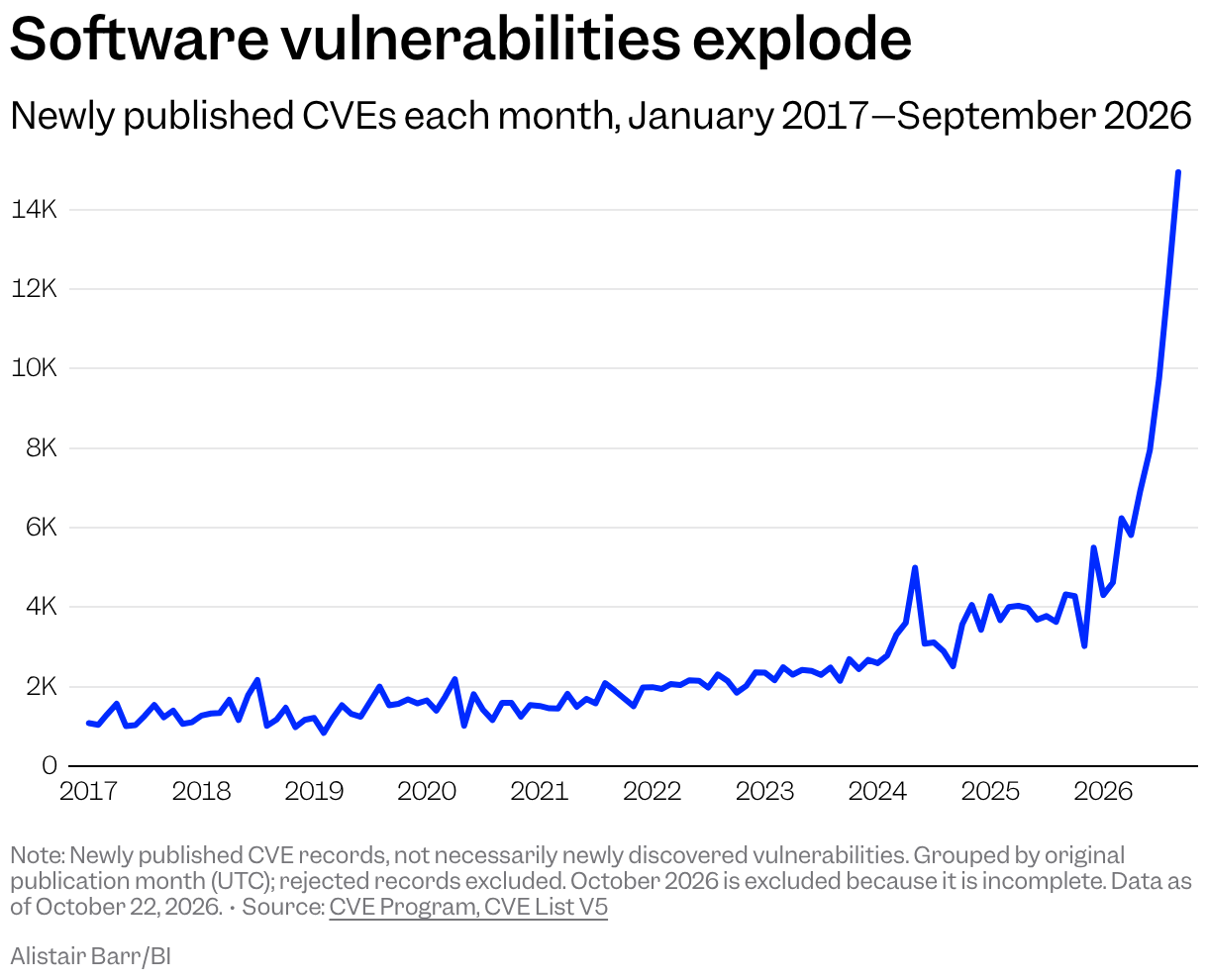
Now, there's a frantic race between people trying to break into systems and those trying to protect them.
Don't panic about AI
Cohen's message, though, was surprisingly reassuring.
AI helps the good guys find and fix these problems. Cloudflare, for instance, released protections for the latest vulnerability to customers, including those using its free service.
And there's a bigger effort underway.
OpenAI has launched an initiative called Patch the Planet, working with Cloudflare and other security professionals to use AI to find weaknesses in widely used software and help repair them.
Tom Occhino, chief product officer at Vercel, told me recently that his company has been talking with partners about launching a nonprofit that would fund a swarm of good AI agents that go out on the internet to find and fix software flaws.
Amazon is joining the fight, too. Its new Continuum service, available Thursday, uses AI agents to find security holes and propose fixes. Amazon said that people maintaining freely available software can use it to help protect the wider internet.
Humans may still have to check and approve these repairs, but the prospect of AI helping clean up decades of neglected software is encouraging.
The irony of this is not lost on some in the industry.
"The funny thing is everyone was saying AI slop code will cause a cyber crisis but it's actually all the old human slop causing it and the AI is just cleaning it up," software engineer Ben Kaufman wrote on X on Thursday.
Either way, Cloudflare's Cohen thinks these AI-inspired freakouts will push the industry to do better — by exposing issues and adding urgency to get them patched.
"We may end up in a world where actually we've become significantly more secure at the end," she said.
The trouble is getting there.
A fundamental question about the internet
Alistair Barr/Business Insider
When I ran into Occhino recently at a Vercel conference in San Francisco, he described a world in which software that everyone assumed was safe suddenly looks vulnerable because increasingly capable AI models are scrutinizing the basic systems that underpin the internet.
That led to a more fundamental discussion between us: Why did we connect so many things to the internet in the first place?
For years, the technology industry has raced to put everything online. Thermostats. Refrigerators. Doorbells. Cars. Bank accounts.
We assumed that connecting something to the internet automatically made it better.
Perhaps we should reconsider.
Before the internet
I remember the world before the internet. It worked pretty well. We managed to buy groceries, pay bills, heat our homes, and generally get through the day without every appliance talking to a computer somewhere.
That doesn't mean abandoning online banking or throwing your smartphone into the sea.
Occhino, for one, isn't particularly worried about hackers wiping out his bank account. Modern banks have sophisticated protections, and he recommends everyone turn on additional login security.
Maybe the cybersecurity crowd, which spends its life immersed in online threats, is missing something obvious.
Not everything needs to be connected.
Occhino put it neatly: "There's certain things that don't make sense to be on the internet in the first place."
Perhaps that's the lesson from this week's panic. We don't need to turn off the internet.
We just need to remember where the off switch is.
Alice Tecotzky contributed reporting.
Sign up for the AI Insider newsletter here. Reach out to me via email at abarr@businessinsider.com
