Several thousand Protestant Orange Order members marched through a Northern Irish town Saturday ahead of a ruling on a legal challenge to the UK government's ban on a separate parade
Oct 24 (Reuters) – Ras Al Khaimah authorities said on Saturday that all beaches in the emirate would be closed until further notice, a day after anoffshore oil leak prompted beach closures in...
Michigan Democratic Senate candidate Abdul El-Sayed pushed back at Fox News’s Bret Baier in an interview that aired on Friday evening over questions about his alleged ties to an Islamist political group. After Baier began asking the candidate about accusations repeatedly made by his opponent, former Rep. Mike Rogers (R-Mich.), that the Democrat has ties…
The author travels with her parents and her family.
Courtesy of the author
My 21-year-old son wanted to visit a lively beach club during our family vacation.
I never expected my parents, both in their 70s, to get up and dance to ABBA.
Seeing their joy reminded me that getting older doesn't mean giving up new experiences.
My 75-year-old dad told me he'll feel like he's closer to dying if our annual family vacations stop. He's not ready for that. Neither am I.
It stopped me in my tracks and frankly scared me a little. While I know my parents are aging, I haven't begun thinking about life without them, and I found myself spending the rest of the vacation looking through this new lens.
For the last 12 years, my husband, my parents, my son, and I have traveled all over the world on an annual multigenerational trip. And while the sights have been spectacular, what struck me most on this last vacation is just how much each of us has grown to value these trips.
I'm in the middle between my parents and my son
The dynamic has certainly evolved. My son was 9 when we started, is now 21, and brings his girlfriend along. My parents are now in their mid-70s, with some health challenges that require more patience and care. And I'm in the middle, adjusting the trip so everyone can still participate. I used to plan for adventure. Now I'm thinking about walking distances, downtime, unpacking, and what my parents can comfortably do, while still making it fun for the 21-year-olds.
The author says she now needs to take into consideration what her parents can do, and what will keep her son entertained.
Courtesy of the author
But what I learned on this trip was that sometimes, when choosing something for the youngest generation, a magical memory is created for the oldest, like when we went to Nikki Beach in St. Tropez at my son's request. We had been there for lunch a few years prior, and we wanted to return, this time when we could see the true Euro summer beach club vibe in action, complete with waving white napkins and ABBA blasting from the DJ booth.
I never would have guessed it, but both of my parents were up and dancing that day. My mom has since declared the whole day one of her favorites. Who knew? Maybe all they need is a "darty" (day party, as my college kid tells me!).
These are not just vacations for my parents
After what my dad had said earlier in the trip, I watched him differently that day. Seeing him dancing with my mom, laughing and completely in the moment, I understood a little more of what he meant. These trips aren't just vacations to him. They are something he still gets to look forward to, proof that there are more places to go, more memories to make, and more life ahead of him.
The thing is, for the first few years of these trips, I just wanted to knock places off my bucket list. Now, I want to figure out how to bottle the time and have lasting pictures in my head because a time will come when they stop, when it is no longer feasible for my parents to travel, and when my son will be busy with work and his own family.
The author realized these trips won't last forever.
Courtesy of the author
I know the finality of life all too well, as I still struggle with the loss of my son Jake after 15 years. I know firsthand the fragility of life and how it can all change in an instant.
My dad's comment also made me realize that I've been thinking about these trips mostly from my own perspective as planner and caregiver. I worry about how much walking they can do, whether they need an afternoon off, or if I've planned too much. He's thinking about something entirely different. He's thinking about what it means to still be able to go.
The goal is to spend time together
The success of these trips used to be measured by where we went and what we saw. Now they are measured by how much uninterrupted time we have together. As we've shifted from bucket-list places like Africa and the Galápagos, we've begun to choose places where we don't have to pack and unpack every three or four days, where we can settle in and spend time together.
We've all learned that the real moments of these trips do not lie in the over-the-top experiences. They lie in the moments after the excursion, when we are all having cocktails by the pool and sharing time, the most valuable gift we all have. It's in the final glass of wine, listening to music, or playing Flip 7 or Pass the Pigs. It's when we are tired from exploring and stop to have a beer on a random street in a random place that we may never find again.
I don't know how many more years the five, now six, of us will be able to do this together. I hope it's many. But my dad's comment made me realize that counting the years almost misses the point. We got this trip, and while we were there, everyone could still dance.
Perhaps the most important thing is that when my parents started this tradition all those years ago, they started something that won't end with them. I know someday these trips will be for my son and his family. I love knowing my parents gave us that tradition. I'm just in absolutely no hurry to inherit it.
The theme park operator announced the extra safeguard less than two weeks after 42-year-old Hassan Jihad Ibn Kariem of Atlanta died after being ejected from his seat on the Goliath coaster at Six Flags Over Georgia.
Uma colisão entre dois veículos ligeiros de passageiros, ocorrida perto pouco antes das três da tarde deste sábado, na Autoestrada do Sul (A2), no concelho de Palmela, distrito de Setúbal, teve como resultado a morte de uma mulher, segundo revelaram a Guarda Nacional Republicana (GNR) e Proteção Civil à Agência Lusa, citada pelo Correio da Manhã (CM).
À Lusa, fonte do Comando Sub-Regional de Emergência e Proteção Civil da Península de Setúbal explicou que o acidente aconteceu cerca do quilómetro 24,5, no sentido Sul-Norte, junto às portagens de Coina, na freguesia da Quinta do Anjo, tendo o alerta às autoridades sido dado às 14h52.
O CM adianta na sua publicação que por volta das 16h10, o corpo da vítima mortal ainda não tinha sido transportado para os serviços de medicina legal.
Fonte da Autoridade Nacional de Trânsito da GNR, revelou à Lusa que a vítima mortal é uma mulher, cujo óbito declarado no local, mas não precisou a idade da mesma.
Para o local foram empenhados 17 operacionais, apoiados por sete viaturas, incluindo os Bombeiros Sapadores de Setúbal, de Sul e Sueste do Barreiro e corporação do Pinhal Novo, assim como a GNR, Instituto Nacional de Emergência Médica (INEM) e Brisa.
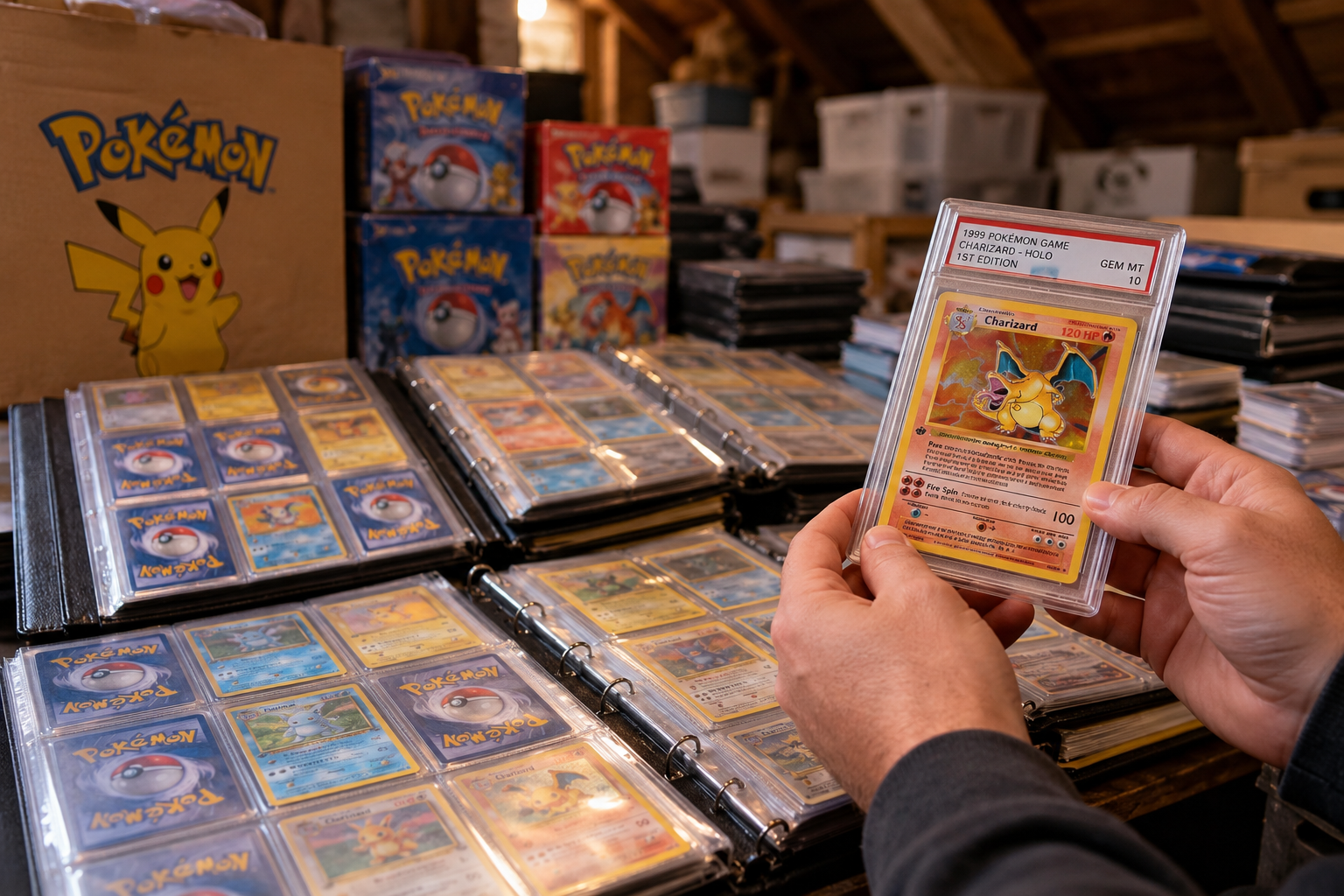
Uma coleção de cartas Pokémon esquecida durante 15 anos num sótão transformou um antigo pintor e decorador britânico num milionário. O homem, residente em Woking, no Reino Unido, conseguiu vender 42 conjuntos de cartas por 1,56 milhões de libras, aproximadamente 1,8 milhões de euros, num leilão realizado esta quarta-feira, 21 de outubro.
De acordo com a BBC, citada pelo Jornal SOL, o proprietário tinha adquirido as cartas no final da década de 1990, numa altura em que o fenómeno Pokémon começava a conquistar crianças e adolescentes em todo o mundo.
O que começou por ser uma compra motivada pelo interesse do filho acabou por se transformar num investimento inesperadamente lucrativo, depois de as cartas permanecerem guardadas durante mais de uma década.
Comprou cartas Pokémon por 300 libras e vendeu-as por 75 mil
A história começou quando o filho do britânico passou a colecionar e trocar cartas Pokémon na escola. Ao observar o entusiasmo da criança, o pai decidiu adquirir conjuntos completos, acreditando que poderiam valorizar no futuro.
Algumas das coleções foram compradas através do eBay, incluindo conjuntos provenientes de um vendedor na Malásia.
Uma dessas compras, que custou originalmente apenas 300 libras, cerca de 345 euros, acabou por ser vendida no leilão por 75 mil libras, aproximadamente 86 mil euros.
O proprietário teve o cuidado de guardar as cartas em álbuns próprios, preservando o seu estado de conservação. Quando o filho perdeu o interesse, a coleção acabou esquecida no sótão durante cerca de 15 anos.
Uma carta Charizard ajudou a atingir um valor surpreendente
Entre os conjuntos mais valiosos encontrava-se o Legendary Collection Complete Master Set, uma coleção que incluía uma carta Charizard em estado de conservação quase perfeito.
Inicialmente, os especialistas estimavam que este conjunto pudesse alcançar entre 15 mil e 20 mil libras. No entanto, a procura durante o leilão fez disparar o preço final para 100 mil libras, aproximadamente 115 mil euros.
Segundo James Spooner, responsável pelo departamento de cartas colecionáveis da leiloeira Ewbank’s, a qualidade dos 42 conjuntos surpreendeu os especialistas, sobretudo por se encontrarem completos e em excelente estado de conservação.
A coleção acabou por ser vendida na leiloeira britânica Ewbank’s, em Surrey, com compradores de diferentes países a disputarem os lotes.
Só descobriu que tinha uma fortuna depois de ler uma notícia
Durante vários anos, o antigo pintor e decorador não tinha conhecimento do verdadeiro valor das cartas que guardava em casa.
A descoberta aconteceu quando leu num jornal local que uma única carta Pokémon tinha sido vendida por mais de 6000 libras.
Perante esta informação, decidiu procurar uma avaliação especializada e acabou por descobrir que os conjuntos adquiridos décadas antes poderiam valer centenas de milhares de euros.
O leilão tornou-se a venda mais valiosa da história da Ewbank’s, que conta com mais de 30 anos de atividade, e poderá representar um recorde europeu neste tipo de leilões.
Cartas Pokémon antigas podem valer milhares de euros
A valorização das cartas Pokémon está relacionada com vários fatores, incluindo a raridade, o estado de conservação, a edição e a procura entre colecionadores.
Andrew Ewbank, responsável pela leiloeira, explicou que a nostalgia desempenha um papel importante neste mercado, uma vez que muitos dos antigos fãs de Pokémon têm atualmente entre 30 e 40 anos e maior capacidade financeira para adquirir peças ligadas à infância.
No entanto, nem todas as cartas antigas representam investimentos valiosos. As primeiras edições, determinadas cartas holográficas e exemplares em excelente estado de conservação tendem a despertar maior interesse.
Para quem ainda guarda cartas Pokémon antigas em casa, a história deste britânico demonstra que poderá valer a pena verificar a edição e o estado dos exemplares antes de os vender ou descartar.
A recomendação dos especialistas passa por procurar uma avaliação profissional, especialmente quando existem conjuntos completos ou cartas raras das primeiras coleções lançadas no final dos anos 1990.
Il “CasoSinner“ costringe la Wada (World Anti-Doping Agency), l’agenzia mondiale antidoping, a cambiare le regole. Dall’1 gennaio 2027, infatti, entreranno in vigore le modifiche al Codice mondiale antidoping che riguardano soprattutto i casi di contaminazioneaccidentale, come quello che ha portato allo stopforzato di tremesi di JannikSinner nel 2025. In più ci saranno nuove regole anche per quanto riguarda i controlliantidoping a sorpresa.
Il nuovo Codice mondiale antidoping introdurrà criteri più ampi per valutare i casi di positività dovuti a contaminazioniinvolontarie. La modifica principale consiste nel superamento della definizione di “prodottocontaminato“, sostituita da quella più estesa di “fontecontaminata“. In questo modo, gli atleti potranno fare riferimento a un ventaglio più ampio di circostanze per dimostrare che l’assunzione di una sostanzavietata è avvenuta senza intenzionalità, come appunto nel caso di Sinner. Tra le situazioni contemplate rientra l’assunzione di medicinali o integratori che contengano sostanzeproibite non riportate sulla confezione o nelle informazioni individuabili attraverso una ricercaragionevole, anche con l’ausilio di strumenti di intelligenzaartificiale o tecnologieequivalenti.
La normativa prende in considerazione anche l’ingestione di cibi e bevandecontaminati, come carne o liquidi, purché non vi siano avvisi, indicazioni sulle etichette o altri segnali che possano mettere l’atleta in guardia dalla possibile presenza di sostanzevietate. Un’ulteriore casistica riguarda il trasferimento di una sostanzaproibita attraverso il contattofisico con un’altra persona oppure con oggetti che quest’ultima abbia toccato o utilizzato.
È proprio quest’ultimo scenario nello specifico a richiamare il caso di JannikSinner, risultato positivo nel 2024 al clostebol in seguito a una contaminazione involontaria attraverso la pelle. La sostanza era stata trasferita dal fisioterapista GiacomoNaldi, che aveva utilizzato un prodotto contenente clostebol per curarsi una ferita a un dito e aveva successivamente trattato il tennista. La precedente formulazione del Codice, incentrata sul concetto di prodotto contaminato, non contemplava espressamente questa modalità di esposizione.
Con il nuovosistema, gli sportivi avranno quindi maggioripossibilità di dimostrare l’origine accidentale di una positività e di ottenere una riduzione della sanzione. Le conseguenze potranno variare da un semplice richiamo, senza sospensione, fino a un massimo di due anni di stop, in base alle circostanze del caso. Resta comunque a carico dell’atleta l’onere di provare da dove provenga la contaminazione e di dimostrare che non vi siano state colpa o negligenzasignificative.
Un altro aspettoimportante, che cambierà, riguarda le modalità con cui gli atleti devono comunicare la propria disponibilità per i controlliantidoping. A partire dal 2027, la WADA imporrà a tutti gli sportivi appartenenti al RegisteredTestingPool (RTP), il gruppo sottoposto a un programmaspecifico di controlli, di indicare ogni giorno una finestra di 60minuti durante la quale poter essere reperiti. L’obbligo sarà valido anche nei giorni in cui sono impegnati nelle competizioni.
Finora il tennis aveva beneficiato di una deroga per le giornate di torneo, poiché gli orari delle partite possono subire variazioni e rendere difficile stabilire in anticipo un momento preciso in cui essere disponibili. Con l’entrata in vigore delle nuovedisposizioni, anche i tennisti dovranno però adeguarsi alla regola generale. Per affrontare le difficoltà legate alla programmazione degli incontri, l’International Tennis Integrity Agency (ITIA), in collaborazione con la WADA, ha individuato una soluzione specifica per il circuito. La principale novità sarà una riduzione significativa del numero di giocatori inseriti nel gruppo RTP.
Attualmente ne fanno parte circa 250. Dal 2027 il totale dovrebbe scendere a una cinquantina di atleti, pari a circa un quinto del numero attuale. La selezione terrà conto di diversiparametri, tra cui la posizione in classifica e una valutazione individuale del rischio. Potranno essere considerati anche eventualiprecedentilegati al doping, gli infortuni e altri elementi ritenuti pertinenti. L’ITIA ha inoltre precisato che la riduzione del gruppo non comporterà una diminuzione del numero complessivo né della frequenza dei controlli antidoping. I nominativi dei giocatori inseriti nell’elenco ristretto, inoltre, non saranno resi pubblici. Rimarrà infine valido per tutti i tennisti l’obbligo di sottoporsi ai controlli quando richiesto da un ufficiale antidoping, indipendentemente dalla fasciaoraria di 60minuti precedentemente comunicata. Il mancato rilascio di un campione dopo una convocazioneregolare potrà comportare una sospensione fino a quattro anni.
The author and her husband have a 23-year age gap.
Courtesy of Caroline Chirichella
My husband is 23 years older than I am, but our age difference never bothered me before.
Now that he's 61 and we're raising two young kids, I'm noticing our different energy levels.
I love our life together, but I'm struggling with the realities of our age gap.
When my husband and I first met back in 2014, we had what many would consider a whirlwind romance. We met, fell in love almost instantly, moved in together after a year, got engaged six months later, married a month after that, and a little over a year later, welcomed our first child.
It was all very exciting, rushed, and filled with emotion and love.
I'm also a very rational person who doesn't get easily swept up in the moment. So we talked about a lot of the "hard" decisions that couples so often neglect to discuss at the beginning of a relationship. We talked about children, our future, and what we wanted our lives to look like. That's why, now, more than 12 years later, it's surprising to find myself struggling with something I thought I had already made peace with: our age gap.
He is 23 years older than me
My husband and I have a 23-year age difference. Yes, I was always aware of it. And, to be honest, it never really made a difference to me.
The author's husband is now in his 60s and the couple has two young kids.
Courtesy of the author
Especially when it came to the big life decisions, including having children, we had those conversations before we even got engaged. I knew exactly how old he was. I knew there would be things about growing older together that would be different for us.
But I guess there's a big difference between being aware of something that could eventually happen and actually living it.
Our age difference has been showing up in more ways than one lately, and there's a part of me that's angry with myself for being surprised by it.
It's not like my husband was always going to be the 48-year-old I met when I was 25. I knew he would age. I knew things would change as he got older. I knew there would eventually be a point when the difference between us became more noticeable.
I just don't think I ever wanted to admit to myself exactly how much.
He's in his 60s now
I knew he was going to be an older father. I knew all of this. But knowing something and seeing it firsthand are two very different things. Lately, I've seen just how much his 61 years are catching up to him, and it's been putting me in a strange place.
I keep a lot of things together for my family. We have two young children, and I have my own business. There is already a lot that weighs on me. But what I've noticed recently is my husband's physical health beginning to catch up with his age.
Courtesy of the author
Don't get me wrong — my husband is in great shape for a 61-year-old. But at the same time, most 61-year-olds aren't running after toddlers or handling the daily insanity of school drop-off and pick-up.
And that difference is becoming harder for me to ignore. What bothers me most is how naive I feel. I knew this was a possibility. Quite frankly, my husband knew it, too. When we discussed having children, we were always on the same page, but he expressed his concerns about being an "old" dad. I heard him. We talked about it. We made the decision together.
And yet, now that I'm watching the reality unfold in front of me, I'm beginning to feel guilty. As though I've been selfish. As though somehow this isn't fair to my kids.
I see how much fatherhood — and, frankly, being a husband — can weigh on him.
The everyday insanity of being part of a household with a high-maintenance 8-year-old and a very independent 3-year-old is a lot for anyone, myself included. But it's especially a lot for a 61-year-old.
Sometimes he physically can't keep up with our 3-year-old, who runs at a pace that could outrun the best of us. Sometimes he mentally can't keep up with our eight-year-old, who talks at about a million miles a minute.
And those moments make the age difference feel very real.
It's not just the fatherhood aspect
I feel his patience with me beginning to waver, too, and I wonder how much of that is because we're simply in such different phases of life.
I have a thriving public relations firm, and I feel like I'm just getting started. I have energy and ambition and a feeling that there is still so much ahead of me.
He had a contracting firm for many years, but that chapter of his life is well behind him now. At his age, he should be enjoying retirement. Instead, he's a stay-at-home dad and handles a huge amount for our family. But he's far from retired.
He's the only one who drives, so he's the family's chauffeur. He makes appointments and handles logistical things. He oversees the renovations on our house. He does the grocery shopping. He does so, so much.
And the truth is, at this age, maybe he shouldn't have to.
Our relationship itself hasn't really changed. We are still very lucky to have an incredibly open and loving relationship. We talk about these things. We try to give each other space and understand where one another is coming from. We each do what we can mentally and physically for each other, for our children, and, just as importantly, for ourselves.
I think what we're realizing is that neither of us has ever been here before.
We knew there was an age gap when we met. We knew what it meant on paper. We talked about the difficult possibilities before we got married and before we had children.
At 25, I could understand that my husband was 23 years older than me. At 38, I can feel it.
Deixar de fumar, reduzir o álcool e recuperar rotinas de alimentação, sono e exercício são mudanças que podem ajudar a ter uma vida mais saudável depois dos 50 anos. Especialistas ouvidos pelo jornal britânico The i Paper explicam que os benefícios continuam a ser possíveis, mesmo após décadas de excessos, mas não equivalem a eliminar todas as consequências do passado.
Numa reportagem publicada esta quarta-feira, o jornal cita uma investigação da Universidade de Ciências Aplicadas Laurea, na Finlândia, publicada em 2025, que identificou repercussões de hábitos como fumar e beber em excesso já aos 36 anos entre os participantes. Os efeitos persistiram nas décadas seguintes.
A mensagem dos especialistas, porém, não é de resignação. “O corpo não é um disco rígido que guarda permanentemente cada má decisão, nem um quadro branco que se possa limpar com um detox”, explica a imunologista Jenna Macciochi.
“Não precisamos de apagar todas as consequências do nosso passado para melhorar significativamente a nossa saúde futura”, acrescenta.
Deixar de fumar é a primeira prioridade
Entre as mudanças apontadas na reportagem, abandonar o tabaco surge como uma das mais importantes. O jornal recorda que fumar reduz a esperança de vida, em média, em dez anos e está associado a doenças cardiovasculares, vários tipos de cancro e problemas que afetam, entre outros, a visão, a audição e o sistema imunitário.
O envelhecimento da pele é outra consequência. “O fumo do cigarro gera stress oxidativo, interfere com a produção de novo colagénio e afeta as fibras elásticas que sustentam a pele”, explica a dermatologista Anjali Mahto.
Na prática, isso pode traduzir-se em rugas mais pronunciadas, sobretudo em redor da boca, sulcos mais profundos na parte inferior do rosto e perda de elasticidade.
Os benefícios de deixar de fumar começam rapidamente. De acordo com as informações do serviço nacional de saúde britânico, o NHS, citadas na reportagem, a pulsação regressa aos valores normais ao fim de 20 minutos e a quantidade de monóxido de carbono no sangue reduz-se para cerca de metade após oito horas. Dez anos depois, o risco de morrer de cancro do pulmão é aproximadamente metade do de quem continua a fumar.
Mahto refere também que existe um conjunto ainda pequeno, embora crescente, de evidências sobre o envelhecimento da pele associado aos cigarros eletrónicos. Faltam, contudo, estudos de longa duração que permitam quantificar os efeitos nas rugas.
Menos álcool também pode significar noites melhores
A reportagem sublinha que não existe um nível de consumo de álcool isento de risco. Para algumas pessoas, deixar de beber será a melhor opção; para quem mantém um consumo regular, reduzir a quantidade é uma das mudanças centrais propostas.
Reservar três dias da semana sem álcool é outra das recomendações apresentadas. O objetivo não se limita a evitar episódios de consumo excessivo, mas também a interromper o hábito de beber todos os dias.
“O fígado tem propriedades regenerativas extraordinárias, pelo que deixar de beber, temporária ou permanentemente, pode ajudá-lo a recuperar”, explica Tamara Gall, cirurgiã geral e hepatopancreatobiliar do Cromwell Hospital, numa declaração ao The i Paper recuperada na reportagem.
Os benefícios dependem dos danos existentes. Segundo a especialista, podem ser observados ao fim de uma semana, enquanto lesões mais graves exigem períodos de abstinência muito mais prolongados.
O sono também é afetado pelo álcool, mesmo quando a sensação inicial parece ser de relaxamento. Heather Darwall-Smith, psicoterapeuta especializada em sono e neurodiversidade, explica que beber pode facilitar o adormecer, mas prejudica a segunda metade da noite.
“O sono torna-se mais leve, acordamos mais vezes e o sono REM é perturbado”, afirma, acrescentando que o álcool também agrava o ressonar e os problemas respiratórios durante o sono.
Alimentar o intestino antes de procurar suplementos
O consumo excessivo de álcool, o tabaco e as noites mal dormidas podem afetar o apetite, a alimentação e o microbioma intestinal. Uma dieta pobre em fibra e dominada por alimentos ultraprocessados deixa as bactérias intestinais sem parte dos nutrientes de que necessitam.
Para a investigadora e dietista Megan Rossi, a resposta não deve começar automaticamente por um suplemento.
“Quando recebo pessoas na consulta, pensam que, para recuperar a saúde intestinal, precisam de tomar um probiótico, mas essa não é a solução. É preciso cuidar primeiro dos fundamentos”, explica.
A especialista propõe diversificar seis grupos de alimentos de origem vegetal: fruta, hortícolas, cereais integrais, ervas aromáticas e especiarias, leguminosas, e frutos de casca rija e sementes. Cada grupo fornece diferentes fibras e compostos que alimentam diferentes bactérias intestinais.
“Uma maior diversidade de bactérias intestinais significa que serão mais resistentes às coisas a que as sujeitamos”, afirma.
Rossi cita uma investigação da Universidade de Bergen que aponta benefícios potenciais da passagem para uma alimentação de estilo mediterrânico mesmo quando a mudança começa aos 80 anos.
Para quem procura um primeiro passo simples, sugere introduzir leguminosas, como o feijão. O seu impacto, explica, não resulta de serem um alimento milagroso, mas de estarem frequentemente ausentes da alimentação.
A especialista destaca ainda alimentos fermentados, como iogurte, queijo e kimchi, associados à redução de marcadores inflamatórios no sangue. Refere também um estudo em que uma alimentação rica em fibras prebióticas, que alimentam bactérias intestinais benéficas, melhorou a qualidade do sono relatada pelos participantes.
Acordar à mesma hora ajuda a recuperar o ritmo
Na meia-idade, o descanso pode ser perturbado não apenas pelos hábitos anteriores, mas também pela menopausa, pelas pressões profissionais, pelas responsabilidades familiares e pelo cansaço acumulado.
Nem todos estes fatores são controláveis. Ainda assim, Darwall-Smith destaca uma medida que recomenda aos seus clientes: acordar aproximadamente à mesma hora todos os dias.
“Levantar-se à mesma hora todos os dias é quase como traçar uma linha na areia”, afirma. “Não é preciso ser rígido, apenas bastante consistente.”
A regularidade ajuda a estabilizar o ritmo circadiano, o relógio biológico que organiza o sono e outras funções do organismo. A exposição à luz natural de manhã reforça esse sinal.
Anjali Mahto acrescenta que a sincronização destes ritmos pode beneficiar a digestão e, potencialmente, o funcionamento e a reparação da pele.
Exercício com espaço para o treino de força
Passar de uma vida sedentária para uma vida ativa é outra das mudanças com maior potencial. Macciochi descreve o exercício como “provavelmente uma das nossas intervenções mais poderosas”, com benefícios para o risco cardiovascular e a forma como o organismo responde à insulina.
Correr, pedalar e nadar são exemplos de atividade aeróbica referidos na reportagem. Mas o treino de força também merece atenção.
O álcool interfere com o crescimento muscular e a densidade óssea. A estes efeitos juntam-se as perdas de músculo e de massa óssea associadas ao envelhecimento, que podem deixar o corpo mais vulnerável a quedas e dores.
O treino de força ajuda a contrariar essas perdas, a melhorar a sensibilidade à insulina e a manter um peso saudável. A reportagem salienta também a importância de uma alimentação com proteína suficiente para apoiar o desenvolvimento muscular, sem descurar a fibra necessária ao microbioma intestinal.
Cuidar da pele sem tentar compensar tudo de uma vez
Perante sinais visíveis de envelhecimento, a tentação pode ser recorrer a muitos produtos ou tratamentos intensivos. Mahto considera que essa abordagem pode ser contraproducente.
“Uma limpeza suave e um hidratante adequado são suficientes para muitas pessoas, sobretudo quando a barreira cutânea está irritada”, afirma. Ingredientes como a glicerina e as ceramidas podem ajudar a proteger essa barreira.
Pelo contrário, uma esfoliação agressiva ou a introdução simultânea de vários ingredientes ativos fortes depois de um fim de semana de excessos tende a provocar irritação, em vez de acelerar a recuperação.
A dermatologista recomenda ainda proteção solar diária de largo espectro, idealmente com fator de proteção entre 30 e 50 e boa proteção contra os raios UVA. Menciona também os retinoides tópicos, incluindo a tretinoína sujeita a prescrição, que têm evidência de benefício em algumas alterações da pele, mas não são adequados para todas as pessoas.
“Se alguém deixa de fumar aos 50 anos ou começa a fazer exercício regularmente aos 55, considero isso uma excelente decisão”, afirma. “Não é necessário recuperar o rosto que tinha aos 25 anos para que essas mudanças valham a pena.”
Começar pelo que tem maior impacto
Adotar novos hábitos na meia-idade pode ser difícil num período marcado por responsabilidades familiares, pressão profissional e alterações hormonais. A proposta dos especialistas não é transformar tudo de uma só vez, mas começar pelo comportamento com maior impacto na saúde.
“Deixar de fumar estará provavelmente em primeiro lugar, seguido do álcool”, resume Macciochi.
Darwall-Smith deixa uma orientação para evitar que a procura de uma vida melhor se transforme noutra fonte de ansiedade: “Fazer mudanças que se consigam realmente manter e dar-lhes tempo para se consolidarem.”
The AI data center boom looks like it's running into serious trouble. Projects are being delayed, canceled, or abandoned. Electricity shortages are holding everything up.
But there's a twist: A lot of these data centers were probably never going to get built in the first place.
Bernstein Research analyzed thousands of planned US data centers and concluded that only about 35% of the announced capacity is likely to become reality.
The industry has a wonderful name for some of the more dubious projects: "Bragawatts."
These are enormous data centers announced by companies that often have little experience building them. Some haven't secured electricity, construction permits, or even customers.
Then there are the "ghost projects." Developers submit multiple requests for electricity connections, hoping at least one location works out. In Texas, these requests have reached more than five times the state's existing electricity supply.
No wonder the grid looks overwhelmed.
This doesn't mean the AI boom is fake. Far from it.
But there's a big difference between Amazon's very real problems and an inexperienced developer announcing a gigantic project that may never happen.
The AI data center boom is real, and so are the challenges of building all these facilities. But the sheer number of speculative projects may be making those challenges look bigger than they truly are.
Cybersecurity leaders talked with BI about the rise in demand for workers in the field.
MASTER/Getty Images
All hell broke loose this week after a security flaw in 70% of the world's websites was made public.
It was supposed to be kept under wraps as a fix was deployed, but one researcher jumped the gun.
Chainguard CEO Dan Lorenc told POLITICO why he decided to go public.
The exposure was immense, with AI multiplying the risks — and yet time-tested global cybersecurity procedures appeared to be functioning. Then suddenly, it all broke down.
The decision by a cybersecurity company on Wednesday to prematurely release information about a flaw in the popular PHP computer programming language left much of the web exposed to hackers, triggering a panic that brought to life months of warnings of how the AI-powered era could cause widespread damage.
The flaws in PHP, discovered using AI tools through a monthslong process coordinated by OpenAI, caused cyber agencies across Europe, the US, the UK, Australia and Canada to post urgent warnings Wednesday. Numerous governments took websites offline as a precaution.
While no major hacking damage was immediately apparent, the way the incident unfolded over 72 hours showed how easily cybersecurity processes can break down and the outsized consequences of cyber risks in the AI era.
The man who set off the chain reaction with the early release — Chainguard's CEO Dan Lorenc — quickly apologized in a LinkedIn post. But on Thursday, in an interview with POLITICO, Lorenc said he'd shared the information ahead of time because the flaw was already being exploited. Though others disputed that, Lorenc said he believed he'd seen enough evidence to invalidate an embargo set up to allow time to find a fix for the flaws.
While he disputed that his actions would have caused problems for other defenders, Lorenc said that the evidential threshold in these coordinated cyber defense systems is a "grey area."
The revelation of the PHP flaw brings out into the open what cyber officials have been bracing for since the arrival of the most powerful tools of artificial intelligence, which not only can be used to discover vulnerabilities but also to exploit them at scale.
The cybersecurity world's long-established protocols helped prevent disaster scenarios in which hackers would have successfully exploited the vulnerabilities to take control of numerous websites and access their data. But the scale and end-of-days potential of AI-driven cyber risks are now visible for the world to see.
This "is what happens when AI turns up a flaw that's been hiding for years," said Eylam Milner, cofounder and chief technology officer at cybersecurity startup Echo. The vulnerabilities, he added, are "about as serious as it gets for the web."
Origin story
Understanding how this week's emergency unfolded offers a glimpse at how companies and authorities are working to stave off attacks — and how much risk they face going forward.
The origins of the incident can be traced back as far as April, when leading frontier AI firm Anthropic unveiled Mythos, leading some in the cybersecurity world to worry that systems would quickly be overrun by advanced artificial intelligence, with potential for catastrophic events to ensue.
But while researchers did find more flaws in computer systems in the months after Anthropic and other AI firms like OpenAI released those models, they had little impact in the real world. Even the Hugging Face incident, a widely discussed hack that saw OpenAI's autonomous AI agents go rogue during an internal security evaluation, related more to the level of control AI companies exert over their models than their power to break into systems worldwide.
That changed this week after researchers unveiled the vulnerability in PHP, a coding language estimated to be integrated into some 70% of the web.
The process by which information about flaws is released among cybersecurity officials and affiliated companies is crucial. Through a long-standing practice known as coordinated disclosure, researchers and companies that identify flaws can find a fix and share it confidentially with agencies and others before releasing it to the public, meaning they don't hand malicious hackers the gift of a hole without a fix.
In the case of the PHP flaw, that process worked well, but not perfectly. Information about the bugs started to circulate ahead of the planned release time. Then, according to the PHP Foundation, Chainguard "unilaterally broke the embargo," which "disregarded weeks of work by many parties toward a coordinated disclosure." PHP Foundation executive director Elizabeth Barron told POLITICO by email that while it was "disappointed" with Chainguard, it hopes to "rebuild trust with them in the future to ensure we can continue to collaborate effectively."
After the leak — which meant information about the bugs was in the open before the fix was ready — confusion quickly ensued, with government bodies and private companies choosing to temporarily shut down their websites rather than risk potentially damaging breaches to their data and the sites themselves.
Early Thursday, Matthew Prince, the CEO of Cloudflare, an internet services company widely used by websites to block cyberattacks, which gives it a high level of visibility into what hackers are doing, said in a post on X that it had seen "millions" of attempts to exploit the flaw.
Cloudflare saw thousands in the 10 hours before the flaw was publicly announced, then tens of thousands in the 45 minutes after the announcement, hundreds of thousands within two hours, and now millions, Prince said.
Amazon's cloud division also said the flaw is "now being broadly exploited in the wild."
One senior US government cyber official said that federal authorities have been overwhelmed — and not just by PHP. The same day the world was racing to address PHP, they were also dealing with bugs in node.js, a widely used JavaScript framework, Fortinet, GitHub and Oracle.
"The fire department is fighting multiple fires at once," the official said, adding: "The good news is they're all one-story structures on fire, which the fire department deals with all day, every day."
More to come
Dauntingly, OpenAI said there's more on the way. "These bugs are among several significant vulnerabilities we've already found and are working to fix, and we expect similar findings to increase sharply in the coming months," the company said Wednesday in a statement.
Matthijs van Amelsfort, head of the Dutch cybersecurity agency, said in an interview that the job of keeping computer systems safe has been transformed by the advancement of AI. "As soon as the frontier models came out, that's exactly what we said: This will be the trend," he said. "And actually that's happening now."
Thomas Caspers, vice president of Germany's cyber agency BSI, concurred: "We expect that [to be] happening more and more during the coming months."
AI also ramps up the risks once the flaws are out in the open. Cyber agencies' recommendation that organizations take their websites offline was "really a drastic measure," Caspers said. "We wouldn't have done that a few years ago or so." But because AI has made it quicker and easier to exploit flaws, "we had to do that," he said.
At the same time, the use of advanced AI to detect the flaws may create a new level of protection against malicious hackers looking to take advantage of them. Caspers said that though his German agency has also seen attacks, it has not seen any successful use of the flaw by hackers.
"It seems a little bit more complicated than expected to exploit," he said.
Despite the fact that AI offers a new way to discover flaws, the work involved in keeping systems protected is more quotidian, with cyber agencies urging organizations to install the fix shared by the PHP Foundation, in a process known as patching.
"There are three things that you have to do right now," said van Amelsfort from the Dutch agency. "And that's patch, patch, and patch."
John Sakellariadis contributed to this report.
The Axel Springer Global Reporters Network harnesses the resources of the company's newsrooms to publish ambitious scoops, investigations, interviews, opinion pieces and analysis. It allows journalists — including those from POLITICO, The Telegraph, Business Insider, WELT, BILD, Onet and Fakt — to collaborate on major stories for an international audience of hundreds of millions across platforms: online, print, TV and audio.
The violence accompanying France’s October protests has revealed how foreign influence networks can exploit domestic grievances to undermine governments and European support for Ukraine. New evidence suggests Russian-linked operations were active before the riots, raising questions about whether information manipulation is moving beyond propaganda towards the mobilisation of political unrest.
France’s violent protests have exposed a vulnerability in European security that conventional policing cannot easily address: the ability of foreign information networks to exploit domestic political crises, amplify social divisions and transform legitimate grievances into instruments of geopolitical pressure.
President Emmanuel Macron has acknowledged foreign manipulation of information surrounding the disturbances of 17–18 October but insists there is no evidence that foreign actors organised the violence itself. His assessment reflects the evidence currently available, although new investigations indicate that Russian-linked networks were actively exploiting the protest movement weeks before the worst disorder began.
On 24 October, France deployed approximately 70,000 police officers and gendarmes to prevent further violence. Yet the security operation addresses only the physical consequences of a crisis whose online dimension extends across national borders.
Researchers examined 547,471 posts and articles across nine languages. They identified 639 coordinated messages attributed with high confidence to Russia’s Doppelgänger operation, generating approximately 7.4 million views in the six weeks preceding 17 October.
The campaign used genuine concerns about living costs and public expenditure to promote a particular political argument: money allocated to Ukraine was being taken from European citizens.
This was not a random selection of grievances. France’s budget difficulties, public-service pressures and disagreements over defence expenditure provided material through which Moscow could seek to weaken support for Kyiv.
The researchers found that the operation targeted pro-European and pro-Ukraine politicians across the political spectrum. It praised selected proposals associated with Jean-Luc Mélenchon while also promoting nationalist narratives, illustrating a strategy driven less by ideological consistency than by opposition to existing European policies.
From manipulating opinion to encouraging mobilisation
Russian-linked channels were not merely commenting on existing demonstrations. They were circulating protest dates, identifying organisers and encouraging French audiences to follow the example of demonstrators in Germany.
On 28 September, the International Reporters network published an appeal urging French audiences to take to the streets. Other channels subsequently reproduced information about planned school blockades and demonstrations.
In one instance, a channel identified as Gavroche published rhetoric encouraging an attack on France’s Education Ministry.
Such activity goes beyond retrospective propaganda. It attempts to influence participation and behaviour while events are developing. Nevertheless, evidence that a network encouraged protests does not establish that it controlled the organisers or directed subsequent violence.
The original demonstrations arose from domestic grievances over schools, prices and government policy. The significance of the foreign activity lies in attempts to redirect and intensify an existing movement.
How France’s crisis was rewritten abroad
Once violence erupted, the information campaign acquired an international audience.
Alliance4Europe found that claims blaming migrants or Islam for the disturbances appeared in approximately one in 33 French-language posts, compared with nearly one in five English-language posts.
False allegations that immigrants had burned Limoges town hall circulated substantially more frequently in English than in French.
The same report identified 1,018 articles distributed through 28 websites associated with the Russian Pravda network. Their rapid republication across languages enabled a common narrative to reach audiences far beyond France.
The operation also presents a longer-term technological problem. Repeated publication of manipulated accounts can contaminate material subsequently retrieved or reproduced by artificial-intelligence systems, allowing false narratives to persist beyond the original campaign.
The political effects were visible when President Donald Trump and other foreign leaders portrayed France’s unrest principally through immigration and cultural conflict.
Speaking in Qatar on 21 October, Macron rejected these portrayals and criticised the circulation of fabricated AI-generated images. His remarks identified foreign manipulation after the riots but stopped short of alleging foreign responsibility for their organisation.
The Heritage Foundation and transatlantic networks
The transcript raises a more substantial allegation: that the American Heritage Foundation and Russia’s FSB have participated in a coordinated effort to destabilise France.
There are documented connections between the Heritage Foundation and political institutions associated with Hungary’s former prime minister Viktor Orbán.
These relationships demonstrate the development of transatlantic political networks capable of circulating common ideas about sovereignty, migration and European integration.
They do not establish operational cooperation with Russian intelligence. Nor has credible evidence emerged connecting Heritage to the organisation or financing of France’s October riots. Ideological convergence, institutional cooperation and participation in a clandestine operation require separate evidential assessments.
The implications for European security
The European Union’s response has exposed a regulatory problem.
Under the EU’s Digital Services Act, major online platforms must address systemic risks arising from their services, including the amplification of illegal content and threats to public security.
These measures targeted unlawful online activity, particularly incitement to violence and looting. They did not constitute findings that the suspended accounts belonged to foreign intelligence networks.
The European Commission has likewise refrained from activating emergency measures under the Digital Services Act without sufficient evidence connecting foreign manipulation to the violence.
The broader security concern is that foreign operations can exploit the interval between the emergence of social unrest and the establishment of reliable information about its causes.
Russia need not organise an entire protest movement to advance its strategic interests. By amplifying domestic grievances, promoting hostility towards support for Ukraine and circulating distorted accounts internationally, it can attempt to convert France’s internal political difficulties into pressure on European policy.
With France approaching its 2027 presidential election, these operations warrant continuing scrutiny. The central investigative question is no longer simply whether foreign networks spread false information after violence occurred, but whether their activities before and during demonstrations materially influenced mobilisation, radicalisation or political responses.
The evidence currently demonstrates organised manipulation and attempts at amplification. Establishing direct responsibility for violence would require a further evidential step, involving financial records, communications, operational instructions or connections with identifiable perpetrators.
France’s experience illustrates how contemporary information warfare can operate within a democratic society without necessarily directing events on the ground. Its immediate objective may be to alter the political interpretation of a crisis; its longer-term consequence may be to influence the policies adopted in response.
The author, shown with one of her sons, said that extras like fan gear, gas for away games, and concession snacks add a lot to the cost of youth sports.
Courtesy of Alexandra Frost.
Years ago, I made fun of sports parents who went all out and spent thousands on their kids.
Now I'm one of them.
Last season cost our family over $8,800. Looking back, I have no regrets and would do it all again.
Ten years ago, I was the mom making fun of select sports parents. I thought they were crazy. Nuts. Over-spenders. People who didn't understand priorities, or budgeting, for that matter. Then I became one of them.
It didn't happen overnight, but gradually. My then-7-year-old son was asked to try out for a team. At the time, it seemed more competitive than the rec league he had been playing in, but not overly so. Practice times doubled. Costs also doubled. The following year, it happened again, and they doubled again. And now, I'm a mom of 5, with an 11-year-old who is obsessed with his select baseball team. Well, career. It's called a career, he's told me.
And that would be fine, but it's the unexpected costs that really caught me off guard. Over time, I got used to the idea that team fees would pass the three-figure mark. I was okay with that, because I saw the joy it brought him and realized that he's a young athlete who is more naturally competitive than rec teams typically allow for.
What I didn't anticipate were the extra costs. Here's how much it really costs to be a select sports family. And as select sports families might note, this isn't even for the most competitive, select travel teams in our area.
The real cost of select sports for our family
Growing up as a competitive gymnast, I look back and realize what it really meant for my single mom to shell out $90 for a competition leotard — and that was 25 years ago. Now, I see just how those extras add up and can tank a budget unexpectedly, one little overpriced concession stand hot dog at a time.
If I sit and add up the cost of the sport, which I do periodically, I find that it's a lot, even if I'm focusing on the more conservative end of our expenses. Here's how last season played out for us:
Concession stand spending: $40 per game, estimated at $2,000 for last season. Our family of seven attends 40 to 60 games a season. Yes, we could pack our own food, but here we are, imperfect and flawed parents, just trying to find a uniform 10 minutes before warm-up.
Gas: at least $700 per season. Our local practice field is over 20 minutes away so we do our fair share of driving for the sport. We also have tournaments in cities that are hours away, our furthest was about a 5-hour drive. In a season, this accounts for 10 to 12 tanks of gas, which of course varies with the price we pay at the pump. If we drive our large Sprinter van with the whole family tagging along, it's even more.
The author says the cost of gear can add up, especially once you add in a specialty bat that can cost hundreds.
Courtesy of Alexandra Frost.
Gear: around $1,250 last season. I consider myself a slightly scrappy shopper, having grown up on garage sale gear. So as an adult, I try to walk the line of buying new items, such as baseball gloves and pants (used pants at this age are often very worn), cold gear for chilly practices, hats, gloves, catcher gear (used on eBay), cleats, socks, and more. Then, there's gear from the actual team, such as belts and casual wear like hoodies and shorts. None of this includes the overpriced composite bats, which range from $200 to $500 apiece and come with the promise of "hitting bombs." Sure, we don't buy everything new every season, but looking back over my credit card bills reveals this past season was a pricey one.
Private lessons: $300 a month for six months. As anyone with a semi-serious athlete knows, regular practice never seems to be enough. When my son became a catcher, we had to, well, catch up and learn catching. When he hit a mental block with hitting, his private lesson teacher scheduled extra sessions.
Babysitting: $600 last season. When a game starts at 8 p.m. and ends after 10, parents with little kids need other options. Sometimes, we have our local babysitter chip in and help the other kids maintain a more normal schedule, including bedtimes. This can add up, but sometimes it's just nice to watch your older kid play without toddlers climbing on you with sticky hands. We pay our sitter $25 an hour and used them several times last season.
The author said that siblings often attend games, but she needs to schedule a sitter at $25 an hour when the games run into the night.
Courtesy of Alexandra Frost.
Parent gear: $400 last season. Parents are the fan club, and they need to look the part. Even if each parent buys just an item or two from the team pro shop, it adds up. I might have also grabbed the super-cute Bauble Bar Perfect Catch Earring Set this year, along with team-colored HOKA sneakers for lugging gear around the city and getting some steps in during warmups. Finally, with so many kids, we invested in a double-decker wagon that hauls kids, chairs, drinks, snacks, and diaper bags from game to game.
Hotel stays: $1,200 for four nights away. I know this is lower than many teams with a heavier travel schedule, but our cost is higher because we need a suite or two rooms for our large family. Teams often require these stays, and hanging out in the hotel pool is a big part of the kids' memory-making that can't be skipped.
Registration fees: $900 per season. There are options to fundraise for parts of this, but I very rarely feel good about asking others to pay for my son's sports. I know it works for some people, but for me, going to the same people over and over to chip in feels off (aside from the grandparents who are always down to buy a coupon book).
The total isn't the point
When I say I really don't want to add this list up, I mean it. But for the sake of other parents who feel stressed about so much of their family budget going to sports, or those who need a real look at what it entails, I will.
Before I do, though, I have to acknowledge what all these extras mean for my son. The movement outside instead of getting addicted to screens: priceless. The self-esteem and confidence gained by overcoming stress in a high-pressure game: priceless. The camaraderie and friendships on a team: priceless. The bonding experience of watching the sunset with toddlers screaming their brother's name and number: priceless.
The grand total for the past season landed around $8,850, give or take a bag of popcorn or four. I'm off now to get a second job.
Spring signups are happening soon. I'll do what I can to save, and hope my son doesn't need a new bat, but I know I'll gladly be paying close to this again for yet another season. After all, the popcorn is decent, and my son's joy is contagious.
by Jeffrey A. Tucker, Brownstone: ut, damned spot! Out, I say!” said Lady Macbeth as she paced in a hallucinatory state, reliving in her subconscious the murders she helped plan. She rubbed her hands as if washing them, to wash away the sin, following up the promise to her son that “a little water clears […]
 Login