Although our trips have grown from fun and wild in our 20s to fun and chill in our early 30s, we're always excited to spend this special time together.
Alexa Mellardo
After college, my best friend and I committed to going on a trip together every year.
It's been a great way to stay connected and make new memories, even as our lives change.
Our trips are more relaxed in our 30s than they were in our 20s, but they've all been wonderful.
I'm a firm believer that there are some people in this world you're simply destined to meet and have in your life forever. For me, one of those people is my sorority-Little-turned-soul-sister, Lisa.
After bonding over many things during recruitment sophomore year — including our shared love for Blink-182 and punk rock — we both unknowingly wrote down on the get-to-know-you quizzes for the committee that we hoped to be paired as Big and Little sisters.
We were, and the rest is history. Our college days were constantly filled with plans together, and by graduation, we couldn't imagine embarking on this next phase of adulthood with over 180 miles between us.
She's from the Boston area, while I'm from Connecticut and moved to New York City right after college. So, we agreed to prioritize our friendship and made a pact to spend time together in person every year.
Our trips haven't always looked the same, but they have some constants
Distance has never kept us apart because we didn't let it.
Alexa Mellardo
Right out of college, Lisa and I looked forward to a few sun-drenched days spent catching up on Long Beach Island, New Jersey.
From the Victoria Guest House to the Engleside Inn, we'd book a charming yet affordable place steps away from the beach to spend long days working on our tans, cranking up the tunes, and sipping spiked seltzers.
At night, we'd head out for bar hopping and dancing to live music until the wee hours of the morning. The next day, we would rinse and repeat.
We initially chose the Jersey Shore because it's an easy ride to perfect summer weather and beautiful beaches. It became our go-to place, though we now switch up locations every now and then.
No matter where we go, I know we'll have a good time.
Alexa Mellardo
Fast-forward to more than a decade after graduating from college, and our summer tradition is still going strong — but it looks quite different.
For this year's getaway, we stayed in a charming room at Greydon House in downtown Nantucket, Massachusetts. (We've always taken the aesthetics of our accommodations seriously and became obsessed with B&Bs and boutique hotels early on.)
We brunched at Lemon Press, popped into all of the boutiques (and shopped for Lisa's little ones), enjoyed early afternoon cocktails at CRU (the restaurant's signature Crucomber cocktail was a must), pedaled our beach cruisers past the hydrangea-lined shingled homes, and relaxed at the beach while we gabbed and reminisced.
Although we're no longer partying like it's 2015, we've come to genuinely enjoy an early dinner reservation at an aesthetically pleasing restaurant, plus after-dinner cocktails. A perfect night usually includes slipping into our PJs and streaming a chick flick.
We're also more organized these days, sticking to a well-planned itinerary to ensure our experience is top-notch.
In fact, we both watched "Five Star Weekend" before heading to Nantucket and knew we absolutely had to grab morning buns from Wicked Island Bakery. (If you know, you know!)
Above all, we don't let life get in the way of our friendship or summer tradition
The one constant over the past 10+ years has been our ability to evolve through every chapter of life together with love, support, and great advice.
Alexa Mellardo
Our lives look very different now that we're in our 30s. Lisa married her high-school sweetheart and is a mom of two, while my husband and I recently purchased our first home and have been tackling countless renovation projects in between doing lots of travel.
It takes true commitment from Lisa and me to carve out time for our tradition amid this hectic stage of adulthood — and it's always well worth it.
We know the importance of prioritizing our time together and start planning our trip in the early spring so we can block off a time that works for both of us in the summer.
We always carve out time for each other.
Alexa Mellardo
While, like fine wine, our getaways have improved in the best way, one thing has always remained the same: We still talk, let our hair down, and laugh until our sides hurt from start to finish.
There's rarely a moment of silence, and when there is, it feels completely natural.
We can go weeks or even months without gabbing and somehow always pick up where we left off. We listen, give advice, and discuss what we both have planned in the near and distant future. We celebrate each other's successes and offer endless support.
Our friendship has grown with us and is incredibly strong; it's exactly what a best friendship should be. Of course, our summer tradition is here to stay.
The author, shown with one of her sons, said that extras like fan gear, gas for away games, and concession snacks add a lot to the cost of youth sports.
Courtesy of Alexandra Frost.
Years ago, I made fun of sports parents who went all out and spent thousands on their kids.
Now I'm one of them.
Last season cost our family over $8,800. Looking back, I have no regrets and would do it all again.
Ten years ago, I was the mom making fun of select sports parents. I thought they were crazy. Nuts. Over-spenders. People who didn't understand priorities, or budgeting, for that matter. Then I became one of them.
It didn't happen overnight, but gradually. My then-7-year-old son was asked to try out for a team. At the time, it seemed more competitive than the rec league he had been playing in, but not overly so. Practice times doubled. Costs also doubled. The following year, it happened again, and they doubled again. And now, I'm a mom of 5, with an 11-year-old who is obsessed with his select baseball team. Well, career. It's called a career, he's told me.
And that would be fine, but it's the unexpected costs that really caught me off guard. Over time, I got used to the idea that team fees would pass the three-figure mark. I was okay with that, because I saw the joy it brought him and realized that he's a young athlete who is more naturally competitive than rec teams typically allow for.
What I didn't anticipate were the extra costs. Here's how much it really costs to be a select sports family. And as select sports families might note, this isn't even for the most competitive, select travel teams in our area.
The real cost of select sports for our family
Growing up as a competitive gymnast, I look back and realize what it really meant for my single mom to shell out $90 for a competition leotard — and that was 25 years ago. Now, I see just how those extras add up and can tank a budget unexpectedly, one little overpriced concession stand hot dog at a time.
If I sit and add up the cost of the sport, which I do periodically, I find that it's a lot, even if I'm focusing on the more conservative end of our expenses. Here's how last season played out for us:
Concession stand spending: $40 per game, estimated at $2,000 for last season. Our family of seven attends 40 to 60 games a season. Yes, we could pack our own food, but here we are, imperfect and flawed parents, just trying to find a uniform 10 minutes before warm-up.
Gas: at least $700 per season. Our local practice field is over 20 minutes away so we do our fair share of driving for the sport. We also have tournaments in cities that are hours away, our furthest was about a 5-hour drive. In a season, this accounts for 10 to 12 tanks of gas, which of course varies with the price we pay at the pump. If we drive our large Sprinter van with the whole family tagging along, it's even more.
The author says the cost of gear can add up, especially once you add in a specialty bat that can cost hundreds.
Courtesy of Alexandra Frost.
Gear: around $1,250 last season. I consider myself a slightly scrappy shopper, having grown up on garage sale gear. So as an adult, I try to walk the line of buying new items, such as baseball gloves and pants (used pants at this age are often very worn), cold gear for chilly practices, hats, gloves, catcher gear (used on eBay), cleats, socks, and more. Then, there's gear from the actual team, such as belts and casual wear like hoodies and shorts. None of this includes the overpriced composite bats, which range from $200 to $500 apiece and come with the promise of "hitting bombs." Sure, we don't buy everything new every season, but looking back over my credit card bills reveals this past season was a pricey one.
Private lessons: $300 a month for six months. As anyone with a semi-serious athlete knows, regular practice never seems to be enough. When my son became a catcher, we had to, well, catch up and learn catching. When he hit a mental block with hitting, his private lesson teacher scheduled extra sessions.
Babysitting: $600 last season. When a game starts at 8 p.m. and ends after 10, parents with little kids need other options. Sometimes, we have our local babysitter chip in and help the other kids maintain a more normal schedule, including bedtimes. This can add up, but sometimes it's just nice to watch your older kid play without toddlers climbing on you with sticky hands. We pay our sitter $25 an hour and used them several times last season.
The author said that siblings often attend games, but she needs to schedule a sitter at $25 an hour when the games run into the night.
Courtesy of Alexandra Frost.
Parent gear: $400 last season. Parents are the fan club, and they need to look the part. Even if each parent buys just an item or two from the team pro shop, it adds up. I might have also grabbed the super-cute Bauble Bar Perfect Catch Earring Set this year, along with team-colored HOKA sneakers for lugging gear around the city and getting some steps in during warmups. Finally, with so many kids, we invested in a double-decker wagon that hauls kids, chairs, drinks, snacks, and diaper bags from game to game.
Hotel stays: $1,200 for four nights away. I know this is lower than many teams with a heavier travel schedule, but our cost is higher because we need a suite or two rooms for our large family. Teams often require these stays, and hanging out in the hotel pool is a big part of the kids' memory-making that can't be skipped.
Registration fees: $900 per season. There are options to fundraise for parts of this, but I very rarely feel good about asking others to pay for my son's sports. I know it works for some people, but for me, going to the same people over and over to chip in feels off (aside from the grandparents who are always down to buy a coupon book).
The total isn't the point
When I say I really don't want to add this list up, I mean it. But for the sake of other parents who feel stressed about so much of their family budget going to sports, or those who need a real look at what it entails, I will.
Before I do, though, I have to acknowledge what all these extras mean for my son. The movement outside instead of getting addicted to screens: priceless. The self-esteem and confidence gained by overcoming stress in a high-pressure game: priceless. The camaraderie and friendships on a team: priceless. The bonding experience of watching the sunset with toddlers screaming their brother's name and number: priceless.
The grand total for the past season landed around $8,850, give or take a bag of popcorn or four. I'm off now to get a second job.
Spring signups are happening soon. I'll do what I can to save, and hope my son doesn't need a new bat, but I know I'll gladly be paying close to this again for yet another season. After all, the popcorn is decent, and my son's joy is contagious.
Federal civil servants in environmental and Indigenous affairs fear a resurgence of the intimidation and institutional harassment they faced under the administration of far-right former President Jair Bolsonaro (2019-2022) if his son, Senator Flávio Bolsonaro, wins the presidency in Brazil. The candidate has announced that he will eliminate “environmental hurdles” so rural landowners can do “whatever they want on their land.” “We literally have a target in the middle of our forehead,” Tânia Maria de Souza, president of the federal environmental civil servants’ association, Ascema, told Mongabay. “It’s déjà vu.” The Bolsonaro administration brought a relentless series of actions against the environment and Indigenous rights. Bolsonaro refused to demarcate any Indigenous territories, fulfilling his 2018 campaign pledge, while deforestation and violence against Indigenous groups and public servants escalated alongside measures to open Indigenous lands to mining and agribusiness in clear violation of the Federal Constitution. “It was traumatic,”Alexandre Bahia Gontijo, former director of Ascema and former president of Asibama-DF, which represents IBAMA civil servants in the Federal District, said of the Bolsonaro administration. “Everyone is extremely apprehensive.” Activists call Flávio’s agenda “the return of the cattle herd,” referencing a 2020 statement by then-Environment Minister Ricardo Salles that the COVID-19 pandemic was an opportunity to “let the cattle herd run through” by changing environmental rules and regulations without drawing scrutiny from the National Congress and the press. Former Environment Minister Ricardo Salles left, with former President Jair Bolsonaro (right). Image courtesy of Marcos Corrêa/PR. Flávio finished first in the opening round…This article was originally published on Mongabay
MEXICO CITY — In early October, Mexico’s environment ministry published a statement about minimizing infrastructure development inside the Sian Ka’an Biosphere Reserve, a protected area on the Caribbean coast. But environmental groups say road construction continues to move forward there, threatening mangroves, cenote sinkholes, and dunes. The courts should address a lawsuit filed by local communities to halt the road construction and repair ecological damage, they said. They added that while the statement by the ministry, formally the Secretariat of Environment and Natural Resources (Semarnat), is hopeful, it doesn’t provide the same legal guarantees as a court ruling. “We want certainty for the communities that, first, the project is canceled, and second, that they repair the damage already done,” Viridiana Maldonado, co-coordinator with Territorios Diversos para la Vida, an environmental NGO that supports Indigenous peoples defending the environment, told Mongabay. “Because a good part of the project is already built, the damage is done. They cut down mangroves, they cut down forest, they interrupted hydrological flows.” The Sian Ka’an Biosphere Reserve covers more than 528,000 hectares (1.3 million acres) of mangroves, rainforests, and dunes in the southern state of Quintana Roo. It received UNESCO World Heritage status in 1987 and provides extensive habitat to jaguars (Panthera onca), Central American tapirs (Tapirus bairdii), and hundreds of migratory birds, among other species. The reserve also has 47 community-based tourism initiatives and 140 permits for tourism and recreational activities, according to Semarnat. The Puerta al Mar (“Door to the Sea”) project underway in…This article was originally published on Mongabay
“People think that because we live in the forest we have plenty of water, but this is the reality,” Erick Tijé, an Indigenous Harakmbut resident of the southern Peruvian Amazon, says in a tone of disappointment, pointing to the murky water flowing down the Inambari River. That river isn’t what it was five years ago, when fishing and life along its banks were very different for residents of the Arazaire Indigenous community. Illegal mining stole their water, only to return it to them polluted. Today, they have to buy the water they drink. On the other side of the Peruvian border, in the Colombian Amazon, Lázaro Ibañez, an elder of the Coreguaje people who live in the Jácome Indigenous Reserve, blames cattle ranching and climate change for reducing water availability around their territory. “The cattle have been destroying everything, and now all you can see is pastureland; there are hardly any trees left,” he says, having witnessed how deforestation to create grazing for cattle has gone hand in hand with the drying up of their water sources. Inhabitants of parts of the world’s greatest rainforest face a paradox: they’re surrounded by water, but can’t use it. For Indigenous peoples, it’s also the loss of the spirits that guard their water sources, driven away by the advance of logging and cattle ranching. Reporters from Mongabay, Colombian news outlet El Espectador, and Venezuela’s El Correo del Caroní, in partnership with scientists from Brazil’s Serrapilheira Institute, analyzed more than two decades of satellite…This article was originally published on Mongabay
The New Statesman has published a letter signed by the great and good defending Sally Rooney's right to support Palestine Action. Prof James Alexander wonders why so many writers couldn't write a decent letter.
Republican lawmakers alarmed over Ukraine’s loss of access to Starshield, a critical battlefield tool, are pushing for more congressional oversight on what some view as Elon Musk’s “space monopoly,” fearing that Musk will have too much power over future national security operations. Sen. Kevin Cramer (R-N.D.), a member of the Senate Armed Services Committee, on…
Trita Parsi puts the odds of a new round of US-Israeli war on Iran at 90% – and it could start as soon as this weekend. The US and Israeli militaries have plans for renewed strikes after the midterms, the New York Times reports; three aircraft carriers are en route to the region, and Netanyahu, trailing ahead of Tuesday’s elections, says he’s ordered Israel’s military and Mossad to topple Iran’s government. Parsi, executive vice president of the Quincy Institute for Responsible Statecraft, tells Rania Khalek and Zoe Alexandra why Trump’s third round will be far worse than the first two.
Parsi argues that Trump, initially driven by hubris, is now out for revenge against a Tehran he believes is deliberately dragging out the war to destroy his presidency. He explains why time is on Iran’s side; how Washington is spinning the war of attrition in the Strait of Hormuz; why soaring gas prices make the war impossible to tune out; and why even European conservatives say the protests sweeping the continent are fueled by the war’s economic fallout. Parsi warns Netanyahu may see escalation as the Hail Mary pass he needs to lock in his legacy, and says that if Democrats take control of Congress, they’ll have the power to stop this – and will be complicit if they don’t.
Watch full episodes of BT Live, join breakthroughnews.org as a member today!
It’s very difficult to see this war lead to a scenario in which the impact on the global economy is sufficiently insignificant for it not to translate to any political changes. If you look at the polls right now, the top issues motivating people in this election are inflation and gas prices. That’s all due to the Iran war. Nearly eight months ago, the US and Israel launched a very destructive war on Iran, killing the Supreme Leader and disrupting global oil markets. Trump wanted a quick knockout, but instead, he got a war he can’t contain, a stalemate that nobody seems able to break, and a deal to end it that looks further away than ever.
Somehow, this war has become background noise in the US, and the next round may already be on the calendar. The New York Times reports that the US and Israeli militaries have drawn up plans for renewed strikes on Iran after the midterms. This campaign would hit energy infrastructure, nuclear sites, and Iran’s missile and drone arsenal. They came close to doing this earlier this month before Trump pulled the plug at the last minute. Now, three aircraft carriers and thousands of Marines are on the way. Netanyahu, trailing in the polls ahead of next week’s elections in Israel, says he’s ordered the military to prepare for preemptive action and to topple the regime. Iran’s intelligence assessments suggest strikes could come even before Israel votes on Tuesday. The White House says nothing happens before the midterms. Meanwhile, the State Department has ordered non-emergency staff and their families out of Saudi Arabia, and the AFP cites a diplomatic source saying families of embassy staff in the UAE, Jordan, Qatar, and Bahrain have been ordered out as well.
Netanyahu is making big threats a week before elections. Trump says this time the fight will be neither quick nor limited, with no restraints. So what breaks this stalemate? Is escalation the only way out? And who can last longer, Iran or Washington? Joining us now to discuss all of this is Trita Parsi, executive vice president of the Quincy Institute. Trita, welcome back to BT Live.
[Trita Parsi:]
Good to be with you.
[Interviewer:]
You are putting the odds of a new round of war at 90%. That’s quite high. The New York Times says the plans are drawn up and carriers are on their way. Why are you and the New York Times so confident? Some US planners think that three days of intense strikes will manage to break Iran’s economy and force concessions. Is that a serious theory?
[Trita Parsi:]
First of all, it’s kind of insulting to say that the New York Times and I are on the same page on this. I’m just kidding. But look, I’ve been warning about this for more than five weeks now that a third round was extremely likely because of a couple of factors. What we’re seeing now is more the motions necessary to bring about this disastrous third round being put in place. The signs and the logic as to why we were going in this direction were clear to me several weeks ago because Trump, at the end of the day, his psychology does not allow for him to lose. He is willing to sacrifice everything to win.
Earlier on, he thought that the MOU and a diplomatic deal could end the story in a way that made the war look worth it or at least acceptable. But he had a bad experience with the MOU. He got attacked for it by Democrats, Republicans, the pro-Israel crowd, everyone. He realized the political cost was very high. So now he thinks diplomacy won’t end it acceptably. Blockade won’t end it acceptably, even though they’re putting forward this mythology that they’re winning on the blockade. And the limited amount of war he’s had won’t do it. So now the only thing he hasn’t tried is this all-out war that he threatened several times but never did—taking out Iran’s oil infrastructure, energy infrastructure, desalination plants, critical infrastructure. He avoided that, knowing it would lead to massive retaliation by the Iranians against GCC infrastructure, which would throw the global economy into a depression. But now he doesn’t seem to care. The midterms are over, and he’s just looking to do something that brings this to an end on his terms.
There’s another element that makes matters worse now, which is last time he went in with hubris. He thought he could do this in four days. The Israelis had sold him that mythology. He had managed to do Venezuela quickly, so he was very confident. This time, it’s not hubris bringing him back; it’s vindictiveness. He’s very angry about the war’s outcome so far. He believes the Iranians deliberately dragged things out to destroy his presidency, and to a certain extent, they have. Now there’s this new element of revenge. So we may very well go towards a third disastrous round of war, not because of a flawed geopolitical miscalculation, but because of one man’s desire for vengeance.
[Interviewer:]
It’s truly tanking the global economy, putting tens of thousands of lives at risk because of vengeance. Trump has previously vetoed a major return to combat, including at the last minute earlier this month. He’s pulled back from major threats repeatedly. The White House says no strikes before midterms. Iran’s intelligence says it could come before Israel votes on Tuesday. Which clock is correct? If the Republicans lose Congress, can Democrats stop a possible escalation? Will they?
[Trita Parsi:]
Unfortunately, not to the extent that they should be. It’s perhaps a different political calculation before the midterms versus after. But with the MOU, there were Democrats who should have known better, who played a fantastic role in the JCPOA, who now returned a favor to the Republicans by doing bad faith attacks against the MOU. It contributed to the MOU collapsing. It’s not the only reason, but it contributed to Trump’s conception that a deal with Iran is not a win because of the high political price, a conception every previous American president has had. It’s interesting that Trump didn’t have it. It’s part of why he was willing to strike a deal with Iran, willing to strike a deal with North Korea because he was immune to the idea of a political cost for such an agreement. But that’s changed, and the Democrats contributed to it.
After the midterms, it will be critical for Democrats to do everything they can, from using the power of the purse to other means, to put an end to this war. Once they’re in control of the House and particularly if they also control the Senate, they’re no longer bystanders. They’re complicit if this is allowed to continue because they will have the power to stop it.
[Interviewer:]
There’s so much damage incurred from this war, obviously not as much as the Iranian side, but it still stands to be seen just how deep that damage can go. Iranian officials are now talking about expanding targets to data centers and undersea internet cables. Iran analysts floated hitting Saudi refineries like Aramco to spike oil prices. A top adviser to Ghalibaf called the idea of that 72-hour war a fantasy. What does the next round look like from Iran’s side? How much more can they escalate? Why do you think Iran has decided to wait out Trump rather than cut any more deals?
[Trita Parsi:]
I spoke to a senior advisor to a European president who’s no longer in office, not particularly unsympathetic to Trump. I asked him about the protests around Europe, not just in France, but in many other countries. How much of that is driven by the economic consequences of this war? To my surprise, he said overwhelmingly, a lot of it has to do with the economic consequences of this war. The focus is often on immigration, but it’s not the driving force. Even someone from the right, more on the anti-immigrant side, said what we’re seeing in Europe is largely driven by the economic consequences of this war. The global repercussions so far, in the first two rounds, are going to be benign compared to the third round, which will become overwhelming.
The other part of your question, if you could repeat?
[Interviewer:]
I was wondering why Iran has decided to wait out Trump rather than cut any more deals.
[Trita Parsi:]
That’s a very good question. In this war of attrition, the Iranians have been comfortable—not in the sense that they’re not hurting, but because they believe time is on their side. The Trump administration is putting forward a different story, saying they’re winning. They won the battle of Hormuz, more volume is coming out of the Strait of Hormuz, and they’re winning the war of attrition. Yet, it’s the US and Israel about to start this war, which tells you something about who actually is winning that war of attrition. The administration has been successful not because of their brilliance but because of the lack of brilliance in the media and analytical core. They said focus only on the volume of oil coming out, not the cost or oil prices. The impression was that the war of attrition is being won by the American side, and if anyone wanted to escalate, it would have been the Iranians. But reality seems to be the opposite.
Israel goes to vote on October 27th. If Netanyahu loses, he’ll be a caretaker, and technically, it would be hard for him to launch a war. Some analysts think he could use the threat of an imminent strike to force his rivals into a unity government. Are these threats about Iran or about keeping his job, or is that essentially the same?
[Trita Parsi:]
I think they’re pretty much one and the same. I’m not convinced that being a caretaker would make it more difficult for him to start. There will be resistance from within the security establishment, but the resistance may be higher because they’re worried he’ll start this war to impact the elections or force their postponement. The chief of staff of the army has publicly said this. Once the elections are over, and it’s in the process of forming a coalition, I’m not convinced he won’t have the ability to start a war, and certainly not convinced he wouldn’t want to. If he feels he’s about to lose the coalition, this would be his last chance for his legacy to do what his secretary of defense said is the Israeli objective: bomb Iran back to the stone age, shift the balance of power in the region so dramatically that Israel will no longer have a problem with Iran providing any deterrence against Israel. That has been the Israeli objective, and the Israelis are so openly talking about it, yet it almost never translates to any real conversation in Washington.
[Interviewer:]
Lastly, before we let you go, this war has really fallen off the front page. It’s become so normalized, like background noise. Do you think there’s a risk that opposition to this war fades because it’s becoming a kind of forever war that people just tune out, or is it too damaging to the global economy to stay a forever war?
[Trita Parsi:]
Part of the reason the US could have forever wars was because the political cost of ending the war was higher than the political cost of continuing a losing war, which was because the cost of continuing the war was relatively low. In Afghanistan, it was not good, but as long as casualties were low, the anger never reached a critical mass. The wars in Iraq and Afghanistan had no significant impact on the economy or oil markets in the manner that this war has had. It’s difficult to see this war lead to a scenario where the impact on the global economy is insignificant enough not to translate to political changes. If you look at the polls, the top issues motivating people in this election are inflation and gas prices, all due to the Iran war. Corruption ranks even higher, but both sides believe the other is corrupt, whereas with the Iran war, there’s no debate about who started it and why. The risk of escalation is far greater than the opportunities for de-escalation, which does not lend itself to an endless, low-intensity war that just continues. It could be a long war with highs and lows, still costly, but not just simmering in the background.
[Interviewer:]
Real quick, put a number on it. You believe there’s going to be another round starting this weekend. Since you like percentages, put a percentage on it.
[Trita Parsi:]
I put it at 90%. It could only change if Trump changes his mind. He’s been on the point of approving something and changed his mind seven times. We can’t have a situation like this continue without him agreeing at some point. That’s why the odds are the way they are. He’s not going to constantly back off last minute. At some point, he’s going to say yes, go through with it, and all of us are going to pay the price for it.
[Interviewer:]
Trita Parsi, executive vice president of the Quincy Institute, always appreciate your analysis. Thank you so much for joining us.
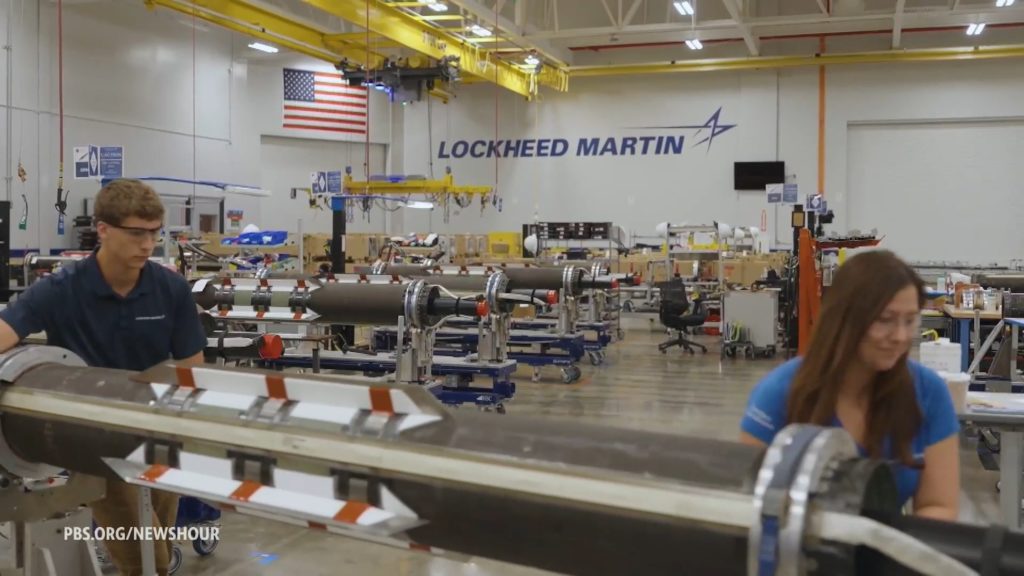
Ukrainians are desperate for more defense systems to repel Russia's relentless onslaught of drones and ballistic missiles. For the missiles, no system is more valuable than the U.S. Patriot interceptor. But years of use in Ukraine and by the U.S. and allies in the war with Iran have depleted thin stocks. Special correspondent Mike Cerre has an exclusive look at the Patriot manufacturing process.
Enquanto investigadores de diferentes áreas preocupados com a atual crise da habitação, as opções políticas que a agravam e as soluções políticas que podem contribuir para a sua superação, sentimos a obrigação de tomar uma posição pública
“You talk so much about my president, President Trump, being a humanitarian. You are a humanitarian also, sir, and I salute that, I commend you, and I thank you again.”
— Steve Witkoff, U.S. special envoy to the Middle East, addressing Russian President Vladimir Putin
Mark Wednesday, October 21, 2026, as “the day words lost all meaning.” My dictionary just ran outside and threw itself off a bridge. Noah Webster arose from his grave and lurched around, howling and tearing at his hair. Samuel Johnson is bellowing something awful; I can hear it across the Atlantic Ocean. George Orwell is sighing; he has been here before.
I have to imagine that Putin is a little insulted at being so gravely misunderstood. With this single word, humanitarian, our envoy has revealed a stunning ignorance of the Russian president’s life’s work. This is like going to Picasso and praising him as a “representational painter,” or calling the Sahara “the wettest place in the world,” or describing Witkoff’s statement as “unembarrassing.”
I see, perhaps, where the misunderstanding began. Putin referred to Trump as a “humanitarian,” and Witkoff thought to himself: Ah! This word clearly has a different meaning than I have been led to believe! I will have to reconstruct its definition from context clues. Maybe it’s someone with P in his name. Maybe it’s someone who doesn’t think that the United States should be in NATO. Maybe it’s someone who would look really good on horseback. Maybe no words mean anything! Maybe they are just phonemes to be thrown at a wall, at random, in the manner of that great representational painter Jackson Pollock.
One of the conditions of freedom is that words have an understood meaning. If Putin is a humanitarian, then Dolly Parton was an axe murderer. Who else gets to be filed under humanitarian if Putin makes the cut? Stalin? The iceberg that sunk the Titanic? Calling Putin a humanitarian is like calling Hannibal Lecter a humanitarian, although there is more of a case to be made for Hannibal because he does, at least, subsist on people.
Let me start over. It is nice and convenient, I think, when words have meaning. It makes it easier to order a sandwich. When words are more of a suggestion, reality evaporates at your touch, and none of your rights is secure. Good luck getting a sandwich then! Real is fake, fake is real, and all your society’s most precious values carry a disconcerting wink: freedom, free speech, meritocracy, equality. When you chant them, when you promise them to one another, you are not sure exactly what you are saying. Their meaning melts like hot wax, and homeland security becomes an unmarked car slamming into your neighbor.
Authoritarians treat words as a game. (Putin, great humanitarian that he is, has some experience with this.) Perhaps war is peace (big news for the Nobel Committee, if true)!
Perhaps the best humanitarian is whoever voids the world of the most people! Perhaps election integrity is the exact opposite of that!
In the spirit of this new, callous disregard for words and their meaning, I say: Great job! Well done! What a magnificent time to be alive, when all of the best people are in charge.
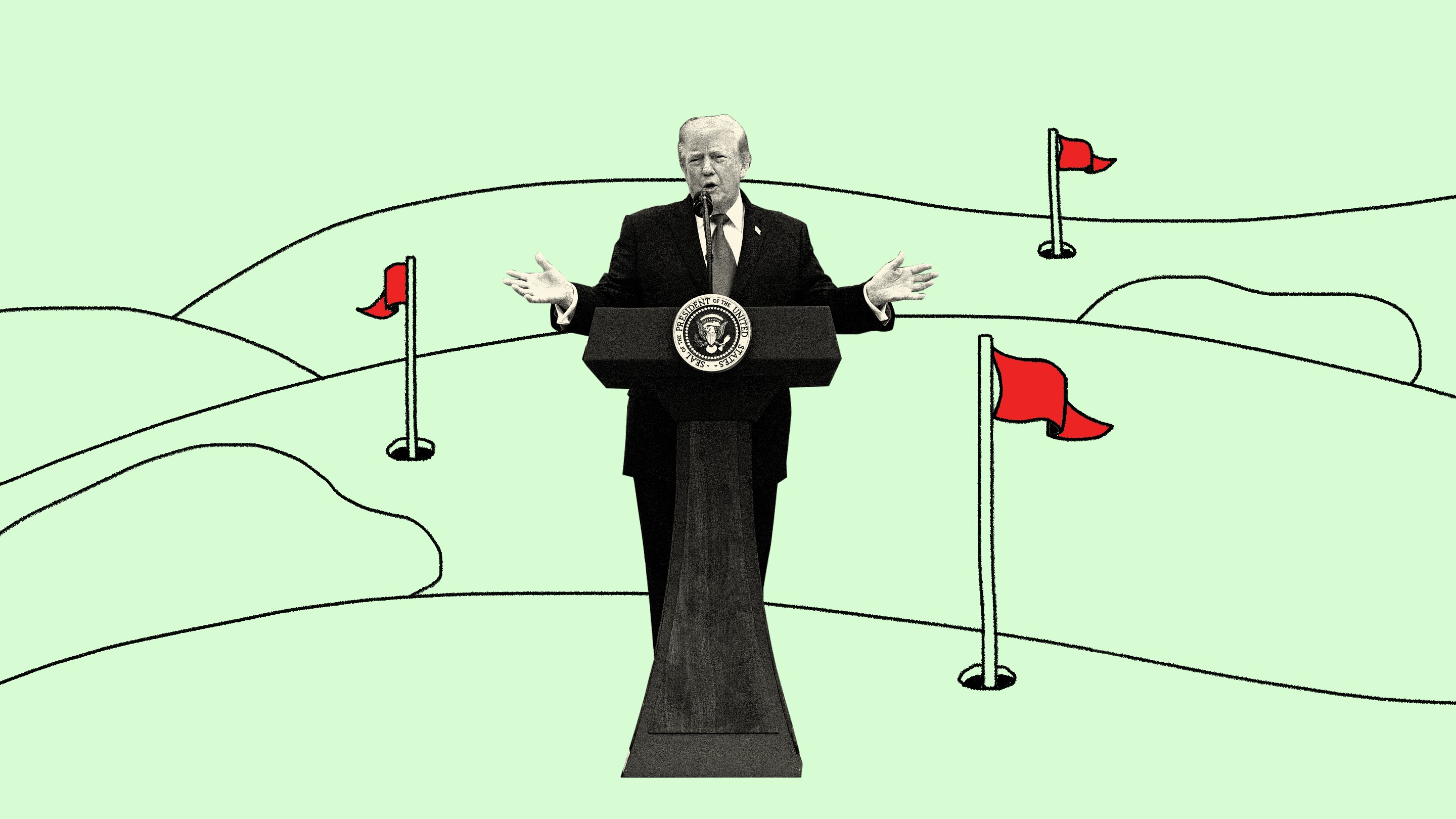
Hush! I must hear! It’s an election year, I am a voter, and I need to know the president’s answers to the most pressing questions facing America today: How upholstered are the chairs in the Rose Garden? Is the helipad at the White House any good? How are things progressing with the ballroom? And is the golf course going to be ready soon? No, do not ask about affordability. That is a made-up word. I could not care less about the price of eggs! What am I, a hen?
My concerns are more basic. I demand to hear: HOW IS THE HELIPAD? AND IS THAT GOLF COURSE IN EAST POTOMAC PARK BEING DEVELOPED TO THE HIGHEST STANDARDS OF GOLF, TURNING THAT TRASH ISLAND INTO AN ISLAND OF BEAUTY AND SUCCESS?
I was up late last night. I looked at my bills. Pretty high—but that just means the economy is booming. Still, it was hard to rest. I walked down the hall and looked at my sleeping children. How long could we hope to survive, knowing that at this very moment, in Washington, D.C., a judge is preventing East Potomac Park from becoming one of the world’s great golf courses, instead just letting it lie there, old, tired, beaten up, and useless?
My children say, “Father, Father! When will we be able to afford hamburger?” And I say, “How can you talk about hamburger when you know thatTrash Islandstill needs to be developed to the highest levels and standards of golf?”And they say, “Do you even play golf?” And I say, “Silence!”They don’t have their priorities straight. But I’m glad we have a president who does.
The other day, I was at the gas pump. I hate going to the gas pump, because the numbers there are so high, which I know is a deliberate distraction from the real problems Americans face: the hazardous, dangerous trees on East Potomac Golf Links. No one is safe from those trees.
After that, I stopped by a restaurant and ate some salad. Immediately, I felt sick to my stomach. “That was tainted lettuce,” my family said. “No,” I said, “it is because of the shame, pertaining to the golf course.”
I don’t need a fully staffed FDA monitoring lettuce-borne diseases! I need to know that we are stopping our assistance to Ukraine in defiance of Congress. I need to know whether Vladimir Putin seemed happy when our president talked to him. I really hope that our president impressed him; Putin is a big, important man. Maybe someday, America will be a world power too. If we can just get this golf course in shape, we can build on that momentum.
Don’t you dare say that this isn’t a kitchen-table issue. You haven’t seen my kitchen table, on which a replica of the president’s plans for a truly beautiful arch have sat for the past six months, gathering dust. That arch holds all my dreams. “Why did you buy that and not food?” my children ask. They don’t know what they’re talking about.
Don’t try to appeal to me by talking about the cost of living. IRRELEVANT! I want to know: Does the president have a nice-enough plane? Are the right letters on all the buildings in the capital? Good, beautiful letters, such as T, R, U, M, and P—not bad, subpar letters such as K, E, N, N, E, D, Y? These are my concerns, just as they are the concerns of the whole electorate.
For years, I have been unable to hold my head up high, knowing that we don’t have the greatest ballroom slash military complex ever built. How do you think that feels? Every night, I toss and turn, asking myself: Is New Mexico going to keep its disgusting, embarrassing name? Or will it change it to something nice, like New America? Will they ever manage to cut down those terrifying trees in East Potomac Park, so we can finally feel safe? Hurry, Mr. President! Please, hurry! I don’t know how much longer I can keep living like this.
After Russia released an American prisoner, President Trump’s special envoy praised President Vladimir V. Putin as “a humanitarian.” Our White House and national security correspondent, David E. Sanger, describes how the release comes amid Mr. Trump’s broader shift toward Russia and away from Ukraine.
Guardian Europe columnists Rokhaya Diallo and Alexander Hurst answered your questions about the recent protests in France, the role of the French police, foreign influence and the upcoming presidential election.
Michael Wolfcarius asks: I cannot understand why the Guardian is selecting dots instead of joining them. France may have developed into the big story for many reasons, many of which have yet to be discussed, but it is not the only place where seemingly small incidents grew into massive protests, some also quite violent; Spain, Italy, Serbia and Albania come to mind. The crystallising reason may be different but the conditions leading up to it are quite similar. Can you put all these events into perspective, context and relation? There are obviously underlying currents making it difficult for people to refrain from making themselves ‘heard’.
Rokhaya: I agree that these movements deserve to be considered together, while at the same time, recognising their different specific national contexts. Housing in Spain, living costs and public services in Italy and France, and corruption in Serbia and Albania are bringing people onto the streets. These concerns touch the foundations of a decent life and people’s ability to shape their future.
What connects them, in my view, is the widening gap between what people need and what political institutions seem willing to deliver. These incidents that have led to protests are not “small .” Serbia’s movement began after a deadly railway-station canopy collapse, which became a focus for anger over corruption and accountability. My reading is that these protests express a crisis of political responsiveness.
Alexander: I think people in all these places – Albania, Spain, France – feel that the political systems that exist aren’t capable of dealing with the sheer scale and nature of the crises facing us, and they’re responding to a sense of ‘loss of control’ (the Brexit campaign really did strike upon a brilliant slogan) over where their societies are headed. There is a general social sense that has flipped from “this is broken, but things can and will get better”, which gives people a stake in the institutions around them, to “this is broken and things can and will get worse”.
The impact of the arrival of AI has been understated. Not just on labour markets, or on the environment, but ontologically. The investment pitch of the most powerful companies in the world, the ones amassing trillion dollar valuations, isn’t just that X-subset of jobs are replaceable, it’s that human beings themselves are replaceable. That the things we do fundamentally don’t matter, and that their goal is to bring this into being. I think that feeling is there even if we don’t immediately put our finger on it in those terms.
“With a single stroke of a pen, he can undo all the achievements we have accomplished in these almost four years,” said the Minister of Indigenous Peoples, Eloy Terena, regarding a possible victory of the far-right candidate, Senator Flávio Bolsonaro, for Brazil’s Presidency. “We are very concerned.” With 47.03% of the vote, Flávio topped the first round of the presidential election on Oct. 4, despite voting polls showing current President Luiz Inácio Lula da Silva as the favorite for reelection. “If elected, one of the first ministries that will be abolished is the Ministry of Indigenous Peoples,” Terena told Mongabay by phone. “For us, this is a given, because it’s a government that has no commitment to Indigenous peoples.” The candidates face a runoff on Sunday, Oct. 25. The unprecedented Ministry of Indigenous Peoples (MPI) was created by Lula in January 2023, fulfilling a promise to native peoples who supported his candidacy. Sonia Guajajara was appointed minister, the first time an Indigenous person led a ministry. “The creation of the Ministry of Indigenous Peoples has a very great symbolic, but also effective, power, because it is a government that comes precisely after a period in which Indigenous peoples were extremely attacked during Bolsonaro’s administration,” said Terena, who took office in March when Sonia left the ministry to run for reelection as a federal deputy for São Paulo. The unprecedented Ministry of Indigenous Peoples was created by President Lula in January 2023. Sonia Guajajara was appointed minister, marking the first time…This article was originally published on Mongabay
The annual Emma Crawford Coffin Races and Festival is returning to Manitou Springs this weekend.
The event, which takes place on October 24, kicks off at 10 a.m. when the Fan Zone and coffin staging begins.
Previous Coverage: Thousands gather in Manitou Springs for 31st anniversary of the Emma Crawford Coffin Races Thousands gather in Manitou Springs for the 31st anniversary of the Emma Crawford Coffin Races
The parade starts at noon followed by the popular coffin races.
Started in 1995, the Manitou Springs Chamber of Commerce held the first coffin races in the nation to honor Emma Crawford, a beloved resident who died in 1891.
According to the events website:
In 1929, after years of harsh winters and spring rains, Emma and her coffin came racing down the mountainside. The young children who happened upon her remains found only the casket handles, a nameplate, and a few bones.
Last year marked the 31st anniversary of the famed event.
Watch KOAA News5 on your time, anytime with our free streaming app available for your Roku, FireTV, AppleTV and Android TV. Just search KOAA News5, download and start watching.
Dominic Cummings is right, says Professor James Alexander: the idea that civil servants are the 'guardians of the constitution' is pernicious in the extreme. But who then should play such a lofty role?
 Login