PM insists threatening economic outlook is result of developments that don't have to do with Israel, but rivals say his government's policies are to blame
Today's guest is Ted Brown, the Libertarian Party candidate for U.S. Senate in Texas. Brown is facing off against Republican Ken Paxton and Democrat James Talarico in a closely contested race. Brown received more than 267,000 votes in his 2024 Senate campaign and is now challenging both major parties on their commitment to individual liberty. He argues that Republicans have abandoned limited government while Democrats increasingly embrace economic policies that undermine the free market.
Nick Gillespie talks with Brown about Paxton's corruption scandals, Talarico's hostility toward billionaires, and why Texas ranks poorly on personal freedom despite its business-friendly reputation. Brown makes the case for returning to an Ellis Island–style immigration system, cutting federal spending to confront the $40 trillion national debt, and ending America's military involvement in the Middle East. They also discuss abortion rights, government surveillance, online age-verification laws, and how regulations drive up the cost of healthcare. Brown explains what it will take to rebuild the Libertarian Party and why he believes a senator could accomplish more by stopping bad legislation than by passing new laws.
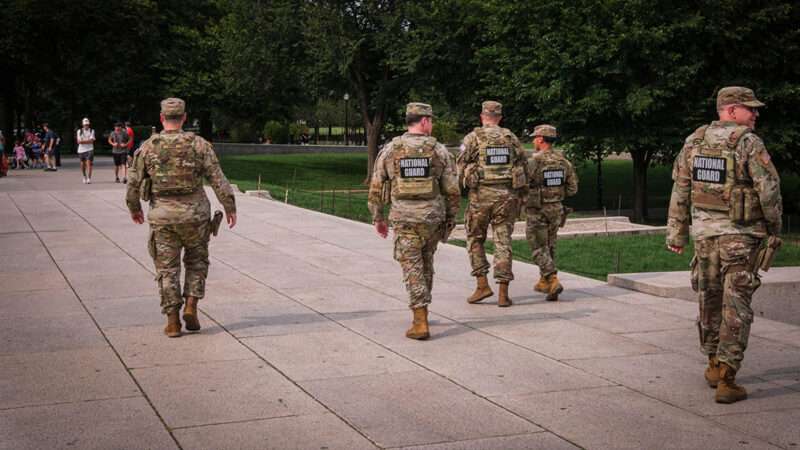
One month after Washington, D.C., celebrated America's 250th anniversary, it marked a more ignominious milestone: a full year since President Donald Trump deployed thousands of National Guard soldiers to the capital.
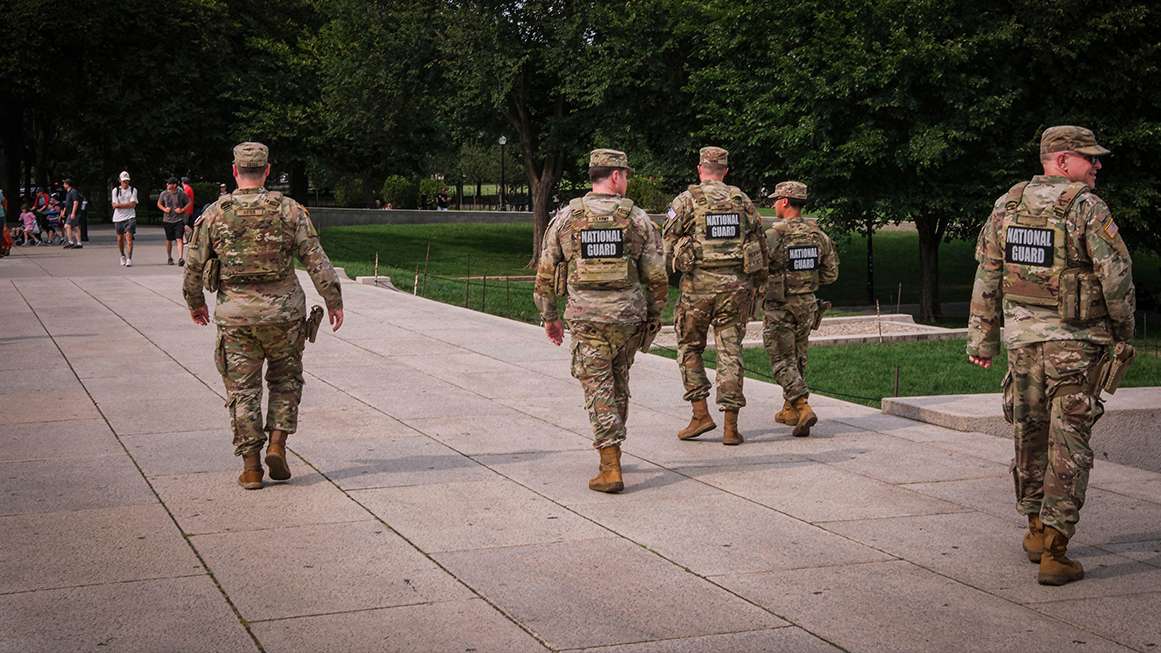
The approximately 4,600 National Guard members have been an unavoidable presence in D.C., wandering the National Mall and downtown streets in groups of three or four, or standing idly in Metro stations chatting. Occasionally, they're tasked with picking up trash at parks. Tourists take selfies with them by the now-fenced-off Lafayette Square in front of the White House.
They're not going anywhere. The Trump administration is moving forward with plans to acquire up to 2,000 housing units to support long-term National Guard deployments. The Department of Defense has estimated that extending the mission from October 2026 through to the end of the Trump administration in January 2029 will cost about $1.4 billion.
According to the Trump administration, all of this has been necessary to transform D.C. "from a crime-ridden city into a safe and beautiful haven for residents and visitors alike."
Crime in D.C. is down 20 percent from 2025, according to the Metropolitan Police Department, but an August Reuters investigation found National Guard soldiers were involved in only a tiny fraction of arrests in the safer parts of the city, mostly for minor offenses such as shoplifting and turnstile jumping. Crime has been dropping nationwide, a trend that started before Trump took office and includes cities that aren't occupied by federal law enforcement and soldiers.
Even if the Guard presence has contributed to a drop in crime, it's a civil liberties nightmare. It puts untrained military in the role of policing civilians. It usurps local police departments that are ostensibly answerable to the communities they police, and it normalizes the deployment of military forces domestically—a red line for a free society.
"There's a deep irony that here we are in the capital of the free world, and our president is treating it like a police state," Scott Michelman, legal director of the ACLU of the District of Columbia, told PBS in August. "D.C. residents have lived with our National Guard troops in our neighborhoods for about a year, despite the absence of any genuine emergency and really any reason for them to be here."
Last November, a federal court preliminarily ruled that the deployment was illegal. However, an appeals court allowed the Trump administration to keep troops deployed in D.C. while it considers the administration's appeal of that ruling.
The appeals court decision is absurd. The appellate panel is fully aware that every day the case drags on is another day that D.C. residents are being subjected to a potentially illegal military occupation, and another day that taxpayers will foot the bill for a wasteful fit of presidential hubris.
The damages are compounding. The first anniversary of Trump's deployment of National Guard soldiers to D.C. should be the last.
An analysis published on Wednesday by ABC News estimated that companies backed financially by Donald Trump Jr. and Eric Trump have so far scored more than $6 billion in contracts from the US Department of Defense. As ABC documented, many of the investments into the defense firms come through 1789 Capital, a venture capital firm […]
Thousands of students across Germany were once again on strike against conscription and militarization on Friday, September 25. Actions took place in at least 100 localities as young people demanded a sharp turn from the government’s chosen path.
“We don’t want to be forced into military service and we don’t want to go to war,” the students wrote in declaration after their last strike in May.
This is the fourth time students have exchanged classrooms for streets since the end of 2025. The mobilization has strengthened in resistance to the Merz administration’s plans to build the “strongest conventional army in Europe” – including by drawing more people into the Bundeswehr, the German armed forces.
While authorities insist military recruitment remains voluntary, students have warned of a clear tendency toward outright conscription. Local strike committees and activists also emphasized the widespread repression ahead of actions. This included scheduling of exams on strike days and locking-in students on school grounds, they pointed out.
Billions for the Bundeswehr, cuts for schools and youth services
Over recent months, the government has sent thousands of questionnaires to map voluntary interest in joining the armed forces. According to German media, the response has been underwhelming: tens of thousands of students have disclaimed no interest whatsoever. Not even a multi-million-euro budget allocated to promoting the army has been able to shake this opinion.
“They sell us war service as an ‘adventure’ while we know that what awaits us is coertion, humiliation, sexism, right-wing extremism, and racism,” the student declaration adds.
Instead of taking the message seriously, authorities recently advanced the implementation of medical checks among their targeted population, drawing further frustration from students.
“We don’t want compulsory questionnaires, fines, draft physical examinations, conscription assessment centres across the country, nor planned integration of the Federal Volunteer Service into military service,” they wrote. “These are means to prepare the reintroduction of the draft and thus another war originating from Germany.”
“In case of conscription, we’ll be trained as cannon fodder, forced into the trenches,” students added. “War costs us our lives, while corporations like Rheinmetall make record profits.”
Students on strike have expressed solidarity with other ongoing struggles against militarization and budget cuts. They stated they would join peace demonstrations planned for early October in Berlin and Stuttgart, as well as a trade union-backed mobilization against budget cuts on Saturday, September 26.
Their decision reflects the widespread understanding that youth and education services are among those impacted by this round of austerity. According to junge Welt, the federal ministry responsible for education will face close to €1 billion in cuts – while €140 billion will be made available for so-called defense in 2027.
“Every tank, every rocket we pay for with dilapidated schools and social cuts,” students remarked.
 Login