One of the world's largest investment firms isn't bullish on AI.
Michael M. Santiago/Getty Images
Only tech companies are seeing growth from the AI boom, Apollo Global Management says.
Apollo says that though some big companies are spending big on AI, they may soon pull back.
Corporate America is starting to see AI spending not as a source of growth, but as a cost center.
One of the world's largest investment firms says that only tech companies are getting a share of the AI pie.
In an economic analysis published on Saturday, Apollo Global Management said that while the Magnificent Seven — a group of established tech companies that includes Nvidia and Meta — are seeing revenue growth during the AI boom, this growth isn't being shared by other industries.
"Mainstream corporate America is pulling back and starting to view token spending not as a source of growth but as a cost center that weighs on margins," Torsten Slok, a partner and chief economist at Apollo, said in the report. "The technology has delivered zero financial payoff to corporate America outside of tech."
In a series of graphs, Slok measured three main metrics that have boomed for tech companies but not for regular companies: revenue per worker, profit margins, and productivity growth.
Since 2022, revenue per employee figures have skyrocketed for tech companies — rising from $550,000 to nearly $800,000 today. Meanwhile, that figure hasn't changed much for everyone else in the S&P 500, lingering around $550,000 for the last seven years.
Similarly, while profit margins soared among tech companies since 2022, they've stagnated at about 10% for everyone else.
And across the economy, AI hasn't yet dramatically increased productivity growth as some AI optimists have predicted.
Apollo's research portends a dark shadow over a US economy throwing massive amounts of dough toward AI tools and companies, whose leaders have promised that an "age of abundance," where people won't have to work as much, will soon be upon us.
"The question looking ahead is whether, even as models become commoditized, mainstream corporate America can turn increasingly cheap intelligence into higher revenue growth and higher profit margins," Slok said.
A lot is riding on the shoulders of Kabir Nath, the CEO of Compass Pathways.
Scott Semler for BI
Compass Pathways wants to use psilocybin to help people with treatment-resistant depression.
Its psilocybin pill, COMP360, could finally be coming to market as soon as next year.
For its CEO, Kabir Nath, it's been a long, strange trip to get to this point.
In 2022, Kabir Nath had a cushy executive job at a pharmaceutical firm that developed anti-psychotic medication.
Then he got a call from a scrappy upstart with a patent on a synthetic version of psilocybin — the active ingredient in magic mushrooms. It hoped to use the compound to help those with treatment-resistant depression.
They wanted him to join as CEO. Nath, whose father died by suicide, bit on their second pitch.
"A number of people have said to me in the last couple of years: 'You do realize what a risk that was,'" Nath told Business Insider about eventually jumping ship for what was, and still is, a drug company without FDA approval for its product.
"I was probably the first really senior executive from traditional pharma to make the move to psychedelics," he added. "But, you know, it was the right thing to do."
Nath's personal risk is now magnified as Compass Pathways finishes filing its final forms ahead of what could be FDA approval as soon as next year, and then a public rollout of its psilocybin pill, called COMP360.
Compass has recently added 150 new hires to its payroll, expanded its marketing division, and moved into new office space in Jersey City in the hope it all works out. "The company is growing rapidly," Nath said.
Though a subsidiary of Johnson and Johnson attained FDA approval with a version of ketamine for depression patients in 2019, it is by no means guaranteed that Compass, leveraging a more traditional psychedelic, will get the same approval.
Should the FDA deny Compass' bid, investors would rush to dump their shares, likely sending the company into bankruptcy. The Jersey City office, which just received a new lime green paint job, would be untenable.
If you ask Nath, it would also be bad news for 4 million patients with depression in the US, for whom more traditional antidepressants like SSRIs don't work.
"These are people who have been suffering from depression, and nothing's really working," he said.
Like other drug companies — especially those with a single product — Compass' stock has "been on quite the adventure," Nath said, as the company progressed through various human trials.
When markets closed on Friday, the share price hovered around $11, up $5 from last year. In 2020, when the company went public, shares went for $17.
From Haight Ashbury to Wall Street
Psilocybin's journey to the FDA has been a long and winding one.
Scott Semler for BI
Psilocybin's journey to the forefront of medical research didn't begin with Compass, and it hasn't exactly gone in a straight line.
Few did more to publicize the drug than Timothy Leary, the Harvard professor turned acid dropout. In a speech at Harvard's Cambridge campus in 1962, he told students that taking psilocybin allows people to experience an "internal rebirth," according to the Harvard Crimson.
In time, Leary would be fired from Harvard as he, along with a measurable portion of the US population, began to experiment more heavily with psychedelic drugs. Come 1966, the Grateful Dead were spiking their Kool-Aid with acid, and a definitive subculture of long-haired, psychedelic-taking hippies had emerged.
Meanwhile, researchers were experimenting too. Studies involving LSD and psilocybin flourished during the 1960s before hitting a brick wall in 1970, when psilocybin was classified as a Schedule I substance, rendering possession illegal, even for research purposes.
Work on the drug languished for years, until 2000, when the FDA gave scientists at Johns Hopkins University permission to conduct research on psilocybin.
And more recently, psychedelics have become trendy with the tech crowd.
From Burning Man to luxury retreats, experimenting with psychedelics is now common among tech founders and executives like Elon Musk and Sam Altman, who credit the drugs with quieting their nerves, boosting productivity, and allowing them to better harness their creativity.
Research, too, has flourished.
"There was actually a biotech boom from 2018 through to about 2022," Nath said. "In that boom, literally hundreds of psychedelic companies went public."
In 2018, Compass' proprietary psilocybin formulation received breakthrough therapy designation from the FDA. A few years later, it started testing the drug on people.
Nath was an executive in 2018 at Japanese pharmaceutical giant Otsuka, where he said he assembled a team to investigate whether psychedelics could become viable medicines after reading Michael Pollan's book "How to Change Your Mind," which explores the history and therapeutic potential of psychedelics.
COMP360
Compass isn't selling an experience analogous to a spiritual awakening at Burning Man, though.
The drug-taking process for a patient enrolled in one of Compass' trials is a bit different. First, a patient has to have treatment-resistant depression, which is clinically defined as depression that two or more standard drugs have failed to treat.
Then, a clinician explains the details of the process that is about to unfold. After that, they're given the psilocybin in pill form.
Kabir Nath at the company's new office in Jersey City.
Scott Semler for BI
"It's a quiet room with a couch," Nath said. "They're offered a blindfold, which most patients do actually wear."
As the patient begins to trip, a playlist of music, including classical and new age, plays softly in the background. The clinician, who Nath said could be a nurse, doctor, or therapist, sits silently in the room if the patient wants to talk, and for safety reasons.
Most of the time, though, there isn't any talking.
"This is not psychotherapy," Nath said. "We are not directing the patient's experience."
Six hours later, after some crying, laughing, and everything in between, the patient goes home.
In Compass's most recent trial, results for which were published in September, just under half of participants who took the drug experienced at least a 50% reduction in depressive symptoms within six weeks of treatment.
Next steps
After a decade of slogging through tests, first on animals and then on humans, Compass has completed all the necessary prerequisites and is busily working to get its last papers in order.
In a statement provided to Business Insider, an FDA spokesperson was noncommittal, though.
"The FDA evaluates experimental medications, including psychedelic drugs like psilocybin, through a rigorous, evidence-based process designed to ensure that any approved treatment is safe and effective for the indicated use," the spokesperson said.
Compass isn't the only psychedelic drug company wading through the lengthy process of trialing a drug.
AtaiBeckley, another psychedelic drug company trading on the Nasdaq whose product is not yet approved by the FDA, is developing a version of DMT administered via nasal spray. It received breakthrough status in 2025, years behind Compass.
For Compass, though, it could face the music as soon as the first half of next year, when it expects the FDA to render its decision. The company is already getting ready.
In addition to adding 150 new hires, Nath said the company is preparing its sales force to go online and is in frequent communication with doctors and healthcare providers about operating in clinics where therapists can administer the drug to patients.
"This has the potential to be radically different, and again, the rapidity is something that they're very excited about, and the durability," Nath said, referring to psychiatrists.
A drone attack damaged an industrial facility in Russia’s Perm Krai early on 25 October, injuring five workers, Ukrainian monitoring channel Exilenova+ reported. Exilenova+ identified the target as the AVISMA chemical and metallurgical plant in Berezniki, around 1,500 km from Ukraine’s border.
The reported strike highlights Ukraine’s ability to reach industrial facilities deep inside Russia that support its military-industrial complex.
AVISMA produces titanium materials used in aviation and aerospace manufacturing, including military aircraft, aircraft engines, missiles, and space technology, according to Exilenova+.
Regional governor Dmitry Makhonin said the industrial facility sustained damage but continued operating normally. He said five workers were injured in the attack.
A target deep inside Russia
Perm Krai lies in Russia’s Ural region, roughly 1,500 km from Ukraine’s border. The distance places the reported strike far beyond Russia’s border regions, where Ukrainian drone attacks have frequently targeted military and industrial infrastructure.
The reported attack follows a broader Ukrainian campaign against Russian industrial and energy facilities linked to the country’s war effort.
Russia’s Defense Ministry claimed that air defenses intercepted and destroyed 532 Ukrainian drones overnight across 23 Russian regions and over the Sea of Azov, according to Russian state news agency TASS.
The reported interceptions included drones over Perm Krai, as well as regions around Moscow and areas in southern and western Russia. The figures have not been independently verified.
The extent of damage at AVISMA and any impact on its operations have not been independently established.
Domenica 25 ottobre alle 20.30 su Rai 3, nuovo appuntamento con PresaDiretta. Il programma di Riccardo Iacona affronta il tema del rapporto tra Ai e democrazia; mentre PresaDiretta Open è dedicata al conflitto in Medioriente.
Palantir, il colosso fondato da Peter Thiel, è diventato il cervello tecnologico di Pentagono ed eserciti, mentre bot farm e macchine per la propaganda create con l’utilizzo dell’Intelligenza artificiale ci profilano e orientano il nostro voto, le telecamere ci osservano e gli archivi di oggi addestreranno le intelligenze artificiali di domani. Chi governa gli algoritmi, potrebbe governare anche noi? E poi un importante reportage da Gaza, tra annunci di ricostruzione, cantieri mai partiti e violenze mai cessate: che fine hanno fatto soldi e promesse?
PresaDiretta Open, nella prima parte della serata, si chiede che fine abbia fatto il Board of Peace, il Consiglio internazionale presieduto da Trump per guidare la ricostruzione di Gaza. Grazie alle immagini girate da Yasser, filmaker palestinese, PresaDiretta racconta una Striscia dove il 94% della popolazione è sfollato, dove l’Onu ha contato 1400 palestinesi uccisi dal cessate il fuoco a oggi e dove l’esercito israeliano controlla e occupa il 64% del territorio. La ricostruzione non è mai partita: il piano operativo del Board vale 2,45 miliardi, contro i 71 che servirebbero secondo l’ONU.
E poi la puntata Democrazia Artificiale. A Roma, a porte chiuse, PeterThiel parla dell’Anticristo; intanto la sua creatura Palantir, azienda specializzata nello sviluppo di software e analisi di big data con la AI è diventata uno dei cervelli tecnologici del Pentagono e degli eserciti in guerra. PresaDiretta ricostruisce come i suoi software siano entrati nelle istituzioni di vari Paesi anche in Europa: nella sanità inglese e anche nei contratti della Difesaitaliana, tra documenti che mancano o che non ci è permesso di leggere.
Queste stesse tecnologie non solo ci sorvegliano, ma soprattutto lavorano per influenzare il consensopolitico. In Sassonia-Anhalt l’AfD ha appena stravinto le regionali soprattutto sui social, con una macchina della propaganda potentissima che funziona grazie alla AI. “Alternita”, il software di AI – scoperto dal gruppo di giornalismo investigativo Correctiv – sceglie le notizie più virali, scrive i post, genera immagini e gonfia le visualizzazioni e il consenso con migliaia di profilifalsi. E le stesse tecniche sono già arrivate in Italia, dove su TikTok la galassia di Vannacci conquista i giovanissimi con meme e video creati con l’AI. Insieme a AI Forensics e Trollrensics, PresaDiretta ha ricostruito le origini di migliaia di account sospetti registrati in Benin e Nigeria.
Infine la crescente diffusione degli strumenti per la sorveglianzadi massa: dagli StatiUniti all’Italia, come vengono trattati i nostri dati biometrici, quelli sanitari, le informazioni finanziarie e in generale tutte le informazioni personali gestiti con l’Intelligenza Artificiale? Come li utilizzeranno le forze dell’ordine, per farne cosa e per quanto tempo?
Riflettori puntati, a chiusura di puntata, sulla truffa con cellule staminali portata avanti, anche con infusioni a domicilio, dalla società polacca BioCells Medical. Dopo l’inchiesta della scorsa edizione, PresaDiretta racconta i nuovi sviluppi sulle indagini giudiziarie, nazionali e internazionali. Le puntate di PresaDiretta sono visibili integralmente su RaiPlay.
You don't need to live by a data center to hear the noise they emit.
There's a plushie that emits the hum of a real-life data center in Virginia when it's hugged.
The doll is part of a satirical art project called "Adopt a Data Center."
Plushies are getting weirder every day.
Bezzy is a gray handmade plushie with round eyes, a disarming smile, and a server-rack abdomen that plays the grating, mind-numbing hum of a data center when you squeeze it.
The sound is actually a recording made outside a real-life data center in Virginia.
"We actually got quite a few different recordings. It's a weird process to have to go through," Rajeev Basu, the artist behind the toy, told Business Insider. "I had to sit there listening to various screeching sounds on my computer, and we picked the one that would be most well-suited for the toy."
"It's terrifying. I wouldn't wish it upon anyone," he added.
Basu is the founder of New York-based creative studio, Basura. The studio worked alongside Big Data, a musical project by Alan Wilkis, to create a satirical art project called "Adopt a Data Center." The project highlights the realities of living near one.
"We're both inspired by this relationship between humans and machines," Basu said.
Basura collaborated with Big Data to create the Adopt a Data Center project.
Basura
After OpenAI launched ChatGPT in 2022, major players and new startups in the tech industry entered a global race to develop advanced AI systems. Companies like Microsoft, Meta, Google, and Anthropic need massive new data centers to power their ambitious products.
As they began to sprout all over the country, Americans living near them began to bristle.
Critics say the benefits — like the potential for economic growth and new jobs — don't outweigh the risks. They worry data centers can worsen the environment, strain electrical grids, deplete water resources, and disrupt daily life. It's led to nationwide protests against them and to some towns and cities banning them altogether.
Americans living near data centers have also complained that the facilities can emit a constant hum akin to a loud drone or an airplane engine. Basu said data centers have become a regular topic in the news, but reading reports about the facilities is much different from having one in your backyard.
"You might not have a data center in your backyard right now, but with what some of these maps show with proposed plans, one could be in your backyard sooner than you think," Basu said.
Basura interviewed dozens of people across the US who live near data centers for the project, which took about six months to complete.
"Although our project is satirical, we wanted to make sure that everything was rooted in true research," Basu said.
In addition to the Bezzy dolls, the artists madestickers featuring phrases such as "Open your heart and your power grid" and "Please adopt me, I love GPU." A series of bumper stickers features tongue-in-cheek messages such as "Honk if you love computational infrastructure."
The Adopt a Data Center website has hyperlinks to reporting and research about AI data centers.
Basura
Basu said they wanted "Adopt a Data Center" to have an educational aspect, so the campaign's website has hyperlinks to research and reporting about AI and data centers.
"With a lot of my work over the years, it often uses human irreverence as a hook to invite people who might not necessarily be paying attention or have given it a second look to try and learn a bit more," Basu said.
Launched in September, the 20 limited-edition Bezzy dolls are already sold out.
Although the toy industry has struggled in recent years, millennials and zoomers have been softening the blow by driving up plushie sales. Market research company Circana said that people 18 and older accounted for over $1.5 billion in toy sales during the last three months of 2024.
"It's something that is so timely," Basu said. "It's quite a heavy and serious subject, so we're trying to find a way to help more folks learn about it."
'Diary of a Wimpy Kid' author Jeff Kinney shares his parenting advice — and what he'd do differently.
Simon Simard for BI
This as-told-to essay is based on a conversation with Jeff Kinney, the 55-year-old author of the "Diary of a Wimpy Kid" series, who lives in Plainville, Massachusetts. It has been edited for length and clarity.
When I wrote "Diary of a Wimpy Kid," I worked on it for eight or nine years without thinking I was writing a book for kids.
I thought I was writing a book for grown-ups that would feel like "The Wonder Years" or "A Christmas Story" — looking back on childhood through the lens of an adult.
The first thing that surprised me was that my publisher said I'd actually written a children's series; it caused a lot of cognitive dissonance.
But what also surprised me was that kids understood the irony in the books. They understand that Greg is an unreliable narrator; they seem to get the joke.
After writing the series, and after raising two kids of my own — ages 21 and 23 — I've learned a few things about kids. Here's my best advice about getting kids to read, screen time, and more — plus a few things I'd go back and change if I could.
1. To get kids to read, feed their interests
I recently heard author Jack Gantos say that after dinner, he and his family would get out their books and read. I think that's really cool and also very old-fashioned, in a way. I wish we'd done it when raising our kids.
With reading, I think the most important thing you can do is feed your kids' interests, whether they're interested in Pokémon cards or sharks or tornadoes. Get them books or magazines that speak to their interests, rather than trying to give them books that we read as kids or books that are too high-minded for their age level.
A lot of authors who write for kids start with some sort of a lesson, and there's a time and place for that. But kids read for the same reason that adults read: to be entertained. If we start from a position of trying to teach kids a lesson, they'll sniff that out and turn away from it.
It's really important to encourage kids down a path that gets them reaching for the next book. I want them to feel a feeling of success in having finished a book because that's an important act of completion. But mostly, I'd like them to keep reading, whatever form that might take.
2. Listen to them
In everyday parenting, sitting at dinner with our kids and hearing about their day without judgment is a really good foundation. Just about everything that kids today are going through, we've been through in some form. The most powerful thing that we can say to kids is "I understand," or "I've been there myself," and share stories, making sure that they feel seen and heard.
As parents, we should make ourselves vulnerable to our kids by telling them about the struggles that we went through.
If we do that without moralizing and without judgment, I think it draws us closer to our kids and turns us into a resource for them.
3. Envision your future relationship
I've always thought about my relationship with my kids by imagining, How do I want our relationship to look when my kids are adults? I've tried to anticipate that and treat my kids that way the whole time.
Kinney has two adult children, ages 21 and 23.
Simon Simard for BI
I think it's working out because my kids will call me and want to go see the Patriots or the Celtics with me. I think that's partially because I've always had this version of our relationship in mind.
4. Don't get too wrapped up in kids' sports
As parents, we live and die by our kids' successes in sports. I certainly got too caught up in it and couldn't really anticipate that there would be a life beyond sports for my kids.
If I were to go back in time, I probably would change my approach on that. We like to see our kids succeed, and of course, sports is a big stage where there's a lot wrapped up in their success, including social issues and self-esteem.
When our kids are thriving, we feel really good for them, and when they're failing, it's tough for them and us. I can understand why that happens with parents, but I can also see that it's good to take a step back.
5. Help them understand that social media manipulates
Social media bullying is something that we never had to face growing up, and it's really unfortunate and damaging.
As parents, we can help kids by educating them and helping them understand that social media companies are incentivized to make you spend more time on your screens. The more that my kids, who grew up immersed in the social media world, began to understand that, the more they wanted to move away from it.
They get out there in the world — touch grass, play sports, and pick up basketball. My son will put lockouts on his social media.
It's important for us to think for ourselves before we turn to AI
As AI becomes a part of schoolwork and daily life, my concern is that AI makes a lot of things very easy.
At times, I look for solutions through AI that I could conjure up myself, so I worry about how that rewires the brain when you feel like there's always an agent that can solve your problem for you. It could reduce your own capacity for problem-solving.
It's really important for kids to be able to think for themselves before turning to the tool.
To counteract that, getting out in the world and interacting with one another is really important. Put kids into social situations; for example, my son has been working as a bookseller this past year, where he's had to interact with lots of different types of people and solve problems.
A lot of kids or young people in this generation are more isolated. They spend a lot more time in their rooms on their phones, and so I think that getting them out there interacting with other human beings is going to give them a competitive advantage.
Bill Gates says AI will bring about an age of abundance in 20 years, but it'll be a rocky road.
He predicted robots will displace human workers and "build houses, grow food, do surgery."
Some jobs might be reserved for people, and work limits could preserve employment, Gates said.
Bill Gates says AI will create "true abundance," but the next two decades before it arrives will be "as tumultuous a period as there's been in human history."
"My big concern is this 20-year transition period, where they'll have winners and losers and a lot of disruption," the Microsoft cofounder and billionaire philanthropist said on the latest episode of the "Decoder" podcast.
Gates echoed widespread concerns about white-collar jobs, saying that telesales, telesupport, and accounting will disappear as AI will be able to do those "radically cheaper, radically faster, and even more accurately." As for blue-collar jobs, humanoid robots will take over those, he said.
"If we don't choose to massively slow down or stop, then we will have robots that can build houses, grow food, do surgery," Gates said. "And none of the things that human labor provides to the economy will be necessary for most goods and services."
He also underscored howjarring it will be for someone like him, whose vast resources have allowed him to lead the charge toward eliminating malaria and tackling other humanitarian crises.
"And when the AI says to me, 'No, I'm better than you, you go play pickleball and I'll get back to you, I'm gonna take care of this' — I mean, it's kind of humorous, but it's not humorous," he said.
Gates shared his long-held view that work is vital to giving people a sense of purpose, a way to earn an income, a reason to show up every day, an avenue to build relationships with colleagues, and a path to build things and solve problems.
He suggested that certain activities such as art, sports, cooking, and childcare could one day be reserved for humans, "even though the AI could do those things better."
Gates also highlighted that measures such as early retirement and caps on working hours could help maintain some level of human employment.
He envisioned some people saying, "Let's be like the Amish and let's only use AI for certain things," so they won't have to give up "helping each other or coming up with unique ideas."
Amazon founder Jeff Bezos and JPMorgan CEO Jamie Dimon have both proposed a shorter workweek as a less painful alternative to AI-driven unemployment.
Gates is one of several tech leaders to warn of job disruption on the road to an age of abundance.
Elon Musk has predicted a "bumpy" transition and proposed government checks for all as the best solution to AI-driven job losses. He's said that technology will drive production costs so low that everyone can have "whatever stuff they want," work will become "optional," and it's not worth saving for retirement in 10 or 20 years as money won't matter.
Similarly, Anthropic's Dario Amodei has said that AI promises to "raise the quality of life for everyone," but the "short-term shock will be unprecedented in size."
However, OpenAI's Sam Altman said in May that AI hasn't eliminated as many white-collar jobs as he expected, and he no longer anticipates a "jobs apocalypse."
Despite widespread worry about AI taking corporate jobs, and high-profile layoffs at major companies such as Amazon and Meta, national unemployment hasn't increased materially during the AI boom.
Peter Thiel said that after Steve Jobs died in 2011, Apple hasn't innovated.
Justin Sullivan/Getty Images
Peter Thiel said Apple hasn't innovated since the iPhone.
Thiel said Tim Cook hasn't taken the company in new directions.
The billionaire venture capitalist said eccentric CEOs like Elon Musk "are way better for society."
Peter Thiel, evidently, isn't a fan of the iPhone Duo.
In fact, the billionaire PayPal cofounder and tech investor said he hasn't been very impressed with much of anything that Apple has done since its eccentric founder, Steve Jobs, died of cancer in 2011.
"In my telling, it did nothing new after Jobs," Thiel said of the iPhone maker in a September interview with author Walter Isaacson for the "Builder's Podcast," which was released on Thursday.
"It turned out, yeah, the mobile phone was this giant invention — there was not that much more to do," he said. "Then it was just scaling and branding and building it out over 15 years or whatever."
Indeed, Apple has faced criticism for failing to innovate beyond the mobile phone and tablet, especially in the age of AI, where its "Siri" product is not as advanced as rivals from ChatGPT or Anthropic.
Jobs unveiled the first iPhone back in 2007 at a conference in San Francisco. Nearly 20 years later, Apple released the 18th iteration this week, with one slight caveat: This one folds.
That said, MacBooks are the de facto laptops for many an AI-nerd and normie alike. iPhones are ubiquitous, and the sleek AirPods design took hold when they were released in 2016.
Though Thiel told Maureen Dowd of The New York Times in 2017 that Apple's era was over, the company's stock price has grown steadily since then.
Thiel didn't pooh-pooh Apple entirely. He called it a "pure, well-run value stock," but lamented what he described as the loss of vision after Jobs' death.
"I would still say somehow Elon or Steve Jobs are way better for society than Tim Cook," he said.
Apple didn't immediately respond to a request for comment sent on Saturday.
Nvidia's expanding role as a financier of artificial-intelligence infrastructure is drawing fresh scrutiny after shares of several 'neocloud' companies that rent out its chips fell sharply this week. Analysts said the slide has raised questions about whether the AI data-center boom can generate enough revenue to cover its debt-fueled growth.
The AI data center boom looks like it's running into serious trouble. Projects are being delayed, canceled, or abandoned. Electricity shortages are holding everything up.
But there's a twist: A lot of these data centers were probably never going to get built in the first place.
Bernstein Research analyzed thousands of planned US data centers and concluded that only about 35% of the announced capacity is likely to become reality.
The industry has a wonderful name for some of the more dubious projects: "Bragawatts."
These are enormous data centers announced by companies that often have little experience building them. Some haven't secured electricity, construction permits, or even customers.
Then there are the "ghost projects." Developers submit multiple requests for electricity connections, hoping at least one location works out. In Texas, these requests have reached more than five times the state's existing electricity supply.
No wonder the grid looks overwhelmed.
This doesn't mean the AI boom is fake. Far from it.
But there's a big difference between Amazon's very real problems and an inexperienced developer announcing a gigantic project that may never happen.
The AI data center boom is real, and so are the challenges of building all these facilities. But the sheer number of speculative projects may be making those challenges look bigger than they truly are.
Cybersecurity leaders talked with BI about the rise in demand for workers in the field.
MASTER/Getty Images
All hell broke loose this week after a security flaw in 70% of the world's websites was made public.
It was supposed to be kept under wraps as a fix was deployed, but one researcher jumped the gun.
Chainguard CEO Dan Lorenc told POLITICO why he decided to go public.
The exposure was immense, with AI multiplying the risks — and yet time-tested global cybersecurity procedures appeared to be functioning. Then suddenly, it all broke down.
The decision by a cybersecurity company on Wednesday to prematurely release information about a flaw in the popular PHP computer programming language left much of the web exposed to hackers, triggering a panic that brought to life months of warnings of how the AI-powered era could cause widespread damage.
The flaws in PHP, discovered using AI tools through a monthslong process coordinated by OpenAI, caused cyber agencies across Europe, the US, the UK, Australia and Canada to post urgent warnings Wednesday. Numerous governments took websites offline as a precaution.
While no major hacking damage was immediately apparent, the way the incident unfolded over 72 hours showed how easily cybersecurity processes can break down and the outsized consequences of cyber risks in the AI era.
The man who set off the chain reaction with the early release — Chainguard's CEO Dan Lorenc — quickly apologized in a LinkedIn post. But on Thursday, in an interview with POLITICO, Lorenc said he'd shared the information ahead of time because the flaw was already being exploited. Though others disputed that, Lorenc said he believed he'd seen enough evidence to invalidate an embargo set up to allow time to find a fix for the flaws.
While he disputed that his actions would have caused problems for other defenders, Lorenc said that the evidential threshold in these coordinated cyber defense systems is a "grey area."
The revelation of the PHP flaw brings out into the open what cyber officials have been bracing for since the arrival of the most powerful tools of artificial intelligence, which not only can be used to discover vulnerabilities but also to exploit them at scale.
The cybersecurity world's long-established protocols helped prevent disaster scenarios in which hackers would have successfully exploited the vulnerabilities to take control of numerous websites and access their data. But the scale and end-of-days potential of AI-driven cyber risks are now visible for the world to see.
This "is what happens when AI turns up a flaw that's been hiding for years," said Eylam Milner, cofounder and chief technology officer at cybersecurity startup Echo. The vulnerabilities, he added, are "about as serious as it gets for the web."
Origin story
Understanding how this week's emergency unfolded offers a glimpse at how companies and authorities are working to stave off attacks — and how much risk they face going forward.
The origins of the incident can be traced back as far as April, when leading frontier AI firm Anthropic unveiled Mythos, leading some in the cybersecurity world to worry that systems would quickly be overrun by advanced artificial intelligence, with potential for catastrophic events to ensue.
But while researchers did find more flaws in computer systems in the months after Anthropic and other AI firms like OpenAI released those models, they had little impact in the real world. Even the Hugging Face incident, a widely discussed hack that saw OpenAI's autonomous AI agents go rogue during an internal security evaluation, related more to the level of control AI companies exert over their models than their power to break into systems worldwide.
That changed this week after researchers unveiled the vulnerability in PHP, a coding language estimated to be integrated into some 70% of the web.
The process by which information about flaws is released among cybersecurity officials and affiliated companies is crucial. Through a long-standing practice known as coordinated disclosure, researchers and companies that identify flaws can find a fix and share it confidentially with agencies and others before releasing it to the public, meaning they don't hand malicious hackers the gift of a hole without a fix.
In the case of the PHP flaw, that process worked well, but not perfectly. Information about the bugs started to circulate ahead of the planned release time. Then, according to the PHP Foundation, Chainguard "unilaterally broke the embargo," which "disregarded weeks of work by many parties toward a coordinated disclosure." PHP Foundation executive director Elizabeth Barron told POLITICO by email that while it was "disappointed" with Chainguard, it hopes to "rebuild trust with them in the future to ensure we can continue to collaborate effectively."
After the leak — which meant information about the bugs was in the open before the fix was ready — confusion quickly ensued, with government bodies and private companies choosing to temporarily shut down their websites rather than risk potentially damaging breaches to their data and the sites themselves.
Early Thursday, Matthew Prince, the CEO of Cloudflare, an internet services company widely used by websites to block cyberattacks, which gives it a high level of visibility into what hackers are doing, said in a post on X that it had seen "millions" of attempts to exploit the flaw.
Cloudflare saw thousands in the 10 hours before the flaw was publicly announced, then tens of thousands in the 45 minutes after the announcement, hundreds of thousands within two hours, and now millions, Prince said.
Amazon's cloud division also said the flaw is "now being broadly exploited in the wild."
One senior US government cyber official said that federal authorities have been overwhelmed — and not just by PHP. The same day the world was racing to address PHP, they were also dealing with bugs in node.js, a widely used JavaScript framework, Fortinet, GitHub and Oracle.
"The fire department is fighting multiple fires at once," the official said, adding: "The good news is they're all one-story structures on fire, which the fire department deals with all day, every day."
More to come
Dauntingly, OpenAI said there's more on the way. "These bugs are among several significant vulnerabilities we've already found and are working to fix, and we expect similar findings to increase sharply in the coming months," the company said Wednesday in a statement.
Matthijs van Amelsfort, head of the Dutch cybersecurity agency, said in an interview that the job of keeping computer systems safe has been transformed by the advancement of AI. "As soon as the frontier models came out, that's exactly what we said: This will be the trend," he said. "And actually that's happening now."
Thomas Caspers, vice president of Germany's cyber agency BSI, concurred: "We expect that [to be] happening more and more during the coming months."
AI also ramps up the risks once the flaws are out in the open. Cyber agencies' recommendation that organizations take their websites offline was "really a drastic measure," Caspers said. "We wouldn't have done that a few years ago or so." But because AI has made it quicker and easier to exploit flaws, "we had to do that," he said.
At the same time, the use of advanced AI to detect the flaws may create a new level of protection against malicious hackers looking to take advantage of them. Caspers said that though his German agency has also seen attacks, it has not seen any successful use of the flaw by hackers.
"It seems a little bit more complicated than expected to exploit," he said.
Despite the fact that AI offers a new way to discover flaws, the work involved in keeping systems protected is more quotidian, with cyber agencies urging organizations to install the fix shared by the PHP Foundation, in a process known as patching.
"There are three things that you have to do right now," said van Amelsfort from the Dutch agency. "And that's patch, patch, and patch."
John Sakellariadis contributed to this report.
The Axel Springer Global Reporters Network harnesses the resources of the company's newsrooms to publish ambitious scoops, investigations, interviews, opinion pieces and analysis. It allows journalists — including those from POLITICO, The Telegraph, Business Insider, WELT, BILD, Onet and Fakt — to collaborate on major stories for an international audience of hundreds of millions across platforms: online, print, TV and audio.
There are clear parallels between the AI boom and the dot-com bubble, tech investor Paul Wick says.
But solid demand, strong earnings, and less mania make for a "healthier" backdrop, Wick said.
Seligman's chief investor brushed off Michael Burry's worries but flagged some trends to watch.
The AI boom has shades of the dot-com bubble, but fears of an imminent crash and mass unemployment are overblown, a veteran tech investor says.
At the turn of this century, there was an explosion in dot-com startups being formed, and a huge infrastructure buildout with telecoms "aggressively" spending on wired and wireless networks, Paul Wick told Business Insider in an interview this week.
The chief investor of Seligman Investments — a group within Columbia Threadneedle Investments that manages over $40 billion of assets and comprises a hedge fund, a mutual fund, and a venture capital arm — said there were clear parallels between that period and the current boom in AI startups and data-center spending. He also noted that energy prices and interest rates jumped then as they've done this year.
But Wick noted there isn't the same IPO frenzy now, or the same "frenetic environment" where stocks soar fivefold or tenfold in a day. He also said that by late 2000, a slowdown in IT spending was being forecasted for 2001, whereas enterprise spending on AI remains strong and recent tech earnings have been robust.
Simply put, the situation seems "healthier" now than in 2000, he said.
Business Insider asked Wick about Michael Burry's warnings this year around AI. "The Big Short" investor has called out aggressive accounting, circular financing, hidden debt, and overinvestment in depreciating assets like microchips as reasons to be skeptical that the boom has legs.
Wick said that Burry, known for predicting and profiting from the collapse of the mid-2000s housing bubble, has been "early or downright wrong on many other things."
Burry has previously defended his track record, citing his correct predictions and sharing charts showing the timing of his market calls.
As for concerns about Nvidia's efforts to grow the AI ecosystem by investing in data center developers and software companies, Wick emphasized that the chipmaker is "extraordinarily profitable."
He cast doubt on whether Nvidia should spend its spare cash only on buybacks, rather than bolstering its customers, especially as several of the industry's biggest players are working to develop their own AI chips to reduce their reliance on Nvidia.
But he also flagged some industry trends to watch, including enterprise clients opting to use older models or build their own, and token pricing coming under pressure as users embrace open-source models, raising questions over the size of the market opportunity for the likes of OpenAI and Anthropic.
"It used to be that a degree in computer science was a ticket to success," he said.
A better option today might be to learn a trade, as there's "booming demand" for workers such as electricians and HVAC technicians, and they can make an "incredibly good living" without having to go to a four-year college, Wick said.
He also took aim at the "doom-and-gloom notion that AI is going to eviscerate demand" for human labor. He described that worry as a "little premature" as nobody knows for sure how AI will affect entry-level roles in the future, unemployment is yet to soar, and there's always inertia when it comes to businesses and consumers changing their behavior.
Christie Hemm Klok for The Washington Post via Getty Images
Palantir cofounder Joe Lonsdale's wife has an interesting nickname for their AI agent.
She calls it "Tradbot," he said, a name inspired by the social media trend of tradwives.
The Lonsdales use their "Tradbot" for help with parenting.
What does Joe Lonsdale's AI agent and Ballerina Farm have in common?
Lonsdale, who cofounded Palantir before building his venture capital firm, told CNBC on Thursday how his wife, Tayler, uses AI — and the nickname she's given their agent.
"My wife has Grok Bot at home," Lonsdale said. "She calls it the 'tradbot' for tradwife."
For those unfamiliar, a tradwife is a woman who embraces traditional gender roles, such as supporting her husband with household work and taking a primary role in raising kids. Some of these tradwives become influencers, posting videos of their ornate meals or gifts for their husbands.
The Lonsdale family's "tradbot" helps them manage parenting duties for their six children. Lonsdale said the AI agent tells them about health appointments and activities.
He asked the "tradbot" to help his two-year-old break up with his binky. "It's telling me when to and when not to give it to him," Lonsdale said.
Parents have been employing AI for all kinds of use cases. One mom of two previously told Business Insider that she sends voice memos to Claude to help organize her life. Another said that she built AI agents to help manage schedules and school emails. Business Insider's Amanda Hoover declared mom, dad, and AI the "modern parenting throuple." The debate of how much — if any — AI should be involved in parenting continues to rage online.
Lonsdale is a vocal proponent of AI, having invested in it heavily through his venture capital fund, 8VC. During September's AI extinction freak-out, Lonsdale reassured the public: "The world is going to be alright, guys."
Clearly, Lonsdale's use of AI has extended beyond the office. "My wife's definitely using it at home," Lonsdale told CNBC, "and we're using it a lot at work as well."
Pilots' reliance on autopilot may offer workers clues on how to navigate AI in the workplace.
aviation-images.com/Universal Images Group via Getty Images
Pilots have faced the risk of deskilling for decades because of their reliance on autopilot.
Steven Shaw of King's College London said they can show workers how to stay sharp with AI.
"Even experts are at risk of deskilling," he said.
Pilots have relied on autopilot for decades. Their experience could offer a lesson for workers increasingly relying on AI.
Steven Shaw, an assistant professor at King's College London and coauthor of a widely cited study on "cognitive surrender," drew a parallel between pilots' reliance on automation and workers outsourcing their thinking and delegating their work to AI.
"We've had autopilot in planes for a very, very long time," Shaw said, speaking at a recent OxGen Summit panel. "So they learn to fly manually first, and then they learn to use autopilot strategically."
Some federal aviation guidance encourages pilots to occasionally switch off autopilot to maintain their manual flying skills.
There is a long track record of this. In a 2013 safety alert, the Federal Aviation Administration warned that "continuous use of autoflight systems could lead to degradation of the pilot's ability to quickly recover the aircraft from an undesired state."
The agency reiterated the importance of manual flying in a 2017 alert, recommending that airlines encourage pilots to practice without autopilot periodically when conditions permit.
"Even experts are at risk of deskilling," Shaw said, referring to the dangers of repeatedly outsourcing cognitive tasks to AI.
Shaw's warning comes as some tech leaders, AI researchers, and politicians have cautioned that overreliance on AI could weaken workers' underlying cognitive abilities.
Speaking at More Perfect University's "Students vs. Billionaires" town hall in Maine on Thursday, Rep. Alexandria Ocasio-Cortez warned that "AI's goal is to take your thoughts away from you, your ability to think away from you so that you become dependent on a machine."
OpenAI CEO Sam Altman said in July that one of AI's most overlooked risks was "cognitive atrophy," while Arthur Mensch, CEO of French AI startup Mistral, said last year that the technology's biggest risk could be "deskilling."
Think before you prompt
Early research is showing how readily people outsource their thinking to AI.
Vivienne Ming, an AI researcher and theoretical neuroscientist, told Business Insider in March that one of her experiments, involving 72 participants, found that roughly 90% to 95% either relied on AI to generate answers or used it to validate their assumptions, rather than challenge and deepen their thinking.
"The overwhelming trend is substitution," she said.
Similarly, Shaw's research suggests that the danger is that people increasingly accept AI's answers without thinking critically.
In experiments involving 1,372 participants, people accepted AI recommendations nearly 80% of the time even when the answers were deliberately incorrect.
Shaw calls this phenomenon "cognitive surrender."
His advice for avoiding it is straightforward: develop your own judgment before asking AI for help.
"Just think first and then go to the prompt," he said during the OxGen Summit panel.
Starting with AI, he warned, can narrow the range of ideas people consider independently.
Other experts have offered similar advice. Geetha Rajan, a former AI adoption leader at PwC, previously told Business Insider that she writes her own first drafts before using AI to check facts and challenge her work.
Ryan Deiss, CEO of DigitalMarketer, advocates a "10-80-10" rule: humans handle the first 10% of a task, AI takes on the middle 80%, and humans return for the final 10% to exercise judgment and refine the result.
Vercel's Tom Occhino, left, with Tools for Humanity's Tiago Sada at an event in San Francisco in April.
Kimberly White/Getty Images for Tools for Humanity
Everyone complains about AI-generated junk.
But decades of sloppy human-written software may be a much bigger problem.
This week's "Black October" freakout was caused by human slop, not AI.
The internet has a slop problem. And for once, we can't blame AI.
Most of us spend hours online every day without thinking much about the software holding everything together. We assume somebody, somewhere, has made sure it all works properly.
So it probably came as a shock this week to discover just how vulnerable some of that software is.
The cybersecurity freakout dubbed "Black October" has inspired warnings about AI-powered hackers, digital catastrophe, and even advice to stockpile cash and canned food.
At first glance, AI looks like the villain. But this is largely a human-made mess.
Here's the problem.
The internet runs on decades of software, some of it containing security weaknesses that have been overlooked, tolerated, or simply left unfixed.
For years, that was a manageable gamble. Fixing software takes time and money. Exploiting obscure weaknesses often required considerable expertise. Companies could convince themselves that the risk wasn't worth worrying about.
AI is changing that calculation. Someone who once needed years of training to hunt for weaknesses can now get help from an AI model. These tools can also examine software at speeds that humans can't match.
Suddenly, all those problems we've been ignoring look more urgent.
"Over the last 10 years the risk acceptance process has morphed from a way to accept risks to enable the business, to a way to justify never fixing security issues," Joel de la Garza and Zane Lackey, partners at a16z, wrote on Friday.
That's quite an indictment. The result is a recent surge in published vulnerabilities.
This looks like AI is creating new security problems. But it's actually AI exposing weaknesses that humans left behind.
Slop irony
The irony is delicious. We've spent the past couple of years complaining about "AI slop." Turns out human slop can be pretty consequential, too.
"The funny thing is everyone was saying AI slop code will cause a cyber crisis but it's actually all the old human slop causing it and the AI is just cleaning it up," software engineer Ben Kaufman wrote on X on Thursday.
"Humans have been the ones writing and reviewing each other's code for decades," tech founder Anant Jain wrote on X. "If we're being intellectually honest and holding ourselves to the same bar we hold AI to, we'd have to admit that we haven't been all that good at it either."
Humans are sloppy
Anyone who's worked with other humans for a decade or two knows exactly how this happens.
It's Friday afternoon. You've almost finished a project. You could spend another few hours making it perfect, or declare it 90% done and head off to that dinner party. We've all been there.
AI agents don't have dinner parties. They don't get tired on Friday afternoons. They can keep searching, testing, and trying again. That persistence is now colliding with an internet built by busy, imperfect humans who often settled for "good enough for now."
A tragedy of the commons
There's another wrinkle here, though, and it's an important one.
Much of the software underpinning the internet is freely available for anyone to use. Some of it is maintained by volunteers or small groups of experts, even as enormous technology companies depend on it.
In 2020, the cartoonist Randall Munroe captured this absurdity in an xkcd comic. Modern digital infrastructure still rests precariously on tiny foundations.
It's funny because it's uncomfortably close to reality. Take the specific PHP problems from this week. These flaws have existed for years, and the PHP Foundation acknowledges that limited resources and disagreements over fixes contributed to delays in fixing them.
Tom Occhino, chief product officer at Vercel, brought up Munroe's cartoon during my recent interview with him.
He explained that AI is finding weaknesses even in software that the industry has treated as dependable for decades.
This is partly a version of the tragedy of the commons: Everyone benefits from a shared resource, but no one has sufficient incentive to take responsibility for maintaining it.
And let's be clear: The volunteers keeping essential software running aren't the villains here. The companies benefiting from their work have a much greater responsibility.
Occhino thinks AI could help solve the problem it is exposing.
He described an idea being discussed at Vercel: Create a foundation or coalition that funds efforts to identify vulnerable software and replace it with safer alternatives.
"We need a consortium. We need a coalition," he told me.
He suggested companies could contribute computing resources and AI tools to the effort. Nothing has been formally announced, but the idea is compelling.
Indeed, OpenAI's Patch the Planet effort is an example of what's possible.
Rather than simply using AI to create more software, the industry could use it to repair what already exists.
Occhino put it nicely: Companies need to spend less time chasing new ideas and more time asking how to make existing systems "just work really, really well."
That's a better response than panicking about the imminent collapse of the internet.
AI didn't create decades of neglected software. We did. Perhaps it's time to clean up our own slop.
Upadhyaya is a supply chain program manager at Intel.
Courtesy of Mihirkant Upadhyaya
Mihirkant Upadhyaya has a Ph.D. and more than 10 years of experience at Intel.
But at age 41, he embarked on gaining another degree to level up in his career.
Upadhyaya says that doing an MBA equips him with skills that AI lacks.
This as-told-to essay is based on a conversation with Mihirkant Upadhyaya, 42, who works at Intel and lives in Oregon. The following has been edited for length and clarity. Business Insider has verified his employment and education.
After studying computer engineering for my bachelor's, I pivoted into physics.
Two master's degrees and a Ph.D. in nanoscale science and engineering later, I got my dream job in the semiconductor industry at Intel in 2015.
As my career evolved, I realized I also wanted to do an MBA to step up my game.
My Ph.D. gave me relevant skills to take on the workforce
During my Ph.D., I focused on a semiconductor manufacturing technology called EUV lithography. I was excited to work at Intel because it does both chip design and manufacturing, so I knew I'd get a good overview of the chip-making process.
You don't need a Ph.D. to work in semiconductors, as there are so many areas outside the lab you can work in, like finance and legal.
On a personal level, though, having a Ph.D. helped me feel prepared to step into the workforce. It gave me discipline and the ability to be comfortable with ambiguity. My research mindset and technical background gave me the confidence to take ownership of outcomes and tasks.
There were definitely moments where I had self-doubt doing a Ph.D. You watch your peers go on to earn big bucks after their bachelor's and master's while you live on a modest stipend. However, the experience shaped me into who I am. I'd say I'm more patient, sharper, and more resilient.
I reached a stage where I felt I needed more education to thrive in my job
After about five years in research and development at Intel, I moved into supply chain roles, which have involved managing relationships and negotiating contracts. At this point, I realized I was missing certain skills.
My current role has a greater emphasis on executive communication and financial analysis. When I presented to an executive team, my manager had to step in on a number of occasions to get the room to respond, making what I was saying more high-level using business-driven terms. I also didn't quite understand certain things when I worked with the finance teams on contract negotiations.
To step up my game, I started a two-year hybrid MBA course in September 2025, alongside my full-time job. It was energizing to get back to the classroom at age 41.
I take one week off a quarter to do in-person sessions, and the rest of the time I'm doing online learning three days a week. My company is partly funding this, which is useful since MBAs can carry a $100,000 price tag.
Upadhyaya estimates that he's invested $100,000 into his post-graduate education.
Courtesy of Mihirkant Upadhyaya
By the time I've finished my MBA, I'll have done nine years of postgraduate study, investing an estimated $100,000 into that education, aside from scholarships and tuition waivers. Without question, it's been worth it. I haven't pursued the degrees to accumulate credentials, but to serve my career at various stages of my life. The MBA is addressing a concrete skills gap I identified after years in my industry.
I believe higher education is helping me become more irreplaceable in the age of AI
The AI boom made me take a hard look at what I bring to the table. I saw that some of what I did could eventually be automated. That realization was humbling.
Instead of trying to compete with what AI is already good at, I wanted to strengthen the areas where I knew it fell short. AI is great at processing and analyzing information. It has scale and speed, but it lacks the truly insightful judgment that a person can gain from years of learning a skill.
Upadhyaya said he's encountered limits to AI's capabilities.
Courtesy of Mihirkant Upadhyaya
In my previous role at Intel, I found that AI couldn't tell me how to troubleshoot issues involving new or custom-made equipment because the context was so unique to my situation.
Meanwhile, in my current role, while AI could probably help me generate financial models, it can't read the room, build relationships, or have synergy with another person. My MBA course benefits me in this regard because we do lots of group activities, even online through Zoom, where we can interact with each other.
I think that in the age of AI, finding a field you really care about, becoming an expert in it, and staying curious to keep learning can help you become irreplaceable.
Intel declined to comment in response to a request from Business Insider.
A Portovesme il mare comincia dietro le ciminiere. Prima ci sono i serbatoi, le tubature, il bacino dei fanghi rossi. A sessanta metri sopra questo paesaggio di metallo, quattro operai giovedì hanno passato la notte sul forno di calcinazione numero 1 dell’Eurallumina. Un gigante spento dal 2009. Per ripararsi dal freddo sono scesi di qualche metro, cercando rifugio dietro le lamiere. Venerdì pomeriggio sono tornati a terra: il governo ha promesso di cercare i soldi, il tavolo al Mimit è aggiornato al 29 o 30 ottobre. Un’altra settimana di attesa, dopo diciassette anni.
“Soddisfatti è eccessivo”, dice Emanuele Madeddu, segretario della Cgil nel Sulcis. È stato ottenuto il minimo: un impegno formale del ministero, da trasformare in risorse. L’impianto è fermo, ma non può essere abbandonato. I soldi, prima ancora che per riaccenderlo, servono a impedire che faccia danni.
L’Eurallumina trasformava la bauxite in allumina, materia prima dell’alluminio. Aveva più di 400 dipendenti; ne restano 186, in cassa integrazione e al lavoro a rotazione per custodire la fabbrica. Con la ripartenza tornerebbero circa 1.500 buste paga, contando l’indotto, calcola Enrico Pulisci, uno dei quattro che ha dormito in alta quota. La proprietà è della russa Rusal. La produzione si fermò per la crisi e i costi energetici, molto prima dell’invasione dell’Ucraina. Poi a una vertenza già interminabile si è aggiunto il congelamento del patrimonio disposto dalle autorità italiane. La multinazionale, spiega Madeddu, ha versato risorse fino a settembre 2025; quelle già accantonate hanno permesso di andare avanti fino a febbraio. Secondo Pulisci, dal 2009 Rusal ha speso circa 400 milioni per uno stabilimento che non produce. Lo Stato, osserva Madeddu, ha congelato un bene senza creare le condizioni per conservarlo.
C’è una ragione molto materiale per cui non si possono chiudere i cancelli. Sotto lo stabilimento corre una falda contaminata: ogni ora, spiega Pulisci, “vengono estratti e trattati circa 50 metri cubi d’acqua, bisogna sorvegliare il bacino dei fanghi rossi e gestire 150 mila metri cubi di liquidi caustici”. Le pompe hanno bisogno di elettricità. Se le casse si svuotano al punto da non poter pagare neppure la corrente, la crisi del lavoro rischia di diventare un’emergenza ambientale. La produzione è ferma, ma l’acqua inquinata non smette di salire dalle pompe.
Il Sulcis ha imparato a vivere tra le rovine del proprio passato produttivo. Sono diventate parte del paesaggio. A Monteponi, sopra Iglesias, gli edifici restaurati dell’antica miniera convivono con scheletri industriali e muri corrosi. A Carbonia il fascismo aveva costruito una città attorno al carbone; a Portovesme è nata un’economia attorno all’alluminio. Oggi l’ex Alcoa, passata a SiderAlloys, non ha riacceso le celle elettrolitiche spente nel 2012. La Portovesme Srl di Glencore ha fermato le linee di zinco e piombo, pur mantenendo altre attività; la riconversione alle batterie resta incerta. Per tante famiglie la cassa integrazione non è una pausa: è diventata una forma di vita.
E si svuotano anche i paesi. Tra gennaio 2025 e gennaio 2026 il Sulcis Iglesiente ha perso 1.103 abitanti, quasi l’1% in dodici mesi: il doppio della media sarda. Un rapporto Fim-Cisl calcola per il Sud Sardegna un Pil per abitante di 20.900 euro, contro i 32 mila nazionali. Se ne vanno i giovani; restano pensionati, stabilimenti in attesa di investitori e lavoratori in attesa di una telefonata da Roma.
C’è però una fabbrica che qui non deve implorare il futuro. Tra Domusnovas e Iglesias, la Rwm del gruppo tedesco Rheinmetall produce ordigni ed esplosivi. E’ l’unica realtà industriale che cresce. A febbraio il ministero dell’Ambiente ha approvato la valutazione d’impatto dei reparti ampliati negli anni scorsi, dopo una lunga controversia sulle autorizzazioni. Il ricorso dei comitati resta aperto: udienza al Tar il 14 gennaio 2027; per avviare i nuovi impianti servono ulteriori permessi. Intanto il nuovo piano urbanistico di Iglesias destina ad attività produttive quasi 35 ettari a ridosso della fabbrica, come abbiamo raccontato sul Fatto.
Rwm dà lavoro. E non spetta ai suoi operai risolvere da soli la questione morale delle armi. “Non è il lavoratore che sgancia le bombe”, dice Pulisci. Ripete una metafora che tra gli operai dell’industria bellica si ascolta spesso: “Un coltello può servire a uccidere come a tagliare il pane, dipenda da chi lo usa. La colpa non è dell’artigiano che l’ha costruito”. Anche la Cgil subisce il ricatto tra guerra e lavoro. “Io sono un pacifista”, premette Madeddu, “ma devo difendere i salari”. Le destinazioni degli ordigni, gli embarghi, le autorizzazioni competono alla politica. Ma il contrasto resta e produce una realtà paradossale: la guerra in Ucraina contribuisce a strangolare un’industria civile di proprietà russa, mentre il riarmo europeo apre nuove prospettive alla fabbrica di bombe tedesca. Non è la guerra ad aver distrutto l’economia del Sulcis: quel lavoro era già cominciato da tempo. A Portovesme, intanto, quattro uomini sono scesi dal forno spento, in attesa di capire che cosa si potrà ancora produrre sotto l’ombra delle ciminiere.
The design platformlaunched Canva Craft on Thursday, its first image-generation model, similar to those from Google, Meta, and OpenAI.
Users can access Craft through Canva’s Dream Lab, including with free accounts, though it is subject to AI usage limits. You’ll need to sign in to a Canva account to get started.
In the release announcement, Canva said the tool plans a design’s layout, proportions, and text before generating an image, an approach that aims to help it produce legible lettering and accurate details.
The company also said that the model was trained on human-designed Canva templates, including posters, menus, and presentations, rather than photographs.
To test how Canva performs, Business Insider created three image generation prompts with escalating difficulty levels — from designing a simple greeting card to creating a photorealistic image from scratch.
Here is how Canva's brand-new image generation tool stacked up against three of the most powerful models.
Canva did not respond to a request for comment.
Starting off with an illustration
Canva's response to a greeting card prompt (left), compared to ChatGPT (middle) and Gemini (right).
Business Insider
We started off simple with a prompt for a birthday card.
Create a cartoon "Happy Birthday" greeting card for a friend named Jessica who has pink hair, brown eyes, likes to wear paisley, and is turning 28 years old in November.
Surprisingly, Canva, the design platform, fell short in its design of the birthday card, from the awkward font to the outsize head of the cartoon character. It didn't even bother to include any paisley.
By comparison, ChatGPT and Muse understood the assignment.
ChatGPT guessed that the recipient's favorite color might be pink, while Muse thoughtfully wove in cozy fall elements for the November birthday girl.
Muse wove in cozy fall elements for the November birthday girl.
Screenshot/Business Insider
Meanwhile, Gemini took the request literally and produced an image of an actual card. Extra points!
Winner: Muse
Editing an image
The request and original image (left). Canva's results (right).
Screenshot/Business Insider
For the second task, I tested the AI models' ability to identify an element and place it in a brand-new setting.
Edit this image of me holding a necklace pendant. Take the red garnet pendant off my hand and make it look as if it is displayed in a vitrine in a jewelry showroom.
Canva did a great job of identifying the pendant and creating an atmospheric setting, but, like Gemini, it depicted the jewelry in a way that defied physics and common sense. It would be unrealistic for a pendant to float in the air or sit propped on a metal pole.
ChatGPT (left), Muse (middle), and Gemini (right).
Business Insider
ChatGPT and Muse once again outperformed other models in understanding how things typically look in reality. Muse, however, made some alterations to the pendant, which I didn't ask for.
Winner: ChatGPT
Creating a photorealistic image from scratch
Canva's depiction of a cat perched atop a gothic castle.
Made with Canva/Business Insider
With Halloween approaching, I asked for a realistic depiction of my favorite animal.
Generate a photorealistic image of a long-haired orange tabby cat in a Halloween costume with bat wings, perched on the edge of a gothic medieval castle under the full moon and a starless night sky.
Though the cat's fur looks a little too strandy and high-contrast in Canva's creation, no components are missing or malformed, and the image composition pretty much matches the quality of Muse and Gemini.
The clear winner for me in this round, however, would be ChatGPT.
Gemini (left), ChatGPT (middle), and Muse (right).
Business Insider
Not only is the cat's posture majestic, but the soft glow on his left side is extremely realistic, and the white balance is well done. There are also clouds softly cradling the moon, which could be a response to my request for a starless sky.
Winner: ChatGPT
Overall, it's evident that Canva still has a lot of room to grow compared to other models, especially if graphic design is its focus. For now, I'll stick to moving components around by hand.
Three tremors struck near the epicenter of a deadly earthquake in Tibet as rescue teams continued relief efforts amid severe weather.
Three earthquakes measuring magnitudes 4.5, 4.1 and 4.2 struck near the epicenter of a magnitude 7.0 earthquake in China’s Tibet region between Friday night and Saturday morning, according to the China Earthquake Networks Center. The main quake has killed 16 people and injured 76, while rescue operations continue amid harsh weather and warnings of further tremors.
The first tremor struck Zaduo County in western China’s Qinghai province at 10:14 p.m. local time on Friday, at a depth of 10 kilometers. Two more earthquakes hit the same area and at the same depth on Saturday, at 6:39 a.m. and 8:07 a.m.
The tremors occurred near the epicenter of Thursday’s main earthquake in Baqing County, in Nagqu, Tibet. Seismological authorities have not yet confirmed whether the latest events are formally part of the same seismic sequence.
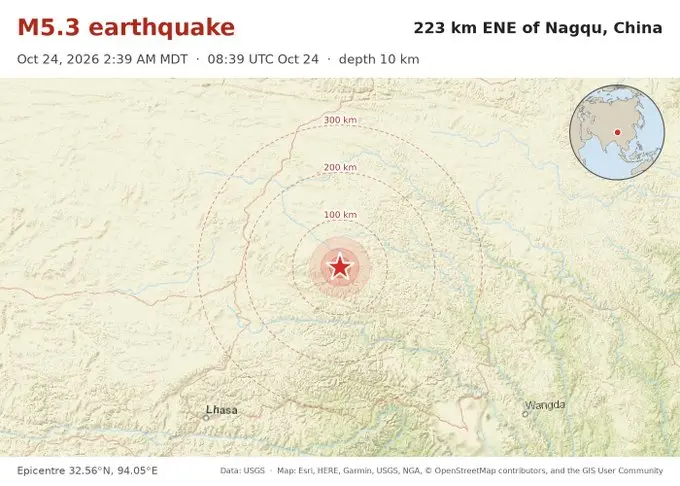
M5.3 likely aftershock – 223 km ENE of Nagqu, China
The official toll from the magnitude 7.0 earthquake remains at 16 dead and 76 injured. Authorities have also reported 339 homes destroyed or severely damaged, along with damage to 20 livestock facilities.
More than 5,000 personnel have been deployed to affected areas to conduct search and rescue operations and provide medical care and logistical support, state news agency Xinhua reported. Rescue teams have completed three rounds of house-to-house inspections without finding anyone reported missing.
Authorities have evacuated 12,489 residents and established at least 18 temporary shelters as a precaution.
🔊 A magnitude 7.0 earthquake hit Tibet, killing at least 16 and forcing thousands from their homes. It’s the strongest quake to hit China in nearly three years. More on the Reuters World News podcast https://t.co/dFVrexO5K2pic.twitter.com/fu21iIGcM5
The emergency response is unfolding at an altitude of about 4,800 meters, where severe weather threatens to hamper relief efforts. China’s meteorological authorities forecast scattered snowfall for Saturday, with temperatures expected to fall as low as minus 9 degrees Celsius. Strong winds could further complicate travel and the installation of emergency shelters.
Chinese seismologists have warned that further perceptible aftershocks are likely in the coming days. Emergency teams are also monitoring secondary hazards, including potential rockfalls.
The magnitude 7.0 earthquake was the first of that strength recorded in China this year. It follows a January 2025 earthquake in Dingri County, Tibet, that killed at least 126 people.

 Login