❌

Reading view

The rise and fall of Route 66

In the 1940s and '50s, Route 66 was one of America's most popular highways, driving business to small towns from Chicago to Santa Monica. But today, the road and its people have been largely forgotten. Ghost towns, empty motels, and abandoned gas stations line its path. Chief correspondent Abby Narishkin grew up along the road. In celebration of its 100th anniversary, she drove down the old route herself to visit the people and businesses still keeping this Americana legacy alive.

Read the original article on Business Insider

  •  

I tried Ina Garten's 2 favorite chocolate cakes. One recipe took more time, but it was the best cake I've ever made.

Ina Garten Beatty's Chocolate Cake
I made two of Ina Garten's most popular chocolate cakes to see which dessert was best.

Anneta Konstantinides/Business Insider

  • I tried two of Ina Garten's most popular chocolate cakes for the ultimate dessert showdown. 
  • Her chocolate cake with mocha frosting was delicious and easier to make. 
  • But Garten's Beatty's Chocolate Cake is a total showstopper.

I've been making my way through Ina Garten's recipes to become a better home cook, so naturally, I've tried many of her desserts to satisfy my sweet tooth. 

From a blueberry-ricotta breakfast cake that won over my mom on Mother's Day to the iconic mocha icebox cake that Garten says makes "grown men weep," she truly has a dessert for everyone.  

But Garten really excels at chocolate, and I've made two of her favorite chocolate cakes. The question is, which one is best? 

First, let's make Garten's chocolate cake with mocha frosting.
Ina Garten's chocolate cake with mocha frosting

Anneta Konstantinides/Business Insider

Garten's chocolate cake with mocha frosting first appeared in her 2014 cookbook, "Make It Ahead." 

The "Barefoot Contessa" star has called this recipe a "dessert everyone will remember." I had to see if it lived up to the hype.  

Garten's chocolate cake features unsweetened cocoa powder, pure vanilla extract, and instant espresso powder.
Ingredients for Ina Garten's chocolate cake with mocha frosting

Anneta Konstantinides/Business Insider

To make Garten's chocolate cake, which serves 12, you'll need: 

  • 3 extra-large eggs, at room temperature  
  • 2 cups of sugar 
  • 1 ½ sticks (12 tablespoons) of unsalted butter, at room temperature 
  • 1 ¾ cups of all-purpose flour 
  • ⅔ cup of unsweetened cocoa powder 
  • ⅔ cup of half-and-half 
  • ⅔ cup of the hottest tap water 
  • 1 tablespoon of pure vanilla extract 
  • 1 teaspoon of baking soda 
  • 1 teaspoon of kosher salt 
  • 1 teaspoon of instant espresso powder

To make the frosting for the cake, you'll need:

  • 12 ounces of bittersweet chocolate
  • 1 ¼ cups of heavy cream
  • 3 tablespoons of unsalted butter (diced), at room temperature
  • 1 tablespoon of Kahlúa
  • 2 teaspoons of instant espresso powder
  • 1 teaspoon of pure vanilla extract
I sifted my dry ingredients and mixed the cocoa and espresso powders with half-and-half and hot water before I began making the batter.
Batter for Ina Garten's chocolate cake with mocha frosting

Anneta Konstantinides/Business Insider

I then placed the sugar and room-temperature butter into the bowl of my electric mixer — fitted with the paddle attachment — and beat them for about 4 minutes on medium speed. 

After adding the eggs one at a time, I added the flour and chocolate mixtures alternately in thirds, starting and ending with the flour mixture. 

I poured my batter into a 9-inch-by-13-inch baking pan and smoothed the top.
Batter for Ina Garten's chocolate cake with mocha frosting

Anneta Konstantinides/Business Insider

Before I made my batter, I had buttered my pan, lined the bottom with parchment paper, then buttered and floured it again. 

"There's no point in making a cake if you can't get it out of the pan," Garten said in the "Barefoot Contessa" episode where she demonstrated this recipe. 

I placed my cake in the oven, which had been preheated to 350 degrees Fahrenheit.
Baking Ina Garten's chocolate cake with mocha frosting

Anneta Konstantinides/Business Insider

Garten says the cake should bake for 25 to 35 minutes. You'll know it's ready when the cake tester or knife comes out clean from the center.

Once my cake was out of the oven, I let it cool for 45 minutes while I made the frosting. 

The mocha frosting for Garten's cake was quick to assemble.
Making the mocha frosting for Ina Garten's chocolate cake

Anneta Konstantinides/Business Insider

I chopped my chocolate and added it to a bowl with my butter and espresso powder. Then I heated my heavy cream and mixed everything together before adding the Kahlúa and vanilla. I covered the bowl with plastic wrap and left it in the fridge for 30 minutes, per Garten's instructions.

After the frosting has chilled, Garten says you should mix it on high speed for about 15 to 20 seconds, until it forms soft peaks. She also warns that it will curdle if you overbeat it. 

This step was, unfortunately, a bit of a struggle for me. The consistency didn't look thick enough when I took it out of the fridge, so I had to let the frosting chill for another 10 minutes. And after mixing the frosting with my electric mixer, it still didn't appear as whipped as it had looked in the "Barefoot Contessa" episode. 

I was still able to spread the mocha frosting on the cake easily, but it didn't look as good as I had hoped. 

I loved the texture of Garten's chocolate cake, but the icing didn't blow me away.
Ina Garten's chocolate cake with mocha frosting

Anneta Konstantinides/Business Insider

Garten's cake is springy and light, and I loved the enhanced chocolate flavor thanks to the espresso powder. I think it's really easy for a chocolate cake to become too dense or heavy, but Garten's recipe has a lovely texture.

I just wish I had enjoyed the mocha frosting as much as the cake. The consistency tasted off, and the flavor didn't grab me. But, paired together, the cake and mocha icing still pack a punch that I know any big chocolate fan would love.

Get the full recipe for Ina Garten's chocolate cake with mocha frosting here.

Next up was Beatty's Chocolate Cake, which Garten called the "most fabulous chocolate cake" she's ever made.
Ina Garten Beatty's Chocolate Cake

Anneta Konstantinides/Business Insider

The recipe for Beatty's Chocolate Cake actually comes from Garten's friend Michael Grimm, who has frequently appeared on "Barefoot Contessa."  

"He actually served this cake to me once at dinner, and I just begged him for the recipe," Garten said on an episode featuring the cake. "I didn't have to beg very hard." 

Beatty was Grimm's grandmother, and she baked this cake for her husband and the customers on his milk route, according to Grimm's friend Monte Mathews, who shared the cake's origin story on his blog Chewing The Fat. 

Beatty's Chocolate Cake features freshly brewed coffee, cocoa powder, and buttermilk.
Ingredients for Ina Garten's Beatty's Chocolate Cake

Anneta Konstantinides/Business Insider

To make Beatty's Chocolate Cake, you'll need: 

  • 1 ¾ cups of all-purpose flour (plus more for pans) 
  • 2 cups of sugar 
  • 1 cup of freshly brewed hot coffee 
  • 1 cup of buttermilk (shaken) 
  • ¾ cup of cocoa powder 
  • ½ cup of vegetable oil 
  • 2 extra-large eggs at room temperature 
  • 2 teaspoons of baking soda 
  • 1 teaspoon of baking powder 
  • 1 teaspoon of kosher salt 
  • 1 teaspoon of pure vanilla extract 

To make the frosting, you'll need:

  • 6 ounces of good semisweet chocolate
  • 2 sticks (½ pound) of unsalted butter at room temperature
  • 1 ¼ cups of powdered sugar (sifted)
  • 1 extra-large egg yolk at room temperature
  • 1 tablespoon of instant coffee granules (such as Nescafé)
  • 1 teaspoon of pure vanilla extract

Pro tip: You can also use Garten's recipe for cupcakes. This recipe will make 24 cupcakes, just make sure to reduce the baking time to 25-30 minutes. 

First, I made the batter.
Making Ina Garten Beatty's Chocolate Cake

Anneta Konstantinides/Business Insider

I sifted my dry ingredients into the bowl of my electric stand mixer and mixed everything together until combined. I mixed my wet ingredients in a separate bowl, making sure to shake the buttermilk before throwing it in. 

While the mixer was on low speed, I carefully poured my wet ingredients into the bowl with my dry ingredients. Then I added Garten's "secret" ingredient — the freshly brewed cup of hot coffee — while the mixer was still on low, letting it stir just to combine. 

I poured my batter into two 8-inch round pans.
Cake batter in tins for Ina Garten Beatty's Chocolate Cake

Anneta Konstantinides/Business Insider

Before adding the batter, I buttered my pans, lined the bottoms with parchment paper, then buttered and floured both pans again. 

I threw my pans into the oven, which was set at 350 degrees Fahrenheit.
Ina Garten Beatty's Chocolate cake

Anneta Konstantinides/Business Insider

Garten says the cakes should bake for 35 to 40 minutes. You'll know they're ready when your cake tester or knife comes out clean. 

Once my pans were out of the oven, I let them cool for 30 minutes while I made the buttercream frosting. After 30 minutes had passed, I took my cakes out of their pans and let them sit on a cooling rack and a baking sheet. 

Garten calls her frosting the "easiest, most delicious buttercream you've ever seen."
Making frosting for Ina Garten Beatty's Chocolate Cake

Anneta Konstantinides/Business Insider

After chopping and melting my chocolate, I added my butter to the electric mixer and beat it on medium-high speed for about 3 minutes, until it turned fluffy. 

I then added the egg yolk, vanilla, and sugar to mix everything together before throwing in the chocolate and instant coffee granules, which I had dissolved in hot water first. 

The winner was clear, Beatty's Chocolate Cake really ... took the cake.
Ina Garten Beatty's Chocolate Cake

Anneta Konstantinides/Business Insider

I was blown away by how moist Beatty's Chocolate Cake tasted. The flavor was deliciously rich, but the texture wasn't heavy or dense. As I wrote in my original review, it's without a doubt one of the fluffiest cakes I've ever had — even from a restaurant or bakery. And I loved the buttercream frosting, which had the perfect amount of sweetness and paired beautifully with the chocolate cake.

Beatty's Chocolate Cake requires a bit of work and effort, but that makes it all the more special. It's a cake no one will forget.

Get the full recipe for Ina Garten's Beatty's Chocolate Cake here. 

Read the original article on Business Insider
  •  

‘It’s part of our history’: can the menú del día survive Spain’s changing eating habits?

Established under the Franco dictatorship, the lunchtime ritual is in decline but all is not lost

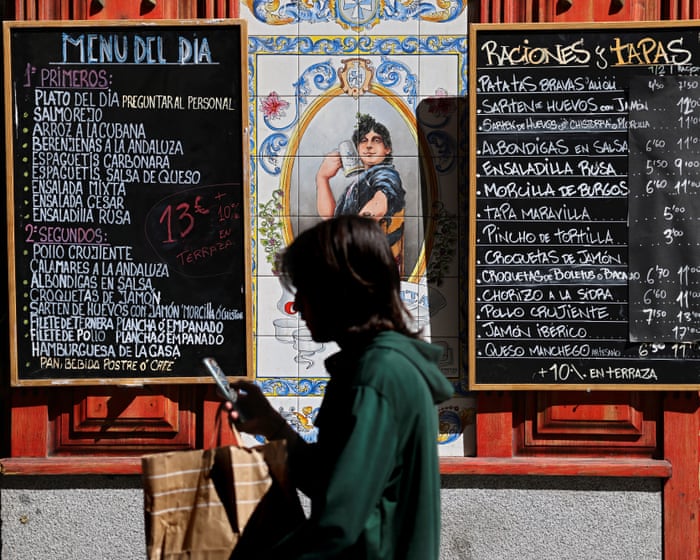
A little before lunchtime each working day across Spain, evidence of one of the lingering, if less notorious, legacies of the Franco dictatorship is carefully traced in chalk, marker pen and printer ink.

Beckoning to hungry workers from blackboards, whiteboards and pieces of paper hastily taped to windows, the competitively priced menú del día, or daily set-price lunch, has been part of everyday Spanish life for more than half a century. But while 4m menús are still served each weekday, Spain is slowly losing its appetite for the familiar ritual.

Continue reading...

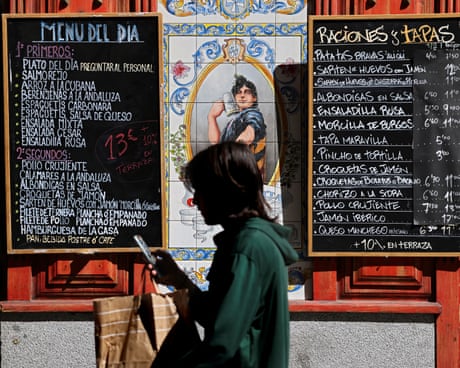
© Photograph: Thomas Coex/AFP/Getty Images

© Photograph: Thomas Coex/AFP/Getty Images

© Photograph: Thomas Coex/AFP/Getty Images

  •  

The latest sign we're eating out less: Restaurants are buying fewer disposable cups and paper towels

A person in dark clothing holds a white illy paper coffee cup at an indoor gathering.
Restaurants are buying fewer disposable cups, paper towels, and packaging supplies, companies that make the goods have said.

Lia Toby/Getty Images for illycaffè

  • Restaurants are buying fewer paper cups and takeout containers.
  • Companies making the goods say their North American sales declined in results released this year.
  • It's the latest sign that diners are eating out less.

Even the humble disposable coffee cup suggests that diners are eating out less at restaurants.

Companies that sell paper cups, plates, delivery containers, and similar packaging to restaurants say that they're seeing less demand from US businesses.

Essity, a Swedish company that sells paper towels and cleaning supplies to businesses, including restaurants, said on Thursday that the dining pullback in the US was affecting sales. The company's sales volumes and prices in the US fell during its third quarter, it said.

"Consumers are not going out to restaurants as much as they do in Europe," CEO Ulrika Kolsrud told Reuters on Thursday.

Finland-based Huhtamaki Oyj, which makes disposable cups and takeout containers for fast-food restaurants, said that second-quarter sales in North America decreased.

Analysts at Jefferies wrote that results in the region, which accounts for about one-third of Huhtamaki Oyj's sales, will likely be hurt by lower consumer spending at fast-food chains in the US.

Higher prices at some chains, and many consumers still working from home, "have impacted sales volumes, and ultimately packaging demand," the analysts wrote earlier this month.

With wages stagnant and the lingering effects of inflation, many diners are eating out less. Those who are still spending tend to look for good deals — a trend that has tested value menus at fast-food chains like McDonald's and benefited others, such as Chili's, which offered deals that got consumers ordering.

That doesn't necessarily mean Americans have stopped spending on restaurant food altogether. Many diners are still willing to pay for food delivery, a trend that has bolstered results at DoorDash and Uber.

Do you have a story idea? Contact this reporter at abitter@businessinsider.com or via encrypted messaging app Signal at 808-854-4501. Use a personal email address, a nonwork WiFi network, and a nonwork device; here's our guide to sharing information securely.

Read the original article on Business Insider

  •  

She used Facebook Marketplace to sell seafood in South Carolina. A viral review led to 300 orders overnight.

reds garlic seafood
Natendrea Jones has been cooking seafood for more than a decade. In 2026, a viral food review brought her more than 300 orders overnight.

Natendrea Jones

  • Natendrea Jones used Facebook Marketplace to market her seafood-catering business.
  • A viral TikTok review in May brought her more than 300 orders overnight.
  • Jones now runs Red's Garlic Seafood from her home kitchen and hopes to expand into a food truck.

When TikTok food reviewer Gabriel Rivera DMed Natendrea Jones about her seafood this spring, she assumed it was a prank.

"I thought somebody was playing a joke," Jones, 36, told Business Insider.

The South Carolina native had spent years trying to turn her cooking into a full-time business. She grew up surrounded by home cooking and began earning money young, first by preparing salads for neighbors and family cookouts, then by doing hair and nails.

Cooking remained a side hustle for more than a decade. Jones made seafood platters for friends and occasionally sold pans, but hair and nails paid the bills.

A viral food review brought 300 orders overnight

Jones had been posting her food on Facebook Marketplace for years. The platform didn't strike her as unusual: As a hairstylist and nail technician, she'd previously used Craigslist to find clients.

"I would always post on Facebook Marketplace because that was like my Craigslist," she said. "I was a Craigslist girl."

Meanwhile, Rivera had built a following of more than 2 million on TikTok by ordering food through Facebook Marketplace and reviewing it from his car. When he found Jones' listing, he offered her $200 to make him anything she wanted.

Jones prepared a pan overflowing with snow crab legs, lobster, shrimp, oysters, and fixings. It was not yet a menu item, she said, but it would soon become known as the "Gabriel Special."

When Rivera posted his glowing review in May — "her seasoning is on another level," he said between bites — Jones woke up to a flood of orders.

"I checked my Square. I had literally over 300 orders," she said. "I dropped my phone. I dropped to my knees."

Jones said she generated $50,000 in sales over the following two weeks and later surpassed six figures in sales. She used some of the money to buy supplies, such as new pots and pans.

Going viral created new problems

The sudden growth was exciting, but it was also difficult to manage. Jones enlisted help from family members early on, refunded some orders, and said some customers waited as long as a month for their food.

"There's no way I can do 100 orders in a day," she said. "This type of motion is new to me."

reds garlic seafood
Jones named her catering business after her late father, who was known as "Big Red."

Courtesy of Natendrea Jones

The pace eventually caught up with her. About three weeks after the review went live, Jones said she had to pause orders for a day to reset and catch up on sleep.

"The adrenaline was there, but I crashed," she said.

Since then, Jones has built more structure into the business. Customers order through her website, which adjusts pickup dates based on demand. She uses preorders to determine how much inventory she needs and now schedules pickup windows. On busy days, she said, her home-kitchen operation can handle 50 to 60 orders.

She still gets inquiries through Facebook Marketplace, but said most sales now come through Instagram and TikTok, where she has built sizable followings.

The business behind the seafood platter

Jones' best-selling platters are not cheap to produce. She buys seafood in bulk, along with fresh corn, potatoes, garlic, butter, edible flowers, packaging, and other ingredients. She estimates that she spends roughly $20,000 a month on supplies, though costs fluctuate based on order volume and seafood prices.

"People just say, 'More money, more problems,'" she said. "Sometimes I'll have moments where I don't see money at all — the money is gone, but it comes right back because that's a business."

reds garlic seafood
Jones' pans are topped with edible flowers and served with her signature garlic sauce.

Natendrea Jones

Her signature sauce is central to the business, she said. Jones spent nearly eight years refining it and is protective of the recipe.

"My sauce is everything — because anybody can make a seafood boil, but how is your sauce?" she said. "I make my sauce from scratch and love and magic."

natendrea jones
Jones and her family live in Summerville, South Carolina, where she operates Red's Garlic Seafood from her home kitchen.

Natendrea Jones

The business is named Red's Garlic Seafood after her late father, who was known as "Big Red." He was a chef who had hoped to open a family restaurant, Jones said.

Her next goal is a food truck, though she's taking her time to secure the vehicle, permits, and licenses needed to operate it.

"I want to do everything the smart way," she said.

Eventually, she hopes to open a brick-and-mortar restaurant. For now, she said she focuses on making each platter with the same care she brought to Rivera's order — the one that changed her business overnight.

"I make sure every pan has the flavors that it needs," she said. "I put the love and effort into the pan."

Read the original article on Business Insider

  •  

Algarve café celebrates Halloween with “spookily irresistible” pastry collection

Algarve café celebrates Halloween with “spookily irresistible” pastry collection

Glee Boutique Café in Vilamoura is celebrating Halloween by launching a limited-edition collection of skulls, brains and one-eyed monsters – all thankfully made from mousse, chocolate, fruit and praline. Created

The post Algarve café celebrates Halloween with “spookily irresistible” pastry collection appeared first on Portugal Resident.

  •  

Have You Been to the Sixth-Worst McDonald’s in America?

There is virtually no way I could have resisted Sylvie McNamara’s dispatch from her journey to a disreputable McDonald’s in Stafford, Virginia. I’ve listened to my share of the Doughboys podcast, and regularly debate burger rankings with my son. What’s more, I went to high school just two miles down the road from this particular location, whose aggregated Google reviews won it dubious distinction in a nation of interchangeable fast-food franchises. Thankfully, McNamara’s lighthearted investigation, which invites readers to consider Robert Caro and teenage commitments to the social contract, will satisfy you no matter your relationship with the Golden Arches. It reminded me of tongue-in-cheek alt-weekly features, a few pleasurable Paris Review web essays, and that episode of Mystery Show where Starlee Kine goes deep with a Ticketmaster employee. Ba-da-ba-ba-ba, I loved it.

I asked the employee for an explanation. “I think I can give you real insight,” he said. “It be the certain workers we got.” He himself is a high schooler, but he said that “we’re starting to get more younger managers. As soon as they turn 18, they’re getting a manager spot. I think my general manager’s 20. It’s a lot of kids getting these manager titles and positions, but they’re not really managers.”

I told him that to be honest, that environment sounded kind of fun.

  •  

EU Ministers Agree New Agricultural Market Rules as Farm Budget Dispute Continues

European Union governments have agreed a negotiating position on new agricultural market rules intended to take effect under the bloc’s 2028–2034 budget, advancing reforms to support arrangements for farmers while leaving the most contentious financial questions unresolved.

The Council approved its partial negotiating mandate on Monday, 19 October, covering changes to the Common Market Organisation regulation, which governs agricultural markets across the European Union.

The proposals include new arrangements for wine producers, protein crops and oilseeds, revised marketing standards, changes to the EU school food programme and provisions intended to improve preparedness for agricultural market disruptions.

However, the agreement does not settle future funding allocations or the broader structure of agricultural subsidies, which remain under negotiation as EU governments attempt to reconcile farming expenditure with competing demands for defence, industrial investment and regional development.

Agricultural markets under review

The Council’s negotiating position retains much of the European Commission’s original proposal while introducing amendments intended to accommodate national differences in agricultural production.

Under the proposed arrangements, sector-specific interventions would become mandatory in several areas, including beekeeping, fruit and vegetables and, under certain circumstances, wine production.

The Council has also proposed flexibility for countries where particular sectors are absent or relatively undeveloped.

For the wine industry, governments would be able to seek exemptions from certain obligations where national circumstances justify different arrangements.

This would allow the framework to retain common European rules while avoiding requirements that would be inappropriate for member states with little or no domestic wine production.

Sectoral interventions form part of the mechanisms through which the EU supports agricultural markets and producer organisations. They can cover measures intended to improve competitiveness, manage production and strengthen farmers’ commercial position.

New provisions for protein crops

The Council has endorsed the establishment of a separate sector for protein crops and oilseeds, replacing existing provisions covering dried fodder.

The objective is to encourage domestic production and reduce dependence on imported agricultural inputs, particularly crops used in animal feed and food production.

European livestock producers rely on protein-rich feed ingredients, including soyabeans, that are often sourced internationally.

Greater domestic production could reduce exposure to fluctuations in global commodity prices, transport costs and disruptions to international supply chains.

Under the Council’s proposal, member states would be encouraged to recognise producer organisations specialising in protein crops and oilseeds.

Such organisations can help farmers coordinate production, marketing and investment, although the effectiveness of the proposed measures will depend on how they are implemented nationally.

The proposals follow broader EU efforts to improve supply security in sectors extending from agricultural inputs to critical industrial materials.

School food and product labelling

The negotiating mandate also preserves the EU school scheme, which provides support for the distribution of fruit, vegetables and milk to schoolchildren.

Under the proposed framework, the programme would move from a school-year financing cycle to a calendar-year system, with transitional provisions intended to prevent disruption during implementation.

The Council has maintained the Commission’s objective of encouraging healthier eating habits by limiting products containing high levels of free sugars and fats.

The proposal also opens the possibility of additional marketing standards for several agricultural products, including protein crops, beef, pork, sheepmeat, goatmeat and rice.

These standards could provide consumers with more detailed information about product origins, subject to the final legislation.

Such measures would also have implications for producers and food businesses, which would need to comply with any new requirements concerning classification, marketing and labelling.

The Council additionally supports the harmonisation of rules covering industrial hemp, while retaining safeguards concerning seed certification and the permitted level of tetrahydrocannabinol.

Farming subsidies remain contested

The agricultural market agreement forms part of negotiations over the next Common Agricultural Policy, which will operate within the EU’s new seven-year financial framework.

Under the Commission’s proposed budget structure, several funding streams, including agricultural and cohesion programmes, would be brought together within national and regional partnership plans.

The restructuring has encountered opposition from governments and agricultural interests concerned that farming could lose protected access to EU funding.

As EU Today previously reported, 17 member states have called for agricultural and regional development expenditure to be protected against further reductions.

The Council’s latest position addresses how agricultural markets should operate rather than determining the size of the financial support available to them.

A separate debate concerns the conditions for receiving direct farm payments, including the definition of an active farmer and the degree of discretion granted to national governments.

Those questions remain central to the continuing CAP negotiations, which are due to return to the Agriculture and Fisheries Council on 26–27 October.

Negotiations move to Parliament

The Council’s partial mandate now provides a basis for negotiations with the European Parliament on the agricultural market provisions.

The legislation will still require agreement between the institutions, while its financing will depend on the eventual settlement of the 2028–2034 budget.

Governments must also complete negotiations on the wider CAP framework, including direct income support and the distribution of responsibility between Brussels and national administrations.

The market agreement reached on 19 October therefore establishes important elements of the proposed agricultural rules, but leaves unresolved the level of financial support available to European farmers after 2027.

  •  

Do not be distracted by global crises. Nature cannot wait for a better year – we must act now | Steven Guilbeault

In 2022, I helped push through the international agreement to protect biodiversity. Wars and economic pressures can make nature seem like a ‘nice-to-have’. But it is a critical asset, and Cop17 must deliver real action

When I was five, property developers came to cut down the woods behind my home in La Tuque, Quebec. My mother encouraged me to climb one of the trees in protest, then told the developers, straight-faced, that there was nothing she could do when they asked her to get me down. A few days later, the tree was cut down anyway.

I thought about that tree in the early hours of a freezing Montreal morning in December 2022, as the gavel came down on a global agreement between nearly 200 countries to halt and reverse the loss of nature by 2030. I thought about how important nature is for our health, our food security and our economies, but also how much passion there is around protecting it, and how it has the power to inspire people all around the world.

Continue reading...

© Photograph: COP17

© Photograph: COP17

© Photograph: COP17

  •  

Committee on World Food Security Convenes in Rome

From October 19 to 23, the world gathers in Rome for the 54th session of the Committee on World Food Security (CFS)*—a global platform dedicated to combating hunger and malnutrition, and to upholding the right to food. Discussions will focus on food security, coordinated responses to food crises, and sustainable food systems. The agenda will […]

  •  

France Introduces New Tax on Added Sugar

A new tax on added sugar in France could lead to higher prices for sweet products. The measure was proposed by the government as part of the 2027 draft budget and has been approved by members of parliament. However, it has raised concerns among manufacturers. The new tax follows an existing levy on carbonated drinks […]

  •  

Feeding the Revolution

“As a child, I thought of the burrito as something predictable, filling, and reliable. It would be years before I saw it as a source of political conviction; something that once split my family’s loyalty between their hungry children and a revolutionary cause.” In this essay at Orion, Victoria Blanco writes about her Abuelita, whose family had owned a burrería in downtown Juárez during the Mexican Revolution, and how she worked hard there through childhood, making burritos for Pancho Villa’s troops—an army fighting for a better life for the next generation. “The food we ate was built for movement,” she writes, “the same way we were.” Blanco reflects on the burrito as a symbol resistance, the borderland, and belonging.

I found the unspoken parts of Abuelita’s childhood when I was working in a university archive as a student, examining photographs no one in my family had ever seen. One image stopped me completely: a rooftop terrace at the Paso del Norte hotel, where well-dressed Americans held cocktails and binoculars, watching the war across the river as though it were a form of entertainment. On the other side of that same river—a river with two names, Río Bravo on one bank, Rio Grande on the other—men were falling from gunfire while children went without food so that revolutionaries could have the sustenance they needed to keep fighting. I sat with that photograph for a long time, thinking about my abuelita, a girl somewhere in that city while Americans sipped cocktails and watched her world from a hotel roof.

  •  

Organic Eggs Have a Carbon Footprint Nearly Twice as Large

The production of organic, free-range eggs can have a climate impact nearly twice as great as that of eggs produced by caged hens. This is according to a new study published in the scientific journal *Royal Society Open Science*, as reported by the British newspaper *The Guardian*. The analysis indicates that if the entire egg […]

  •  

Core values: the Austrian scheme bringing forgotten apple varieties back to life

Spar pilot scheme will test whether heirloom fruit can thrive in today’s commercial and environmental conditions

Only about 10 of the 2,000 types of apples growing in Austria can be found in supermarkets among the polished, pristine fruit usually on display – a sad ratio according to fans of historic varieties being primed for a comeback.

One of the country’s biggest retail chains has embarked on a pilot rollout of unusual and long-forgotten apples enjoyed in previous centuries, riding an international trend of reviving heirloom fruit and vegetables.

Continue reading...

© Photograph: Marek Slusarczyk/Alamy

© Photograph: Marek Slusarczyk/Alamy

© Photograph: Marek Slusarczyk/Alamy

  •  
❌