❌

Reading view

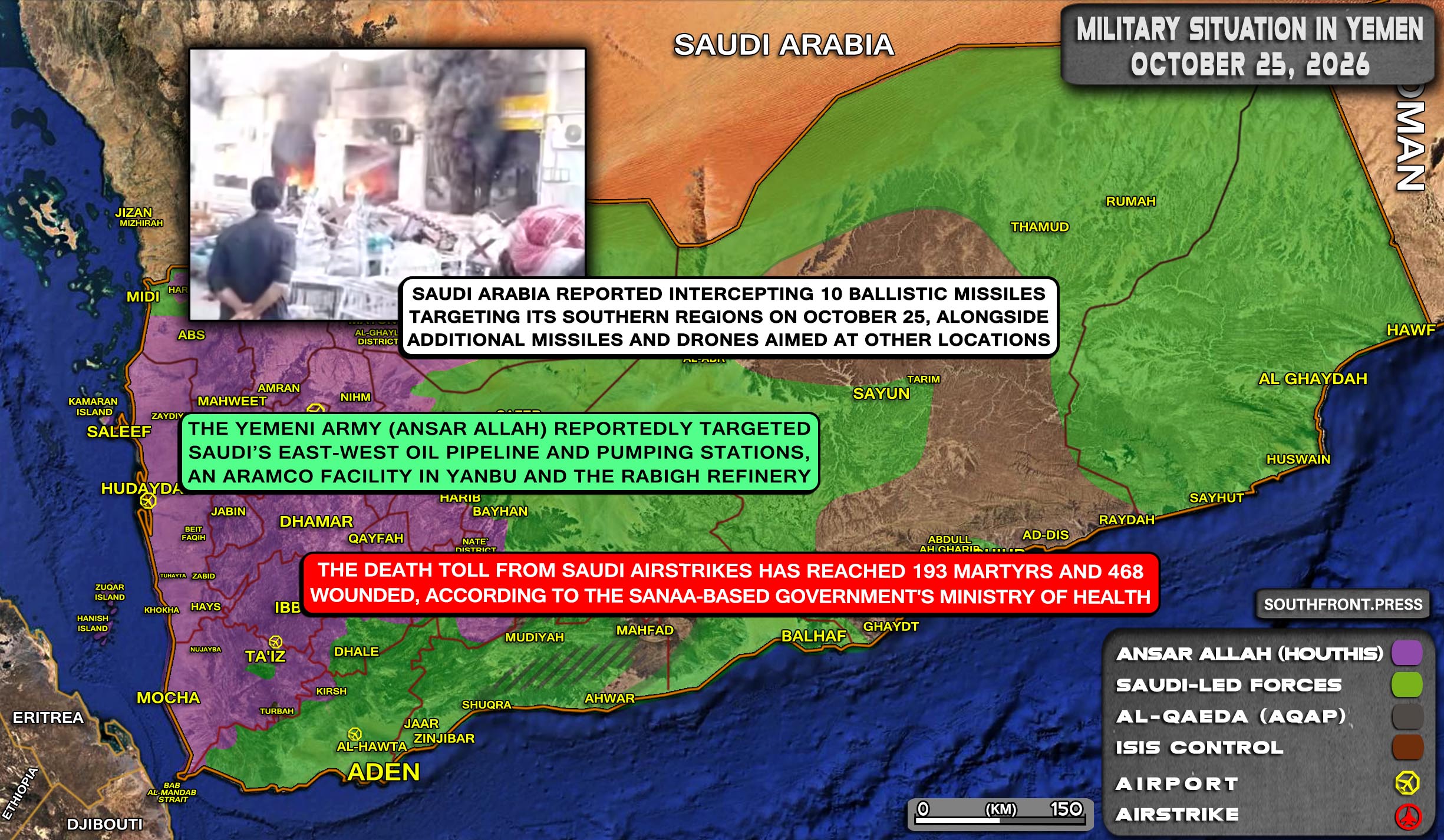
Military Situation In Yemen On October 25, 2026 (Map Update)

Click to see the full-size image

  • The death toll from Saudi airstrikes has reached 193 martyrs and 468 wounded, according to the Sanaa-based government’s Ministry of Health;
  • The Yemeni army (Ansar Allah) reportedly targeted Saudi’s East-West oil pipeline and pumping stations, an Aramco facility in Yanbu and the Rabigh refinery;
  • Saudi Arabia reported intercepting 10 ballistic missiles targeting its southern regions on October 25, alongside additional missiles and drones aimed at other locations.

MORE ON THE TOPIC:

The post Military Situation In Yemen On October 25, 2026 (Map Update) appeared first on South Front.

  •  

Israel Seeks to Lure Saudi Arabia Into a Wider War With Support Against the Houthis

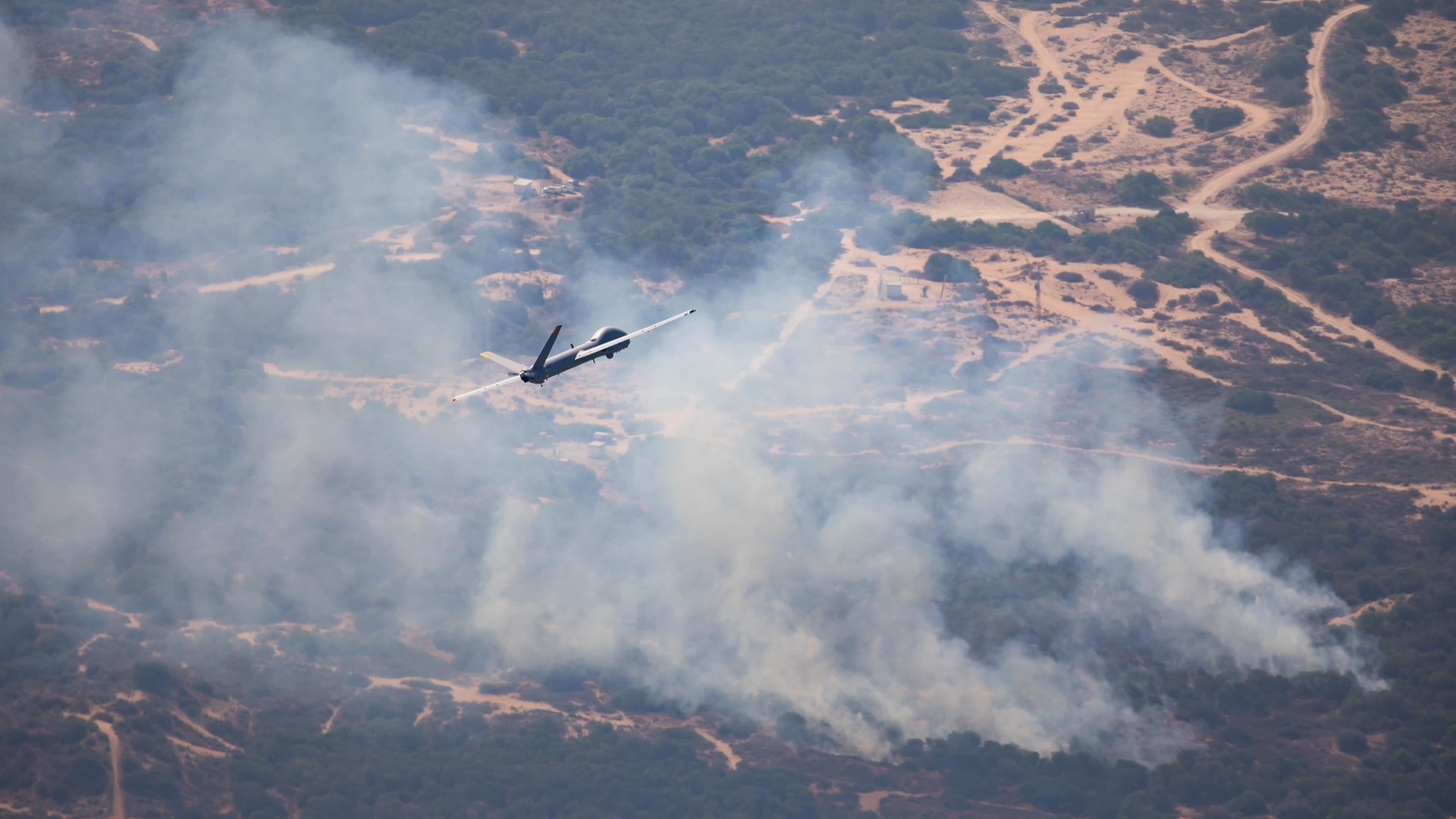
Illustrative image. (The Israeli Defense Forces)

Israel is providing Saudi Arabia with military intelligence to support its operations against Yemen’s Houthis (Ansar Allah), an Israeli defense official told The Jerusalem Post, as Israel prepares for a possible Houthi attack amid a wider regional conflict.

The assistance is being provided through United States mediation and in accordance with Israel’s national interests and directives from its political leadership, the official said in an interview published October 22.

Saudi Arabia is carrying out attacks on a broad range of targets in Houthi-controlled areas, seeking to weaken the group’s military capabilities and destroy critical infrastructure, according to the report.

“Two main points need to be made about this. First, it serves Israel’s interests quite well because it wears down the military strength of an Israeli enemy that is preparing and planning to harm us in the future. In addition, we are monitoring and observing methods of operation and tactics, and learning a great deal from what is happening there, including about weapons that are not necessarily manufactured by the Houthis,” the official said.

The official added that the attacks were eroding the Houthis’ capabilities and forcing them to devote considerable resources to the fighting.

“The Houthis are accustomed to building up their forces, not employing them on this scale. They are a serious enemy, well structured for the long term, but this presents them with a significant challenge. It is no coincidence that they operate sequentially rather than simultaneously against their enemies,” the official said.

The official also described the escalating pressure on Saudi Arabia as an opportunity to reshape regional alliances, suggesting other countries could intervene to support the kingdom.

“The question here is who will intervene on Saudi Arabia’s behalf. There is apprehension among countries, but we assess that there will be intervention. Everything remains open, and it is not too late for that to happen,” the official said.

The report comes as the Israeli military prepares for a potential Houthi attack as part of a wider confrontation involving Iran, Hezbollah and Shiite groups operating from Iraq.

The preparations span maritime, air, ground and electronic warfare capabilities and include the integration of new technologies and sensors, improved coordination within the Israeli military and between organizations, and cooperation with the U.S. military, according to the official.

The U.S. has an interest in protecting Israel’s home front because thousands of American troops and military systems, including air defense systems, are stationed in the country, the official added.

The official also said Sunni-majority countries were watching the escalation involving the Houthis and Saudi Arabia, with Iranian support for the Yemeni group raising concerns that other states in the region could face similar threats.

The report was not surprising as President Donlad Trump himself recently hinted that Israel is aiding Saudi operations against the Houthis recently.

Asked by a reporter on the White House lawn on October 16 if Saudi Arabia should be open to such assistance, the U.S. president said, “I do, I think they will. Israel’s been very helpful to Saudi Arabia, and yeah they certainly would do that, yeah.”

Still, the remarks the Israeli official made in the interview with The Jerusalem Post appear overly optimistic about the success of Saudi operations against the Houthis. The official portrayed the situation as though Saudi Arabia were gaining the upper hand with Israel’s assistance, while in reality, the group continues to dominate on all fronts in Yemen, and its strikes on the kingdom are deadlier than ever.

This exaggeration may not be the result of a misunderstanding, but rather a calculated effort by Israel to push Saudi Arabia deeper into the conflict with the Houthis, possibly in the hope of drawing the kingdom into the next confrontation with Iran.

_______________________________________________________________________________________________________________________

SouthFront: Analysis and Intelligence

NOW hosted at southfront.press

Previously, SouthFront: Analysis and Intelligence was at southfront.org.

The .org domain name had been blocked by the US (NATO) (https://southfront.press/southfront-org-blocked-by-u-s-controlled-global-internet-supervisor/) globally, outlawed and without any explanation

Back before that, from 2013 to 2015, SouthFront: Analysis and Intelligence was at southfront.com

SOUTHFRONT.PRESS

MORE ON THIS TOPIC:

 

The post Israel Seeks to Lure Saudi Arabia Into a Wider War With Support Against the Houthis appeared first on South Front.

  •  

Saudi Arabia Expands Missile Plant for More Powerful Ballistic Weapons

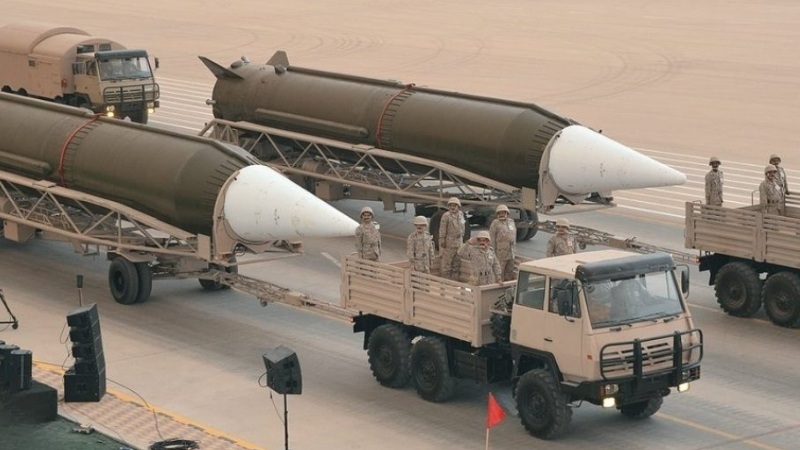
File image. (Saudi Armed Forces)

Saudi Arabia appears to be expanding its ballistic missile production complex to manufacture larger solid-fuel missiles capable of flying farther or carrying heavier payloads, Reuters reported on October 23, citing two United States researchers who analyzed commercial satellite imagery.

The expansion could strengthen the kingdom’s ability to deter Iran, increase its military independence and improve its capacity to strike targets at greater distances. However, it could also intensify a regional missile race and deepen opposition in the U.S. Congress to a proposed U.S.-Saudi civilian nuclear agreement.

Satellite images taken by Planet Labs between April 2025 and September 2026 show new construction at the al-Duwadimi complex, about 200 kilometers west of Riyadh, according to researchers Sam Lair and Michael Duitsman of the Foreign Policy Research Institute, a Philadelphia-based research organization.

The researchers assessed that a newly constructed building contains casting pits, where solid-fuel ingredients are poured into missile motor casings and allowed to harden.

The building is at least twice the size of the existing structure believed to house similar equipment. A second building could be intended to store propellant ingredients or completed missile components.

Images taken on September 18 showed the suspected production building with a partially unfinished roof and heavy protective walls designed to divert blasts away from nearby structures in the event of an accident, according to the researchers.

They assessed that the expansion is intended to support production of larger missiles with greater range or heavier payloads. Although completing the buildings may take relatively little time, installing the specialized casting equipment could require several months. The facility could begin producing missiles by the end of the year.

Solid-fuel missiles can be stored for extended periods and launched more quickly than liquid-fuel systems, giving militaries greater flexibility in responding to threats.

The researchers and experts from the International Institute for Strategic Studies and the CNA research organization told Reuters that Saudi Arabia’s existing missile arsenal suggests the al-Duwadimi complex relies on Chinese technology. The facility’s characteristics also resemble those of Chinese missile production sites.

Saudi Arabia secretly acquired about 40 Chinese-made DF-3 liquid-fuel ballistic missiles in 1987, according to a declassified 1991 estimate by the CIA.

Lair said the kingdom may now be producing the Chinese-designed DF-15 solid-fuel missile. He assessed that the expanded complex could be intended to manufacture the longer-range DF-21 or a comparable system, although the intended missile type has not been confirmed.

Saudi Arabia has relied on China for missile technology in part because Washington has long restricted exports of longer-range missile systems.

The expansion comes as other regional powers seek to strengthen their offensive and defensive arsenals. Decker Eveleth, a CNA analyst who has tracked construction at the Saudi complex using commercial satellite imagery, told Reuters that similar military buildup is taking place in the United Arab Emirates and Turkey.

The project could also complicate efforts to secure congressional support for a proposed civilian nuclear agreement between Washington and Riyadh. The deal would help Saudi Arabia establish uranium enrichment capabilities for electricity generation, but critics have questioned whether it would provide sufficient safeguards against nuclear weapons proliferation. Saudi Arabia has denied plans to develop nuclear weapons.

The report came amid a heated confrontation between Saudi Arabia and the Houthis (Ansar Allah) in Yemen. It also came as tensions are building up again between the U.S. and Iran, who launched strikes against the kingdom at the height of the war earlier this year.

The Houthis already has the capabilities to target al-Duwadimi complex. Iran could also strike the facility if full-on war resumes.

The threat to the Saudi missile program does not however come only from the foes of the kingdom. Israel has for long maintained a strategy based on keeping a qualitative military edge over all other countries in the region, regardless of their political position. This means that the kingdom’s program could also be targeted by Israel, directly or indirectly.

_______________________________________________________________________________________________________________________

SouthFront: Analysis and Intelligence

NOW hosted at southfront.press

Previously, SouthFront: Analysis and Intelligence was at southfront.org.

The .org domain name had been blocked by the US (NATO) (https://southfront.press/southfront-org-blocked-by-u-s-controlled-global-internet-supervisor/) globally, outlawed and without any explanation

Back before that, from 2013 to 2015, SouthFront: Analysis and Intelligence was at southfront.com

SOUTHFRONT.PRESS

MORE ON THIS TOPIC:

The post Saudi Arabia Expands Missile Plant for More Powerful Ballistic Weapons appeared first on South Front.

  •  

Houthi Strikes Kill Dozens In Yemen And Saudi Arabia

Fighting intensified across Yemen over the past week, as the Houthis (Ansar Allah) escalated their missile and drone strikes on Saudi Arabia.

On October 16, two missiles hit Aden International Airport’s perimeter. The Houthis said they targeted a nearby military facility housing a Saudi-led coalition command center and weapons depot. No casualties were reported.

Two days later, October 18, the Houthis shot down a Saudi AH-6i light attack helicopter near Najran. Footage released by the group’s military media showed a missile striking the helicopter before it fell. The crash killed both crew members. The Houthis also downed a Turkish-made Karayel combat drone in Yemen.

On October 19, a ballistic missile hit the Al-Alam training camp in Shabwa province as recruits assembled. The strike killed 73 people and wounded more than 200. The dead were all new recruits. The Houthis claimed the attack. A missile strike also targeted Marib.

The next day, October 20, Houthi military media released footage of an operation on Jabal Han, a mountain overlooking Taiz’s western approaches, and said the group’s forces had stormed the summit and ridgeline, driving out Saudi-backed forces. Fighting also continued around Al-Dhabab, the Old Airport and Madarat, while clashes south of the city extended into Al-Misrakh and Sabr al-Madawim. The mountain overlooks the Al-Dhabab road, a key supply route into Taiz.

On October 21, the Houthis fired a ballistic missile at the Saudi-led coalition’s operations room at Badr Camp in Aden. An explosion was heard and smoke reported near the airport. Three drones also targeted Al-Rayyan Airport in Mukalla.

In addition, the group’s military media released footage from operations east of Raghwan in Marib showing wreckage of Turkish-made STM Kargu loitering munitions. The footage showed at least two of the systems. This was evidence of growing involvement by Ankara in the war.

The same day, Saudi authorities said debris from a drone intercepted over the Shaybah oilfield killed two foreign workers, one Filipino and one Nepali, and injured two others, a Pakistani and an Indian. A separate attack on King Fahd International Airport in Dammam killed two people and injured eight; the second death was announced the following day. The airport sustained material damage, prompting flight diversions.

All in all, the Houthis maintain the upper hand on the battlefield, in Taiz, near Bab al-Mandab and on other fronts. The group’s air defenses also remain a credible threat. Meanwhile, strikes on Saudi-backed forces and the kingdom itself are becoming more lethal. Despite all of these factors, Riyadh appears to be determined to go on with the war, with reports indicating it is close to securing more support not just from Turkey, but also from Egypt and Syria.

______________________________________________________________________________________________________________________

DEAR FRIENDS. IF YOU LIKE THIS TYPE OF CONTENT, SUPPORT SOUTHFRONT WORK:

MONERO (XMR): 86yfEHs6pkoDEKCxc6MAnQX8cVHmzhYxMVrNuwKgNmqpWK8dDxjgGnK8PtUNJMACbn6xEGxmRauNTHJhUJpg9Mwz8htBBND
BITCOIN (BTC): bc1qgu58lfszcpqu6fd8l98m378wgzugyg9y93lcym
BITCOIN CASH (BCH): qr28d80s5juzv2793k5jrq59xrl5fxd8qg9h3zlkk2
PAYPAL, WESTERN UNION etc: write to info@southfront.press , southfront@list.ru

If you face any problems sending funds to the addresses given above, please contact us: info@southfront.press and southfront@list.ru. Also be aware that many email services such as Hotmail, Yahoo etc. may block correspondence from info@southfront.press and some others put it in spam.

If you want to support SouthFront but have no opportunity to do it via cryptocurrency, please contact us: info@southfront.press and southfront@list.ru.

SouthFront: Analysis and Intelligence
NOW hosted at southfront.press
Previously, SouthFront: Analysis and Intelligence was at southfront.org.
The .org domain name had been blocked by the US (NATO) (https://southfront.press/southfront-org-blocked-by-u-s-controlled-global-internet-supervisor/) globally, outlawed and without any explanation
Back before that, from 2013 to 2015, SouthFront: Analysis and Intelligence was at southfront.com

SOUTHFRONT.PRESS

The post Houthi Strikes Kill Dozens In Yemen And Saudi Arabia appeared first on South Front.

  •  

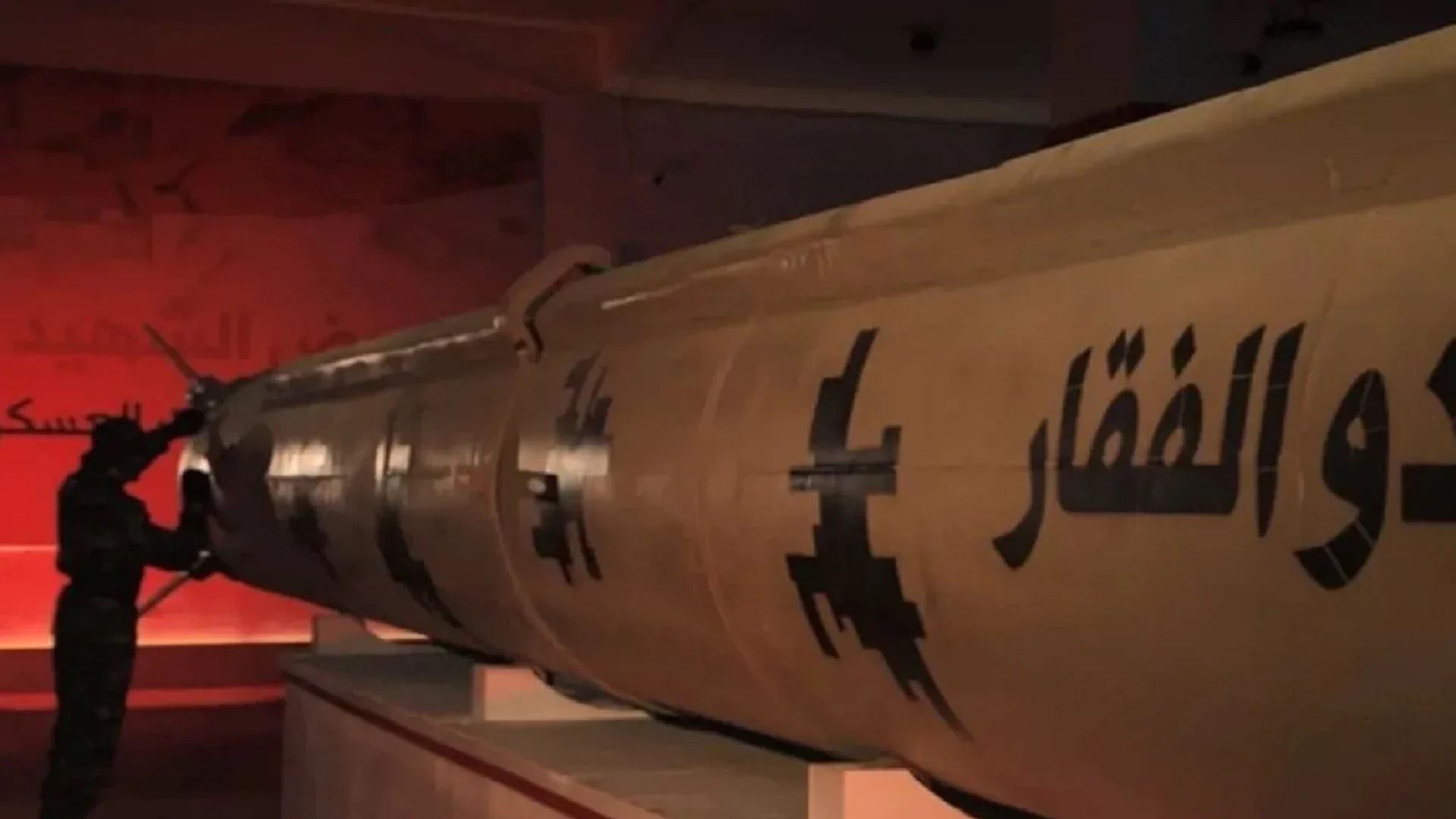
In Video: Houthi Drones Hunt Down Saudi Soldiers Along Yemen’s Border

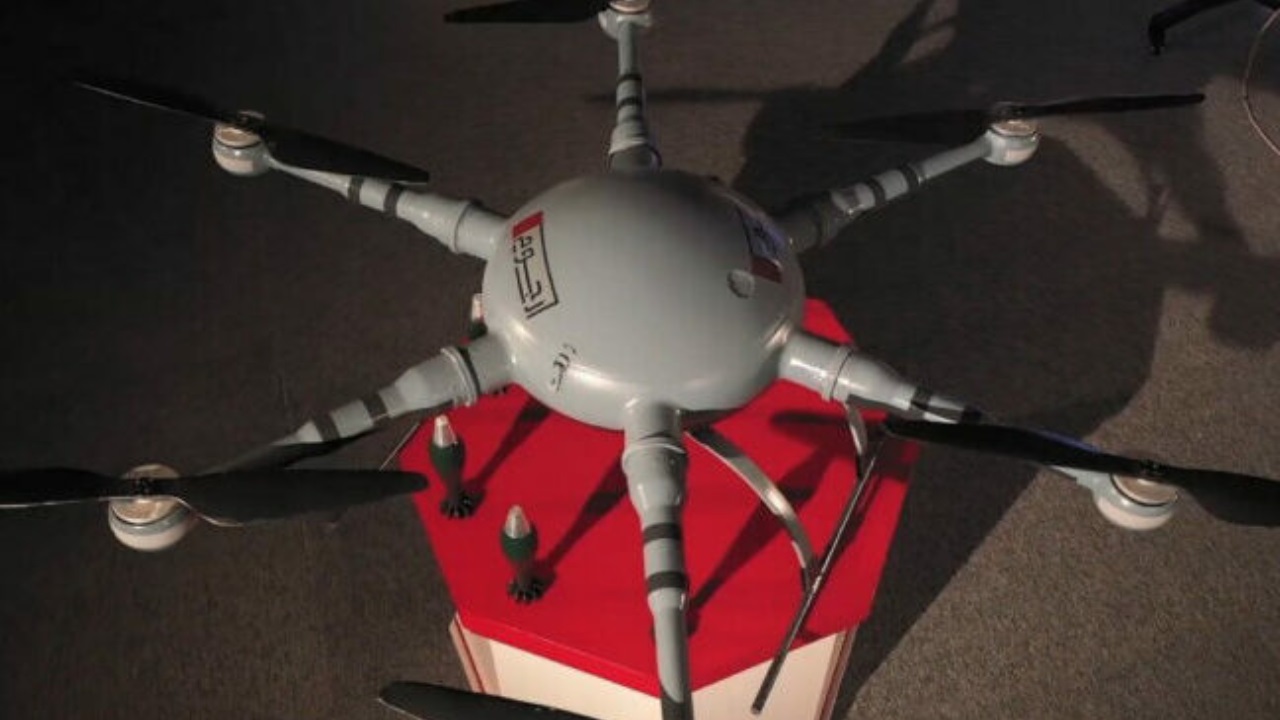
File image.

Yemen’s Houthis (Ansar Allah) released footage October 20 showing Rujum drones striking Saudi military positions along the border with the kingdom’s Jizan and Asir provinces.

The video showed the drones targeting troops, barracks and vehicles. The group described the attacks as the first use of Rujum drones on those border fronts. It said surveillance enabled coordinated strikes on multiple locations simultaneously.

The Rujum is a modified version of the Chinese-made YD6-1000S hexacopter bomber drone featuring a 44-minute flight time and a 2 kg payload capacity, adapted to deploy munitions such as 60 mm mortars.

Houthi military media said the strikes destroyed main battle tanks, weapons depots and rear-area supply centers, and breached Saudi defensive barriers.

Reports of Saudi troops killed near the Yemen border or inside Yemen have circulated more frequently in recent weeks. No official overall toll has been published.

The Houthis also have stepped up operations along the border. Earlier this week, the group shot down a Saudi AH-6i light attack helicopter near Najran, killing both crew members. Despite the release of footage confirming the helicopter was hit, the kingdom said the aircraft crashed because of a technical malfunction.

The escalation along the Yemen-Saudi border could be a prelude to a large-scale Houthi incursion into the kingdom in the near term.

_______________________________________________________________________________________________________________________

SouthFront: Analysis and Intelligence

NOW hosted at southfront.press

Previously, SouthFront: Analysis and Intelligence was at southfront.org.

The .org domain name had been blocked by the US (NATO) (https://southfront.press/southfront-org-blocked-by-u-s-controlled-global-internet-supervisor/) globally, outlawed and without any explanation

Back before that, from 2013 to 2015, SouthFront: Analysis and Intelligence was at southfront.com

SOUTHFRONT.PRESS

MORE ON THIS TOPIC:


The post In Video: Houthi Drones Hunt Down Saudi Soldiers Along Yemen’s Border appeared first on South Front.

  •  

Houthis Claim Six Strikes on Saudi Oil, Airports and Bases in 48 Hours

Illustrative image.

Yemen’s Houthis (Ansar Allah) announced on October 19 that they had carried out six operations against Saudi oil facilities, airports and military installations over 48 hours, claiming fires at energy sites, disrupted air traffic and casualties among Saudi forces.

Brig. Gen. Yahya Saree, the Houthis’ military spokesman, said in a statement that the operations involved “a large number of ballistic and cruise missiles and drones.” The targets included Saudi Aramco facilities in Yanbu, the Shaybah oil field, King Khalid International Airport in Riyadh, Abha International Airport and several military installations.

Saree noted that the operation against Aramco facilities in the Red Sea port city of Yanbu was carried out in two phases and caused “large fires” at the targeted sites. A separate strike on the Shaybah oil field also scored a direct hit and sparked fires, he added.

The third operation targeted King Khalid International Airport in Riyadh in three phases. Saree described the strikes as accurate and direct but did not specify any resulting damage.

The fourth operation targeted Abha International Airport, Saudi radar installations in the al-Hisn and al-Rahma mountains, and Khamis Mushait air base. Saree claimed the strikes disrupted air traffic at Abha airport and damaged the air base.

The fifth operation struck a camp belonging to the Saudi naval task force, killing and wounding Saudi personnel, according to Saree. The sixth targeted a Saudi radar installation at Bir Askar, which he said was destroyed.

On the Saudi side, the Saudi-led coalition said a day earlier that its air defenses intercepted and destroyed two ballistic missiles fired toward Khamis Mushait and a drone in the Riyadh region. Saudi Civil Defense separately reported that a projectile fired by the Houthis landed in a residential area of Najran province, wounding six people.

Saree also accused Saudi Arabia of carrying out more than 200 airstrikes and missile attacks against civilian sites in Sanaa and other Houthi-held areas during the same 48-hour period, causing dozens of deaths and injuries, most of them among women and children.

The spokesman said the total number of Saudi airstrikes and missile attacks since the escalation began had exceeded 2,700.

Vowing to continue the campaign, Saree said Yemen would not submit to Saudi Arabia and threatened “wider operations, harsher strikes and more severe targeting.”

“We will continue our military operations deep inside Saudi territory and enforce the equation of blockade for blockade, escalation for escalation,” he said, adding that the attacks would continue until Saudi military operations and the blockade against Yemen ended.

The Houthis’ latest operations show that the conflict is escalating, and despite taking some serious losses, Saudi Arabia and its allies in Yemen do not seem to be planning to take a step back.

_______________________________________________________________________________________________________________________

SouthFront: Analysis and Intelligence

NOW hosted at southfront.press

Previously, SouthFront: Analysis and Intelligence was at southfront.org.

The .org domain name had been blocked by the US (NATO) (https://southfront.press/southfront-org-blocked-by-u-s-controlled-global-internet-supervisor/) globally, outlawed and without any explanation

Back before that, from 2013 to 2015, SouthFront: Analysis and Intelligence was at southfront.com

SOUTHFRONT.PRESS

MORE ON THIS TOPIC:

The post Houthis Claim Six Strikes on Saudi Oil, Airports and Bases in 48 Hours appeared first on South Front.

  •  

Saudi Royal Ties Emerge in OpenAI Spying Case

Click to see full-seize image. (FBI)

A former OpenAI engineer accused of planting a hidden recording device in an executive conference room maintained frequent contact with a Saudi royal who sought to recruit him for an artificial intelligence role in the kingdom, United States prosecutors said on October 19, raising new questions about possible official Saudi role in the spying scandal.

Abdulrahman Alfozan, 35, exchanged messages with an unnamed member of the Saudi royal family as recently as October 5, four days before his arrest, according to a detention memorandum filed by federal prosecutors.

In one exchange, the royal wrote, “Saudi needs you more then the US!” and Alfozan replied, “100,” according to the prosecutors.

The royal’s identity has not been disclosed. Prosecutors allege the communications reflected an effort to recruit Alfozan to work on artificial intelligence in Saudi Arabia, where he had been pursuing professional opportunities while employed at OpenAI.

Prosecutors also cited assistance from Saudi officials in arguing that Alfozan could flee the U.S. if released. A Saudi military official paid for a business-class flight for Alfozan’s wife and infant son, who left San Francisco for Doha, Qatar, on October 10, according to the filing.

His wife told investigators that she intended to move permanently to Saudi Arabia with their son and that Alfozan eventually planned to join them.

Before his arrest, Alfozan had booked a one-way flight to Riyadh for October 12, coinciding with a planned two-month parental leave. Prosecutors argued that his financial resources and apparent support from a foreign government without an extradition treaty with the United States made him a serious flight risk.

The case began after OpenAI employees discovered a concealed audio recording device on September 30, inserted into a USB port behind a television in an executive conference room at the company’s San Francisco offices. The device, which investigators said had been installed around September 28 and contained encrypted recordings, was wrapped in toilet paper.

According to the criminal complaint, the room was regularly used for discussions involving confidential research, product plans, commercial strategy and government engagements.

Prosecutors said government officials attended meetings there around the time the device was installed, heightening concerns about the potential exposure of sensitive discussions.

Investigators cited office surveillance footage showing Alfozan close to the conference room despite lacking authorization to access it. Footage from October 5 allegedly showed him looking behind the television where the device had been placed.

OpenAI security personnel also found a second, similar recording device in a bag containing his identification and other belongings, according to the complaint.

The investigation uncovered additional digital evidence. A chatbot account associated with Alfozan’s wife, which prosecutors said shared multiple identifiers with his own account, had submitted prompts about constructing and concealing an audio recorder, improving live listening and encrypting stored files.

Investigators also cited his inquiries into office locations, meeting-room calendars and scheduled gatherings involving company executives and external partners.

Alfozan was arrested on October 9 and subsequently dismissed by OpenAI, where he had worked as an engineer since July 2025. The company referred the matter to the FBI after discovering the device.

OpenAI has said it found no evidence that the incident resulted in the theft or extraction of model weights, source code or customer data. The case has nevertheless drawn attention to the risks surrounding the protection of advanced artificial intelligence research as governments and technology companies compete for strategic advantages.

Alfozan’s lawyer, William Pernik, has challenged the prosecution’s argument that his client would flee if released. He said the planned travel was for family and immigration reasons, noting that the tickets had been booked in advance and that Alfozan did not leave after learning that OpenAI had discovered the device.

Pernik asked the court to release him under home detention, GPS monitoring and a bond supported by the Saudi consulate.

Alfozan has been charged with using or attempting to use an electronic device to intercept oral communications, an offense punishable by up to five years in prison and a $250,000 fine. He has not been charged with espionage or theft of trade secrets, and prosecutors have not alleged that the Saudi royal directed the placement of the recorder.

The spying attempt may have been to gain a financial edge rather than steal AI technology. Inside knowledge of OpenAI’s investment plans, commercial partnerships, negotiations and business strategy could potentially help Saudi royal-linked interests anticipate market movements, secure more favorable terms in major deals or gain an advantage over competitors. Such intelligence could carry substantial economic value without revealing a single line of OpenAI’s code.

_______________________________________________________________________________________________________________________

SouthFront: Analysis and Intelligence

NOW hosted at southfront.press

Previously, SouthFront: Analysis and Intelligence was at southfront.org.

The .org domain name had been blocked by the US (NATO) (https://southfront.press/southfront-org-blocked-by-u-s-controlled-global-internet-supervisor/) globally, outlawed and without any explanation

Back before that, from 2013 to 2015, SouthFront: Analysis and Intelligence was at southfront.com

SOUTHFRONT.PRESS

MORE ON THIS TOPIC:

The post Saudi Royal Ties Emerge in OpenAI Spying Case appeared first on South Front.

  •  

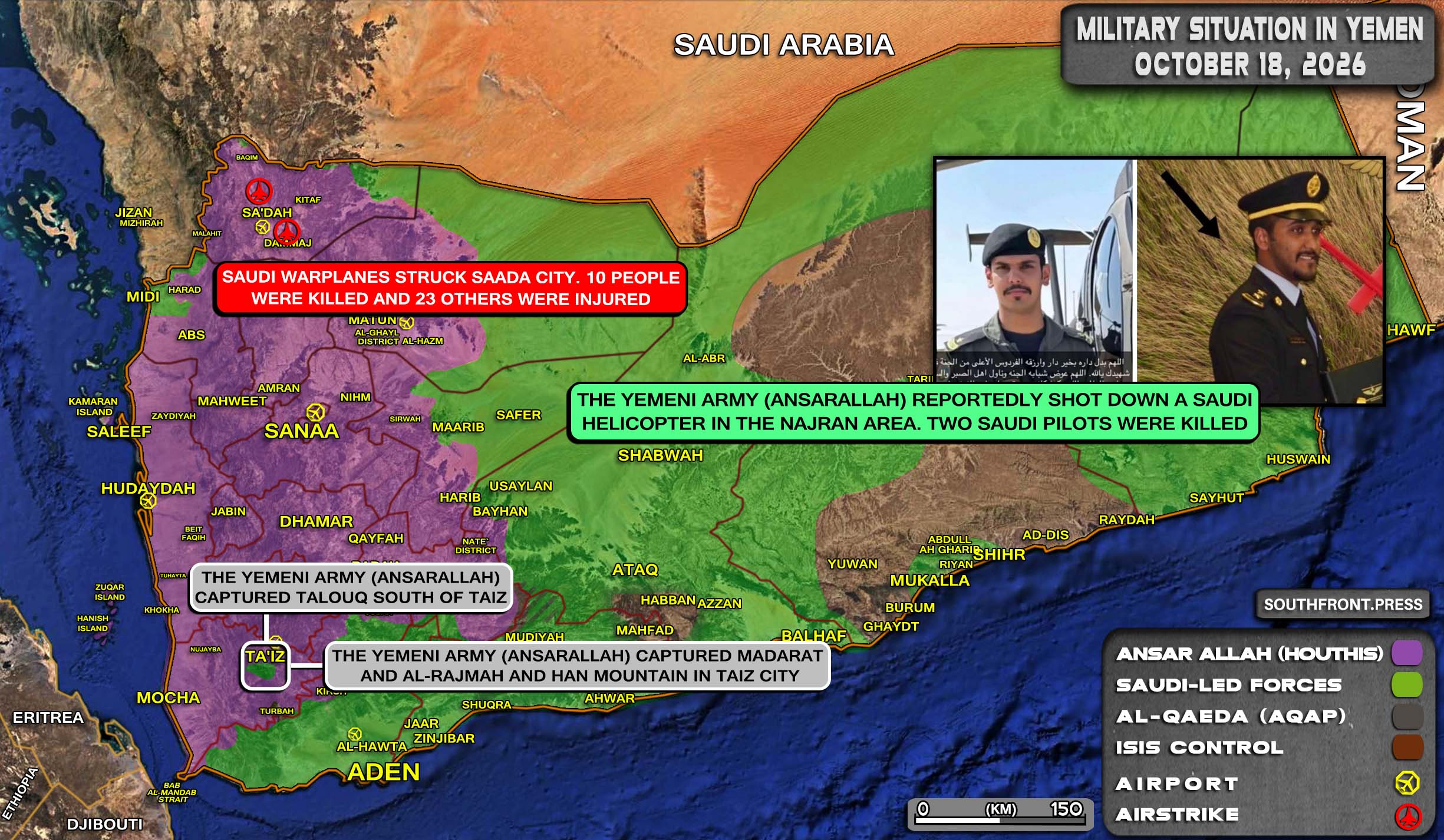
Military Situation In Yemen On October 18, 2026 (Map Update)

Click to see the full-size image

  • The Yemeni army (AnsarAllah) captured Madarat and Al-Rajmah and Han mountain in Taiz city;
  • The Yemeni army (AnsarAllah) captured Talouq south of Taiz;
  • Saudi warplanes struck Saada city. 10 people were killed and 23 others were injured;
  • The Yemeni army (AnsarAllah) reportedly shot down a Saudi helicopter in the Najran area. Two Saudi pilots were killed.

MORE ON THE TOPIC:

The post Military Situation In Yemen On October 18, 2026 (Map Update) appeared first on South Front.

  •  

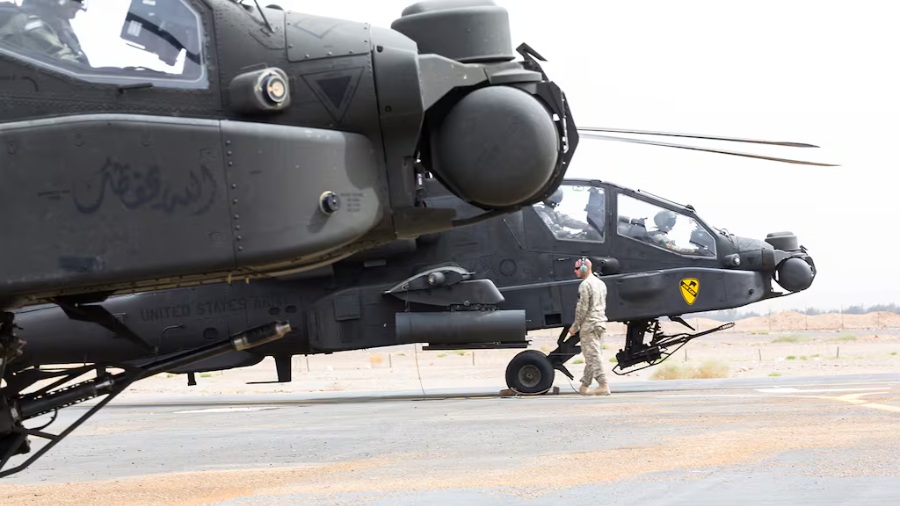
Houthis Shot Down Saudi Apache Helicopter Near Najran

Click to see full-size image. (Sgt. Harley Jelis/Army National Guard)

Yemen’s Houthis (Ansar Allah) announced late on October 17 that they shot down a Saudi AH-64 Apache attack helicopter near the border with the kingdom’s southern province of Najran.

In a statement, Brig. Gen. Yahya Saree, the movement’s military spokesman, said the American-made helicopter had been targeting Houthi positions along the border.

“Our armed forces, with the help and grace of God, managed to shoot down an Apache belonging to the Saudi enemy opposite Najran while it was carrying out hostile actions against our forces’ positions along the border,” Saree said. “It was shot down with a suitable weapon.”

The Houthis operate a range of air defense systems, from man-portable weapons to interceptors and medium-range surface-to-air missiles.

The Apache is Saudi Arabia’s principal attack helicopter, with a modernized AH-64E estimated to cost about $52 million per helicopter according to recent U.S. Army procurement figures.

Open-source inventories list 22 Apaches with the Royal Saudi Land Forces and 12 others with the Saudi Arabian National Guard.

The announcement came just days after the Houthis said they had struck a Saudi Eurofighter Typhoon fighter jet over Yemen’s Saada province. The group later released footage showing a missile hitting the jet during flight, supporting its claim.

Including the latest claim, the Houthis have announced 18 shootdowns since the start of the ongoing confrontation with Saudi Arabia. Aside from an American-made F-15SA fighter jet, all other warplanes shot down by the Houthis were combat drones.

_______________________________________________________________________________________________________________________

SouthFront: Analysis and Intelligence

NOW hosted at southfront.press

Previously, SouthFront: Analysis and Intelligence was at southfront.org.

The .org domain name had been blocked by the US (NATO) (https://southfront.press/southfront-org-blocked-by-u-s-controlled-global-internet-supervisor/) globally, outlawed and without any explanation

Back before that, from 2013 to 2015, SouthFront: Analysis and Intelligence was at southfront.com

SOUTHFRONT.PRESS

MORE ON THIS TOPIC:

The post Houthis Shot Down Saudi Apache Helicopter Near Najran appeared first on South Front.

  •  

Sisi Calls Emergency Session to Authorize Egyptian Defense of Saudi Arabia

Illustrative image. (Egyptian Ministry of Defense)

Egyptian President Abdel Fattah El-Sisi on October 17 called for an emergency parliamentary session to authorize a possible Egyptian intervention to defend Saudi Arabia if requested by the kingdom.

“I call on parliament to convene an emergency session to authorize us to take action to intervene in defense of Saudi Arabia, if we are asked to do so,” El-Sisi said at a graduation ceremony for military academy and college cadets.

“This move and this defense require approval from the Egyptian parliament,” he noted, stressing that Egypt was not seeking to join the war against Yemen’s Houthis.

“I am not speaking about attacking or waging war. We are seeking only to defend,” the Egyptian president added.

Egypt is the latest country to publicly signal support for Saudi Arabia as the kingdom faces escalating missile and drone attacks by the Houthis, who control much of Yemen.

El-Sisi said Cairo would take the necessary measures to protect Saudi Arabia, adding that it was “absolutely unacceptable” for the kingdom’s security and stability to be undermined.

Saudi Arabia has secured defensive military support from Pakistan and Turkey through the Mecca Joint Defense Agreement, which the three countries agreed to activate on October 5. More recently, the kingdom also received defensive support from the United Kingdom and France.

The United States, for its part, has been providing more substantial military support to Saudi Arabia, including intelligence sharing, operational planning and assistance identifying Houthi targets, as well as weapons and air defense systems.

Still, Riyadh has so far failed to secure a publicly announced commitment from its allies to directly join its offensive against the Houthis inside Yemen.

_______________________________________________________________________________________________________________________

SouthFront: Analysis and Intelligence

NOW hosted at southfront.press

Previously, SouthFront: Analysis and Intelligence was at southfront.org.

The .org domain name had been blocked by the US (NATO) (https://southfront.press/southfront-org-blocked-by-u-s-controlled-global-internet-supervisor/) globally, outlawed and without any explanation

Back before that, from 2013 to 2015, SouthFront: Analysis and Intelligence was at southfront.com

SOUTHFRONT.PRESS

MORE ON THIS TOPIC:


The post Sisi Calls Emergency Session to Authorize Egyptian Defense of Saudi Arabia appeared first on South Front.

  •  

Houthis Escalate On All Fronts

Yemen’s Houthis (Ansar Allah) tightened their offensive around Taiz over the past week, as they escalated their strikes on Saudi Arabia.

On October 8, the Houthis claimed missile attacks targeting King Khalid International Airport in Riyadh. Saudi aviation authorities said three Saudi citizens were killed, and an aircraft was damaged. The attacks disrupted international flights and prompted a response from the Saudi-led coalition. Explosions were also reported in Sanaa the following day, with Houthi media reporting six people wounded.

The attacks escalated on October 10, when a missile struck Riyadh airport, killing 12 people and injuring more than 300. Another projectile hit a passenger terminal on October 11, killing a Pakistani national and wounding 11. The repeated strikes severely disrupted air travel and exposed vulnerabilities in Saudi Arabia’s air defenses.

On the ground, Houthi forces reported capturing al-Misrakh district and positions in Jabal Habashi in Taiz on October 11. The following day, Houthi media showed operations around the Birin Triangle and Yafrus junction. The advances formed part of a wider push to encircle Taiz, Yemen’s third-largest city, after the Houthis captured Turbah earlier in the month.

Also on October 12, Houthi military media released footage from al-Faliha in Marib showing artillery and missile strikes against Saudi-backed troops, with several military vehicles burning. The group said its forces had repelled a government offensive.

On October 13, the Saudi-led coalition struck fuel facilities in Sanaa and storage infrastructure around Ras Isa and elsewhere in Hodeidah and Dhamar, saying the sites supported Houthi missile and drone operations. Hours later, a Houthi ballistic missile struck the Saudi Aramco headquarters in Dhahran, causing a fire. Saudi authorities reported no casualties.

Houthi media also reported clearing al-Sharjan, al-Ka’ala, Harazu and al-Khabakhib in western Lahij, potentially putting additional pressure on Saudi-backed forces near Bab al-Mandab.

On October 14, the group released footage it said showed fighters driving Saudi-backed troops from Dhubab Airport in Taiz, capturing personnel and seizing military vehicles. Houthi forces also reported capturing al-Hangar checkpoint and clearing positions in Anbian and Wateer, further tightening pressure around Taiz.

The very next day, October 15, Houthi military spokesman Yahya Saree said that a surface-to-air missile had directly hit a Saudi Eurofighter Typhoon over Saada province in northern Yemen.

All in all, the Houthis have escalated on all fronts in recent weeks, tightening their siege of Taiz, pushing Saudi-backed forces away from Bab al-Mandab, and stepping up strikes on Saudi Arabia. The kingdom and its allies are yet to respond in any meaningful way in the face of this escalation, and despite their repeated military failures, they are yet to seek a real diplomatic solution.

______________________________________________________________________________________________________________________

DEAR FRIENDS. IF YOU LIKE THIS TYPE OF CONTENT, SUPPORT SOUTHFRONT WORK:

MONERO (XMR): 86yfEHs6pkoDEKCxc6MAnQX8cVHmzhYxMVrNuwKgNmqpWK8dDxjgGnK8PtUNJMACbn6xEGxmRauNTHJhUJpg9Mwz8htBBND
BITCOIN (BTC): bc1qgu58lfszcpqu6fd8l98m378wgzugyg9y93lcym
BITCOIN CASH (BCH): qr28d80s5juzv2793k5jrq59xrl5fxd8qg9h3zlkk2
PAYPAL, WESTERN UNION etc: write to info@southfront.press , southfront@list.ru

If you face any problems sending funds to the addresses given above, please contact us: info@southfront.press and southfront@list.ru. Also be aware that many email services such as Hotmail, Yahoo etc. may block correspondence from info@southfront.press and some others put it in spam.

If you want to support SouthFront but have no opportunity to do it via cryptocurrency, please contact us: info@southfront.press and southfront@list.ru.

SouthFront: Analysis and Intelligence
NOW hosted at southfront.press
Previously, SouthFront: Analysis and Intelligence was at southfront.org.
The .org domain name had been blocked by the US (NATO) (https://southfront.press/southfront-org-blocked-by-u-s-controlled-global-internet-supervisor/) globally, outlawed and without any explanation
Back before that, from 2013 to 2015, SouthFront: Analysis and Intelligence was at southfront.com

SOUTHFRONT.PRESS

The post Houthis Escalate On All Fronts appeared first on South Front.

  •  

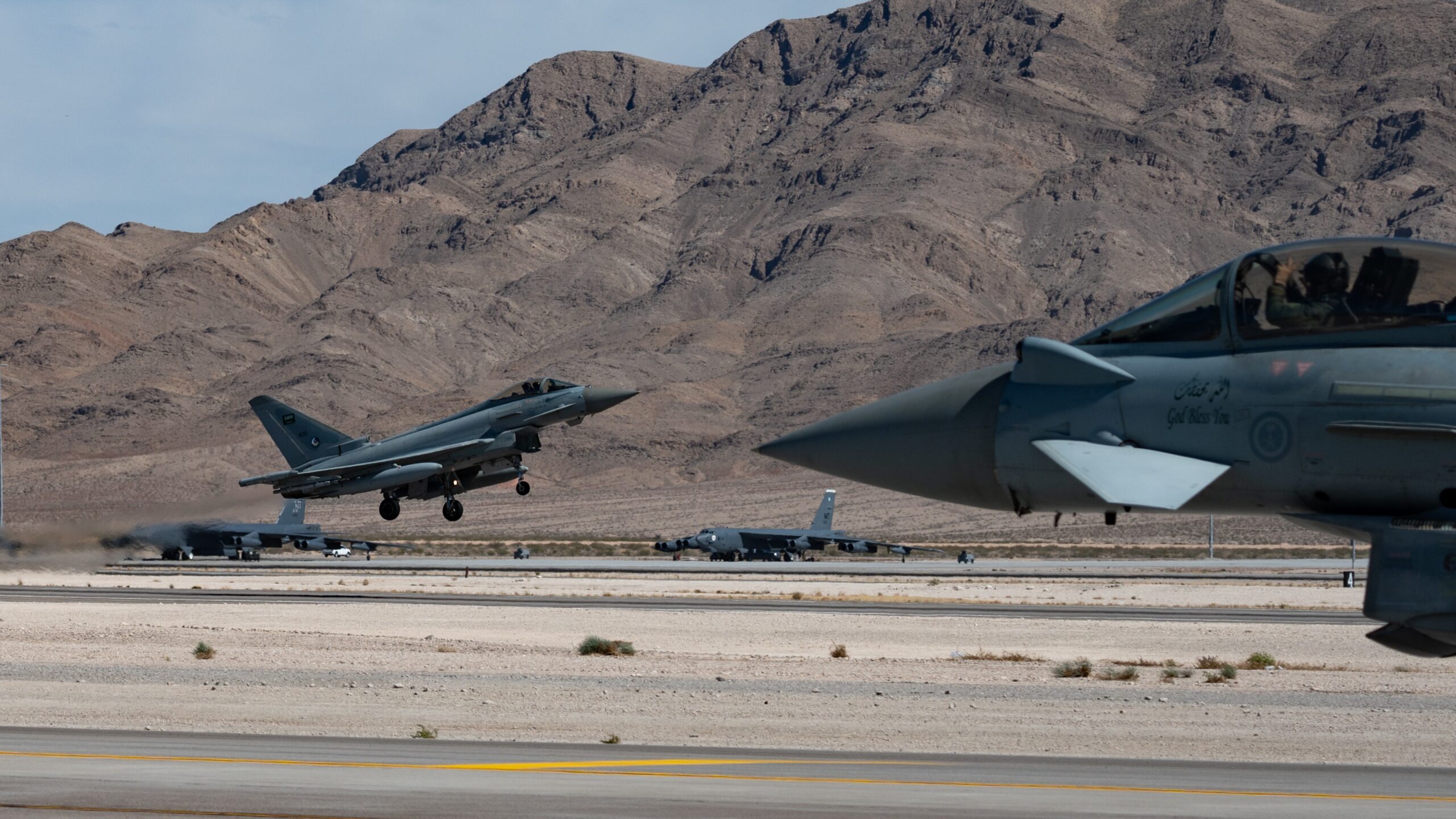
Houthi Air Defenses Hit Saudi Typhoon Fighter Jet Over Yemen

Illustrative image. (U.S. Air Force Photo by Airman 1st Class Michael Sanders)

The Houthis (Ansar Allah) announced on October 15 that their air defenses had hit a Saudi Eurofighter Typhoon fighter jet over the Yemeni province of Saada.

In a statement, Houthi military spokesman Brig. Gen. Yahya Saree said that the warplane had taken off from Taif Air Base in western Saudi Arabia before being engaged over northern Yemen.

“It was directly hit and is at risk of crashing,” Saree added.

The reported engagement follows the Houthis’ September 16 downing of a Saudi F-15SA fighter jet over the central province of Marib. At the time, the group said it used a locally made surface-to-air missile, without elaborating. Saudi Arabia is yet to acknowledge the loss. The fate of the pilot and the weapons system officer also remain unknown.

The fighter incidents have come alongside four Houthi-reported shootdowns of combat drones this month so far. On October 5, the group said it downed a Chinese-made Wing Loong II over the southwestern province of Taiz.

Two days later, it announced the destruction of a CH-4 over the northern province of Al-Jawf, followed by a Turkish-made Bayraktar Akinci over Taiz on October 8. On October 13, Houthi forces reported another Wing Loong II shootdown over Saada.

The Houthis possess fairly capable air defenses, ranging from man-portable systems to interceptors and medium-range anti-aircraft missiles.

The recent engagements indicate the group’s air defense capabilities are growing, which would further complicate Saudi aerial operations over Yemen.

_______________________________________________________________________________________________________________________

SouthFront: Analysis and Intelligence

NOW hosted at southfront.press

Previously, SouthFront: Analysis and Intelligence was at southfront.org.

The .org domain name had been blocked by the US (NATO) (https://southfront.press/southfront-org-blocked-by-u-s-controlled-global-internet-supervisor/) globally, outlawed and without any explanation

Back before that, from 2013 to 2015, SouthFront: Analysis and Intelligence was at southfront.com

SOUTHFRONT.PRESS

MORE ON THIS TOPIC:


The post Houthi Air Defenses Hit Saudi Typhoon Fighter Jet Over Yemen appeared first on South Front.

  •  

Houthi Strikes Hit Aramco Headquarters In Saudi Arabia (Videos)

File image.

Yemen’s Houthi military spokesman Brig. Gen. Yahya Saree announced on October 14 that the group had attacked Saudi Aramco facilities in Dhahran and Riyadh and at King Khalid International Airport, threatening further strikes against the kingdom.

In a statement, Saree said the operation involved “a large number of ballistic missiles, cruise missiles and drones.” The spokesman claimed the weapons struck their targets accurately, causing destruction and fires at the targeted sites.

Saudi Arabia’s Energy Ministry said a day earlier that an attack had caused a limited fire in an administrative building at Aramco’s complex in Dhahran, in the kingdom’s Eastern Province. No injuries or fatalities were reported.

A source at the company told Reuters that a ballistic missile struck an office tower in the complex, damaging its top three floors.

Saree said the attacks were retaliation for Saudi strikes on Sanaa and other areas under Houthi control. He claimed Saudi Arabia had carried out 2,281 airstrikes and missile attacks against Yemen during the current escalation, accusing the kingdom of committing dozens of crimes.

The spokesman warned that Houthi operations against targets inside Saudi Arabia would continue over the coming days, specifically threatening airports and oil installations.

He urged international shipping companies, civilians and workers to stay away from the targeted sites and called for the immediate evacuation of the sites, declaring them “legitimate targets” for Houthi forces.

The latest threats came after the Saudi-led coalition launched strikes against Houthi-held areas a day earlier, including the al-Sabah fuel facility on the outskirts of Sanaa. The coalition had warned civilians to evacuate the area, saying the operation was intended to neutralize Houthi capabilities to threaten Saudi Arabia, Yemen and international waterways.

The Saudi Civil Defense said debris from two intercepted Houthi missiles fell on residential areas in Riyadh, injuring four people and damaging 15 homes.

On October 14, residents reported hearing new explosions in the capital, and the Saudi-led coalition said it had intercepted a ballistic missile launched toward Riyadh. No casualties or damage were immediately reported from that incident.

The exchanges follow a series of Houthi attacks on Saudi airports. A strike on King Khalid International Airport on October 10 killed 13 people and wounded more than 300, according to Saudi authorities. Another attack the following day killed one person and injured 11, further disrupting aviation operations in the kingdom.

The renewed fighting is part of a broader escalation in Yemen, where Saudi Arabia is backing forces aligned with the internationally recognized government against the Houthis. The Saudi-led campaign intensified after Houthi forces made advances along Yemen’s Red Sea coast toward the strategic Bab al-Mandeb Strait.

Saree said the Houthis would continue to match what he called Saudi “escalation with escalation” and maintain a policy of “blockade for blockade” until Saudi Arabia ends its military campaign and lifts the blockade on Yemen.

_______________________________________________________________________________________________________________________

SouthFront: Analysis and Intelligence

NOW hosted at southfront.press

Previously, SouthFront: Analysis and Intelligence was at southfront.org.

The .org domain name had been blocked by the US (NATO) (https://southfront.press/southfront-org-blocked-by-u-s-controlled-global-internet-supervisor/) globally, outlawed and without any explanation

Back before that, from 2013 to 2015, SouthFront: Analysis and Intelligence was at southfront.com

SOUTHFRONT.PRESS

MORE ON THIS TOPIC:

The post Houthi Strikes Hit Aramco Headquarters In Saudi Arabia (Videos) appeared first on South Front.

  •  
❌