❌

Reading view

The U.S. Tax System Gets a Middling Score
A gold medal on top of a calculator | BillionPhotos/maylim/Magnific/Mariam Zakaidze

Politicians may not like it, but the countries they misgovern compete with one another for businesses, people, and capital. To attract startups, entrepreneurs, and investors, governments have to offer attractive environments, or else lose out to friendlier nations. When it comes to tax competitiveness, a new report says that Estonia leads the way in first position, with the United States lagging at 17th.


Low Rates and Simplicity Make Countries More Attractive

"The structure of a country's tax code is a determining factor of its economic performance," write Alex Mengden and Luis Zarka for the Tax Foundation's International Tax Competitiveness Index 2026. "A well-structured tax code is easy for taxpayers to comply with and can promote economic development while raising sufficient revenue for a government's priorities. In contrast, poorly structured tax systems can be costly, distort economic decision-making, and harm domestic economies."

The report notes that competition among countries has resulted in widespread improvements (and some backsliding) across the world in recent years. Especially among members of the Organization for Economic Cooperation and Development (OECD), marginal tax rates on corporate and individual income have declined. That said, most governments haven't given up on milking their populations, with growing reliance on payroll taxes and value-added taxes (VAT).

On the other hand, while "corporate tax base improvements have occurred in Canada, Germany, Lithuania, the United Kingdom, and the United States," France, the Slovak Republic, and Slovenia have hiked corporate tax rates. Even worse, tax policy has moved in many countries from a revenue-raising measure into a weapon of economic warfare "deployed to exert economic pressure."

The Tax Foundation's index ranks countries on the degree to which they keep their tax systems competitive—with low rates—and neutral, with minimal social engineering to avoid economic distortions.


Estonia Is First, France Last, With the U.S. in the Middle

According to these criteria, Estonia scores in first place for the best tax code in the OECD for the 13th straight year. According to Mengden and Zarka, the tiny Baltic state earns this distinction for four reasons:

First, it has a 22 percent tax rate on corporate income that is only applied to distributed profits. Second, it has a flat 22 percent tax on individual income that does not apply to personal dividend income. Third, its property tax applies only to the value of land, rather than to the value of real property or capital. Finally, it has a territorial tax system that exempts 100 percent of foreign profits earned by domestic corporations from domestic taxation, with few restrictions.

By contrast, France comes in dead last with the highest top corporate tax rate (36.1 percent) in the OECD, on top of which are "multiple surtaxes and distortive production taxes." France "also applies multiple distortionary property taxes with separate levies on estates, bank assets, and financial transactions, in addition to a wealth tax on real estate. Its VAT covers about 50 percent of final consumption, and it has one of the highest VAT registration thresholds."

The United States ranks at 17, down one place from last year. Among the U.S.'s weaknesses is that its "real property tax burden is among the highest in the OECD" and "the US has a partial territorial system and does not exempt foreign capital gains income." On the plus side, Americans pay relatively low sales/consumption taxes (an average of 7.5 percent, while the OECD average is 19.4 percent).

Not discussed in depth in the index, but still important, is that the U.S. is one of two countries (along with Eritrea) that base income taxation on citizenship rather than residency. "A Canadian living in France pays French taxes, not Canadian ones. An American in France? They pay French taxes and still file with the IRS," notes Bright!Tax. The U.S. tax obligation can be offset for nonresidents, but only by jumping through more bureaucratic hoops.

By and large, countries score better on the index by keeping tax rates low and broadly applied, emphasizing simplicity, and keeping their systems neutral to raise revenue and encourage investment, rather than achieve social and political goals.

Not everybody shares the Tax Foundation's preference for low burdens and minimal complexity. In its 2022 report on Lithuania's tax system (ranked a commendable 5th by the International Tax Competitiveness Index 2026), the OECD urged the country to increase taxes on businesses and self-employed people, and to increase reporting requirements. The OECD apparently favors higher tax burdens and complexity. Keeping the OECD happy would undoubtedly make Lithuania (or any country) less attractive to investors and entrepreneurs.


The U.S. Scores Better on Overall Economic Freedom—Though It's Losing Ground

While the index's middling score for the U.S. on tax competitiveness is disappointing, if understandable, it's not the final word on a country's economic attractiveness. In the Fraser Institute's recently published Economic Freedom of the World 2026 report, the U.S. ranks a credible 5th place, based on 2024 data. It comes in after Hong Kong, Switzerland, Singapore, and New Zealand. The formerly British and now Chinese territory of Hong Kong remained in the leading position despite erosion in economic liberty to accompany its sadly decaying civil liberties status. That's a worldwide concern.

"Global economic freedom fell following the pandemic as policymakers imposed new regulations, raised barriers to trade, expanded the size of government, and then printed money to pay for spending," wrote the Fraser Institute authors, including the late James Gwartney. "While governments have begun to reverse these policies, economic freedom in the average country has not yet returned to pre-pandemic levels."

Unfortunately, the U.S. is forecast to slide two positions in next year's Economic Freedom report because of "increases in the size of government, weaker protection of property rights and the rule of law, and significant restrictions on trade freedom."

Improving the U.S. tax environment might help to improve America's economic freedom score. Then again, so would reducing government's role and discontinuing protectionist policies.

Tax competitiveness is one important element of any country's overall economic freedom, which creates an attractive environment to invest, create businesses, and generate prosperity. The U.S. has long thrived because it is, in relative terms, free. That's a status worth maintaining.

The post The U.S. Tax System Gets a Middling Score appeared first on Reason Magazine.
  •  

Grassroots Revolt Targets Unpopular Property Taxes

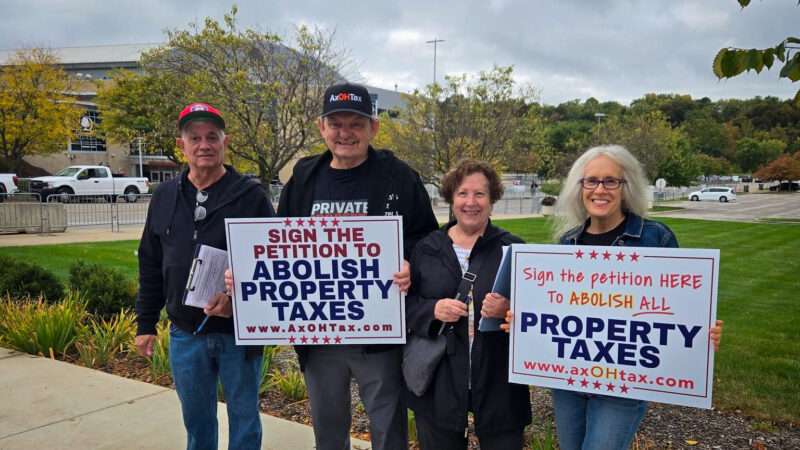
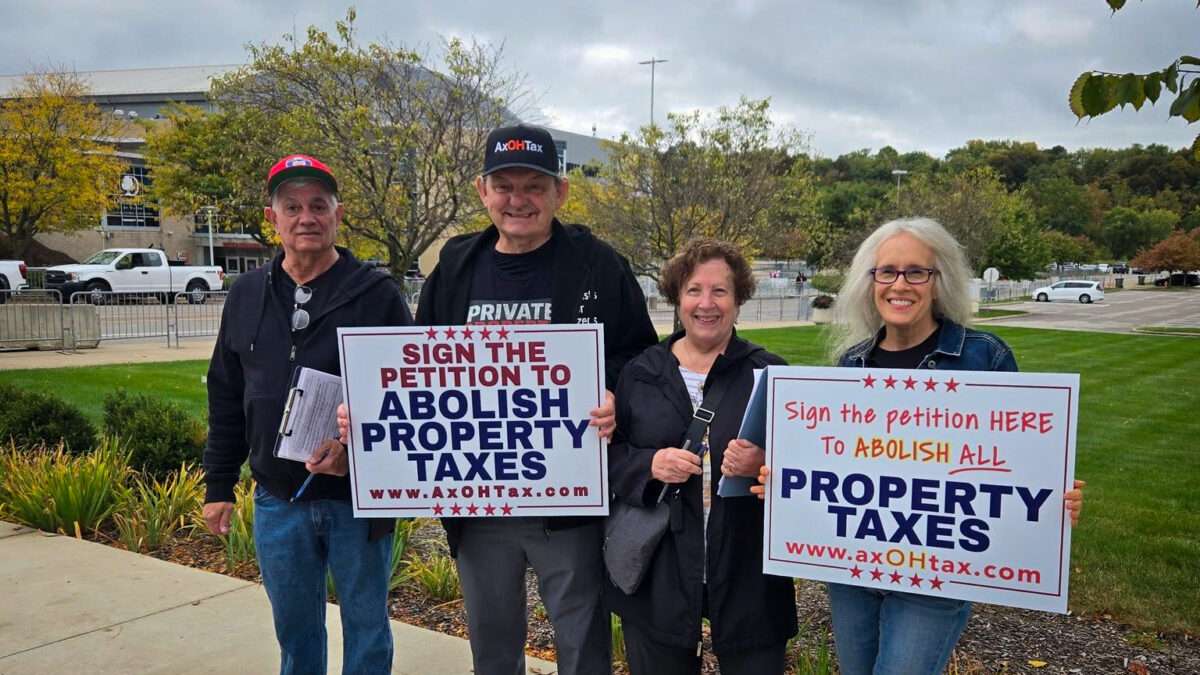
Four elderly protesters hold two signs that say "Sign the petition to abolish property taxes." | Denise DiFabio/Facebook

If you have to pay a regular fee to maintain control and use of a home or other parcel of property, do you really own it? Or are you just renting it from whoever collects the money? That's the question behind a growing movement against property taxes, which is winning support across the country and may see its next big test in the form of a proposed constitutional amendment on the Florida ballot that would significantly trim taxes on owner-occupied homes.


'Property Is the Foundation of Liberty'—and a Big Source of Tax Revenue

Advocates of reform understandably champion the inviolability of private property, which is threatened by continuously rising levies. Opponents predictably include people who fear reduced government revenues, but also those who worry that cutting property taxes will shift power to state governments at the cost of local autonomy.

"Property is the foundation of liberty," argues economist Vance Ginn. "It represents the right to the product of voluntary exchange, investment, and saving—not a privilege granted by government. To tax property again every year after it has been bought with after-tax income is to deny genuine ownership. Property taxes operate like an annual wealth tax or unrealized capital-gains tax, applied regardless of income or ability to pay."

Opposing Ginn's argument in the debate is the Tax Foundation's Jared Walczak, who is not so much a fan of property taxes as a believer that they suck less than the alternatives.

"Spending restraint can reduce property tax burdens," argues Walczak. "But with property taxes accounting for 70 percent of local tax collections nationwide and upwards of 90 percent in some states, any discussion of property tax elimination must grapple with revenue alternatives."

"It is axiomatic that whatever you tax, you get less of," he adds. "Taxing income means less income-producing labor and investment, for instance. But because land is an immobile asset, taxing property does less to distort market decisions than taxing income or even sales."

Walczak also points out that while property taxes are usually imposed by local governments, most alternatives to property taxes come at the state level. That would move power further up the political food chain, away from the property owners worrying about their tax bills.

To this, Ginn responds that governments at all levels cost more than they should and that "the moral and fiscal failure of property taxes lies not only in how the money is raised, but also in how much government spends."

That means the debate over property taxes isn't just a struggle between those who want to trim the state's take and those who prefer larger government, but also between anti-tax activists and their frequent allies among advocates of local power. In a piece this week on the groundswell against property taxes, Politico's Liam Dillon notes that "the uprising's most pitched battles are being fought in Red States where the issue has emerged as yet another dividing line on the right."


Localities Are Dependent on Taxing Property

The debate over property taxes is fierce partially because governments have come to rely so heavily on them. "In fiscal year 2023, property taxes comprised 28.9 percent of total state and local tax collections in the United States, more than any other source of tax revenue, despite being levied almost exclusively at the local (not state) level," Janelle Fritts wrote for the Tax Foundation.

Property taxes in the U.S. range from roughly half a percent to just under 2 percent of assessed home value. States that rely most heavily on them, like New Hampshire (1.5 percent in 2024) and Texas (1.4 percent in 2024), also tend to leave a lot of government responsibility in local hands that might be exercised at the state level elsewhere. It's worth noting that Cato's Freedom in the 50 States ranks New Hampshire as having the second least burdensome tax regime among states, with Texas in fourth place.

The lowest taxed states in property terms are Alabama (0.37 percent in 2024), Arizona (0.48 percent), Hawaii (0.29 percent), and Utah (0.48 percent). Some states, such as Illinois (1.88 percent in 2024) and New Jersey (also 1.88 percent), tax the hell out of many things to support large and intrusive governments. Hawaii, despite low property taxes, is ranked as the most tax-burdened state by Cato.

As mentioned above, economists tend to like property taxes because they are efficient, minimally distort economic decisions, and empower localities relative to state and federal authorities. But as Politico's Dillon emphasizes, "everyone who is not an economist seems to hate property taxes."


Homeowners Don't Like the Insecurity That Comes With Property Tax Bills

Property taxes rise with assessed property valuations that homeowners have no control over, as the market shifts with supply and demand. They require what feels an awful lot like an annual rent payment to keep a roof over people's heads many already paid for. That reduces the sense of security that owners feel in their homes, since their habitation remains conditional on meeting local authorities' demands. The bite of sales taxes can be reduced by buying less, and income taxes are dependent on earning paychecks, but property taxes (with some local exceptions) come due no matter what.

Soaring property valuations in recent years drove property tax bills higher for Americans who did nothing but remain at their established addresses, though localities can and sometimes do adjust tax rates to offset rising values. USA Today reported that "between 2019 and 2023, the median value of annual property taxes increased nearly 25%." That has energized the movement to cut or abolish the taxes.

Efforts to reform property taxes have been effective in more than a dozen states, according to Governing. Most of these efforts involved reducing taxes, though eyes are currently on Florida where Amendment 3, a proposed change to the state constitution, would incrementally raise the homestead exemption to $250,000. It also would require "the Legislature to prescribe a uniform procedure for counties and municipalities, for their respective levies, to increase the homestead exemption up to full assessed value," effectively abolishing property taxes on owner-occupied dwellings.

As a constitutional amendment, the measure requires 60 percent of votes to pass. Polling shows more support than opposition, but not necessarily at the supermajority level necessary for victory.

According to the Tax Foundation, in Florida, "the statewide average sales tax rate would have to rise from 7.02 to 15.34 percent to replace the property tax" with equivalent revenue. Rates could widely vary if localities implemented sales taxes instead of leaving them to the state.

Of course, that assumes state and local governments continue spending and providing services at the same level. But as economist Ginn points out, the problem lies not only in how property taxes raise money "but also in how much government spends." If the property tax revolt represents revulsion not just at the tax, but at the expense of large government, that may require less revenue to fund a smaller Leviathan.

The post Grassroots Revolt Targets Unpopular Property Taxes appeared first on Reason Magazine.

  •  
❌