The AI data center boom looks like it's running into serious trouble. Projects are being delayed, canceled, or abandoned. Electricity shortages are holding everything up.
But there's a twist: A lot of these data centers were probably never going to get built in the first place.
Bernstein Research analyzed thousands of planned US data centers and concluded that only about 35% of the announced capacity is likely to become reality.
The industry has a wonderful name for some of the more dubious projects: "Bragawatts."
These are enormous data centers announced by companies that often have little experience building them. Some haven't secured electricity, construction permits, or even customers.
Then there are the "ghost projects." Developers submit multiple requests for electricity connections, hoping at least one location works out. In Texas, these requests have reached more than five times the state's existing electricity supply.
No wonder the grid looks overwhelmed.
This doesn't mean the AI boom is fake. Far from it.
But there's a big difference between Amazon's very real problems and an inexperienced developer announcing a gigantic project that may never happen.
The AI data center boom is real, and so are the challenges of building all these facilities. But the sheer number of speculative projects may be making those challenges look bigger than they truly are.
Pilots' reliance on autopilot may offer workers clues on how to navigate AI in the workplace.
aviation-images.com/Universal Images Group via Getty Images
Pilots have faced the risk of deskilling for decades because of their reliance on autopilot.
Steven Shaw of King's College London said they can show workers how to stay sharp with AI.
"Even experts are at risk of deskilling," he said.
Pilots have relied on autopilot for decades. Their experience could offer a lesson for workers increasingly relying on AI.
Steven Shaw, an assistant professor at King's College London and coauthor of a widely cited study on "cognitive surrender," drew a parallel between pilots' reliance on automation and workers outsourcing their thinking and delegating their work to AI.
"We've had autopilot in planes for a very, very long time," Shaw said, speaking at a recent OxGen Summit panel. "So they learn to fly manually first, and then they learn to use autopilot strategically."
Some federal aviation guidance encourages pilots to occasionally switch off autopilot to maintain their manual flying skills.
There is a long track record of this. In a 2013 safety alert, the Federal Aviation Administration warned that "continuous use of autoflight systems could lead to degradation of the pilot's ability to quickly recover the aircraft from an undesired state."
The agency reiterated the importance of manual flying in a 2017 alert, recommending that airlines encourage pilots to practice without autopilot periodically when conditions permit.
"Even experts are at risk of deskilling," Shaw said, referring to the dangers of repeatedly outsourcing cognitive tasks to AI.
Shaw's warning comes as some tech leaders, AI researchers, and politicians have cautioned that overreliance on AI could weaken workers' underlying cognitive abilities.
Speaking at More Perfect University's "Students vs. Billionaires" town hall in Maine on Thursday, Rep. Alexandria Ocasio-Cortez warned that "AI's goal is to take your thoughts away from you, your ability to think away from you so that you become dependent on a machine."
OpenAI CEO Sam Altman said in July that one of AI's most overlooked risks was "cognitive atrophy," while Arthur Mensch, CEO of French AI startup Mistral, said last year that the technology's biggest risk could be "deskilling."
Think before you prompt
Early research is showing how readily people outsource their thinking to AI.
Vivienne Ming, an AI researcher and theoretical neuroscientist, told Business Insider in March that one of her experiments, involving 72 participants, found that roughly 90% to 95% either relied on AI to generate answers or used it to validate their assumptions, rather than challenge and deepen their thinking.
"The overwhelming trend is substitution," she said.
Similarly, Shaw's research suggests that the danger is that people increasingly accept AI's answers without thinking critically.
In experiments involving 1,372 participants, people accepted AI recommendations nearly 80% of the time even when the answers were deliberately incorrect.
Shaw calls this phenomenon "cognitive surrender."
His advice for avoiding it is straightforward: develop your own judgment before asking AI for help.
"Just think first and then go to the prompt," he said during the OxGen Summit panel.
Starting with AI, he warned, can narrow the range of ideas people consider independently.
Other experts have offered similar advice. Geetha Rajan, a former AI adoption leader at PwC, previously told Business Insider that she writes her own first drafts before using AI to check facts and challenge her work.
Ryan Deiss, CEO of DigitalMarketer, advocates a "10-80-10" rule: humans handle the first 10% of a task, AI takes on the middle 80%, and humans return for the final 10% to exercise judgment and refine the result.
Vercel's Tom Occhino, left, with Tools for Humanity's Tiago Sada at an event in San Francisco in April.
Kimberly White/Getty Images for Tools for Humanity
Everyone complains about AI-generated junk.
But decades of sloppy human-written software may be a much bigger problem.
This week's "Black October" freakout was caused by human slop, not AI.
The internet has a slop problem. And for once, we can't blame AI.
Most of us spend hours online every day without thinking much about the software holding everything together. We assume somebody, somewhere, has made sure it all works properly.
So it probably came as a shock this week to discover just how vulnerable some of that software is.
The cybersecurity freakout dubbed "Black October" has inspired warnings about AI-powered hackers, digital catastrophe, and even advice to stockpile cash and canned food.
At first glance, AI looks like the villain. But this is largely a human-made mess.
Here's the problem.
The internet runs on decades of software, some of it containing security weaknesses that have been overlooked, tolerated, or simply left unfixed.
For years, that was a manageable gamble. Fixing software takes time and money. Exploiting obscure weaknesses often required considerable expertise. Companies could convince themselves that the risk wasn't worth worrying about.
AI is changing that calculation. Someone who once needed years of training to hunt for weaknesses can now get help from an AI model. These tools can also examine software at speeds that humans can't match.
Suddenly, all those problems we've been ignoring look more urgent.
"Over the last 10 years the risk acceptance process has morphed from a way to accept risks to enable the business, to a way to justify never fixing security issues," Joel de la Garza and Zane Lackey, partners at a16z, wrote on Friday.
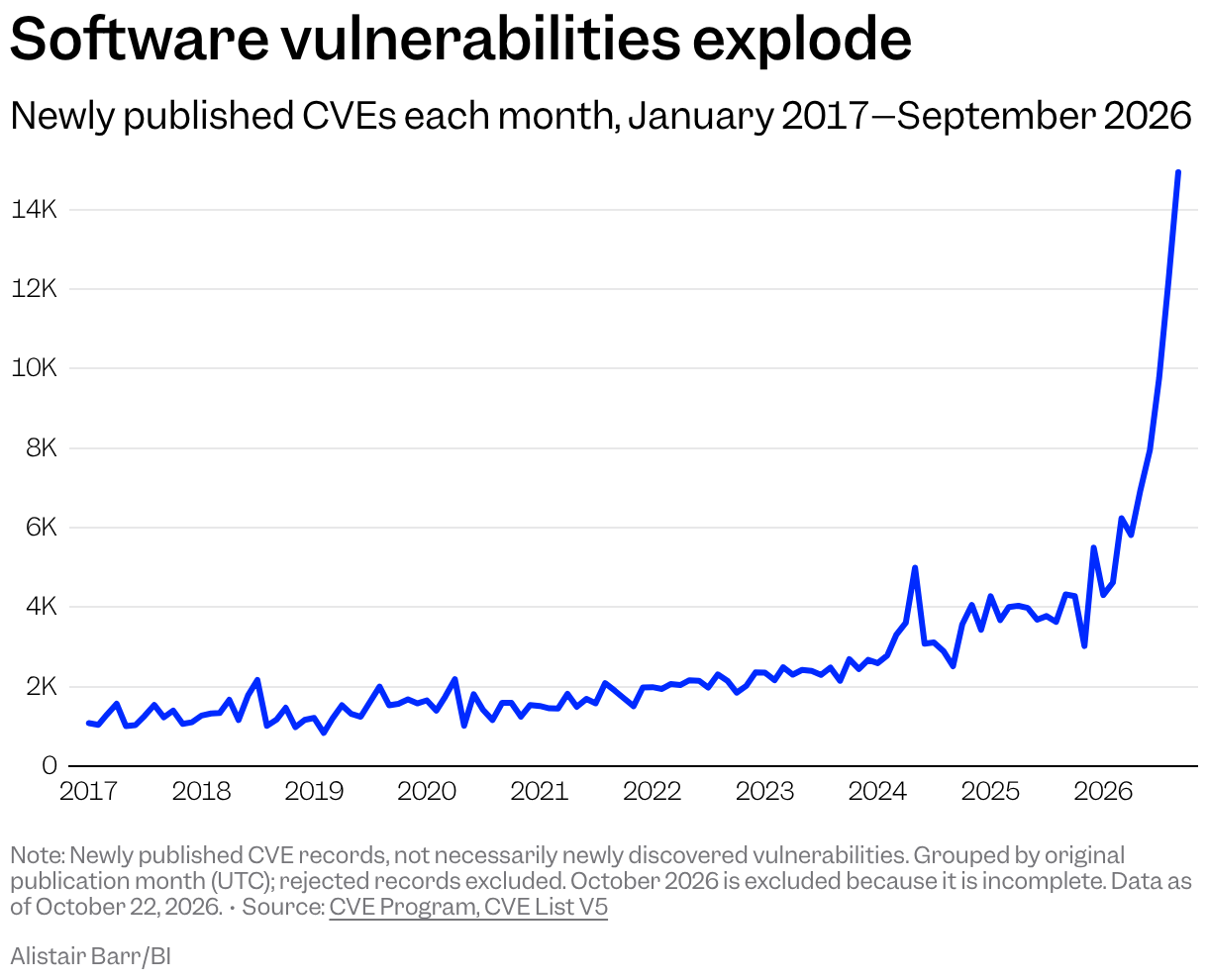
That's quite an indictment. The result is a recent surge in published vulnerabilities.
This looks like AI is creating new security problems. But it's actually AI exposing weaknesses that humans left behind.
Slop irony
The irony is delicious. We've spent the past couple of years complaining about "AI slop." Turns out human slop can be pretty consequential, too.
"The funny thing is everyone was saying AI slop code will cause a cyber crisis but it's actually all the old human slop causing it and the AI is just cleaning it up," software engineer Ben Kaufman wrote on X on Thursday.
"Humans have been the ones writing and reviewing each other's code for decades," tech founder Anant Jain wrote on X. "If we're being intellectually honest and holding ourselves to the same bar we hold AI to, we'd have to admit that we haven't been all that good at it either."
Humans are sloppy
Anyone who's worked with other humans for a decade or two knows exactly how this happens.
It's Friday afternoon. You've almost finished a project. You could spend another few hours making it perfect, or declare it 90% done and head off to that dinner party. We've all been there.
AI agents don't have dinner parties. They don't get tired on Friday afternoons. They can keep searching, testing, and trying again. That persistence is now colliding with an internet built by busy, imperfect humans who often settled for "good enough for now."
A tragedy of the commons
There's another wrinkle here, though, and it's an important one.
Much of the software underpinning the internet is freely available for anyone to use. Some of it is maintained by volunteers or small groups of experts, even as enormous technology companies depend on it.
In 2020, the cartoonist Randall Munroe captured this absurdity in an xkcd comic. Modern digital infrastructure still rests precariously on tiny foundations.
It's funny because it's uncomfortably close to reality. Take the specific PHP problems from this week. These flaws have existed for years, and the PHP Foundation acknowledges that limited resources and disagreements over fixes contributed to delays in fixing them.
Tom Occhino, chief product officer at Vercel, brought up Munroe's cartoon during my recent interview with him.
He explained that AI is finding weaknesses even in software that the industry has treated as dependable for decades.
This is partly a version of the tragedy of the commons: Everyone benefits from a shared resource, but no one has sufficient incentive to take responsibility for maintaining it.
And let's be clear: The volunteers keeping essential software running aren't the villains here. The companies benefiting from their work have a much greater responsibility.
Occhino thinks AI could help solve the problem it is exposing.
He described an idea being discussed at Vercel: Create a foundation or coalition that funds efforts to identify vulnerable software and replace it with safer alternatives.
"We need a consortium. We need a coalition," he told me.
He suggested companies could contribute computing resources and AI tools to the effort. Nothing has been formally announced, but the idea is compelling.
Indeed, OpenAI's Patch the Planet effort is an example of what's possible.
Rather than simply using AI to create more software, the industry could use it to repair what already exists.
Occhino put it nicely: Companies need to spend less time chasing new ideas and more time asking how to make existing systems "just work really, really well."
That's a better response than panicking about the imminent collapse of the internet.
AI didn't create decades of neglected software. We did. Perhaps it's time to clean up our own slop.
The design platformlaunched Canva Craft on Thursday, its first image-generation model, similar to those from Google, Meta, and OpenAI.
Users can access Craft through Canva’s Dream Lab, including with free accounts, though it is subject to AI usage limits. You’ll need to sign in to a Canva account to get started.
In the release announcement, Canva said the tool plans a design’s layout, proportions, and text before generating an image, an approach that aims to help it produce legible lettering and accurate details.
The company also said that the model was trained on human-designed Canva templates, including posters, menus, and presentations, rather than photographs.
To test how Canva performs, Business Insider created three image generation prompts with escalating difficulty levels — from designing a simple greeting card to creating a photorealistic image from scratch.
Here is how Canva's brand-new image generation tool stacked up against three of the most powerful models.
Canva did not respond to a request for comment.
Starting off with an illustration
Canva's response to a greeting card prompt (left), compared to ChatGPT (middle) and Gemini (right).
Business Insider
We started off simple with a prompt for a birthday card.
Create a cartoon "Happy Birthday" greeting card for a friend named Jessica who has pink hair, brown eyes, likes to wear paisley, and is turning 28 years old in November.
Surprisingly, Canva, the design platform, fell short in its design of the birthday card, from the awkward font to the outsize head of the cartoon character. It didn't even bother to include any paisley.
By comparison, ChatGPT and Muse understood the assignment.
ChatGPT guessed that the recipient's favorite color might be pink, while Muse thoughtfully wove in cozy fall elements for the November birthday girl.
Muse wove in cozy fall elements for the November birthday girl.
Screenshot/Business Insider
Meanwhile, Gemini took the request literally and produced an image of an actual card. Extra points!
Winner: Muse
Editing an image
The request and original image (left). Canva's results (right).
Screenshot/Business Insider
For the second task, I tested the AI models' ability to identify an element and place it in a brand-new setting.
Edit this image of me holding a necklace pendant. Take the red garnet pendant off my hand and make it look as if it is displayed in a vitrine in a jewelry showroom.
Canva did a great job of identifying the pendant and creating an atmospheric setting, but, like Gemini, it depicted the jewelry in a way that defied physics and common sense. It would be unrealistic for a pendant to float in the air or sit propped on a metal pole.
ChatGPT (left), Muse (middle), and Gemini (right).
Business Insider
ChatGPT and Muse once again outperformed other models in understanding how things typically look in reality. Muse, however, made some alterations to the pendant, which I didn't ask for.
Winner: ChatGPT
Creating a photorealistic image from scratch
Canva's depiction of a cat perched atop a gothic castle.
Made with Canva/Business Insider
With Halloween approaching, I asked for a realistic depiction of my favorite animal.
Generate a photorealistic image of a long-haired orange tabby cat in a Halloween costume with bat wings, perched on the edge of a gothic medieval castle under the full moon and a starless night sky.
Though the cat's fur looks a little too strandy and high-contrast in Canva's creation, no components are missing or malformed, and the image composition pretty much matches the quality of Muse and Gemini.
The clear winner for me in this round, however, would be ChatGPT.
Gemini (left), ChatGPT (middle), and Muse (right).
Business Insider
Not only is the cat's posture majestic, but the soft glow on his left side is extremely realistic, and the white balance is well done. There are also clouds softly cradling the moon, which could be a response to my request for a starless sky.
Winner: ChatGPT
Overall, it's evident that Canva still has a lot of room to grow compared to other models, especially if graphic design is its focus. For now, I'll stick to moving components around by hand.
The US has been building these computing facilities for decades, but development has ramped up dramatically in recent years as AI increasingly drives demand for computing power.
Business Insider compiled a list of some of these enormous US data-center projects to illustrate the scale of what's being built. Those on the list have at least 1 gigawatt of capacity and have broken ground.
Among the largest is a city-sized campus in Texas pursuing up to 17 gigawatts of power capacity. Another in Ohio is aiming to have up to 10 gigawatts of data-center capacity, most of which OpenAI has contracted to use. For reference, 1 gigawatt of electricity continuously supplied for a year could power roughly 835,000 average American homes.
In total, the Pew Research Center says the US has more than 3,000 operating data centers nationwide and over 1,500 more under development, mostly in rural areas. According to data from the Energy Institute's 2026 Statistical Review of World Energy, US data centers accounted for nearly 40% of global data-center electricity use in 2025, consuming about 313 terawatt-hours. That's more electricity than all of Australia used that year.
Planned capacity is the closest public proxy for how much computing these AI campuses can support, and that's important because the electricity and water needed to run their servers and cooling systems can have major implications for local grids and sustainability.
Residents affected by developments in places like Texas and Utah have pushed back over concerns about noise, property values, and the effects on nearby communities. New York has temporarily paused the construction of new large-scale AI data centers.
Still, the 2025 US Data Center Energy Usage Report from Berkeley Lab projects that data centers will consume 11.8% of US electricity by 2030, up from about 4.4% in 2023. Oracle, SB Energy, SpaceX, Google, and Meta are among the leading developers and operators.
Elon Musk's SpaceX is so eager to build its supercomputers that it's offering employees a pay bump to temporarily move to the data-center sites to help with the buildout.
Here's a closer look at some of the largest AI data-center campuses being built.
Meta Lebanon Campus — Indiana
Thibault Camus/AP
Mark Zuckerberg's Meta currently has 21 data centers under construction. Its Lebanon, Indiana, data center is one of its biggest investments — and the company's second in the state.
It's expected to be completed by early 2028. Neighbors have complained about light pollution from the construction, while residents across Indiana have urged state lawmakers to regulate the growing data-center industry.
Meta El Paso Data Center — Texas
EL PASO, TEXAS - AUGUST 13: In an aerial view, the Meta El Paso Data Center is seen on August 13, 2026 in El Paso, Texas. Meta Platforms continues construction on its more than $10 billion Meta El Paso Data Center in Northeast El Paso, Texas. Occupying approximately 1,000 acres, Meta has expanded the project to 1 gigawatt of
Brandon Bell/Getty Images
Meta's data center in El Paso, Texas, is planned to be powered by 1 gigawatt of capacity and span roughly 1,000 acres. It originally called for $1.5 billion in investment, which later increased to $10 billion.
The center will support more than 300 workers once complete, while around 4,000 construction workers are expected to build it out.
The site broke ground in October 2025 and is expected to be finished in 2028. The site has also sparked backlash from residents.
Project Freebird (Stargate) — Texas
OpenAI CEO Sam Altman
Bloomberg/Getty Images
Project Freebird is part of Stargate, the AI-infrastructure initiative co-led by OpenAI and SoftBank, which OpenAI said in January 2025 would invest up to $500 billion in US infrastructure.
Freebird will be a 1.2-gigawatt data center campus in Milam County, Texas, near Austin. The first phase was expected to be completed by October, while additional phases are planned through 2028. Construction began in 2025.
However, the company has not issued any update on the data center's completion as of late October.
The site, being developed by SB Energy, a SoftBank-backed infrastructure company, will span roughly 595 acres. Phase 1 has an estimated construction cost of $470 million, while total investment in the broader project is expected to range from $1.8 billion to $3 billion.
The first phase had a scheduled construction-completion date of October 15, while SB Energy says operations are expected to begin in 2027.
Fort Wayne Data Center — Indiana
Google CEO Sundar Pichai delivers a speech during the AI Impact Summit in New Delhi in February 2026.
Ludovic MARIN / AFP via Getty Images
In 2024, Google broke ground on a $2 billion data center campus in Fort Wayne, Indiana, to support its AI and cloud operations.
The campus is expected to require up to 1.2 gigawatts of power at full build-out. Some Indiana politicians have expressed concern about the amount of power required to run the data center and who will foot the energy bill.
"If companies want to build a data center here, and we have to build new power generation for them, then they need to share in that risk," Indiana Rep. Ed Soliday, a Republican, previously told Business Insider. "There are a couple of data center folks who have said, 'Oh no, that's not fair.' Yes, it is. Grandma down the street shouldn't have to pay for your dreams."
Stargate Abilene — Texas
The Stargate AI data center in Abilene, Texas.
Bloomberg/Getty Images
The Stargate AI data center campus outside Abilene, Texas, is expected to deliver 1.2 gigawatts of capacity. Crusoe, the lead developer and builder behind the project, broke ground on the campus in June 2024. The first phase is already operational.
The second phase, which is under construction, is backed by a $15 billion joint venture between Crusoe, Blue Owl Capital, and Primary Digital Infrastructure. It will add six buildings to the campus, bringing the total to eight and the planned capacity to 1.2 gigawatts. The site will span 875 acres.
Nebius AI Factory — Missouri
Danila Shtan, chief technology officer at Nebius. The company is an AI cloud infrastructure provider headquartered in Amsterdam.
Bloomberg/Getty Images
Nebius' data center in Independence, Missouri, will span roughly 400 acres and reach a capacity of up to 1.2 gigawatts. The company broke ground in May and is expected to bring roughly 1,200 construction jobs and 130 permanent jobs.
Nebius has not announced a total investment amount, though the city expects to begin collecting tax revenue from the campus in 2028.
The site hasn't come without controversy. A group of citizens is suing the city of Independence and companies involved with the project, alleging 16 counts, including claims that the city violated Missouri's Sunshine Law several times by failing to provide finalized data center construction plans. Nebius did not offer a comment.
CloudBurst San Marcos Data Center I — Texas
CloudBurst Data Centers and Evolve Holdings broke ground on the site in late 2025.
Evolve Holdings
CloudBurst's San Marcos Data Center I is a planned 1.2-gigawatt capacity campus on 706 acres in central Texas. Guadalupe County approved a $500 million tax abatement for the project.
The company and its development partner, Evolve, broke ground in November 2025, with an initial 50-megawatt phase expected to be complete by late 2026. Construction is expected to be complete in 2029.
San Marcos residents have protested proposed data centers over water and energy concerns. The city has since become the first in Texas to ban new data centers, though the ban won't stop CloudBurst's project, which is outside city limits.
The Barn Data Center — Michigan
Jim West/UCG/Universal Images Group via Getty Images
The Barn, part of the Stargate project, is a multi-billion-dollar AI data center campus in Saline Township, southwest of Ann Arbor, Michigan. Related Digital, a data-center developer, is building the campus for Oracle as part of its partnership with OpenAI. Construction for The Barn began in June.
The campus will comprise three data center buildings with a combined capacity of 1.4 gigawatts. The $16 billion project is backed by Related Digital and investment firm Blackstone. The first facilities are expected to enter service by the end of 2027.
In October, state regulators opened public comment on a wastewater permit for the campus’s proposed on-site water-treatment system.
Stargate Frontier Campus — Texas
OpenAI CFO Sarah Friar (left) and CEO Sam Altman (right) during a media tour of the Stargate AI data center in Abilene, Texas, in 2025.
Bloomberg/Getty Images
The Stargate Frontier Campus, developed by Vantage Data Centers, will be a 1.4 gigawatt, 1,200-acre data center in Shackelford County, Texas, near Albany in north-central Texas.
The campus is part of the broader Stargate initiative led by OpenAI, Oracle, and other partners, and is being designed for ultra-high-density AI workloads. Vantage plans to invest more than $25 billion in the project, which is expected to be fully built out by 2028.
Work continues on a data center being built by SpaceXAI on August 2, 2026 in Southaven, Mississippi. Hastily built to meet the skyrocketing demand for computing power required by the global artificial intelligence race, these data centers are meeting stiff opposition across the United States. In Southaven, 69 turbines are constantly in motion to
Brandon Dill / AFP via Getty Images
Elon Musk's xAI is building Colossus 2 to power Grok, the AI chatbot on X. Construction began in 2025 in Memphis, Tennessee, and the company has said it plans to expand the site to 1.5 gigawatts. The nonprofit research institute Epoch AI estimates its current capacity at about 946 megawatts.
Environmental justice groups, led by the NAACP, sued xAI earlier this year, alleging that the company installed and operated gas turbines that power Colossus 2 in nearby Southaven, Mississippi, without the required air permits. In March, Mississippi regulators approved a permit for xAI to build and operate a new fleet of turbines at the site.
Local residents have filed a class-action lawsuit against xAI, MZX Tech, and SpaceX, alleging that noise and vibrations from the gas turbines have disrupted their lives and harmed their property values.
Still, in late October, Business Insider reported that SpaceX was offering employees a 20% pay bump to temporarily relocate to Memphis or Southaven, Mississippi, for six weeks to help build out Colossus 1 and 2.
Project Jupiter — New Mexico
Project Jupiter is located in Santa Teresa, New Mexico
Omar Ornelas/El Paso Times/Reuters
Developed by infrastructure companies STACK Infrastructure and BorderPlex Digital Assets, Project Jupiter will be an AI data center campus in Doña Ana County, New Mexico, near the Texas border. It is part of the Stargate initiative and is expected to support Oracle's AI-computing operations for OpenAI.
Construction for Project Jupiter began in September 2025. The campus's planned on-site power system could include up to 2.45 gigawatts of Bloom Energy fuel cells, replacing an earlier proposal centered on gas turbines and diesel generators.
In May, Oracle ditched its plan to construct a natural gas plant to power Project Jupiter, following local residents' concerns over the potential negative water usage and air pollution effects it could cause.
Oracle issued a force majeure notice in September due to potential delays in the project's power infrastructure, though it says the campus remains on track for 2028.
Meta Hyperion — Louisiana
Aerial view of Richland Parish Data Center.
Meta
Meta's Hyperion AI data center in rural northeast Louisiana, backed by more than $50 billion in investment, will span more than 3,600 acres and is planned to deliver 5 gigawatts of capacity once fully developed. Hyperion broke ground in December 2024.
Meta says Hyperion is designed to train and run its artificial-intelligence systems. Earlier this year, Louisiana gave Meta $3.3 billion in tax breaks for Meta to build Hyperion. The project is expected to be completed in the 2030s.
Since the center is located in a rural part of the state, the influx of 7,500 trade and construction workers has spurred a housing boom, with mobile homes built for workers that rent for $3,000 a month.
Still, the project has also faced pushback from local residents and environmental groups concerned about its impact on water, energy use, and the surrounding community.
Louisiana regulators held hearings in October on the proposed power build-out for the campus. The state's Public Service Commission will issue a decision in December.
PORTS-Pike Technology Campus — Ohio
Breaking ground at the Portsmouth Site on March 20
US Department of Energy
The Department of Energy said SB Energy broke ground in March in Ohio on the planned AI and cloud campus at the former Portsmouth Gaseous Diffusion Plant, known as PORTS. The campus will span private land and remediated federal land leased from the DOE.
The Nvidia-backed project is expected to include up to 10 gigawatts of data-center capacity, with OpenAI set to use up to 8 gigawatts of it for its workloads.
While the DOE says the historical PORTS site is in active remediation, the project has raised concerns about potential health and environmental risks associated with the site's history as a uranium enrichment plant. SB Energy told the Guardian in August that it is "committed to paying for accelerated cleanup and remediation at the site" and that the company "performs thorough site reviews and due diligence for each of our infrastructure projects, including soil sampling."
SB Energy said in October that it would begin initial clearing and grading work for the campus’s first phase.
Project Matador — Texas
Construction work at Project Matador's 17GW Private Power Campus
Fermi America via PR Newswire
Fermi America's Project Matador, also called HyperGrid, is an AI data center and private power campus being built near Amarillo, Texas.
Fermi, which was co-founded in 2025 by former Texas Gov. and US Energy Secretary Rick Perry, said it is pursuing roughly 17 gigawatts of private power for the campus, up from the initially planned 11 gigawatts. That means the campus would generate much of its own electricity on-site rather than relying entirely on the public grid. The company says 6 gigawatts have been permitted so far.
Fermi has a 99-year land lease with the Texas Tech University System for the core site, and the project could span roughly 8,400 acres at full build-out. Fermi says construction is underway, with completion planned for the 2030s, and AI cloud company TensorWave has signed a 15-year lease expected to generate about $6.5 billion in contracted revenue for the first phase. Fermi is also developing a cooling system designed to substantially reduce water use.
The company was hit with a class action lawsuit earlier this year. The investor lawsuit alleges Fermi misled investors about the status and prospects of Project Matador; its shares fell after Amazon withdrew a $150 million construction advance in December 2025.
SpaceX, Meta, Google, Oracle, Fermi America, CloudBurst, and xAI did not immediately respond to a request for comment from Business Insider. SB Energy did not offer a comment.
Uber is giving all of its corporate employees access to OpenAI's enterprise tool
Bloomberg/Getty Images
Uber is giving its corporate employees access to OpenAI's enterprise work tool.
ChatGPT Work can "prepare meeting briefs," among other tasks, OpenAI said.
Uber is rolling out the tool after laying off thousands of workers last month.
Uber is giving all of its corporate employees access to OpenAI's enterprise tool weeks after laying off thousands.
About 30,000 employees at the ride-hailing service's offices will have access to ChatGPT Work, the two companies said on Thursday.
The tool will connect with other programs that Uber employees use, such as Slack and Gmail, to "research information, prepare meeting briefs, create presentations, analyze data and complete workflows across applications," a statement said.
"As AI transforms how we work, we want to give everyone the tools to innovate, solve problems and help shape Uber's future," Uber CTO Praveen Neppalli Naga said. Uber initially tested the tool among a group of 1,000 employees.
The rollout comes the month after Uber laid off about 10% of its corporate workforce, or about 3,300 people. The company made the job cuts to reduce management layers and reduce the number of small teams, CEO Dara Khosrowshahi said at the time. It didn't cite AI in its announcement.
Some laid-off employees told Business Insider that AI was doing significant parts of their jobs, from answering their questions in Slack to crafting replies to messages from riders and drivers.
Uber cited AI as a reason for an earlier round of layoffs in July, which targeted Uber's customer service employees.
Do you have a story idea about Uber? Contact this reporter at abitter@businessinsider.com or via encrypted messaging app Signal at 808-854-4501. Use a personal email address, a nonwork WiFi network, and a nonwork device; here's our guide to sharing information securely.
This week's cyber freakout explained: AI is making software weaknesses easier to find and exploit.
The message from Cloudflare's Stephanie Cohen and Vercel's Tom Occhino: Don't panic!!!
Do we need everything connected to the internet? Paper bank statements work well.
A few weeks ago, I heard a strange story about a friend who works at one of the Big Tech companies in Silicon Valley.
She'd recently ripped out the connected devices in her home, ordered paper bank statements, and stocked up on canned goods in her basement.
Now, she's a very sane, experienced person, and quite senior at one of the largest internet companies on earth. Why was she disconnecting so much? Just to be sure, my family ordered paper bank statements, too. It was still a head-scratcher, though.
Fast forward to this week, and her actions look a little less crazy.
The digerati have now entered full freakout mode. Much of the internet meltdown is happening on, well, the internet, my colleague Alice Tecotzky noted.
On X and Reddit, warnings of a looming “Black October” spiraled into visions of AI grinding civilization to a halt. One lengthy post on X warned of a potential “global cyberattack/AI swarm” and offered a survival checklist: Stockpile cash in small bills, print out your neighbors' phone numbers, download maps, buy a hand-crank radio, and stash a gallon of water per person per day.
Oh, and don't forget the manual can opener. You don't want to survive the AI apocalypse only to be defeated by a tin of beans.
Nikita Bier, a prominent app developer and former head of product at X, best captured the mood.
"The world is a little bit scary right now," she told me on the side of Cloudflare's annual conference in San Francisco this week.
Here's the problem. The internet is built on decades of software, much of it riddled with security holes.
Some of these weaknesses have been known for years. However, fixing them takes time and money, and hackers often lacked the skills to exploit them anyway. So they were left alone.
AI changesthat calculation dramatically. Someone who previously needed years of training to break into a computer system can now get help from an AI model. And these tools can search for weaknesses at a speed humans simply can't match.
Now, there's a frantic race between people trying to break into systems and those trying to protect them.
Don't panic about AI
Cohen's message, though, was surprisingly reassuring.
AI helps the good guys find and fix these problems. Cloudflare, for instance, released protections for the latest vulnerability to customers, including those using its free service.
And there's a bigger effort underway.
OpenAI has launched an initiative called Patch the Planet, working with Cloudflare and other security professionals to use AI to find weaknesses in widely used software and help repair them.
Tom Occhino, chief product officer at Vercel, told me recently that his company has been talking with partners about launching a nonprofit that would fund a swarm of good AI agents that go out on the internet to find and fix software flaws.
Amazon is joining the fight, too. Its new Continuum service, available Thursday, uses AI agents to find security holes and propose fixes. Amazon said that people maintaining freely available software can use it to help protect the wider internet.
Humans may still have to check and approve these repairs, but the prospect of AI helping clean up decades of neglected software is encouraging.
The irony of this is not lost on some in the industry.
"The funny thing is everyone was saying AI slop code will cause a cyber crisis but it's actually all the old human slop causing it and the AI is just cleaning it up," software engineer Ben Kaufman wrote on X on Thursday.
Either way, Cloudflare's Cohen thinks these AI-inspired freakouts will push the industry to do better — by exposing issues and adding urgency to get them patched.
"We may end up in a world where actually we've become significantly more secure at the end," she said.
The trouble is getting there.
A fundamental question about the internet
Tom Occhino (left), chief product officer at Vercel, talks with Meta executive Prashant Ratanchandani at Vercel's Ship SF conference.
Alistair Barr/Business Insider
When I ran into Occhino recently at a Vercel conference in San Francisco, he described a world in which software that everyone assumed was safe suddenly looksvulnerable because increasingly capable AI models are scrutinizing the basic systems that underpin the internet.
That led to a more fundamental discussion between us: Why did we connect so many things to the internet in the first place?
For years, the technology industry has raced to put everything online. Thermostats. Refrigerators. Doorbells. Cars. Bank accounts.
We assumed that connecting something to the internet automatically made it better.
Perhaps we should reconsider.
Before the internet
I remember the world before the internet. It worked pretty well. We managed to buy groceries, pay bills, heat our homes, and generally get through the day without every appliance talking to a computer somewhere.
That doesn't mean abandoning online banking or throwing your smartphone into the sea.
Occhino, for one, isn't particularly worried about hackers wiping out his bank account. Modern banks have sophisticated protections, and he recommends everyone turn on additional login security.
Maybe the cybersecurity crowd, which spends its life immersed in online threats, is missing something obvious.
Not everything needs to be connected.
Occhino put it neatly: "There's certain things that don't make sense to be on the internet in the first place."
Perhaps that's the lesson from this week's panic. We don't need to turn off the internet.

 Login