Login

Zelenskyy can leverage Moscow ties from comedy days to make peace deal, says former key aide
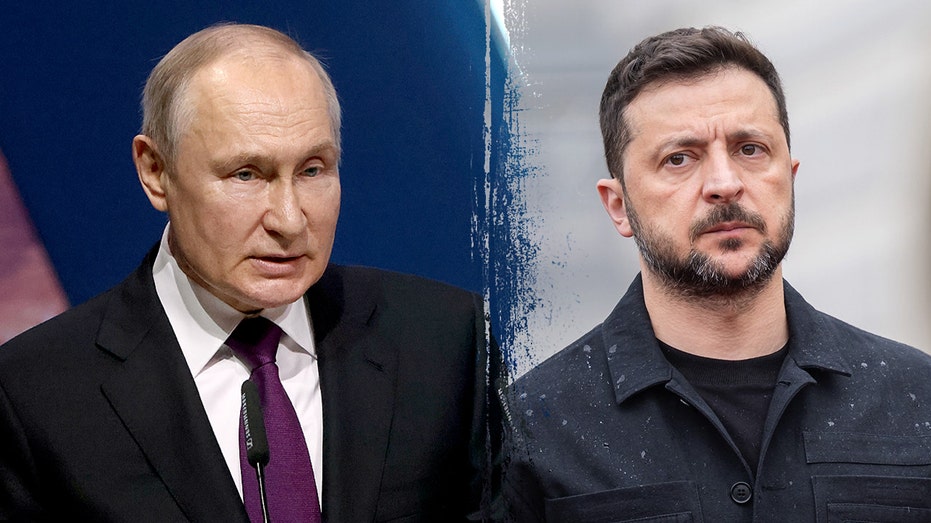
Ukrainian President Volodymyr Zelenskyy's former spokesperson urged him Sunday to meet Russian President Vladimir Putin face-to-face in Moscow, arguing that his past business and political connections in the Russian capital from years back could help him negotiate a peace deal there.
Iuliia Mendel, who served as Zelenskyy's spokesperson from 2019 to 2021, told Fox News Digital that the former comedian had also made his first millions in Russia and should perhaps leverage those ties to pursue lasting peace.
"When Zelenskyy was an entertainer, he often performed in Moscow," Mendel said, adding that the Ukrainian president "knows a lot of people from Putin's elite."
"He actually professionally grew in Moscow and earned his first millions in Moscow, and today he pretends that he has nothing in common with them," Mendel said.
"He needs to go to Moscow and needs to agree on compromises that are acceptable," she said, before adding that Zelenskyy "doesn't need to play his maximalist games and to play this noble actor."
Mendel's criticism came as Ukraine, Russia and the United States prepared for another round of technical-level peace talks, potentially in Abu Dhabi or Switzerland, in November.
U.S. envoys Steve Witkoff and Jared Kushner have helped lay the groundwork for renewed negotiations that officials hope could finally lead to direct talks between the two leaders.
Before entering politics, Zelenskyy had built a successful entertainment career. Beginning in the late 1990s, he performed with the comedy troupe Kvartal 95, competed on the Russian-language comedy program KVN and later worked as an actor, writer and producer in television and movies.
From the late 1990s, he performed on Russian stages and at private parties and appeared in movies shown across former Soviet republics, Mendel claimed.
She said that after Russia annexed Crimea and launched its war in Donbas in early 2014, Zelenskyy traveled to Russia to work on the comedy film "Eight New Dates" which was released in Russian theaters in 2015.
According to a report by Business Insider, many of Zelenskyy's movies were also in Russian and were marketed to a Russian audience, David Dodson, an American movie editor who worked with Zelenskyy told the outlet.
"He was a well-loved comic, actor and performer in Russia, but after [the 2013-14] Maidan [Revolution], everything changed," Dodson said.
"People need to realize that Volodya’s movies were very big in Russia. Most of his market was in Russia. He’s always been a popular comedy star in Russia," Dobson also clarified to GQ when asked if he directed the former actor in "Eight First Dates" in Russia, released in 2012.
In 2013, the movie received the Russian National Movie Awards as the Best Russian Comedy of the Year.
In 2019, Zelenskyy also promised to relinquish ownership of a Cyprus-registered company operating a film studio in Russia after investigative journalists revealed that he and his business partners still owned three Russian companies, according to the Kyiv Post.
Zelenskyy's entertainment career made him a household name in Ukraine and other former Soviet republics before he entered politics and won Ukraine's 2019 presidential election with roughly 73% of the runoff vote on promises to fight corruption and pursue peace in eastern Ukraine.
Mendel argued that Zelenskyy's promise to bring peace at the time stands in stark contrast to the devastating war that has crippled the country and defined much of his presidency.
TRUMP ANNOUNCES IMMEDIATE ENERGY CEASEFIRE BETWEEN RUSSIA AND UKRAINE
"Zelenskyy became the president with 73% record support," Mendel said. "Because he promised to bring peace to Ukraine."
"And now he has been presiding for almost five years (over) the largest war in Europe since World War II. This shows a lot."
"When his country is bleeding, he needs to make a peace deal for his people," she said before adding that the leader "needs to put the interests of his people first, just for Ukraine to exist as an independent state."
Whether Zelenskyy should travel to Moscow has, in fact, become a flashpoint in efforts to arrange direct peace talks.
In 2025, Putin offered to host Zelenskyy for talks in Moscow, but the Ukrainian president rejected the invitation as Russian forces continued attacking Ukraine.
"He can come to Kyiv," Zelenskyy told ABC News at the time, saying he could not visit Moscow while Ukraine remained under Russian missile attacks.
In September, on the sidelines of the U.N. General Assembly, Russian journalists pressed Zelenskyy on when he would visit Moscow. He replied, "On a missile."
Mendel, however, argued that personal animosity between the two leaders has become the main obstacle to diplomacy.
"Today there are diplomatic efforts to try to stop this brutal and bloody war that Russia started," she said.
"But what we see now is a personal opposition between Zelenskyy and Putin that continues to grow into constant escalation in which people suffer tremendously, Ukraine's infrastructure, energy grid, and businesses are in ruins, and refugees are fleeing."
Russia launched its full-scale invasion of Ukraine in February 2022. More than four years later, peace negotiations are deadlocked over territory, security guarantees and the terms of a lasting ceasefire.
Moscow has demanded territorial concessions from Ukraine, including areas Russian forces do not fully control.
Kyiv has rejected ceding sovereign territory and insists that any agreement include enforceable security guarantees against another Russian attack.
RUSSIA RELEASES AMERICAN TEACHER IMPRISONED ON UKRAINE MERCENARY CHARGES AFTER TRUMP PRESSED PUTIN
Mendel went on to praise President Donald Trump's efforts to break the diplomatic deadlock, calling him the first Western leader to "challenge the status quo" and consistently push for an end to the war.
"For this reason, many Ukrainians place great hope in his ability to bring peace," she said.
"A sustainable peace deal cannot be reached solely between Zelensky and Putin; it requires the involvement and initiative of a strong third party to halt the ongoing devastation."
On Friday, the White House announced that first lady Melania Trump had helped broker a temporary ceasefire in Oleshky, a Russian-occupied town in southern Ukraine's Kherson region, to allow humanitarian aid deliveries, demining operations and civilian evacuations.
An estimated 1,700 to 2,000 people remain in the devastated front-line town, many of them facing severe shortages of food, medicine and other essentials.
The White House said the ceasefire would begin Oct. 29, although Ukrainian and Russian officials have indicated that operations could begin Oct. 27.
Pope Leo also reportedly spoke with Zelenskyy and Putin about the humanitarian crisis, according to Vatican News.
ZELENSKYY ACCUSES PUTIN OF DEFYING TRUMP'S CEASEFIRE PUSH, SENDS POINTED MESSAGE TO WHITE HOUSE
"Melania Trump has become synonymous with the words of a saver and a hero, since she has brokered the deal for Oleshky," Mendel said. "This is something that is going to save around 2,000 people and that neither Ukraine nor Russia could have solved for months and months."
"That is why, you know, what Melania Trump has done is actually a case to show that where two men are fighting, a woman can actually save lives," she added.
"And this is the new approach that would show that peace really should focus on human lives, not on maps and territories."
Mendel also criticized the influence of Zelenskyy's longtime ally Andriy Yermak on his diplomatic approach, arguing that the Ukrainian president has favored confrontation over compromise.
"Mr. Yermak was teaching Zelenskiy to be a strong man in diplomacy. And what today we see is actually diplomacy that doesn't exist," she said.
CLICK HERE TO DOWNLOAD THE FOX NEWS APP
"It's a diplomacy of humiliation, diplomacy of constant threats, diplomacy of demands," Mendel added.