❌

Reading view

Student List defeats Vučić’s Serbian Progressive Party

On October 25, an election list formed after two years of student-led protests in Serbia toppled Aleksandar Vučić and the Serbian Progressive Party (SNS). The announcement was met with street celebrations that continued throughout the night, recognizing the outcome as a chance to break with 12 years of the former president’s anti-people policies. 

Election turnout surged to almost 70% of registered voters. The Student List secured roughly 53% of the vote and the SNS came in second with close to 39%. The two options are set to be the only forces in parliament except for minority representatives.

“These results have shown that a genuinely homegrown – even if heterogeneous – movement can articulate social discontent with SNS rule, provided it makes a decisive break with the baggage of the pro-Western opposition,” the Party of the Radical Left (PRL) wrote in a reaction on Monday.

The Students List ran on a platform titled “Serbia or the Mafia,” consisting of anti-corruption promises and plans to tackle the political establishment’s capture of the media sector. It also included a call for more transparency in public procurement and recruitment in the public sector. The platform promised to limit import monopolies, lower drug prices, and make healthcare more accessible.

From the Novi Sad canopy collapse to the ballots

Sunday’s results were made possible by months of demonstrations and public assemblies triggered by the canopy collapse in Novi Sad in November 2024. Sixteen people died in the event. In the aftermath, students across the country threw their energy into a campaign demanding accountability for the tragedy. 

From the beginning, protesters insisted the Novi Sad disaster was a consequence of the SNS’s way of doing politics, marked by widespread corruption, nepotism, and disregard for the public interest. During his tenure as prime minister and president, Vučić attempted to cast himself as a supporter of multilateralism and a political figure critical of the West, yet his actions exposed this as a more rhetorical than anything else.

These actions included supporting extractive deals with British-Australian mining company Rio Tinto – which the European Union included on its strategic projects list despite risks posed to communities in Jadar and mass mobilizations against the project – as well as the launch of a drone factory in cooperation with Israeli arms producer Elbit Systems. In fact, despite the former SNS leader’s efforts to present him as neutral, Serbia’s involvement in arms trade to Israel has been such to warrant notes of particular concern by UN Special Rapporteur Francesca Albanese.

Locally, Vučić’s rule was marked by violent crackdowns on activists and campaigns, from the most recent student campaigns to Palestine solidarity. There was no substantial reaction to these reports from other European countries or the EU.

Aleksandar Vučić (center) with Bulgarian Prime Minister Rumen Radev and Albanian Prime Minister Edi Rama in June 2026. Rama is also facing a major wave of protests demanding his resignation. Source: Aleksandar Vučić/Facebook

On the other hand, while very heterogeneous in character, the student movement aligned itself clearly against the Gaza genocide. Some local groups made solidarity with Palestine a central issue in their mobilizations. They also mobilized against projects associated to US interests, including the redevelopment of the former General Staff complex – a Belgrade landmark damaged in the 1999 NATO bombardment of the city – into a luxury hotel by Jared Kushner, the son-in-law of US President Donald Trump. This project was also brokered while the SNS was in power.

Progressives within Student List face difficult task ahead

The student campaign grew in significance through decentralized plenums and consultations across the country. This approach was not abandoned even during the formation of election lists – leading to a roster of new candidates, previously largely unknown to the public. University staff and other education workers who had supported the mobilization from the early days figured prominently on this list.

The success of the Student List represents an extraordinary achievement, especially considering the movement faced obstructions at every turn. These included police violence and institutional intimidation over the past two years, as well as schedule provisions that jeopardized voting rights in the diaspora. 

“The progressive elements within the Student List and the movement now face a difficult task: to resist the forces of the establishment within their own ranks,” the PRL emphasized after the election.

Earlier on, the party and other progressive voices expressed “critical support” for the Student List, recognizing the elements of social justice incorporated in its platform – but also noting aspects belonging to a technocratic vision of governance. 

Read more: Albania’s protests show no signs of backing down

“When it comes to the published program, the measures set out in the ‘Serbia or the Mafia‘ plan are not enough to eradicate the structural injustice that has taken root in Serbia over thirty years of privatization, ‘structural adjustment’ to the Euro-Atlantic regime, and the weakening of public institutions – and their systematic incapacitation from carrying out their mandated functions and protecting the public interest against the arbitrary power of capital,” the PRL stated in September.

Despite such reservations, the hope embedded in the movement surrounding the Student List is clear. The PRL observed: “Beyond the mass politicization of students and the raising of awareness on many key social issues – and despite pressure from ‘opposition’ politicians who would rather keep all these topics quiet […] we consider the following to be progressive developments: the construction of a directly democratic movement that antagonizes both the government and the parliamentary opposition in practice […] open communication and cooperation with trade unions, which gave rise to the first mass protest-based May Day commemoration in many years […] and cooperation with informal labor and professional collectives, which gave rise to a new organization – the Social Front.”

  •  

Protests banned and curfews declared ahead of next major mobilization in France

Hundreds of thousands are set to take to the streets in cities across France on Saturday, October 24, once again protesting austerity and the cost of living crisis. Demonstrations are set to go ahead despite an extremely repressive response from the government and local authorities, including curfews and bans.

Over the past couple of days, a growing number of cities and regions have announced protest bans, drawing criticism from trade unions and progressive groups. “The government has banned demonstrations on Saturday in Lyon, Marseille, Rouen, Grenoble, Le Havre, Bourg-en-Bresse, Le Mans, Toulon, Chambéry, Perpignan,” wrote Clémence Guetté of La France Insoumise on October 22. “New bans are coming down every hour. Is this what democracy looks like?”

Many of the bans are being contested in court, with the final outcome yet to be determined.

Read more: Italian government to deploy troops to Milan after anti-austerity protests

French President Emmanuel Macron failed to revise his stance on the protests in the same period, announcing that only trade union mobilizations will be allowed on Saturday. “Where they are not organized by trade unions, we will ban them wherever we can,” Macron stated.

The government announced the intention of deploying troops to “guard” the demonstrations. The idea was announced after nationwide protests on October 17 – attended by roughly 800,000 people – turned into riots against the erosion of education services and overall living standards.

A securitization strategy tested in Kanaky

This institutional response has been heavily criticized by progressive forces that joined students on the streets. As Prime Minister Sébastien Lecornu’s administration insisted on framing the mobilization exclusively as a security issue, including in meetings with political parties, left forces denounced the strategy for failing to address concrete issues.

Paul Vannier of La France Insoumise said the government was engaging in “a strategy of letting the situation rot,” insisting that it should instead shape a solution to students’ demands. This would include freezing prices, increasing wages, making higher education more accessible, and allocating €10 billion for the education system.

Read more: Students in France are fighting for stronger public education

The French left has also sounded the alarm about the long-term consequences of the violent repression of the protests: thousands of youth were arrested during the mobilization, and dozens were injured – some of them very seriously.

While alarming, this course of events is not surprising, La France Insoumise pointed out. The party compared the repression observed in French cities to the one witnessed during protests in Kanaky in 2024: “a state of emergency, extended curfews, a general ban on demonstrations, the blocking of TikTok, nearly 3,000 security personnel deployed with army support, armored vehicles, and the massive use of LBD launchers and grenades.”

“What the state tested in 2024 in Kanaky, it is now applying in 2026 to its own youth, with the same men in charge,” the media outlet L’Insoumission wrote.

Trade unions’ support continues

It is in this context that progressive forces in France have reiterated calls for the public to respond to the students’ call and protect their right to protest on Saturday. “On October 24, we once again call on all activists to put on their red [trade union] vests so that young people and workers can exercise their right to demonstrate and to make their demands heard,” the General Confederation of Labour (CGT) wrote.

“We are witnessing an authoritarian shift that goes hand in hand with the government’s stubborn refusal to own up to its record and to call into question its unjust policy in favor of the wealthiest,” dozens of trade unionists, advocates, and cultural workers wrote in an appeal, calling for support for the protests.

“This choice is irresponsible and dangerous for democracy, and for the physical integrity of those who defend it without the framework of these mobilizations,” they stated. “It paves the way for the far right to come to power.”

  •  

Italian government to deploy troops to Milan after anti-austerity protests

Giorgia Meloni’s administration has announced the deployment of 500 military troops to Milan after a weekend of intense protests and riots resulted in broken windows at luxury shops. 

But while mainstream coverage has focused on exclusive brands hiding inventory from angry demonstrators, progressive organizations emphasize that the rage witnessed on the streets of several northern Italian cities is a result of the government’s own policies.

“A Louis Vuitton bag can cost €5,600, while the monthly maximum for the wage guarantee fund in 2026 is €1,340,” wrote the grassroots union Unione Sindacale di Base (USB). In a statement on Tuesday, the union cited devastating national statistics, including data showing that over 14% of working-class families live in absolute poverty.

Broken windows can be repaired, USB noted. “Five years of lost wages, an impoverished family, and a denied future cannot be recovered so easily.”

Students oppose austerity at school and beyond

Significant mobilizations preceded the weekend’s protests. On Friday, October 16, roughly 400,000 students flooded the streets for “No Meloni Day”. They criticized the government’s so-called securitization measures which in practice has meant stifling the right to protest, as well as the unabated turn toward war and armament.

Protesters warned that by prioritizing these points over public services and working conditions, Meloni and her ministers knowingly undermine the future of a whole generation. 

Read more: Curfews imposed in French cities as rebellion against austerity grows nationwide

Echoing developments in France, where teachers’ unions have supported students’ demands over recent weeks of historic struggle for a stronger public education system, educators in Italy began circulating appeals to do the same.

“The established order is the worst of all possible worlds – or comes very close to it – and our schools are a mirror of this: they are falling apart, alienating, militarized,” the appeal reads. “Places where the need to stretch one’s legs is labeled ‘indiscipline,’ and where the ‘foreigner’ is blamed for the decline in knowledge, rather than two decades of underfunding and neglect.”

Real solutions, not repression, needed to address social crisis

Trade unions, teachers, and students all denounced the repression authorities unleashed in response to the protests – both after mobilizations in cities and during school occupations. 

“This government – incapable of offering solutions to the social crisis raging across the country – is once again attempting to manage the streets and social discontent solely through the lens of ‘public order,’ while intensifying repression and shrinking the space available for political activity,” emphasized youth organization Cambiare Rotta.

Students opposed the government’s focus on militarization. Source: Cambiare Rotta/Facebook

Teachers specifically called upon others in the system not to endorse crackdowns on students while invoking democratic values. “Democracy today resists in the French and Spanish squares, in the occupied Italian schools, in the resistance to the genocide of the Palestinian people, in the words and deeds of those who oppose the piecemeal world war,” they wrote.

“It is not to be found in threats, in tear gas, in police officers inside schools, or in students maimed by the weapons of our law enforcement. It is not to be found in the unjust rules that too many persist in defending.”

Read more: Mediterranean dockworkers launch historic international strike

The increased protest activity has given hope that the spark that inspired massive mobilizations throughout 2025 might resurface. It comes less than two weeks before a new general strike – and an international dockworkers’ strike in which Italian port workers are set to play a notable role – on October 30.

  •  

Curfews imposed in French cities as rebellion against austerity grows nationwide

Mass mobilizations against austerity policies and their effects are not winding down in France. On Saturday, October 17, roughly 800,000 people joined protests across more than 1,700 assembly points, according to union figures – amplifying demands tabled over a month of student protests and demanding urgent action on the cost of living crisis.

In the aftermath of the protests, the government expanded local authorities’ powers to introduce curfews. This led to overnight movement limitation orders introduced in several cities, including central parts of Paris, Lille, Lyon, and Nice. Many of the curfews target young people in particular, reflecting institutional concern about the success of their recent mobilizations.

Over the past weeks, students launched a wave of school strikes and occupations, resisting the erosion of education services under successive neoliberal governments. Their movement drew support from trade unions and progressive political forces, who joined students on the streets to pressure the Lecornu administration to change course and prioritize public services and labor rights over armament. 

Read more: One barricade after another: How protesters marched on the garrisoned heart of India’s capital

Rallies and marches reinforced the student movement’s demands for accessible, equitable higher education, alongside trade unions’ calls for higher wages. 

They also drew links to other historic moments of mobilization, including the struggle for Algeria’s liberation. Many groups taking part echoed the anniversary of the 1961 demonstration that ended in the massacre of hundreds of people protesting for independence.

Police violence continues

Teachers, families, and elected officials also joined, for a practical reason: to shield students from the law enforcement violence unleashed on their mobilization. 

Saturday’s protests were again met with police violence, with officers relying – unsuccessfully – on tear gas and water cannons to disperse crowds. Serious injuries and cases of severe police brutality were reported throughout the day.

After repeated repression, and with neither the government nor President Emmanuel Macron offering credible solutions to protesters’ grievances, protests turned into riots. While those close to social movements emphasized the events were triggered by years of cuts and unimpeded attacks on workers’ rights, the middle and upper classes were indignant.

Recent protests in France have a decisively antifascist character. Protester’s sign reads: “Always angry, never fascist.” Source: Manon Aubry/Facebook

Macron channeled their reaction in his post-protest speech. He declared those responsible for the looting must be punished, while promising more “dialogue” and offering a mild acknowledgment of people’s concerns over fuel, food, and other essentials. 

“There are people out there who rightfully feel that the price of fuel is too high,” the president said – before shifting responsibility elsewhere. He said rising prices were the result “of what is happening in the Persian Gulf – a war that France was not part of.” 

The speech landed poorly at home and abroad. The Iranian government, for one, has repeatedly called out Macron for applying double standards between protests in West Asia and France, emphasizing that the French president had expressed support for US plans in Iran and that ongoing mobilizations were a logical outcome of the policies he endorsed. 

Students reject Macron’s response

In France, protesters called out Macron for failing – yet again – to identify a concrete way out of the situation facing the country. 

“Since the beginning of this movement, high school and university students have been met with nothing but contempt and police batons in response to their demands,” the university students’ union Union Étudiante wrote. “Yet we have put forward a clear set of demands, widely supported by everyone who took to the streets on October 17.” 

Read more: Madrid teachers and students launch strike to defend public schools

“He did not utter a single word about the high school and university students maimed in the crackdown,” the organization added. “He said nothing at all about the real violence committed on Saturday,” referring to approximately 2,300 arrests made on that day alone – and dozens of young people who were seriously injured over the past weeks.

“It is not a matter of engaging in endless dialogue, but of responding concretely to the needs of high school and university students: income, housing, food services, healthcare, study conditions, access to degrees, and an end to repression.”

Lecornu attempts to blame left for chaos

Prime Minister Sébastien Lecornu’s reaction to the protests drew an equally negative response from progressive forces, especially after he suggested left movements were responsible for chaos and violence.

“What a pathetic politician,” wrote presidential candidate Jean-Luc Mélenchon. “He is responsible for the chaos – chaos he methodically prepared, whether through sheer incompetence or a deliberate ‘strategy of the worst’ aimed at conjuring up a ‘party of order’ that would make people forget his failure on the public finances.”

  •  

Madrid teachers and students launch strike to defend public schools

The public education system in Madrid – teachers and students alike – launched an indefinite strike on Wednesday, October 14. Tens of thousands emptied classrooms and took to the streets, demanding an end to the regional government’s education policy – warning that it promotes privatization.

Episodes of police violence were reported near part of the education sites.

Read more: Spanish unions announce general strike over housing

A joint union front, including sectoral branches of the General Union of Workers (Unión General de Trabajadores, UGT), the Workers’ Commissions (Comisiones Obreras, CCOO), and the General Confederation of Labor (Confederación General del Trabajo, CGT), among others, started building the mobilization months ago. 

While preparing the strike, they tabled demands including wage increases, investment into education infrastructure, and smaller class sizes.

A strike to defend quality public education

“Madrid’s teachers have said ‘enough is enough’ in the face of regional policies that seek to dismantle public services in favor of private management, demonstrating a profound contempt for the inclusive school, one that equalizes, protects, and guarantees real opportunity for the future of children and the working class,” the union front stated.

“This strike is not just for teachers,” UGT Public Services Madrid emphasized in a statement. “We are defending quality public education for students and their families, who are the ones who suffer the consequences of overcrowded classrooms and staff shortages.”

Students on the first day of the strike. Source: Sindicato de Estudiantes

Union demands were endorsed by students, including the student union Sindicato de Estudiantes. “Ceilings are crumbling, there is no air conditioning, facilities are outdated, and students are forced to learn in makeshift and portable classrooms or overcrowded spaces,” the organization stated.

Student union recognizes strike’s “decisive moment”

Students and teachers insist on the responsibility borne for the crisis by the regional People’s Party government led by Isabel Díaz Ayuso. Ayuso was also an often-quoted name in recent housing mobilizations in Madrid, where demonstrators linked the right-wing party’s policies with the ongoing housing crisis – including the eviction of Maricarmen Abascal.

The education strike, Sindicato de Estudiantes wrote, is a “way to involve the entire working class and youth against a reactionary government that not only does business with public education, but is selling our neighborhoods to vulture funds and rentier landlords who speculate on housing, one that steals money from public health to hand it to companies and the corrupt …”

Read more: Students in France are fighting for stronger public education

In their communications, student associations echoed the historic school strikes taking place in France. “Also very present in the minds of Madrid students, as in the entire State, are the events shaking France and Belgium: the enormous student strikes of our colleagues that have filled Paris and dozens of cities, and the brutal police repression that they have had to endure,” they wrote. “We know that we are in a decisive moment, and like them, we will fulfill our task.”

Strong adherence to the education strike gives hope for an even stronger mobilization on November 11, when Spain’s labor movement has called for a general strike to increase wages, fight against the cost of living crisis, and overhaul the country’s housing policy.

  •  

Students in France are fighting for stronger public education

High school and university students in France continued their protests on Tuesday, October 13, demanding government investment in public education. Approximately 480,000 protesters took to the streets in the latest iteration of the mobilization, with families, teachers, and trade unions backing students’ demands. 

Read more: French students shut down schools in historic strike against austerity

The mobilization remains marked by widespread police violence. Police used tear gas and dispersal grenades on crowds, including at Tuesday’s central march in Paris. Hundreds of students were injured and thousands arrested in these incidents, prompting reactions from human rights organizations. 

In response, the public joined students as they blocked high schools and organized marches to physically shield them from potential harm. Trade union members, notably from the education sector, were highly represented in these support lines. 

“The CGT reaffirms the urgent need to address the demands of those who are the country’s future ,” the General Confederation of Labor (CGT) asserted. “The CGT salutes their fighting spirit. It welcomes the strong anti-fascist tone of the demonstrations, which shows that there is no inevitability to the continued flourishing of fascist ideas or to the far right’s rise to power.” 

Students demand access to higher education

Since the beginning of the month, French students have organized three massive demonstrations to warn against the state of education under austerity. “For several weeks, high school and university students have been mobilizing to denounce the deterioration of their study conditions, the Parcoursup system, staff and resource shortages, policies that are dismantling public services, and – more broadly – the future this society holds in store for them,” the trade union federation Solidaires recognized in their statements. 

Trade unions continued their support for student mobilizations. The banner reads: "Electricity and gas workers stand with the youth. Our rage is nuclear." Source: CGT/Facebook
Trade unions continued their support for student mobilizations. The banner reads: “Electricity and gas workers stand with the youth. Our rage is nuclear.” Source: CGT/Facebook

Equal access to higher education has been high on the protesters’ demand list since the beginning. This refers in good part to how students are currently recruited into university courses – the Parcoursup admission platform. Introduced in 2018 under Macronist ministers to replace a previous system that randomized selection for oversubscribed courses, Parcoursup was supposed to “rationalize” admissions.

In practice, however, critics and applicants emphasize the platform allows institutions to apply unclear selection criteria and even discriminate against students from working-class areas.

In September 2026, the left party La France Insoumise warned that 126,652 students were not able to access a course as a result of the system – up from 77,000 in 2023. “This selection process is the product of austerity-driven political choices deliberately implemented by successive Macron-era governments,” the party warned.

“Parcoursup is a social sorting machine,” Solidaires echoed. “The platform organizes competition among young people for places that the State deliberately refuses to create. It transforms the right to study into a privilege, scarcity into selection, and austerity into supposed individual failure.”

Commodification of education

Jean-Luc Mélenchon, the left’s presidential candidate, pointed out that these choices are part of a broader political agenda: “the commodification of education and knowledge.”

Trade union briefs on the subject back this interpretation. At the beginning of this school year, Solidaires warned that thousands of those left without higher education placings are being sacrificed in the name of austerity. 

“But not everyone experiences this violence in the same way,” they wrote. “The wealthiest families can afford private schooling, fund housing on the other side of the country, or sustain a year without studying. Young people from working-class backgrounds, however, have no way out. A lack of options means either being forced into the job market or military service – abandoning their plans for good – or facing precariousness, isolation, and debt at a private institution.”

“We have shifted from an egalitarian system to a discriminatory one: pay for your own future,” Mélenchon concluded in a recent interview.

Read more: Greek university labor leaders face charges after supporting students

The left leader anticipated that student demands will be an important topic during the upcoming election campaign, where the left is contrasting a program of rupture with neoliberal policies to the far right’s intention to build a debt brake not unlike Germany’s. In practice, this would translate into years of sustained attacks on social security and public services. 

Trade unions and progressive organizations announced their support for the youth mobilizations will continue as they build campaigns to resist the government’s intention to impose billions in cuts to pensions and social security while spending record amounts on rearmament.

For their part, student unions invited their members to remain active and join a general mobilization against the cost of living crisis this Saturday, October 17.

  •  

Gen Z vs. Macron: France’s student rebellion explodes

French students shut down 1,800 schools and brought more than 450,000 people to the streets Tuesday, as the nationwide youth revolt grows against Macron austerity. Danièle Obono, La France Insoumise MP in the French National Assembly, joins Zoe Alexandra and Rania Khalek to unpack how one protest in Saint-Denis over teacher shortages and overcrowded classrooms has transformed into a movement that’s shaking Paris to its core.

Obono lays out a decade of neoliberal attacks on public education under Macron’s austerity agenda, and explains why the viral video of Saint-Denis Mayor Bally Bagayoko shielding students from riot police has transformed him into a symbol of solidarity for young and working-class people across France. And she responds to Trump’s claims that immigrants and Islam are behind the rebellion; Obono argues that a growing movement of working-class youth from diverse neighborhoods singing “La Marseillaise” and demanding their rights is the only answer to the far right:

“We tell Donald Trump to mind his own business. We have absolutely no lessons to learn from him.”

Watch full episodes of BT Live, join breakthroughnews.org as a member today!

******

Rough transcript follows:
[Speaker 1:] Massive student protests have been taking place across France, where students are mobilizing for the right to education and against austerity measures undermining it. Roughly 1,800 high schools shut down on Tuesday, October 7, as students, supported by trade unions, families, and progressive politicians, took to the streets. According to trade unions, over 450,000 people participated in protests across the country. Students at 90% of French universities also organized actions that same day, adding even more weight to this historic mobilization.

The students’ main demands include urgent measures to address the critical situation in French schools: staffing, class sizes, and the condition of school buildings. They are basic demands to make education dignified and high-quality. These protests made international headlines, and even Donald Trump commented on them, which we’ll get to in this interview. The protests are expected to continue.

To talk about the significance of these protests and what they mean for the progressive camp in France, we’re very lucky to be joined by Danielle Obono, a deputy in the French National Assembly with La France Insoumise. Danielle, welcome to the show.

[Speaker 2:] Hi, thank you for having me.

[Speaker 1:] We’re so excited you’re with us. A lot of people in the United States have seen videos of the protests, but perhaps aren’t fully aware of why people have been taking to the streets. Can you tell us about the underlying causes and motivations for these protests? What is the situation of public education in France? And how did almost 2,000 high schools organize to shut down on Tuesday?

[Speaker 2:] The situation is very difficult for students. This historic nationwide movement actually started in a small high school near Paris. At first, teachers—and then teachers and students—decided to mobilize to protest the lack of staff, the condition of the buildings, the overcrowded classrooms, and, overall, the inequalities between schools and teachers. They went on strike, and then the students decided to join in and help their teachers. They blocked the whole school.

That’s how it started. Through social media, they shared videos, and students in other places recognized the same situation. This is also something that has been happening over the past two or three years. You could see videos on social media of teachers showing the appalling state of their classrooms, and students showing the very bad food they had at school, and things like that.

That’s really what sparked the movement. The root cause is ten years of Macron attacking public schools and public education in France, which used to be of a very high standard and accessible to every segment of society. In France, schools are really a symbol of the French Republic and of equality, and a way to access citizenship. It means a lot to people, and people really love public schools.

Over the past ten years, neoliberal policies have attacked this public school system. Macron, an overzealous neoliberal, has been hell-bent on privatizing it and turning it into a market. I think that’s why this movement sparked and happened: because of this decade-long rule by Macron and his attack on social services, especially public education.

[Speaker 1:] There’s a video circulating of the mayor of Saint-Denis, Bally Bagayoko, in the middle of Tuesday’s protest, protecting students from riot police. I’m sure you’ve seen it. Why did Bally’s actions—and the fact that he, along with other left-wing politicians and trade unionists, was on the streets with young people—have such a big impact?

[Speaker 2:] I think there are two reasons. The first is Bally Bagayoko himself, who is the new mayor of Saint-Denis. Saint-Denis is the second-largest city in the Paris region, next to Paris. It was a huge win for us that he won the election. He was immediately attacked because he is a Black Muslim mayor from La France Insoumise. That also created a lot of solidarity among young people, working-class people, and many others in France.

But beyond Bally himself, La France Insoumise members, especially elected officials, have supported the movement from the very start. Two of our MPs went to the first high school that sparked the whole movement. That’s also how it spread in videos: the students welcomed them and started asking us to come support the movement. Then, when the police started attacking the students, we went there to protect them.

Unfortunately, we’ve become used to police brutality and the police attacking social movements. That’s how Macron has dealt with social unrest in the country. We’ve always been part of the movement and supported it. As elected public officials, we go to demonstrations to protect protesters. When they’re arrested or detained, we go to the police stations and make sure everything is all right.

That’s why you could see many of us at the protests. We believe we have to be there to protect the protesters, especially because they’re very young high school students. There’s been a lot of police brutality targeting those young students.

That’s the context of this moment you see, and I think it’s very symbolic of what’s been happening in France: the brutality of the Macron regime, and who is standing beside the people and the students. We are side by side, and now we’re joined by elected officials who have been doing the same thing we’ve been doing.

[Speaker 1:] It’s a really powerful image. As you said, it encapsulates this feeling of the people versus this neoliberal regime. We know that, in addition to protracted social unrest, there have been numerous protests against Macron’s austerity measures. This is happening at a time when his government is facing pressure on the streets and a crisis of institutional legitimacy.

We know that in 2024, when the left-progressive alliance led by La France Insoumise, the New Popular Front, emerged as the largest group in Parliament, Macron blocked it from appointing a prime minister. That seems completely against democracy and the will of the people. Given this institutional crisis, how do you see the high school students’ protests connecting to the broader societal rejection of Macron’s government? And what do you see as an institutional path forward?

[Speaker 2:] The student protests have already spread. On October 6, the call to action was supported by trade unions. That’s one reason so many people came out: parents are taking to the streets with their kids, and grandparents, too. There are lots of videos of elderly people supporting the youth.

It’s already a mass movement, supported by a majority of people in France. It shows how young people are expressing all their anger and opposition to the Macron government. On the demonstrations, you can see posters saying “Macron out,” and another very important slogan is against the far right.

As you pointed out, back in 2024, when we won the election, Macron betrayed the results of the democratic process. The reason he did that was that they wanted the far right to win. Macron himself had decided to call a snap election after the European election, where the far right came first. He said, “Okay, let’s have a snap election and give them power,” but it didn’t happen because the people said, “No way.” We actually won.

This has been going on for years. Young people, especially, have been witnessing everything happening. They’ve also been witnessing what’s going on all over the world, especially the genocide in Gaza. You can see a lot of Palestinian flags and posters at the demonstrations, with people saying, “Give money to the schools, not to fund genocide.” There’s a mass politicization process among young people that is already shaking power.

We are at the end of ten years of Macron in power. Next year will be the presidential election, and a lot of young people—those who are on the streets now—will be voters. They’re calling for an end to Macron, opposing the far right, and many are supporting our movement. At the start of the movement, a lot of media said we were manipulating students, which was very condescending. They thought the students couldn’t have started the movement on their own.

There are two institutional fights we’re going to take on now as members of Parliament. The first is the budget. We’re starting to debate it, and the Macron government had planned to reduce the education budget even further. I think it will be very difficult for them to do that, since the movement is still going on and there will be a lot of pressure. The combination of people in the streets, young people striking, and us battling in the National Assembly will be very interesting to build on over the next month or so, as we head toward the presidential campaign.

The campaign is about the themes being discussed now. I also think it’s interesting that this began with the far right and a lot of xenophobic and racist media discourse. We’ve been countering that with issues like the cost of living, and we’ve been quite successful. This counter-narrative is becoming stronger because of the students’ demands. That’s what we’re talking about, and that’s what the media have to ask the government and everyone about.

I think it’s also very important ideologically that the discourse and narratives center working-class, anti-racist, and solidarity messages.

[Speaker 1:] U.S. President Donald Trump and other cabinet members have made very disparaging comments about the protests, saying that France is enveloped in chaos because there are so many, quote-unquote, illegal immigrants, and that Islam is taking over the country. What do you make of this narrative, and what is your response to Donald Trump?

[Speaker 2:] We would say to Donald Trump that he should mind his own business. We have absolutely no lessons to take from him.

But I think it’s interesting to see how racist, racialized narratives are something the right wing and the far right have been trying to promote here, too. That’s especially because the people who started this movement are from poor, working-class neighborhoods, where there are a lot of people from immigrant backgrounds.

I think it’s all the more powerful because those young people are saying, “We demand equality. We demand to be treated as citizens, not second-class citizens.” When we came to the protest, they started chanting “La Marseillaise,” which is very powerful because they were reclaiming this revolutionary history, but also this French identity, which is very revolutionary—the revolutionary side of laïcité. It was the best answer to people like Donald Trump and the far right and right-wing people: those leading the movement are very diverse, and there’s a lot of solidarity.

It was also interesting that more well-off students—young people studying in high schools in central Paris that are a little wealthier—started protesting in solidarity with students in poorer neighborhoods. You see this coalition of young people reclaiming their rights and demanding equality. I think that’s the best answer to the far right and to the racist and xenophobic discourse against them.

Among the demands of university students, they’re also opposing some of the xenophobic measures implemented against foreign students, especially those from Africa, the Middle East, and elsewhere. So, yes, I think that’s the best thing young people can do right now to answer Mr. Trump.

[Speaker 1:] An extremely powerful response. Of course, he doesn’t speak for the people of the United States. We’ve seen young people across the United States consistently taking to the streets for the past two years, since he took office. I know they’ve also taken great inspiration from French youth. It’s a beautiful outpouring from young people across the world. I love to see it and hear it. Donald Trump is clearly frightened by the example the French people are setting for young people in his own country.

[Speaker 2:] If I may, I think those young students have also been very impacted by the protests they watched on U.S. campuses against the genocide. You can see it in the posts. There’s also been a youth movement in Nepal over the past couple of years, and now, in Germany, students are opposing the war. They’re also leading mass movements.

I think it’s very inspiring because you see young people connecting the dots between their situation at home and a sense of internationalism and solidarity with people all around the world. It’s very inspiring, and it’s a powerful movement. It’s great to be part of it here, and also to feel this sense of an international anti-austerity, anti-imperialist movement led by young people.

[Speaker 1:] Amazing. Incredible. Danielle, thank you so much for joining us here on BT Live. We’re very excited to have you back on soon and see how Macron’s government weathers this youth-led storm.

[Speaker 2:] Thank you.

  •  

French students shut down schools in historic strike against austerity

Massive school protests are ongoing in France, where students have been mobilizing for their right to education – and against the austerity measures undermining it. Roughly 1,800 high schools were forced to shut down on Tuesday, October 6, as students – supported by trade unions, families, and progressive politicians – took to the streets. According to trade unions, over 450,000 people participated in protests across the country.

Students at 90% of French universities organized actions on the same day, adding even more weight to the historic mobilization.

The students’ main demands include urgent measures to address the critical situation in French schools: a shortage of teaching and support staff, oversized classes, and dilapidated buildings – particularly in working-class areas. Protesters are also calling for more manageable timetables, affordable and quality food and student housing, and an equitable education system.

Austerity at the roots of the protests

The situation in schools is strongly linked to years of neoliberal policies pushed by President Emmanuel Macron and several administrations. The mobilizations are taking place amid widespread discontent over the planned continuation – and harshening – of the same policies.

The country’s public deficit reached 5.1% of GDP in 2025, and debt interest rates represent a growing driver of this deficit. In 2025, the interest burden amounted to around €66 billion across all public administrations; it is expected to reach €91 billion in 2027 and approximately €120 billion in 2030, warned Francesco Tirro for Progetto Me-Ti.

Read more: Tens of thousands of Chilean students demand ‘not a single peso less for education’

Mainstream economists suggest the only way to address that deficit is through cuts – an approach the current administration is only too eager to try, including through attacks on the pension and education systems.

Police repression against students

In response to the protests, French authorities have unleashed a rarely seen wave of police violence against students. The Ministry of Interior recorded approximately 5,000 arrests between September 21 and October 2, with 85% of those detained underage. Police used rubber bullets and dispersal grenades on children, leading to serious injuries – including protesters losing limbs and vision.

“Footage and testimonies widely reported over the last week raise alarming concerns about the dangerous use of tear gas, batons and restraint techniques by police,” said Anne Savinel-Barras from Amnesty International France. The organization emphasized that authorities must ensure the response to demonstrations is “necessary and proportionate,” and that “children and young people peacefully demanding their right to education are protected rather than being beaten, tear-gassed, or arbitrarily detained.”

Source: Sophie Binet/X

While human rights organizations appealed for an end to state-sanctioned violence against students, things were much quieter among the European political establishment. Where reactions were formulated, they were mild at best.

Unions and left support the students

Different progressive movements have sharpened their support for the student demonstrations over the past week, resulting in thousands of trade union members and dozens of elected officials forming cordons between police and students to shield the youth. “All over the country, union members have turned out in large numbers to provide protection and support for high school students,” one of the main student associations, Union Syndicale Lycéenne, stated on Tuesday.

“Today’s high school and university students are tomorrow’s workers, and they shouldn’t have to pay the price for austerity policies,” the General Confederation of Labor (Confédération Générale du Travail, CGT) emphasized. “When there is a shortage of teachers, when classrooms are overcrowded, when buildings are falling apart, and when young people see their future prospects shrinking, the answer cannot be repression.”

Progressive politicians, notably from La France Insoumise (LFI), also joined the protests, providing physical protection for students. As the mobilization began to roll out from Créteil, home of LFI’s Clémence Guetté and several other members, the left party was among the first to offer support – and remained by their side as repression grew. One of the most notable examples was Saint-Denis mayor Bally Bagayoko, filmed as he protected students from more violence.

“The coming together of labor unions, the youth movement, and the parliamentary left-wing opposition forms a kind of ‘tortoise formation’ of mutual protection, making a broader collective momentum possible,” emphasized left presidential candidate Jean-Luc Mélenchon.

Read more: Students and teachers in Italy strike against right-wing reforms and militarization

Solidarity statements came from youth organizations in other European countries, including Greece. “Young people are reacting massively to the cuts in education spending, given that the French government, as in the rest of the EU, is spending billions on military equipment at the expense of wages, healthcare and education,” the Communist Youth of Greece (KNE) wrote in a statement, foreshadowing more student struggles to follow.

  •  

German students say ‘we don’t want to go to war’

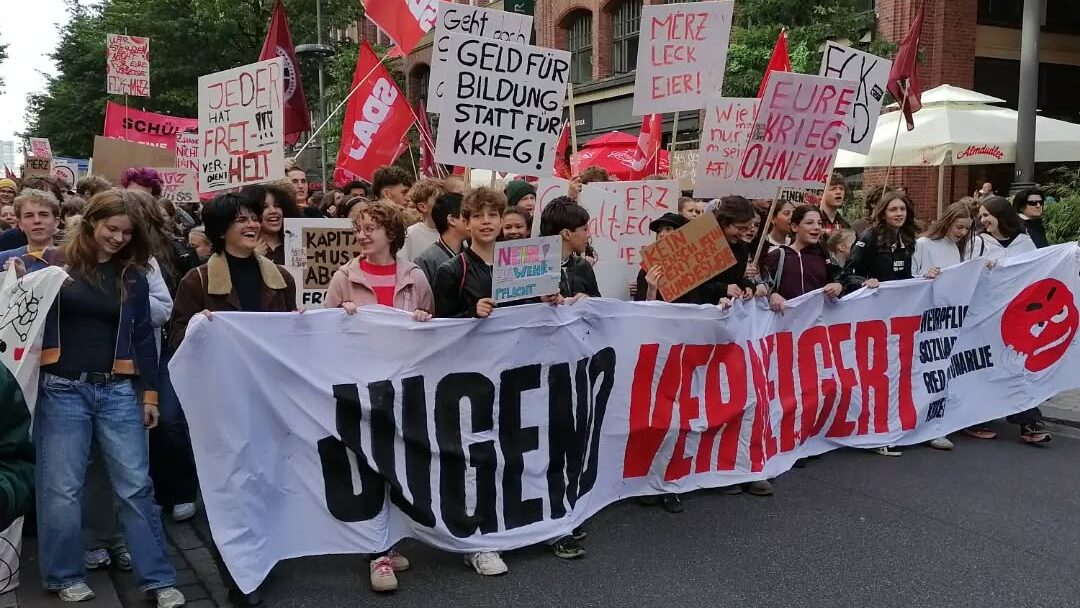
Thousands of students across Germany were once again on strike against conscription and militarization on Friday, September 25. Actions took place in at least 100 localities as young people demanded a sharp turn from the government’s chosen path.

“We don’t want to be forced into military service and we don’t want to go to war,” the students wrote in declaration after their last strike in May.

Read more: German students expand their strike against conscription and militarization to 150 cities

This is the fourth time students have exchanged classrooms for streets since the end of 2025. The mobilization has strengthened in resistance to the Merz administration’s plans to build the “strongest conventional army in Europe” – including by drawing more people into the Bundeswehr, the German armed forces.

While authorities insist military recruitment remains voluntary, students have warned of a clear tendency toward outright conscription. Local strike committees and activists also emphasized the widespread repression ahead of actions. This included scheduling of exams on strike days and locking-in students on school grounds, they pointed out.

Billions for the Bundeswehr, cuts for schools and youth services

Over recent months, the government has sent thousands of questionnaires to map voluntary interest in joining the armed forces. According to German media, the response has been underwhelming: tens of thousands of students have disclaimed no interest whatsoever. Not even a multi-million-euro budget allocated to promoting the army has been able to shake this opinion.

“They sell us war service as an ‘adventure’ while we know that what awaits us is coertion, humiliation, sexism, right-wing extremism, and racism,” the student declaration adds.

Instead of taking the message seriously, authorities recently advanced the implementation of medical checks among their targeted population, drawing further frustration from students.

“We don’t want compulsory questionnaires, fines, draft physical examinations, conscription assessment centres across the country, nor planned integration of the Federal Volunteer Service into military service,” they wrote. “These are means to prepare the reintroduction of the draft and thus another war originating from Germany.”

“In case of conscription, we’ll be trained as cannon fodder, forced into the trenches,” students added. “War costs us our lives, while corporations like Rheinmetall make record profits.”

Read more: Ulrike Eifler: ‘The workplace is a place where we have to fight against war’

Students on strike have expressed solidarity with other ongoing struggles against militarization and budget cuts. They stated they would join peace demonstrations planned for early October in Berlin and Stuttgart, as well as a trade union-backed mobilization against budget cuts on Saturday, September 26.

Their decision reflects the widespread understanding that youth and education services are among those impacted by this round of austerity. According to junge Welt, the federal ministry responsible for education will face close to €1 billion in cuts – while €140 billion will be made available for so-called defense in 2027.

“Every tank, every rocket we pay for with dilapidated schools and social cuts,” students remarked.

  •  
❌