The U.S. Secret Service and D.C. police are investigating reports of a “suspicious item” near the Eisenhower Executive Office Building, which resulted in a road closure. “Around 2:40 p.m., on October 23, 2026, Secret Service Police were notified of a suspicious item near 17th St. and Pennsylvania Avenue,” according to a statement from a Secret Service…
The death of a person in France infected with the Shamonda virus (SHAV) has put European public health authorities on alert. “The European Centre for Disease Prevention and Control (ECDC) is carefully monitoring the situation after the French authorities announced the first ever reported human infection with Shamonda virus (SHAV), a disease that has until now only affected animals,” the agency said in a statement.
October 22nd marks the National Day to Stop Police Brutality. Free DC and Pan-African Community Action (PACA) are two organizations in the nation’s capital engaged in building community and direct action against the various entities that form the policing apparatus in DC: police, FBI, HSI, National Guard, etc.
While Trump boosts their funding—much like giving a steroid to the carceral machine—Free DC and PACA are heightening the contradictions of the Trump administration’s fascist agenda by providing vulnerable communities with the resources that the government withholds and refuses to fund.
Trump’s deployment of the National Guard costs upwards of $3M daily and will total $2.9B by the end of his term. How would you spend $3M a day?
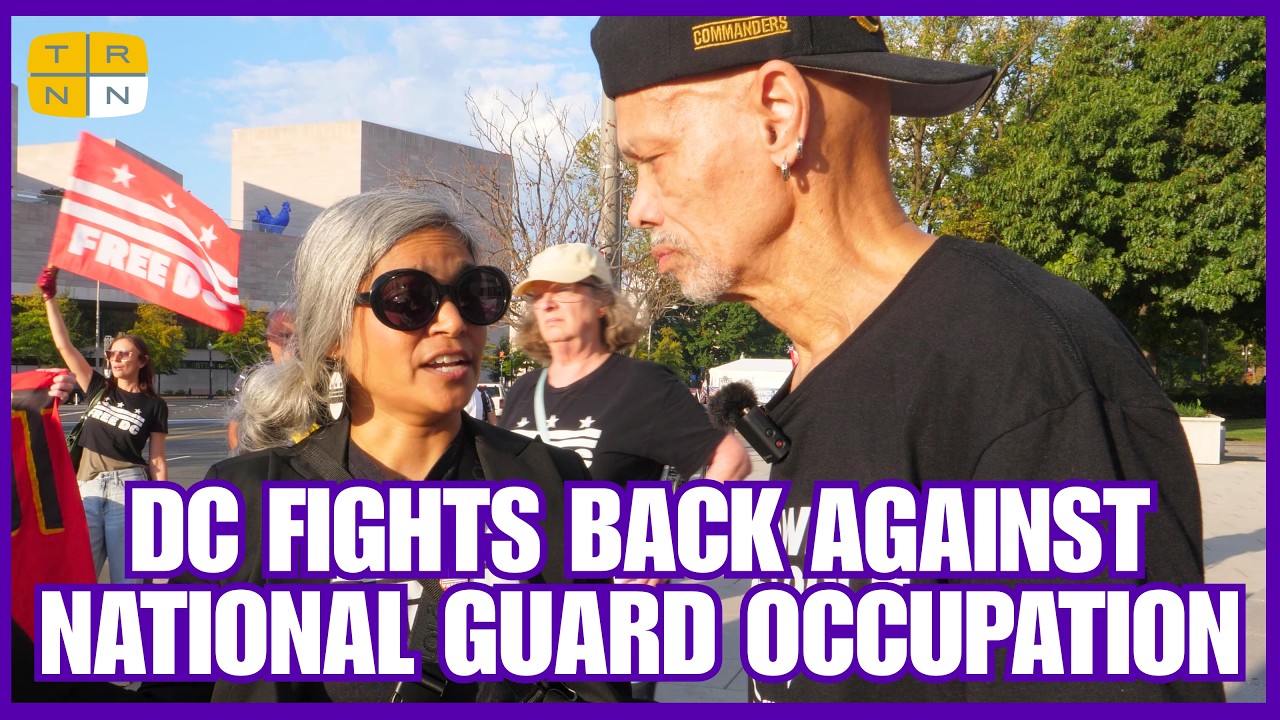
On this episode of Rattling the Bars, former political prisoner and Black Panther Mansa Musa speaks with organizers pushing back against the National Guard occupation of DC on the eve of the Black Panther Party’s 60th Anniversary.
Credits:
Production/Post-production: Cameron Granadino
Transcript
The following is a rushed transcript and may contain errors. It will be updated.
Mansa Musa:
Welcome to this edition of Rattling the Bars. I’m your host, Mansa Musa. The presence of the National Guard in the District of Columbia calls $3 million a day and an estimated $2.9 billion the next presidential election. Recently, I covered two organizations that are pushing back against their present. PACA, Pan-African, Community Action, who primarily organize in the Southeast section or the District of Columbia, Anacostia area, and Free DC. Take a look. We’re at the Black Workers Wellness Center. I’m talking to Alex from the Pan-African Community Action, PACA. And today they’re having political education form because of the anniversary, the 60th year anniversary of the Black Panther Party. And we’re doing political education in its roles form. So Alex, tell our audience a little bit about PACA.
Alex:
We’re a group of African and black people organizing in Southeast DC for power. We’re trying to build up institutions that are made up of just ordinary working class people, working class black people. We’re trying to build up alternative institutions that are able to challenge the preexisting institutions that are currently failing us. We see failing healthcare. We see funding going towards police and national guard. At the same time, we’re seeing cutting off from SNAP benefits, disinvesting from education affecting black children. And so we believe in a power shift and the only way to achieve that power shift is through building up a mass movement. And we’ve been organizing down here for 10 years.
Oliver:
When we look in our communities, we see occupying police forces. We see education we don’t control. History we don’t define. We see institutions we don’t have, whether it’s healthcare, whether it’s housing, whether it’s transportation. So the colonization we’re experiencing domestically, the Panthers saw that as linked to the anti-colonial struggles taking place around the world.
Huey P. Newton:
In America, black people are treated very much as the Vietnamese people or any other colonized people because we’re used, we’re brutalized. The police and our community occupy our area, our community as a foreign troop occupies territory.
Mansa Musa:
Earlier today, we was in free DC downtown where they was protesting the occupation by the National Guard.
Keya Chatterjee:
We want to be really clear that it is time for these armed soldiers to leave DC and leave our community. We’re in the middle of an election right now. We’ve seen them standing in front of polling locations, standing in front of ballot boxes. We’ve seen them at our schools. We’ve seen them all over our transportation system for all over a year. It is time for the guard to leave. I mean, from August 11th to January of 2029, can you imagine? It’s billions of dollars. It is a clear effort to violate our rights and to suppress dissent and we’re not going to stand for it.
Mansa Musa:
They’re blocking both sides of the street. They’re at the top on third street, third DC, and at the bottom of third and constitution. They’re definitely representing the right to civil disobedience.
DC resident 1:
Nobody in DC wants them. They’re a hassle to us and they don’t do anything good and they’re taking a lot of our money and they make the city feel unsafe because of their presence. So I’m not interested in having them here any longer.
DC resident 2:
And I think the National Guard are making our streets less safe. They’re scaring people away from U Street Corridor, which is such a vibrant place where young people like to come and gather and they are chasing everybody out of our city and our businesses and it’s not good for us.
Keya Chatterjee:
We’re going to be in all the places. We also will be over at Bard Early College at 3:00 PM today because the soldiers have been walking around with HSI and FBI in front of that school for weeks. Nobody asked you to be there. Nobody wants you there. Our DC council who we elect have been clear unanimously sending letters to every single governor saying, “Remove your troops. You are not wanted here.” At the end of the day, they say the soldiers are going to be here until January of 2029. We know why they say January of 2029, right? We’re standing here in front of the Capitol. We know what happened in January of 2021. And so what we say is that we will not tolerate that. They can’t do this without our consent. If we start collectively refusing to go to work, refusing to go to school, refusing to shop in the face of their blatant attempts to consolidate power, then they can’t get away with it.
And it’s already working. We’re already winning. What we know is that when we act collectively, it works. Even multi-billion dollar corporations have to give in to us and even this corrupt regime cannot stand if we act collectively and refuse to consent. So that’s what we’re building our way towards, neighborhood by neighborhood, person by person, training by training. We are building towards having enough collective power that they cannot get away with it.
Mansa Musa:
And in terms of y’all’s strategy about occupation, National Guard and Ward seven and eight, how do y’all see y’all being effective in terms of y’all organizing?
Alex:
Yeah, absolutely. I mean, historically Ward seven is eight has been redlined, experiences the most disinvestment from healthcare, from education, always over policing. And now we’re seeing over policing on a broad level across the entire DC, but it always starts with Ward seven and eight. It always starts with these metro stations, Anacostia, Congress Heights, Southern Avenue. We see the FBI, the DHS, the National Guard here first. And so we understand that it does affect all of DC, but it hits Ward seven and eight the hardest. This is where people experience the most oppressed conditions. There’s the most poverty down here. There’s already a heightened police presence even before the National Guard here. And so everything with the safe and beautiful task force and National Guard is just making it more violent. It’s bringing out more tension in these areas and it’s heightened the need for us to organize for ourselves too.
Mansa Musa:
What else do you want to PACA primary objectives in terms of organizing? We talking about the Black Panther Party and we know that they evolved and got to a place where they had survival programs and here we call them survival pending revolution. The ultimate goal was the programs was to turn them over to the community so they become a part of the infrastructure for revolutionary activities. So what are some of the programs y’all got?
Alex:
Absolutely. So our objectives are similar to the Panthers in the sense that we also have survival programs. We have our People’s Pan-African Wellness Front, which is a health clinic which we operate every four Sunday where we try to bring people in to volunteer and work together. We provide free blood pressure testing, glucose testing. We have activities like yoga. We have free grocery distribution, which includes locally grown vegetables and fruits. Oftentimes we have speakers come in and give lectures. So that’s just one example of a space where the community can come together and provide for ourselves, training people to become organizers for our mass movement. Another one of our programs, the Transit Solidarity Program, that’s a program we have going on this weekend where we take community donated smart trip cards, we put money on them and we distribute them at Anacostia Station. And we do this to basically heighten the contradiction between ourselves, the people coming together to provide for working class people just trying to access Metro versus the state, which is dumping upwards of $3 million a day into FBI, DHS, National Guard, MPD to occupy and patrol these stations, ticket people, $50, $100 just for trying to access the bus.
It’s ridiculous.
Mansa Musa:
As you can see, people are standing up against the military industrial complex, policing and the National Guard in the nation capital and around the country. October the 15th marked the 60th anniversary of the Black Panther Party. And one of the things the Black Panther Party stood for among many was community control over the police. As you can see, it’s the community that’s opposed to the presence of the National Guard and heavy-handed policing in the District of Columbia. We ask that you continue to look at the real news and rattling the bar and weigh in on these issues, all power to the people.
"We want to be really clear that it is time for these armed soldiers to leave DC… We've seen them standing in front of polling locations… at our schools… all over our transportation system… It's billions of dollars. It is a clear effort to violate our rights… and we're not going to stand for it."
For two decades, data centers were relatively safe, lucrative real estate investments. They attracted investors because they served as digital infrastructure — the essential plumbing that keeps the internet running. The growth of artificial intelligence (AI) and its increased demands on computing power has meant data centre builders are in a race to build out […]
Tracy Beth Høeg, M.D., Ph.D., an epidemiologist and sports physician, said her decision to follow the data during the COVID-19 pandemic came at a steep professional price.
Høeg said her experience exposed the unwillingness of universities, media and public health institutions to adapt when research conflicted with their accepted narratives.
In an interview this week with investigative journalist Paul D. Thacker on The DisInformation Chronicle, Høeg said institutions too often treated the accepted narrative as settled and then dismissed or attacked people who questioned it.
That approach did more than distort the public discussion about COVID-19, Høeg said. It also created a scientific and institutional culture that could affect how other medical questions are handled long after the pandemic.
For Høeg, the solution is simple: Scientists should follow the evidence wherever it leads.
“It’s a core belief of mine that you have to be objective when you’re doing scientific studies,” she said. “Otherwise, you just shouldn’t do them. It’s pointless if you’re not willing to be objective.”
‘I … didn’t realize the jeopardy that I was putting myself in’
During the pandemic, Høeg published 30 to 40 papers on COVID-19 transmission, masking, youth sports, vaccine risk-benefit, pregnancy, long COVID, visitor restrictions and testing.
Some of her research challenged widely accepted claims.
One study found little evidence of COVID-19 transmission among children in Wisconsin schools, which was consistent with data from Europe. Another examined myocarditis risk in boys after their second Pfizer COVID-19 vaccine dose and found the risks outweighed the benefits in boys who didn’t have underlying health conditions.
Høeg said she didn’t initially understand the professional risks she was taking by challenging the prevailing narrative.
“There was sort of a hesitancy to do this sort of research because I think people were afraid for their careers,” she said. “I actually was blessed with having recently moved from Denmark and didn’t realize the jeopardy that I was putting myself in by doing these sorts of studies.”
At the time, Høeg was conducting research at the University of California, Davis.
She said the university received calls, including from Naturemagazine, complaining about her studies on pandemic policies. Eventually, the university asked her not to use her affiliation with the school.
Høeg said the university refused to renew her voluntary position in 2022, after the European Journal of Clinical Investigation published her study on myocarditis risks in boys who received the COVID-19 vaccine.
NPR also dropped an interview with Høeg for “All Things Considered” after she raised concerns about masking children during outdoor sports.
In a pre-interview discussion with NPR, she told the outlet, “We don’t have evidence that these masks work to prevent transmission. … Bottom line is, we shouldn’t be doing these unproven things to children that are harmful.”
Soon after, NPR told Høeg she was no longer needed for the interview.
“It does say a lot about our universities and institutions because it’s like they had been brainwashed to an extent to believe what the media was saying rather than actually look at the data,” Høeg said.
‘They repeated the same wording … even when the data didn’t back it up’
In 2022, Høeg and her colleagues conducted a follow-up analysis of a Centers for Disease Control and Prevention (CDC) study on school mask mandates.
Høeg said their analysis used a larger dataset and a longer time period and reached the opposite conclusion about the relationship between mask mandates and COVID-19 transmission among children.
The team’s submission to the CDC’s Morbidity and Mortality Weekly Report (MMWR) was rejected. Høeg said reviewers described the submission as “rife with polemics.”
“Well, maybe it’s polarizing if you disagree with it,” Høeg said.
The rejection unearthed an underlying problem at the CDC, according to Høeg.
“They have a scientific agenda,” she said. “And so as soon as you have a scientific agenda, science has been thrown out the window. Science doesn’t have an agenda other than to find the truth.”
A 2024 analysis by Høeg and colleagues examined 77 mask studies published in the MMWR beginning in 2020. According to Høeg, 75% of the studies said masks were effective, while only 14% reported statistically significant results and none were randomized studies.
One finding especially stood out to her: She said 5% of the studies found masks were connected to higher infection rates, yet “they still concluded that masks worked.”
“They repeated the same wording over and over again in each of the studies, that ‘masks are necessary to decrease the spread’ and ‘masks are critical in controlling the case rates of COVID-19,’” she said. “They use the same sort of wording even when the data didn’t back it up at all.”
‘Why are we demonizing people for looking into this?’
A leaked memo from then-FDA official Dr. Vinay Prasad said career staff had linked at least 10 child deaths to the COVID-19 vaccine between 2021 and 2024.
Høeg said she reviewed the Vaccine Adverse Event Reporting System (VAERS) reports and found that investigations involving medical records and autopsies had already been conducted.
“My question at the time was … why are these not being made public?” Høeg told Thacker.
Høeg said news leaked that she would present information about the deaths and their possible association with COVID-19 vaccines. She said the media response focused on portraying her as an “anti-vaxxer” rather than asking why the deaths had been investigated but not publicly disclosed.
“If we have these sorts of deaths happening in children due to medical products of any kind, why are we sitting on them for years?” she asked. “That’s the take-home I want people to have from this.”
She also questioned why people who investigate potential safety problems are attacked for trying to expose the dangers.
“Why are we demonizing people for looking into this? … Isn’t that what the public wants?” she asked.
‘The deep state really is a thing’
In May, just days after FDA Commissioner Marty Makary resigned, Høeg said she arrived at work to find media reports claiming she had resigned — something she said she knew nothing about.
FDA lawyers later asked her to resign, but she refused to sign the letter. She was subsequently locked out of the agency’s systems and escorted from the building.
Høeg said she never received a performance-based explanation for her termination. She also said the person identified as the author of her termination memo later denied writing or seeing it.
According to Høeg, agency lawyers told her the order came from “way above their pay grade.”
The experience changed how she viewed other departures from the agency. “It opened my eyes to the fact that maybe a number of the people who I thought had resigned really had not resigned,” she said.
“The deep state really is a thing,” she added.
‘Women who want to get pregnant … should be told about these risks’
For Høeg, the concerns she encountered during the COVID-19 era are not limited to COVID-19.
In 2025, she helped organize an FDA panel examining potential risks associated with selective serotonin reuptake inhibitors, or SSRIs, during pregnancy.
The American Psychiatric Association criticized the panel for what it called “misinterpretation and unbalanced viewpoints.” Høeg said the media also portrayed any discussion of potential risks as “misinformation about SSRI use” and a signal that depression wasn’t being taken seriously.
According to Høeg, the panel discussed risks already addressed in FDA labeling and scientific research, including miscarriage, premature birth, postpartum hemorrhage, congenital heart defects and neonatal adaptation syndrome.
“This should not be controversial that women who want to get pregnant and who are pregnant should be told about these risks,” she said.
She also warned about the lack of ongoing monitoring of drug safety.
“The FDA is not actively investigating the safety of these products in pregnancy or at all after the initial trials are done,” she said.
Høeg said the discussion should not be interpreted as an argument against treating depression. “I don’t think that any of this should be synonymous with not taking depression seriously,” she said. “That’s just nonsense.”
‘There’s just no reporting on this. … People have died taking this drug’
Høeg also discussed Tavneos, the Amgen-manufactured brand name for avacopan, a drug approved to treat a type of blood-vessel inflammation.
While at CDER, Høeg said she raised concerns that the pivotal clinical trial used to approve the drug had included manipulated data.
According to Høeg, at least eight deaths had been attributed to the drug because of liver injury.
“There’s just no reporting on this,” Høeg said. “People have died taking this drug. … We asked for them to withdraw it from the market, and the media is just totally silent.”
Thacker: ‘There was no real learning in the end. … If anything, we became dumber’
Høeg said it is troubling that some of the most disputed COVID-19 policies are still treated as settled questions.
“How is this still part of our collective conversation that people … are still saying school closures were necessary and mask mandates were necessary?” she asked.
Thacker said the failure to learn from those policies could have consequences during the next pandemic. People who developed a “false sense of safety from masks” during COVID-19 could mistakenly assume masks will protect them from a more dangerous virus in the future, he said.
Thacker also questioned whether the country understands anything about the COVID-19 vaccines. “There was no real learning in the end. … If anything, we became dumber,” he said.
Høeg said the problem stems from the widespread failure to reconsider policies when the evidence changed.
“Once the government decided this is what we have to do, they just kept digging in, even though the data didn’t support it,” she said.
“This is why I keep doing these interviews, because it’s important for people to know the truth.”
Watch Høeg on ‘The DisInformation Chronicle’ podcast here:

 Login