❌

Reading view

Built as a cheap Shahed lookalike, Russia’s Gerbera now flies with a 10-kg warhead and an incendiary bag

built cheap shahed lookalike russia’s gerbera now flies 10-kg warhead incendiary bag · post payload bay russian gerbera-2 drone additional tank гербера-2 з бойовою частиною масою 10 кг і додатковим

Russia has started fitting its enlarged Gerbera-2 drones with a 10-kg warhead and an extra bag of incendiary mixture, Ukrainian military outlet Militarnyi reported on 18 October. The setup is designed to start a fire where the drone hits and is probably meant for attacks on critical infrastructure and warehouses, the outlet said.

Russia’s industry makes about 3,000 jet-powered Geran-4 and Geran-5 drones a month, Ukraine’s military intelligence has said, and Russian strikes have destroyed 2.1 million m² of Ukraine’s modern warehouse space since the full-scale invasion began. A cheap drone that carries fire adds one more threat for air defenses that already let nearly half of Russia’s jet-powered Shaheds through.

A fire bag behind the warhead

Ukrainian Telegram channel Polkovnyk HSh posted photos of the payload on 17 October. Gerbera-2 strike and reconnaissance drones had begun to appear with a 10-kg high-explosive fragmentation-incendiary warhead and an extra package of incendiary mixture, the channel wrote. They navigate with Kometa-M12, a 12-element antenna array designed to resist jamming, it added.

Explore further

Russian drones set their own detonators at altitude: Why cutting wires won’t save from new Gerberas?

In the photos, the incendiary mixture sits in a separate soft plastic tank behind the main warhead, Militarnyi said. Gerbera-2s have been seen with warheads of 4 to 10 kg depending on range, while strike versions of the original Gerbera usually carried up to 5 kg, the outlet noted.

Half a Shahed engine

Russia has mainly fielded the Gerbera, a cheap drone shaped like a Shahed, as a decoy and reconnaissance platform flying alongside Shahed-type strike drones. It has also used bigger Gerberas to drop FPV drones.

Serhii Beskrestnov, now an adviser to Ukraine’s president, flagged a much bigger Gerbera in Ukraine’s skies on 7 August. The Gerbera-2 has a larger airframe, a reshaped wing, and a bigger tail fin, Militarnyi said. In August, the outlet reported it had a stronger piston engine: half of the one in the Shahed-type Geran-2, at about 275 cm³. Production of these engines was set up at the Izhevsk Motorcycle Plant, according to preliminary information the outlet cited.

Ukrainian defense technology adviser Serhii “Flash” Beskrestnov works near the front line monitoring Russian drone signals. Photo: Serhii “Flash” Beskrestnov
Explore further

Russia equips Geran attack drones with image-based navigation using Google map imagery, reducing reliance on satellite navigation that Ukraine can jam, defense adviser warns

Earlier versions ran on a Chinese DLE60 model-aircraft engine of about 61 cm³. The switch was likely possible because Geran-2 engine output partly freed up as jet-powered Geran-4s took a growing share of Russia’s drones, Militarnyi said. The Gerbera-2’s fuel tank also holds up to 63 liters, against 10 liters on the original.

One reached Poland’s Baltic coast

In September, a drone preliminarily identified as a Gerbera-2 was recovered from the Baltic Sea near Rusinowo, on Poland’s coast. It carried a high-explosive fragmentation warhead of about 4 kg, a Polish military prosecutor said.

  •  

Russia is losing the Black Sea grain war it started. Its answer is to sink civilian ships off Romania and Bulgaria

Bulk carrier "Royad Mammadov" under the flag of Saint Kitts, partially sunk after an attack by Russian sea and air drones on October 5, 2026, 20 nautical miles off the coast of Romania. Photo: Romanian Interior Ministry

  • Russian drones have hit two more ships in the western Black Sea
  • Rival Russian and Ukrainian countershipping campaigns have throttled grain exports since this summer
  • Diplomatic efforts to restore a grain shipping ceasefire haven't yet moved Moscow

On or just before Wednesday, 14 October, Russian Geran-4 one-way attack drones struck two more cargo ships—one in the Buh River Estuary near Mykolaiv and another in Chornomorsk, 20 km south of Odesa.

They're the latest strikes in competing Russian and Ukrainian countershipping campaigns that have, since this summer, throttled Black Sea grain exports.

The jet-propelled Geran-4s are Russia's weapons of choice for these ship strikes. The drones haul warheads of up to 90 kg at up to 500 km/h and can fly more than 700 km. They already had AI-assisted targeting, and the Russians recently added terrain-matching navigation to make them less reliant on satellites and harder to jam with signal-scrambling electronic warfare.

For months, the Geran-4s and other Russian munitions have pummeled Ukrainian ports and the ships hauling grain from them. But Ukrainian forces were actually the first to escalate the shipping fight in an effort to squeeze Russian logistics.

Russian Geran-4 jet-drones struck two more cargo ships, in the Buh River Estuary and at Chornomorsk Port in Odesa Oblast. pic.twitter.com/wOXcJFAj5O

— AMK Mapping 🇳🇿 (@AMK_Mapping_) October 14, 2026

As recently as early this summer, hundreds of Russian tankers and dry cargo ships plied the Black Sea and adjacent Sea of Azov, hauling fuel and bulk supplies between ports in Russia and Russian-occupied ports in southern Ukraine.

Most of the Russian vessels were unregistered and sailed without transponders, making them a kind of regional adjunct of Moscow’s “shadow fleet” that ships Russian oil and other goods to the global market in defiance of international sanctions.

Black Sea grain war between Ukraine and Russia escalates
Map: Euromaidan Press

Ukrainian drones had already hit ships hauling stolen Ukrainian grain out of occupied ports in June.

On 6 July, Ukraine’s deep strike drone force finally started hunting the rest of the Russian ships. By day eight of the countershipping effort, the Ukrainians had hit 105 vessels. By day 12, drones including AI-assisted Fire Point FP-1/2s had struck 159, even a few tugboats sent to assist the damaged tankers.

Just a few days after Ukraine launched its countershipping campaign, Russia launched a retaliatory campaign targeting Ukraine’s Black Sea grain ports as well as the ships, many of them foreign-flagged, that haul grain through Türkiye’s Bosporus Strait out to the Mediterranean Sea and onward to foreign ports.

Soon, the Russian shadow fleet’s hundreds of ships were either drifting, disabled, or sheltering in Russian ports. On the other side of the Black Sea, Ukraine’s lucrative grain trade was in a state of collapse. Ports were under constant attack. International shippers were increasingly reluctant to send their vessels into the Black Sea.

Grain pours from a combine harvester into a trailer during harvest in Ukraine.
Ukrainian grain. Photo: Ukrainian World Congress

Trade freefall

Grain shipment figures on both sides tell a stark tale. According to the Russian Grain Union, in September approximately 1.36 million tons of wheat shipped from Russian ports, including ports on the Black Sea and Sea of Azov, compared to 5.4 million tons in September 2025—a 75% reduction.

Meanwhile, Ukraine exported 1.094 million tons of wheat in September, down from 2.051 million tons in September 2025—a 47% reduction. The only thing preventing further throttling of Ukrainian grain exports was Izmail, Renia, and Kilia—the country’s three small ports on the Danube River, which forms Ukraine’s southern border with Romania and flows into the western Black Sea a relatively short 435 km from the Bosporus Strait.

But the Russians were beginning to target the Danube ports and the grain ships heading to and from them, too. In October, Russian drones sank the Saint Kitts-flagged M/V Royad Mammadov, bound from Izmail to Ravenna, Italy, with Ukrainian grain, and the Togo-flagged M/V Alfa Watan, and damaged the Palau-flagged M/V Able, killing at least two seafarers.

“The Black Sea grain standoff, in which both Russia and Ukraine continue to suffer losses, persists,” Polish open-source intelligence analyst Thorkill wrote.

With global food prices rising partially as a result of the bottleneck in grain exports through the Bosporus, the United Nations and Türkiye have been trying to arrange talks between Russia and Ukraine regarding a possible Black Sea ceasefire.

A previous grain deal, brokered by Türkiye and the UN in 2022, collapsed a year later. Ukraine kept ships moving through its own corridor until Russian strikes shut it down this summer.

Update, 16 October: Drones hit at least four more merchant ships off Bulgaria and Romania between 13 and 15 October, sinking the HS Dignity off Krapets. At least 17 seafarers are missing. Romanian President Nicușor Dan called the attacks “attempts by Russia” to destabilize Romania and Bulgaria and said NATO’s North Atlantic Council would discuss them.

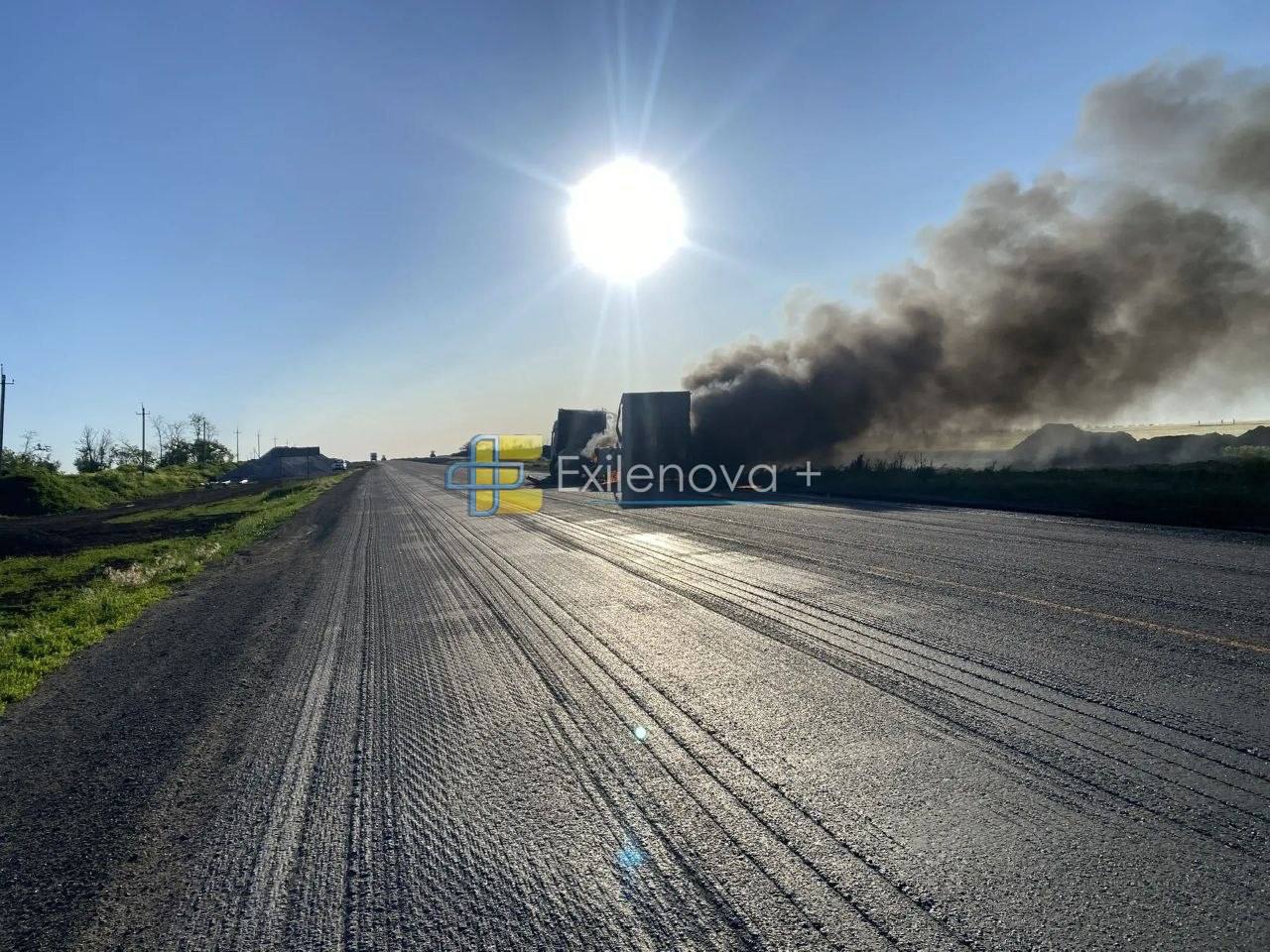
russian radar occupied crimea didn't see ukrainian drones coming became 28th air-defense asset wrecked · post supply trucks burning mariupol-melitopol highway main road russia's land corridor 29 2026 exilenova+ -
Explore further

“Supplying Crimea is turning into a nightmare”: Ukrainian drones hit Russian trucks 770 times in September, and winter will make it worse, analyst says

  •  
❌