'Fresh Off the Boat' star Randall Park is the biggest name in this adaptation of the web series of the same name from production company American High.
On October 22, India’s Indo-Tibetan Border Police (ITBP) chief, Shatrujeet Singh Kapoor, stated while addressing ITBP personnel in Alwar, Rajasthan, that the threat from China continues to persist. He said there had been face-offs between Indian and Chinese troops at several locations in Arunachal Pradesh in the preceding days, and that these were continuing.
Kapoor stressed that conventional military methods alone would not suffice against China, given the People’s Liberation Army’s extensive modernization. He called for stronger drone and anti-drone capabilities.
The ITBP chief’s call for stronger drone and anti-drone capabilities needs to be viewed in the correct perspective. Media coverage of military threats tends to focus on an adversary’s high-value weapon systems—ballistic and cruise missiles, fighter aircraft, bombers, warships and tanks. These systems are conspicuous, expensive and relatively easy to identify, quantify and assess in terms of their capabilities and the threats they pose.
The threat from drones, however, is fundamentally different and often underappreciated. Their low cost, small signatures, ease of deployment, and the difficulty of reliably detecting, identifying, and tracking them make the threat particularly hard to assess.
Drone Evolution
Drone warfare has evolved rapidly since the start of the war in Ukraine in February 2022.
Initially, small drones were widely deployed for short-range reconnaissance and attack, including as loitering munitions. Their range was often limited by their dependence on line-of-sight communications and control.
Ukraine and Russia also fielded medium-altitude, long-endurance (MALE) drones, which provided reconnaissance and strike capabilities broadly analogous to those of close air support aircraft.
However, their effectiveness depends inversely on the strength of the adversary’s air defenses. As a result, both sides have increasingly relied on these drones for reconnaissance and target acquisition, rather than operating them freely in heavily defended airspace.
Drone warfare capabilities have improved significantly since the start of the war through advances in propulsion, navigation, communications and machine vision. The evolution from short-range reconnaissance and attack drones to low-cost, long-range precision-strike systems has created a capability that, in some missions, can compete with that of cruise missiles.
Propulsion
Initially, many drones relied on internal combustion engines, which could be noisy, while smaller electric drones offered quieter operation but generally had more limited range and endurance.
Advances in battery technology have improved electric propulsion, although energy storage remains a constraint.
The development and wider availability of relatively low-cost jet engines have enabled some drones to fly at high speeds and altitudes over long distances, potentially complicating ground-based detection and interception.
Communication
Line-of-sight communications remain important, particularly for smaller drones. Their limitations can be mitigated through relay systems and mesh networking, while satellite links can extend communications beyond the radio horizon.
Geostationary satellite links generally have higher latency than low-Earth-orbit (LEO) satellite links, which can provide lower-latency communications. Together with improved networking, these technologies have expanded the scope for remote piloting and long-range operations. However, communications remain vulnerable to jamming and disruption.
Navigation and Precision Attack
Drones have traditionally relied on satellite navigation (SatNav) and other navigation methods to reach their targets. SatNav is vulnerable to jamming and can become unreliable in contested environments. A significant advance has been the development of AI-enabled terrain matching and machine vision, which allow drones to navigate using terrain features and visual cues rather than relying solely on satellite signals.
Machine vision has also improved precision-strike capabilities through target identification. Meanwhile, advances in counter-drone technologies have helped shape the evolution of strike drones, driving the development of systems designed to overcome increasingly sophisticated defenses.
Drone Development Cycle
Drone development and operational fielding cycles are considerably shorter than those of manned aircraft and helicopters.
Lower development costs and shorter timelines allow drone warfare to evolve rapidly in response to battlefield conditions. Drone designs and capabilities can be tailored to the specific challenges of a battlefield and the objectives of a particular campaign.
The design and capabilities of attack drones depend on the targets they are intended to engage. Attacking bridges, troop concentrations, moving road vehicles, or logistical storage facilities presents different operational requirements and calls for different drone capabilities. These requirements must also account for the counter-UAS systems deployed by the adversary.
The same principle applies to drone interceptors: their capabilities must match the threats they are designed to counter. For instance, countering high-speed, jet-powered attack drones may require equally fast, jet-powered interceptors, although other interception methods may also be effective.
Both the targets to be attacked and the capabilities of the adversary vary from one conflict to another. Consequently, drone development is driven by the specific operational requirements of each battlefield and the continuing interaction between attack drones and the defenses designed to defeat them.
Indian and Chinese army troops greeted each other along the Line of Actual Control (LAC) near the Karakoram Pass in Ladakh on October 31, 2024, on the occasion of Diwali. Chinese troops greeted Indian soldiers and exchanged sweets on October 31 at two points along their contested border to mark a major Indian festival, army sources said, a week after leaders of the Asian rivals held their first bilateral meeting in five years. (Photo by Indian Army / AFP) / XGTY / RESTRICTED TO EDITORIAL USE – MANDATORY CREDIT “AFP PHOTO/INDIAN ARMY” – NO MARKETING NO ADVERTISING CAMPAIGNS – DISTRIBUTED AS A SERVICE TO CLIENTS
Drone Warfare Enabling Technologies
A formidable drone warfare capability cannot be built merely by developing drones with impressive specifications. It requires drones whose capabilities are tailored to specific targets and tactical scenarios. For example, interdicting road supply lines requires drones that can identify and engage moving supply trucks while distinguishing them from other vehicles. Such drones may be unsuitable for attacking bridges.
The key is to master the enabling technologies that allow drones to perform specific tasks.
These broadly encompass five areas:
Propulsion: Low-cost, efficient engines for the required combination of speed, range, and endurance.
Communication: Resilient, low-latency communications, including LEO satellite links, for responsive remote piloting and target engagement.
Navigation: AI-enabled machine vision and terrain matching for navigation that does not depend solely on satellite navigation (SatNav).
Precision attack: Machine vision and target recognition for accurate engagement of intended targets.
Warheads: Payloads tailored to the intended targets and desired effects.
A nation cannot become a leader in drone warfare simply by developing drones. It must master these enabling technologies and continuously improve them to meet evolving battlefield requirements.
India’s mastery of drone-warfare enabling technologies remains limited in several critical areas, particularly when compared with China’s industrial scale and technological capabilities.
The Chinese Threat
China has substantial capabilities in many of the enabling technologies discussed above. More importantly, it has a formidable drone-component manufacturing ecosystem spanning electric motors, flight controllers, sensors, machine vision, navigation and communications modules, as well as drone propulsion.
Its experience with mesh networking can support low-latency drone control and coordination. China is also developing large-scale LEO satellite constellations, although their specific contribution to military drone operations should not be assumed without further evidence.
China could potentially develop and field drones tailored to exploit specific vulnerabilities in Indian Army capabilities or tactics within relatively short periods. It could also adapt its systems to counter tactical innovations introduced by Indian forces.
Along the border, China’s industrial capacity could enable it to manufacture and field drones in large numbers, threatening Indian troop movements by day and night. Supply lines, radars, tanks and artillery could all face persistent drone attacks.
Without comparable capabilities, the Indian Army would risk losing operational ground.
Long-range precision strikes by Chinese drones could also threaten IAF airbases, radars, air-defense units and logistics bases, potentially degrading India’s ability and willingness to sustain a prolonged conflict.
If this scenario seems overstated, consider how Russia, despite possessing a formidable layered air-defense network, has struggled to prevent Ukraine’s sustained drone attacks.
Ukrainian long-range strikes have benefited from intelligence, surveillance and reconnaissance (ISR) support, including Western assistance. Satellite communications, including Starlink, have also played a role in some Ukrainian drone operations.
China possesses substantial ISR and communications capabilities of its own, although their effectiveness in a conflict along the Indian border would depend on operational conditions and the resilience of the systems involved.
Given India’s resource constraints and technological gaps, it could struggle to withstand a sustained, large-scale Chinese drone campaign unless it develops comparable capabilities in drone production, deployment, and counter-drone warfare.
Vijainder K Thakur is a retired IAF Jaguar pilot, author, software architect, entrepreneur, and military analyst.
Welcome to our weekly wrap of what’s happening on stages around town, kicking off with Lily Allen’s concert version of the theatrical work based on her album.
With a tactile dongle for on-the-fly customization and a metal chassis, the Wallhack M-001 is the most fun I've had reviewing a gaming mouse in a long time.
It may not look like it, but this is one of the fastest cars I've ever driven.
Ben Shimkus/Business Insider
It looks unassuming, but the Subaru Trailseeker is ridiculously fun to drive. And fast.
Technically, Subaru classifies this car as a midsize SUV. (Sure, Jan.)
It's the Subaru-iest of all the vehicles built in partnership with Toyota.
American parking lots are awash with a sea of sameness. There's just a bunch of basic SUVs and pickup trucks.
That makes the wagon-ish 2026 Subaru Trailseeker EV a real eye-catcher. Unlike the homogeneous crossovers rolling up to elementary school pickup lines today, it gets a stretched, long-roof profile and carries a Subaru badge. It looks like a proper successor to the Subaru wagons of yore, like the 2000s Outbacks and Legacys.
Technically, Subaru sees this differently. They classify the Trailseeker as an all-electric midsize SUV — and they do have a point with its 8.5 inches of ground clearance and easy-to-slide-into seats.
But, I mean, come on, look at this thing.
The Subaru Trailseeker wagon —err — SUV's side profile.
Ben Shimkus/Business Insider
That's a wagon in my book.
I drove the Trailseeker's top Touring trim for about 450 miles to see if it was a worthy antidote to America's great car-design flattening. My tester — complete with premium blue paint, a panoramic glass roof, and radiant leg warmers in the front seat (yes, you read that right) — stickered at $48,400.
And it was pretty wild.
This wagon — sorry, SUV — can really move
Why is this thing so fast?
Ben Shimkus/Business Insider
I've driven around 80 cars in my career as an auto journalist: EVs, muscle cars, sports cars, big trucks, premium luxury vehicles, etc.
The Trailseeker easily makes my personal list of top 10 fastest vehicles. It can launch from standing to 60 mph in about 4.4 seconds and produces 375 horsepower.
Get behind the steering wheel of this family-wagon-shaped car, and you feel that power at all times. On my highway-dominant drive from New York City to the Washington, DC, area, it quickly dashed by slower traffic and 18-wheelers.
The speed doesn't come at the expense of efficiency or refinement, either.
The Trailseeker returned about 3.7 miles per kWh, giving the battery about 270 miles of juice. While it was whipping past cars on the New Jersey Turnpike, I could still hear back-seat passengers when they spoke.
And, speaking of the back seat, the Trailseeker's long body gives rear passengers an almost comical amount of legroom. Fold those seats down, and my panoramic-roof tester has up to 71.8 cubic feet of cargo space, in case you have to move some furniture around, too.
The Trailseeker's backseat has more than enough room.
Ben Shimkus/Business Insider
Its biggest red flag was charging.
I saw speeds peak around 127 kW, which is pretty middling in today's EV age. Subaru says the car can accept up to 150 kW.
Let's compare that to the much higher-priced (but similarly shaped) Lucid Gravity, which is considered America's fastest-charging EV. That one can accept up to 420 kW, adding up to 200 miles of range in under 12 minutes.
My initial fast-charge of the Trailseeker — a top-off kind of stop while I grabbed a coffee — took 21 minutes, charging the car from 49% to 77%.
Is it Subaru-y enough?
Take away the Subaru badge, and this might look a lot like a Toyota interior...
Ben Shimkus/Business Insider
Subaru didn't build the Trailseeker alone.
It's the product of Subaru's expanding EV partnership with Toyota. The two companies now sell three closely related EV pairs: Subaru's Solterra, Uncharted, and Trailseeker correspond with Toyota's bZ, C-HR, and bZ Woodland. Next year, the companies are launching mechanically similar three-row EVs, too, with the Toyota Highlander and the Subaru Getaway.
The Trailseeker is easily the Subaru-iest of the bunch, and it's not just because of its wagon-y looks. It gets a dose of Subaru's adventure-seeking vibe, including standard Symmetrical All-Wheel Drive, X-Mode settings for snow and mud, roof rails, and a 3,500-pound towing capacity.
That outdoorsy tuning comes with a trade-off. The Trailseeker felt noticeably firm over broken pavement, especially at lower speeds.
A wagon comeback? Don't hold your breath.
Good luck finding a Trailseeker on a dealership lot right now...
Ben Shimkus/Business Insider
You want a wagon now, right? Isn't this thing so cool?
Well, I'm teasing you. Good luck finding a Trailseeker.
Right now, Subaru has only a 9.7-day supply of the model in dealer lots, per CarGurus data shared with Business Insider. That's well under the industry average of about 70 days' worth of supply.
Kevin Roberts, CarGurus's director of economic and market intelligence, says the low supply isn't a product of high demand. In September, the automaker only sold 849 units, just 1.6% of all Subaru sales in America.
As the calendar turns, Roberts says there's little momentum for the wagon body type: "This segment has accounted for less than 1% of new car sales," he said, adding that "the traditional wagon has become increasingly rare in today's new car market."
So, no, the Trailseeker probably isn't about to resurrect the American station wagon.
That's a shame. After 450 miles in one, I'm increasingly convinced that good ones could win over American drivers.
By the end of his pre-trial detention at Moscow's infamous Lefortovo Prison, American journalist Evan Gershkovich had developed a curious rapport with the FSB investigator tasked with proving he was a spy.
"Most people break after four months or so, but you're still holding strong
The New Statesman has published a letter signed by the great and good defending Sally Rooney's right to support Palestine Action. Prof James Alexander wonders why so many writers couldn't write a decent letter.
In a “landmark” agreement, the Pentagon and Lockheed Martin have agreed to a framework agreement to buy F-35 Joint Strike Fighters for the next 10 years.
Under the multi-year production and sustainment agreement, Lockheed Martin will produce 1,560 F-35 Lightning II aircraft for the US and its international customers at a rate of 156 fighters per year.
The US will buy at least 850 of these stealth fighter jets.
The agreement also covers associated initial spares, 10 years of modification kits, and a sustainment package for the global F-35 fleet.
It creates a stable, long-term procurement signal to modernize and expand America’s 5th-generation tactical aircraft.
However, the agreement’s execution remains subject to Congressional authorization and appropriations.
The US Congress is already considering granting the Pentagon authority to enter into multi-year procurement agreements with defense companies, specifically Lockheed Martin for the F-35 fighter and Boeing for the F-15EX Eagle.
The Pentagon also wants to buy at least 268 F-15EX fighters over the next decade.
The multi-year procurement and sustainment framework was first envisioned in the fiscal 2027 National Defense Authorization bill, released in May.
“We have fundamentally changed how we stabilize the American defense industrial base to produce at speed and scale,” said Under Secretary of War Michael P. Duffey in a statement.
“This agreement with Lockheed Martin proves it. By aligning financial incentives with actual performance, we are ensuring our warfighters are equipped with the lethal capabilities they need to fight and win.”
The Pentagon believes that multi-year procurement agreements, totaling hundreds or even thousands of aircraft and valued at billions of dollars, will encourage defense companies to make upfront investments in expanding production facilities.
Earlier this week, while commenting on the US Air Force’s updated fighter force structure report, under which the force envisions a 1,509 combat-coded fighter fleet by 2035, Lt. Gen. David Tabor, deputy chief of staff for plans and programs, has underlined that pushing multi-year procurement packages will provide financial stability to defense contractors and encourage them to invest in production facilities.
Notably, the US fighter force structure report is also pending before Congress, and it envisions a 60% stealth fleet by 2035.
The 60% stealth force will include 40% F-35s and 20% F-22 Raptors and F-47s.
If the report is approved, by 2035, two out of every five combat-coded fighters in the USAF will be F-35As.
Besides, the US Navy and the US Marine Corps will also fly additional F-35B and F-35C variants of the fighter.
The ten-year procurement framework with Lockheed for 1,560 F-35s over the next decade, including 850 exclusively for the US, will help the company invest in expanding and streamlining its production facilities to meet extraordinary global demand for the F-35.
To meet the demand, Lockheed will have to produce 156 F-35s annually.
Under the framework agreement with the Pentagon, Lockheed Martin has agreed to invest at least US$7 billion of its own money into projects to support the F-35 program.
“This multiyear framework strengthens the way we can plan and invest in the F-35 enterprise,” said Lockheed Martin Chairman, President and CEO Jim Taiclet.
“With the greater certainty that comes from the U.S. government’s transformative approach to F-35 production and sustainment, we can make the upfront investments needed to expand capacity, improve efficiency, and build a more resilient supply chain. That’s good for the taxpayer, good for our suppliers, and, most importantly, good for the United States and its allies.”
Lockheed Martin said in a statement that if the U.S. Congress grants multiyear authority and associated appropriations in the coming months, the F-35 Joint Program Office (JPO) and Lockheed Martin will finalize contract terms, pricing, and schedules through a formal contract award.
The statement added that the framework agreement will offer several advantages, including predictable, multi-year procurement planning, high-volume procurement efficiencies, and transparent, data-driven decision-making.
Notably, the F-35 Lightning II program relies on more than 1,400 domestic and global suppliers and contractors.
According to Lockheed Martin, the company manufactures nearly 30 to 42 percent of the jet outside the US across three continents before final assembly in Texas.
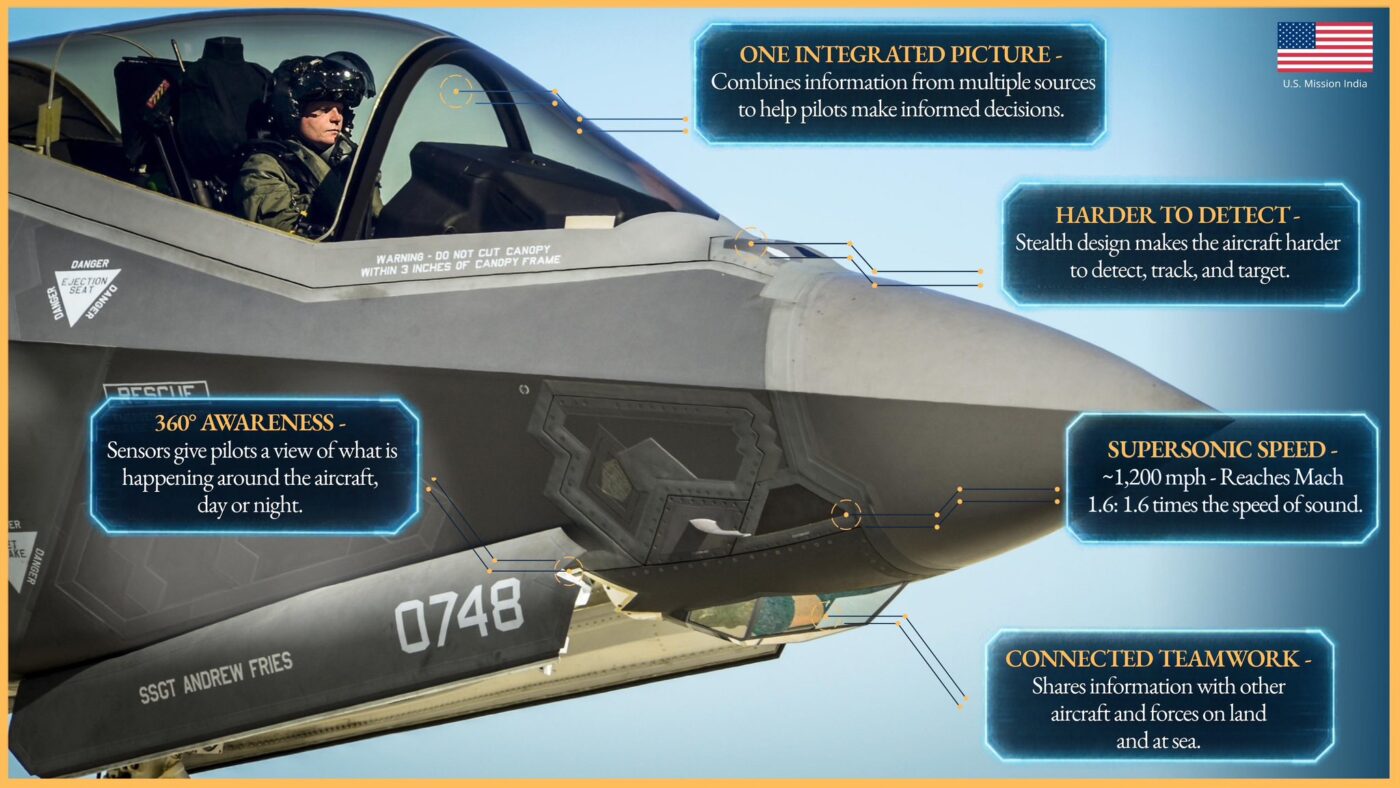
F-35: Image via US Embassy, New Delhi
While Lockheed Martin is the primary contractor, the UK’s BAE Systems is a principal partner. BAE supplies much of the software code, the F-35’s rear fuselage, tails, the AN/ASQ-239 Barracuda electronic warfare system, the antenna, various avionics, and more.
Another British contractor, Martin Baker, is providing the ejection seats. The LiftSystem found in the F-35B variant is made by the UK’s Rolls-Royce (the only company building that type of STOVL lift fan).
Northrop Grumman is also a principal contractor, and it designs and produces critical F-35 components, including the center fuselage, AN/APG-81 AESA radar, communications subsystems such as the AN/ASQ-242 Integrated Communications, Navigation, and Identification (CNI) system, and the EO/IR Distributed Aperture System.
Leonardo and Cameri in Italy, GKN Fokker in the Netherlands, ASDAM Group in Australia, and nearly 30 companies in Canada also supply crucial parts for the F-35 fighters.
Over 1,500 firm orders for the F-35 over the next 10 years will allow Lockheed Martin to enter into long-term contracts with these suppliers to buy raw materials and critical parts in bulk, thereby stabilizing supply chains and increasing F-35s mission-capability rates.
It said the integrated procurement model, which pairs aircraft production with purchases of spare and modification parts, will deliver high-volume procurement discounts, drive down unit prices, and give the U.S. government the cost predictability it requires.
Meanwhile, during the October 22 earnings call, Lockheed reported third-quarter 2026 sales of US$20.7 billion, up from $18.6 billion in the third quarter of 2025.
It also reported a record backlog of US$292.0 billion, including US$52.5 billion tied to the multi-year award to produce PAC-3 Missile Segment Enhancement (MSE) interceptors.
Notably, Lockheed Martin’s market capitalization is approximately US$127 billion, so its current backlog of US$292 billion is 2.3 times its market value.
Together, the multi-year agreements for PAC-3 MSE interceptors and F-35 fighter jets will provide Lockheed with a stable source of income for years to come.
If Congress approves the F-35 multi-year procurement framework, Lockheed Martin’s backlog order book could easily cross US$350 billion.
“In the third quarter each of our four segments posted growth year-over-year, sales topped $20.7 billion and net earnings exceeded $1.8 billion, increases of 11% and 14%, respectively. We delivered $3 billion of free cash flow in the quarter, and increased our backlog to a record $292 billion, allowing us to raise our dividend for the 24th year in a row,” said Lockheed Martin Chairman, President and CEO Jim Taiclet.
Taiclet also reiterated the company’s desire to integrate sixth-generation fighter-jet technologies into the F-35, upgrading it into what he called a “Ferrari” F-35.
Taiclet first voiced this desire in April last year after Lockheed lost to Boeing for the USAF’s Next Generation Air Dominance (NGAD) fighter, the F-47. He claimed that the company can integrate 80% of sixth-generation NGAD technology into its fifth-generation F-35 Lightning II, which is already in production, at half the cost.
If the multi-year F-35 agreement is approved and it provides Lockheed with 1,560 firm orders and stable cash flow over the next decade, then the company can invest in integrating some of these sixth-generation technologies into the F-35.
Notably, the F-35 is already the world’s most popular stealth aircraft.
Lockheed Martin has already delivered nearly 1,300 F-35s to the US and its international customers, more than all other stealth fighters combined, including the US F-22 Raptor, China’s J-20 and J-35A, and Russia’s Su-57.
A firm order for 1,560 more F-35s would bring the total close to 3,000 fighters by 2035.
The final decision, however, rests with the US Congress.
Sumit Ahlawat has over a decade of experience in news media. He has worked with Press Trust of India, Times Now, Zee News, Economic Times, and Microsoft News. He holds a Master’s Degree in International Media and Modern History from The University of Sheffield, UK.
He can be reached at ahlawat.sumit85 (at) gmail.com
The author's guest room at the Four Seasons Jackson Hole resort starts at about $1,000 during the winter ski season.
Joey Hadden/Business Insider
I've never been skiing.
But if I ever decide to learn, I'll do it at the Four Seasons in Jackson Hole, Wyoming.
My 550-square-foot room felt like a luxury cabin on the slopes.
When I arrived at the Four Seasons Jackson Hole on a muggy day in early September, I imagined it covered in snow. This was in 2024, when I visited Jackson Hole, Wyoming, for the first time.
I spent one night at the five-star ski-in, ski-out resort. If I ever take a ski trip, I imagine that my room at this Four Seasons would be a peaceful place to rest after an active day of gliding through powder.
Step inside the 550-square-foot room with a starting rate of nearly $1,000 a night during the winter ski season.
Welcome to the Four Seasons Jackson Hole, a five-star, slopeside ski resort.
Courtesy of Four Seasons Jackson Hole
The 65-year-old hotel chain has a luxurious reputation and over 130 locations worldwide, each designed to reflect its destination.
Kim Cole, the director of public relations for the Four Seasons, told Business Insider that the company describes the Jackson Hole location's aesthetic as "modern mountain chic," catering to hikers, bicyclists, and skiers in the winter.
After checking in, I explored the room with the typical peak-season guest in mind.
Joey Hadden/Business Insider
The hotel has 106 guest rooms and 18 suites. The starting rate is $525 in the offseason and $995 in the peak winter season. Business Insider received a media rate for a one-night stay.
There are also 31 Resort Residences on-site, built to serve large groups. These residences have kitchens and up to five bedrooms. Starting prices range from $4,200 to $11,000, depending on the season.
Cole told Business Insider that in the winter, guest rooms are typically booked with active guests who participate in winter sports, so I imagined how the room would feel as a skier.
I thought my 550-square-foot room blended traditional cabin nostalgia with midcentury modern luxury.
Joey Hadden/Business Insider
My room had a king-sized bed, a full bathroom, and a private balcony.
Renovated by Wimberly Interiors in 2022, the guest rooms were designed to bring the outside in, with metal accents, stone finishings, and a soft, earth-toned color palette. This nature-inspired trend, known as biophilic design, gained traction in 2024.
The bed was plush with warm, fluffy bedding and dense pillows.
Joey Hadden/Business Insider
The king-sized bed sat between mixed-material nightstands with edgy lamps that contrasted with classic wooden shutters.
With one king-sized bed, the room sleeps up to three adults (or two adults and one kid). The room can also be arranged with two double beds, increasing the maximum occupancy to four adults (or two adults and two kids).
The nature-inspired headboard was a mesmerizing statement piece.
Joey Hadden/Business Insider
The headboard was the standout piece in the room. A cherry-wood frame juxtaposed with a bright-white image gave it a midcentury modern look.
The image was a textured carving of trees that I could feel when I brushed my fingers over the branches. A light bar glowed beneath the board, making it easier to see the details of the monochrome image.
The bed was so comfy that I didn't want to get up — and with smart controls on the in-room tablet, I didn't have to.
Joey Hadden/Business Insider
The tablet on the nightstand served as the room's control center, commanding everything from the TV to room service. This amenity was added in the 2022 remodel.
The tablet would be especially handy after an exhausting day on the slopes.
The other nightstand held an eclectic shelf of books with a warm white color palette.
Joey Hadden/Business Insider
Few things are more relaxing on a snow day than cozying up with a good book.
Luckily, my room had a small selection of biographies, historical literature, and novels, ranging from realistic fiction to young adult fantasy.
Publishing dates for these books ranged from 2003 to 2020, but I thought they looked much older. They were all sleeveless with a white or off-white binding.
Across from the bed, a large TV was mounted above a stone fireplace.
Joey Hadden/Business Insider
Rustic drawers were to the left of the fireplace, while a modern sitting area was on the right.
I noticed all the seating in my room was soft and cushy, which seemed ideal for sore bodies after an active day.
The room also had a private bar with gold trimmings.
Joey Hadden/Business Insider
The bar had an espresso machine, neutral-toned ceramic mugs, and Four Seasons-branded water.
Beneath the bar, a cabinet hid the mini-fridge. It was stocked with alcohol and snacks like peanut M&Ms and gummy bears, which were available for an extra cost.
In the marble bathroom, the oversize tub had a bendy shower head that made me feel like I was in a spa.
The bathroom felt spacious, with a double-sink vanity, a sizable shower, and a separate toilet room.
Joey Hadden/Business Insider
The mirrors and vanities were replaced by Wimberly Interiors in 2022.
Across from the bathroom, a walk-in closet held bathrobes, a safe, and some classic, upscale amenities I've only seen in ultra-luxury hotels.
Joey Hadden/Business Insider
I spotted old-school amenities like a shoehorn and a shine brush, which I've seen more often in high-end European accommodations than in the US.
The ample size of the bathroom and closet made the room suitable for up to four guests.
The private balcony seated one in a comfortable lounge chair.
Joey Hadden/Business Insider
I spent some time on the deck, but since I imagined it would be less enjoyable in the cold, I appreciated the sliding glass doors that let me enjoy the view without the cold.
Out there, I had a view of the ski lifts traveling up and down Rendezvous Mountain.
Joey Hadden/Business Insider
From the balcony, I spotted the downhill trails towering over the resort's courtyard. Looking down, I pictured the green courtyard blanketed in snow.
In the winter, I imagine the biggest luxury of this $1,000-a-night room is hitting the slopes just outside. If I ever visit Jackson Hole during peak season, I'll only splurge on a Four Seasons stay if I'm taking a ski trip.
CES 2026 loved these innovative headphones that transform into a Bluetooth speaker. After living with them, I’m impressed by the engineering, but less impressed by the sound.
 Login