❌

Reading view

Captured Russians say there is one place on Kupiansk front they will not go: “Orion” safety corridor

Frodo ground robotic vehicle (UGV).

Captured Russian soldiers have a rule for one stretch of the Kupiansk front: go anywhere, but not there.

That stretch is the “safety corridor” the “Orion” unit of Ukraine’s Offensive Guard brigade “Pomsta” says it has built for its ground robots. The zone is so lethal that, by the unit’s count, 88% of attacking Russians are killed before they reach their positions, and Russian armor cannot get within 25 kilometers, the military outlet ArmyInform reports.

Behind that shield, the unit says its ground robots have run dozens of fully autonomous missions through the most dangerous ground on the axis, with a success rate of 99.57%. The results made Orion the top-ranked unit for effectiveness on the South-Kupiansk axis in September within Ukraine’s battlefield management system, DELTA.

“You can go anywhere, just not into the Orion zone”

The claim that the Russians now avoid the sector, the unit says, comes from them themselves.

“Prisoners admit in interviews: 'You can go anywhere, just not into the Orion zone.' Eighty-eight percent of the enemy is destroyed before reaching their positions, and Russian equipment cannot approach closer than 25 kilometers,” the unit says.

That is what opens the corridor. Where a human supply run would be a death sentence, a robot can cross, and cross again.

The quiet blood of the front

The point, the unit says, is to take the soldier out of the deadliest job on the front: carrying ammunition and the wounded across open fire.

“We broke the stereotype that supplying the army takes truck convoys and hundreds of soldiers under targeted fire. Our robotic systems are the ‘quiet blood’ of the front,” Vladyslav Zolotarov, an officer in the unit’s staff control group, says.

When Russia thinks our positions are depleted, a tracked platform quietly comes in at night and brings in a ton of ammunition.

In September alone, the unit says, its wheeled and tracked robots ran 85 of the hardest combat missions and hauled more than 30,000 kilograms of cargo. Its evacuation record is the line it is proudest of: four missions pulling wounded soldiers out by robot, all four successful, not one man lost.

Ukraine has bet heavily on this kind of machine, aiming to field 50,000 ground robots to keep its troops out of the drone-ruled kill zone.

  •  

Bill Gates predicts 20 years of turmoil before AI creates 'true abundance'

Microsoft cofounder Bill Gates.

Fabrice COFFRINI / AFP via Getty Images

  • Bill Gates says AI will bring about an age of abundance in 20 years, but it'll be a rocky road.
  • He predicted robots will displace human workers and "build houses, grow food, do surgery."
  • Some jobs might be reserved for people, and work limits could preserve employment, Gates said.

Bill Gates says AI will create "true abundance," but the next two decades before it arrives will be "as tumultuous a period as there's been in human history."

"My big concern is this 20-year transition period, where they'll have winners and losers and a lot of disruption," the Microsoft cofounder and billionaire philanthropist said on the latest episode of the "Decoder" podcast.

Gates echoed widespread concerns about white-collar jobs, saying that telesales, telesupport, and accounting will disappear as AI will be able to do those "radically cheaper, radically faster, and even more accurately." As for blue-collar jobs, humanoid robots will take over those, he said.

"If we don't choose to massively slow down or stop, then we will have robots that can build houses, grow food, do surgery," Gates said. "And none of the things that human labor provides to the economy will be necessary for most goods and services."

He also underscored how jarring it will be for someone like him, whose vast resources have allowed him to lead the charge toward eliminating malaria and tackling other humanitarian crises.

"And when the AI says to me, 'No, I'm better than you, you go play pickleball and I'll get back to you, I'm gonna take care of this' — I mean, it's kind of humorous, but it's not humorous," he said.

Gates shared his long-held view that work is vital to giving people a sense of purpose, a way to earn an income, a reason to show up every day, an avenue to build relationships with colleagues, and a path to build things and solve problems.

He suggested that certain activities such as art, sports, cooking, and childcare could one day be reserved for humans, "even though the AI could do those things better."

Gates also highlighted that measures such as early retirement and caps on working hours could help maintain some level of human employment.

He envisioned some people saying, "Let's be like the Amish and let's only use AI for certain things," so they won't have to give up "helping each other or coming up with unique ideas."

Amazon founder Jeff Bezos and JPMorgan CEO Jamie Dimon have both proposed a shorter workweek as a less painful alternative to AI-driven unemployment.

Gates is one of several tech leaders to warn of job disruption on the road to an age of abundance.

Elon Musk has predicted a "bumpy" transition and proposed government checks for all as the best solution to AI-driven job losses. He's said that technology will drive production costs so low that everyone can have "whatever stuff they want," work will become "optional," and it's not worth saving for retirement in 10 or 20 years as money won't matter.

Similarly, Anthropic's Dario Amodei has said that AI promises to "raise the quality of life for everyone," but the "short-term shock will be unprecedented in size."

However, OpenAI's Sam Altman said in May that AI hasn't eliminated as many white-collar jobs as he expected, and he no longer anticipates a "jobs apocalypse."

Despite widespread worry about AI taking corporate jobs, and high-profile layoffs at major companies such as Amazon and Meta, national unemployment hasn't increased materially during the AI boom.

Read the original article on Business Insider

  •  

Artificial Intelligence Runs an Entire Café in Stockholm

While drinks may be prepared by human hands, an artificial intelligence system is in full control of an experimental café in the Swedish capital, Stockholm, the Associated Press reported in late July. San Francisco-based startup Andon Labs has placed an AI-powered agent named “Mona” at the helm of a café in Stockholm. The system, built […]

  •  

No crew, a cargo bed, and pontoons: Ukraine’s MAT1LDA robot is built to cross water with 400 kg

crew cargo bed pontoons ukraine’s mat1lda robot built cross water 400 kg · post amphibious ground video tencore амфібійний нрк у вод ukraine news ukrainian reports

Ukrainian company Nodrics has developed MAT1LDA, an eight-wheeled amphibious ground robot that can carry supplies across water, swamps, and rough terrain, robot-maker Tencore said, Ukrainian military outlet Militarnyi reported on 17 October. The machine joins Tencore’s new family of ground robots, which the company has also shown in the US.

Ukraine’s ground robots now haul supplies and evacuate wounded soldiers through zones where drones make every move deadly, and the Defense Ministry has launched its first competitive tender for them.

500 kg on land, 400 kg afloat

A petrol engine drives MAT1LDA’s eight wheels, and side pontoons keep it afloat, so it can cross water, marshland, and rough ground without preparation, Militarnyi said. Its makers claim it carries up to 500 kg on land and 400 kg on water, with a range of up to 160 km on land and 50 km on water.

Its open frame lets crews swap equipment quickly to suit the task, fitting cargo containers or evacuation stretchers.

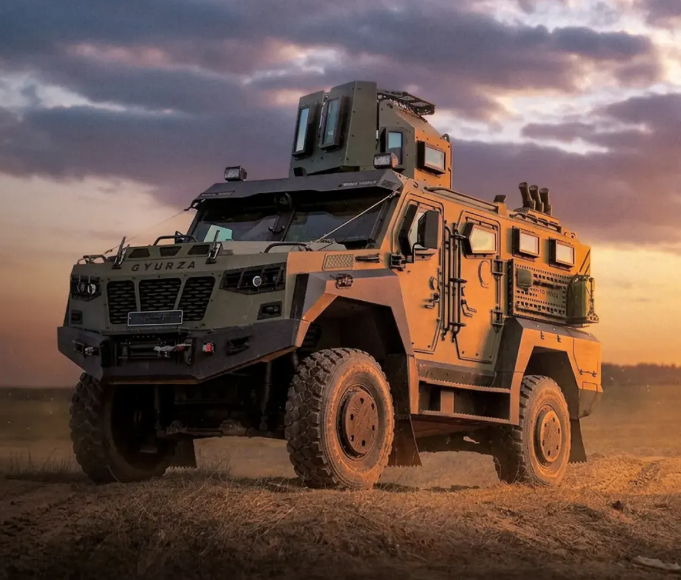
Ukraine's Gyurza-2 armored vehicle. Source: The Ukrainian Defense Ministry
Explore further

Robots won’t replace armored vehicles, says Ukrainian company that builds both. It reveals one job they can’t do

Four robots, one system

MAT1LDA is part of the Tencore Ecosystem, which brings together four classes of ground robots for military and civilian work, Militarnyi reported earlier. Besides the amphibious eight-wheeler, it includes the tracked TerMIT, the wheeled TOR 4×4, and the TRAX Utility firefighting and rescue robot. The company says it has delivered more than 4,000 robots to Ukraine’s armed forces since the full-scale invasion, used across more than 50 brigades.

The amphibious MAT1LDA ground robot
The amphibious MAT1LDA ground robot. Photo: Tencore

Tencore calls it Ukraine’s first integrated ecosystem of its kind. Putting the platforms into one system is meant to make them easier to use, maintain, and fit with extra equipment. One of the first shared add-ons is AI KIT, a hardware and software module that lets a robot keep to its route or drive back on its own after losing contact with its operator.

Ground robots from Tencore, clockwise: TerMIT, 4×4 TOR, 8×8 MAT1LDA, and TRAX
Ground robots from Tencore, clockwise: TerMIT, 4×4 TOR, 8×8 MAT1LDA, and TRAX. Collage: Militarnyi

On show in Washington

Tencore displayed MAT1LDA carrying a TerMIT robot at the Association of the US Army’s annual trade show in Washington this month, Breaking Defense reported.

Other Ukrainian makers have built swimming ground robots too: one switches from land to water in seconds, and another can tow 10 tons, its maker says. In April, Tencore formed a joint venture with France’s Shark Robotics.

  •  

Ukraine’s hobbit-named robot fired on targets up to 1.3 km away in a demo for border guards

Frodo universal ground robotic vehicle (UGV).

Ukraine’s six-wheeled Frodo ground robot fired on targets during a demonstration in Kharkiv Oblast for the Pomsta (Revenge) Border Guard Brigade, a border guard detachment posted on Facebook. Frodo made its public debut only on 30 September.

Ukraine had contracted more than 22,000 ground robots for 2026 by July, mostly logistics carriers, with combat models the smallest group, the Defense Ministry said. Frodo’s first reported mission was an evacuation. The demo shows its armed version to a fighting brigade, the kind of robot Ukraine has ordered least.

What the armed version carries

The platform completed its tasks at a training ground in near-combat conditions, said the 3rd Border Guard Detachment named after Hero of Ukraine Colonel Yevhenii Pikus. The Buria turret mounted on Frodo can fire either a Mk 19 automatic grenade launcher or a Browning M2 heavy machine gun. It engaged targets at up to 1.3 km (0.8 mile), the detachment said.

Frodo ground robotic vehicle (UGV).
Frodo ground robotic vehicle (UGV). Screenshot from a video by the 3rd Border Guard Unit

The 47-kg (104-lb) module has a ballistic calculator, stores up to 256 targets, aims in three seconds, and has a stated autonomous run time of up to 48 hours, the post said. Frodo is rated for up to 150 km (93 miles) on paved roads and 75–80 km (47–50 miles) over rough terrain, the post added. A Frontline Robotics Zoom reconnaissance drone flew reconnaissance during the test.

The developer, Frontline Robotics, describes its core philosophy as arriving fast, doing the job, and leaving very fast—hit and run, the detachment’s post said. Familiarizing the brigade’s soldiers with such systems aims first and foremost to preserve personnel’s lives and health, the detachment said.

A robot first reported as a medevac

Frontline Robotics told Militarnyi at the unveiling that Frodo had passed Defense Ministry codification and was built for logistics, evacuation, and strike missions. The robot reaches 40 km/h (25 mph) and carries up to 200 kg (441 lb) of payload, or 400 kg (882 lb) at most, the company said. A single soldier can swap its batteries.

Frodo ground robotic vehicle (UGV).
Frodo ground robotic vehicle (UGV). Photo: Frontline Robotics

The 92nd Assault Brigade used an early test unit to evacuate a wounded soldier, Frontline Robotics told Militarnyi. An operator, callsign Tango, named the robot’s speed and its ability to handle complex maneuvers as its main advantages, Militarnyi reported.

  •  

What Happens When a Kid’s Robot Best Friend Dies?

In this story for MIT Technology Review, Sara Harrison explores the field of social robotics and the growing use of robot companions as therapy for autistic and other neurodivergent kids. These playful machines show promise: Research suggests that they can help children practice social skills and offer something overworked therapists and exhausted parents can’t—a patient companion, available 24/7. But Harrison also reports on their limitations and risks. Does this approach truly work? What about all the data gathered on the child? And what happens when a robot friend suddenly stops working and “dies”? A fascinating and unsettling look at tech that has moved into the most intimate corners of a family’s home.

While Moxie found herself in more and more people’s homes, Embodied still struggled to make money. In 2024, the company announced it would cease operations. Its robots—which depended on external servers that the company could no longer pay for—would descend into a deep slumber. 

Videos of bereft children who seemed to have become deeply attached to the blue bot began to circulate online. “I don’t want her to leave,” wailed one child in a TikTok video. Desperate parents posted on TikTok, Instagram, and Reddit looking for solutions. “My autistic child is devastated and I’m pissed,” wrote one parent. “Hope Embodied gives us a couple days to say goodbye,” wrote another. 

  •  
❌