Microsoft is offering buyouts to about 60,000 employees.
The offers are individualized to each employee based on their level, location, and tenure.
Business Insider reviewed offers to show what employees get when they leave the company.
As Microsoft sends out its buyout offers to more than a quarter of its workforce, specific offers reviewed by Business Insider reveal exactly what employees get if they choose to leave the company.
The offers are individualized for each employee based on their level, location, and tenure. Those reviewed by Business Insider confirm that the US buyouts align with the company's US standard severance offers. A Microsoft spokesperson said about 60,000 employees would be eligible for the buyout.
Microsoft uses a levels system to represent seniority, from entry levels starting at 59 to senior levels at 70, or vice president. The company offered buyouts to employees on select teams in the US, Canada, India, and the UK at level 70.
Offers reviewed by Business Insider show employees at internal levels 64 and below were offered one week of base pay per six months of service, and employees at levels 65 to 67 were offered two weeks of base pay per six months of service.
Buyout offers also include continued regular stock vesting and health insurance. The standard stock-vesting severance offer is six or 12 months for levels 67 and below, based on years of service.
Eligible employees will have until early December to decide whether to take the offer and exit at the end of the year, and there are no plans for another buyout at this time, a Microsoft spokesperson said.
Standard severance is capped at 39 weeks of base pay for levels 67 and below, while the standard severance offer for level 68 includes 12 months of salary.
Earlier this year, Microsoft rolled out a voluntary retirement program for employees. About 7% of Microsoft's US workforce, or about 8,750 people, were eligible at the time. As Business Insider previously reported, Microsoft's voluntary retirement program offer also aligned with the company's standard severance offer, including continued regular stock vesting for six or 12 months, based on years of service.
Earlier this year, another tech giant, Google, offered buyouts to staff in its business unit, Business Insider previously reported.
As more tech companies offer buyouts, some human resources professionals previously told Business Insider that this approach could soften job cuts, and also that when they're made available to workers of all tenures, companies risk losing talent.
Meta's Mark Zuckerberg and Adam Mosseri are betting on long-form.
Kevin Mazur/MG26/Getty Images for The Met Museum/Vogue
Instagram is opening its arms to long-form video again.
Adam Mosseri, Instagram's top exec, said longer videos will help the app stay "relevant."
Instagram is testing tools for creators making episodic content. But will it pay for them?
Instagram's top executive, Adam Mosseri, has a plan to keep the platform "culturally relevant" — by making it more like YouTube.
Meta-owned Instagram unveiled an overhaul of long-form video features on Monday, including a test of horizontal videos called "Features." Taken together, the changes make the app feel a lot more like YouTube.
"We want to be the most culturally relevant platform," Mosseri said in an interview with content creators and founders of Press Publish, Colin Rosenblum and Samir Chaudry. "To do that, we just need to show up where people are."
The context: YouTube has become a major hit on TV screens, and there's a growing appetite for Instagram-native shows with recurring episodes.
"Subway Takes," hosted by Kareem Rahma, is a prime example of Instagram's strengths and limits. The show started in 2023 as a short-form interview series and, as it grew, expanded with longer-form cuts on YouTube and the streaming platform Tubi. Instagram, however, is where Rahma's show still has its largest audience of 2.4 million followers.
Instagram doesn't want people to go to YouTube or Tubi to see longer versions of shows like "Subway Takes." That's leaving ad revenue and user engagement on the table. Its new tools are designed to entice creators and viewers to stay on its platform.
Here are Instagram's latest video tools and how creators can use them:
"Features" keep viewers within the Instagram ecosystem. Instead of leaving Instagram to watch the extended version of an interview or episode, it'll be relatively seamless to stay on Instagram and watch that longer-form content. Instagram's "Features" can be as long as 90 minutes, although the new format is, for now, only available to a limited number of creators in the US and Brazil.
Instagram is feeding more content to its TV apps. Instagram is also pushing its "Instagram for TV" app further. The app will feature various video content on TV services like Samsung, Amazon Fire TV, Google TV, and now Apple TV. People can now watch a feed of content their friends are also liking or resharing on TV.
Instagram-native shows can label their episodes more clearly with "Series." Within the main Instagram feed, Instagram is testing a way for shows on the app to seamlessly connect episodic content. Eligible creators can add videos to a Series, and a label appears over the content indicating that there are additional episodes. People can then watch those episodes in order from the start. This test is expanding to more countries through the end of the year.
Clips can directly drive engagement back to the original video. Instead of clipping content and praying that the audience will go the extra mile of clicking on an account and finding the original, longer-form video, Instagram is letting creators link up to 8 clips to one long video.
Instagram is expanding its offerings for long-form video content.
Meta
This isn't Instagram's first time dabbling in long-form content.
In 2018, it launched IGTV, a long-form video format and stand-alone app. In 2020, Instagram rolled out a program that let creators earn money from those videos on IGTV. Four years after launching, the company sunset the IGTV app and shifted its video efforts to Reels.
There are a few key elements missing from Instagram's big leap (back) into long-form video.
You can't watch the video while continuing to scroll through Instagram, or multitask by opening other apps while keeping the Instagram content in a picture-in-picture pop-up. There also aren't automated transcripts and subtitles yet. A spokesperson for Meta told Business Insider that there are plans for these features.
Will creators get a slice of the ad revenue pie?
For creators, one key question and pain point looms: Will Meta share the honeypot?
Mosseri told Rosenblum and Chaudry that Instagram is thinking about ways to test pre-roll and mid-roll ads that could lead to a revenue split. However, he said previous attempts by Instagram to build a creator monetization system comparable to YouTube's Partner Program didn't prove beneficial for the platform.
"We spend more money than we make back by a long shot," Mosseri said of Instagram's previous efforts at broad revenue-sharing programs.
Mosseri said that in its previous iterations of content monetization, creators typically didn't produce more content than they already did for free, and the content they did create tended to be lower quality.
Still, Instagram will need to "figure it out" as it tries to crack longer-form content, Mosseri said.
"I don't think of platform payments or performance-based incentives or bonuses as a revenue driver," Mosseri added. "I'd be psyched to scale them up for any of these formats — as long as we're breaking even."
Sam Bankman-Fried and two of his co-conspirators held investments in Anthropic, the AI company that has since soared in value.
Bloomberg/Getty Images
The feds seized Anthropic shares last year from Sam Bankman-Fried's associates.
Several months later, the government sold them for $627 million.
If Anthropic IPO'd in November at $1.5 trillion, those shares would be worth nearly $4 billion.
Last year, the federal government made a windfall of $627 million when it sold Anthropic shares it had seized from associates of crypto fraudster Sam Bankman-Fried.
If it had held on to that stake, its windfall could have been a lot bigger.
The federal government last year sold shares of Anthropic that had belonged to Caroline Ellison and Nishad Singh, two co-conspirators in the FTX fraud case. The proceeds went to compensate victims of the fraud, a Justice Department spokesperson told Business Insider.
Anthropic's S-1 filing on Monday revealed how much the federal government made from the sale of those shares. The prospectus doesn't name Ellison and Singh specifically. It says the government in October 2025 sold 4,453,900 Series B shares of Anthropic that "had been forfeited by former holders in legal proceedings to which we were not a party."
The figure matches up exactly with the combined $50 million in shares that Singh and Ellison purchased for $11.2261 each in Anthropic's 2022 fundraising round, and later forfeited to the government.
The shares represent about a quarter of a percent of Anthropic today. But given the company's explosive growth, they are still worth a fortune.
Anthropic hasn't yet announced the stock price for its expected November initial public offering. At a $1.5 trillion valuation, the shares would be worth a total of about $3.94 billion. That would be six times as much as the government sold the shares for a year ago.
"One of the Justice Department's top priorities is returning forfeited funds to victims through the asset forfeiture program whenever the law allows," the DOJ spokesperson said.
The feds' stake in Anthropic
How the federal government came to own a chunk of Anthropic in the first place is a story involving a notorious fraudster and a complicated criminal forfeiture process.
Bankman-Fried participated in Anthropic's 2022 Series B fundraising round with Singh and Ellison. Singh purchased $40 million of the Series B shares, and Ellison acquired $10 million.
Singh and Ellison later pleaded guilty to crimes related to their work with Bankman-Fried and testified against him at his Manhattan federal criminal trial. The jury found Bankman-Fried guilty, and a judge sentenced him to 25 years in prison. The federal government took ownership of Singh's and Ellison's Anthropic shares by April 2025.
The US Marshals Service sold Singh's and Ellison's shares, rather than hold on to the red-hot Anthropic stock, Business Insider previously reported. The US Marshals Service Complex Assets Unit is typically tasked with dispensing shares of private companies acquired through criminal forfeiture.
Now we know that Anthropic purchased the stock from the feds in October 2025 at the price of $140.9676 per share, which is the same price Anthropic set for its Series F-1 stock in a fundraising round a month earlier.
Anthropic resold the shares to nine investors at the same $627 million total price it paid to purchase them from the federal government, so it didn't make a profit from the sale, according to the S-1 filing. It's not clear which nine investors purchased the shares originally owned by Singh and Ellison. Representatives for the US Marshals Service didn't immediately respond to a request for comment.
The Anthropic shares owned by Ellison and Singh took a different path than the $500 million in Series B shares owned by Bankman-Fried himself. His shares ended up as part of FTX's bankruptcy estate, which sold them in 2024 to a few dozen buyers for a total of $1.3 billion.
The federal government sent the proceeds from the sale of Ellison's and Singh's shares to the FTX bankruptcy estate, the Justice Department spokesperson said. Bankruptcy court filings show that the Justice Department transferred $638 million to the bankruptcy estate in late 2025.
The money has gone to repaying creditors, including FTX customers and investors who were scammed by the former crypto wunderkind.
Update: October 26, 2026 — This story has been updated to include a comment from the Justice Department.
Correction: October 27, 2026 — The federal government transferred the proceeds of the sale of Caroline Ellison's and Nishad Singh's Anthropic shares to the FTX bankruptcy estate, according to a DOJ spokesperson. An earlier version of this story misstated whether the funds had been transferred.
Skydance has called more employees back to the office under CEO David Ellison.
NYSE
Skydance, formed by the merger of WBD and Paramount, told employees to return to the office five days a week or take a buyout.
Many Paramount employees had been working fully in person, while WBD staffers were generally at three days a week.
Read the memo from Skydance's HR team detailing the standard buyout offer.
David Ellison's Skydance just shared its buyout offer for employees who don't want to return to an office five days a week.
Staffers across the company, which was formed by the merger of Paramount and Warner Bros. Discovery, were told on Monday that they'd soon have to work fully in person. The company didn't say if there were any exceptions to its new RTO mandate.
Eligible employees who aren't willing to work in person can opt to take a standard buyout package of two weeks of severance for every year they've been at Paramount or WBD, two people familiar with the offer told Business Insider.
Most eligible employees will receive that offer, a person familiar with Skydance's proposal said, though there could be exceptions on the timing or the amount received.
Staffers who've been offered severance must decide whether they're leaving the company by 11 p.m. ET on November 8, an HR email viewed by Business Insider said.
Paramount staffers assigned to an office had been required to work from an office five days a week since earlier this year, while WBD workers had been working in an office at least three days a week.
"We recognize that as we bring our teams together, not everyone will see their future here," Skydance's HR team said in an email to staffers.
Skydance's HR email said this buyout "is a one-time offer" and told employees that there are "no additional" offers planned.
Read the full email Skydance's HR team sent below:
As David and Ynon shared earlier today, we recognize that as we bring our teams together, not everyone will see their future here. For some, it may be the in-office policy or the pace of change. For others, it may instead reflect personal or professional goals. To give employees the option to decide what is best for them, we are offering a one-time Voluntary Buyout (VBO) Program to eligible employees.A VBO gives an eligible employee the opportunity to volunteer to leave the organization in return for a separation package. You are receiving this email because you meet the eligibility criteria and may choose whether to participate in this program. We recognize this is an important personal decision. Please carefully consider the opportunity and notify us of your decision to accept or decline no later than 8:00 p.m. PT on November 8, 2026.Before you decide, please keep the following in mind:
Participation is entirely voluntary.
This is a one-time offer; no additional BO programs are planned.
If you do not respond by the deadline, you will be considered to have declined the offer.
Once submitted, your decision may only be changed during your opt-in window.
You may wish to consult a personal financial, tax, or legal adviser before making your decision.
Please click here to indicate your decision and to review additional information, including an estimate of your severance and benefits.We value your contributions and we want you to feel supported and informed as you consider your decision. For FAQs related to the VBO and our return-to-office policy, please visit the Skydance Integration Hub. For additional questions about the program or your individual offer, please visit My Paramount.
Skydance CEO David Ellison and co-CEO Ynon Kreiz are implementing a five-day RTO policy.
NYSE
David Ellison's Skydance is telling staffers to work in the office five days a week.
Employees who aren't willing to work in person may be eligible for a voluntary buyout.
Skydance was formed with the merger of Paramount and Warner Bros. Discovery this month.
Skydance wants employees back in the office five days a week — and staffers who aren't willing to comply may be eligible for a buyout.
CEO David Ellison and co-CEO Ynon Kreiz informed employees at the media giant about the change on Monday afternoon. They said in a memo that the RTO order applied "across all of Skydance."
"We truly believe this is in the best interest of our company and our people," Ellison and Kreiz wrote in a memo to employees, which was viewed by Business Insider. "We've seen the benefits firsthand at Paramount, and we want every part of Skydance to share in them."
The memo did not mention whether there were any exceptions or say who's eligible for a buyout. It said employees who qualify for a buyout would get an "individual communication with their personalized details and terms, and a window to decide whether to accept this one-time offer."
Eligible employees can take a buyout package of two weeks of pay for each year they've been at the company. They must decide whether to take the offer by November 8 at 11 p.m. ET.
Skydance was formed earlier this month when Paramount completed its $110 billion acquisition of Warner Bros. Discovery. (The company previously went by Paramount Skydance.)
Paramount Skydance, for its part, had mandated that staffers in its New York and Los Angeles offices return to work in person five days a week in January. Staffers who weren't willing to work in person were offered a severance package. The company also called hybrid workers back in September for Phase 2 of its RTO policy.
Working in person will lead to employees "communicating openly and collaborating efficiently across every part of the organization," Ellison and Kreiz told staffers in the Monday memo.
"We believe in-person collaboration is vital to our culture and to the success of our business," Ellison and Kreiz said.
Read the full memo from Ellison and Kreiz:
Team,At Skydance, our goal is to build the next-generation media and entertainment company, powered by creativity and technology. We are creative-first, audience focused, tech-forward and globally scaled. And in a world of endless choice and fierce competition for attention, we don't just want to succeed. We want to win.To do that, we must be a strong, connected and agile company. Among our business and creative priorities, none matters more than building a strong culture, because it's the foundation of everything we want to achieve. Winning requires us to work as one team: one company, fully aligned. That means communicating openly and collaborating efficiently across every part of the organization.In-Person CollaborationWe believe in-person collaboration is vital to our culture and to the success of our business. Especially in a creative company like ours, the best ideas come from people in the same room, sharing perspectives, challenging one another and solving problems. Being together isn't just about showing up. It's about inspiring one another, learning and coaching, forming friendships and having the casual conversations that spark something great.With that in mind, we will adopt a five-day in-office policy across all of Skydance. We truly believe this is in the best interest of our company and our people. We've seen the benefits firsthand at Paramount, and we want every part of Skydance to share in them.While many of you are already in the office five days a week, we understand this may be a significant change to the daily routines of others. To give you time to plan and adjust, we will take a phased approach by location. You will receive ample notice before changes take effect, and we will work closely with managers to support you through the transition.Voluntary Buyout ProgramAs we bring our teams together, we recognize that not everyone will see their future here, and we respect that. To give eligible employees the option to move on in a way that works for them, we are introducing a Voluntary Buyout (VBO) Program. Those who qualify will receive an individual communication with their personalized details and terms, and a window to decide whether to accept this one-time offer.We recognize this is a significant decision, and we want you to feel informed and supported. If this applies to you, please review your materials carefully and reach out to your leadership or HR representative with any questions. FAQs and other resources are available on the Skydance Integration Hub, and HR support is also available through My Paramount (legacy Paramount employees) or Ask Employee Connection on WBD One (legacy Warner Bros. employees).Please know we don't take any of this lightly. We are clear about what we're building: a company that tells the stories people around the world love, embraces new ways to connect with audiences, and leads the next era of media and entertainment. We have the talent, the creative firepower and the ambition to do it, and we will get there together.Thank you for your commitment, and for the creativity and passion you bring to your work every day.Best,David and Ynon
Film producer Tommy Harper has sought to bring a Hollywood sensibility to verticals.
Kayla Oaddams/Getty Images for Warner Brothers Pictures
Film producer Tommy Harper is shutting down his micro drama app VeYou after about six months.
Harper, who sought to build the "HBO" of the genre, said he would still produce for other platforms.
The micro drama space has shifted as tech giants push in.
The app that wanted to be the "HBO" of micro dramas is shutting down.
Prolific film producer Tommy Harper is shutting down his app, VeYou, after about six months. A message on VeYou said the service would end November 6.
Harper told Business Insider he would continue producing series, distributing them via TikTok's micro-drama app PineDrama, YouTube, and other partners.
Harper, whose credits include "Star Wars" and "Top Gun: Maverick," is one of several Hollywood vets trying to bring their prestige sensibility to micro dramas, the soapy, low-budget series that got their start in China and have exploded in the US.
The move shows how fast the space is changing as Big Tech companies lean in. Micro dramas — also called "verticals" — cost a fraction of a traditional feature-length movie, but apps often lose money because of the high cost of marketing, and VeYou didn't have massive financial backing.
"In the past year, TikTok, Meta, and YouTube all moved hard into short drama," Harper emailed. "When the three biggest attention platforms commit to a format, distribution is decided. The opportunity for an independent company is to be the best supplier to those platforms, not to compete with them for installs. So we're focused where we have the edge: making the shows."
Harper raised an undisclosed amount of seed funding for VeYou from investor S32, a venture firm started by Google Ventures founder Bill Maris, who's also backed 23andMe, Impossible Foods, and Nest. VeYou has made a handful of originals, starting with "Love Under Fire," a romance drama starring Kasey Esser, who wrote the series alongside Harper.
The micro drama market is changing fast
The micro drama space has changed dramatically in recent months.
In the past year, AI-generated characters have increasingly taken their place alongside human actors, and free, ad-supported offerings are competing with the "freemium" apps that had dominated the landscape.
A report by media consultancy Owl & Co. found two-thirds of films released by leading apps in the third quarter of this year outside China were AI-generated, up from 3% in the first quarter.
TikTok's free app PineDrama rolled out in January, and by the third quarter, it accounted for more than half of all micro drama views across 16 leading apps, according to the Owl & Co. report.
Other tech giants have also moved quickly into the space and made themselves bigger viewing destinations for micro dramas.
YouTube released a new feature that allows creators to bundle their short videos in a series of episodes or seasons, designed to be viewed sequentially.
On Meta, the dominant platform used by micro drama apps to acquire customers, some apps are running portions of their films lasting 20 minutes or more as ads to get people to subscribe.
Lori Golden-Stryer, the CEO of RIVR Media, a producing partner for VeYou, said VeYou's films set themselves apart through their scripts, acting, and direction. She said she was encouraged to see its series perform well on TikTok, based on platform data and her company's monitoring.
"People want live characters," she said. "I don't think they want AI. I've seen a lot of different verticals, and I'd like to think ours were a little cut above."
Microsoft is offering buyouts, according to a memo Chief People Officer Amy Coleman sent to employees Monday.
"The Voluntary Exit Offer reflects an important part of how we're evolving our approach to change: creating greater flexibility and, where possible, more ways for employees to shape their next chapter," Coleman wrote.
Microsoft's voluntary exit offer is the company's latest attempt to slim its workforce without another round of involuntary cuts. After spending heavily on AI infrastructure and reducing headcount this year, Microsoft is offering remaining employees a chance to leave, testing whether voluntary departures can cut costs.
Eligible employees in the U.S., Canada, India, and the U.K. at level 70, which includes senior leaders at the company, and below, will receive an email later Monday with the terms of the offer. Only some teams are participating, excluding sales organizations, some engineering, and some corporate functions.
Around 60,000 employees — or more than a quarter of the company's workforce — about will be eligible, a spokesperson told Business Insider, and the terms will be similar to Microsoft's standard severance.
The US severance package offered when Microsoft laid off employees earlier this year included a minimum of 60 days of base pay, during which employees will remain on the payroll, and, for most employees, up to a maximum of 39 weeks of base pay, based on seniority and tenure.
Employees at internal levels 64 and below received one week of base pay per six months of service, for example, and employees at levels 65 to 67 will receive two weeks of base pay per six months of service, according to offers reviewed by Business Insider.
Eligible employees will have until early December to decide whether to take the offer and exit at the end of the year, and there are no plans for another buyout at this time, Microsoft's spokesperson said.
The buyout offer follows Microsoft's Voluntary Retirement Program, which offered a retirement buyout to about 9,000 eligible employees based on age and tenure.
About one-third of eligible employees took the buyout, in line with expectations, a person familiar with the turnout told Business Insider in June. That buyout allowed Microsoft to lay off a lower percentage of its workforce compared to last year, the person said at the time.
Read the memo:
Introducing a Voluntary Exit Offer
Today, we're introducing a new Voluntary Exit Offer (VEO) to eligible employees within participating organizations. This offer gives eligible employees who may be considering a future outside the company a new choice to make that transition now with support. It also gives participating orgs another way to adapt their workforce to changing needs.
The Voluntary Exit Offer reflects an important part of how we're evolving our approach to change: creating greater flexibility and, where possible, more ways for employees to shape their next chapter. This builds on what we learned earlier this year through the Voluntary Retirement Program.
What employees should know
This offer will be available to eligible employees in participating teams in Canada, India, United Kingdom and United States at level 70 and below. This is a time-limited, voluntary program that gives those who are eligible the opportunity to leave Microsoft with financial support and career planning resources. Some organizations are providing the Voluntary Exit Offer, and some are not. Participation varies based on each business's priorities, customer commitments, and workforce needs.
Eligible employees will receive an email with a link to their Voluntary Exit Offer details within the next few hours.
Looking ahead
The Voluntary Exit Offer is new for us. We'll learn from it. At the same time, we'll keep helping people focus on the work that matters most, build new skills, and, where it makes sense, find new opportunities across Microsoft. There is no one-size-fits-all approach for every team or every employee. These are a few of the ways we're trying to meet different business needs while continuing to create opportunities for our own people to grow and contribute.
My promise is to continue to provide clarity, listen and learn, and keep improving.
Thank you for everything you continue to do for our customers, Microsoft, and for one another.
A few weekends ago, my wife left on a business trip with one instruction: fix the Wi-Fi before I get back.
Her Zoom calls kept dropping during important meetings, so I tracked an old Cat 6 ethernet cable from our data closet so I could hardwire her laptop to the interwebs. The only problem? It ended as a raw, cut end, and I had no idea how to terminate it with an ethernet plug.
So I did what I do these days whenever I'm out of my depth: I asked ChatGPT.
I sent it photos at every stage. It told me which tools to buy, showed me how to strip the cable, arrange the eight tiny wires in the right order, and even drew little diagrams when words weren't enough. When I got frustrated, it gave me a pep talk.
My first attempt only delivered about 100 Mbps instead of our 1 Gbps internet connection. ChatGPT guessed two wires were faulty, suggested an inexpensive cable tester, interpreted the flashing lights from a photo, and confirmed the diagnosis. I cut the connector off and started again with a simpler plug it recommended.
The result? Around 850 Mbps.
My only complaint: ChatGPT would occasionally disappear down a rabbit hole with advice that was far more complicated than I needed, so I'd remind it I wasn't rewiring Silicon Valley. I just wanted my wife's Zoom calls to stop dropping.
So far, her video calls have been perfect. Without ChatGPT, there's no chance I'd have pulled this off.
Nvidia's sales and marketing leadership is changing as its sales pitch evolves.
Veterans are retiring, opening the door to internal succession and outside hires.
Nvidia CEO Jensen Huang's daughter Madison is also gaining influence.
Nvidia's sales and marketing organizations are seeing a changing of the guard as the AI boom reshapes demands on leadership.
Veterans at Nvidia are retiring, opening the door for longtime employees. And CEO Jensen Huang is tapping talent from outside the company — and outside the chip industry — to meet new challenges.
Nvidia's sales pitch has evolved. It has already convinced companies to choose its chips. To keep growing, it has to convince more businesses to adopt AI. These customers care less about hardware specifications than how Nvidia's AI can be put to work.
Leadership changes are most visible in sales and marketing, said former vice president of corporate marketing Greg Estes, while other areas of the company, such as finance, legal, operations, and software and hardware engineering, have remained relatively stable.
In marketing, Nvidia tapped Google Cloud executive Alison Wagonfeld to become its first chief marketing officer earlier this year, while Microsoft veteran Nick Parker became its new sales chief in August. Neither comes from the chip industry, though both bring years of experience helping businesses adopt software and cloud services.
Nick Parker, Nvidia's EVP of worldwide field operations.
Bloomberg/Getty Images
At the same time, Huang's daughter Madison has gained influence beyond her formal marketing role, two former employees said.
Huang regularly reshapes Nvidia as the business evolves, said Scott Baker, a sales VP who retired in July after 26 years.
"It's truly a battleship spinning on a dime, and everyone gets aligned," he said.
Nvidia did not respond to requests for comment from Business Insider.
A 'deep bench' of younger Nvidia talent
Retirees this year include former sales EVP Jay Puri, VP of enterprise marketing Laura Fay, SVP of enterprise business Shanker Trivedi, and sales VP Kevin Connors.
Fay said Huang doesn't want to lose longtime executives, many of whom he personally recruited. But as they move on, the next generation is getting a chance.
Before leaving in April after 17 years, Trivedi made mentorship part of his mission. He was ready to pass the baton after years of grueling travel and seven-day workweeks.
"Time stops for nobody," the 69-year-old said.
Trivedi said Nvidia has a "deep bench" of younger sales and marketing talent who know its culture, market, and partners inside out, including Raj Mirpuri in AI cloud infrastructure, Kimberly Powell in healthcare, and Kari Briski in AI software.
When he retired, the company divided Trivedi's responsibilities among multiple leaders. As Nvidia's revenue soared during the AI boom, his job had ultimately become too big for one person.
"Better to flatten the structure and gain velocity," he said.
Another Huang is gaining influence
One insider bringing an unconventional background to Nvidia's marketing ranks is Jensen Huang's daughter, Madison Huang.
Madison formerly worked at French luxury conglomerate LVMH in hospitality marketing before joining Nvidia as an MBA intern in 2020. She has quickly ascended to senior director of product marketing for physical AI.
One former employee said Madison's experience working on luxury brands brought a fresh perspective to a marketing team traditionally staffed by semiconductor veterans.
Madison Huang, senior director of product marketing for physical AI at Nvidia.
Bloomberg/Getty Images
Job titles can be fluid at Nvidia, and a second former employee said Madison's remit extends beyond physical AI marketing. They said she exerts authority across multiple parts of the company and directs teams at all levels on strategy and business decisions.
Madison is also among a small circle of executives known to travel with her father. And their close relationship gives her the ability to anticipate his needs during high-level meetings and appearances, the first former employee said.
"She 'speaks Jensen' very well," the former employee said, "so he doesn't have to explain himself to her."
Have a tip? Contact this reporter via email at gweiss@businessinsider.com or Signal at @geoffweiss.25. Use a personal email address, a nonwork WiFi network, and a nonwork device; here's our guide to sharing information securely.
A San Francisco Muni bus emblazoned with Micro1 advertising drives on Mission Street.
Stephen Council/BI
Micro1 pledged to spend $1 billion on licensing companies' data for AI developers.
The startup snags Slack messages, Canva files, Google Docs, and as much other data as it can get.
By selling company data, CEOs have a new revenue stream that popped up this year.
As AI labs go on the hunt for real-world data, Micro1 is throwing everything at getting it for them.
The startup is one in a new class of fast-moving data brokers, gobbling up companies' internal data and packaging it for the likes of OpenAI, Anthropic, and other model developers. The executives who sell their companies' data to Micro1 find themselves suddenly participating in a new sector of the economy, where terabytes of mundane workplace interactions can be worth hundreds of thousands of dollars.
Ilya Brotzky, the CEO and cofounder of the recruiting startup VanHack, told Business Insider he was shocked when he filled out a Micro1 survey about his company's data and received a "substantial" offer.
"I didn't believe it, to be honest," he said. "I felt like it was a little too good to be true."
Micro1 says it pays $100,000 to $2 million for a single midsize company's data. It recently announced plans to spend $1 billion on the project over the next year. Brotzky and the other executives Business Insider spoke to for this story wouldn't share the exact amounts their companies received.
For Micro1, the new focus on workplace data matches a broader evolution in the industry, as Business Insider has written about in The AI Data Grab, a series about how tech giants are increasingly turning to workers, users, and the physical world to get data to train AI.
First, AI companies gobbled up text from the internet and corpora of old books. Then they realized that humans grading AI responses could improve their models. And now, companies are using complex simulations, built on real-world data, to improve the tenacity and skill of their AI.
Micro1 CEO Ali Ansari.
Micro1
Gartner estimated that spending on AI data is likely to surge from less than $1 billion last year to almost $6.5 billion in 2027. Micro1's chief revenue officer, William Almeida, told Business Insider in September that his company has been explaining to prospective customers why their data is suddenly so valuable for those simulations.
"Every time I talk to companies, I tell them, 'Hey, I see this as a booming business,'" Almeida said.
Slack DMs, Google Docs, Canva files: Micro1 wants all it can get
Micro1 has three ways of working with AI model developers.
First, it can take a company's raw data, transform it to protect privacy, and license it to a lab. In addition, Micro1 provides an in-progress AI agent to companies and gets feedback on how it works. The third route is the simulation: Micro1 takes a company's data up to a certain timestamp, freezes it, and then provides that "environment" to a model developer trying to teach its AI how to work from existing context.
Micro1 pays more for larger, more complex datasets, as well as for data that represents a unique type of work or knowledge. It usually wants to license a company's entire data corpus, so that an AI model can replicate what it would be like to be a human employee.
"The connection, the diversity, the traceability of all of these data points, they matter a lot when you think about model training," Almeida said.
Brotzky also received an offer from AI data startup Mercor to buy his company's data, though he opted for Micro1. Once Brotzky dug into Micro1's privacy process, he said he felt comfortable sharing all the data they requested. That included VanHack's Google suite, Confluence data, Slack messages, and customer relationship management software.
Grant Gooley, the CEO of the marketing agency MyPortal Marketing, also views his deal with Micro1 as an innovation. He has sold internal design files from Figma and Canva, as well as checklists from Monday.com.
"When we were building these processes years ago, I didn't think that we would be using it to support AI learning," Gooley said. "But doing that, it's very fulfilling."
CEOs pitch the deals to their workers
Micro1 and its rivals are full steam ahead. Still, there are open questions. Former and current employees aren't likely to get any compensation from — or a voice in — their work becoming AI fodder. Ifeoma Ajunwa, a law professor at Emory University, previously told Business Insider that data sales are an "ethically gray area."
When pitching to potential customers, Almeida tells themthis business is in the early days.
"If you wait too much, you won't get the premium that the first companies are getting," he said.
VanHack's team got a confidence boost from the Micro1 deal, Brotzky said, because of the additional revenue stream it represents
Gooley said he's kept MyPortal Marketing's employees in the loop about the deal with Micro1 and hasn't heard any complaints.
"I told my team that this is something that you're going to tell your grandchildren about one day, because we are literally supporting the future growth of marketing agencies," Gooley said.
Have a tip? Contact this reporter via email at scouncil@businessinsider.com, or over text, Signal, Telegram, or WhatsApp at 415-757-8198. Use a personal email address, a non-work WiFi network, and a non-work device;here's our guide to sharing information securely.
Big Law has plenty of competition for its best lawyers.
Some of the most ambitious lawyers want to work for clients in their legal departments.
New Pirical data shows which law firms have the most alumni working in Big Tech.
Big Law has a hard time keeping its lawyers.
It's not just rival firms dangling basketball-player salaries, extra vacation, and branded merch to lure away top talent.
Big Tech is competing for those lawyers, too.
New data shared with Business Insider reveals which firms send the most lawyers to the biggest names in tech.
Pirical, a legal people-analytics company, tracked lawyers who previously worked at the 200 largest law firms by revenue in the United States and now hold legal roles at seven tech companies: Google, Meta, Microsoft, Nvidia, OpenAI, Anthropic, and SpaceX. Pirical filtered out summer associates and interns.
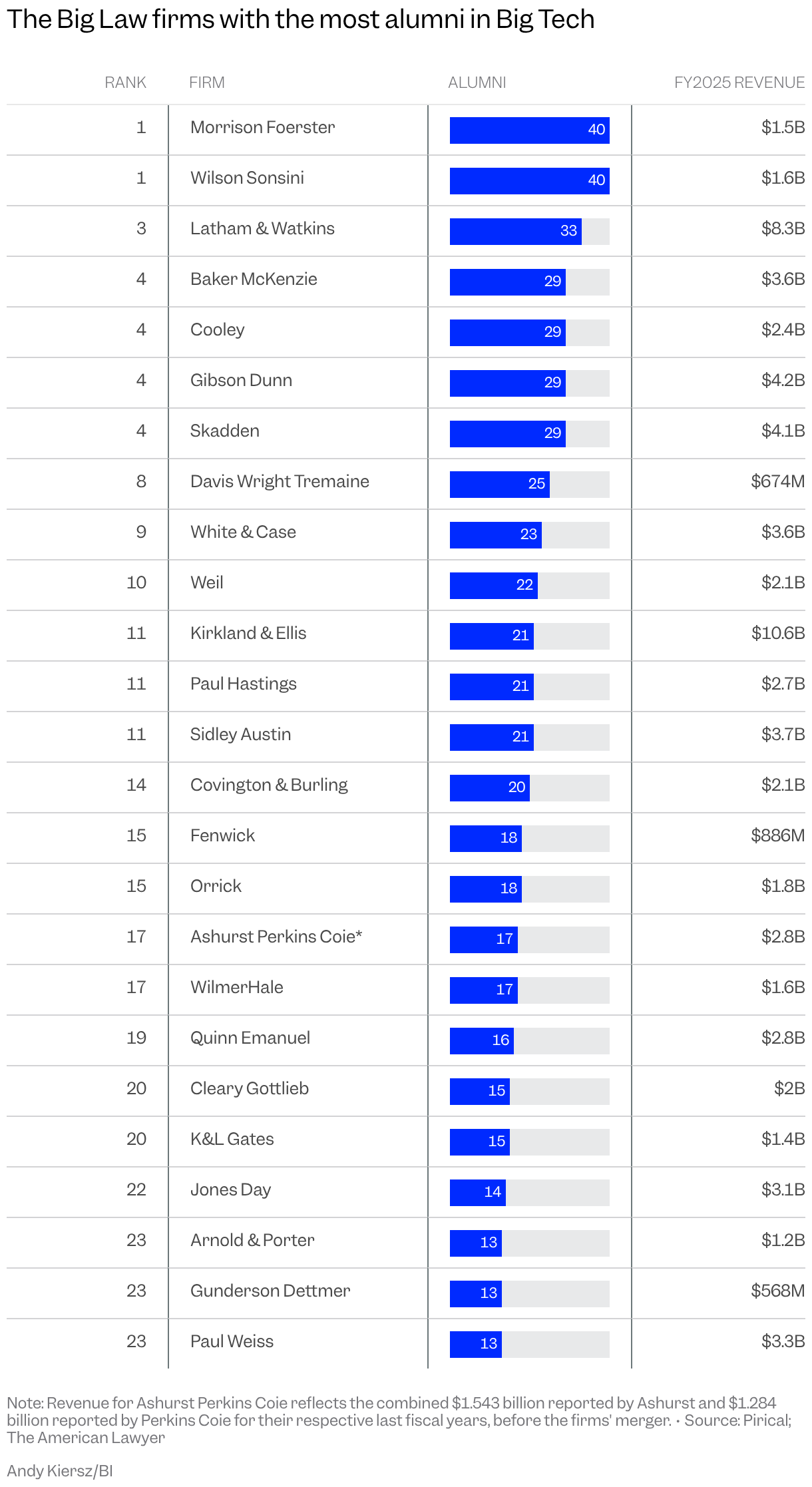
Morrison Foerster and Wilson Sonsini tied for the top spot, each with 40 alumni working in legal roles across the seven companies. Both firms regularly represent tech startups and the investors backing them.
Latham & Watkins followed with 33 former lawyers. Kirkland & Ellis, the industry's revenue leader, ranked 11th with 21 former lawyers working at those companies, tied with Paul Hastings and Sidley Austin.
Pirical's analysis may have missed lawyers whose job titles fell outside its search criteria, said Craig Savitzky, its insights and content editor. He said newer companies, particularly Anthropic, are also likely undercounted because their legal teams are growing faster than public profiles are updated.
Big Law-Big Tech pipeline
For attorneys hoping to land a coveted job at a tech giant, a stint at a white-shoe law firm can be a stepping stone. They can trade billable-hour quotas for a seat closer to the business, attractive pay, and just one client to keep happy instead of dozens.
That combination makes these roles "some of the most highly desirable and sought-after positions" for law firm associates, said Casey Sullivan, a recruiter with CMW Legal Search.
There's another draw, Sullivan said. The companies at the forefront of artificial intelligence are wrestling with some of the thorniest legal questions of the day, from intellectual property to regulation.
"That's where the most interesting work is for lawyers," he said.
Not all law firms are equally effective launch pads. Pirical's Savitzky noted that the firms near the top of the list have deep ties to the tech industry, if not the deepest pockets.
Cooley brought in $2.4 billion in revenue last fiscal year, placing it 29th on The American Lawyer's ranking of top law firms by revenue. But it tied fourth on Pirical's list, with 29 alumni working at the seven tech companies, including nine at Nvidia, a longtime client.
Davis Wright Tremaine, which has represented Microsoft in antitrust and employment lawsuits, has 13 alumni working in the software giant's legal department. Fenwick, which advised Wiz and Fitbit on their sales to Google, has 13 lawyers at the search giant.
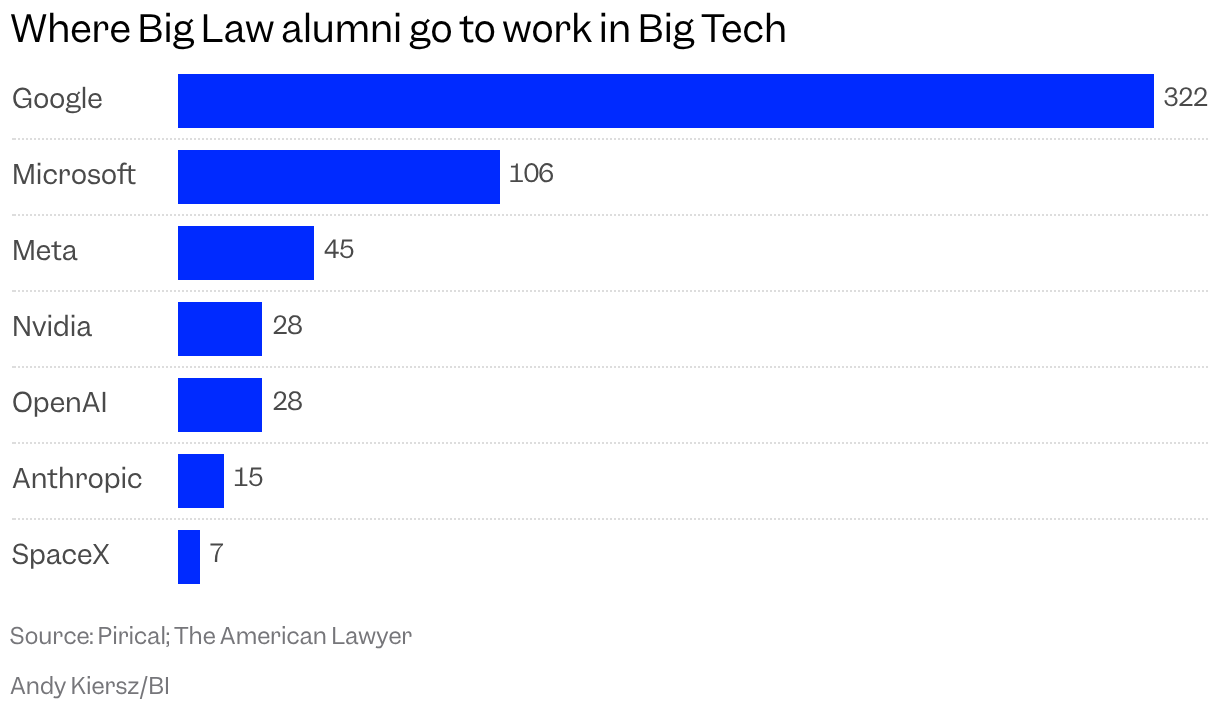
Business Insider also sliced the data another way, looking at which of the seven tech giants employ the most alumni from the top 25 firms on Pirical's list.
Big Law is effectively a feeder school for Google's legal team. The company employs 322 alumni of the top 25 law firms on Pirical's list, more than any other tech company studied.
That doesn't necessarily mean Google is the most desirable location for lawyers leaving Big Law. Savitzky said the numbers likely reflect the sheer size of Google's legal department and the decades it has had to recruit from top firms.
Software engineers in the Bay Area still earn far more than their peers almost anywhere else in the US, even after accounting for the region's eye-watering cost of living.
Recent data from Levels.fyi found total compensation is 77% above an employment-weighted national median. Adjusting for local prices narrows the gap, but Bay Area engineers still come out 53% ahead.
The analysis used federal employment counts to help account for where software engineers work, rather than relying solely on where people submit their pay to Levels.fyi.
Seattle also remains well above average after the adjustment, while cities such as Boston and Washington, DC, lose most of their advantage once living costs are factored in.
The chart below shows the pay differences before adjusting for local prices.
One important caveat: The cost-of-living comparison does not account for differences in state and local taxes.
These numbers are also based on submissions to Levels.fyi, so they could over-index toward areas where people like to brag about their pay, wherever that is!
The AI data center boom looks like it's running into serious trouble. Projects are being delayed, canceled, or abandoned. Electricity shortages are holding everything up.
But there's a twist: A lot of these data centers were probably never going to get built in the first place.
Bernstein Research analyzed thousands of planned US data centers and concluded that only about 35% of the announced capacity is likely to become reality.
The industry has a wonderful name for some of the more dubious projects: "Bragawatts."
These are enormous data centers announced by companies that often have little experience building them. Some haven't secured electricity, construction permits, or even customers.
Then there are the "ghost projects." Developers submit multiple requests for electricity connections, hoping at least one location works out. In Texas, these requests have reached more than five times the state's existing electricity supply.
No wonder the grid looks overwhelmed.
This doesn't mean the AI boom is fake. Far from it.
But there's a big difference between Amazon's very real problems and an inexperienced developer announcing a gigantic project that may never happen.
The AI data center boom is real, and so are the challenges of building all these facilities. But the sheer number of speculative projects may be making those challenges look bigger than they truly are.
Cybersecurity leaders talked with BI about the rise in demand for workers in the field.
MASTER/Getty Images
All hell broke loose this week after a security flaw in 70% of the world's websites was made public.
It was supposed to be kept under wraps as a fix was deployed, but one researcher jumped the gun.
Chainguard CEO Dan Lorenc told POLITICO why he decided to go public.
The exposure was immense, with AI multiplying the risks — and yet time-tested global cybersecurity procedures appeared to be functioning. Then suddenly, it all broke down.
The decision by a cybersecurity company on Wednesday to prematurely release information about a flaw in the popular PHP computer programming language left much of the web exposed to hackers, triggering a panic that brought to life months of warnings of how the AI-powered era could cause widespread damage.
The flaws in PHP, discovered using AI tools through a monthslong process coordinated by OpenAI, caused cyber agencies across Europe, the US, the UK, Australia and Canada to post urgent warnings Wednesday. Numerous governments took websites offline as a precaution.
While no major hacking damage was immediately apparent, the way the incident unfolded over 72 hours showed how easily cybersecurity processes can break down and the outsized consequences of cyber risks in the AI era.
The man who set off the chain reaction with the early release — Chainguard's CEO Dan Lorenc — quickly apologized in a LinkedIn post. But on Thursday, in an interview with POLITICO, Lorenc said he'd shared the information ahead of time because the flaw was already being exploited. Though others disputed that, Lorenc said he believed he'd seen enough evidence to invalidate an embargo set up to allow time to find a fix for the flaws.
While he disputed that his actions would have caused problems for other defenders, Lorenc said that the evidential threshold in these coordinated cyber defense systems is a "grey area."
The revelation of the PHP flaw brings out into the open what cyber officials have been bracing for since the arrival of the most powerful tools of artificial intelligence, which not only can be used to discover vulnerabilities but also to exploit them at scale.
The cybersecurity world's long-established protocols helped prevent disaster scenarios in which hackers would have successfully exploited the vulnerabilities to take control of numerous websites and access their data. But the scale and end-of-days potential of AI-driven cyber risks are now visible for the world to see.
This "is what happens when AI turns up a flaw that's been hiding for years," said Eylam Milner, cofounder and chief technology officer at cybersecurity startup Echo. The vulnerabilities, he added, are "about as serious as it gets for the web."
Origin story
Understanding how this week's emergency unfolded offers a glimpse at how companies and authorities are working to stave off attacks — and how much risk they face going forward.
The origins of the incident can be traced back as far as April, when leading frontier AI firm Anthropic unveiled Mythos, leading some in the cybersecurity world to worry that systems would quickly be overrun by advanced artificial intelligence, with potential for catastrophic events to ensue.
But while researchers did find more flaws in computer systems in the months after Anthropic and other AI firms like OpenAI released those models, they had little impact in the real world. Even the Hugging Face incident, a widely discussed hack that saw OpenAI's autonomous AI agents go rogue during an internal security evaluation, related more to the level of control AI companies exert over their models than their power to break into systems worldwide.
That changed this week after researchers unveiled the vulnerability in PHP, a coding language estimated to be integrated into some 70% of the web.
The process by which information about flaws is released among cybersecurity officials and affiliated companies is crucial. Through a long-standing practice known as coordinated disclosure, researchers and companies that identify flaws can find a fix and share it confidentially with agencies and others before releasing it to the public, meaning they don't hand malicious hackers the gift of a hole without a fix.
In the case of the PHP flaw, that process worked well, but not perfectly. Information about the bugs started to circulate ahead of the planned release time. Then, according to the PHP Foundation, Chainguard "unilaterally broke the embargo," which "disregarded weeks of work by many parties toward a coordinated disclosure." PHP Foundation executive director Elizabeth Barron told POLITICO by email that while it was "disappointed" with Chainguard, it hopes to "rebuild trust with them in the future to ensure we can continue to collaborate effectively."
After the leak — which meant information about the bugs was in the open before the fix was ready — confusion quickly ensued, with government bodies and private companies choosing to temporarily shut down their websites rather than risk potentially damaging breaches to their data and the sites themselves.
Early Thursday, Matthew Prince, the CEO of Cloudflare, an internet services company widely used by websites to block cyberattacks, which gives it a high level of visibility into what hackers are doing, said in a post on X that it had seen "millions" of attempts to exploit the flaw.
Cloudflare saw thousands in the 10 hours before the flaw was publicly announced, then tens of thousands in the 45 minutes after the announcement, hundreds of thousands within two hours, and now millions, Prince said.
Amazon's cloud division also said the flaw is "now being broadly exploited in the wild."
One senior US government cyber official said that federal authorities have been overwhelmed — and not just by PHP. The same day the world was racing to address PHP, they were also dealing with bugs in node.js, a widely used JavaScript framework, Fortinet, GitHub and Oracle.
"The fire department is fighting multiple fires at once," the official said, adding: "The good news is they're all one-story structures on fire, which the fire department deals with all day, every day."
More to come
Dauntingly, OpenAI said there's more on the way. "These bugs are among several significant vulnerabilities we've already found and are working to fix, and we expect similar findings to increase sharply in the coming months," the company said Wednesday in a statement.
Matthijs van Amelsfort, head of the Dutch cybersecurity agency, said in an interview that the job of keeping computer systems safe has been transformed by the advancement of AI. "As soon as the frontier models came out, that's exactly what we said: This will be the trend," he said. "And actually that's happening now."
Thomas Caspers, vice president of Germany's cyber agency BSI, concurred: "We expect that [to be] happening more and more during the coming months."
AI also ramps up the risks once the flaws are out in the open. Cyber agencies' recommendation that organizations take their websites offline was "really a drastic measure," Caspers said. "We wouldn't have done that a few years ago or so." But because AI has made it quicker and easier to exploit flaws, "we had to do that," he said.
At the same time, the use of advanced AI to detect the flaws may create a new level of protection against malicious hackers looking to take advantage of them. Caspers said that though his German agency has also seen attacks, it has not seen any successful use of the flaw by hackers.
"It seems a little bit more complicated than expected to exploit," he said.
Despite the fact that AI offers a new way to discover flaws, the work involved in keeping systems protected is more quotidian, with cyber agencies urging organizations to install the fix shared by the PHP Foundation, in a process known as patching.
"There are three things that you have to do right now," said van Amelsfort from the Dutch agency. "And that's patch, patch, and patch."
John Sakellariadis contributed to this report.
The Axel Springer Global Reporters Network harnesses the resources of the company's newsrooms to publish ambitious scoops, investigations, interviews, opinion pieces and analysis. It allows journalists — including those from POLITICO, The Telegraph, Business Insider, WELT, BILD, Onet and Fakt — to collaborate on major stories for an international audience of hundreds of millions across platforms: online, print, TV and audio.
Vercel's Tom Occhino, left, with Tools for Humanity's Tiago Sada at an event in San Francisco in April.
Kimberly White/Getty Images for Tools for Humanity
Everyone complains about AI-generated junk.
But decades of sloppy human-written software may be a much bigger problem.
This week's "Black October" freakout was caused by human slop, not AI.
The internet has a slop problem. And for once, we can't blame AI.
Most of us spend hours online every day without thinking much about the software holding everything together. We assume somebody, somewhere, has made sure it all works properly.
So it probably came as a shock this week to discover just how vulnerable some of that software is.
The cybersecurity freakout dubbed "Black October" has inspired warnings about AI-powered hackers, digital catastrophe, and even advice to stockpile cash and canned food.
At first glance, AI looks like the villain. But this is largely a human-made mess.
Here's the problem.
The internet runs on decades of software, some of it containing security weaknesses that have been overlooked, tolerated, or simply left unfixed.
For years, that was a manageable gamble. Fixing software takes time and money. Exploiting obscure weaknesses often required considerable expertise. Companies could convince themselves that the risk wasn't worth worrying about.
AI is changing that calculation. Someone who once needed years of training to hunt for weaknesses can now get help from an AI model. These tools can also examine software at speeds that humans can't match.
Suddenly, all those problems we've been ignoring look more urgent.
"Over the last 10 years the risk acceptance process has morphed from a way to accept risks to enable the business, to a way to justify never fixing security issues," Joel de la Garza and Zane Lackey, partners at a16z, wrote on Friday.
That's quite an indictment. The result is a recent surge in published vulnerabilities.
This looks like AI is creating new security problems. But it's actually AI exposing weaknesses that humans left behind.
Slop irony
The irony is delicious. We've spent the past couple of years complaining about "AI slop." Turns out human slop can be pretty consequential, too.
"The funny thing is everyone was saying AI slop code will cause a cyber crisis but it's actually all the old human slop causing it and the AI is just cleaning it up," software engineer Ben Kaufman wrote on X on Thursday.
"Humans have been the ones writing and reviewing each other's code for decades," tech founder Anant Jain wrote on X. "If we're being intellectually honest and holding ourselves to the same bar we hold AI to, we'd have to admit that we haven't been all that good at it either."
Humans are sloppy
Anyone who's worked with other humans for a decade or two knows exactly how this happens.
It's Friday afternoon. You've almost finished a project. You could spend another few hours making it perfect, or declare it 90% done and head off to that dinner party. We've all been there.
AI agents don't have dinner parties. They don't get tired on Friday afternoons. They can keep searching, testing, and trying again. That persistence is now colliding with an internet built by busy, imperfect humans who often settled for "good enough for now."
A tragedy of the commons
There's another wrinkle here, though, and it's an important one.
Much of the software underpinning the internet is freely available for anyone to use. Some of it is maintained by volunteers or small groups of experts, even as enormous technology companies depend on it.
In 2020, the cartoonist Randall Munroe captured this absurdity in an xkcd comic. Modern digital infrastructure still rests precariously on tiny foundations.
It's funny because it's uncomfortably close to reality. Take the specific PHP problems from this week. These flaws have existed for years, and the PHP Foundation acknowledges that limited resources and disagreements over fixes contributed to delays in fixing them.
Tom Occhino, chief product officer at Vercel, brought up Munroe's cartoon during my recent interview with him.
He explained that AI is finding weaknesses even in software that the industry has treated as dependable for decades.
This is partly a version of the tragedy of the commons: Everyone benefits from a shared resource, but no one has sufficient incentive to take responsibility for maintaining it.
And let's be clear: The volunteers keeping essential software running aren't the villains here. The companies benefiting from their work have a much greater responsibility.
Occhino thinks AI could help solve the problem it is exposing.
He described an idea being discussed at Vercel: Create a foundation or coalition that funds efforts to identify vulnerable software and replace it with safer alternatives.
"We need a consortium. We need a coalition," he told me.
He suggested companies could contribute computing resources and AI tools to the effort. Nothing has been formally announced, but the idea is compelling.
Indeed, OpenAI's Patch the Planet effort is an example of what's possible.
Rather than simply using AI to create more software, the industry could use it to repair what already exists.
Occhino put it nicely: Companies need to spend less time chasing new ideas and more time asking how to make existing systems "just work really, really well."
That's a better response than panicking about the imminent collapse of the internet.
AI didn't create decades of neglected software. We did. Perhaps it's time to clean up our own slop.
Meta's AI gamble is suddenly looking like a win for Mark Zuckerberg.
That was far from a given. Even the Meta CEO was doubting himself. His company had poured hundreds of billions of dollars into AI investments with largely unproven results.
"Are you sure this is going to work?" he asked his 29-year-old AI chief, Alexandr Wang, at the end of last year, he recalled on a recent episode of the "Cheeky Pint" podcast.
Those risky AI bets — which one analyst compared to throwing spaghetti at the wall — as well as the massive layoffs and reorganization that came with them, are now starting to pay off. Meta beat its AI rivals to the punch with its new AI assistant, Muse, and it finally released a frontier AI model. Although Muse is bleeding cash amid high compute costs, analysts are excited by its moneymaking potential.
Zuckerberg is riding high, too. Sipping a Guinness alongside Wang during a recent podcast interview, the pair extolled Meta's AI prowess.
"You never know when you launch something how it's going to be received," the CEO said. "There's always the case where you get a home run, which in this case it was, right? And it's just like extremely well received right off the bat."
And Meta seems to believe in Zuckerberg's leadership more than ever. His latest coup: Convincing the company to issue a new class of shares after he threatened to list his Palo Alto compound and leave California as voters weigh a billionaire tax.
The big question is how long the good vibes will last. Meta is still spending gobs of money on AI without a concrete financial payoff. Some remain skeptical.
"The bill is huge," David Wagner, a portfolio manager at Aptus Capital Advisors, told Business Insider.
"He's won the narrative. He hasn't proven the return yet."
Meta's social reckoning era
Zuckerberg is no stranger to public discourse. He's undertaken multiple personas: the nerdy wunderkind in hoodies, the jacked wife guy, the unapologetically masculine Trump ally.
At the beginning of this year, it looked as if he was headed for a new reckoning, and it wasn't just because of the aptly named sequel to "The Social Network."
Zuckerberg was on trial, taking the stand in a landmark lawsuit that alleged Meta's platforms harmed the mental health of young people. (Meta was found negligent and is appealing.) It was one of three major lawsuits this year that put the company on the defensive against claims that its technology posed safety risks to children.
In February, Mark Zuckerberg appeared at a Los Angeles courthouse to defend the company in a landmark social media addiction trial.
Jon Putman/Anadolu via Getty Images
And there were the more typical Zuckerberg cringe moments, too, like his front-row appearance at a Prada fashion show that raised eyebrows across the internet.
On the inside, employee morale was waning. Though the billionaire CEO had called 2026 "the year of AI," Meta had little momentum, and unpopular decisions — including a program to track employee keystrokes — amplified the discontent.
Also, Meta had one of its largest rounds of layoffs, ever. Meta began trimming staff in March, followed by a huge round in May, when it laid off about 10% of its workforce.
Separately, Meta reshuffled another 7,000 workers as part of an AI-focused reorganization of its tech and product teams. Many engineers were relegated to individual contributor status. Meta later asked some of the employees it had demoted to return to their managerial roles.
The AI push didn't seem to be paying off: In the second quarter of this year, 98% of revenue came from its traditional advertising business — not AI.
Morale was "maybe not the worst it's ever been in 20 years here, but it's probably up there," Meta's chief technology officer, Andrew "Boz" Bosworth, said during an internal call in June.
The groundwork for Meta's comeback
Amid the chaos, Zuckerberg laid the groundwork for a comeback. Wang and Meta's elite AI researchers moved their desks to sit near Zuckerberg.
Starting last year, Zuckerberg and Wang also went on a talent-hiring spree, dangling pay packages worth hundreds of millions of dollars to poach top researchers.
Zuckerberg empowered key lieutenants, including former GitHub CEO Nat Friedman, to go ham on any vision they had, including on his pet project, an AI assistant. It all fit into Zuckerberg's longtime playbook of embracing small teams and overseeing reorgs until something works — move fast and break things, as he has infamously put it.
It worked.
Muse, the long-awaited Meta AI agent, became a breakout hit. A week after it launched, it shot to the top of the app store, and has since achieved more than 10 million downloads in North America. The team was stunned to have beaten OpenAI to market, a person familiar with the matter said. OpenAI's rival product, Dots, launched three weeks later.
Jolly is the mascot for Meta's Muse AI agent, which launched successfully last month.
Bloomberg/Getty Images
Meta also threw unprecedented compute and talent at building a series of frontier AI models, called Muse Wonder, that could keep up with those from giants like OpenAI and Anthropic.
On Meta's third-quarter earnings call, Zuckerberg was optimistic that Meta's AI and hardware investments could soon become cash cows, as people shop through Muse and buy more virtual-reality glasses powered by the company's growing AI chops.
Meta, meanwhile, views Zuckerberg as more critical than ever to its long-term fortunes.
Key board members abruptly excused themselves from a dinner with Zuckerberg in September after he told them he was going to sell his Palo Alto estate in response to California's proposed billionaire tax, Meta disclosed in a filing on Wednesday.
Four days later, a special committee returned with a deal that would give Zuckerberg $20 billion in "immediate liquidity" to cover the tax — if it passes — without reducing his controlling stake in Meta. Meta also made plans to ensure that billions in fresh AI fundraising wouldn't dilute Zuckerberg's control.
"Meta's track record of significant value creation for its shareholders is in large part due to his strong leadership, unique and creative vision, and exceptional management abilities," the company said in a press release.
The personal win comes as some of his other problems have blown over. Meta settled a major lawsuit brought by attorneys general across states, Washington, DC, and US territories. As part of the settlement, the company committed to make changes to its apps, such as daily time limits and pausing notifications overnight. The agreement was part of an August settlement, a move that allowed Meta to call out its competitors such as YouTube and TikTok.
"All platforms should empower parents and support teens by putting the same measures in place, because we know that when teens are restricted on one app, they simply move to another," the company said in a blog post at the time.
Big questions still loom. The day after Meta reported strong earnings and Muse adoption, its stock fell 7% as investors absorbed the scale of the company's hundreds of billions of dollars in future spending commitments.
And the legal troubles keep on coming. This week, a New Mexico jury also ordered Meta to pay a staggering $25 billion over the Cambridge Analytica scandal, a case that Meta plans to appeal.
Whether Zuckerberg's strategy is sustainable or not, the vibe shift has been notable — and may have proven naysayers wrong, at least until the next period of chaos erupts.
"Meta is cool again," Jesse Cohen, an analyst at Investing.com, said in a note. "That's the Muse effect."
Christophe Fouquet, the CEO of Dutch tech firm ASML, said last week that the company will incorporate employee satisfaction into its compensation strategy for top executives in an effort to quell discontent over a major reorganization, per a memo to employees obtained exclusively by Business Insider.
Fouquet was responding to the results of an annual survey that polled more than 38,000 of ASML's roughly 44,000 employees.
The survey results, seen by Business Insider, show that ASML's employee engagement index — a measure of worker satisfaction — fell from 78% last year to 73.5% this year.
In the memo, Fouquet said that the declining employee engagement scores "reflect a period of significant change" and acknowledged that it had been a "disruptive and emotional year" for the company.
He added that ASML's executive team had highlighted six questions in the survey and combined them into a new Workplace Experience Index, which would be incorporated into the company's Long-Term Incentive plan for executive compensation.
"In the coming years, it will directly influence the remuneration of senior leaders, including the Board of Management," Fouquet wrote, adding that strengthening the company's culture and reinforcing its values would be a personal priority in the coming year.
ASML's lithography machines are a critical part of the semiconductor supply chain.
Bloomberg/Getty Images
The six questions include whether employees feel they can share their opinions without fear of retaliation and if they have confidence in ASML's senior leadership team.
Employees will also be polled on whether they have a clear understanding of their role, whether they think their teams are operating efficiently and are well organized, and whether they feel their direct manager shows they care about them as an individual.
"We recognize the role that leaders play in creating a good workplace, and we now strengthen our commitment by including the workplace experience index in the remuneration of senior leadership, including our Board of Management," an ASML spokesperson told Business Insider.
It comes as ASML, the only firm on the planet capable of building the advanced EUV lithography machines critical for chipmakers like TSMC and Intel, attempts to slash bureaucracy with a sweeping org chart reorganization.
ASML announced in January that it could cut 1,700 jobs to reduce management layers and focus on engineering. Leaked documents previously reported by Business Insider show that these ongoing efforts have focused on reducing the number of managers at the company. The company later said it expected to cut fewer jobs than initially planned.
The ASML spokesperson said that its organizational changes were "necessary to strengthen ASML's ability to innovate" for its customers, but it also recognized they were "disruptive" for staff.
Going against tech's 'hardcore' trend
Major companies tying executive pay to employee satisfaction is uncommon, but not unheard of.
Companies like IBM and Aviva have previously included employee engagement in their compensation targets for top executives.
ASML's decision, however, runs counter to the cultural winds of Big Tech, which have seen some companies embark on relentless layoffs and push employees to work longer hours as part of a "hardcore" working shift.
Meta was an early, prominent leader of this push, with a series of layoffs that began in 2023 during Mark Zuckerberg's "year of efficiency" and, last year, cutting "low performers." CTO Andrew Bosworth at one point suggested that employees who disagreed with the company's direction should "consider working elsewhere."
Executives have since acknowledged internally that Meta went too far with its efficiency push, with Bosworth telling workers that morale at the company was almost the worst it has ever been.
Fouquet's memo to employees came days before ASML raised its 2026 sales forecast and pledged to accelerate production of its unique lithography machines as the AI boom fuels surging demand.
The company's machines are vital for producing the advanced semiconductors used to train and run AI models, and the rapid buildout of AI data centers has pushed ASML's shares up 45% this year.
One major prospective customer for the Dutch firm is Elon Musk, who is racing to build a massive semiconductor factory dubbed "Terafab" in Texas. Business Insider previously reported that Musk gave a virtual presentation to a private ASML employee conference in June to pitch Terafab, which is a joint project by Tesla and SpaceX.
Editor's note: October 23, 2026 — This story was updated to include a statement from ASML.
George Brett Olson (right) said his joke was taken by an AI account (left).
George Brett Olson via Instagram
George Brett Olson is one of a set of comedians who've called out AI accounts for ripping off their work.
Olson said he was upset with Meta for allowing the situation to persist on its platforms.
Instagram's top exec said the platform is invested in promoting original content and would look into the issue.
This as-told-to essay is based on an interview with George Brett Olson, one of several comedians who have lately called out AI accounts for ripping off their jokes. It's been edited for length and clarity. Instagram head Adam Mosseri said he would look into what could be done about the issue and that the platform was invested in driving traffic to original content.
I started doing stand-up in 2021 after getting burned out from being a winemaker. I'd been doing live shows, and this joke I made about, ironically, AI stealing jobs went viral. The whole joke was about AI stealing jobs and people still blaming immigrants, which is very silly when the most powerful people were saying, "We're literally coming to take all your jobs."
Then a friend sent me the video of this lady doing the joke. He's like, "AI is for real, for real, stealing your jokes." It was basically me, in my clothes, but it's a 42-inch butt. It's just the pornification of women online. It was very strange.
I'd been doing that joke for a year. I thought of it after working out with my buddy, and we were talking, walking. It takes a lot of work to get a joke stage-ready. It's a lot of repetition, tweaking, driving from place to place to perform. Comedy's not easy. So it's pretty sad to see it happen, especially when the AI comedians who are stealing jokes have more followers than the people they're stealing from.
I asked the account behind the joke if she was real. She said yes. Then I asked, "Did someone help you do this?" And she just left me on read. She also left a comment saying, "Sorry, won't happen again," and removed a bunch of videos.
I've had a bunch of followers try to report it. Adam Mosseri, the head of Instagram, replied and basically said, "Not all AI's bad. We don't know how we're going to stop it, but people shouldn't be able to steal. Seems like we should do something about that."
[This was Mosseri's exact comment: "I don't think it's practical for us to try and ban AI content from the platform. It's gonna be harder and harder to identify, and it's not all bad content (though yes, there is plenty of slop). But we are very invested in trying to drive more traffic to original content creators, and if an AI creator is ripping off content wholesale, it would be good for us to work out what we can do about that. I'm not sure what it would be, but I'll make sure to talk to the team and look into it."]
George Brett Olson is one of several comedians who have lately called out AI accounts for copying their jokes.
Max Brandt
I blame Meta, not the AI
I don't blame someone for stealing. That's just someone trying to make a buck with the tools they have available. We want to hold people responsible that do not have the mechanisms of power because we can't hold an institution accountable.
I feel demoralized more by Meta's response. The language that's coming from all of them is that we're powerless, and this is inevitable, and there's nothing we can do. And it's just not true. And you just have to sit, be powerless, which is demoralizing.
As a comedian, you just want to sell tickets to your shows, engage with live people. That's why most of us post on social media — so people see that you're funny so they come to your live shows. I do live shows every week.
If we flood the internet with agents, and we don't know the difference anymore between what's real and what's not, this could be the death of the internet. Hopefully more people come to live shows. Because the one thing about AI comedians is: You can't see them live.
School of Hard Knocks founders, from left, Jack Dumoulin, James Dumoulin, and Josh Smith, want to be the "Barstool Sports of business."
School of Hard Knocks
James Dumoulin has turned street interviews with moguls into a business on track for $37 million in revenue this year.
School of Hard Knocks uses staged drama to hook viewers and sells consulting services and memberships.
Dumoulin and his partners aim to expand and become the "Barstool Sports of business content."
As James Dumoulin approaches a private equity investor in Lagos, Nigeria, there's an ominous moment when a bodyguard holding a rifle puts his hand up and demands the content creator stop.
"I have a channel with 24 million followers," the School of Hard Knocks cofounder responds, and then asks if he can interview the investor, Adesuwa Rhodes, for one minute about how she got rich.
Rhodes steps forward, dressed in a vibrantly patterned suit, and begins answering Dumoulin's questions, explaining how she broke into the business, the importance of persistence, and her faith in God.
The video's formula — mixing a high-drama street interview with advice from the wealthy and successful — has been distilled down to a science by 24-year-old Dumoulin, and helped him create a company that's on track to do $37 million in revenue this year, profitably, according to copies of financial documents he provided to Business Insider. The initial set-up is also, as Dumoulin readily explains, partly scripted.
"They're screaming at me, and it looks like a war is about to break out, and then I get her to calm them down," he said of how he blocked out the Rhodes scene. "And she gave some incredible sound bites and advice."
Street interviews, which have their predecessors on radio and TV, have been reborn as one of social media's hottest formats. Standout stars of the genre include Kareem Rahma of "Subway Takes," who gets opinions on hot topics from strangers, and TikToker Caleb Simpson, who asks people what they pay in rent and tours their apartments. As the format has grown increasingly lucrative, it's also become more orchestrated. Rahma and Simpson have both leaned into celebrity appearances, for example.
In Dumoulin's case, the upfront drama of the street encounter is contrived, a way to draw the viewer in and hook them so they'll listen to the interview, which is where he says the valuable information actually resides. He asks his subjects how they made their money, what their leadership principles are, and for advice for future entrepreneurs. The conceit is that they're lessons not taught in school.
"People love tension," Dumoulin said. "They want to see that conflict, they want to see what's going to happen, and then the payoff is a great interview on the back half. That's why I think our videos do really, really well."
Dumoulin's success in the creator economy — where the term "authenticity" is employed like a sacred totem — raises a host of questions about what it means to be "real," and how much it truly matters if you're entertaining and informing your audience. Any questions of authenticity haven't seemed to hamper the growth of School of Hard Knocks, though, which has nearly 11 million Instagram followers and over 7 million on TikTok, plus several million more on YouTube and other platforms.
Dumoulin said he'd consider a video a failure if it got under a million views.
The 'Barstool Sports of business content'
The videos serve as the center of an operation — run by Dumoulin, his brother Jack, 26, and their childhood friend Josh Smith, 28 — that contains a slew of businesses. The partners say they expect their media revenue to double over the next six months.
"One of the long-term visions of the School of Hard Knocks is to create the Barstool Sports of business content," James Dumoulin said.
The team poses with Tom Cruise, one of several celebrities they've interviewed.
School of Hard Knocks
The brand has done long-term sponsorships with companies including Shopify, ZipRecruiter, and Alibaba, but advertising isn't the most lucrative part of the business. The core moneymaker is School of Content, which provides social media consulting to small businesses.
The other two contributors are Hard Knocks Agency, a short-form video production and social media management agency for business owners, and School of Mentors, a membership community for aspiring entrepreneurs. Members pay $19 or $49 a month for live calls, workshops, and training with founders and operators.
Jack Dumoulin said the subscribers to its Mentors community are people who want to connect with successful entrepreneurs and learn from them, while the agency's clients are established businesspeople who want to build their personal or company brands.
"Founder-led brands are becoming a really, really big thing, where we're seeing more and more founders become the face of brands, their product, their service, or their company," Jack Dumoulin said.
Monica Khan, CEO of Creator Revolution, which helps creators build businesses and advises companies on influencer strategy, said she sees strong demand from execs and founders for help building personal brands, and business-to-business (B2B) creators are stepping up.
School of Hard Knocks took a smart approach by building a media brand first by interviewing entrepreneurs, then turning that credibility into a service, Khan said.
"We're going to see a lot more of that," she added.
The School of Hard Knocks cofounders have also invested in real estate, including a portion of an apartment complex in San Antonio and commercial properties.
The founders went through several pivots
The Dumoulin brothers grew up in a military family in Northern Virginia and became friends with Smith while serving in the same Boy Scouts troop. All went on to become Eagle Scouts.
James Dumoulin attributes some of their success to the mentoring they got from the military dads who ran the troop. He recalled the especially long conferences they'd have with scout leaders evaluating them for advancement to the next rank, and the scoutmaster who used to say, "There's never enough time to do it right, but there's always enough time to do it again."
"That resonated with us," he said.
Mark Cuban gave School of Hard Knocks its first big break.
Shafkat Anowar/The Dallas Morning News via Getty Images
The three reconnected in Austin in 2020. Josh Smith had gotten into digital marketing, and Jack Dumoulin, who had won a trophy in a worldwide Microsoft Excel competition, had become a junior analyst at Buc-ee's. James Dumoulin was in college, making TikTok videos. They combined their skills to make online content.
School of Hard Knocks was by no means an overnight success. They experimented with several approaches, including giving their own business advice. People didn't care about a 20-year-old kid's perspective on business, James Dumoulin said.
"Ultimately, we were like, 'What if we tried doing interviews?'" he said. "'What if we were the ones that were able to go seek advice from the most successful people?'"
They started approaching people cold on the street, asking them for interviews, and more often than not, getting blown off.
"It was just constant rejection after rejection," James Dumoulin said. "You'd probably have to go to 100 people before you get anybody to even look at you in the eye."
Their big break came in 2022 when they intercepted Mark Cuban outside the South by Southwest festival and asked for an interview. The gregarious entrepreneur obliged.
"That one interview was so powerful for us, because I leveraged it in so many other interviews," James Dumoulin said.
Eventually, PR agents were calling them to have their clients be featured on the channel.
The videos are carefully planned
School of Hard Knocks videos have a spontaneous feel that belies the meticulous planning behind them.
They start with a cold open, often creating tension by involving a security guard or other bystanders. For an interview with Ring founder Jamie Siminoff, James Dumoulin roped in a few employees from a store on Rodeo Drive where he met Siminoff and asked them to stand in a group, chatting. Dumoulin asked the group who the richest of them was. As briefed, they pointed to Siminoff, who said he was an inventor who made "something on your front door."
James Dumoulin reshoots the opening several times until he's satisfied with the result. The rest of the interview is shot in one take. He approaches his subjects with hearty enthusiasm and said he does minimal research on them, to preserve a certain amount of natural surprise in his reactions. All told, he takes five to seven hours to edit videos that are between a minute and a half and two minutes long.
"He's got unbelievable guests," said Josh Suggs, founder of StreetTalk, an ad agency built around impromptu street interviews. "He has real A-list celebrities. So I think people naturally want to hear what an A-list celebrity is going to say. At the same time, he asks a question people want to hear: How much money do you make? It's very scroll-stopping questions."
Some subjects — like Shaq and Tom Cruise — are household names. Most are not. James Dumoulin said the best-performing videos are unknown moguls because they create a curiosity gap.
He doesn't press his guests on controversial topics. Convicted felon "Wolf of Wall Street" Jordan Belfort and streamer Adin Ross, who has hosted far-right creator Nick Fuentes and self-described misogynist influencer Andrew Tate on his stream, get the same treatment as everyone else.
A platform reality check
The cofounders said that when their content started to take off, around 2022, they got a reality check about dependence on platforms.
They said their content was making about $30,000 a month, mostly from Facebook, when they were unexpectedly demonetized by the platform for what James Dumoulin said was an "unoriginal content violation." (They've since been reinstated.) Their monthly revenue dropped to $5,000. They said it was a wake-up call that they had to find other, more predictable sources of income. They started their first offshoot, the Hard Knocks Agency, in 2023.
"Sometimes you're not in control, because you don't own the platform," James Dumoulin said. "It made us realize, 'We've got to create a media company.'"
The School of Hard Knocks founders are also aware of the risk they run of being dependent on a single person. That's why they're adding new brands like Hard Knocks Business and Hard Knocks Women, with Hard Knocks Sports to come. The goal is to get to eight channels by the end of the year.
"If it is all really relying on one person, if something happens to that person, the whole company's kind of screwed," James Dumoulin said. "And so I think that's why it is very, very important to have that distribution beyond just one channel."
E.l.f. Beauty hosted an influencer activation at Coachella.
VALERIE MACON / AFP via Getty Images
Influencer marketing can be messy and unpredictable.
We asked top creator marketers about the main challenges they face when running campaigns.
Marketers said choosing talent, approving content, and forecasting reach create the most headaches.
Influencer marketing has ballooned into a $12 billion industry in the US. And yet, running campaigns can still feel unpredictable.
Business Insider asked more than a dozen executives at top brands like Poppi, E.l.f. Beauty, and the National Football League what challenges they face when working with creators. Three common pain points emerged.
First, it's tough to find relevant talent amid a growing pool of content creators. It can also be tricky to agree on content copy when balancing a brand's messaging goals with the creator's own voice. Lastly, campaign performance can be erratic as social-media algorithms become more personalized and harder to crack.
Buying influencer ads, unlike TV spots or display ads, requires a human touch. It's tough to automate (despite some attempts to do so). Forty-five percent of brands said they relied on manual processes like spreadsheets, emails, and DMs to run creator campaigns, according to a June survey of 209 executives conducted by Northwestern University and LTK.
"We're dealing with people, and making content is their time and their business, and it's hard," said Lindsay Burstein, senior director of integrated social and communications at Keurig Dr Pepper. "We're always looking for ways to do it faster and in a way that feels more real-time so that we're keeping up with the pace and the culture of the internet. But also knowing that these are people. They have lives. They have other commitments."
Read on for more details on the common pain points that emerged from our conversations with marketing executives at 14 brands. These execs were recently featured in Business Insider's 2026 list of innovative influencer marketers.
1. It's hard to find the right creators for your brand when there are so many
"The landscape of the influencer, creator, and affiliate model is changing every single day, and new people are coming in and identifying as an influencer," said Patrick O'Keefe, chief integrated marketing officer at E.l.f. Beauty. "I would love a model or a plan or a program that would capture all the new people coming into this space in real time."
"We've just seen this space get so much more saturated than it ever has before," said Kiara Kempski, vice president of global consumer marketing at The Knot Worldwide. "The game of scale is totally changing."
2. Breaking through the noise
"The feed is so loud right now," said Anna Doré, Rothy's vice president of brand and communications. "In this AI-driven algorithm world where we're all being served the same content on the feed, we, more than ever, are going to be looking to great tastemakers."
"There is a ton of content that's just content for content's sake that's out there," said Ian Trombetta, the National Football League's senior vice president of global social, creator, and content marketing. "The creative bar is going up in order for us to drive that organic reach and engagement."
Ninety to 95% of the content that we see in our own feeds is not from accounts we follow, Keurig Dr Pepper's Lindsay Burstein said. "Followership matters a little, but not nearly as much as I think it once did because the algorithms just don't favor it the way that we used to."
3. Agreeing on content that works for both a brand and a creator's audience
Some brands "are a little bit too prescriptive and don't allow the creators to do what it is that they really are good at, which is understanding their audience and how to create great content and formats that work for their audience," the NFL'sTrombetta said.
"Overbriefed" projects are "not the business that we want to be in," said Sophia Sesto, Poppi's vice president of culture. "We want to take these opportunities and work with the talent to make something special" and "lean into their personalities and let them carry the brand forward with us."
"For a long time, the industry treated creators as ad placements," said Samim Sadrzadeh, director of creator content and partnerships at Disney. "We think that significantly undersells the value they actually bring."
"We start from a pretty simple place, which is creators know their audiences better than we ever will," said Stacy Martinet, Adobe's chief content and creative officer. "The most effective approach has been to treat creators as creative partners, first and foremost."

 Login