Satya Nadella said he changed his mind on AI alignment and that it represented a separate challenge.
David Paul Morris/Bloomberg/Getty Images
Satya Nadella says he changed his mind on AI alignment, or ensuring AI aligns with human values.
Nadella said he previously thought alignment would just happen as AI capabilities improved.
"I no longer believe that," Nadella said on the 20VC podcast.
Microsoft CEO Satya Nadella says he has changed his mind about the idea that alignment would naturally emerge as AI systems became more capable.
On a new episode of the 20VC podcast, host Harry Stebbings asked Nadella what he'd changed his mind about over the past year. The CEO said he had previously assumed that as AI became more capable, alignment — ensuring AI behaves in line with human values and goals — would automatically follow.
Instead, he said, while scaling has played out as he expected and the models' capabilities have continued to improve, alignment remained a challenge.
"I used to always think that alignment would just fall out," Nadella said. "I no longer believe that. I think this alignment thing may be a harder, different problem."
The Microsoft CEO previously warned about the risks of AI and argued for greater external controls in a post on X on October 10. Nadella said companies should treat AI models as insider threats and assume they are "compromised."
"We need to surround non-deterministic models with strong, deterministic system design, human controls, and reliable operating procedures, and establish industry standards where existing ones are insufficient," Nadella wrote.
His belief that AI's increasing capabilities won't automatically ensure human control is in line with warnings of other tech leaders. Both OpenAI CEO Sam Altman and Anthropic CEO Dario Amodei have warned about the threats of AI. A letter signed by more than 1,000 AI workers in July warned that AI capabilities could advance faster than people's ability to understand or control the systems.
Microsoft is offering buyouts to about 60,000 employees.
The offers are individualized to each employee based on their level, location, and tenure.
Business Insider reviewed offers to show what employees get when they leave the company.
As Microsoft sends out its buyout offers to more than a quarter of its workforce, specific offers reviewed by Business Insider reveal exactly what employees get if they choose to leave the company.
The offers are individualized for each employee based on their level, location, and tenure. Those reviewed by Business Insider confirm that the US buyouts align with the company's US standard severance offers. A Microsoft spokesperson said about 60,000 employees would be eligible for the buyout.
Microsoft uses a levels system to represent seniority, from entry levels starting at 59 to senior levels at 70, or vice president. The company offered buyouts to employees on select teams in the US, Canada, India, and the UK at level 70.
Offers reviewed by Business Insider show employees at internal levels 64 and below were offered one week of base pay per six months of service, and employees at levels 65 to 67 were offered two weeks of base pay per six months of service.
Buyout offers also include continued regular stock vesting and health insurance. The standard stock-vesting severance offer is six or 12 months for levels 67 and below, based on years of service.
Eligible employees will have until early December to decide whether to take the offer and exit at the end of the year, and there are no plans for another buyout at this time, a Microsoft spokesperson said.
Standard severance is capped at 39 weeks of base pay for levels 67 and below, while the standard severance offer for level 68 includes 12 months of salary.
Earlier this year, Microsoft rolled out a voluntary retirement program for employees. About 7% of Microsoft's US workforce, or about 8,750 people, were eligible at the time. As Business Insider previously reported, Microsoft's voluntary retirement program offer also aligned with the company's standard severance offer, including continued regular stock vesting for six or 12 months, based on years of service.
Earlier this year, another tech giant, Google, offered buyouts to staff in its business unit, Business Insider previously reported.
As more tech companies offer buyouts, some human resources professionals previously told Business Insider that this approach could soften job cuts, and also that when they're made available to workers of all tenures, companies risk losing talent.
O plano abrange trabalhadores nos EUA, Canadá, Índia e Reino Unido. Os funcionários que aceitarem a proposta e saírem da empresa terão direito a condições semelhantes às de uma indemnização.
Num esforço de contenção de custos e adaptação à era da IA, a empresa tecnológica promove um programa de rescisões voluntárias dirigido a mais de 25% do total de trabalhadores.
Microsoft prepara un nuovo programma di incentivi per favorire l’uscita volontaria di circa 60mila lavoratori negli Stati Uniti, in Canada, India e Regno Unito. L’iniziativa arriva mentre il colosso tecnologico aumenta gli investimenti nelle infrastrutture per l’intelligenza artificiale, con una spesa crescente che mette sotto pressione le finanze aziendali.
Il programma riguarda quattro Paesi e segue quello di pensionamento annunciato ad aprile
Microsoft mette sul tavolo incentivi economici per i dipendenti che scelgono di lasciare volontariamente l’azienda. La nuova offerta potrebbe interessare circa 60mila lavoratori tra Stati Uniti, Canada, India e Regno Unito, secondo le informazioni diffuse lunedì 26 ottobre. Il gruppo di Redmond punta così a favorire le uscite su base volontaria attraverso un programma dedicato a una parte del proprio personale. La cifra di 60mila indica la platea potenzialmente interessata, non il numero di dipendenti che hanno già deciso di lasciare Microsoft. L’effettiva adesione dipenderà dalle scelte dei singoli lavoratori.
L’iniziativa segue un primo programma di pensionamento volontario annunciato ad aprile 2026, al quale poteva accedere circa il 7% dei dipendenti statunitensi. Il nuovo piano estende la possibilità di aderire a un’offerta di uscita volontaria anche a lavoratori di altri tre Paesi.
Microsoft, gli investimenti nell’intelligenza artificiale mettono sotto pressione i conti
Il programma arriva mentre Microsoft sta aumentando gli investimenti nei data center, necessari a sostenere la crescente domanda di servizi legati all’intelligenza artificiale. Il gruppo fornisce infrastrutture e servizi cloud ad aziende come OpenAI e Anthropic, oltre ad altri clienti che utilizzano le sue piattaforme per sviluppare e gestire applicazioni basate sull’IA. La crescita degli investimenti nelle infrastrutture tecnologiche sta assorbendo risorse finanziarie e aumentando la pressione sui conti del colosso americano. Microsoft interviene contemporaneamente sull’organizzazione del personale con il nuovo programma di incentivi.
Per il momento non è noto quanti dipendenti accetteranno effettivamente l’offerta. Il piano prevede la possibilità di un’uscita incentivata, senza che questo equivalga all’annuncio di 60mila licenziamenti.
Microsoft is offering buyouts, according to a memo Chief People Officer Amy Coleman sent to employees Monday.
"The Voluntary Exit Offer reflects an important part of how we're evolving our approach to change: creating greater flexibility and, where possible, more ways for employees to shape their next chapter," Coleman wrote.
Microsoft's voluntary exit offer is the company's latest attempt to slim its workforce without another round of involuntary cuts. After spending heavily on AI infrastructure and reducing headcount this year, Microsoft is offering remaining employees a chance to leave, testing whether voluntary departures can cut costs.
Eligible employees in the U.S., Canada, India, and the U.K. at level 70, which includes senior leaders at the company, and below, will receive an email later Monday with the terms of the offer. Only some teams are participating, excluding sales organizations, some engineering, and some corporate functions.
Around 60,000 employees — or more than a quarter of the company's workforce — about will be eligible, a spokesperson told Business Insider, and the terms will be similar to Microsoft's standard severance.
The US severance package offered when Microsoft laid off employees earlier this year included a minimum of 60 days of base pay, during which employees will remain on the payroll, and, for most employees, up to a maximum of 39 weeks of base pay, based on seniority and tenure.
Employees at internal levels 64 and below received one week of base pay per six months of service, for example, and employees at levels 65 to 67 will receive two weeks of base pay per six months of service, according to offers reviewed by Business Insider.
Eligible employees will have until early December to decide whether to take the offer and exit at the end of the year, and there are no plans for another buyout at this time, Microsoft's spokesperson said.
The buyout offer follows Microsoft's Voluntary Retirement Program, which offered a retirement buyout to about 9,000 eligible employees based on age and tenure.
About one-third of eligible employees took the buyout, in line with expectations, a person familiar with the turnout told Business Insider in June. That buyout allowed Microsoft to lay off a lower percentage of its workforce compared to last year, the person said at the time.
Read the memo:
Introducing a Voluntary Exit Offer
Today, we're introducing a new Voluntary Exit Offer (VEO) to eligible employees within participating organizations. This offer gives eligible employees who may be considering a future outside the company a new choice to make that transition now with support. It also gives participating orgs another way to adapt their workforce to changing needs.
The Voluntary Exit Offer reflects an important part of how we're evolving our approach to change: creating greater flexibility and, where possible, more ways for employees to shape their next chapter. This builds on what we learned earlier this year through the Voluntary Retirement Program.
What employees should know
This offer will be available to eligible employees in participating teams in Canada, India, United Kingdom and United States at level 70 and below. This is a time-limited, voluntary program that gives those who are eligible the opportunity to leave Microsoft with financial support and career planning resources. Some organizations are providing the Voluntary Exit Offer, and some are not. Participation varies based on each business's priorities, customer commitments, and workforce needs.
Eligible employees will receive an email with a link to their Voluntary Exit Offer details within the next few hours.
Looking ahead
The Voluntary Exit Offer is new for us. We'll learn from it. At the same time, we'll keep helping people focus on the work that matters most, build new skills, and, where it makes sense, find new opportunities across Microsoft. There is no one-size-fits-all approach for every team or every employee. These are a few of the ways we're trying to meet different business needs while continuing to create opportunities for our own people to grow and contribute.
My promise is to continue to provide clarity, listen and learn, and keep improving.
Thank you for everything you continue to do for our customers, Microsoft, and for one another.
Big Law has plenty of competition for its best lawyers.
Some of the most ambitious lawyers want to work for clients in their legal departments.
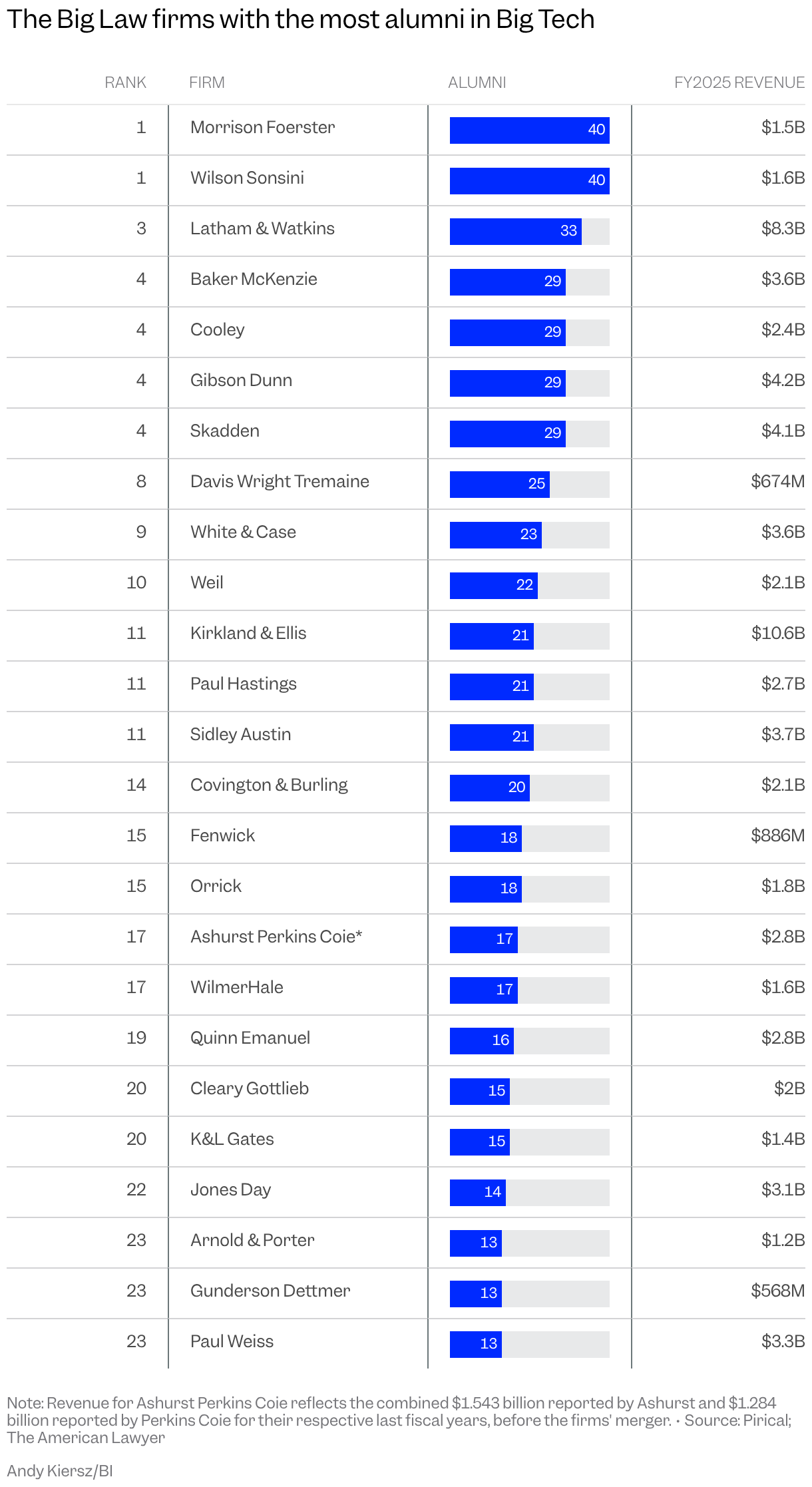
New Pirical data shows which law firms have the most alumni working in Big Tech.
Big Law has a hard time keeping its lawyers.
It's not just rival firms dangling basketball-player salaries, extra vacation, and branded merch to lure away top talent.
Big Tech is competing for those lawyers, too.
New data shared with Business Insider reveals which firms send the most lawyers to the biggest names in tech.
Pirical, a legal people-analytics company, tracked lawyers who previously worked at the 200 largest law firms by revenue in the United States and now hold legal roles at seven tech companies: Google, Meta, Microsoft, Nvidia, OpenAI, Anthropic, and SpaceX. Pirical filtered out summer associates and interns.
Morrison Foerster and Wilson Sonsini tied for the top spot, each with 40 alumni working in legal roles across the seven companies. Both firms regularly represent tech startups and the investors backing them.
Latham & Watkins followed with 33 former lawyers. Kirkland & Ellis, the industry's revenue leader, ranked 11th with 21 former lawyers working at those companies, tied with Paul Hastings and Sidley Austin.
Pirical's analysis may have missed lawyers whose job titles fell outside its search criteria, said Craig Savitzky, its insights and content editor. He said newer companies, particularly Anthropic, are also likely undercounted because their legal teams are growing faster than public profiles are updated.
Big Law-Big Tech pipeline
For attorneys hoping to land a coveted job at a tech giant, a stint at a white-shoe law firm can be a stepping stone. They can trade billable-hour quotas for a seat closer to the business, attractive pay, and just one client to keep happy instead of dozens.
That combination makes these roles "some of the most highly desirable and sought-after positions" for law firm associates, said Casey Sullivan, a recruiter with CMW Legal Search.
There's another draw, Sullivan said. The companies at the forefront of artificial intelligence are wrestling with some of the thorniest legal questions of the day, from intellectual property to regulation.
"That's where the most interesting work is for lawyers," he said.
Not all law firms are equally effective launch pads. Pirical's Savitzky noted that the firms near the top of the list have deep ties to the tech industry, if not the deepest pockets.
Cooley brought in $2.4 billion in revenue last fiscal year, placing it 29th on The American Lawyer's ranking of top law firms by revenue. But it tied fourth on Pirical's list, with 29 alumni working at the seven tech companies, including nine at Nvidia, a longtime client.
Davis Wright Tremaine, which has represented Microsoft in antitrust and employment lawsuits, has 13 alumni working in the software giant's legal department. Fenwick, which advised Wiz and Fitbit on their sales to Google, has 13 lawyers at the search giant.
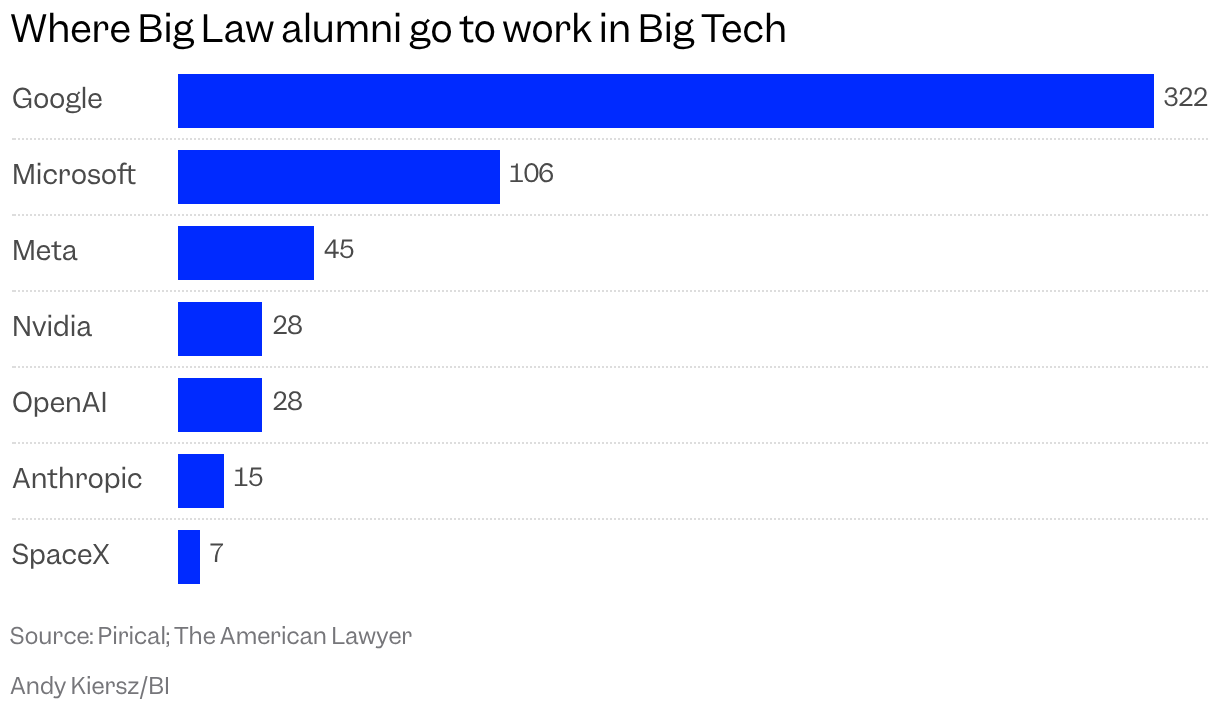
Business Insider also sliced the data another way, looking at which of the seven tech giants employ the most alumni from the top 25 firms on Pirical's list.
Big Law is effectively a feeder school for Google's legal team. The company employs 322 alumni of the top 25 law firms on Pirical's list, more than any other tech company studied.
That doesn't necessarily mean Google is the most desirable location for lawyers leaving Big Law. Savitzky said the numbers likely reflect the sheer size of Google's legal department and the decades it has had to recruit from top firms.
Two years ago, every argument about AI was about quality. The machines hallucinated court cases, absorbed biases from their training data, misspelled words in their own images, drew hands with six fingers, and couldn’t count the letters in strawberry. The confident claims that biases and hallucination errors were inherent to machines already sound quaint. Those […]
The US has been building these computing facilities for decades, but development has ramped up dramatically in recent years as AI increasingly drives demand for computing power.
Business Insider compiled a list of some of these enormous US data-center projects to illustrate the scale of what's being built. Those on the list have at least 1 gigawatt of capacity and have broken ground.
Among the largest is a city-sized campus in Texas pursuing up to 17 gigawatts of power capacity. Another in Ohio is aiming to have up to 10 gigawatts of data-center capacity, most of which OpenAI has contracted to use. For reference, 1 gigawatt of electricity continuously supplied for a year could power roughly 835,000 average American homes.
In total, the Pew Research Center says the US has more than 3,000 operating data centers nationwide and over 1,500 more under development, mostly in rural areas. According to data from the Energy Institute's 2026 Statistical Review of World Energy, US data centers accounted for nearly 40% of global data-center electricity use in 2025, consuming about 313 terawatt-hours. That's more electricity than all of Australia used that year.
Planned capacity is the closest public proxy for how much computing these AI campuses can support, and that's important because the electricity and water needed to run their servers and cooling systems can have major implications for local grids and sustainability.
Residents affected by developments in places like Texas and Utah have pushed back over concerns about noise, property values, and the effects on nearby communities. New York has temporarily paused the construction of new large-scale AI data centers.
Still, the 2025 US Data Center Energy Usage Report from Berkeley Lab projects that data centers will consume 11.8% of US electricity by 2030, up from about 4.4% in 2023. Oracle, SB Energy, SpaceX, Google, and Meta are among the leading developers and operators.
Elon Musk's SpaceX is so eager to build its supercomputers that it's offering employees a pay bump to temporarily move to the data-center sites to help with the buildout.
Here's a closer look at some of the largest AI data-center campuses being built.
Meta Lebanon Campus — Indiana
Thibault Camus/AP
Mark Zuckerberg's Meta currently has 21 data centers under construction. Its Lebanon, Indiana, data center is one of its biggest investments — and the company's second in the state.
It's expected to be completed by early 2028. Neighbors have complained about light pollution from the construction, while residents across Indiana have urged state lawmakers to regulate the growing data-center industry.
Meta El Paso Data Center — Texas
EL PASO, TEXAS - AUGUST 13: In an aerial view, the Meta El Paso Data Center is seen on August 13, 2026 in El Paso, Texas. Meta Platforms continues construction on its more than $10 billion Meta El Paso Data Center in Northeast El Paso, Texas. Occupying approximately 1,000 acres, Meta has expanded the project to 1 gigawatt of
Brandon Bell/Getty Images
Meta's data center in El Paso, Texas, is planned to be powered by 1 gigawatt of capacity and span roughly 1,000 acres. It originally called for $1.5 billion in investment, which later increased to $10 billion.
The center will support more than 300 workers once complete, while around 4,000 construction workers are expected to build it out.
The site broke ground in October 2025 and is expected to be finished in 2028. The site has also sparked backlash from residents.
Project Freebird (Stargate) — Texas
OpenAI CEO Sam Altman
Bloomberg/Getty Images
Project Freebird is part of Stargate, the AI-infrastructure initiative co-led by OpenAI and SoftBank, which OpenAI said in January 2025 would invest up to $500 billion in US infrastructure.
Freebird will be a 1.2-gigawatt data center campus in Milam County, Texas, near Austin. The first phase was expected to be completed by October, while additional phases are planned through 2028. Construction began in 2025.
However, the company has not issued any update on the data center's completion as of late October.
The site, being developed by SB Energy, a SoftBank-backed infrastructure company, will span roughly 595 acres. Phase 1 has an estimated construction cost of $470 million, while total investment in the broader project is expected to range from $1.8 billion to $3 billion.
The first phase had a scheduled construction-completion date of October 15, while SB Energy says operations are expected to begin in 2027.
Fort Wayne Data Center — Indiana
Google CEO Sundar Pichai delivers a speech during the AI Impact Summit in New Delhi in February 2026.
Ludovic MARIN / AFP via Getty Images
In 2024, Google broke ground on a $2 billion data center campus in Fort Wayne, Indiana, to support its AI and cloud operations.
The campus is expected to require up to 1.2 gigawatts of power at full build-out. Some Indiana politicians have expressed concern about the amount of power required to run the data center and who will foot the energy bill.
"If companies want to build a data center here, and we have to build new power generation for them, then they need to share in that risk," Indiana Rep. Ed Soliday, a Republican, previously told Business Insider. "There are a couple of data center folks who have said, 'Oh no, that's not fair.' Yes, it is. Grandma down the street shouldn't have to pay for your dreams."
Stargate Abilene — Texas
The Stargate AI data center in Abilene, Texas.
Bloomberg/Getty Images
The Stargate AI data center campus outside Abilene, Texas, is expected to deliver 1.2 gigawatts of capacity. Crusoe, the lead developer and builder behind the project, broke ground on the campus in June 2024. The first phase is already operational.
The second phase, which is under construction, is backed by a $15 billion joint venture between Crusoe, Blue Owl Capital, and Primary Digital Infrastructure. It will add six buildings to the campus, bringing the total to eight and the planned capacity to 1.2 gigawatts. The site will span 875 acres.
Nebius AI Factory — Missouri
Danila Shtan, chief technology officer at Nebius. The company is an AI cloud infrastructure provider headquartered in Amsterdam.
Bloomberg/Getty Images
Nebius' data center in Independence, Missouri, will span roughly 400 acres and reach a capacity of up to 1.2 gigawatts. The company broke ground in May and is expected to bring roughly 1,200 construction jobs and 130 permanent jobs.
Nebius has not announced a total investment amount, though the city expects to begin collecting tax revenue from the campus in 2028.
The site hasn't come without controversy. A group of citizens is suing the city of Independence and companies involved with the project, alleging 16 counts, including claims that the city violated Missouri's Sunshine Law several times by failing to provide finalized data center construction plans. Nebius did not offer a comment.
CloudBurst San Marcos Data Center I — Texas
CloudBurst Data Centers and Evolve Holdings broke ground on the site in late 2025.
Evolve Holdings
CloudBurst's San Marcos Data Center I is a planned 1.2-gigawatt capacity campus on 706 acres in central Texas. Guadalupe County approved a $500 million tax abatement for the project.
The company and its development partner, Evolve, broke ground in November 2025, with an initial 50-megawatt phase expected to be complete by late 2026. Construction is expected to be complete in 2029.
San Marcos residents have protested proposed data centers over water and energy concerns. The city has since become the first in Texas to ban new data centers, though the ban won't stop CloudBurst's project, which is outside city limits.
The Barn Data Center — Michigan
Jim West/UCG/Universal Images Group via Getty Images
The Barn, part of the Stargate project, is a multi-billion-dollar AI data center campus in Saline Township, southwest of Ann Arbor, Michigan. Related Digital, a data-center developer, is building the campus for Oracle as part of its partnership with OpenAI. Construction for The Barn began in June.
The campus will comprise three data center buildings with a combined capacity of 1.4 gigawatts. The $16 billion project is backed by Related Digital and investment firm Blackstone. The first facilities are expected to enter service by the end of 2027.
In October, state regulators opened public comment on a wastewater permit for the campus’s proposed on-site water-treatment system.
Stargate Frontier Campus — Texas
OpenAI CFO Sarah Friar (left) and CEO Sam Altman (right) during a media tour of the Stargate AI data center in Abilene, Texas, in 2025.
Bloomberg/Getty Images
The Stargate Frontier Campus, developed by Vantage Data Centers, will be a 1.4 gigawatt, 1,200-acre data center in Shackelford County, Texas, near Albany in north-central Texas.
The campus is part of the broader Stargate initiative led by OpenAI, Oracle, and other partners, and is being designed for ultra-high-density AI workloads. Vantage plans to invest more than $25 billion in the project, which is expected to be fully built out by 2028.
Work continues on a data center being built by SpaceXAI on August 2, 2026 in Southaven, Mississippi. Hastily built to meet the skyrocketing demand for computing power required by the global artificial intelligence race, these data centers are meeting stiff opposition across the United States. In Southaven, 69 turbines are constantly in motion to
Brandon Dill / AFP via Getty Images
Elon Musk's xAI is building Colossus 2 to power Grok, the AI chatbot on X. Construction began in 2025 in Memphis, Tennessee, and the company has said it plans to expand the site to 1.5 gigawatts. The nonprofit research institute Epoch AI estimates its current capacity at about 946 megawatts.
Environmental justice groups, led by the NAACP, sued xAI earlier this year, alleging that the company installed and operated gas turbines that power Colossus 2 in nearby Southaven, Mississippi, without the required air permits. In March, Mississippi regulators approved a permit for xAI to build and operate a new fleet of turbines at the site.
Local residents have filed a class-action lawsuit against xAI, MZX Tech, and SpaceX, alleging that noise and vibrations from the gas turbines have disrupted their lives and harmed their property values.
Still, in late October, Business Insider reported that SpaceX was offering employees a 20% pay bump to temporarily relocate to Memphis or Southaven, Mississippi, for six weeks to help build out Colossus 1 and 2.
Project Jupiter — New Mexico
Project Jupiter is located in Santa Teresa, New Mexico
Omar Ornelas/El Paso Times/Reuters
Developed by infrastructure companies STACK Infrastructure and BorderPlex Digital Assets, Project Jupiter will be an AI data center campus in Doña Ana County, New Mexico, near the Texas border. It is part of the Stargate initiative and is expected to support Oracle's AI-computing operations for OpenAI.
Construction for Project Jupiter began in September 2025. The campus's planned on-site power system could include up to 2.45 gigawatts of Bloom Energy fuel cells, replacing an earlier proposal centered on gas turbines and diesel generators.
In May, Oracle ditched its plan to construct a natural gas plant to power Project Jupiter, following local residents' concerns over the potential negative water usage and air pollution effects it could cause.
Oracle issued a force majeure notice in September due to potential delays in the project's power infrastructure, though it says the campus remains on track for 2028.
Meta Hyperion — Louisiana
Aerial view of Richland Parish Data Center.
Meta
Meta's Hyperion AI data center in rural northeast Louisiana, backed by more than $50 billion in investment, will span more than 3,600 acres and is planned to deliver 5 gigawatts of capacity once fully developed. Hyperion broke ground in December 2024.
Meta says Hyperion is designed to train and run its artificial-intelligence systems. Earlier this year, Louisiana gave Meta $3.3 billion in tax breaks for Meta to build Hyperion. The project is expected to be completed in the 2030s.
Since the center is located in a rural part of the state, the influx of 7,500 trade and construction workers has spurred a housing boom, with mobile homes built for workers that rent for $3,000 a month.
Still, the project has also faced pushback from local residents and environmental groups concerned about its impact on water, energy use, and the surrounding community.
Louisiana regulators held hearings in October on the proposed power build-out for the campus. The state's Public Service Commission will issue a decision in December.
PORTS-Pike Technology Campus — Ohio
Breaking ground at the Portsmouth Site on March 20
US Department of Energy
The Department of Energy said SB Energy broke ground in March in Ohio on the planned AI and cloud campus at the former Portsmouth Gaseous Diffusion Plant, known as PORTS. The campus will span private land and remediated federal land leased from the DOE.
The Nvidia-backed project is expected to include up to 10 gigawatts of data-center capacity, with OpenAI set to use up to 8 gigawatts of it for its workloads.
While the DOE says the historical PORTS site is in active remediation, the project has raised concerns about potential health and environmental risks associated with the site's history as a uranium enrichment plant. SB Energy told the Guardian in August that it is "committed to paying for accelerated cleanup and remediation at the site" and that the company "performs thorough site reviews and due diligence for each of our infrastructure projects, including soil sampling."
SB Energy said in October that it would begin initial clearing and grading work for the campus’s first phase.
Project Matador — Texas
Construction work at Project Matador's 17GW Private Power Campus
Fermi America via PR Newswire
Fermi America's Project Matador, also called HyperGrid, is an AI data center and private power campus being built near Amarillo, Texas.
Fermi, which was co-founded in 2025 by former Texas Gov. and US Energy Secretary Rick Perry, said it is pursuing roughly 17 gigawatts of private power for the campus, up from the initially planned 11 gigawatts. That means the campus would generate much of its own electricity on-site rather than relying entirely on the public grid. The company says 6 gigawatts have been permitted so far.
Fermi has a 99-year land lease with the Texas Tech University System for the core site, and the project could span roughly 8,400 acres at full build-out. Fermi says construction is underway, with completion planned for the 2030s, and AI cloud company TensorWave has signed a 15-year lease expected to generate about $6.5 billion in contracted revenue for the first phase. Fermi is also developing a cooling system designed to substantially reduce water use.
The company was hit with a class action lawsuit earlier this year. The investor lawsuit alleges Fermi misled investors about the status and prospects of Project Matador; its shares fell after Amazon withdrew a $150 million construction advance in December 2025.
SpaceX, Meta, Google, Oracle, Fermi America, CloudBurst, and xAI did not immediately respond to a request for comment from Business Insider. SB Energy did not offer a comment.
An Amazon Web Services data center under construction in Sterling, Virginia. Virginia has the highest number of data centers of any state.
Anna Moneymaker/Getty Images
The AI boom is accelerating data center development across the US.
Even states with few data centers are attracting major hyperscale projects.
Here's how all 50 US states rank by their number of operational data centers.
The data center business is booming in the US, and some states are feeling it more than others.
Data centers, which house the computing machines that power digital services, have been around for decades. However, the amount of computing power required to fuel the AI boom has accelerated their development and brought the industry into the mainstream.
This ranking was compiled by analyzing data from Data Center Map, an industry source that maps data center locations around the world. It shows a snapshot of its US database as of October 2026. Business Insider limited this ranking to fully operational data centers.
Data Center Map compiles its data from multiple sources and mainly tracks cloud and colocation service providers. Each data center it tracks has to have an initial capacity of at least 10 cabinets. While some states have hyperscale AI data centers, others have relatively small operations.
Firstly, data center operators and service providers add their own listings to market themselves. Data Center Map also monitors external databases and manually identifies any missing operators. It also handles requests from users who identify missing or outdated listings.
There is no federal requirement for data centers to register in a central database, so the figures should not be interpreted as a complete census of every data center in the country. Data Center Map also says it has a "more limited coverage on enterprise and government data centers."
Last year, Business Insider created its own US data centers map, which included estimated power usage, as part of an investigation into the industry.
Here are the states with the most operational data centers, ranked from least to most.
50. Vermont
Stowe, Vermont.
Jim Espey/Getty Images
Number of operational data centers: 3
Vermont's three operational data centers are located in Stowe, South Burlington, and Williston. The state has a limited electrical grid, according to the Vermont Natural Resources Council.
49. Alaska
Anchorage, Alaska.
Jacob Boomsma/Getty Images
Number of operational data centers: 4
Half of Alaska's operational data centers are located in Anchorage. The University of Alaska Fairbanks said that the high cost of electricity and network connections are some of the challenges for data center buildout in the state.
48. South Dakota
Sioux Falls, South Dakota.
Lindsay Guido/Getty Images/iStockphoto
Number of operational data centers: 5
Most of South Dakota's data centers are in Sioux Falls. Lawmakers in South Dakota rejected proposals for industry tax incentives in 2026 while enacting new restrictions on electricity and water use, according to the South Dakota Searchlight.
46. Maine (tie)
Brunswick, Maine.
Photo Italia LLC/Getty Images/iStockphoto
Number of operational data centers: 6
Maine has data centers in Portland, Brunswick, and Bangor.
Maine's Gov. Janet Mills signed an order in April to establish a data center advisory council to advise on large-scale data center development.
46. Delaware (tie)
Wilmington, Delaware.
Bo Shen/Getty Images
Number of operational data centers: 6
Half of the data centers in Delaware are located in Wilmington.
Delaware Gov. Matt Meyer signed legislation in August requiring data centers to generate their own energy and cover infrastructure costs, WHYY reported.
44. West Virginia (tie)
Charleston, West Virginia.
Sean Pavone/Getty Images/iStockphoto
Number of operational data centers: 7
West Virginia's data centers are located in South Charleston, Bridgeport, Charleston, Star City, Petersburg, Nitro, and Berkeley Springs.
Having previously lacked the regulatory framework to approve or deny large-scale projects, Gov. Patrick Morrisey announced a data center development plan in August.
44. Rhode Island (tie)
Providence, Rhode Island.
Wirestock/Getty Images
Number of operational data centers: 7
All of Rhode Island's data centers are located in Providence.
The Providence Journal reported in April that one of the reasons Rhode Island has not been as attractive to data center developers is high energy costs.
42. Montana (tie)
Billings, Montana.
George Dodd/Getty Images
Number of operational data centers: 8
The majority of Montana's data centers are located in Billings.
Over half of Hawaii's data centers are in Honolulu.
The Honolulu Civil Beat reported that there are currently no hyperscale data centers in Hawaii.
41. Arkansas
Little Rock, Arkansas.
Brandon Olafsson/Getty Images
Number of operational data centers: 9
The city with the most data centers in Arkansas is Little Rock.
Google announced its first data center in the state, to be located in West Memphis, in 2025, while Avaio is developing a large-scale one near Little Rock.
39. New Hampshire (tie)
Manchester, New Hampshire.
ChrisBoswell/Getty Images/iStockphoto
Number of operational data centers: 10
Manchester has three data centers, while the rest are spread across seven different cities.
A proposed data center in Nottingham was withdrawn earlier this year following local opposition, the New Hampshire Bulletin reported.
39. Idaho (tie)
Boise, Idaho.
knowlesgallery/Getty Images
Number of operational data centers: 10
Four of Idaho's 10 data centers are located in Boise, followed by three in Coeur d'Alene.
Meta plans to operate a $1.2 billion data center in Kuna, which it broke ground on in 2022.
38. Louisiana
Construction underway at River Bend, Hut 8's AI data center campus in Saint Francisville, Louisiana.
Kathleen Flynn/Getty Images
Number of operational data centers: 12
The majority of Louisiana's data centers are located in New Orleans and Baton Rouge.
Meta is building its largest-ever data center in Richland Parish, which will house the multi-gigawatt AI cluster Hyperion.
37. North Dakota
Fargo, North Dakota.
gnagel/Getty Images
Number of operational data centers: 13
Four of North Dakota's data centers are located in Fargo, followed by three in Ellendale.
There are some large-scale data center projects in the state, such as Applied Digital's 280-megawatt campus near Harwood.
36. Kansas
Lenexa, Kansas.
Wirestock/Getty Images/iStockphoto
Number of operational data centers: 15
Nearly half of Kansas' operational data centers are located in Lenexa, which has seven of the state's 15 facilities.
Kansas is experiencing a surge in plans for large-scale data center development, including one by Dubai-based developer Damac Properties in Edgerton, Kansas, The Wall Street Journal reported.
35. Mississippi
Work continues on a data center being built by SpaceXAI in Southaven, Mississippi.
Brandon Dill / AFP via Getty Images
Number of operational data centers: 16
Six of Mississippi's operational data centers are located in Canton.
Amazon announced in April this year that it increased its total planned investment in its Mississippi data centers, including in Canton, to $25 billion.
33. New Mexico (tie)
Los Lunas, New Mexico.
Lily Kimei/Getty Images
Number of operational data centers: 20
Over half of New Mexico's data centers are located in Los Lunas.
Meta opened a data center in Los Lunas in 2019, which it has since expanded.
33. Connecticut (tie)
Stamford, Connecticut.
stockphoto52/Getty Images/iStockphoto
Number of operational data centers: 20
Connecticut's 20 operational data centers are spread across multiple cities, with the highest concentration in Stamford.
The Connecticut Mirror reported that lawmakers said the state's high electricity costs make it unattractive to data center developers.
32. Wyoming
Cows graze in the area where the Prometheus Hyperscale Data Center will be built east of Evanston, Wyoming.
Natalie Behring/Getty Images
Number of operational data centers: 22
All but two of Wyoming's data centers are located in Cheyenne, with the other two in Casper and Afton.
In 2012, Microsoft built its first data center in Cheyenne and has expanded its footprint there multiple times since.
31. Alabama
Dusk Over The Downtown Urban City Center of Huntsville Alabama
ChrisBoswell/Getty Images/iStockphoto
Number of operational data centers: 23
Huntsville has the most operational data centers in Alabama.
Missouri's 47 operational data centers are spread across eight cities, with Kansas City accounting for most of them.
Axios reported in September that most of Missouri's planned data center expansion is concentrated in the Kansas City metropolitan area, citing research by Cleanview.
21. Minnesota (tie)
Minneapolis, Minnesota.
GummyBone/Getty Images
Number of operational data centers: 47
Minnesota's 47 data centers are spread across 21 cities, with Minneapolis accounting for 15, followed by Eden Prairie, St. Paul, Shakopee, and Minnetonka.
Google announced earlier this year that it plans to build a data center in Pine Island.
20. Nevada
The Tahoe Reno Industrial Center. Several companies are building facilities in an area about 15 miles east of downtown Reno in this development project named the Tahoe Reno Industrial Center including data storage facilities from Switch. Apple is also building a data storage facility nearby in the Reno Technology Park (Photo by David Butow/Corbis via Getty Images)
David Butow/Corbis via Getty Images
Number of operational data centers: 51
More than half of Nevada's data centers are located in Las Vegas.
Switch has plans to expand its Citadel Campus at the Tahoe Reno Industrial Center, which the company says will have gigawatts of power capacity upon completion.
19. Indiana
A technician works at an Amazon Web Services AI data center in New Carlisle, Indiana.
Noah Berger/Getty Images via Amazon Web Services
Number of operational data centers: 51
Indiana's 51 operational data centers are spread across 11 cities, with Indianapolis leading and New Carlisle following.
18. Tennessee
Construction at an xAI data center in Memphis on April 25, 2025.
Brandon Dill for The Washington Post via Getty Images
Number of operational data centers: 53
Nashville has the largest concentration of Tennessee's 53 operational data centers.
Elon Musk's xAI describes its Colossus facility in Memphis as the world's largest AI supercomputer.
16. Michigan (tie)
Construction of a data center developed by Related Digital for Oracle and OpenAI in Saline, Michigan.
: Jim West/UCG/Universal Images Group via Getty Images
Number of operational data centers: 58
Michigan's 58 data centers are spread across 27 cities, with Southfield accounting for the most.
Part of the Stargate Project, Related Digital kicked off construction of a $16 billion data center called "The Barn" in Saline Township in June.
16. Colorado (tie)
QTS constructs a data center in Aurora in 2025.
RJ Sangosti/MediaNews Group/The Denver Post via Getty Images
Number of operational data centers: 58
There are 14 data centers in operation in Denver, followed by 11 in Englewood, 7 in Centennial, and 7 in Colorado Springs.
QTS is expanding its 65-acre data center campus in Aurora, Colorado, Colorado Public Radio reported in July.
15. Iowa
The "Edged Des Moines" data center nears completion in Altoona, Iowa.
Leon Neal/Getty Images
Number of operational data centers: 69
Altoona and West Des Moines are among Iowa's leading data center locations, alongside Council Bluffs and Des Moines.
Google has had a campus in Council Bluffs since 2007, recently invested in its expansion, and has also kicked off a new one in Cedar Rapids.
14. North Carolina
Meta's data center in Forest City, taken in 2010 when it was formerly a Facebook data center.
Rainier Ehrhardt/Getty Images
Number of operational data centers: 76
Charlotte has 24 data centers, the most in North Carolina, followed by Raleigh, Maiden, and Lenoir.
An Amazon Web Services construction project in Berwick.
Paul Weaver/SOPA Images/LightRocket via Getty Images
Number of operational data centers: 78
Pittsburgh and Philadelphia have the largest concentrations of operational data centers in Pennsylvania.
In 2025, Amazon announced plans to invest at least $20 billion in the state to expand its data center operations.
12. New Jersey (tie)
The Equinix NY5 data center in Secaucus, New Jersey.
Kena Betancur/Getty Images
Number of operational data centers: 78
Secaucus and Piscataway are two of New Jersey's main data center hubs, alongside Jersey City.
Equinix operates a 129,436-square-foot data center in Secaucus, known as NY5.
11. Florida
The HostDime data center in Eatonville, Florida, is north of Orlando.
Paul Hennessy/SOPA Images/LightRocket via Getty Images
Number of operational data centers: 113
Florida's 113 operational data centers are spread across 27 locations, with Miami accounting for the most at 33, followed by Tampa with 20, Jacksonville with 13, and Orlando with nine.
Data center provider HostDime has been based in the state since 2003 and is building a 100,000-square-foot facility in Eatonville.
10. Arizona
A QTS data center under construction in Phoenix in 2024.
Bloomberg/Getty Images
Number of operational data centers: 114
Phoenix contains 34 of Arizona's data centers, followed by Goodyear with 24, and Chandler with 17.
ABC 15 reported that companies such as Meta, Apple, and Microsoft all have campuses in Arizona.
9. Georgia
A QTS data center complex in Fayetteville, Georgia, in 2024.
Bloomberg/Getty Images
Number of operational data centers: 123
Atlanta has the largest concentration of operational data centers in Georgia, with 43 facilities, followed by Lithia Springs with 25 and Social Circle with 10.
The Sabey Data Centers' Seattle Data Center campus in Tukwila, Washington.
Bloomberg/Getty Images
Number of operational data centers: 132
Quincy has the largest concentration of operational data centers in Washington, with 33 facilities, followed by Seattle with 31, Tukwila with 16, and East Wenatchee with 11.
Washington's Department of Ecology says Quincy and Wenatchee are popular spots because they have cheaper, reliable energy.
7. Oregon
The Facebook Inc. Prineville Data Center stands in Prineville, Oregon, U.S., on Monday, April 28, 2014. The Facebook Prineville Data Center features leading energy-efficient technology, including features such as rainwater reclamation, a solar energy installation for providing electricity to the office areas and reuse of heat created by the servers to heat office space. Photographer: Meg Roussos/Bloomberg via Getty Images
Bloomberg/Getty Images
Number of operational data centers: 141
Hillsboro has the most operational data centers in Oregon, followed by Boardman, and then Umatilla and Prineville.
Oregon is home to Meta and Google's first-ever data centers: Meta built its in Prineville, and Google's The Dalles.
6. Illinois
A CyrusOne data center in Aurora, Illinois.
Bloomberg/Getty Images
Number of operational data centers: 143
Chicago has the largest concentration of operational data centers in Illinois, with 49 facilities, followed by Elk Grove Village, which has 24. Lombard, Aurora, and DeKalb each have seven.
The JPMorgan Chase data center in Orangeburg, New York.
Kena Betancur/Getty Images
Number of operational data centers: 149
New York City is home to a large share of the state's operational data centers, with additional concentrations in Buffalo and Albany.
In July, New York was the first state to enact an executive order that imposed a statewide yearlong moratorium on hyperscale AI data centers.
4. Ohio
The 5C Data Centers CMH01 on October 18, 2026 in Springfield, Ohio.
Michael M. Santiago/Getty Images
Number of operational data centers: 189
Columbus has the largest concentration of operational data centers in Ohio, with Johnstown, Hilliard, and Cleveland also home to significant numbers of facilities.
Intel announced plans in 2022 for a major semiconductor manufacturing facility in New Albany, a suburb in central Ohio known as the "Silicon Heartland," which is already home to data centers operated by Amazon, Google, and Meta, as Business Insider previously reported.
3. California
The Digital Realty SFO12 Data Center, center in the Rincon Hill neighborhood of San Francisco.
Stephen Lam/San Francisco Chronicle via Getty Images
Number of operational data centers: 285
Santa Clara has the largest concentration of operational data centers in California, with 75 facilities, followed by Los Angeles with 51 and San Jose with 26.
The Stargate Oracle AI data center under construction on August 26, 2026 in Abilene, Texas.
Brandon Bell/Getty Images
Number of operational data centers: 358
Of Texas's 358 operational data centers, 58 are located in Dallas, 42 in Houston, and 39 in San Antonio.
Earlier this year, Business Insider, citing research from Jones Lang LaSalle, reported that Texas is on track to become the largest data center market in the world by 2030.
Texas is home to some of the world's largest planned data center projects, such as Fermi America's Project Matador.
1. Virginia
An Amazon Web Services data center in Aldie, Virginia.
Mobile World Live (MWL) brings you our top three picks of the week, as Microsoft backed out of its UK data centre deal with Nscale, four European telco heavyweights confirmed plans to explore a joint satellite spectrum bid and SpaceX targeted a launch in 2028 for its direct-to-device (D2D) service.
Microsoft pulls out of Nscale UK data centre deal
What happened: Microsoft reportedly pulled out of an agreement to lease capacity at Nscale’s planned AI data centre in Loughton, Essex, after delays to its electricity connection pushed expected supply into the 2030s.
Why it matters: The 50MW facility was announced in 2025 as part of Nscale’s £2.5 billion UK investment commitment. Microsoft planned to occupy the entire site and deploy a supercomputer containing around 23,000 Nvidia GB300 chips. According to Reuters, Nscale said it remained “committed to both the Loughton project and the UK” and was exploring alternative power sources. It added its wider relationship with Microsoft remained strong, with the companies continuing to work together in Norway, Portugal and the US.
In February, an investigation by The Guardian found the Loughton site was still operating as a scaffolding yard, exposing a widening gap between the UK’s AI investment announcements and its ability to deliver the infrastructure required. Roderick Beck, a subsea and network capacity specialist, and VP of business development at UCC Hudson Bore, said “the big and growing order backlogs in the AI data centre sector reflect not just strong demand, but the difficulty of building these data centres and equipping them”. He added: “The construction, power, and GPU supply chains are extremely stressed.” Meanwhile, David Johnson, CEO of Greater London Industrial, noted “this is not an isolated case”, pointing to research from Roadnight Taylor which found half of UK data centre developers expected grid connections within one to two years, while many faced waits of three to eight years. He concluded: “Grid capacity is now as important to growth as planning consent. We need to treat it that way.”
European operators confirm satellite spectrum move
What happened: Deutsche Telekom, Orange, Telefonica and Vodafone Group signed a letter of intent to explore a joint bid for spectrum earmarked for Mobile Satellite Services (MSS), as operators look to expand D2D connectivity.
Why it matters: The quartet stated a joint approach would support open, non-discriminatory access to satellite connectivity, while reducing market fragmentation and boosting consumer choice. They plan to establish ground infrastructure, coordination and monitoring functions without investing directly in a satellite constellation. A satellite partner has yet to be selected.
Counterpoint Research senior analyst Subhadip Roy noted the move comes ahead of the expiry of existing 2GHz spectrum authorisations held by Viasat and EchoStar in May 2027, with a new allocation framework being developed by the European Commission. He added the move takes D2D beyond satellite partnerships to the question of “who controls spectrum and how satellite connectivity becomes part of mobile networks”. Meanwhile, PP Foresight’s Paolo Pescatore said success depends on making satellite coverage “a seamless extension of mobile connectivity”. He added execution, device compatibility and pricing must give customers “a compelling reason to pay, along with reassurance they can stay connected in more places”.
SpaceX targets early 2028 for own D2D service launch
What happened: SpaceX revealed plans to launch its own D2D service in early 2028, following deployment of its second-generation Starlink Mobile satellites in 2027 and integration of additional spectrum.
Why it matters: On the company’s Q3 earnings call, president Gwynne Shotwell said its spectrum acquisition and the Federal Communications Commission’s approval to launch 15,000 next-generation V2 satellites would “pave the way for Starlink Mobile to become a major mobile carrier in the US”. Earlier this month, SpaceX agreed to buy up to 14MHz of paired spectrum in the 800MHz band from Grain Management. The company also plans to use ground-based femtocells to complement satellite coverage.
Ananth Theivendrapoopathy, global head of pricing, product and commercial strategy at Lycamobile Group, said SpaceX could compete “without having to replicate the entire physical infrastructure of traditional mobile operators”, adding this could provide “a significant advantage through a different network cost structure”, although urban capacity and indoor coverage challenges remain. He argued the move also raises regulatory questions over whether satellite providers competing directly with mobile operators should face comparable regulatory obligations. He noted Deutsche Telekom, Orange, Telefonica and Vodafone Group’s joint approach to satellite connectivity, alongside mounting calls for European sovereignty, become “important considerations”.
Separately this week, Elon Musk revealed plans to explore a potential merger between SpaceX and Tesla in a combination that could bring satellite connectivity, vehicles and AI infrastructure under one umbrella.
The upcoming U.S. midterms are not just another vote. They are on track to become a new testing ground for autonomous AI agents that first emerged in the Hugging Face attack. Experts are already warning of the potential for these “rogue agents,” seen in action this summer, to carry out more refined, dangerous and harder-to-trace disinformation campaigns and electoral interference than those observed in previous election cycles.
O local de Loughton, prometido como o maior centro de dados de IA soberano britânico, não terá eletricidade antes dos anos 2030, segundo a distribuidora UK Power Networks.
Alguns projetos de centros de dados têm dificuldade em avançar devido a preocupações relacionadas com o elevado custo da eletricidade e aos longos prazos de espera para a ligação à rede elétrica britânica
Microsoft reportedly withdrew from a deal to lease computing capacity at AI infrastructure player Nscale’s planned data centre in the UK due to delays related to power supply, adding to mounting concerns around the status of the country’s AI projects.
According to The Telegraph, the US technology giant pulled the plug on the mooted data centre to be constructed in Loughton, Essex, which was originally expected to receive a grid connection by the end of 2026.
However, it now faces a wait until the following decade for supply.
“Our relationship with Microsoft remains strong and long-term, and this unfortunate London-wide grid issue has no impact on our other contracts,” an Nscale spokesperson told Reuters. The pair are still collaborating across other projects, including developments in Norway, Portugal and the US.
The company reportedly added it remained “committed to both the Loughton project and the UK” and was exploring alternative power sources.
Announced last year, the Loughton development was backed by a £2.5 billion investment commitment from Nscale and formed part of a wider UK push to attract AI infrastructure spending. Microsoft had planned to lease the site’s entire 50MW capacity and deploy an AI supercomputer equipped with around 23,000 Nvidia GB300 chips.
The setback revives questions about the delivery of the UK’s headline AI investment pledges. A Guardian investigation in March raised concerns over the status of major announced projects, including the Loughton site, which was still being used as a scaffolding yard when visited by reporters in February. Nscale subsequently said it had purchased the site in September 2025 and was targeting delivery in 2027.
Power availability remains a wider constraint for UK data centre development, as growing demand from AI workloads puts pressure on grid infrastructure.
Nscale, which is backed by Nvidia, filed for a US IPO last month and raised $3.4 billion in pre-IPO financing. The UK-based company named Microsoft and Anthropic as expected major customers in its prospectus.
Microsoft took the wraps off the third-generation of its in-house AI chip, as part of a plan to reduce its reliance on buying processors from Nvidia.
The Maia 300 chip will be used for the tech giant’s multi-gigawatt deployments in 2027, making it the primary inference system for Microsoft products and services. Reuters reported it plans to potentially deploy more than 1 million of the chips next year.
According to a blog post from EVP Scott Guthrie, the company expects Maia 300 to deliver 40% more tokens per megawatt compared to leading GPU-based systems without naming Nvidia.
The Maia 300 is built as a single system, with software, silicon, physical rack infrastructure, networking, and data centres co-designed to operate as a single platform.
Guthrie noted a 96-chip rack offers seven times the rack-scale token throughput of Microsoft’s Maia 200. He said the new chip is “designed with an inference-first architecture optimized for long-context, memory-intensive and decode-heavy AI workloads”.
The Maia 200 chip powers the company’s production workloads, including Microsoft 365 Copilot, as well as OpenAI models running on Microsoft’s Azure cloud computing service.
Sie macht nicht so viele Schlagzeilen, wie der Krieg selbst, aber die Hightech-Front ist nicht weniger wichtig als die Front. Beim Quincy Institute for Responsible Statecraft ist darüber ein interessanter Artikel erschienen, den ich übersetzt habe, weil er mich nachdenklich gemacht hat. Beginn der Übersetzung: Sie tragen keine Uniform, aber diese US-Unternehmen kämpfen für die […]

 Login