
❌

Reading view

EasyJet joins the ranks of budget airlines installing Starlink — and puts pressure on its rival Ryanair

LISBON, PORTUGAL - APRIL 01: An easyJet aircraft moves past 
 a Ryanair airplane while taking off for London at Humberto Delgado International Airport during the first of a three-day strike by the low cost carrier cabin crew on April 01, 2023 in Lisbon, Portugal. EasyJet cabin crew strike in Portugal, called by the National Civil Aviation Flight Personnel Union (SNPVAC), takes place from April 01 to 03. The Portuguese Ministry of Infrastructure and the Ministry of Labor ordered that there have be a minimum service of 52 easyJet flights during the workers' strike, deemed necessary to meet social needs relating to the constitutional right to travel, taking into account the season covered by the declared strike days, on which is expected the displacement of a significant number of people. (Photo by Horacio Villalobos#Corbis/Getty Images)
EasyJet's Starlink deal is a potential edge over Ryanair, Europe's dominant budget airline.

Horacio Villalobos#Corbis/Getty Images

  • EasyJet announced a deal with Starlink on Monday.
  • It means two of Europe's three major budget airlines have now signed up for Elon Musk's service.
  • The move puts pressure on budget titan Ryanair after its CEO feuded with Musk over Starlink.

Elon Musk's Starlink has won its latest customer, a budget airline that could put pressure on one of the WiFi service's biggest critics.

EasyJet announced on Monday that the high-speed WiFi service would be deployed on its airplanes from the first half of next year. The British airline, which carries 100 million passengers a year, hopes to have Starlink installed across its 300-strong fleet by early 2028.

The deal means two of Europe's three biggest budget airlines have committed to Starlink.

Wizz Air, a Hungarian carrier that flies about 70 million passengers a year, signed up in June.

That leaves Ryanair, the continent's largest airline and the world's third-largest, as the only one of Europe's biggest budget carriers without the service.

Its CEO, Michael O'Leary, is well-known for being outspoken and took aim at Starlink earlier this year, leading to a spat with Musk.

"We don't think ‍our ⁠passengers are willing to pay for WiFi for an average ⁠one-hour flight," O'Leary told Reuters in January.

While Starlink is typically offered free to passengers, O'Leary also complained about increased fuel costs due to the aerodynamic drag of a Starlink terminal, installed on the top of airplanes.

Musk responded in an X post, arguing that Ryanair — which carries over 200 million passengers a year — would lose customers to airlines that do have internet access.

Over the next week, the two CEOs called each other idiots while Musk called for O'Leary to be fired and joked about purchasing the airline.

But Ryanair appeared to have the last laugh, using the publicity to launch a "Big 'Idiot' Sale" with 100,000 tickets starting at £16.99, or about $23.

The situation has some parallels with the US's Big Three airlines. While United Airlines has Starlink on almost half of its fleet and American Airlines is starting installations early next year, Delta Air Lines has instead tapped Amazon Leo, beginning in 2028.

This has led Musk to insult Delta's CEO, Ed Bastian, and call for his firing.

But American passengers are wealthier and more interested in premium offerings than their European counterparts. That trend has also prompted US budget airlines to offer comfier seats and package deals.

Adding free amenities for passengers is at odds with the typical no-frills budget-airline business model that relies on extra charges to turn a profit.

However, easyJet and Wizz may see Starlink as a way to gain an edge over Ryanair.

That may not last forever, though. In a January earnings call, O'Leary said, "I think as the WiFi technology improves over the next four or five years, we'll all be offering free WiFi access."
Read the original article on Business Insider

  •  

The neocloud stock rout continues as Elon Musk warns of 'guppy-level death'

Elon Musk sits onstage in a dark suit, gesturing while speaking against a plain light backdrop.
Elon Musk said that many neocloud companies face "guppy-level death."

Bloomberg/Getty Images

  • Shares in neocloud companies are falling over concerns about their levels of debt.
  • CoreWeave and Nebius, two major public neoclouds, have seen their stocks drop sharply in recent weeks.
  • On Sunday, Elon Musk questioned the sector, saying that "some will make it through, but not many."

Neocloud companies are sliding even lower.

Shares dropped further on Monday after Elon Musk warned that many of them face "guppy-level death."

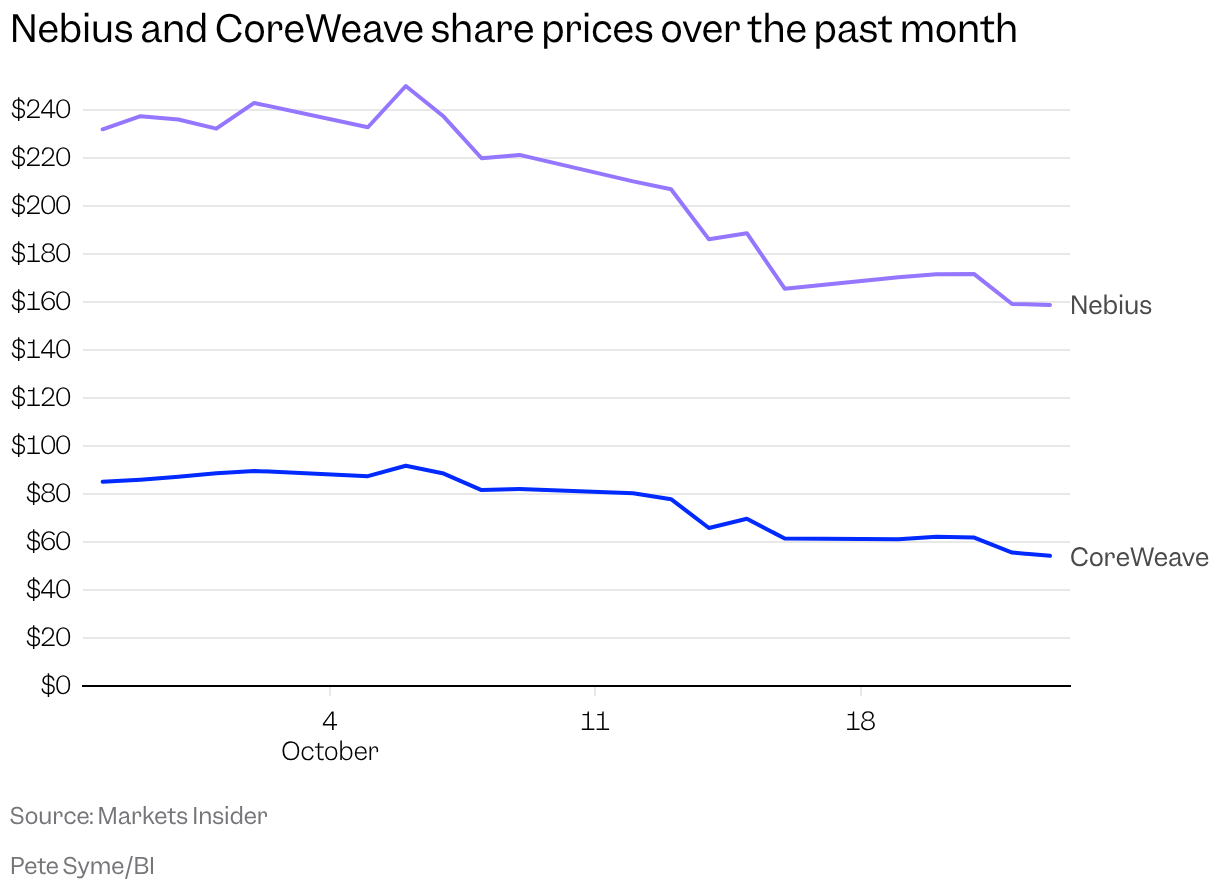
CoreWeave and Nebius have both fallen more than 30% over the past month, largely due to growing concerns about the debt they've taken on to build more data centers.

Soon after Monday's open, shares in both companies were down a further 4%, while Iren, another publicly traded neocloud, fell 2%.

The declines follow a string of X posts from Musk on Sunday evening questioning the neocloud business model.

"As of the past few weeks, debt markets have almost entirely shut off access to money for any company that doesn't have substantial revenue independent of AI data centers," he said.

"That means the 200+ neoclouds are going to see guppy-level death and consolidation," he added. "Some will make it through, but not many."

A line chart shows the share prices of Nebius and CoreWeave between September 28 and October 23, both falling more than 30%.

Musk said that while SpaceX has closed $40 billion in debt to buy GPUs, his company makes money through Starlink and rocket launches.

Meanwhile, investors are worried that a slowing AI boom could leave debt-heavy neoclouds struggling to service their loans.

After one X user posted arguing that Musk was trying to drive down the share prices of neocloud companies to acquire them, Musk replied: "SpaceX is not buying any neoclouds. Pointless."

Nvidia CEO Jensen Huang remains bullish about the sector. "The demand for the neoclouds is off the charts," he told CNBC last Thursday.

Nvidia holds significant stakes in CoreWeave, Nebius, and other cloud-computing companies.

A CoreWeave spokesperson said: "The AI cloud market is not a monolith," and that lenders distinguish between speculative capacity and businesses with contracted revenue and a record of delivery.

They added that the company is "already a market leader operating at scale" with expertise, which it sees as key for opportunities to finance further growth.

A recent Bernstein Research report analyzed thousands of planned US data centers and estimated that only about 35% of the announced capacity will be built.

"Press releases are cheap … concrete is not," Bernstein analysts wrote in a research note.

Read the original article on Business Insider

  •  

One of Google DeepMind's top execs says lifelong learners will have an edge in the AI workplace

Lila Ibrahim, chief operating officer of DeepMind Technologies
Lila Ibrahim is Google DeepMind's chief AI readiness officer.

Bloomberg/Getty Images

  • Working at an AI lab is one of the hottest jobs in tech.
  • Lila Ibrahim, DeepMind's chief AI readiness officer, explained what skills she looks for in graduates.
  • Extracurricular activities on a CV show if someone has a preset for "lifelong learning," she said.

Pay attention, prospective applicants: The graduate candidates Google DeepMind wants to hire are not defined by their degree alone.

At a media lunch in September, Lila Ibrahim, Google DeepMind's chief AI readiness officer, said that the firm is increasingly looking for candidates who can show a record of learning beyond the classroom.

Whether it's researchers, engineers, or other roles, degrees still matter, she said, but there's been a shift toward placing greater weight on the extra credentials and experience on a candidate's résumé.

"One credential will tell me what you've learned, but multiple credentials tell me that you have a learning mindset," said Ibrahim.

Today's graduates often showcase more detail about what they have studied outside a formal learning environment on their résumés, alongside their job and education history, she said.

"I look at some of the new college grad résumés and CVs right now, and I'm like, 'Oh wow, this is so different from what I did in my generation.'"

That additional detail matters to recruiters at Google DeepMind because it can reveal whether a candidate is curious and "preset to a life of lifelong learning," she said.

Ibrahim said she believes another benefit of diverse learning experiences is that people can become better at asking questions — a capability she sees as valuable in an AI-powered workplace, but one she said isn't taught well in schools.

"You realize that a lot of people in school haven't necessarily been taught how to ask questions, how to ask good questions, and how to really question why."

These human skills matter even if someone is technically skilled with AI, she added. "Getting answers is super cheap these days, but actually knowing how to ask really good questions is getting harder and harder."

Ibrahim summed up DeepMind's criteria for applicants as: "Curiosity, courage to take on something completely new that is unpredictable, and the ability to work in a dynamic environment and to be able to collaborate with people."

Humanities or STEM?

Ibrahim was formerly Google DeepMind's chief operating officer, a role she had held since 2018. At the beginning of 2026, she became chief AI readiness officer, a role she said she created to help address a widening gap between the technology being built and society's readiness to receive it.

Google DeepMind's founder, Demis Hassabis, has been among the frontier AI executives warning that society has a narrow window to prepare for the next stage of the technology.

Google DeepMind CEO Demis Hassabis
Demis Hassabis, founder of Google DeepMind.

Chris Jung/NurPhoto via Getty Images

Hassabis has said that STEM and computer science studies remain important, but the AI world also requires the humanities, such as philosophy, economics, and ethics.

"I think we really need them in the world we're about to enter," he said during an interview at a London business conference in July.

What Google DeepMind looks for is interdisciplinary people who can collaborate well with others, said Ibrahim.

Having "the neuroscientist, alongside the ethicist, alongside the biologist," has massively helped with some of DeepMind's technical breakthroughs, she said. The lab has hired numerous philosophers, she said, adding that "you need to pair them with operators to turn those ideas into action."

So far, it hasn't been a challenge to find those skills in the UK, said Ibrahim. "Compared to my time in Silicon Valley over 30 years, what I have seen is more diverse talent because there is a strong appreciation toward philosophy and political science, and some of these other skills."

As AI has seeped into the everyday workplace, fears of AI-related job loss have somewhat abated. Rather than taking jobs, AI is changing them, and the pressure is now on workers and HR departments to develop the right combination of "human" and AI skills.

A recent study of more than 300 million registered learners on Coursera and Udemy found that companies' AI deployment is outpacing the skills people need to use it effectively.

While nearly 75% of organizations have deployed or are piloting the technology, only 18% reported that most of their workforce participated in AI upskilling or reskilling over the last year.

Read the original article on Business Insider

  •  
❌