The Federal Bureau of Investigation (FBI) reportedly searched a California home tied to its current investigation into former Rep. Eric Swalwell (D-Calif.). The Beverly Hills mansion, owned by a donor of Swalwell’s, was searched as part of the probe into the former lawmaker, CNN reported, citing two people familiar with the investigation. “Early this morning…
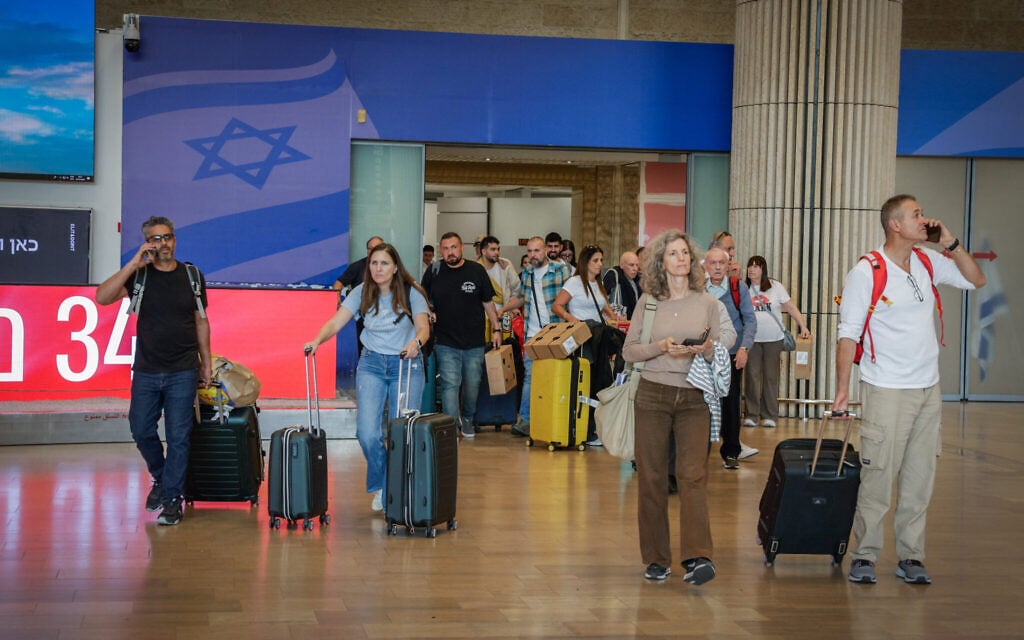
'Israel is on the verge of an abyss,' says one of tens of thousands of Israelis who spent thousands of dollars to return to Israel for the election; 'we need to bring back sanity'
By a 2-1 vote, a federal appeals court panel denied the Trump administration’s request that it immediately order the state to set aside 20,000 mail-in ballots.
A federal appeals court panel Monday refused to order California to set aside 20,000 mail ballots that the Trump administration says are likely from noncitizens. In a 2-1 vote, the panel found it has no jurisdiction and the administration needs to wait for the trial judge to rule. He’s set to hold a hearing Tuesday, but…
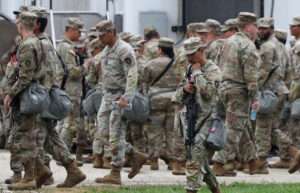
Texas National Guard members in Illinois (Brian Cassella/TNS/Newscom)
On October 23, in the case of Newsom v. Trump, the US Court of Appeals for the Ninth Circuit ruled Donald Trump's June 2025 federalization of the National Guard in Los Angeles was likely illegal. This decision has little immediate effect, because the National Guard deployment ended months ago, after the Supreme Court ruled against Trump in a related Illinois case. But it has important implications for judicial review of executive invocation of emergency powers to use the military domestically. Among other things, it emphasizes that such actions are reviewable, and the president should get only limited deference. It also adopts a properly restrictive definition of "rebellion" (which is one of the conditions that might justify federalization of the National Guard).
Trump federalized the Guard in response to anti-ICE protests. The district court ruled his action was illegal and issued an injunction blocking it. But the Ninth Circuit lifted the preliminary injunction, in a decision I criticized at the time.
The relevant statute 10 U.S.C. Section 12406, can only be used to federalize state forces in one of the following situations:
1) the United States, or any of the Commonwealths or possessions, is invaded or is in danger of invasion by a foreign nation;
(2) there is a rebellion or danger of a rebellion against the authority of the Government of the United States; or
(3) the President is unable with the regular forces to execute the laws of the United States
Last year, the Ninth Circuit ruled (incorrectly, I think) that Trump's action might have been permissible under Subsection 3: a situation where "the President is unable with the regular forces to execute the laws of the United States." As the Ninth Circuit acknowledges in their most recent decision, this basis for Trump's actions was undermined by the Supreme Court's December ruling in the related case of Trump v. Illinois, which held that Subsection 3 can only be invoked when the president is authorized to use regular federal military forces to enforce the law, and those forces are inadequate. These circumstances do not apply to the anti-ICE protests in Los Angeles and Chicago.
No one claims that the situation in Los Angeles amounted to an "invasion" by a "foreign nation." Thus, in its most recent decision the Ninth Circuit considered whether Trump's actions were authorized by Subsection 2, which allows federalization of the guard when "there is a rebellion or danger of a rebellion against the authority of the Government of the United States."
The majority opinion by Judge Jennifer Sung holds that the determination that there is a "rebellion" is subject to judicial review and can be invalidated " if it "did not reflect a colorable assessment within a range of honest judgment." I think this is overly deferential. For reasons I outlined in an article published last year, there should be little or no deference when the executive invokes extraordinary emergency powers. Still, the Ninth Circuit standard is far from a blank check, and does allow invalidation of executive actions where the claim of rebellion is blatantly wrong - as it was here.
Following the district court, the Ninth Circuit defined "rebellion" as "a violent, armed, organized, open and avowed uprising against the government as a whole." This differentiates "rebellion" from smaller-scale violence or other violations of law. I think that definition is largely correct. The court summarizes a wide range of historical evidence supporting it.
The Ninth Circuit also concluded that events in Los Angeles did not even come close to meeting that standard. There were some violations of law by protestors, and some small-scale violence. But no systematic effort to overthrow the government or anything close to it. If anything, both this issue and the definition of "rebellion" are easier calls than the court suggests.
Judge Sung, author of the majority opinion, is a liberal Biden appointee. But her opinion was joined by Judge Eric Miller, a conservative Trump appointee and onetime clerk for Supreme Court Justice Clarence Thomas. This suggests the issue here cuts across ideological and jurisprudential lines. Judge Mark Bennett, another Trump appointee, dissented, but mostly on procedural grounds.
Judge Bennett did also take issue with the majority's conclusion that if Trump's federalization of the National Guard exceeded his statutory authority, it also violated the Tenth Amendment, which reserves to the states or to "the people," those "powers not delegated to the United States by the Constitution." He argues that the power to call forth the National Guard is delegated to Congress by the Calling Forth Clause of the Constitution, which gives Congress power "[t]o provide for calling forth the Militia to execute the Laws of the Union, suppress Insurrections and repel Invasions." This is true enough. But in situations where Congress has not exercised that authority, states retain total control over their militia (of which the National Guard is the principal modern example), and that control is protected by the Tenth Amendment. Indeed, such control over state military forces is a central element of state sovereignty. Overriding it without proper constitutional authority qualifies as unconstitutional "commandeering" of state government forces. As the majority explains:
The federal government—whether the President or Congress—violates the Tenth Amendment by commandeering state personnel to enforce or administer federal law. Printz v. United States, 521 U.S. 898, 925 (1997) (Under the Tenth Amendment, "the Federal Government may not compel the States to implement, by legislation or executive action, federal regulatory programs."). If, for example, the President commandeered state police to help federal officers enforce federal immigration laws, that would violate the Tenth Amendment….
California National Guard members are state personnel, unless properly federalized… The President purported to convert the Guard into federal personnel by issuing federalization orders. If those federalization orders had been valid, then the President would have deployed federal officers in Los Angeles, and no commandeering of state personnel would have occurred. But because the President lacked authority to federalize the California National Guard, the federalization orders were invalid, and the deployed Guard members remained state personnel….
In other words, because the deployed members of the California National Guard were not properly federalized, they remained the legal equivalent (for Tenth Amendment purposes) of the state police. And because the challenged executive orders compelled those state officers to help federal officers enforce federal law, the orders violated the Tenth Amendment….
The Tenth Amendment protects States against overreach by the "Federal Government," whether "by legislation or executive action." Printz, 521 U.S. at 925, 935. The President cannot command state officials to enforce federal law even if a federal statute would authorize him, under some other circumstances, to call those officials into federal service. If the statute did not authorize the President to federalize the California Guard members here…, then the federalization orders were invalid, the Guard members remained state personnel, and Defendants violated the Tenth Amendment by commandeering those state personnel to administer federal immigration laws.
Exactly so. The majority and dissent consider a number of procedural issues, which I will not try to address. The majority also parses a variety of relevant precedents in detail. I may have more to say about some of them in future writings.
For the moment, this decision has little immediate effect. But it sets an important precedent in favor of judicial review of executive invocation of emergency powers, and on the meaning of "rebellion."
This week, editors Peter Suderman, Nick Gillespie, and Matt Welch are joined by Associate Editor Liz Wolfe to discuss California's proposed 5 percent wealth tax on billionaires, which a Hoover Institution study suggests could ultimately cost the state $39 billion in lost revenue. With wealthy residents already leaving California, the panel examines whether the measure will survive next week's vote, why Gov. Gavin Newsom opposes it, and how public sector unions have helped fuel the state's spending problems.
The panelists then look to France, where mounting unrest and economic stagnation raise questions about the long-term consequences of high taxes, expansive welfare programs, and pension obligations that increasingly burden younger generations. Next, they discuss Venezuelan opposition leader María Corina Machado returning home after 10 months in exile. Then, with the midterm elections next week, the editors examine whether Trump's tariffs, war with Iran, and mounting allegations of corruption will deliver Democrats control of Congress. Finally, a listener asks whether today's democratic socialist movement will ultimately be remembered like the libertarian and Tea Party movements of the early 2010s.
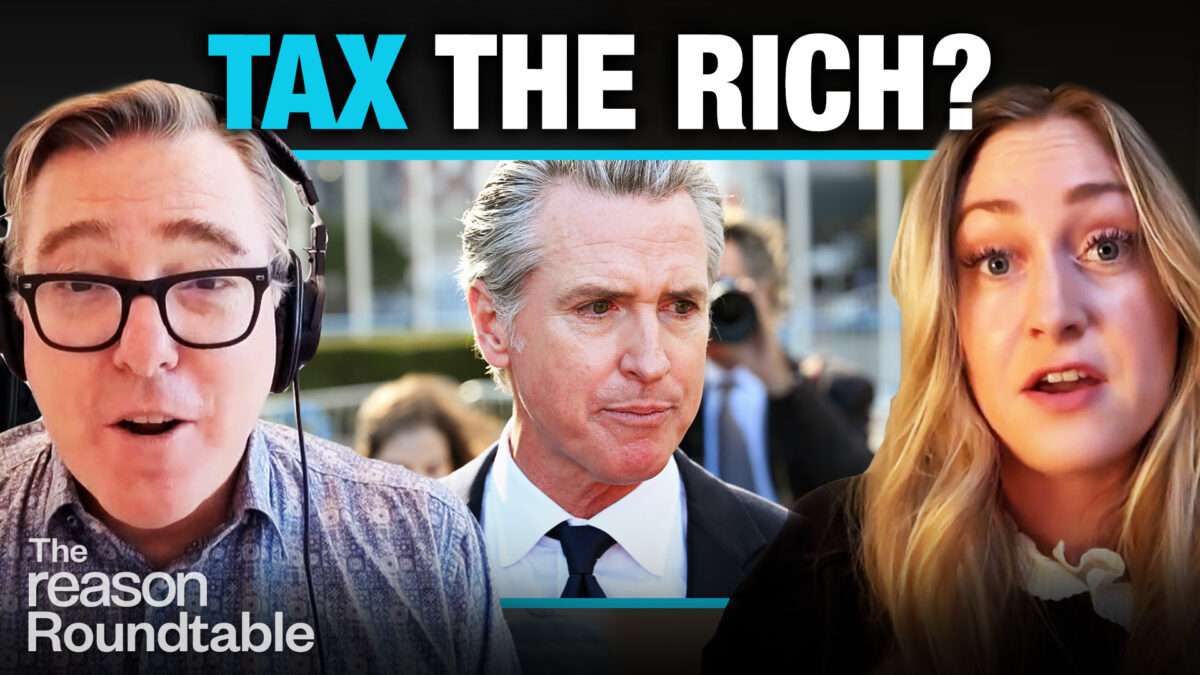
Matt Welch appears on the left. Liz Wolfe appears on the right. Behind them, an image of Governor Gavin Newsom appears looking concerned in the center. Bold text across the top of the screen reads "TAX THE RICH?"
When Americans cast their ballots in this year's midterm elections, they'll not only be picking who represents them in Congress, but also weighing in on a range of topics that could change their state laws and constitutions.
California's experiment: Will California's proposed wealth tax, Prop 40, pass next week? And if it gets passed, will it end up actually costing the state money instead of generating revenue?
The basics: The proposal features a one-time 5 percent tax on people with net worths over $1 billion who lived in the state on January 1, 2026 (with the net worth amount calculated as of December 31, 2026). The idea for the snapshot date is presumably to prevent capital flight once the tax passes. The tax's supporters say the tax's revenues will amount to $100 billion and will fund California's health care system, which need to make up for federal Medicaid cuts.
Seven billionaires, representing 30 percent of the total billionaire wealth in the state, left California before January 1, 2026, when news of the possible tax broke. Peter Thiel, Larry Page, and Sergey Brin are among the deserters. The French economist Gabriel Zucman—an intense defender of the wealth tax—seems committed to the idea that this flight won't matter too much. He argues that while removing those seven brings down revenue estimates to $89 billion, adding in less-prominent small-time billionaires raises revenue to $115 billion.
This is silly. As The Washington Post's Megan McArdle points out, there's no reason to believe those less-famous billionaires would stay put. We have a hard time estimating what the total preemptive flight looks like, and how many billionaires have successfully taken up residency elsewhere.
"Either the tax is annual—and in that case it generates revenue annually, and some billionaires leave," claims Zucman. "Or the tax is one-time—in that case it generates revenue in just one year, and there is no incentive to leave. It can't be both at the same time." Zucman doesn't seem to consider that billionaires have already left, as soon as the idea was seriously floated, thus taking early steps to shield their wealth from the state.
Will it pass? "Likely voters are essentially where they were a month ago," reportsPolitico, based on recent polling data, "with 46% in favor of Proposition 40 and 43% opposed—despite a recent push by backers of the measure, including Sen. Bernie Sanders, to rally support." Interestingly, "a strikingly high share of registered voters (84%) said they'd been exposed to advertisements or messages about the tax, but a 45% plurality said the communications had not swayed them, and those whose views had shifted were just as likely to be more opposed as more supportive."
There's another complication: On that very same ballot, voters will decide on Propositions 41 and 42, competing measures that could keep Prop 40 from taking effect. Prop 40 will be nullified if either one gets more votes; but Prop 40 will nullify both of them if it gets more votes. Prop 42 would bar new taxes on personal property such as businesses, investments, retirement accounts, trusts, and art collections—things Prop 40 targets. It also bans retroactive taxes, thus making Prop 40 impossible to pull off.
Back in January, Pirate Wires' Mike Solana spoke with a bunch of billionaires who were worried about the tax and making plans to flee, partially out of distrust that the tax would be one-and-done. "Three men I spoke with in the largest billionaire Signal chat said they ran an informal poll, and seventy percent of the chat (around sixty people, not all of whom were billionaires) indicated they would leave the state if the ballot proposition passes," reports Solana. "According to that same poll, around 15% have already left the state."
"There is now real danger in appearing successful in the state of California," writes Solana, "as the far left, imbued with a great deal of power, and benefiting now from several years of wealth scapegoating throughout the mainstream press, attempts to liquidate its perceived enemies in business."
Scenes from New York: I'm fully aboard this train these days, though open to being convinced why I'm wrong:
If you truly *love* American cities, you MUST support strict enforcement of laws against anti-social behavior. Paying bus fares, red light cameras, camping on sidewalks, smoking on trains, off-leash dogs, etc etc
"Brazilian markets are heading for a major rout when local trading begins after President Luiz Inácio Lula da Silva pulled off a stunning comeback to defeat Flávio Bolsonaro, the right-wing candidate that many investors preferred," reportsBloomberg. This will be da Silva's fourth term.
Is dynamic pricing on the rise? Customers say yes, but most companies say they're wrong. My thought: Even if it's not currently happening to the degree angry customers claim, it certainly will be big in the future, as online shopping takes over and AI makes implementation easier. Consider the upside, though, noted in this Wall Street Journal piece: "Much current angst is focused on electronic shelf labels, which have replaced the printed labels that dotted shelves at groceries and other stores. Research on digital shelf labels in the U.S. and Europe, where grocers have widely used the technology for more than a decade, found the labels don't lead to surge pricing, in part because price changes are obvious to anyone walking by. Rather, research found, grocers have used the labels to discount goods that are about to expire, reducing food waste."
Great Washington Post headline: "Europe is running out of other people's money."
President Donald Trump claims the ships passing past Cuba on their way home from Iran will just, uh, handle the situation there. Sure.
Interesting:
Striking detail in the big NYT piece on Taiwanese families adjusting to working at the huge new TSMC chip plant in Arizona: their surprise at the lack of rigor in US schools. pic.twitter.com/YkSPzbHCuE
In the race for the mayoralty of Los Angeles, the second-largest city in the United States, two things are certain: a woman will win, and she will be a Democrat. But with a high share of undecided voters and only days remaining before the election, it is still unclear whether Karen Bass will win another term or whether the progressive challenger Nithya Raman will take the post.
Election officials, activists, voting-rights lawyers, legal experts and other watchdogs of U.S. civil society have spent the past year and a half warning about what they describe as a campaign by U.S. President Donald Trump to undermine confidence in the conduct of free and fair elections. Their concern is that he is laying the groundwork to overturn the outcome if it does not favor the Republican Party.
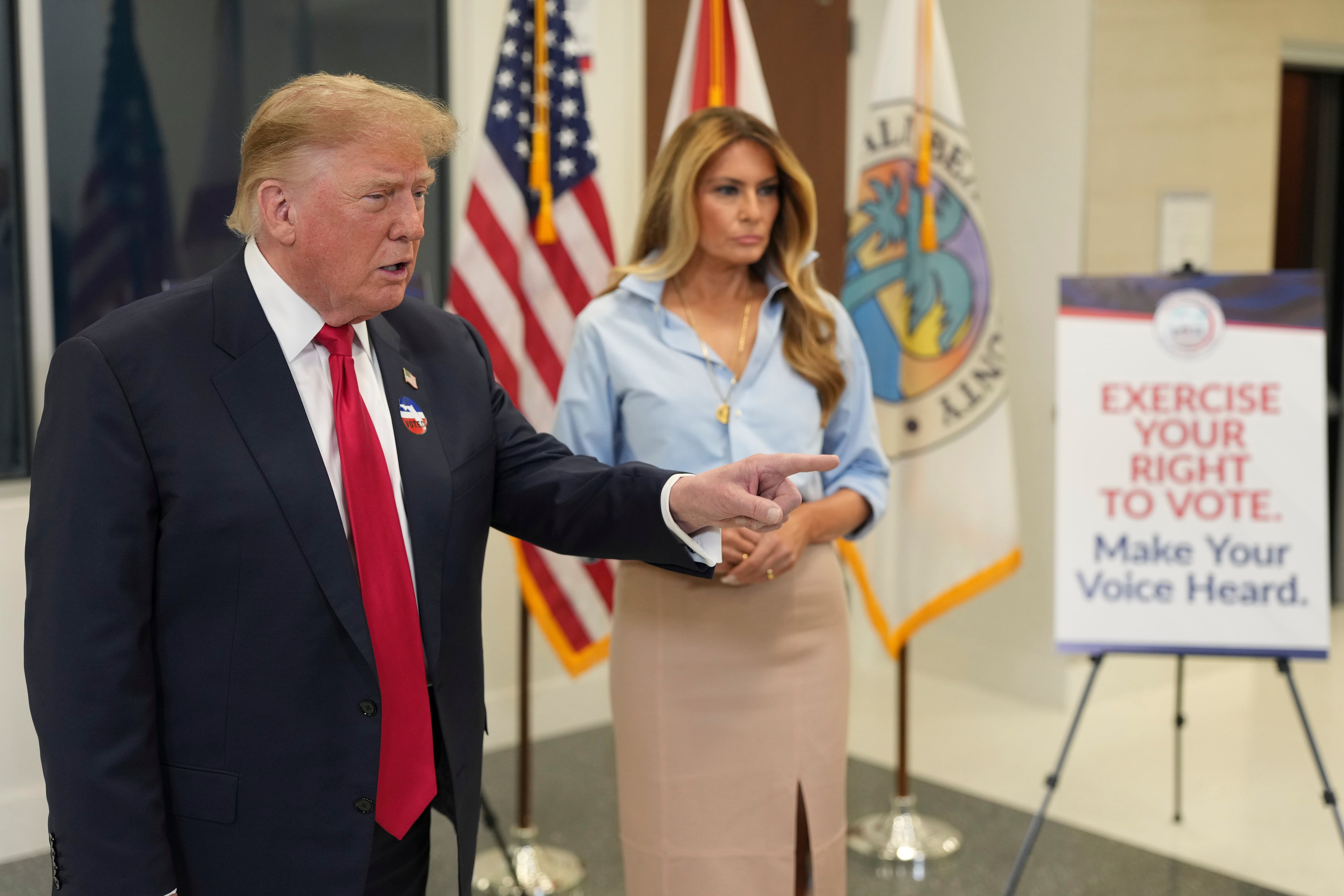
President Donald Trump speaks beside First Lady Melania Trump after casting his early vote in the midterm elections at the Palm Beach County Library in West Palm Beach this Saturday.
Three numbers and a letter opened the negotiations in a private message: 135K. That was the $135,000 that Silvia Zhang, a Los Angeles businesswoman, offered Tronderrica James, a Nevada woman, in 2023 to carry a child she claimed she was unable to have by any means. Later, an assistant at a surrogacy agency provided more details: “They are a Chinese couple looking for their miracle baby.” A contract sealed the arrangement.
Mail-in ballots account for more than half of votes cast so far, as early turnout builds across the United States ahead of Election Day.
More than 26.6 million U.S. citizens have already voted in the midterm elections, according to data released October 24 by the University of Florida’s Election Lab, with mail-in ballots accounting for 14 million of the votes recorded nationwide.
The latest figures show that 26,608,029 votes had been cast ahead of Election Day, including 14,006,420 ballots returned by mail and 12,601,609 votes cast in person. Election authorities have also received requests for more than 59.4 million mail-in ballots nationwide.
Early voting has increased in states including North Carolina, Kansas, Maine and Iowa, while Texas has seen a rise in mobilization among Latino voters, according to the report. The figures come amid concerns over economic conditions and the cost of living.
California has recorded 2,943,863 early votes, overwhelmingly through mail-in voting. Of those, 2,936,954 were returned by mail and 6,909 were cast in person. Voters in the state have requested more than 23.4 million mail-in ballots.
🚨 Estados Unidos se aproxima a unas elecciones legislativas decisivas, con la popularidad de Donald Trump en retroceso y creciente malestar por la economía. Los comicios del 3 de noviembre de 2026 definirán la composición del Congreso.
Text Reads: 🚨 The United States is approaching pivotal legislative elections, with Donald Trump’s popularity on the decline and growing discontent over the economy. The November 3, 2026, elections will determine the composition of Congress. 🗳️🇺🇸 What do you think?
Democrats account for the largest share of California’s early votes, with 1,383,916 ballots, or 50.2% of the total. Republicans have cast 799,054 votes, representing 29%, while voters registered without a party preference and those affiliated with minor parties account for 575,130 votes, or 20.9%.
Los Angeles County leads California in early voting, with 539,589 ballots processed. San Diego County follows with 356,667 votes, ahead of Orange County, where 279,953 ballots have been returned.
The elections will determine all 435 seats in the House of Representatives, 35 Senate seats and 36 governorships.
The run-up to Election Day has also been marked by a legal dispute over the certification of results in Alaska. A federal court challenge backed by former President Donald Trump seeks to block the potential certification of the state’s election results, raising questions about the electoral process as voting approaches its conclusion.
San Diego County, California, has sued Polymaker, a company that manufactures filament for 3D printers. The lawsuit accuses the company of illegally marketing its products to people who make unregistered firearms, often called "ghost guns." The county admits that the filament itself is legal but objects to how the company markets it. The lawsuit alleges that Polymaker worked with a firearm-printing influencer, promoted products for making guns, and provided technical advice to online communities interested in 3D-printed firearms. The county argues that this marketing violates California consumer protection laws. It is seeking the return of revenue linked to the allegedly illegal marketing, a court order stopping the company from continuing the challenged practices, and civil penalties of up to $2,500 per violation—with each day counting as a separate violation.
A federal appeals court appeared unlikely to immediately agree to the Trump administration’s bid to segregate 20,000 California ballots it says are likely from noncitizen voters, expressing skepticism at a rare Sunday hearing that a trial judge needs to move quicker. “I don’t see how we have jurisdiction,” said U.S. Circuit Judge Mark Bennett. The Department of Justice…
The administration has insisted that immigrants voting is a major problem nationwide, when in fact it is quite rare, as even its own investigations have shown.
At the University of California campuses in Berkeley, Irvine and Santa Barbara, students get an unwitting education in navigating the housing market.
The University of California, Santa Barbara, recently said incoming undergraduates would be guaranteed on-campus housing for just two years, up from one before.

 Login